How Do Planetary Magnetic Fields Work? Earth, Jupiter, and Beyond
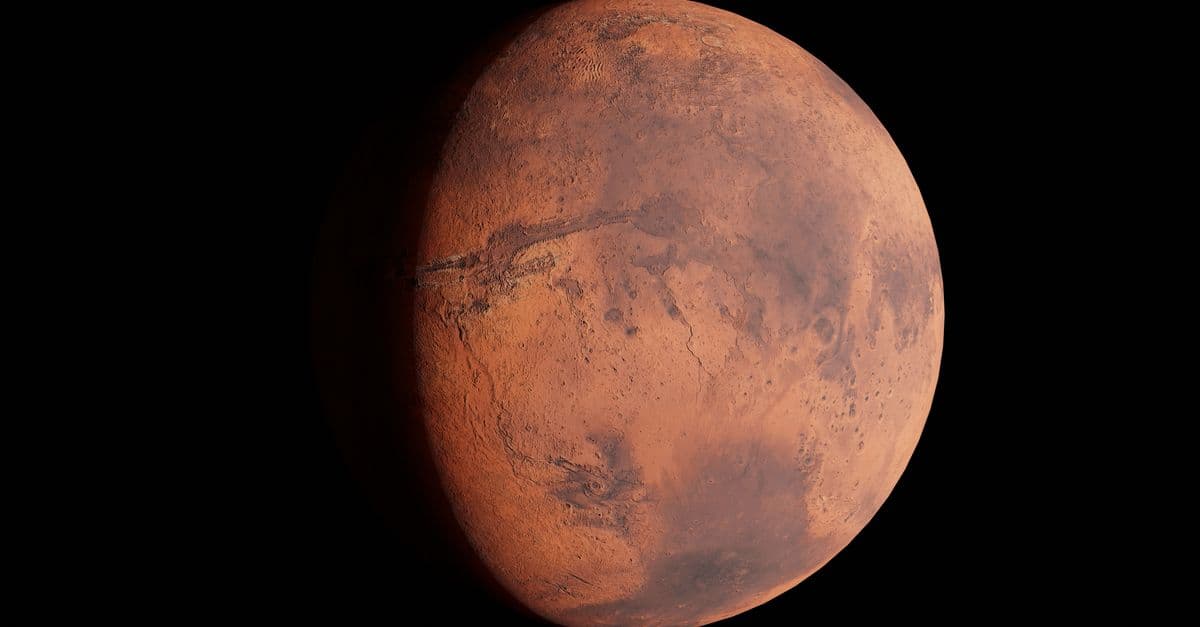
Photo: Zelch Csaba / Pexels
Every compass needle on Earth is being pushed by a machine buried about 2,900 kilometers (1,800 miles) below your feet: a layer of liquid iron alloy, roughly 2,260 kilometers thick, that churns as the planet cools and spins. That churning turns motion into magnetism, and the same basic trick works in very different materials on other worlds, from the metallic hydrogen inside Jupiter to the hot, ammonia-rich water inside Neptune. This article explains how a planetary dynamo works, what each planet's field looks like, and why Mars no longer has one.
What a planetary dynamo is, and why a spinning planet can make its own magnet
Most magnets people meet are permanent: iron atoms locked into alignment. A planet cannot work that way, because the interior of Earth is far hotter than the temperature at which iron loses its magnetization (about 580°C, 1,076°F, for magnetite, the common iron oxide mineral). Heat scrambles the alignment of the atoms. So a planet's field has to be produced continuously, by electric currents flowing in a conducting fluid. That process is called a dynamo.
The everyday version is the bicycle dynamo. Spin a magnet next to a coil of wire and the changing field pushes current through the coil. A planetary dynamo is the strange cousin of that device, because it has no separate magnet and no wire. The fluid is both the coil and the thing that moves. Currents in the fluid create a magnetic field, and the moving fluid drags that field around in a way that drives more current. If the loop reinforces itself, the field sustains itself, which is why such a system is called a self-excited dynamo.
The physics in one equation
The study of electrically conducting fluids moving through magnetic fields is called magnetohydrodynamics, or MHD (fluid dynamics combined with electromagnetism). Its central relation, the induction equation, says how a magnetic field B changes in a fluid moving at velocity v:
∂B/∂t = ∇ × (v × B) + η ∇²B
Read it as a contest between two terms. The first, the induction term, describes the flow stretching, twisting, and folding field lines, which can strengthen the field. The second, the diffusion term, describes the field leaking away as the currents that support it lose energy to electrical resistance. The quantity η = 1/(μ₀σ), the magnetic diffusivity, is larger when the fluid conducts poorly, so poorly conducting fluids lose their fields faster.
The ratio of the two terms is the magnetic Reynolds number, Rm = vL/η, where L is the size of the flow. When Rm is small, diffusion wins and any field fades. When Rm exceeds a critical value, the flow can amplify a field. A rough calculation shows why planets qualify. Convective flow in Earth's outer core is up to about 1 millimeter per second, according to the sources summarized on Wikipedia's page on the outer core. Take L as the 2,260-kilometer thickness of that layer and a conductivity of about a million siemens per meter (an order-of-magnitude figure for liquid iron under core conditions), which gives η of about 0.8 square meters per second. Then Rm comes out near 3,000. A slow creep, at human scale, is a vigorous flow for a magnetic field.
The four ingredients
Simulations and theory agree on what a planetary dynamo needs:
- A conducting fluid. Liquid iron alloy, metallic hydrogen, or an ionic mixture of water and ammonia all qualify.
- Convection. Something must stir the fluid, which means a source of buoyancy: heat flowing out, or lighter material rising.
- Rotation. The Coriolis force, the same effect that bends hurricanes, organizes the flow into spiraling columns aligned with the spin axis. Those helical motions are what twist field lines into the loops that keep the dynamo going.
- A way to start. Any weak seed field will do, including a stray field from the Sun or the planet's surroundings. The dynamo amplifies a seed rather than conjuring a field from nothing.
Think of it as a pot of soup that is simultaneously boiling and being stirred in a circle. Boiling alone makes random bubbling, and stirring alone makes a flat whirl. Together they make organized, twisted flow, and organized, twisted flow is what a dynamo uses.
Why a planetary field cannot be perfectly symmetric
The British mathematician Thomas Cowling showed in 1933 that a perfectly axisymmetric field (one that looks identical when you rotate it around the spin axis) cannot be maintained by a dynamo. The field must have genuinely three-dimensional structure. This is why Earth's field, though roughly dipolar (shaped like a bar magnet), wanders and has bumps and patches that change from year to year. It is also why Saturn's unusually symmetric field has puzzled planetary scientists for decades, a case taken up below.
Inside Earth: where the geodynamo runs
The geodynamo, as the Earth version is called, sits in the outer core. Seismic measurements give the inner core a radius of about 1,220 kilometers and the outer core a radius of about 3,483 kilometers, so the liquid layer is roughly 2,260 kilometers thick and its top lies about 2,889 kilometers below the surface. The inner core is solid even though it is hotter than the outer core, because the pressure there is high enough to keep the iron crystalline. Temperature at the inner core boundary has been estimated at about 5,400 to 6,300 kelvin (Hirose, Wood, and Vočadlo, 2021, as summarized on Wikipedia). That is comparable to the surface of the Sun.
The outer core is mostly iron and nickel, with perhaps 5 percent nickel by weight, plus lighter elements such as oxygen, silicon, sulfur, carbon, and hydrogen. The evidence for the light elements is density: the outer core is roughly 5 to 10 percent less dense than pure iron would be under those pressures. Those lighter elements matter for the dynamo in a way that becomes clear in the next section. For a layered tour of the whole planet, see our explainer on what is inside Earth, and for how anyone knows, how scientists know what is inside Earth.
What keeps the engine running
A dynamo is a heat engine, and it needs fuel. Four sources of energy are usually listed for Earth's core:
- Compression and cooling. Gravitational energy from the original formation of the core, released as the core slowly cools.
- Latent heat. When liquid iron freezes onto the inner core, it releases heat.
- Chemical buoyancy. Freezing iron leaves light elements behind in the liquid at the inner core boundary. That light, buoyant fluid rises, which is a powerful stirring force. Many geophysicists think this is the dominant driver today.
- Radioactive decay. Potassium, uranium, and thorium in the core, if present, would add heat. How much, if any, remains debated.
The inner core grows by an estimated 1 millimeter per year, which sounds tiny until you remember that the inner core's surface covers roughly 19 million square kilometers: even that thin annual layer amounts to enormous quantities of iron freezing out of the liquid. That ongoing crystallization is the engine's central fuel supply.
There is a catch known as the new core paradox. Experiments and calculations in the last decade suggest that iron at core conditions conducts heat better than older estimates assumed (Mittal et al., 2020; Hirose et al., 2021). If heat leaks out through the core by simple conduction, there is less left over to drive thermal convection. Researchers are working on how the geodynamo has been sustained, and one proposed route is light elements precipitating out of a supersaturated core, which would stir the fluid chemically. The field exists, so some mechanism works. Which one has dominated, and for how long, is an active research question.
What Earth's field looks like at the surface
Earth's field is dominated by a dipole tilted about 11 degrees from the rotation axis. At the surface its strength ranges from roughly 30 to 60 microteslas (30,000 to 60,000 nanoteslas), about 60 microteslas over Siberia and 30 over Brazil, according to the 13th International Geomagnetic Reference Field (2019). The weakest region, centered over South America and the South Atlantic, is called the South Atlantic Anomaly. A field that varies by a factor of two across the planet is a reminder that the dipole is only the largest of many components.
That field is not fixed. Three kinds of change matter:
- Drift. The north magnetic pole has been moving toward Siberia for decades. NOAA's National Centers for Environmental Information reports average drift speeds of 36 kilometers per year for the north magnetic pole and 9 kilometers per year for the south over the past year. Because the field is predictable only for a few years, the World Magnetic Model that underlies phone compasses and aircraft navigation is rebuilt every five years; the 2025 edition, NOAA says, has performed accurately in its first year.
- Weakening. Over the past two centuries the dipole has weakened by about 6.3 percent per century, though its present strength is about average for the last 7,000 years (Merrill, McElhinny, and McFadden, cited on Wikipedia). A weakening trend is a measurement, not a prediction that the field will vanish.
- Reversal. The poles swap places at irregular intervals averaging several hundred thousand years, with gaps as short as under 100,000 years and as long as about 50 million years. The last full reversal, the Brunhes-Matuyama event, was about 780,000 years ago. The Laschamp excursion, about 41,000 years ago, was a brief near-reversal during the last ice age. What a modern reversal would do to technology and life is a live question, which we examine in what if Earth's magnetic field flipped.
Farther out, the field carves a cavity in the solar wind, the magnetosphere. Its sunward edge sits about 10 Earth radii away, and its tail on the night side stretches beyond 200 Earth radii. Charged particles from the Sun are steered around the planet or trapped in belts, which we describe in the Van Allen belts. When those particles funnel down the field near the poles, the result is an aurora.
How scientists read a field they cannot see
Nobody can drill into an outer core, so the evidence is indirect. It falls into two families: measurements of today's field, and records of past fields locked into rock.
Present-day field. Magnetometers on the ground, on ships, on satellites, and on interplanetary probes record the strength and direction of the field. Mathematicians then represent the field as a sum of components called spherical harmonics: the dipole, the quadrupole (two north and two south poles), the octupole, and so on. Earth's field is dominated by the dipole. Uranus and Neptune, as we will see, are not.
Past fields. When molten rock cools below the Curie temperature (about 580°C for magnetite), its iron-bearing crystals lock in a magnetization parallel to the field of that moment. Lava flows, sediment layers, and even ancient pottery carry such a record. Rocks in Australia and South Africa show that Earth had a magnetic field at least 3.45 billion years ago (Tarduno et al., 2009). A 2024 study of rocks from Greenland pushed the evidence back to about 3.7 billion years ago, according to Wikipedia's summary.
The same trick works on other worlds, and that is how Mars was shown to have had a field in its distant past. Remnant magnetization in crustal rock is a fossil of the dynamo that put it there.
Jupiter: a dynamo in metallic hydrogen
Jupiter's field is the strongest of any planet in our solar system. Estimates of its dipole moment, a measure of the total strength of the magnet, put it at roughly 18,000 to 20,000 times Earth's (Connerney et al., 2017, as summarized on Wikipedia). NASA's Jupiter fact sheet says the surface field is 16 to 54 times as powerful as Earth's, depending on where you stand, and that the magnetosphere extends 1 million to 3 million kilometers toward the Sun, about 7 to 21 times Jupiter's diameter. Out the back, the tail stretches about 1 billion kilometers, which reaches as far as Saturn's orbit.
Where the field comes from
Jupiter is mostly hydrogen and helium. Deep in the atmosphere the hydrogen becomes liquid, and at greater depths the pressure is high enough that hydrogen conducts electricity like a metal. In this metallic hydrogen state, electrons are no longer bound to individual protons and are free to carry current, as they are in a copper wire. NASA says this occurs at perhaps halfway to the center. Jupiter's rapid rotation, with a day just under 10 hours, is thought to drive the currents there that generate the field.
The nearest equivalent to a seismograph for the field is NASA's Juno spacecraft, which has orbited Jupiter since 2016. Juno's measurements, analyzed by Connerney, Moore, and colleagues, found that the field is much less simple than Earth's. In the northern hemisphere there is a localized band of strong flux, while the southern hemisphere's field is smoother and more dipole-like. That hemispheric dichotomy (Moore et al., 2018, Nature) suggests the dynamo is more complicated than a single, uniform convecting shell. Juno also mapped an isolated, intense patch of field near the equator, nicknamed the Great Blue Spot, which shows changes over time and is loosely analogous to Earth's South Atlantic Anomaly.
Different Juno-based models place the base of the dynamo region at roughly 0.8 Jupiter radii, which is to say a large, deep zone. One abstract from the Juno team ties a value of 0.807 ± 0.006 Jupiter radii to the depth where helium rain stabilizes the metallic mixture. Juno's gravity measurements, summarized by NASA, also indicate that the core is large, not solid, and partly dissolved into the surrounding metallic hydrogen, a "fuzzy" core.
Moons that feed the magnetosphere
Io, the innermost large moon, orbits deep within Jupiter's magnetic reach and is volcanically active. Ions from its volcanoes add as much as about 1,000 kilograms of plasma per second to the space around Jupiter (Khurana et al., 2004). Jupiter's field, rotating once in under 10 hours, grabs and spins that plasma into a doughnut-shaped ring along Io's orbit, the Io plasma torus. Our article on Io and tidal heating explains the volcanic engine. The interaction of that plasma with the field helps power Jupiter's intense auroras.
Saturn: the field that is too symmetric
Saturn has a magnetic moment about 580 times Earth's, yet its equatorial field, about 21 microteslas, is slightly weaker than Earth's. The two facts are compatible because Saturn is so much larger; the field spreads out over a greater volume. The odd thing is the shape. Saturn's dipole is almost perfectly aligned with its rotation axis, to within a fraction of a degree. Cassini, the spacecraft that orbited Saturn until 2017, found a tilt of less than half a degree, far smaller than the roughly 11-degree tilt of Earth's field or the roughly 10-degree tilt of Jupiter's.
That is a problem because of Cowling's theorem. A dynamo cannot sustain a perfectly axisymmetric field. So what is going on? The leading idea is that a layer of electrically conducting, stably stratified fluid (a layer that does not convect) lies above the dynamo region and acts as a filter. Rapidly varying, non-axisymmetric components of the field, produced deeper down, have a harder time crossing that layer, while the steady, symmetric part leaks through. Helium may play a role: at the pressures and temperatures inside Saturn, helium is thought to condense and fall, like rain, toward the center, leaving a helium-depleted layer above it. That layer would be the filter.
The symmetry has a practical consequence. Planets with tilted fields radiate radio waves that pulse once per rotation, so astronomers can clock their interior spin from outside. A symmetric field provides no such pulse, which makes Saturn's deep rotation rate hard to pin down from outside. In the story of the Cassini mission's final orbits, covered in the Cassini Grand Finale, the spacecraft's measurements of the field are among the most important results.
Uranus and Neptune: dynamos in a thinner shell
Uranus and Neptune break nearly every rule that Earth's field suggests. Voyager 2, the only spacecraft to visit either, flew past Uranus on January 24, 1986, and Neptune on August 25, 1989.
| Feature | Uranus | Neptune |
|---|---|---|
| Dipole tilt from rotation axis | 59° | 47° |
| Dipole offset from planet center | about one-third of a Uranus radius, toward the south pole | at least 0.55 Neptune radii (about 13,500 km) |
| Dipole moment | about 50 times Earth's | not given here |
| Field strength | 10 to 110 µT at the surface, 23 µT average | about 14 µT for the dipole component at the equator |
| Flyby | January 24, 1986 | August 25, 1989 |
Sources: Ness et al. (1986) for Uranus; Connerney (1991) for Neptune, as summarized on Wikipedia.
An Earth-like field is a tidy dipole that behaves much like a bar magnet near the center of the planet. Uranus's and Neptune's fields are messy. They include strong quadrupole and higher components, tilted by tens of degrees, and displaced far from the center. Imagine the magnet in a bar magnet shifted to the side of the box that holds it and then tilted: that is the geometry.
The leading explanation is that the ice giants generate their fields in a thin shell of conducting fluid, not in a deep core. The "ice" in "ice giant" is a historical label. Their mantles are thought to be a hot, dense fluid of water, ammonia, and other compounds, which conducts electricity because the molecules partly break into ions (Atreya et al., 2006). If the convecting, conducting layer is a relatively thin shell sitting on top of a stable region, a dynamo in it produces a field with many comparable components, and a dipole that is neither aligned nor centered. Dynamo simulations in thin-shell geometry, such as those by Stanley and Bloxham (2004), produce this kind of pattern.
Because only Voyager 2 has visited, the interiors of both planets are poorly constrained, with a wide margin for error in the models. A dedicated Uranus orbiter and probe was named the highest-priority large mission in the 2023 U.S. planetary science decadal survey, and a spacecraft in orbit would map the field far better than a single flyby.
Mercury and Ganymede: small worlds with fields of their own
Mercury
Mercury is a surprise. It is small, about 0.055 Earth masses, and it was expected to have cooled enough for its core to freeze solid. Mariner 10 found a magnetic field in 1974 anyway. The field is weak, about 1.1 percent of Earth's, with an equatorial strength near 300 nanoteslas.
The explanation lies in the core. Mercury's core has a radius of about 2,020 kilometers, which is roughly 83 percent of the planet's 2,440-kilometer radius and about 57 percent of its volume (Margot et al., 2012, and Hauck et al., 2013, as summarized on Wikipedia). With a core that large, some of it can remain liquid. MESSENGER, which orbited Mercury from 2011 to 2015, refined the dipole moment to 195 ± 10 nanotesla times Mercury radii cubed (Anderson et al., 2011) and found field-aligned structures about 800 kilometers wide, sometimes called magnetic tornadoes, suggesting the field couples to the solar wind in a leaky way. The dipole is displaced toward the north, so the field is stronger in the north than in the south. Our article on Mercury's iron core and polar ice covers the rest of the planet.
The next chapter is arriving now. ESA and JAXA's BepiColombo, launched on October 20, 2018, is scheduled to enter orbit around Mercury on November 21, 2026. The two orbiters separate on December 9 and 10, and science operations begin in April 2027. Two of its instruments are magnetometers, MPO-MAG on the European orbiter and MGF on the Japanese Mio orbiter, which will measure the field from two vantage points at once.
Ganymede
Ganymede, Jupiter's largest moon, is the only moon known to have its own magnetic field. The Galileo spacecraft detected it in 1996. At its equator the field is about 719 nanoteslas, which is roughly six times the 120 nanoteslas of Jupiter's field at that distance. Ganymede's dipole is tilted 176 degrees from its rotation axis, so it points almost directly against Jupiter's field. The interaction between the two fields makes magnetic reconnection possible, in which field lines break and rejoin.
The result is a magnetosphere within a magnetosphere, about four to five Ganymede radii across, sitting inside Jupiter's. Field lines are closed below about 30 degrees latitude, which traps particles, and open above that, connecting to Jupiter's ionosphere. The likely source is convection in a liquid iron-rich core. Observations of Ganymede's auroras with the Hubble Space Telescope, published in March 2015, showed motions that fit a large subsurface saltwater ocean, because a conducting ocean would influence how the field responds to Jupiter's. For the moon itself, see Ganymede: the largest moon is also an ocean world.
Planetary magnetic fields side by side
| Body | Global field today? | Likely source | Tilt from spin axis | Notable fact |
|---|---|---|---|---|
| Earth | Yes | Liquid iron alloy outer core | about 11° | 30 to 60 µT at the surface |
| Jupiter | Yes | Metallic hydrogen | about 10° | Moment roughly 18,000 to 20,000 times Earth's |
| Saturn | Yes | Metallic hydrogen, filtered by a stable layer | under 0.5° | Moment about 580 times Earth's; unusually symmetric |
| Uranus | Yes | Thin shell of ionic water-ammonia fluid | 59° | Dipole offset by about one-third of a radius |
| Neptune | Yes | Thin shell of conducting fluid | 47° | Dipole offset by at least 0.55 radii |
| Mercury | Yes, weak | Liquid outer core | near 0° | About 1.1% of Earth's field strength |
| Ganymede | Yes | Liquid iron-rich core | 176° (reversed) | Only moon with its own field |
| Mars | No | Core dynamo ended long ago | not applicable | Magnetized southern crust |
| Venus | No | None detected | not applicable | Weak field induced by solar wind |
Sources: values compiled from the NASA fact sheets, NOAA, and the mission papers cited in the text; Mercury's tilt as given on Wikipedia.
Mars and Venus: worlds without a global field
Mars
Mars today has no global magnetic field. Yet the planet carries a fossil. Mars Global Surveyor discovered strong magnetization in the old crust of the southern highlands, while the younger northern lowlands are weak or unmagnetized (Acuña et al., 1999). That magnetized crust implies a global field existed roughly 4 billion years ago. Ground measurements by the InSight lander at Elysium Planitia found a crustal field of about 2 microteslas, around ten times larger than the satellite estimate for that spot, according to Johnson et al. (2020).
When did the dynamo stop? The best reading is that it was strong from roughly 4.2 to 4.3 billion years ago and that it had mostly shut down by about 4.0 to 4.1 billion years ago, before the large impact basins formed (the basins lack a magnetic signature). A weak, late dynamo may have persisted until about 3.8 billion years ago, and a few meteorites and young volcanoes hint at stranger possibilities. The date, the duration, and the reason all remain open questions.
Why did it stop? Mars has about half Earth's diameter (a radius of 3,390 kilometers). A smaller planet loses heat faster. Its core, made of iron, nickel, and sulfur with a radius of roughly 1,500 to 2,100 kilometers (NASA), cooled to the point where convection could no longer drive a dynamo. The detailed physics, including whether the core ever grew a solid inner core to fuel chemical convection, is debated. Our article on why Mars lost most of its atmosphere takes the story further.
Venus
Venus is the puzzle in the other direction. It is similar to Earth in size, yet it has no intrinsic global magnetic field. Its weak magnetosphere is induced by the solar wind interacting with the atmosphere, and Venera 4 first showed in 1967 that the field was much weaker than Earth's. Several explanations are on the table: the core may lack a solid inner core, may not be cooling fast enough, or may have been stratified by the planet's history. A global resurfacing event could have slowed the heat flow out of the core. The slow rotation (a Venus day lasts longer than a Venus year) does not by itself rule out a dynamo, according to simulations summarized on Wikipedia, so the missing ingredient is more likely convection than spin. For its atmosphere, see Venus's atmosphere chemistry.
Do planets need a magnetic field to keep their air?
This is the question that makes planetary magnetism matter beyond geophysics. The popular version says that a magnetic field is a shield, Earth has one, Mars lost its, and so Mars lost its atmosphere. There is truth in that account, and there is also an oversimplification.
The truth: MAVEN, NASA's Mars Atmosphere and Volatile Evolution orbiter, found that the solar wind strips about 100 grams of gas from Mars's atmosphere every second, roughly a quarter pound, according to results announced in November 2015 by Bruce Jakosky and colleagues. About 75 percent of the escaping ions came from the tail region behind the planet and about 25 percent from a polar plume. Loss increased significantly during solar storms, such as those in March 2015. Researchers think the rate was higher billions of years ago, when the young Sun was more active, and that solar-wind erosion was likely a major factor, with other loss processes, in turning a once-denser, warmer atmosphere into today's cold, thin one. NASA declared MAVEN's mission over on June 3, 2026, after contact with the spacecraft had been lost in December 2025.
The oversimplification: a global magnetic field is neither clearly necessary nor clearly sufficient. Venus has no global field and holds a very dense atmosphere. Earth, with its field, still loses ions, notably along the open field lines near the poles. A magnetosphere deflects the solar wind and also presents a larger obstacle that can capture energy from it, and the balance depends on the planet's gravity, atmospheric composition, and the strength of the stellar wind. Mars is also small, and its low gravity makes escape easier whatever its magnetic situation. A fair summary is that a field changes the way atmosphere is lost and can reduce some channels of loss, while the full picture is contested. The same caution applies to the direct protection of life: a field deflects charged particles, but it does nothing about ultraviolet light, which the atmosphere handles instead.
For the broader question of what makes a planet livable, the habitable-zone article in Related Reading below is the place to start, and solar storms and space weather covers what the stellar wind does when it reaches a planet. Whether rocky planets around other stars have such fields, and whether the fields can be detected from afar, is an open and active topic, especially for planets orbiting small, active red dwarf stars whose winds would be harsher.
What we still do not know
Despite all that, planetary dynamo theory has gaps, and a good explainer names them.
- How Earth's dynamo has been powered across time. The new core paradox raises the question of whether the inner core is young, and what drove the field before it existed.
- Why Saturn's field is so symmetric. The stably stratified layer hypothesis is plausible but not proven.
- What lies beneath Uranus and Neptune. One flyby each, decades ago, left the models underdetermined.
- When and why Mars's dynamo stopped, and whether a weak late field returned.
- Why Venus has none. Several explanations remain, without enough data to choose among them.
- What a reversal does. The record shows that reversals happen. It does not tell us the detailed sequence on a timescale that matters to the people living through one.
None of these is a fringe puzzle. They are the ordinary frontier of a field that studies objects it cannot visit.
Frequently asked questions
Q: What is a planetary dynamo in simple terms? A: A planetary dynamo is a region of electrically conducting fluid, stirred by heat and rotation, in which moving charges create a magnetic field and the moving fluid reinforces that field. It works like a bicycle dynamo without the separate magnet. The field survives only as long as the fluid keeps moving and the energy source keeps running.
Q: Why does Earth's magnetic field reverse? A: Computer simulations of the geodynamo reproduce reversals without any outside trigger, which suggests they arise from the chaotic behavior of the flow itself. Reversals are irregular, averaging several hundred thousand years apart, and the last one was about 780,000 years ago. The field weakens and becomes complicated during the switch, and the details of what that would mean for modern life are still debated.
Q: Is Earth's magnetic field about to disappear? A: No. The dipole has weakened by about 6.3 percent per century over two centuries, but its current strength is about the average of the last 7,000 years. A decreasing trend over a few centuries does not by itself predict a collapse or a reversal. Scientists track it with satellites and ground observatories and update models such as the World Magnetic Model every five years.
Q: Which planet has the strongest magnetic field? A: Jupiter. Its dipole moment is roughly 18,000 to 20,000 times Earth's, and NASA says its surface field is 16 to 54 times as strong as Earth's. Strength per unit area still depends on where you measure, and some stars and neutron stars have far stronger fields than any planet.
Q: Why are the fields of Uranus and Neptune tilted and off-center? A: The best explanation is that their dynamos operate in a thin shell of electrically conducting fluid, probably a hot ionic mixture of water and ammonia, instead of a deep core. A shell like that generates many comparable field components, so the dipole ends up tilted, at 59 degrees for Uranus and 47 degrees for Neptune, and displaced from the center. Only Voyager 2 has measured them directly.
Q: Did Mars lose its atmosphere because it lost its magnetic field? A: The loss of the field probably contributed, but it is not the whole story. MAVEN measured the modern solar wind stripping about 100 grams of gas per second, and the early Sun was more active. Mars's small size and low gravity also make escape easier, and Venus shows that a planet without a global field can keep a dense atmosphere.
Q: Does any moon have its own magnetic field? A: Ganymede, Jupiter's largest moon, is the only moon known to produce its own field. Galileo discovered it in 1996, and the equatorial strength is about 719 nanoteslas. The field is probably generated in a liquid iron-rich core and sits inside Jupiter's magnetosphere.
The takeaway
A planetary magnetic field is the visible trace of an interior that is still alive, still cooling, and still moving. Earth, Jupiter, Saturn, Uranus, Neptune, Mercury, and Ganymede each run a dynamo in a different material and at a different depth, and the shape of the field records the geometry of the fluid that makes it. Mars and Venus show what happens when the engine stops or never starts. What looks like a simple compass needle is a measurement of a thick shell of churning metal, and the differences between planets are a map of where that churning happens.
Sources
- NOAA National Centers for Environmental Information, World Magnetic Model and pole drift
- NASA, Jupiter facts and Mars facts
- NASA, MAVEN mission page
- AGU, MAVEN mission reveals speed of solar wind stripping Martian atmosphere (November 5, 2015)
- ESA, BepiColombo factsheet
- Wikipedia, Earth's magnetic field, Earth's outer core, Magnetosphere of Saturn, Ganymede, and Uranus, which summarize the primary papers named in the text
Related Reading
Follow new articles
Add SciHub101 to your feed reader to see new science and technology stories.
About the Author
SciHub101 is an independent science and technology publication founded and edited by Buğra Sözeri, a software engineer and app developer based in Türkiye. AI tools assist with drafting and research. Source documentation in the existing archive is uneven, and articles are being reviewed and corrected. The Editorial Team byline identifies editorial responsibility; it does not certify specialist or independent human review. Where we compare products, anything built by our own team is labelled as such — see the editorial guidelines and About page for how corrections and disclosures work.
Related Articles

What Is the Milky Way? Structure, Spiral Arms, and the Galactic Center
The Milky Way is a barred spiral galaxy with roughly 200 to 400 billion stars. Its disk, central bar, bulge, stellar halo, and dark matter halo are mapped from the inside by Gaia and radio surveys. At the center sits Sagittarius A*, a black hole of about 4.3 million solar masses, imaged by the Event Horizon Telescope in 2022. The Sun orbits about 26,000 to 27,000 light-years out, completing a lap in roughly 200 to 230 million years.
What Is Gravitational Lensing? How Gravity Bends Light
Gravitational lensing, the deflection of light by mass, was predicted by general relativity and first measured during the 1919 solar eclipse. Strong lensing produces Einstein rings and multiple images, weak lensing maps dark matter statistically, and microlensing reveals planets through brief brightenings of background stars.
What Are the Van Allen Belts? Earth's Trapped Radiation
The Van Allen belts are zones where Earth's magnetic field traps radiation. How Explorer 1 found them, how they work, and how Apollo and Artemis crossed them.

Can Humans Live on Mars? The Real Challenges
A realistic look at Mars settlement: radiation, dust, low gravity, water, food, power, medicine, psychology, and the economics of staying alive.
Ganymede: The Largest Moon Is Also an Ocean World
Ganymede is bigger than Mercury, has its own magnetic field, and hides a saltwater ocean containing more water than all of Earth's surface oceans combined. It took a Hubble telescope observation of auroral lights rocking back and forth to prove it.