What Is the Milky Way? Structure, Spiral Arms, and the Galactic Center
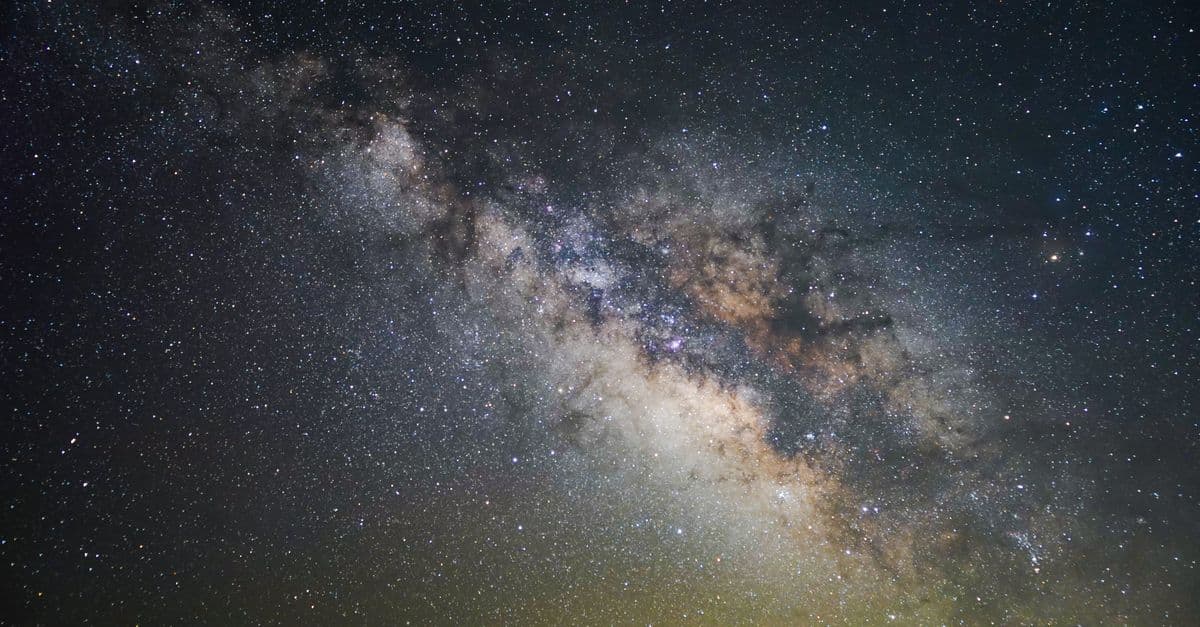
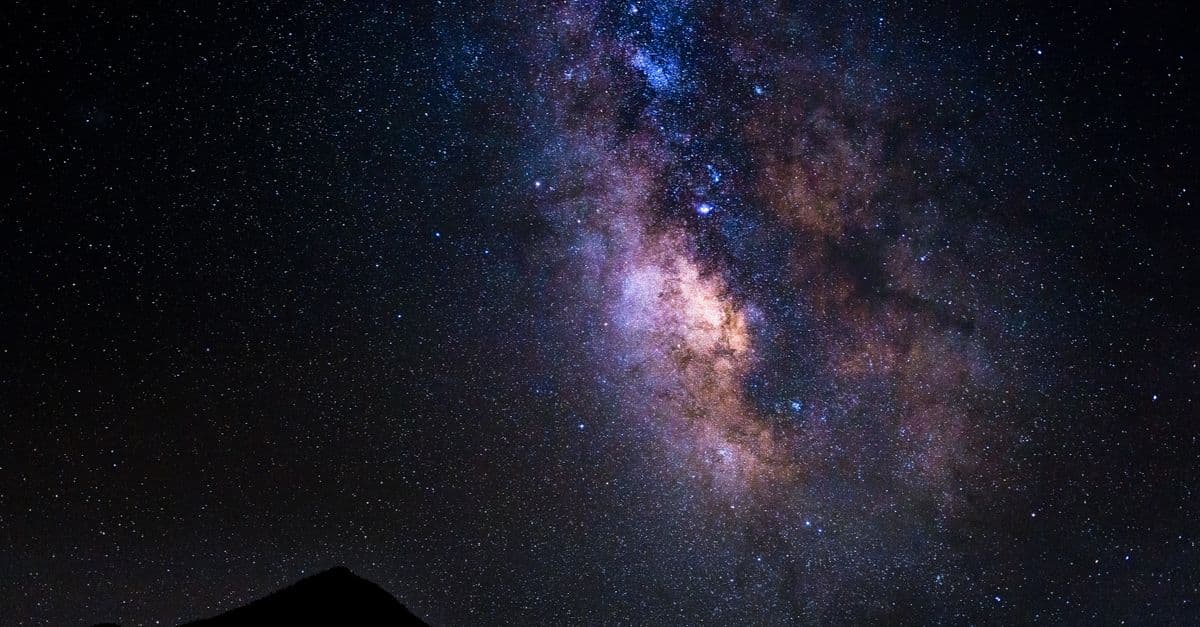
Photo: Soly Moses / Pexels
The Milky Way is a barred spiral galaxy: a flat disk of stars and gas wound into spiral arms, a bar of older stars across its middle, a thick bulge at the heart, a sparse halo of ancient stars, and a far larger halo of dark matter around all of it. It holds roughly 200 to 400 billion stars, and we live about 26,000 to 27,000 light-years from the center. That position is the problem. We cannot step outside and photograph it, so every map of the Milky Way is a reconstruction.
Why the Milky Way is hard to map from the inside
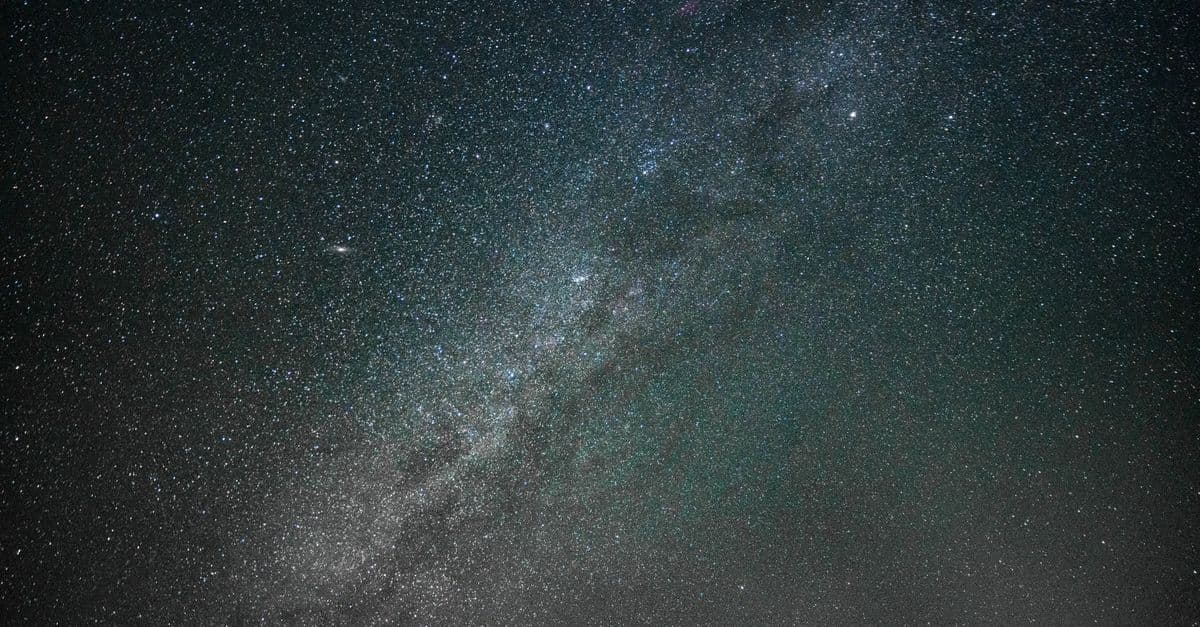
An astronomer looking at our galaxy from outside would recognize the structure at once. From the inside, the picture is a pale band of light stretching across the night sky, the combined glow of billions of stars in the disk seen edge-on. Dust blocks much of the view toward the center, so optical telescopes see only a fraction of the stars in that direction.
Mapping it is like trying to draw a floor plan of a forest while standing among the trees. You can measure the trunks near you, but the ones behind them are hidden, and distances are the hardest part. The tools that have changed the picture work in different ways. Radio and infrared light pass through dust. Parallax, the tiny shift in a star's apparent position as Earth moves around the Sun, gives direct distances. And Gaia, the European Space Agency's astrometry satellite, measures parallax and motion for a huge number of stars at once.
Gaia's third data release, on June 13, 2022, contained about 1.8 billion sources with positions, and radial velocities for about 33.8 million stars, along with astrophysical parameters for roughly 470 million sources. Those numbers let astronomers see not only where stars are, but how they move, and motion is what reveals past mergers and the shape of the invisible mass.
The Milky Way by the numbers
Many of the numbers below are estimates with real uncertainty, and different surveys disagree. The table gives representative values with sources.
| Quantity | Value | Source and caveat |
|---|---|---|
| Number of stars | about 200 to 400 billion | NASA/JPL Night Sky Network; uncertain because faint red dwarfs are hard to count |
| Stellar mass | about 5 ± 1 × 10¹⁰ solar masses | Bland-Hawthorn and Gerhard 2016 |
| Disk scale length | about 2.6 kpc (about 8,500 light-years) | Bland-Hawthorn and Gerhard 2016 |
| Sun's distance from center | 8.15 ± 0.15 kpc, or 8.2 ± 0.1 kpc | Reid et al. 2019; Bland-Hawthorn and Gerhard 2016 |
| Sun's height above the midplane | 25 ± 5 pc (about 80 light-years) | Bland-Hawthorn and Gerhard 2016 |
| Circular speed at the Sun | 229 ± 0.2 km/s (formal) to 236 ± 7 km/s | Eilers et al. 2019; Reid et al. 2019 |
| Dark halo mass within the virial radius | about 7 × 10¹¹ solar masses | Eilers et al. 2019 |
| Central black hole mass | 4.30 × 10⁶ solar masses | GRAVITY Collaboration 2022 |
A parsec (pc) is 3.26 light-years, and a kiloparsec (kpc) is 1,000 parsecs, or about 3,260 light-years. Astronomers favor parsecs because they come straight out of the parallax measurement. A solar mass is the mass of the Sun.
The total across stars, gas, and dark matter is where the biggest disagreements live, and we return to it below. The overall message is that normal matter is a small share of the mass of the Milky Way. Even a generous 5 × 10¹⁰ solar masses of stars is dwarfed by the mass in the dark matter halo.
Disk, bulge, bar, and halo: the parts of the Milky Way
The thin disk
The thin disk is where the Sun lives and where almost all current star formation takes place. It is flat, roughly 1,000 light-years thick compared with a diameter of about 100,000 light-years. Its density falls off exponentially with distance from the center, with a scale length of about 2.6 kpc, according to the review by Bland-Hawthorn and Gerhard. Most of the galaxy's gas and dust sits here, including the giant molecular clouds where stars form.
The disk is also not quite flat. At large radii it warps: one side bends up and the other bends down, a bit like the brim of a hat. In 2020, Eloisa Poggio and colleagues used about 12 million giant stars from Gaia to show that the warp is not a fixed shape. It precesses, meaning its orientation turns over time, at about 10.9 km/s per kpc in the direction of Galactic rotation, roughly a third of the Sun's angular speed around the galaxy. The authors argued that this favors a recent or ongoing encounter with a satellite galaxy over an ancient relic of the Milky Way's assembly.
The thick disk
Wrapped around the thin disk is a puffier, older component. Its stars are older, lower in heavy elements, and richer in alpha elements such as oxygen and magnesium relative to iron. That chemical signature is a fossil record. Alpha elements are made mainly in the explosions of massive stars (Type II supernovae), which go off within a few million years of a star's birth. Iron comes substantially from Type Ia supernovae, which take longer. A population with lots of alpha elements relative to iron therefore formed fast, before the slower iron source had time to contribute.
How the thick disk formed is debated. One idea is rapid star formation in a thick, turbulent gas layer when the galaxy was young. Another is that an earlier thin disk was heated and puffed up by mergers. The two are not exclusive, and we come back to the merger evidence in the section on galactic archaeology.
The bulge and the bar
At the center, the disk thickens into a bulge of old stars. The Milky Way's is not the smooth, round kind found in some galaxies. Star counts show a boxy or peanut-shaped structure, which is how a bar looks when it has buckled vertically. Bland-Hawthorn and Gerhard give a dynamical mass of about 1.8 × 10¹⁰ solar masses for the bulge region they surveyed.
The bulge is the vertical part of a longer, flatter bar. Bland-Hawthorn and Gerhard give the bar's angle as about 27 ± 2 degrees to the line between the Sun and the galactic center. Star-count studies place the long bar's half-length at roughly 5 kpc (about 16,000 light-years), though estimates vary. The bar rotates as a solid pattern, and published pattern speeds are in the tens of km/s per kpc, depending on the method. The bar matters because it stirs gas inward, feeding the central regions, and because the spiral arms appear to connect to its ends.
The stellar halo and its streams
Beyond the disk is a sparse, roughly spherical halo of very old stars, including globular clusters, which are tight balls of hundreds of thousands of stars. The halo holds only a small fraction of the galaxy's stellar mass, but it works like a museum. Many halo stars did not form in the Milky Way. They came from smaller galaxies that were pulled apart.
The clearest evidence is the stellar streams: long ribbons of stars torn from dwarf galaxies and star clusters by the Milky Way's tides. The Sagittarius Stream, from a dwarf galaxy that is still being absorbed, wraps most of the way around the sky. Gaia has revealed many more. Each stream is a record of one merger, with the stars' motions encoding the orbit of the object that was shredded. For the bigger picture, our piece on galactic cannibalism and the Milky Way's merger history follows the thread.
The dark matter halo
The visible parts of the Milky Way sit inside a much larger, invisible halo. Its main evidence is how stars and gas orbit. If the visible matter were all there was, orbital speeds should fall off steeply with distance, like planets in the solar system, where outer planets move slower. Instead, the speeds stay high far into the outskirts.
Details here have shifted. Earlier textbooks described a rotation curve that is flat at about 220 km/s out to the edge. Eilers and colleagues used about 23,000 red giant stars with APOGEE spectra and Gaia astrometry to measure a curve that is "gently but significantly declining" beyond 5 kpc at about 1.7 km/s per kpc, with a circular speed at the Sun of 229 km/s. Combining that with estimates of the normal matter, they inferred a dark halo mass within the virial radius of about 7.25 × 10¹¹ solar masses. Other methods give different numbers, so the total mass of the Milky Way remains uncertain by a wide margin. Our article on dark matter's evidence and current theories covers what the halo may be made of.
How many spiral arms does the Milky Way have?
The answer depends on what you count, and astronomers disagree about it.
Two major arms. NASA's summary of the structure, based largely on infrared star counts from the Spitzer Space Telescope, says the spiral structure is dominated by two arms wrapping off the ends of the central bar: Scutum-Centaurus and Perseus. In that picture, the Norma and Sagittarius arms are minor arms, with more gas and pockets of star formation, and a newly identified Far-3 kiloparsec arm lies along the bar.
Four arms. Mark Reid and colleagues measured about 200 trigonometric parallaxes of masers (natural microwave beacons) associated with very young, massive stars. They concluded that these measurements "strongly suggest that the Milky Way is a four-arm spiral." That count includes Perseus, Sagittarius-Carina, Scutum-Centaurus, and Norma-Outer.
The two results are less contradictory than they sound. Stars trace the old structure; gas and young stars trace where star formation is happening now. An arm can be rich in gas and young stars without being a major concentration of older stars. Which arms you call major depends on the tracer.
The Sun is in a spur
Our own neighborhood is a small, partial arm, the Local Arm, also called the Orion Arm or Orion Spur. NASA places it between the Sagittarius and Perseus arms. It contains the Orion Nebula, about 1,300 light-years away, which is the best-known nearby stellar nursery and gets its own treatment in our article on the Orion Molecular Cloud. Reid and colleagues found that young, high-mass stars within 7 kpc of the center have a scale height of only 19 pc, which shows how thin the star-forming layer is.
Are arms permanent structures?
If arms were rigid objects rotating with the stars, they would wind up like a spring within a few galactic rotations, because inner stars orbit faster than outer ones. Spiral arms persist, so something else must be going on.
The classic answer is the density wave theory developed by C. C. Lin and Frank Shu in the 1960s. In this picture, the arms are traffic jams. A pattern of slightly higher density rotates at its own speed, stars drift in and out of it, and gas compressed in the jam forms new stars. The bright young stars and glowing gas make the arms stand out, as brake lights make a jam visible on a highway. Competing ideas stress that arms may be shorter-lived, transient features that form, stretch, and break up, or that they are driven by passing satellite galaxies. Observations of other galaxies and simulations suggest more than one mechanism operates. Our explainer on why galaxies have spiral arms covers the competing theories in detail.
The galactic center
Sagittarius A*
At the middle of the Milky Way sits a supermassive black hole called Sagittarius A* (Sgr A*, pronounced "A-star"). It is invisible by itself, but the stars around it give it away. Two teams, led by Reinhard Genzel and Andrea Ghez, tracked the orbits of stars close to the center for decades. Genzel and Ghez shared half of the 2020 Nobel Prize in Physics for this work.
The most famous of those stars is S2, which loops around Sgr A* once about every 16 years. At its closest it passes within less than 20 billion km, roughly 120 times the Earth-Sun distance, moving at almost three percent of the speed of light. A 2022 analysis by the GRAVITY Collaboration, using data from ESO's Very Large Telescope Interferometer, found that the orbits are consistent with a single point mass of 4.30 × 10⁶ solar masses, with a precision of about 0.25 percent. The extended mass of stars and dark matter inside S2's orbit is only about 3,000 solar masses, roughly 0.1 percent of the black hole's mass.
S2's path also doubles as a test of Einstein's general relativity. Its orbit does not close into the same ellipse every time. It precesses, producing a rosette. In April 2020, the GRAVITY collaboration published the first detection of this Schwarzschild precession for a star orbiting a supermassive black hole, based on about 27 years of observations and more than 330 measurements. The measurement matched general relativity. The 2022 paper reports the effect at 7 sigma significance.
The 2022 image
On May 12, 2022, the Event Horizon Telescope collaboration released the first image of Sgr A*, a glowing ring around a dark central shadow. The result came from observations in 2017 by eight radio observatories linked into an Earth-sized virtual telescope, followed by five years of analysis by more than 300 researchers at 80 institutes. The black hole sits about 27,000 light-years away and has a mass of about 4 million Suns.
Sgr A* was harder to image than M87*, the first black hole to be pictured, in 2019. Because Sgr A* is so much smaller, gas orbits it very fast. In the words of the ESO release, "it completes an orbit in mere minutes," so the brightness and pattern kept changing while the telescope was collecting data. Imaging it is like trying to photograph a hummingbird's wings with a long exposure. You need special techniques to extract a stable picture. For the story of the first image, see the first image of a black hole.
The Central Molecular Zone
The inner few hundred parsecs of the galaxy contain a ring-like accumulation of molecular gas called the Central Molecular Zone (CMZ). A review by Jonathan Henshaw and colleagues describes it as the most extreme star-forming environment in the Galaxy, with high densities, temperatures, pressures, turbulence, and magnetic field strength. The bar drives gas inward to feed it.
Strangely, the CMZ forms stars less efficiently than its huge reservoir of gas suggests it should. Estimates of its current star formation rate are on the order of a tenth of a solar mass per year, with large error bars. Why it underperforms is under debate. Candidate causes include tidal shear, strong magnetic fields, and turbulence. The details are covered in our article on the Central Molecular Zone.
The Fermi bubbles
In 2010, NASA's Fermi Gamma-ray Space Telescope revealed two vast lobes of gamma-ray emission extending above and below the galactic plane. NASA describes the structure as spanning 50,000 light-years and says it likely formed from an outburst from the monster black hole at the center. It implies that the center of the Milky Way was much more active in the past than it is today, a reminder that a quiet black hole may only be resting. Our article on the Fermi bubbles goes through the competing explanations, including a past episode of black hole feeding versus a burst of star formation.
Where the Sun sits and how long a galactic year lasts
The Sun is about 8.15 to 8.2 kpc from the center, or roughly 26,600 to 26,700 light-years, according to Reid and colleagues and the Bland-Hawthorn and Gerhard review. The EHT release rounds the distance to Sgr A* to 27,000 light-years. The Sun is also slightly above the midplane, about 25 pc (roughly 80 light-years), a small offset when the disk is 1,000 light-years thick.
The Sun's orbital period is not a single settled number, which is why older sources quote anything from 220 to 250 million years. You can check the arithmetic yourself, since an orbit is just a circle.
| Input | Value |
|---|---|
| Distance from center | about 26,600 light-years |
| Circumference of the orbit (2π × radius) | about 167,000 light-years |
| Speed option A (Eilers et al. circular speed) | 229 km/s, so 7.64 × 10⁻⁴ of light speed |
| Resulting period | about 219 million years |
| Speed option B (Reid et al. full solar speed) | 247 km/s, so 8.24 × 10⁻⁴ of light speed |
| Resulting period | about 203 million years |
At a speed that is a fraction f of the speed of light, a light-year takes 1/f years to cover. So the answer sits between about 200 and 220 million years for current measurements. The Sun is about 4.6 billion years old, so it has circled the galaxy something like 20 to 23 times.
The Sun's orbit is not a perfect circle. It wanders in and out, and bobs up and down through the midplane. It is also moving relative to nearby stars. These motions are small compared with the orbital speed, but they matter for local star counts and for the sample of stars used to measure the disk's mass.
Galactic archaeology: reading the Milky Way's past
The Milky Way is not a finished object. It grew by absorbing smaller galaxies and gas, and the surviving stars preserve a record. Astronomers call this approach galactic archaeology. The idea is to use ages, chemical compositions, and orbits of individual stars as fossils.
The biggest single finding from Gaia so far is Gaia-Enceladus, sometimes called the Gaia-Sausage in reference to the elongated shape its stars trace in velocity space. In 2018, Amina Helmi and colleagues showed that much of the inner halo consists of debris from one progenitor galaxy that merged with the Milky Way about 10 billion years ago. They estimated a mass ratio of about 4 to 1 and found that at infall the progenitor was somewhat more massive than the Small Magellanic Cloud. They linked hundreds of RR Lyrae stars and 13 globular clusters to it through their orbits. The merger likely helped build the thick disk.
Spectroscopic surveys add the chemistry. APOGEE, part of the Sloan Digital Sky Survey, measured detailed abundances for several hundred thousand red giants across the galaxy, and later surveys are extending the same approach. Combining ages, abundances, and orbits lets researchers separate stars born in the Milky Way from stars born elsewhere.
The process is not over. The Sagittarius dwarf galaxy is still being stretched into its stream, and the Milky Way's largest satellites, the Large and Small Magellanic Clouds, are still being studied to work out whether this is their first close pass. Further ahead lies a possible encounter with the Andromeda galaxy, a story told in what is the fate of galaxies. Zooming out from one galaxy to the structures built from many, galaxy clusters are the largest objects held together by gravity.
What people get wrong about the Milky Way
"There are photographs of the Milky Way from above." There are not. Every top-down image of our galaxy is an artist's rendering based on data. We have good photographs of other spiral galaxies, and we have maps of ours.
"The Sun is at the center." The Sun is roughly halfway from the center to the edge of the bright disk, in a spur between two arms.
"The galaxy has exactly four arms." Maser surveys favor four. Infrared star counts favor two major ones. Both agree there is structure, and they disagree on the label.
"The flat rotation curve is a settled fact." Older results found rotation speeds roughly constant with distance. Newer Gaia-era work finds a gentle decline. This does not remove the need for dark matter, but it changes the estimate of how much there is.
"A black hole at the center means the galaxy is being pulled in." Sgr A* holds about 4.3 million solar masses, against roughly 50 billion solar masses of stars. Its gravity dominates only the innermost region of the galaxy. The Sun orbits the combined mass of the whole galaxy, not the black hole.
The interstellar gas that fills the disk and fuels future star formation is the topic of what is the interstellar medium.
The takeaway
The Milky Way is knowable only through cleverness. Parallax gives distances, motions give masses, chemistry gives ages, and a few dozen stars near the center have been used to weigh a black hole and test relativity. The structure that emerges is neither a tidy textbook spiral nor a settled one. The number of arms depends on whether you count stars or star-forming gas, the rotation curve declines instead of staying flat, and the halo's mass varies by a factor of two across methods. What stays consistent is the story the stars tell about assembly: a galaxy built over billions of years by mergers, fed by gas, and still reshaping itself, with the Sun a latecomer in one of its quieter neighborhoods.
Frequently asked questions
Q: How big is the Milky Way? A: The bright disk is commonly quoted as about 100,000 light-years across and about 1,000 light-years thick. The outer edge is not sharp, and the dark matter halo extends much farther. The Sun lies about 26,000 to 27,000 light-years from the center.
Q: How many stars are in the Milky Way? A: NASA/JPL's Night Sky Network gives 200 to 400 billion. The range is wide because faint red dwarfs make up most of the stars and are difficult to count at large distances. Gaia's catalog contains about 1.8 billion sources, which is only a small fraction of the total.
Q: How long does the Sun take to orbit the galaxy? A: About 200 to 230 million years, depending on the adopted distance and speed. A circular-orbit calculation using the Sun's speed of 229 to 247 km/s and a distance of about 26,600 light-years gives roughly 203 to 219 million years.
Q: How massive is the black hole at the Milky Way's center? A: Sagittarius A* has a mass of about 4.30 million solar masses, with a precision of about 0.25 percent, based on the GRAVITY Collaboration's tracking of stars such as S2. The Event Horizon Telescope imaged it in 2022.
Q: Does the Milky Way have four spiral arms or two? A: Both counts appear in the literature. Maser parallax measurements by Reid and colleagues suggest a four-arm spiral. NASA's infrared-based picture has two major arms, Scutum-Centaurus and Perseus, with Norma and Sagittarius as minor arms. Our Sun sits in a small spur between the Sagittarius and Perseus arms.
Q: What is the Milky Way's bar? A: It is an elongated structure of older stars across the center of the galaxy, angled about 27 degrees from the line between the Sun and the galactic center and extending roughly 5 kpc (about 16,000 light-years) from the center by common estimates. It funnels gas inward, and the spiral arms appear to connect near its ends.
Q: Will the Milky Way collide with another galaxy? A: It is already absorbing smaller galaxies, such as the Sagittarius dwarf. A future encounter with the Andromeda galaxy is expected, though the timeline and outcome are covered separately in our article on the fate of galaxies.
Sources
- NASA: The Milky Way Galaxy (spiral structure)
- NASA/JPL Night Sky Network: Milky Way star count
- Reid et al. 2019, trigonometric parallaxes of high-mass star-forming regions (arXiv)
- Bland-Hawthorn and Gerhard 2016, "The Galaxy in Context" (arXiv)
- Eilers et al. 2019, the circular velocity curve of the Milky Way (arXiv)
- Poggio et al. 2020, a dynamically evolving Galactic warp (arXiv)
- Helmi et al. 2018, the merger that led to the formation of the Milky Way's inner stellar halo and thick disk (arXiv)
- GRAVITY Collaboration 2022, mass distribution in the Galactic Center (arXiv)
- ESO: Schwarzschild precession of S2 (eso2006)
- ESO: first image of Sagittarius A* (eso2208)
- Henshaw et al., star formation in the Central Molecular Zone (arXiv)
- NASA: Fermi mission
Related Reading
Follow new articles
Add SciHub101 to your feed reader to see new science and technology stories.
About the Author
SciHub101 is an independent science and technology publication founded and edited by Buğra Sözeri, a software engineer and app developer based in Türkiye. AI tools assist with drafting and research. Source documentation in the existing archive is uneven, and articles are being reviewed and corrected. The Editorial Team byline identifies editorial responsibility; it does not certify specialist or independent human review. Where we compare products, anything built by our own team is labelled as such — see the editorial guidelines and About page for how corrections and disclosures work.
Related Articles
What Are Variable Stars? Cepheids, RR Lyrae, and Stellar Pulsations
Variable stars change brightness over time, from gentle pulsations to eclipses and explosions. Cepheids follow a period-luminosity law found by Henrietta Swan Leavitt that turned them into distance markers, proved Andromeda lies outside the Milky Way, and still anchors measurements of the Hubble constant.
How Do Planetary Magnetic Fields Work? Earth, Jupiter, and Beyond
Planetary magnetic fields are made by dynamos: electrically conducting fluid, stirred by heat and rotation, that regenerates its own field. Earth's runs in liquid iron, Jupiter's in metallic hydrogen, and Uranus and Neptune's in shallower layers that give them tilted, off-center fields. Mars lost its global field billions of years ago.

The Fermi Bubbles: Two Giant Lobes Hiding Above Our Galaxy
In 2010, NASA's Fermi telescope found two colossal gamma-ray structures erupting from the center of the Milky Way, each 25,000 light-years tall. In 2020, an X-ray telescope found even larger versions of the same structures. Nobody fully agrees on what made them.
The Central Molecular Zone: The Milky Way's Turbulent Heart
Within 500 parsecs of the Milky Way's center lies a region unlike anything else in the galaxy — the Central Molecular Zone. It contains roughly 10% of the entire galaxy's molecular gas compressed into less than 0.1% of its volume. Star formation there should be rampant, but it is strangely quiet. Giant molecular clouds orbit at velocities that defy simple physics. A cloud called the Brick should have already collapsed into thousands of stars, yet it has not. Understanding the CMZ means understanding what keeps the center of our galaxy from exploding with new stars — and what occasionally makes it erupt instead.
What Are Globular Clusters? Ancient Cities of Stars
Globular clusters are the oldest and densest stellar systems in the universe — spherical swarms of hundreds of thousands of stars bound together for billions of years. Here's how they form, what they reveal about galactic history, and why they remain one of astronomy's most productive laboratories.