Venus Atmosphere Chemistry Explained: 92 Bars, Acid Clouds, and the Phosphine Mystery
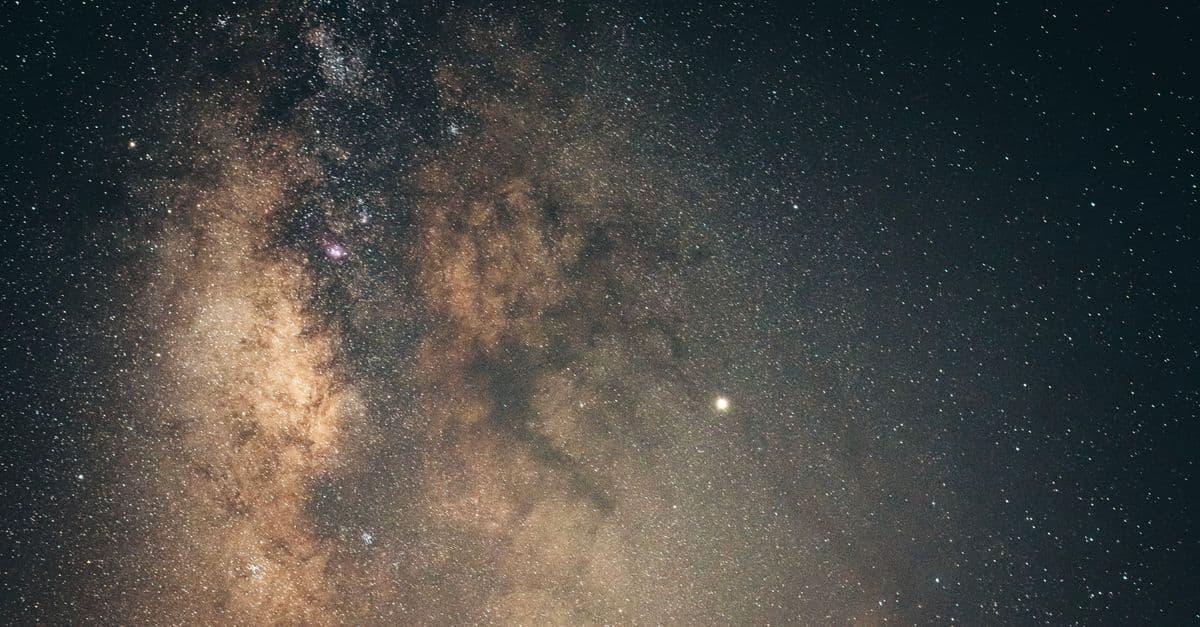
Photo: Connor Scott McManus / Pexels
Venus is nearly Earth's twin in size and mass, yet its atmosphere is one of the most extreme environments in the solar system. The surface pressure is 92 times Earth's — equivalent to diving 900 meters (3,000 feet) into the ocean — and the mean surface temperature is 464°C (867°F), hotter than Mercury despite being nearly twice as far from the Sun. The mechanism behind that heat, and the strange chemistry swirling in the clouds 50 km above the ground, is what planetary scientists have spent decades trying to unpack.
What Venus's Atmosphere Is Made Of
The Venusian atmosphere is overwhelmingly carbon dioxide (CO₂), which accounts for roughly 96.5% of its volume. Nitrogen makes up most of the remaining 3.5%. Trace gases include sulfur dioxide (SO₂), water vapor, carbon monoxide, argon, and helium — but "trace" here means parts per million, and even at those concentrations, sulfur dioxide plays an outsized chemical role.
Carbon dioxide — a linear, triatomic molecule that absorbs and re-emits infrared radiation, the primary mechanism of the greenhouse effect on both Earth and Venus.
Sulfur dioxide — a byproduct of volcanic outgassing on Venus; it reacts in the upper atmosphere to form the sulfuric acid that comprises the cloud layers.
The atmosphere is structured in three broad altitude zones. Below roughly 50 km is the lower atmosphere, a dense, slow-moving region where temperatures and pressures are crushing. From about 48 to 70 km lies the cloud deck, where sulfuric acid droplets form continuous global overcast. Above 70 km is the upper atmosphere, where temperatures drop to –40°C (–40°F) and conditions — at least in terms of temperature and pressure — begin to approach what organisms on Earth can tolerate.
Source: NASA Venus Fact Sheet (2023) — atmospheric composition and vertical structure from Pioneer Venus and Venera mission data.
The Runaway Greenhouse: How Venus Cooked Itself
Earth and Venus started from the same cosmic recipe. Both formed about 4.5 billion years ago from the same region of the protoplanetary disk, received similar initial inventories of volatiles, and likely had liquid water early in their histories. The divergence came from one critical variable: Venus is about 28% closer to the Sun.
That extra solar energy was enough to raise early surface temperatures slightly. Slightly warmer seas evaporated more water vapor into the atmosphere. Water vapor is itself a greenhouse gas, so the atmosphere trapped more heat, evaporating more water, trapping more heat still. This is the runaway greenhouse feedback loop — a self-reinforcing cycle where each degree of warming produces conditions that drive further warming, with no equilibrating restoring force.
Runaway greenhouse effect — a positive feedback loop in which increasing greenhouse gas concentrations raise temperatures, which release more greenhouse gases, which raise temperatures further, until all surface liquid water is gone and a new, hotter equilibrium is established.
Once the oceans were gone, ultraviolet radiation from the Sun split the water molecules (H₂O) into hydrogen and oxygen. The lightweight hydrogen escaped into space. The oxygen reacted with surface rocks and volcanic gases. What remained was a thick, dry CO₂ atmosphere that could no longer shed its heat.
The analogy that works here is a car on a hot day: crack the windows a fraction and interior temperature stays tolerable, but seal the car completely and temperature climbs until it finds a new, lethal equilibrium. Venus sealed its windows about 2 to 3 billion years ago, and the temperature has been climbing ever since.
Source: Ingersoll, A.P. (1969) — "The Runaway Greenhouse: A History of Water on Venus," Journal of the Atmospheric Sciences, the foundational paper establishing the runaway greenhouse threshold.
Sulfuric Acid Clouds: Chemistry at 50 Kilometers
The cloud deck of Venus is one of the more chemically active environments in the solar system. At altitudes of 48–70 km, sulfur dioxide (SO₂) from volcanic eruptions reacts with trace water vapor and oxygen in a photochemical sequence that ultimately produces sulfuric acid (H₂SO₄). The sulfuric acid condenses into droplets 1–3 micrometers in diameter that form three distinct cloud layers.
The upper clouds (65–70 km) are the densest and most reflective: they give Venus its brilliant white appearance and a global albedo of 0.65 — meaning Venus reflects 65% of all incoming sunlight, more than any other planet in the solar system. This high reflectivity actually moderates the greenhouse effect somewhat. Without those clouds, Venus would be even hotter.
| Cloud Layer | Altitude (km) | Droplet Type | Temperature Range |
|---|---|---|---|
| Upper clouds | 65–70 | Sulfuric acid (H₂SO₄ ~75–85%) | –40°C to 0°C |
| Middle clouds | 52–57 | H₂SO₄ + possible other aerosols | 0°C to 60°C |
| Lower clouds | 48–52 | More dilute H₂SO₄ | 60°C to 100°C |
| Below clouds | 0–48 | No clouds; CO₂ haze | 100°C to 464°C |
The middle cloud layer is where the 2020 phosphine story begins.
Source: Esposito, L.W. et al. (1983) — "Sulfur Dioxide at the Venus Cloud Tops from the Pioneer Venus Ultraviolet Spectrometer," Journal of Geophysical Research.
The Phosphine Controversy: Life in the Clouds?
In September 2020, a team led by astronomer Jane Greaves published a paper in Nature Astronomy announcing the detection of phosphine (PH₃) in Venus's middle cloud layer, measured using two ground-based radio telescopes: the James Clerk Maxwell Telescope (JCMT) in Hawaii and the ALMA array in Chile.
Phosphine — a colorless, toxic gas composed of one phosphorus atom bonded to three hydrogen atoms (PH₃); on rocky worlds, no known abiotic (non-biological) process produces it efficiently, which is why it has been proposed as a potential biosignature.
The detection claimed roughly 20 parts per billion (ppb) of phosphine. That concentration mattered because every known non-biological pathway for producing phosphine on Venus — volcanic lightning, meteor impacts, photochemistry — produces far less than 1 ppb. If the measurement was real, the paper's authors argued, something was making phosphine that conventional chemistry could not explain.
The scientific response was swift and skeptical. Within weeks, multiple independent teams reanalyzed the raw data and found serious issues. One critical reanalysis by Snellen et al. (2020) concluded that the claimed signal was much weaker than reported, likely in the range of 1 ppb or less — possibly indistinguishable from zero. A second reanalysis identified a calibration error in the ALMA data that, when corrected, reduced the claimed signal significantly.
By 2021, the consensus among most planetary scientists had shifted to cautious skepticism. The phosphine detection is not confirmed, not disproved, and remains scientifically unresolved. The controversy did something useful, though: it reignited interest in Venus as a target for astrobiology and atmospheric chemistry missions.
Source: Greaves, J.S. et al. (2020) — "Phosphine gas in the cloud decks of Venus," Nature Astronomy; Snellen, I. et al. (2020) — independent reanalysis questioning the detection significance.
Could Anything Actually Live in the Clouds?
The phosphine controversy prompted planetary scientists to revisit a much older idea: Carl Sagan and Harold Morowitz proposed in 1967 that the middle cloud layer of Venus, at 48–60 km altitude, is the most habitable zone in the solar system outside Earth. Temperatures there range from 0°C to about 90°C, and pressures are approximately 0.5 to 1 bar — close to Earth's surface conditions.
The catch is sulfuric acid. The cloud droplets are concentrated sulfuric acid (75–85% H₂SO₄ by mass), which destroys most biomolecules known to biology. Any life in the Venusian clouds would need biochemistry fundamentally different from anything on Earth — capable of thriving in highly acidic aerosols, with no liquid water available, and subject to intense UV radiation in the upper layers.
This is not impossible in principle. Extremophiles on Earth tolerate pH values near zero (the equivalent of living in 10% sulfuric acid), but they still require liquid water. Venusian clouds contain, at most, trace amounts of water vapor, not liquid water. That constraint alone makes the Venusian cloud life hypothesis deeply speculative — interesting, but not yet scientifically supportable.
Source: Sagan, C. and Morowitz, H. (1967) — "Life in the Clouds of Venus," Nature; Seager, S. et al. (2020) — "The Venusian Lower Atmosphere Haze as a Depot for Desiccated Microbial Life."
The Surface: A Crushing, Broiling World
Below the clouds, Venus's surface is geologically active, geomorphically diverse, and utterly hostile. The 464°C surface temperature is uniform to within a few degrees across latitudes and longitudes — day side and night side are nearly the same temperature because the thick atmosphere distributes heat globally, even through Venus's slow 243-Earth-day rotation.
The 92-bar surface pressure means the CO₂ atmosphere at the surface is a supercritical fluid — not quite a gas, not quite a liquid, but a dense, high-viscosity phase that is extraordinarily efficient at absorbing and transferring heat. A human on the surface would be simultaneously crushed, roasted, and corroded.
Radar mapping by NASA's Magellan spacecraft (1990–1994) revealed a surface dominated by volcanic plains, with more than 1,600 major volcanoes. In 2023, researchers reanalyzing Magellan radar data found direct evidence of active volcanism: a volcanic vent near the peak of Maat Mons had measurably changed shape and area between 1991 observations, growing from roughly 2.2 km² to 4 km². This was the first direct detection of an active volcanic eruption on Venus.
Source: Herrick, R.R. and Hensley, S. (2023) — "Surface changes on Venus during the Magellan mission," Science.
What DAVINCI+ and EnVision Will Actually Measure
Two missions are currently in development to decode the Venusian atmosphere in detail for the first time since the Soviet Vega probes in 1985.
DAVINCI+ (Deep Atmosphere Venus Investigation of Noble gases, Chemistry, and Imaging Plus) is a NASA Discovery mission targeted for launch no earlier than 2031. Its centerpiece is a spherical descent probe roughly 1 meter in diameter that will be released into the Venusian atmosphere and descend through all three cloud layers, sampling chemistry in situ as it falls. Key targets include:
- Noble gas abundances (neon, argon, krypton, xenon) — isotope ratios encode Venus's accretion history and water inventory
- Phosphine concentration across cloud layers — the definitive test of the Greaves et al. claim
- D/H (deuterium-to-hydrogen) ratio in water vapor — a direct measure of how much water Venus once had
- SO₂ and H₂SO₄ profiles — the full chemistry of cloud formation
EnVision is an ESA medium-class orbiter targeting a 2032 launch. Unlike DAVINCI+, it stays in orbit, mapping Venus's surface in three radar modes (including a subsurface sounder to depths of ~1 km), measuring volcanic activity, and monitoring atmospheric composition over time. EnVision and DAVINCI+ are designed to be complementary: one maps from orbit, the other tastes the atmosphere directly.
| Mission | Agency | Launch Target | Type | Primary Goal |
|---|---|---|---|---|
| DAVINCI+ | NASA | 2031 (NET) | Orbiter + descent probe | Atmospheric chemistry, noble gases |
| EnVision | ESA | 2032 (NET) | Orbiter | Surface geology, atmospheric monitoring |
| VERITAS | NASA | On hold (2025 review) | Orbiter | Surface mapping, topography |
Source: NASA DAVINCI+ Mission Science Overview (2021); ESA EnVision Mission Definition Report (2022).
What People Get Wrong About Venus
The most persistent misconception is that Venus is hot because it is close to the Sun. Venus is hot because of its atmosphere, not its proximity. Mercury is closer to the Sun and has a negligible atmosphere — its daylight surface temperature peaks at about 430°C, slightly less than Venus's uniform 464°C, and its night side plummets to –180°C. Venus's night side stays at 464°C, because the thick CO₂ blanket circulates and retains heat globally.
The second misconception is that the phosphine detection proved life. It did not. A contested spectroscopic measurement at the limits of detection, using telescopes not optimized for this measurement, is a hypothesis-generating result — not confirmation of anything.
The third is that Venus was always hostile. The current evidence, including Venus's relatively smooth surface (suggesting geological resurfacing within the last 300–600 million years) and the D/H ratio in its atmospheric water vapor (measured by Venus Express as 120–150 times Earth's ratio), points to a past in which Venus may have had liquid water on its surface for hundreds of millions to perhaps 2 billion years. That window may have been long enough for life to arise — which is why the clouds are worth studying so carefully.
Source: Donahue, T.M. et al. (1982) — D/H ratio in Venus water vapor, Science; Kasting, J.F. (1988) — "Runaway and moist greenhouse atmospheres and the evolution of Earth and Venus."
DAVINCI+ and EnVision: The Instrument-Level Case for Solving Venus
In June 2021, NASA announced the selection of two new Discovery and New Frontiers missions targeting Venus — DAVINCI+ and VERITAS — ending a 36-year gap in dedicated US Venus missions since the Magellan orbiter. One month later, ESA selected EnVision as its fifth medium-class science mission. For the first time since the Soviet Vega probes reached Venus in 1985 and 1986, the world had a coordinated plan to send multiple spacecraft to the most poorly understood major planet in the inner solar system.
Source: NASA Science (2021) — "NASA Selects 2 Missions to Study 'Lost Habitable' World of Venus" press release, June 2, 2021; ESA (2021) — EnVision medium-class mission selection announcement.
The phosphine controversy made the timing fortuitous. The 2020 Greaves et al. claim had exposed a fundamental limitation of ground-based Venus science: even the most powerful radio telescopes on Earth struggle to resolve spectral lines in Venus's atmosphere cleanly because the planet's 96.5% CO₂ composition creates a dense forest of overlapping absorption features. The phosphine claim was made at the 266.9 GHz rotational transition of PH₃ — a line that sits adjacent to strong SO₂ absorption, and correctly separating the two signals in ground-based spectra proved extremely difficult. The detection and its subsequent reanalyses were essentially a dispute about instrumental calibration, not fundamental chemistry.
DAVINCI+ addresses this with a fundamentally different approach: direct in-situ measurement. The descent probe carries a mass spectrometer suite — specifically the Venus Mass Spectrometer (VMS), built on heritage from the Sample Analysis at Mars (SAM) instrument on the Curiosity rover — that will sample the atmosphere directly at multiple altitudes as the probe falls from roughly 67 km to the surface over approximately 63 minutes. At each sampling interval, the VMS ingests atmospheric gas, separates it by atomic mass units, and measures the abundance of each component down to parts per trillion sensitivity. Phosphine (PH₃, molecular mass 34) and SO₂ (molecular mass 64) have distinct mass signatures. There is no spectral blending problem. If phosphine is present above 1 ppb anywhere in the cloud layers, DAVINCI+ will detect it unambiguously. If it is absent, DAVINCI+ will set a definitive upper limit that the Greaves et al. signal cannot survive.
Phosphine (PH₃) — a colorless, toxic gas with molecular mass 34 atomic mass units; on Venus, any detection above roughly 1 ppb at cloud altitudes would require a chemical explanation that current atmospheric models cannot supply without invoking either unknown abiotic processes or biological production.
The probe also carries a tunable laser spectrometer — the Venus Tunable Laser Spectrometer (VTLS) — operating in the near-infrared. Tunable laser spectrometers work by precisely tuning a laser to the exact absorption wavelength of a target molecule and measuring how much of the laser light the sample absorbs. This technique achieves sub-ppb sensitivity for molecules like water vapor and its isotopologues (HDO, the deuterium-bearing form), sulfur dioxide, and hydrogen sulfide. The VTLS's measurement of the D/H ratio in atmospheric water vapor is arguably DAVINCI+'s most consequential science: the ratio of deuterium-to-hydrogen in the remaining trace water vapor is a direct recorder of how much water Venus originally had and when it lost it, because deuterium-bearing water molecules are preferentially retained as lighter hydrogen escapes to space. Current estimates from Venus Express put the D/H ratio at roughly 120–150 times Earth's value, implying Venus once had enough water to cover its surface to perhaps several hundred meters depth — but those ground-based and orbiter measurements carry large uncertainties that in-situ sampling will resolve.
EnVision, on its 2032 launch target, approaches the SO₂ and phosphine chemistry problem from orbit using a radio occultation experiment and the VenSpec spectrometer suite. VenSpec-H targets water vapor and SO₂ in the mesosphere using solar occultation in the ultraviolet (170–320 nm range), while VenSpec-M maps SO₂ and SO₂ photolysis products across the globe at near-infrared wavelengths. Critically, EnVision can observe Venus at many local times and latitudes over its four-year nominal mission, building a time-resolved picture of how SO₂ concentrations vary with altitude, latitude, and solar illumination — the context that a single DAVINCI+ descent probe, lasting 63 minutes, cannot supply alone.
The two missions are deliberately designed to be complementary. DAVINCI+ provides a single, high-resolution vertical chemical profile through the cloud layers in one location and one moment in time. EnVision provides the global, long-duration context that explains whether that profile is representative or anomalous. Together they close the measurement gap that made the phosphine controversy possible in the first place: ground-based observatories looking through a full planetary disk of atmosphere versus targeted, in-situ chemistry with known instrument response functions.
Both missions target launch windows in the early-to-mid 2030s — DAVINCI+ no earlier than 2031, EnVision no earlier than 2032 — with Venus arrival occurring roughly six months after launch for DAVINCI+ (a fast ballistic trajectory) and roughly three years after launch for EnVision (requiring aerobraking into a low circular orbit). The SO₂ chemistry measurements and the definitive phosphine test are therefore roughly a decade away from the date of this writing. Until then, the 2020 phosphine claim remains exactly what the scientific process produced it as: a hypothesis, open, pending better instruments.
FAQs
Q: Why is Venus hotter than Mercury despite being farther from the Sun?
A: Venus's thick CO₂ atmosphere traps heat through the greenhouse effect, keeping the surface at 464°C day and night. Mercury has almost no atmosphere, so its heat escapes into space on the night side, dropping to –180°C.
Q: What is the phosphine controversy on Venus?
A: In 2020, a research team reported detecting phosphine gas (PH₃) at ~20 ppb in Venus's clouds — a concentration that no known non-biological chemistry could explain. Multiple reanalyses found the signal was much weaker or possibly a data artifact. The claim is unresolved but drove renewed mission interest.
Q: Could life actually exist in Venus's clouds?
A: The middle cloud layer (48–60 km altitude) has Earth-like temperatures and pressures, but the cloud droplets are 75–85% sulfuric acid — far more corrosive than any environment where life is known to exist on Earth. It remains speculative, and no confirmed biosignature has been detected.
Q: What did the Magellan mission find on Venus?
A: NASA's Magellan spacecraft (1990–1994) used radar to map 98% of Venus's surface through the opaque clouds, revealing volcanic plains, thousands of volcanoes, and impact craters. A 2023 reanalysis of Magellan data detected shape changes in a volcanic vent on Maat Mons — the first direct evidence of an active eruption on Venus.
Q: When will DAVINCI+ reach Venus?
A: DAVINCI+ is targeting launch no earlier than 2031. The descent probe will sample the atmosphere in situ and has been specifically designed to test the phosphine detection and measure noble gas isotopes that will reveal Venus's water history.
Q: What is the surface pressure on Venus in practical terms?
A: 92 bar is equivalent to the pressure at roughly 900 meters (about 3,000 feet) depth in Earth's ocean. Early Soviet Venera landers were crushed within minutes; the longest surface survivor, Venera 13 (1982), lasted 127 minutes before the pressure and heat destroyed it.
The Takeaway
Venus is not just a warning sign about runaway greenhouse warming — though it is that too. It is a chemically complex world whose middle cloud layer is the most debated habitable zone in the solar system, whose active volcanism is still reshaping its surface today, and whose atmospheric history encodes 4.5 billion years of planetary evolution that we have barely started to read. DAVINCI+ and EnVision will produce the first detailed atmospheric chemistry profiles since the Soviet Vega missions in 1985. What they find — phosphine or no phosphine, biosignature or not — will reframe what we know about where in the solar system chemistry becomes biology.
Read next:
Follow new articles
Add SciHub101 to your feed reader to see new science and technology stories.
About the Author
SciHub101 is an independent science and technology publication founded and edited by Buğra Sözeri, a software engineer and app developer based in Türkiye. AI tools assist with drafting and research. Source documentation in the existing archive is uneven, and articles are being reviewed and corrected. The Editorial Team byline identifies editorial responsibility; it does not certify specialist or independent human review. Where we compare products, anything built by our own team is labelled as such — see the editorial guidelines and About page for how corrections and disclosures work.
Related Articles
What James Webb Telescope Has Actually Found (2022–2026) — The Discoveries That Rewrote Astronomy
JWST's confirmed discoveries from 2022 to 2026: ancient galaxies too massive for theory, exoplanet biosignature debates, star formation in infrared, and solar system science.

The Great Red Spot: Science Behind Jupiter's 350-Year Storm
Jupiter's Great Red Spot has been spinning continuously for at least 350 years — longer than the United States has existed. It reaches 500 km deep, its color comes from chemistry that scientists still argue about, and it has been shrinking for a century. But it is not dying. Here is what we actually know.



Venus's Volcanoes: The Planet That Erased Its Own History
Venus has almost no impact craters. That fact alone reveals something extraordinary about its past — and a 2023 re-analysis of 30-year-old radar images just caught its volcanoes in the act.
Why Is Venus So Hot? Earth's Hellish Twin Explained
Venus has a surface temperature of 464°C — hotter than Mercury despite being twice as far from the Sun. Its atmosphere is 96% carbon dioxide with a pressure 90 times Earth's, it rains sulfuric acid, and it rotates so slowly that one day on Venus is longer than a Venusian year. Understanding why Venus went wrong may be crucial for understanding Earth's future.