Why Venus Is Hotter Than Mercury

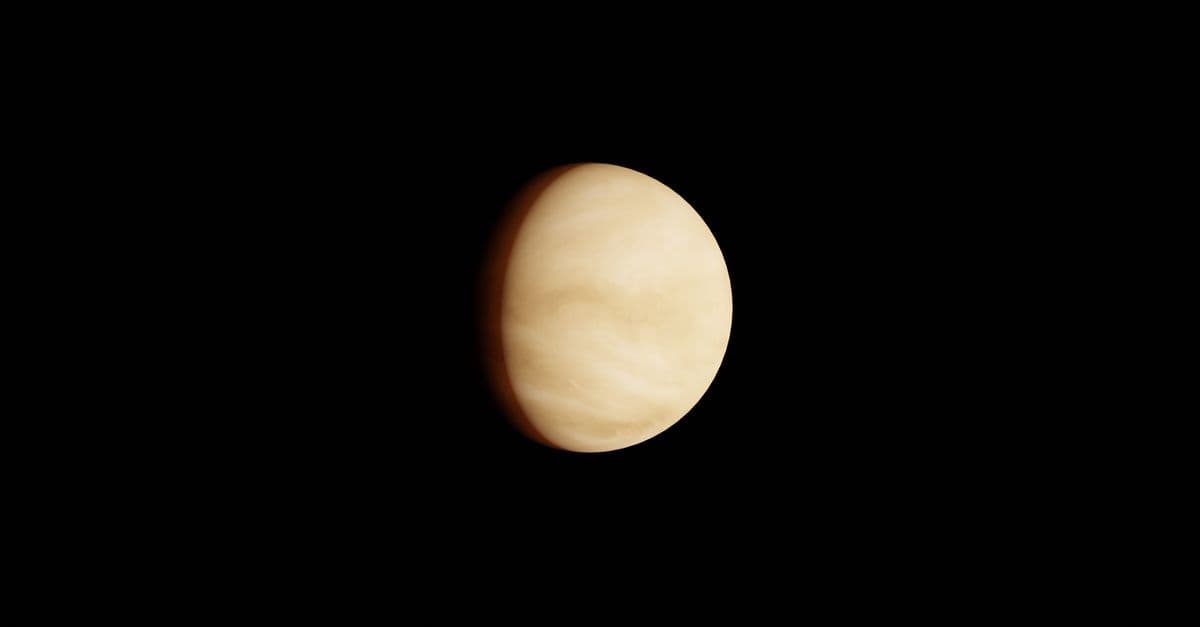
Photo: Erhan Dayı / Pexels
Mercury orbits about 58 million kilometers (36 million miles) from the sun. Venus orbits nearly twice as far out, at roughly 108 million kilometers (67 million miles). By simple geometry, Mercury should be the hotter world. It isn't. Venus's surface holds a punishing, nearly uniform 465 degrees Celsius (869 degrees Fahrenheit), hot enough to melt lead and zinc, while Mercury's blazing daytime peak of about 430 degrees Celsius (800 degrees Fahrenheit) collapses to roughly minus 170 degrees Celsius (minus 274 degrees Fahrenheit) once night falls (NASA Science, 2025). The gap between these two planets is one of the clearest lessons in planetary science: distance from a star sets the ceiling on how much energy a planet receives, but atmosphere decides how much of that energy actually stays.
This isn't a subtle distinction. It's the difference between a planet that can support a spacecraft for two hours and one that destroys landers in under two. Understanding why requires looking closely at what each planet does, and does not, have wrapped around it.
The paradox: closer to the sun should mean hotter
Basic orbital mechanics says solar energy received by a planet falls off with the square of its distance from the sun, a relationship called the inverse-square law. Move a planet twice as far from its star, and it receives roughly one-quarter the solar energy per unit area. Mercury, sitting at about 0.39 astronomical units (AU) from the sun, receives roughly 6.5 times more solar radiation per square meter than Venus does at its distance of about 0.72 AU.
If solar flux were the only variable that mattered, Mercury would be the solar system's hottest planet by a wide margin, and Venus would be a comparatively mild, sun-baked rock somewhere between Mercury and Earth in temperature. That is not what spacecraft measurements show. Soviet Venera landers that touched down on Venus between 1970 and 1982 recorded surface temperatures consistently near 460 to 480 degrees Celsius across multiple sites and multiple missions, while NASA's MESSENGER spacecraft, which orbited Mercury from 2011 to 2015, mapped daytime peaks around 430 degrees Celsius and nighttime lows near minus 170 degrees Celsius (NASA Science, 2025).
The paradox resolves once you stop treating "distance from the sun" as the only knob that controls planetary temperature. A second variable, how efficiently a planet retains the heat it receives, turns out to matter more for these two worlds than orbital distance does. Mercury has almost nothing to retain heat with. Venus has, by a wide margin, the most heat-retentive atmosphere of any rocky planet in the solar system.
Mercury's problem: almost no atmosphere to work with
Mercury does not have a true atmosphere in any meaningful sense. What it has instead is called an exosphere — an extraordinarily thin, surface-bound layer of atoms so sparse that they essentially never collide with one another before escaping or returning to the surface. Its total surface pressure is roughly a trillionth of Earth's, generated mostly by atoms knocked loose from Mercury's crust by solar wind bombardment and micrometeorite impacts, not by any gas that was ever gravitationally bound to the planet the way Earth's or Venus's atmospheres are (NASA Science, 2025).
Think of Mercury's exosphere the way you'd think of a few scattered grains of sand thrown into the air of a stadium. Technically there's "something" up there, but it's nowhere close to a blanket, a cushion, or anything that could trap and redistribute energy. A true atmosphere works like a comforter on a cold night: it holds heat near the surface and spreads it out so no single spot gets extreme. Mercury has no comforter at all.
Two forces conspire to keep Mercury this bare. First, Mercury's gravity is weak, only about 38 percent of Earth's, which makes it easier for any gas molecules to escape into space over geological time. Second, Mercury sits close enough to the sun that intense solar wind, the constant stream of charged particles blown outward by the sun, strips away lighter gas molecules that might otherwise accumulate (NASA Science, 2025). Any primordial atmosphere Mercury once had was almost certainly scoured away within the planet's first several hundred million years.
Why Mercury has the solar system's biggest temperature swing
Without an atmosphere to redistribute heat, Mercury's surface temperature is dictated almost entirely by direct sunlight exposure at any given moment. The sunlit side bakes because nothing intercepts or scatters incoming radiation before it hits rock. The instant that same patch of ground rotates into darkness, heat radiates straight back out to space with nothing to slow the loss, and temperatures crash. The result is a day-night swing of roughly 600 degrees Celsius (about 1,080 degrees Fahrenheit), the largest of any planet in the solar system (NASA Science, 2025).
Mercury's extremely slow rotation compounds this. A single Mercury solar day, the time from one sunrise to the next as seen from the surface, lasts about 176 Earth days, due to a 3:2 spin-orbit resonance where the planet rotates three times for every two orbits around the sun. That means any given patch of surface spends an extraordinarily long stretch baking in direct sun, or an equally long stretch losing heat to the void, before conditions flip.
Venus's atmosphere: a 96.5 percent carbon dioxide blanket at 92 times Earth's pressure
Venus took the opposite path. Instead of losing its atmosphere, it built one of the densest atmospheres of any rocky planet, dominated overwhelmingly by carbon dioxide. Venus's atmosphere is about 96.5 percent CO2 by volume, with most of the remainder made up of nitrogen, and surface pressure reaches roughly 92 to 93 times Earth's sea-level pressure (NASA Science, 2025). Standing on Venus's surface, unprotected, would feel roughly like standing under nearly a kilometer of ocean water on Earth, an environment that has crushed multiple robotic landers within hours of touchdown.
Carbon dioxide is a gas that is largely transparent to incoming visible sunlight, letting most of it pass through to the surface, but strongly absorbs and re-emits outgoing infrared radiation, the heat radiating back off a warmed surface. This selective behavior, transparent to visible light, opaque to infrared, is the mechanism at the core of what's called the greenhouse effect. On Earth, greenhouse gases keep the planet's average temperature well above what it would otherwise be. On Venus, with roughly 154,000 times more CO2 mass in its atmosphere than Earth's atmosphere holds, the same mechanism has run to an extreme conclusion.
Layered on top of the CO2 blanket is a global deck of clouds made largely of sulfuric acid droplets, sitting roughly 45 to 70 kilometers (28 to 43 miles) above the surface. These clouds reflect a large share of incoming sunlight back to space, which is part of why Venus appears so brilliantly bright from Earth, but they also trap outgoing infrared radiation almost as effectively as the CO2 beneath them, adding another layer to the heat-retention problem.
How a runaway greenhouse effect actually runs away
A runaway greenhouse effect is a self-reinforcing feedback loop: warming causes more of a greenhouse-relevant substance, often water vapor, to enter the atmosphere, and that additional greenhouse gas causes further warming, which releases still more of the substance, until a stable equilibrium can no longer be reached. On Venus, scientists reconstruct a scenario where the planet's early oceans, plausible given hydrogen isotope evidence discussed below, absorbed enough solar heating that water evaporated faster than it could condense back out. Water vapor is itself a potent greenhouse gas, so the added vapor trapped more heat, driving still more evaporation, in a loop that eventually boiled Venus's oceans away entirely.
Once water vapor reached Venus's upper atmosphere, ultraviolet radiation from the sun broke the molecules apart into hydrogen and oxygen, a process called photodissociation. The light hydrogen atoms, no longer bound to oxygen, escaped Venus's gravity into space over time, while carbon dioxide, released from volcanic outgassing and from carbonate rocks that would otherwise have locked carbon away, accumulated and came to dominate the remaining atmosphere (European Space Agency, Venus Express mission, 2006-2014).
The evidence Venus once had oceans, and why they disappeared
The idea that Venus once resembled a warmer, wetter world isn't speculation built purely on modeling. It's grounded in a specific measurable signature: the ratio of deuterium to hydrogen, two isotopes of hydrogen, in Venus's present-day atmosphere. Deuterium is roughly twice as heavy as ordinary hydrogen, so when water is broken apart by ultraviolet light and ordinary hydrogen escapes to space preferentially over its heavier deuterium counterpart, the atmosphere left behind becomes progressively enriched in deuterium relative to hydrogen.
ESA's Venus Express orbiter, which studied Venus from 2006 to 2014, measured a deuterium-to-hydrogen ratio in Venus's atmosphere roughly 100 to 150 times higher than Earth's ratio, a signature consistent with a planet that lost an ocean's worth, or close to it, of water over its history (European Space Agency, Venus Express mission, 2006-2014). This single measurement is one of the strongest pieces of physical evidence supporting the runaway greenhouse hypothesis for Venus's history, rather than an assumption that Venus was always the furnace it is today.
It's worth being honest about what remains uncertain. Scientists debate exactly how much water Venus held, exactly when the runaway effect began relative to the planet's formation roughly 4.5 billion years ago, and whether Venus experienced any temperate, potentially habitable window lasting millions or billions of years before the runaway effect took hold. NASA's upcoming DAVINCI mission, expected to launch by the end of the decade, is designed in part to probe Venus's atmosphere for further clues about its early history and composition (NASA Science, 2025).
Why Venus stays hot everywhere, while Mercury swings wildly
The contrast in how heat is distributed across each planet is just as telling as the peak temperatures themselves. Venus's dense atmosphere circulates efficiently across the whole planet, moving heat from the dayside to the nightside and from equator to pole so effectively that surface temperature barely varies by location or by time of day, typically within a few degrees Celsius planet-wide (NASA Science, 2025). A thick atmosphere acts like a giant, slow-mixing bathtub of heat: pour hot water in one spot, and given enough circulation, the whole tub eventually reaches close to the same temperature.
Mercury, with no meaningful atmosphere to circulate heat, behaves the opposite way. Its surface temperature is essentially a direct, local readout of whatever the sun is doing to that specific patch of ground at that specific moment, with almost no lag or averaging. That's why the same planet can register a scorching 430 degrees Celsius on its sunlit face while a crater floor at the poles, permanently shadowed from any direct sunlight, holds water ice at temperatures below minus 170 degrees Celsius, cold enough that NASA's MESSENGER mission confirmed water ice deposits inside those permanently dark polar craters (NASA Science, 2025).
This is a genuinely useful mental model for planetary temperature more broadly: a planet's atmosphere functions less like a heater and more like a thermal regulator, or a moderator. Add greenhouse gases and you shift the regulator toward retention; strip the atmosphere away entirely and you're left with a planet fully at the mercy of direct, local sunlight, with nothing smoothing out the extremes.
| Property | Mercury | Venus |
|---|---|---|
| Distance from sun | ~58 million km (0.39 AU) | ~108 million km (0.72 AU) |
| Atmosphere | Negligible exosphere, ~10⁻¹⁴ Earth pressure | 96.5% CO2, ~92-93x Earth pressure |
| Surface temperature | -170°C to 430°C (day/night swing) | ~465°C, nearly uniform planet-wide |
| Day-night temperature swing | ~600°C, largest in the solar system | Only a few degrees Celsius |
| Primary heat mechanism | Direct solar heating, no retention | Runaway greenhouse effect |
| Length of solar day | ~176 Earth days | ~117 Earth days |
Distance sets the energy budget; atmosphere decides how much of it a planet keeps and how evenly it spreads that heat around.
What this comparison gets wrong in popular explanations
A common shorthand claims Mercury simply "should" be the hottest planet because it's closest to the sun, and treats Venus's higher temperature as some kind of exception or anomaly. That framing gets the physics backward. Distance from the sun determines how much energy a planet receives, not how hot its surface ends up. Once you separate those two ideas, Venus isn't an anomaly at all, it's the predictable outcome of pairing a modest solar energy input with an atmosphere that is extraordinarily good at retaining heat.
A second common misconception treats Mercury's proximity to the sun as the reason it lacks an atmosphere, as if the sun's heat simply "burned off" any gas that formed there. The more accurate explanation involves Mercury's weak gravity combined with sustained solar wind stripping, a slower and more mechanical process than heat evaporation, operating over hundreds of millions of years rather than a single dramatic event.
A third misconception, understandable given Venus's runaway greenhouse effect, is assuming Venus's atmosphere formed the same way Earth's did and simply "went wrong." In reality, Venus, Earth, and Mars likely started with broadly similar volcanic outgassing histories, releasing water vapor, CO2, nitrogen, and other gases early in their formation. Their outcomes diverged sharply based on distance from the sun, a runaway feedback loop on Venus, a stable water cycle and carbon cycle on Earth, and a thin, largely lost atmosphere on Mars, a divergence explored in more detail in coverage of why Mars lost most of its atmosphere. The three inner rocky planets, plus Mercury, form a natural experiment in what different starting distances and different atmospheric fates produce from broadly similar raw materials.
Why this comparison matters beyond these two planets
The Venus-Mercury contrast isn't just planetary trivia. It's become one of the central case studies astronomers use when evaluating potentially habitable exoplanets discovered by missions studying what makes a planet habitable around other stars. A planet's orbital distance alone, whether it sits inside or outside a star's so-called habitable zone, tells researchers relatively little without also knowing what kind of atmosphere, if any, that planet holds onto.
Exoplanet scientists now explicitly model runaway greenhouse thresholds when assessing candidate worlds, recognizing that a planet just inside the inner edge of a habitable zone could, depending on its atmospheric composition and total gas inventory, end up more like Venus than like Earth. Instruments capable of characterizing distant exoplanet atmospheres, including infrared-sensing space telescopes described in how space telescopes see in infrared, are central to this work, since infrared signatures reveal which greenhouse gases, if any, dominate a given exoplanet's atmosphere.
Venus also functions as a cautionary case study for Earth's own climate science. While Earth's atmosphere and Venus's atmosphere differ enormously in scale, roughly 154,000 times more CO2 mass on Venus than in Earth's atmosphere, the underlying physical mechanism, CO2 trapping outgoing infrared radiation, is identical. Planetary scientists sometimes describe Venus as offering the clearest natural demonstration in the solar system that this mechanism is real and can, under the right long-term conditions, run to an extreme conclusion.
The takeaway
Venus is hotter than Mercury despite orbiting roughly twice as far from the sun because its dense, carbon-dioxide-dominated atmosphere traps heat through a runaway greenhouse effect, while Mercury's near-total lack of atmosphere leaves it with nothing to retain heat at all. Mercury's temperature is a direct, local response to sunlight with no buffering, producing blistering days and frigid nights in the same 176-day cycle. Venus's temperature is instead the product of an atmospheric feedback loop that built up gradually, likely following the loss of an early ocean, and now holds the entire planet at a nearly uniform, brutal 465 degrees Celsius. The comparison is one of the clearest illustrations available anywhere in the solar system that atmospheric composition, not orbital distance, is what ultimately determines a rocky planet's surface temperature.
Read next:
- What makes a planet habitable
- Why Mars lost most of its atmosphere
- How space telescopes see in infrared
FAQ
Q: Why is Venus hotter than Mercury if Mercury is closer to the sun?
Venus's thick atmosphere, 96.5 percent carbon dioxide at roughly 92 times Earth's surface pressure, traps heat through a runaway greenhouse effect that keeps its surface near 465 degrees Celsius. Mercury has almost no atmosphere to retain heat, so despite receiving about 6.5 times more solar energy per square meter, it cannot hold onto that heat once a given patch of surface rotates into darkness.
Q: What is the surface temperature of Venus compared to Mercury?
Venus's surface holds a nearly uniform 465 degrees Celsius (869 degrees Fahrenheit) around the entire planet, day or night. Mercury's sunlit side reaches about 430 degrees Celsius, but its night side plunges to roughly minus 170 degrees Celsius due to its lack of atmosphere (NASA Science, 2025).
Q: Why doesn't Mercury have a thick atmosphere like Venus?
Mercury's weak gravity, about 38 percent of Earth's, made it easier for atmospheric gases to escape over time, while intense solar wind close to the sun continuously stripped away lighter molecules. What remains is an extremely thin exosphere made largely of atoms knocked loose from the surface by solar wind and micrometeorite impacts, not a bound atmosphere.
Q: What is a runaway greenhouse effect?
A runaway greenhouse effect is a self-reinforcing feedback loop in which warming causes more of a greenhouse gas, such as water vapor, to enter a planet's atmosphere, which traps additional heat and drives further warming. On Venus, this process likely evaporated an early ocean entirely, leaving hydrogen to escape to space and carbon dioxide from volcanic outgassing to dominate the resulting atmosphere.
Q: Did Venus always have such a hot, dense atmosphere?
Deuterium-to-hydrogen isotope measurements from ESA's Venus Express mission (2006-2014) suggest Venus once held significant surface water, consistent with a runaway greenhouse effect that evaporated it over time. Some details of Venus's early history, including exactly how long any temperate period may have lasted, remain an active area of research that missions like NASA's upcoming DAVINCI aim to clarify.
Q: How big is the temperature swing between Mercury's day and night sides?
Mercury's day-night temperature swing is roughly 600 degrees Celsius (about 1,080 degrees Fahrenheit), the largest of any planet in the solar system, a direct result of having no atmosphere to redistribute or retain heat between its sunlit and shadowed sides (NASA Science, 2025).
Follow new articles
Add SciHub101 to your feed reader to see new science and technology stories.
About the Author
SciHub101 is an independent science and technology publication founded and edited by Buğra Sözeri, a software engineer and app developer based in Türkiye. AI tools assist with drafting and research. Source documentation in the existing archive is uneven, and articles are being reviewed and corrected. The Editorial Team byline identifies editorial responsibility; it does not certify specialist or independent human review. Where we compare products, anything built by our own team is labelled as such — see the editorial guidelines and About page for how corrections and disclosures work.
Related Articles

Why Do Stars Twinkle? The Science of Atmospheric Seeing
Stars twinkle because Earth's turbulent atmosphere bends starlight in constantly shifting ways. Because stars are infinitely distant, they act as point sources, so even tiny bends in light rays cause dramatic brightness and color flickers. Planets, being much closer, show a small disk that averages out the jitter. Twinkling is worst near the horizon and is why the best observatories sit on mountaintops or in orbit.


Venus Atmosphere Chemistry Explained: 92 Bars, Acid Clouds, and the Phosphine Mystery
Venus has a surface pressure 92 times Earth's, clouds made of sulfuric acid, and a surface hot enough to melt lead — yet something in its middle cloud deck may have hinted at life. Explore the chemistry behind the solar system's most hostile atmosphere and the missions racing to decode it.
Mercury Explained: Iron Core, Polar Ice, Odd Orbit
Mercury has an oversized iron core, ice at its poles, and a day longer than its year. What MESSENGER found and what BepiColombo is due to do in November 2026.
Venus Spins Backward: The Planet of Strange Rotation
Venus rotates in the opposite direction of every other planet in the solar system, and it does so so slowly that a single Venusian day lasts 243 Earth days — longer than its year of 225 days. If you stood on Venus, the Sun would rise in the west and set in the east, and by the time it crossed the sky, you would have already lapped the planet in its orbit. Two competing theories — a primordial giant impact and the slow grind of atmospheric tides — argue over how a world ended up this strange, and neither has yet won.