Venus Spins Backward: The Planet of Strange Rotation
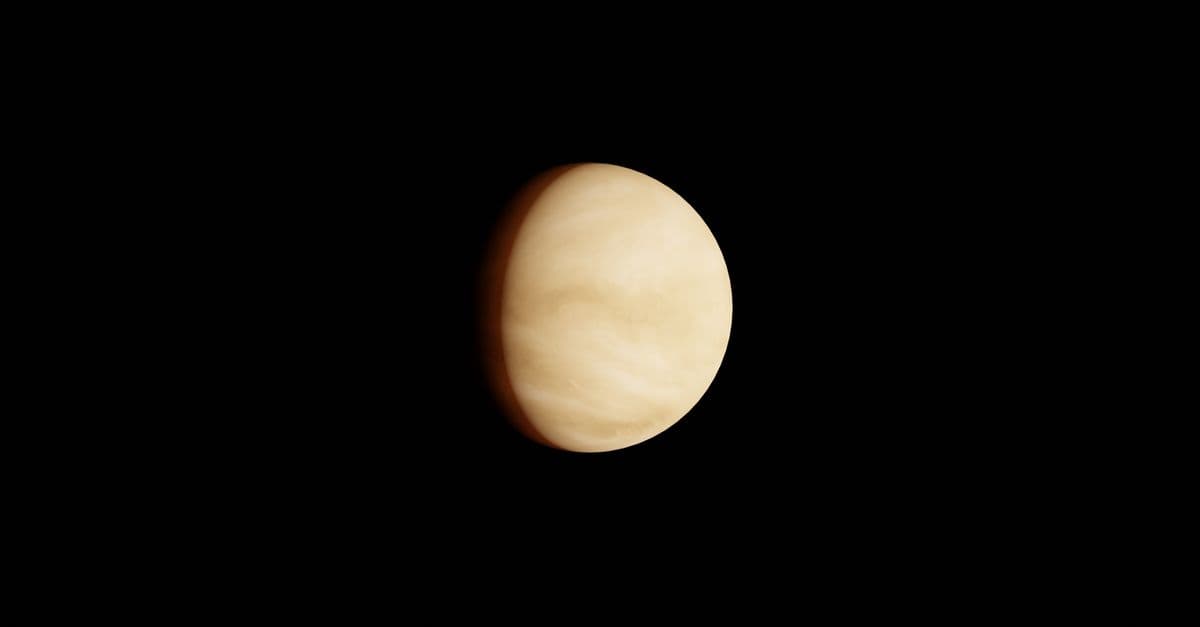
Photo: Zelch Csaba / Pexels
Every planet in the solar system formed from the same rotating disk of gas and dust that surrounded the young Sun. The physics of that disk stamped a direction onto everything: all eight planets orbit counterclockwise when viewed from above Earth's north pole, and almost all rotate counterclockwise on their own axes too. Venus is the exception that breaks the rule most dramatically. It rotates clockwise — backward relative to its orbit — so slowly that a single day on Venus takes longer than a Venusian year. The Sun, viewed from the surface, rises in the west, creeps across the sky over weeks, and sets in the east. No other terrestrial planet behaves this way, and explaining why has occupied planetary scientists for decades.
What Retrograde Rotation Actually Means
Retrograde rotation — rotation in the opposite direction to a planet's orbital motion around the Sun. When viewed from above the solar system's north pole, all planets orbit counterclockwise. A planet with prograde rotation also spins counterclockwise on its own axis. Venus spins clockwise, making its rotation retrograde.
The practical consequence is immediate: on Venus, the Sun rises in the west and sets in the east. This alone would be enough to mark Venus as unusual, but the slow rotation compounds the strangeness. Venus completes one full orbit of the Sun in 224.7 Earth days — its year. But it completes one full rotation on its axis in 243.0 Earth days — its day. A Venusian solar day (the time from one sunrise to the next) is actually 116.75 Earth days, because the planet is orbiting while it rotates backward, so the geometry resolves sooner than the sidereal rotation period suggests. Still, a single day-night cycle on Venus lasts nearly five Earth months.
Sidereal rotation period — the time a planet takes to complete one full rotation relative to the distant stars, as opposed to relative to the Sun. Venus's sidereal day of 243 Earth days exceeds its orbital period, making it the only planet whose sidereal day is longer than its year.
For comparison, Earth's sidereal day is 23 hours 56 minutes. Mars's is 24 hours 37 minutes. Even slow-rotating Mercury completes a rotation in 58.6 Earth days — still shorter than Venus's 243.
Source: NASA Science — Venus Facts (nasa.gov) — orbital period 224.7 Earth days, sidereal rotation period 243 Earth days, surface temperature averaging 465°C.
How We Know Venus Spins the Way It Does
Venus is perpetually shrouded in opaque sulfuric acid clouds. No optical telescope can see the surface. The planet's rotation rate and direction were not established until the early 1960s, when radar astronomy came of age.
In 1961 and 1962, radio telescopes at the Goldstone Solar System Radar facility in California and at Arecibo in Puerto Rico bounced radar pulses off the Venusian surface and analyzed the Doppler shift of the returning signals. Because Venus was rotating, one limb of the planet moved toward Earth and the other moved away, stretching and compressing the return signal's frequency in opposite directions. The analysis revealed not only the rotation rate but the direction: the side moving toward Earth was the side expected to be moving away if the rotation were prograde. Venus was spinning backward.
Doppler shift — the change in frequency of a wave (sound, light, or radio) when the source or reflector is moving relative to the observer. A surface moving toward a radar source returns a higher-frequency signal; a surface moving away returns a lower-frequency signal. The difference between the two limbs of a planet gives both rotation speed and direction.
The radar measurement was simultaneously sobering and scientifically productive. It ended hopes that Venus might be a habitable world with a short day and moderate temperatures, and it posed a question planetary science has spent 60 years trying to answer.
Source: Goldstone Solar System Radar, NASA Jet Propulsion Laboratory — historical radar measurements of Venus rotation, 1961–1964.
The Giant Impact Theory: Venus Was Knocked Over
The most dramatic explanation for Venus's retrograde rotation is that something hit it. In the early solar system, planetary formation was violent. The leading theory for the Moon's origin holds that a Mars-sized body struck the young Earth at an oblique angle, blasting out the debris that became the Moon. If a similar impact struck the proto-Venus, it could, depending on the angle and mass of the impactor, have imparted a retrograde spin.
A 2025 study published in Astronomy & Astrophysics by Alexandre Emsenhuber and colleagues modeled a wide range of impact scenarios and found that many are consistent with Venus's current rotation parameters. An impactor at roughly 10–15% of Venus's mass, arriving at a specific range of angles, can produce a slow retrograde rotation without requiring atmospheric tidal evolution to complete the work. The impact need not be a single catastrophic event; the model considered multiple smaller impacts as well.
The giant-impact hypothesis has an attractive simplicity: one event, one explanation. Its weakness is that it requires the impact to have been remarkably specific in mass, angle, and timing. Too head-on and Venus slows but stays prograde. Too glancing and the spin changes without reversing. The parameter space that produces today's Venus is not especially wide.
Source: Emsenhuber, A. et al. (2025), "The possibility of a giant impact on Venus," Astronomy & Astrophysics — numerical modeling of impact scenarios consistent with Venus's retrograde slow rotation.
The Atmospheric Tide Theory: Braked by Its Own Weather
The second leading theory does not require a single catastrophic event. It relies on a process that has been working continuously since the solar system formed: tidal torques exerted by the Sun on Venus's dense atmosphere.
Atmospheric thermal tides — pressure waves in a planetary atmosphere driven by differential solar heating. The day side heats up, the night side cools, and this creates a pattern of high and low pressure that rotates with the Sun. The gravitational interaction between the Sun and this pressure pattern exerts a torque on the planet. For Venus, with its extraordinarily dense atmosphere (92 times the pressure of Earth's at sea level, mostly CO₂), this torque is substantial.
The atmospheric tide mechanism was proposed in the late 1960s and developed formally by Ingersoll and Dobrovolskis in 1978, with a landmark paper in Nature titled "Venus' rotation and atmospheric tides." Their analysis showed that the atmospheric tidal torque could, over billions of years, slow a prograde Venus to a stop and push it into a retrograde state, provided the planet started with a rotation period not far from its current value.
The mechanism has a self-regulating property: the final spin state is an equilibrium where atmospheric tides, solar gravitational tides (acting on the solid planet, tending to synchronize Venus like the Moon), and the planet's internal dynamics balance. The current 243-day retrograde rotation may be that equilibrium, not an accident of early bombardment.
The problem with the tidal-only model is the initial condition. If Venus started with a fast prograde rotation — like Earth's — atmospheric tides alone would take far longer than the age of the solar system to produce today's state. The model works only if Venus began with a slow rotation.
Source: Ingersoll, A.P. and Dobrovolskis, A.R. (1978), "Venus' rotation and atmospheric tides," Nature, Vol. 275 — the foundational paper establishing that solar atmospheric tidal torques could produce Venus's retrograde rotation given suitable initial conditions.
How the Two Theories Can Coexist
A hybrid model, now favored by many planetary scientists, proposes that both mechanisms contributed. A giant impact early in Venus's history knocked the planet into a slow rotation — possibly retrograde, possibly prograde but with a long period. Atmospheric tidal torques then evolved that slow rotation over billions of years to the current equilibrium state. The impact sets the initial condition that makes tidal evolution tractable; the tides fine-tune the final result.
A 2019 analysis by Alexandre Correia published in arXiv (and subsequent work) explored the parameter space of combined impact-plus-tidal models and found that a wide range of impact scenarios lead to today's Venus, as long as tidal evolution is allowed to continue afterward. This combined model is more robust than either theory alone because it relaxes the requirement that the impact be precisely tuned.
What remains genuinely unknown is which of these mechanisms did more of the work. Without a sample of Venus's crust and mantle — which would preserve isotopic signatures of large impacts — or a detailed history of early solar system dynamics, distinguishing a giant-impact Venus from a tidally-evolved Venus from a hybrid Venus is not yet possible with current data.
The next generation of Venus missions — NASA's DAVINCI and VERITAS, and ESA's EnVision — are targeted to arrive in the 2030s and will provide higher-resolution gravity maps, atmospheric profiles, and possibly surface mineralogy. Those datasets will constrain the models considerably.
Source: Correia, A.C.M. (2006), "The core-mantle friction effect on the secular spin evolution of terrestrial planets," Earth and Planetary Science Letters — analysis of combined tidal and internal friction effects on planetary spin evolution.
The Runaway Greenhouse: Why Venus Is the Hottest Planet
Venus's rotation anomaly is dramatic but has a rival for the title of "strangest thing about this planet." Despite being 41 million kilometers farther from the Sun than Mercury, Venus is hotter than Mercury. Its average surface temperature is 465°C (869°F) — enough to melt lead (which melts at 327°C). Mercury's dayside maximum is only about 430°C. Venus never cools below 450°C, even on its night side.
The mechanism is a runaway greenhouse effect. Venus's atmosphere is 96.5% carbon dioxide with a surface pressure of 92 bar — roughly the pressure at 900 meters depth in Earth's ocean. CO₂ is an efficient absorber of infrared radiation. The Sun's visible light penetrates the Venusian atmosphere, reaches the surface, is absorbed and reemitted as infrared, and then cannot escape because the dense CO₂ absorbs it. The energy accumulates until the surface reaches a temperature where it radiates enough far-infrared to balance the incoming solar energy — at 465°C.
Runaway greenhouse effect — a feedback loop in which warming causes more greenhouse gas to enter the atmosphere (or prevents its removal), which causes more warming, which causes more warming, until a new equilibrium is reached at a dramatically higher temperature. On Venus, the oceans (if they ever existed) boiled off, adding water vapor — a greenhouse gas — to the atmosphere. The water vapor was eventually split by ultraviolet radiation and the hydrogen escaped to space, leaving the CO₂ dominant.
The runaway occurred because Venus sits just inside the inner edge of what planetary scientists call the habitable zone — the orbital distance range where liquid water can exist on a planet's surface given sufficient atmospheric pressure. A slightly different early history might have preserved Venusian oceans. A slightly brighter early Sun, or a slightly denser initial atmosphere, may have tipped the water cycle into positive feedback. Current models suggest Venus may have had liquid water for up to 3 billion years before the runaway began, though this is contested.
Source: MIT Climate Portal — "What makes the climate of Venus so hot?" — explanation of the 92-bar CO₂ atmosphere and the runaway greenhouse mechanism.
Source: NASA Science — Venus Facts — surface temperature 465°C, atmospheric composition 96.5% CO₂, surface pressure 92 bar.
Venus and Earth: Twin Planets Diverged
Venus and Earth are nearly identical in size, mass, density, and bulk composition. Venus has 81.5% of Earth's mass, a radius 95% of Earth's, and a similar internal structure of core, mantle, and crust. For planetary scientists, Venus is the most accessible natural experiment in "what if Earth had a different history."
| Property | Venus | Earth |
|---|---|---|
| Mass (Earth = 1) | 0.815 | 1.000 |
| Radius | 6,051 km | 6,371 km |
| Day length | 243 Earth days | 23.9 hours |
| Year length | 224.7 Earth days | 365.25 days |
| Rotation direction | Retrograde (backward) | Prograde |
| Surface temperature (avg) | 465°C (869°F) | 15°C (59°F) |
| Atmospheric pressure | 92 bar | 1 bar |
| Atmosphere composition | 96.5% CO₂ | 78% N₂, 21% O₂ |
| Moons | 0 | 1 |
| Magnetic field | None detected | Yes |
The absence of a magnetic field on Venus is notable. Earth's magnetic field is generated by convection in its liquid iron outer core. Venus has a similar-sized iron core, but whether it is liquid, and whether there is sufficient convective motion to generate a dynamo, is unknown. The slow rotation of Venus — 243 days compared to Earth's 24 hours — may be a contributing factor, since rapid rotation helps sustain the dynamo. No active magnetic field has been detected; if Venus ever had one, it is gone.
The difference in surface habitability is total. Earth's surface sustains life. Venus's surface would crush, cook, and corrode any unshielded lander within hours. The three Soviet Venera landers that returned data from the surface (Venera 13, 14, and the others in the series between 1970 and 1984) survived between 23 and 127 minutes before being destroyed.
Source: NASA Science — Venus Facts — mass, radius, rotation period, atmospheric data.
What Future Missions Will Resolve
Three Venus missions approved as of 2026 will address the outstanding questions:
DAVINCI (Deep Atmosphere Venus Investigation of Noble gases, Chemistry, and Imaging) — a NASA mission scheduled for the early 2030s. A probe will descend through the Venusian atmosphere for about 63 minutes, measuring noble gas isotopes that can fingerprint whether Venus was ever ocean-bearing, and imaging the highlands (tessera terrain) that may preserve ancient crust.
VERITAS (Venus Emissivity, Radio Science, InSAR, Topography, and Spectroscopy) — a NASA orbiter that will map Venus's surface at higher resolution than Magellan (the last Venus radar mapper, which operated in 1990–1994) and detect volcanic activity. Current evidence suggests Venus may be volcanically active; if so, fresh volcanic gases could be altering the atmosphere on timescales relevant to the rotation models.
EnVision — an ESA orbiter targeting the early 2030s. It will characterize the surface, subsurface, and atmosphere in concert with DAVINCI and VERITAS, creating the first coordinated multi-mission Venus dataset.
The question of how Venus's rotation became retrograde may not have a clean single answer. But the question of whether Venus once harbored life — or could again, in the cloud layers where temperatures and pressures approach Earth-like conditions — is one that the 2030s missions are designed to confront directly.
For more on extreme planetary temperatures, see our coverage of the most extreme temperatures in the universe.
Source: NASA Science Mission Directorate — DAVINCI and VERITAS mission descriptions and target launch windows.
Source: ESA — EnVision mission overview and science objectives.
Frequently Asked Questions
Q: Why does Venus rotate backward compared to other planets?
A: Two theories compete. The giant-impact hypothesis holds that an early collision with a large body reversed Venus's spin. The atmospheric tidal braking hypothesis proposes that solar gravitational torques on Venus's dense atmosphere gradually slowed and reversed a formerly prograde spin over billions of years. A hybrid model — impact sets a slow initial spin, tides fine-tune the equilibrium — is currently favored by many planetary scientists. The 2025 Astronomy & Astrophysics study by Emsenhuber et al. found many impact geometries consistent with Venus's current state.
Q: Is Venus's day really longer than its year?
A: Yes. Venus's sidereal rotation period (day relative to the stars) is 243.0 Earth days. Its orbital period (year) is 224.7 Earth days. So in the time Venus takes to complete one rotation on its axis, it has already completed more than one full orbit of the Sun. The solar day — sunrise to sunrise — is 116.75 Earth days because the retrograde rotation and the orbital motion partially cancel each other out.
Q: Why is Venus hotter than Mercury if Mercury is closer to the Sun?
A: Mercury has almost no atmosphere, so heat absorbed on the dayside radiates directly back to space at night. Venus has a 92-bar atmosphere that is 96.5% carbon dioxide, which traps solar energy so efficiently that the surface averages 465°C day and night. The greenhouse effect more than compensates for the greater distance from the Sun. Mercury's maximum dayside temperature of about 430°C is actually slightly lower than Venus's average.
Q: Could Venus have once had oceans?
A: Possibly. Some climate models suggest that early Venus, with a slower-rotating Sun and a different initial atmospheric composition, could have maintained liquid water for up to 3 billion years. The runaway greenhouse may have begun when the Sun brightened enough to trigger positive feedback between water vapor evaporation and warming. DAVINCI's noble gas measurements in the early 2030s may resolve whether Venus ever had significant surface water.
Q: Does Venus have any moons?
A: No. Venus and Mercury are the only planets in the solar system without moons. Why Venus has none is uncertain. If a large impact caused its retrograde rotation, that impact may not have been at the right geometry to produce a debris disk that could form a moon, or any moon that formed was subsequently lost due to gravitational interactions with the Sun and Venus's slow rotation.
Q: What does "the Sun rises in the west on Venus" actually mean?
A: Because Venus rotates eastward-to-westward (retrograde) while orbiting the Sun counterclockwise (viewed from above), the Sun appears to move from west to east across its sky — the opposite of what observers see from Earth or Mars. An observer on Venus's surface would watch the Sun rise over the western horizon, move slowly eastward across the sky over about 58 Earth days, then set in the east. The total solar day is 116.75 Earth days.
Read next:
Follow new articles
Add SciHub101 to your feed reader to see new science and technology stories.
About the Author
SciHub101 is an independent science and technology publication founded and edited by Buğra Sözeri, a software engineer and app developer based in Türkiye. AI tools assist with drafting and research. Source documentation in the existing archive is uneven, and articles are being reviewed and corrected. The Editorial Team byline identifies editorial responsibility; it does not certify specialist or independent human review. Where we compare products, anything built by our own team is labelled as such — see the editorial guidelines and About page for how corrections and disclosures work.
Related Articles

What Happens to Your Body After You Die: The Stages of Decomposition
Within minutes of your last heartbeat, your own cells begin dismantling your body from the inside out. Enzymes that spent a lifetime building proteins reverse course and start dissolving tissue. Within 24 hours, bacteria that lived harmlessly in your gut begin consuming organs they were never meant to touch. Decomposition is not decay in the casual sense — it is a tightly sequenced biological process that forensic scientists can read like a clock, estimating time of death from temperature gradients, insect populations, and the chemistry of soil beneath a body.

The Most Important Scientific Discoveries of 2025: Breakthroughs and Their Impact
2025 marked significant scientific progress across multiple disciplines: a structural biology breakthrough in protein folding, advances in quantum computing error correction, discovery of a novel class of high-temperature superconductors, clinical trials demonstrating efficacy of novel Alzheimer's disease therapies, successful gene therapy applications for hereditary blindness, and confirmation of predicted gravitational wave signatures. This article examines the most consequential discoveries of 2025 — those that represent genuine advances in human knowledge, demonstrate technological capability, or have immediate clinical applications — explaining the science, why each discovery matters, and the implications for future research.
Why Is Venus So Hot? Earth's Hellish Twin Explained
Venus has a surface temperature of 464°C — hotter than Mercury despite being twice as far from the Sun. Its atmosphere is 96% carbon dioxide with a pressure 90 times Earth's, it rains sulfuric acid, and it rotates so slowly that one day on Venus is longer than a Venusian year. Understanding why Venus went wrong may be crucial for understanding Earth's future.
Long-Period Comets: Messengers From the Edge of the Solar System
Comet Hale-Bopp, which dominated the 1997 night sky, had not been seen by any human being before. Its previous perihelion passage was in approximately 2215 BCE, before writing systems existed in most of the world. It had spent the intervening 4,200 years falling inward from the outer solar system at speeds so slow that a bicycle could have overtaken it. When it finally arrived, its pristine composition — unchanged since the solar system formed 4.5 billion years ago — gave scientists a direct sample of the raw material from which planets were built. Long-period comets are the oldest, least-altered objects available for study. They are time capsules from the beginning.
Asteroids, Comets, and Meteors — What's the Difference?
Asteroids, comets, meteoroids, meteors, and meteorites — what each one is, where they come from, and how scientists study them.
Lunar Seismic Experiments: Listening to Moonquakes
Apollo seismometers left on the Moon revealed extensive seismic activity, proving the Moon is geologically dynamic with thousands of moonquakes annually—surprising findings about our satellite.