What Is Quantum Computing and Why Should You Care
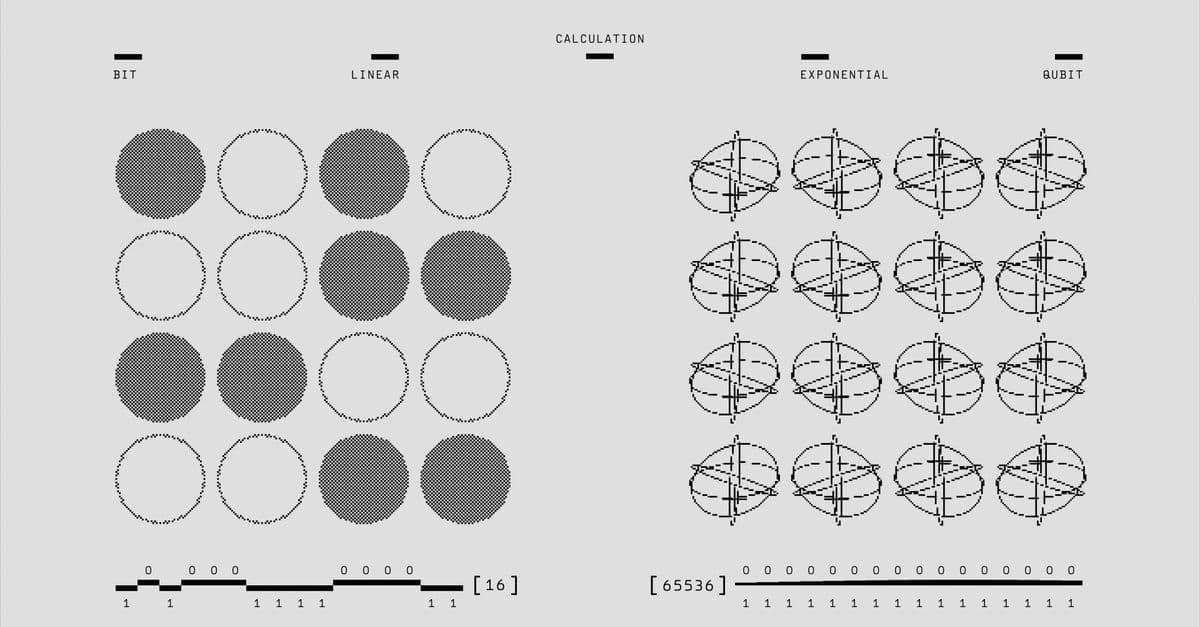
Photo: Google DeepMind / Pexels
A laptop executes instructions one at a time, or in parallel across a few cores, with each operation involving a bit — a physical switch that is either on (1) or off (0). Every email, every video, every database query reduces to billions of those switches flipping states. This works for most of what humans need computers to do. It fails for a specific category of problems where the number of possible states to explore grows faster than any classical machine can handle. Quantum computing is the engineering attempt to use the rules of quantum mechanics — superposition, entanglement, and interference — to explore those enormous state spaces in ways that classical bits structurally cannot. The technology is not hypothetical. Machines exist. The question in 2026 is not whether it works but how far it scales.
What a Qubit Is and Why It Is Different From a Bit
Qubit — the basic unit of quantum information. Like a classical bit, a qubit has two basis states, conventionally labeled |0⟩ and |1⟩. Unlike a classical bit, a qubit can exist in a superposition of both states simultaneously until it is measured, at which point it collapses to either 0 or 1.
The word "superposition" is easy to misunderstand. A qubit in superposition is not secretly one state or the other with the outcome unknown. It genuinely occupies both states with associated probability amplitudes, and those amplitudes can interfere with each other. This interference — constructive for correct answers and destructive for wrong ones — is the computational mechanism that quantum algorithms exploit.
A classical bit can hold one value: 0 or 1. Two classical bits can hold one of four values: 00, 01, 10, or 11. Three classical bits hold one of eight values. The number of states grows as 2ⁿ, but the machine holds only one at a time. Two qubits in superposition can represent all four states (00, 01, 10, 11) simultaneously. Three qubits represent all eight states simultaneously. For n qubits, the superposition space covers 2ⁿ states at once. At 300 qubits, that is 2³⁰⁰ simultaneous states — a number vastly larger than the roughly 10⁸⁰ atoms in the observable universe.
This is not infinite computational power. The catch is measurement: when you read the qubits, the superposition collapses and you get one answer. The art of quantum algorithm design is arranging the quantum operations so that, before measurement, the probability amplitudes of wrong answers have been cancelled (destructive interference) and the probability of the right answer is boosted (constructive interference). You extract one answer from the quantum computation, but that answer has been selected from a space that no classical machine could have searched in the same time.
Source: U.S. National Science Foundation — "Quantum computing: Expanding what's possible" — overview of qubit mechanics and the computational advantages of superposition.
Entanglement: The Other Quantum Resource
Entanglement — a quantum correlation between two or more qubits such that the state of one is not independent of the state of the other, regardless of the physical distance between them. When two qubits are entangled, measuring one instantly determines the state the other will yield upon measurement, even if they are separated by a room, a kilometer, or, in principle, light-years.
Einstein called this "spooky action at a distance" and spent years trying to show it was an artifact of incomplete knowledge rather than a genuine nonlocal correlation. Bell's theorem (1964) and subsequent experiments beginning with Aspect et al. in 1982 showed definitively that the correlations are real: the universe is genuinely nonlocal in this sense. Entanglement cannot be used to send information faster than light — the measurement outcomes are random until both observers compare results — but it is an essential resource for quantum algorithms and quantum cryptography.
In a quantum computer, entanglement allows operations on one qubit to instantaneously affect the state of entangled qubits. This is not communication; it is correlation. The computational consequence is that quantum gates operating on entangled qubits can process exponentially more information per operation than classical gates operating on independent bits. Think of it like this: a classical computer searching a maze tries one path at a time. A quantum computer with enough entangled qubits tries all paths simultaneously — not by cloning itself, but by maintaining a coherent superposition of all paths until interference selects the right one.
Source: NSF Physics Frontiers Centers — 2025 research milestones including creation of 6,100 neutral-atom qubits in entangled arrays, demonstrating the scaling potential of atomic qubit platforms.
What Problems Quantum Computing Actually Solves
The distinction between what quantum computers can and cannot do is sharper than popular coverage suggests. Quantum advantage is not universal — it is specific to problem structures that match the strengths of quantum algorithms.
Integer factoring. The security of RSA encryption relies on the fact that multiplying two large prime numbers is easy, but factoring the result back into its prime components is computationally hard for classical computers. Shor's algorithm (1994) can factor large integers exponentially faster than any known classical algorithm. A quantum computer with enough fault-tolerant qubits would break RSA encryption. This is why governments and financial institutions are now migrating toward post-quantum cryptographic standards. The National Institute of Standards and Technology (NIST) finalized its first post-quantum encryption standards in 2024.
Quantum chemistry simulation. Simulating the behavior of molecules at the quantum level is exponentially hard for classical computers because the quantum state of a molecule with n electrons lives in a Hilbert space of dimension 2ⁿ. Classical computers must approximate. A quantum computer can, in principle, simulate molecules exactly. Applications include designing room-temperature superconductors, developing more efficient nitrogen fixation reactions (potentially transforming fertilizer production), and accelerating drug discovery by computing protein-ligand binding energies directly rather than through approximation.
Optimization problems. Many real-world problems — route planning for logistics networks, portfolio optimization in finance, scheduling of complex industrial processes — involve searching through combinatorially large spaces for the minimum or maximum of some function. Quantum algorithms including the Quantum Approximate Optimization Algorithm (QAOA) offer potential speedups for certain classes of these problems, though the advantage over classical heuristics is not yet demonstrated convincingly at scale.
Machine learning. Quantum machine learning is actively researched, but results are mixed. Some quantum algorithms offer speedups for specific linear algebra operations. Whether those speedups translate to practical machine learning advantages over classical hardware — which is already heavily optimized — is an open question.
| Problem Type | Quantum Advantage | Status |
|---|---|---|
| Integer factoring (RSA) | Exponential (Shor's algorithm) | Theoretical; requires fault-tolerant qubits |
| Quantum chemistry simulation | Exponential | Early demonstrations; not yet at drug-discovery scale |
| Database search (Grover's) | Quadratic (not exponential) | Demonstrated; limited practical impact |
| Optimization (QAOA) | Unclear; problem-dependent | Active research, no clear classical outperformance yet |
| Machine learning | Possible speedups for specific tasks | Highly contested; classical hardware often competitive |
| Video rendering, word processing | None | Classical computers remain optimal |
| Everyday computation | None | Quantum computers will not replace laptops |
Source: NIST — Post-Quantum Cryptography Standardization project, 2024 standards finalization — confirming that Shor's algorithm's threat to RSA is taken seriously enough at the government level to drive cryptographic migration.
The Error Correction Challenge: Why We Are Not There Yet
The fundamental obstacle to useful quantum computing is decoherence — the tendency of qubits to lose their quantum state through interaction with the environment. A qubit must maintain its superposition and entanglement precisely for the duration of a computation. Vibrations, temperature fluctuations, stray electromagnetic fields, even the act of measuring adjacent qubits can disrupt the state. This is called decoherence, and it introduces errors.
Decoherence — the process by which a qubit's quantum state becomes entangled with its surrounding environment, causing the superposition to collapse into a definite classical state. The characteristic time over which a qubit remains coherent before errors accumulate is called the coherence time. For superconducting qubits, coherence times are typically measured in microseconds to milliseconds. For trapped-ion qubits, they can reach seconds.
Classical computers have single-bit error rates around 10⁻¹⁷ per operation. Current quantum computers have error rates around 10⁻³ to 10⁻⁴ per gate operation — roughly a trillion times worse. Running a useful algorithm requires millions or billions of gate operations, which means errors accumulate catastrophically before a computation completes.
The solution is quantum error correction (QEC): encoding one logical qubit across many physical qubits so that errors can be detected and corrected without collapsing the quantum state. The most promising architecture is the surface code, which encodes one logical qubit in roughly 1,000 physical qubits arranged in a 2D grid, with redundant measurements detecting errors without disturbing the logical state.
The overhead is severe. A fault-tolerant quantum computer capable of breaking RSA-2048 using Shor's algorithm would require roughly 4,000 logical qubits. With 1,000 physical qubits per logical qubit, that is 4 million physical qubits operating at very low error rates. No machine remotely approaches this today.
In 2025, Google demonstrated its Willow chip, achieving what it described as the first verifiable quantum advantage on a specific benchmark — a random circuit sampling task that classical supercomputers would take an impractical amount of time to replicate. This benchmark does not correspond to a practically useful computation, but it demonstrates that quantum hardware is advancing along the error-suppression curve that QEC requires.
Source: Riverlane — "Quantum Error Correction: Our 2025 trends and 2026 predictions" — analysis of the error rate thresholds required for fault-tolerant quantum computing, with the first error-corrected machine potentially arriving by 2027.
Source: Physics World — "Quantum computing on the verge: correcting errors, developing algorithms and building up the user base" — survey of 2025–2026 industry state and research frontiers.
Where Quantum Computing Stands in 2026
The state of quantum computing in 2026 is best described as pre-utility. Machines exist and demonstrate genuine quantum behavior. They do not yet outperform classical computers on any problem that matters to industry or science at scale.
Physical qubit counts. A 2025 research group demonstrated a 6,100-qubit neutral-atom array, holding qubits in a laser-defined grid. This is the largest reported qubit array. Superconducting systems from IBM have crossed 1,000 qubits. However, qubit count is not the primary bottleneck — qubit quality and connectivity are. A 100-qubit machine with very low error rates and full connectivity can outperform a 1,000-qubit machine with high error rates and limited connectivity.
Error correction milestones. Research groups at NSF Physics Frontiers Centers in 2025 demonstrated error detection below the threshold required for fault-tolerant surface codes — meaning error correction actually helps rather than hurts, which was not true for earlier hardware. This is a genuine milestone. Riverlane's Deltaflow 3 platform, expected in late 2026, will implement continuous error correction during computation ("streaming logic").
Investment landscape. Quantum companies attracted multi-billion-dollar valuations: Quantinuum at $10 billion, PsiQuantum at $7 billion, SandboxAQ at $5.75 billion as of 2025. National governments — US, China, EU, UK, India — are investing billions in quantum research programs. The field is past the "interesting physics experiment" stage and into the "engineering at scale" stage.
Timelines. Steve Brierley, chief executive of Riverlane, stated that the first error-corrected quantum computer could come as early as 2027. IBM has published roadmaps targeting fault-tolerant systems in the 2030s. Most independent analysts place broadly useful quantum computing — for drug discovery, materials design, or cryptanalysis — in the 2030–2040 window. These timelines have been pushed back repeatedly; the engineering challenges are formidable.
Source: Quantum Zeitgeist — "Quantum Error Correction Explained 2026: 7 Essential Concepts" — current state of QEC architecture and industry timelines.
What Quantum Computing Will Not Do
Correcting the most common misconception about quantum computing is essential, because the hype around the technology often implies it will make all computing faster or replace classical machines.
A quantum computer is not a faster version of your laptop. It is a specialized device suited to a narrow class of problems where quantum parallelism provides a genuine speedup. For everything else — running a spreadsheet, serving a web page, encoding a video, training a neural network on large datasets — classical computers are faster, cheaper, more reliable, and require no exotic cooling infrastructure.
Quantum computers operate near absolute zero: superconducting qubit systems require temperatures around 15 millikelvin (0.015 Kelvin), colder than outer space's average background temperature of 2.7 Kelvin. They are housed in dilution refrigerators the size of a car. They need vibration isolation, electromagnetic shielding, and continuous monitoring. They are inherently unsuited to portable or consumer applications.
The practical path for quantum computing is hybrid classical-quantum systems, where a classical computer handles all ordinary computation and delegates specific subproblems — molecular simulation, optimization subroutines, sampling tasks — to quantum processors accessed via cloud. IBM, Google, Amazon (Braket), and Microsoft all offer cloud quantum computing access today. Most of the current research work happens on these platforms.
The transformation quantum computing will eventually bring — if error correction succeeds — is not general-purpose speed. It is access to computational problems that are currently off-limits: exact simulation of complex chemical reactions that could yield better batteries, pharmaceuticals, and fertilizers; breaking current encryption (prompting the post-quantum migration already underway); and solving optimization problems in logistics and materials design that classical algorithms cannot approach efficiently.
Source: The Quantum Insider — "What Is Quantum Error Correction and How Does It Work" (March 2026) — explanation of why fault tolerance is the central engineering challenge.
Frequently Asked Questions
Q: What is the difference between a qubit and a classical bit?
A: A classical bit holds either 0 or 1. A qubit can exist in a superposition of both 0 and 1 simultaneously, with associated probability amplitudes. When measured, it collapses to one value. The computational power comes from using interference between superposed states to amplify the probability of the correct answer before measurement. Two entangled qubits can represent four states at once; n qubits represent 2ⁿ states simultaneously, though only one answer is extracted per measurement.
Q: Can quantum computers break current encryption?
A: In principle, yes. Shor's algorithm can factor large integers exponentially faster than classical methods, which would break RSA encryption. However, breaking RSA-2048 would require roughly 4 million physical qubits with very low error rates — far beyond today's hardware. NIST finalized post-quantum cryptographic standards in 2024 in anticipation of future fault-tolerant systems. Current quantum computers pose no threat to deployed encryption.
Q: Will quantum computers replace regular computers?
A: No. Quantum computers are specialized tools suited to specific problem types — factoring, quantum chemistry simulation, certain optimization problems. For everyday computing (word processing, browsing, video, databases), classical computers are faster, cheaper, and far more practical. The realistic future is hybrid systems where quantum processors handle specific subroutines delegated by classical computers.
Q: What is quantum entanglement and can it transmit information instantly?
A: Entanglement is a correlation between qubits such that measuring one determines what the other will yield, regardless of distance. The correlations are real and instantaneous, but they cannot transmit information faster than light. Measurement outcomes are random; only when two observers compare their random results (by classical communication) do the correlations become visible. Entanglement is a computational resource, not a communication channel.
Q: How cold do quantum computers need to be?
A: Superconducting qubit systems, the most widely deployed type, operate at around 15 millikelvin — roughly 15 thousandths of a degree above absolute zero. This is colder than the average temperature of outer space (2.7 K). The cooling is provided by dilution refrigerators and limits quantum computers to fixed laboratory or data-center environments. Trapped-ion and photonic qubit approaches have different operating temperature requirements and may offer paths to less exotic cooling.
Q: Where does quantum computing stand in 2026?
A: Physical qubit arrays have reached several thousand qubits, with error rates approaching the threshold needed for fault-tolerant surface codes. Google's 2025 Willow chip demonstrated a quantum advantage on a benchmark sampling task. Error correction research groups have crossed the error-detection threshold for the first time. The first genuinely error-corrected logical qubit operations have been demonstrated at small scale. Broadly useful fault-tolerant quantum computing for chemistry or cryptanalysis is estimated to be in the 2030–2040 range by most independent analysts.
Read next:
Follow new articles
Add SciHub101 to your feed reader to see new science and technology stories.
About the Author
SciHub101 is an independent science and technology publication founded and edited by Buğra Sözeri, a software engineer and app developer based in Türkiye. AI tools assist with drafting and research. Source documentation in the existing archive is uneven, and articles are being reviewed and corrected. The Editorial Team byline identifies editorial responsibility; it does not certify specialist or independent human review. Where we compare products, anything built by our own team is labelled as such — see the editorial guidelines and About page for how corrections and disclosures work.
Related Articles

Why Time Feels Faster as You Age: The Science Behind It
A summer at age eight felt endless. A year at forty disappears. This is not nostalgia distorting judgment — it is a measurable difference in how the brain processes and encodes time. Multiple mechanisms are involved: a mathematical relationship between age and perceived duration, a decline in the novelty that creates dense memories, slowing neural processing speed, and falling dopamine levels that alter the brain's internal clock. Each mechanism operates independently, but they all converge on the same result: subjective time accelerates across a human lifetime.

What Happens to Your Body After You Die: The Stages of Decomposition
Within minutes of your last heartbeat, your own cells begin dismantling your body from the inside out. Enzymes that spent a lifetime building proteins reverse course and start dissolving tissue. Within 24 hours, bacteria that lived harmlessly in your gut begin consuming organs they were never meant to touch. Decomposition is not decay in the casual sense — it is a tightly sequenced biological process that forensic scientists can read like a clock, estimating time of death from temperature gradients, insect populations, and the chemistry of soil beneath a body.
How Do Quantum Computers Actually Work? Beyond the Hype
Quantum computers don't replace your laptop — they solve a small set of problems exponentially faster. Here's what they really are, why they're hard to build, and what they'll change.
Quantum Error Correction Explained: Physical Qubits, Logical Qubits and Thresholds
Quantum error correction combines many noisy physical qubits to protect a logical qubit. Learn how syndrome measurements, surface codes and thresholds address noise, and why laboratory progress is not yet universal quantum advantage.
How Quantum Computers Actually Work — From Qubits to Real Algorithms (2026)
Quantum computers use qubits, superposition, and entanglement to solve problems classical machines cannot. Learn how they work, what algorithms run on them, and where the field stands in 2026.

What If We Could Teleport Matter?
Step in here, step out there — instantly. Teleportation sounds like sci-fi, but the physics gets stranger than fiction.