Mars Explained: Geology, Water, Atmosphere, and the Challenge of Colonization
Photo: Brett Sayles / Pexels
Mars is the planet humanity most seriously talks about visiting. It is the only other world in the solar system where a person in a pressurized suit could plausibly stand on solid ground under a sky with weather, dust storms, and a sunrise. But the Mars that awaits is a planet of extremes: the tallest volcano known anywhere, a canyon system that would stretch from Los Angeles to New York, air so thin that exposed skin would be the least of an astronaut's problems, and a surface that was once wet. Understanding the science of Mars is the first step toward understanding what any future presence there would face.
Key takeaways
- Extreme geology: Olympus Mons rises roughly 21 to 22 km above the Martian datum, depending on the dataset, and Valles Marineris is about 3,870 km long and up to 9.3 km deep, according to NASA.
- Ancient water: Valley networks, lake sediments, and minerals that form only in water show that Mars was once much wetter than it is now.
- Thin atmosphere: The mean surface pressure is about 636 Pa, under 1% of Earth's sea-level value, and the air is 95% carbon dioxide.
- No global magnetic field: Mars lost its global field billions of years ago, and the solar wind stripped away most of its early atmosphere.
- No confirmed life: Perseverance has found a "potential biosignature" in one rock, but NASA stresses it needs more study before anyone can call it life.
- Settlement hurdles: Radiation, perchlorate-laced soil, low gravity, dust, and distance from Earth all remain unsolved at scale.
Mars at a glance: how it compares with Earth
Mars is a small planet. Its mean radius is 3,389.5 km, a little over half of Earth's, and its mass is 0.64 x 10^24 kg, roughly a tenth of Earth's, according to the NASA Mars Fact Sheet. Because it is both smaller and less dense than Earth, surface gravity is only 3.73 m/s^2, about 38% of what you feel at home.
The table below puts the headline numbers side by side. Mars values come from the NASA fact sheet; Earth values are the standard reference figures.
| Property | Mars | Earth |
|---|---|---|
| Mean radius | 3,389.5 km | 6,371 km |
| Surface gravity | 3.73 m/s^2 | 9.81 m/s^2 |
| Solar day | 24.66 hours | 24 hours |
| Orbital period | 686.98 Earth days | 365.25 days |
| Axial tilt (obliquity) | 25.19 degrees | 23.44 degrees |
| Mean surface pressure | about 636 Pa | about 101,325 Pa |
| Mean surface temperature | about -59 degrees C | about 15 degrees C |
| Main atmospheric gas | Carbon dioxide, 95.1% | Nitrogen, about 78% |
| Moons | 2 (Phobos, Deimos) | 1 |
Two numbers in that table deserve a closer look. A Martian solar day, called a sol, is 24.66 hours, or about 24 hours 39 minutes, which is why mission teams that live "on Mars time" see their schedules slide against Earth clocks by roughly 40 minutes a day. And the axial tilt of 25.19 degrees is so close to Earth's that Mars has genuine seasons, though each one lasts almost twice as long because the year is nearly twice as long.
The two hemispheres: a planet divided
Mars has a split personality. The northern hemisphere is mostly low, smooth plains. The southern hemisphere is heavily cratered highland that sits several kilometers higher. Geologists call the boundary the crustal dichotomy, and it is among the oldest large-scale features on the planet.
What caused it is still argued. One leading explanation is a colossal impact early in Mars's history. In a 2008 paper in Nature, Jeffrey Andrews-Hanna, Maria Zuber, and Bruce Banerdt fitted an ellipse about 10,600 by 8,500 km across to the lowland boundary and argued that a giant impact is the simplest way to produce that shape, which would make it the largest impact structure yet identified in the solar system. The main rival idea is that the lowlands formed through mantle convection or overturn. Radar evidence suggests the lowland crust is ancient either way, so the dichotomy formed early.
The split mattered for everything that came after. It influenced where volcanoes grew, where water drained, and where the sediments that later rovers study piled up. Mars is a planet whose geography was largely set in its first few hundred million years.
Reading Mars's history by its eras
Planetary geologists divide Martian history into three broad eras using crater counts, because there is no rock layer sequence to date directly in most places. The Noachian (about 4.1 to 3.7 billion years ago) was the era of heavy bombardment, valley networks, and a thicker atmosphere. The Hesperian (about 3.7 to 3.0 billion years ago) saw widespread volcanism and giant floods. The Amazonian (about 3.0 billion years ago to today) has been cold, dry, and comparatively quiet.
These boundaries are estimates tied to crater-count chronologies, not radiometric dates from the surface, so treat them as approximate. Even so, the sequence tells a consistent story: a wetter, more active young Mars that gradually froze and dried.
Olympus Mons: the solar system's largest volcano
Olympus Mons is the tallest known volcano in the solar system. Measured against the Martian datum (Mars has no sea level, so the datum is a reference surface defined from laser altimetry), its summit sits roughly 21 to 22 km up, with published figures of 21.3 km from the Mars Orbiter Laser Altimeter and 21.9 km from a separate 2004 analysis. That is about two and a half times the height of Mount Everest above sea level. The edifice is about 600 km across, which is the same order as the distance across the state of Arizona, and it is ringed by an escarpment up to roughly 8 km tall in places.
It is a shield volcano, the same broad, gently sloping type as Mauna Loa in Hawaii. Shield volcanoes grow when runny lava erupts again and again from the same vents. The difference is plate tectonics. On Earth, the Pacific plate slides over a fixed hotspot and the Hawaiian volcanoes get carried away from their magma supply one by one, leaving a chain. Mars has no active plate tectonics, so the crust stayed put over its hotspot and the lava kept stacking in one place for an enormous span of time.
The summit holds a complex of nested collapse craters (calderas) roughly 60 by 80 km across. Crater counts on Mars Express images suggest the northwestern flank flows range from about 115 million years old to as young as about 2 million years, which is recent in geological terms. Whether the volcano is truly extinct or just dormant is an open question; for a longer treatment, see our dedicated article on Olympus Mons.
The surrounding Tharsis region is a vast volcanic plateau carrying Olympus Mons and three other giants, Arsia, Pavonis, and Ascraeus Montes. Tharsis is so massive that it has probably shifted the planet's orientation over geological time, a process called true polar wander in which the whole crust and mantle slide around the spin axis to move heavy loads toward the equator.
Valles Marineris: a canyon on a continental scale
If Olympus Mons wins on height, Valles Marineris wins on sheer reach. NASA gives the system as about 3,870 km long (2,400 miles), up to 600 km wide, and as much as 9.3 km deep. Mariner 9 revealed it in 1971, and the canyon was named for that spacecraft. The length is close to the straight-line distance between Los Angeles and New York.
The Grand Canyon makes a useful yardstick. According to the National Park Service, the Grand Canyon is about 446 km (277 river miles) long, as much as 29 km wide at its broadest, and about 1.8 km deep at its deepest. Valles Marineris is therefore about eight to nine times longer and several times deeper.
The two canyons also differ in origin. The Grand Canyon is a river valley, cut by the Colorado River over millions of years. Valles Marineris is mainly a tectonic scar: as the Tharsis bulge grew, it stretched and cracked the crust nearby, and the cracks widened into rift-like troughs. Landslides, wind, and possibly water have since reshaped its walls, which is why it looks carved in places.
Evidence that Mars was once wet
Today liquid water cannot stay stable on most of the Martian surface. At about 636 Pa, the pressure is low enough that ice sublimates and liquid water either boils or freezes quickly. Yet almost every orbiter and rover has found evidence that the situation was different long ago.
Rivers, deltas, and floods
High-resolution images show branching valley networks across the southern highlands that resemble river drainage on Earth, mostly dated to the Noachian. Separately, enormous outflow channels, wider and deeper than most terrestrial rivers, point to catastrophic floods, most likely released from underground reservoirs. NASA's overview of Mars notes that huge floods may have occurred around 3.5 billion years ago and that ancient river valleys, deltas, and lakebeds are scattered over the planet.
Minerals that need water
Orbiters have mapped clays (phyllosilicates), sulfates, and carbonates that form in the presence of liquid water. Rovers have confirmed it from the ground. Curiosity landed on August 6, 2012, in Gale Crater and has been climbing Mount Sharp, the crater's central mound, where the rock layers record past habitable environments. Perseverance landed on February 18, 2021, in Jezero Crater, a basin about 45 km wide that scientists think once held a lake fed by a river delta.
The northern ocean question
Some researchers think the low northern plains once held an ocean, informally called Oceanus Borealis, supported by possible shoreline features and sedimentary layers. The idea remains debated. Shoreline interpretations are hard to test because billions of years of erosion, impacts, and lava flows have modified the terrain.
Water today
Water persists on modern Mars, but mostly as ice. NASA reports that water ice lies just below the surface in the polar regions and that briny liquid water may flow seasonally down some slopes. The polar caps are a mixture of water ice and carbon dioxide ice.
There have also been claims of liquid water hidden deeper. In 2018 radar data from the MARSIS instrument on ESA's Mars Express were interpreted as a lake under the south polar cap. Follow-up work has challenged that reading: Smith and colleagues proposed in 2021 that frozen smectite clays could produce the same bright radar reflections, and other studies found similar signals in places that look too cold for liquid water. And in August 2024, Wright, Morzfeld, and Manga reported in PNAS that seismic data from NASA's InSight lander are best explained by a water-saturated zone in the middle crust, roughly 11.5 to 20 km down. That interpretation depends on assumptions about crustal rock and has not been verified by drilling, and the water would be far too deep to reach. Both results show how much remains open about where Mars's remaining water sits.
Inside Mars: what InSight's seismometer learned
NASA's InSight lander spent several years listening to marsquakes, and the data gave the first direct look at the interior of another planet. A 2021 study in Science led by Simon Stahler used seismic waves reflected off the boundary between mantle and core to show that Mars has a liquid metal core with a radius of about 1,830 km, plus or minus 40 km. That is roughly half the planet's radius, compared with about a fifth for Earth's core.
The measured core density implies that it holds a substantial share of lighter elements, such as sulfur, mixed with the iron and nickel. The same study found that the mantle lacks the dense lower layer seen in Earth's mantle, which fits a planet small enough that internal pressures never get high enough to form it.
A liquid core raises a puzzle. Earth's global magnetic field comes from churning liquid iron in its outer core. Mars still has liquid metal in its core, yet it has no global field today. The usual explanation is that the dynamo, the self-sustaining motion that generates a field, shut down long ago, although exactly why and when is still debated.
The atmosphere: thin, cold, and mostly carbon dioxide
By volume, the Martian atmosphere is carbon dioxide (95.1%), nitrogen (2.59%), argon (1.94%), oxygen (0.16%), and carbon monoxide (0.06%), according to the NASA fact sheet. The mean surface pressure is 6.36 millibars, or about 636 Pa, and it varies seasonally between roughly 4.0 and 8.7 millibars as carbon dioxide freezes onto the polar caps and sublimates back. That is well under 1% of Earth's sea-level pressure.
This is also far below the Armstrong limit, the pressure of about 6,300 Pa at which water boils at human body temperature. Anyone exposed to Mars air without a pressure suit would not be able to breathe, and the fluids in the lungs and mouth would begin to boil. That is a hazard of low pressure, not temperature.
Temperature and weather
NASA's Mars facts page gives a surface temperature range from about 20 degrees C down to about -153 degrees C, and the fact sheet puts the planet's average at about 214 K (-59 degrees C). The thin air stores almost no heat, so temperatures swing wildly between day and night. At the Viking 1 landing site, the daily range measured was 184 K to 242 K (-89 to -31 degrees C).
The thin atmosphere still produces real weather: dust devils, frost, clouds of water ice and carbon dioxide ice, and planet-wide dust storms. A local storm can grow into a global one in some Martian years. In June 2018 a planet-encircling dust storm covered the location of NASA's solar-powered Opportunity rover, which had been operating since landing on January 24, 2004. NASA's last contact with the rover was on June 10, 2018, after the storm blocked the sunlight it depended on. Opportunity had driven 45.16 km (28.06 miles) by then, a record that Perseverance passed in October 2026.
The Mars sky also looks different from ours. Fine, rust-colored dust suspended in the air scatters light so that the daytime sky appears butterscotch or pinkish-tan, while sunsets look blue.
Why Mars lost its air: the vanished magnetic field
Mars has no global magnetic field today. What remains is a patchwork of strongly magnetized rock in the southern crust, which suggests that a global field existed about 4 billion years ago before shutting down. Without that shield, the solar wind (a stream of charged particles from the Sun) could slam directly into the upper atmosphere.
NASA's MAVEN orbiter was built to study exactly that process. It entered Mars orbit on September 21, 2014, and became the first mission devoted to the upper atmosphere. In a 2017 Science paper, MAVEN principal investigator Bruce Jakosky and colleagues compared isotope ratios of argon in the upper atmosphere and at the surface. Lighter argon-36 escapes more easily than heavier argon-38, so the leftover gas becomes enriched in the heavy isotope. From that enrichment, the team calculated that about 65% of the argon that ever existed in the atmosphere has been lost to space, and concluded that most of the carbon dioxide has been lost too, as a minimum estimate.
MAVEN's mission has since ended. NASA lost contact with the spacecraft on December 6, 2025, and a review board found that it could no longer perform its science and data relay mission; NASA declared the mission over on June 3, 2026, after more than 11 years of operation. The work it did on atmospheric escape remains the best evidence that a drifting, magnetically unprotected planet can lose most of its air. For a deeper treatment, read our explainer on why Mars lost most of its atmosphere, and for the mechanism that protects Earth, see how planetary magnetic fields work.
Is there life on Mars?
No confirmed evidence of life exists on Mars. The 1976 Viking landers ran life-detection experiments whose results were ambiguous and are still debated.
The strongest modern lead came from Perseverance. In July 2024 the rover found a rock nicknamed Cheyava Falls in the Bright Angel formation along Neretva Vallis, an ancient river valley in Jezero Crater. It showed "leopard spots," small patterns of minerals at reaction fronts. According to NASA's Jet Propulsion Laboratory, the spots contain vivianite (an iron phosphate) and greigite (an iron sulfide), minerals that on Earth can form when microbes feed on organic matter, but can also form without life under high temperatures or acidic conditions. The rover took a core from the rock called Sapphire Canyon, one of 27 rock cores it had taken by that point. A peer-reviewed paper in Nature was published on September 10, 2025.
NASA described the finding as a "potential biosignature," meaning a feature that could have a biological origin but needs more data or study before life can be confirmed or ruled out. Project scientist Katie Stack Morgan said abiotic explanations are less likely given the paper's findings but cannot be excluded. A definitive test would likely need the sample in a laboratory on Earth. The joint NASA-ESA Mars Sample Return program, meant to bring such samples home, has been reported as cancelled in 2026, so the route for returning them is uncertain.
Curiosity has found organic molecules too. In a drilled rock called Cumberland it detected decane, undecane, and dodecane, the largest organic molecules found on Mars so far, and a February 2026 report in Astrobiology found that the non-biological sources the researchers considered could not fully explain how abundant they are, suggesting they could be fragments of fatty acids preserved in ancient mudstone. Organic compounds are building blocks of life, but they also form without it, in meteorites for example. For the broader field, see our overview of astrobiology.
The moons of Mars
Mars has two small moons, Phobos and Deimos. Phobos is the larger, measuring 27 by 22 by 18 km, and orbits Mars three times a day. It is moving closer by about 1.8 meters per century, and NASA says it will either crash into Mars or break up into a ring in about 50 million years.
Where the moons came from is not settled either. Both have dark, carbon-rich surfaces similar to some asteroids, which suggested capture, but NASA notes that some evidence contradicts a captured-asteroid origin, and a giant impact that left debris in orbit is an alternative. Our article on Mars's moons covers the competing theories.
Colonization challenges: the real science
Living on Mars is a question of engineering and medicine as much as astronomy. None of the hazards below is a showstopper in principle, but each is unsolved at the scale of a permanent settlement.
Radiation
Without a thick atmosphere or global magnetic field, the surface is exposed to galactic cosmic rays and solar particles. The Radiation Assessment Detector aboard Curiosity measured an average galactic cosmic ray dose equivalent of 0.67 millisieverts per day on the surface between August 2012 and June 2013, according to the Hassler et al. 2014 paper in Science. On the journey to Mars, the same instrument recorded about 1.8 millisieverts per day inside the spacecraft. The team estimated that a template mission of 360 days of transit and 500 days on the surface would add up to about 1.01 sieverts. For comparison, a typical person on Earth receives a few millisieverts in an entire year from natural background radiation. Shielding with regolith, water, or underground habitats would be essential.
Perchlorates
Mars soil contains perchlorates, salts of chlorine that are toxic to people. The Phoenix lander found roughly 0.4 to 0.6% perchlorate by mass in the soluble salts in the northern plains, according to Hecht et al. (2009) in Science. Perchlorate can interfere with thyroid function in humans at sufficient doses, so any use of Martian soil for farming would require removing it. The same chemistry has an upside: perchlorate attracts water and could help form briny liquid, a clue to how water might persist on the surface.
Low gravity
Gravity on Mars is 38% of Earth's. Astronauts in microgravity lose bone and muscle, but no one has lived long-term at one-third gravity, so whether that is enough to prevent those effects is unknown. A person has never spent a year at any gravity level between zero and one g, which is why it is hard to predict.
Dust
Martian dust is fine and clings to surfaces. It can coat solar panels, abrade seals, and clog filters, and its chemistry makes it a concern if inhaled. The 2018 global storm that ended Opportunity's mission is a reminder of what it does to solar power.
Resources and life support
Mars's air is nearly useless for breathing, but it is rich in carbon dioxide, which is a feedstock. NASA's MOXIE instrument aboard Perseverance successfully produced oxygen from carbon dioxide in the Martian atmosphere. Ingenuity, the helicopter that traveled with the rover, completed 72 flights, proving that powered flight in the thin air is possible. Neither result by itself makes a settlement feasible, but both show that making use of local resources is not just theoretical. For a fuller engineering view, see our pieces on Mars settlement engineering and whether humans can live on Mars.
Can Mars be terraformed?
Terraforming means deliberately changing a planet to make it more Earth-like. In a 2018 Nature Astronomy paper, Bruce Jakosky and Christopher Edwards cataloged the carbon dioxide available in the polar caps, the soil, and minerals, and concluded that there is not enough accessible CO2 to provide significant greenhouse warming with present-day technology. Importing the needed volatiles from comets or asteroids would require many thousands of impacts. Terraforming remains a thought experiment.
Rovers and landers: how we know what we know
Most of the facts above came from a short list of machines. The table lists the surface missions most relevant to the story so far.
| Mission | Landing | Where | Why it matters |
|---|---|---|---|
| Viking 1 and 2 | 1976 | Plains of Mars | First long-duration landers; ambiguous life-detection experiments |
| Phoenix | 2008 | Northern plains | Found perchlorate in the soil |
| Opportunity | January 24, 2004 | Meridiani Planum | Found evidence of past water; lost to dust storm, last contact June 10, 2018 |
| Curiosity | August 6, 2012 | Gale Crater | Rocks formed in water; organics; climbing Mount Sharp |
| InSight | 2018 | Elysium Planitia | Measured the core and mantle with seismology |
| Perseverance | February 18, 2021 | Jezero Crater | Caching samples; Cheyava Falls potential biosignature |
Our article on Mars rovers from Sojourner to Perseverance tells the full story of these missions.
FAQ
Q: Is there any current evidence for life on Mars? A: No confirmed evidence of life exists. The 1976 Viking experiments gave ambiguous results. In 2025 NASA and a team publishing in Nature described a "potential biosignature" in a Jezero Crater rock called Cheyava Falls, but NASA says it needs more study and that non-biological explanations cannot be fully excluded. Curiosity has also found organic molecules, which can form with or without life.
Q: Why is Mars red? A: The surface is covered in iron-rich rock and fine dust that has oxidized, essentially rusted. Winds lift this dust into the air, which tints the sky a pinkish tan. The oxidation happened over a long time as iron-bearing minerals reacted with water and oxidants.
Q: Could Mars be terraformed? A: Not with current technology. A 2018 study in Nature Astronomy by Bruce Jakosky and Christopher Edwards found that there is not enough accessible carbon dioxide on Mars, in the polar caps, soil, and minerals, to thicken the atmosphere enough for significant greenhouse warming. Bringing in volatiles from comets would take a very large number of impacts.
Q: When might humans go to Mars? A: No crewed Mars mission has a confirmed launch date as of this writing. NASA's Artemis program is focused on the Moon first, and private companies, notably SpaceX with its Starship vehicle, are developing hardware aimed at Mars. Radiation, life support, landing heavy payloads, and funding are all unresolved, so any dates you see are goals, not schedules.
Q: Does Mars have moons? A: Yes, two: Phobos and Deimos. Phobos is about 27 by 22 by 18 km and orbits Mars three times a day. NASA says it is drifting inward at about 1.8 meters per century and will either hit Mars or break apart into a ring in about 50 million years. Deimos is smaller and more rounded.
Q: How long is a day and a year on Mars? A: A Martian solar day is 24.66 hours, which is about 24 hours 39 minutes. A Martian year is 686.98 Earth days, or about 669.6 sols. Because the axial tilt is 25.19 degrees, Mars has four seasons like Earth, but each lasts nearly twice as long.
Q: Does Mars still have a magnetic field? A: Not a global one. Mars has patches of magnetized crust in the southern hemisphere that record a field that existed about 4 billion years ago, but no active dynamo today. This is one reason the solar wind could strip away much of its early atmosphere.
What this means
Mars is not a dead planet frozen in a single state. It is a world with a long, recorded history: it was warmer and wetter, lost much of its air to space after its magnetic field shut down, and has been drying out ever since. That record, preserved in the rocks, is why scientists care about Mars even if no one ever settles it. It offers a rare look at how a planet's habitability can come and go, and what Earth might look like if it lost its own protections.
For human explorers, the same record is a warning. The processes that made Mars uninhabitable were not dramatic; they were slow, physical, and finished billions of years ago. Anything built there will have to supply, by engineering, what Earth gets for free.
Sources
- NASA Mars Fact Sheet (NSSDC)
- NASA: Mars facts
- NASA: Perseverance mission page
- NASA JPL: Potential biosignature found by Perseverance
- NASA: MAVEN mission and MAVEN argon results press release
- NASA: Curiosity mission
- NASA: Phobos
- NASA: Mars Exploration Rovers (Spirit and Opportunity)
- Jakosky and Edwards (2018), Inventory of CO2 available for terraforming Mars
- Stahler et al. (2021), Seismic detection of the martian core
- Andrews-Hanna, Zuber, and Banerdt (2008), The Borealis basin and the origin of the martian crustal dichotomy
Read next:
Follow new articles
Add SciHub101 to your feed reader to see new science and technology stories.
About the Author
SciHub101 is an independent science and technology publication founded and edited by Buğra Sözeri, a software engineer and app developer based in Türkiye. AI tools assist with drafting and research. Source documentation in the existing archive is uneven, and articles are being reviewed and corrected. The Editorial Team byline identifies editorial responsibility; it does not certify specialist or independent human review. Where we compare products, anything built by our own team is labelled as such — see the editorial guidelines and About page for how corrections and disclosures work.
Related Articles
How the Solar System Formed: From Spinning Dust to Eight Planets
About 4.57 billion years ago, a cloud of gas and dust collapsed under its own gravity. Out of the disk it left behind came the Sun, eight planets, hundreds of moons, and the debris belts of our cosmic neighborhood.
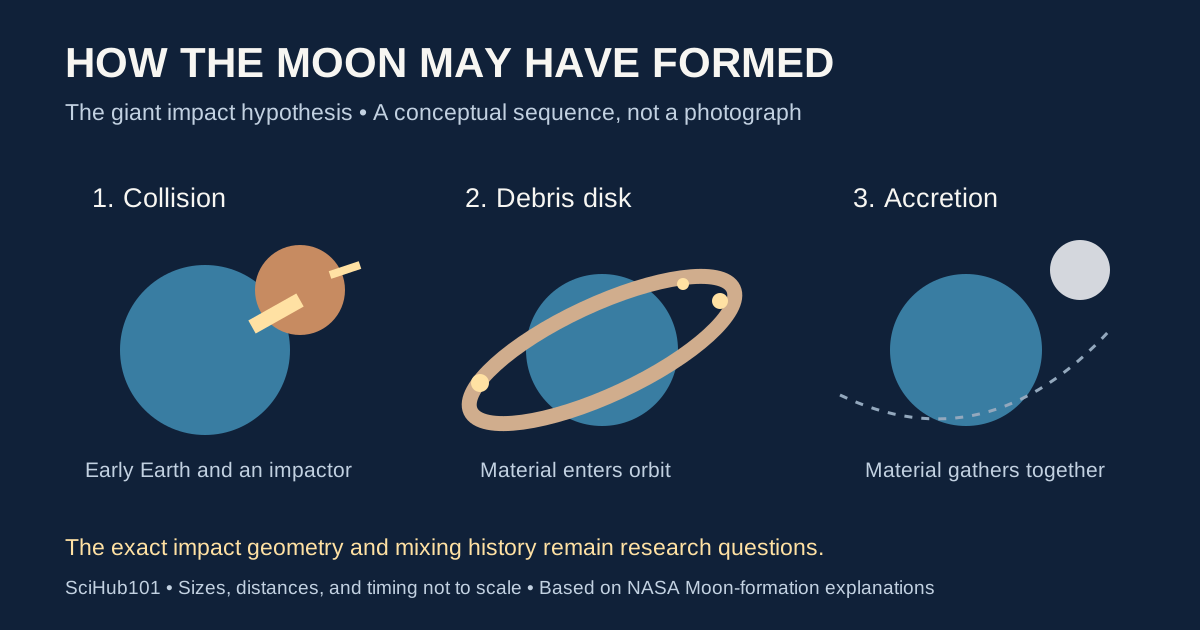
How the Moon Was Formed: Evidence for a Giant Impact
The Moon's origin is reconstructed from rocks, its interior, and orbital models. A giant impact leads the explanation, but the precise scenario is uncertain.
How Gravity Works: From Newton to Einstein's General Relativity
For two centuries, Newton's gravity was the gold standard. Then Einstein showed that gravity isn't a force at all — it's the curvature of spacetime itself. Here's what that actually means, and how it has been tested.
What Are Pulsars? Rotating Neutron Stars and Cosmic Clocks
Pulsars produce repeating signals as neutron stars rotate. Their timing helps researchers study binary orbits and search for gravitational-wave backgrounds.
Hubble Deep Field: Revealing the Universe's True Scale
December 1995: Hubble stared at one blank patch of sky for about 10 days and found roughly 3,000 galaxies, changing how astronomers count the universe.
James Webb Space Telescope: First Images Transform Our Universe View
July 2022: JWST's first images revealed galaxies 13.6 billion light-years distant, formed just 100 million years after the Big Bang, reshaping cosmology.