Hubble Deep Field: Revealing the Universe's True Scale
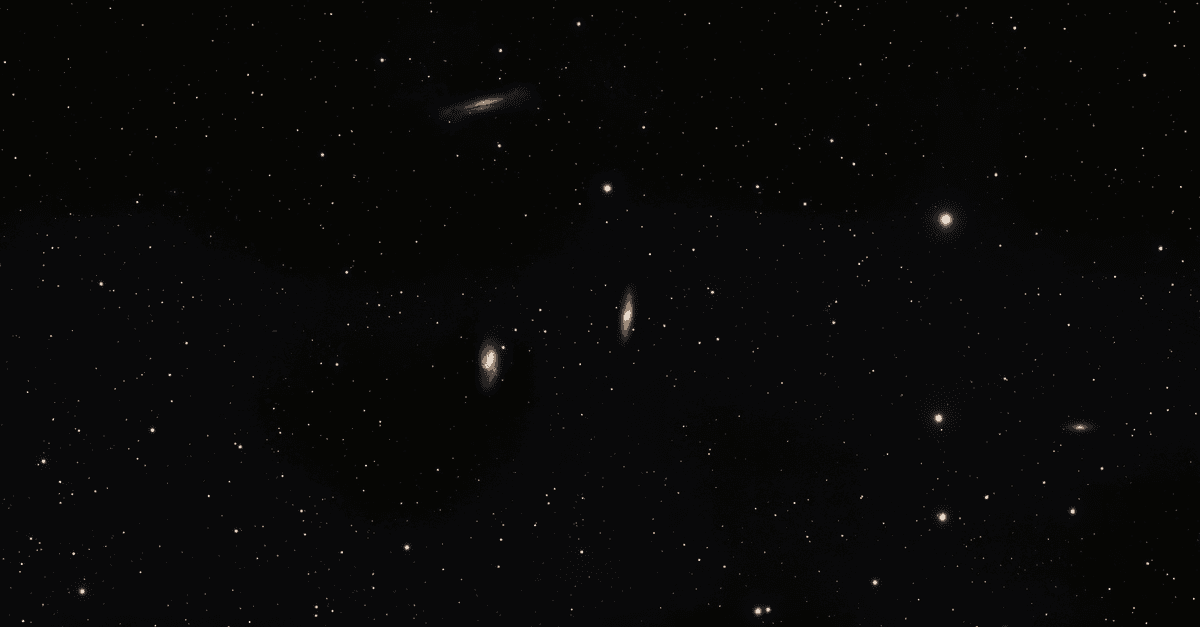
Photo: Del Woodcock / Pexels
Between December 18 and 28, 1995, the Hubble Space Telescope stared at an empty-looking patch of sky near the handle of the Big Dipper, one-thirteenth the diameter of the full Moon. It took 342 exposures, which astronomers stacked into one image holding roughly 3,000 galaxies (NASA). The Hubble Deep Field showed that dark gaps in the sky are crowded with faint, distant galaxies, and it gave astronomers their first census of how galaxies change over cosmic time.
Why point a telescope at nothing?
Hubble's observing time is among the most oversubscribed in science, so spending 10 days on a blank spot looked reckless to some. The idea came from Robert Williams, then director of the Space Telescope Science Institute, who committed about 10 percent of the director's discretionary observing time to the project (NASA).
The logic was simple. A single long exposure collects light from objects too faint to detect in a short one, and a patch with no bright nearby objects would show what lies behind. Think of leaving a bucket out in a light drizzle. A minute collects nothing you can measure; a night collects enough to weigh. A telescope's detector works the same way with photons, and the Deep Field was the biggest bucket astronomers had set out.
How the field was chosen
The choice of field was a design problem, not a guess. According to the project's published selection criteria as summarized on the field's reference page, the target had to sit at high galactic latitude, away from the dust in the plane of the Milky Way, and avoid bright sources in visible, infrared, ultraviolet, and X-ray light, with low infrared "cirrus" emission. It also had to fall in Hubble's northern continuous viewing zone, so that observatories in the northern hemisphere could follow up on it. Twenty fields met the criteria, three candidates were selected, radio snapshots with the Very Large Array ruled one out because of a bright radio source, and the final decision depended partly on the availability of backup guide stars (Wikipedia summary of Williams et al., 1996).
The finished field sits in Ursa Major, at right ascension 12h 36m 49.4s and declination +62° 12′ 58″, about 2.6 arcminutes on a side. That is roughly one 24-millionth of the whole sky, comparable to a tennis ball seen from 100 meters away.
How the image was built
Hubble's Wide Field and Planetary Camera 2 (WFPC2) took 342 images over about 150 orbits. Each exposure by itself was far too faint to show most of the galaxies. Combining them averages out noise, removes artifacts that appear in only one frame, and builds up the signal from the faintest objects.
The camera observed through four filters, each passing a different band of light. The team's exposure times are summarized in the table.
| Filter wavelength | Color band | Total exposure time (hours) |
|---|---|---|
| 300 nm | Near-ultraviolet | 42.7 |
| 450 nm | Blue | 33.5 |
| 606 nm | Red | 30.3 |
| 814 nm | Near-infrared | 34.3 |
Source: Williams et al. (1996), The Astronomical Journal 112, 1335, as summarized in the Wikipedia article on the Hubble Deep Field. Totals add to about 141 hours across the four filters.
The colors in published pictures are assigned from these bands, not photographed the way a phone camera would. Blue-ish galaxies tend to be forming stars, while redder ones either contain older stars or are very distant, with their light stretched toward longer wavelengths on the way to us.
Why ultraviolet mattered
The 300 nm filter received the longest exposure. Distant galaxies lose most of their ultraviolet light before reaching us, because intervening hydrogen gas absorbs it and because the expansion of the universe shifts what remains toward the red. A galaxy that vanishes in the ultraviolet frame but shows up in the red frames is a candidate for being very far away, which makes the set of four filters a rough distance gauge for objects too faint to measure any other way.
What was in the image
The final image contains about 3,000 distinct galaxies. Fewer than 20 of the objects are foreground stars in our own Milky Way, and about 50 are blue, point-like sources that may be distant quasars or white dwarfs (Wikipedia summary of Williams et al., 1996). Many of the galaxies are about four billion times fainter than the human eye can see (NASA).
Four findings made the picture scientifically important, not just beautiful.
- Far more distant galaxies than expected. Many galaxies in the field have high redshifts, up to about six. Redshift is how much the expansion of the universe has stretched a galaxy's light, and a value of six corresponds to light that traveled for roughly 12 billion years.
- Young galaxies looked different. Galaxies in the early universe were more often irregular or disturbed than nearby ones, which fits a picture in which collisions and mergers were more common long ago.
- A history of star formation. The galaxy counts and colors indicated that star formation across the universe peaked about 8 to 10 billion years ago and has since fallen by a factor of about 10.
- A constraint on dark matter candidates. Few faint red dwarf stars turned up in the foreground. That argued against the idea that dim, compact objects of that kind make up much of the Milky Way's dark matter.
The last point is easy to miss. A deep image of "nothing" also counts what is nearby, and in this case the nearby count was low enough to weigh against one proposed explanation for dark matter. For the larger question, see Dark Matter in 2026: Evidence, Candidates, and Current Theories.
Reading distance and time: why far means long ago
Light takes time to travel. We see the Sun as it was about eight minutes ago, and we see a galaxy 12 billion light-years away as it looked 12 billion years ago. A deep field is therefore a stack of snapshots from different eras, arranged by distance.
A fair analogy is a cut through geological strata. A canyon wall shows older rock layers lower down; a deep field shows older galaxies farther out. Reading across the image is reading across time. That is what lets astronomers compare galaxies from different cosmic eras in a single frame without waiting a billion years between shots.
Distances at this scale are subtle. Because space itself expands while the light travels, "how far away" has more than one meaning: the distance the light covered, the distance the galaxy is now, and the lookback time are all different numbers. Astronomers prefer redshift, which is a direct measurement, and convert it using a cosmological model. For a fuller treatment, see How Old Is the Universe, and How Do We Actually Know? and How Space Telescopes See the Early Universe.
The pioneer of this way of thinking was Edwin Hubble, whose work in the 1920s established that galaxies recede with distance and that the universe is expanding. The telescope that bears his name turned that insight into pictures.
Doing the census: from 3,000 to billions
If one tiny patch holds about 3,000 galaxies, how many are there in the whole sky? The arithmetic is straightforward. The field covers about 1/24,000,000 of the sky, so multiplying 3,000 by 24 million gives about 72 billion galaxies bright enough to appear at the Deep Field's depth.
That figure is a floor, not a total, for two reasons. The Deep Field has a sensitivity limit, and fainter galaxies are present but invisible. And galaxies were more densely packed in the early universe, with many since merged into the larger galaxies we see nearby, so a count of what is visible today misses much of the earlier population.
Why deeper fields give bigger totals
The same arithmetic applied to the Ultra Deep Field shows how strongly a census depends on depth. Its 10,000 galaxies fill about 1/26,000,000 of the sky, so scaling it up gives about 260 billion. Nothing about the universe changed between the two observations; the second simply saw fainter galaxies.
| Field | Galaxies counted | Sky fraction | Simple scale-up to the full sky |
|---|---|---|---|
| Hubble Deep Field (1995) | about 3,000 | 1/24,000,000 | about 72 billion |
| Hubble Ultra Deep Field (2004) | about 10,000 | 1/26,000,000 | about 260 billion |
| 2016 recount (Conselice et al.) | models include galaxies too faint to detect | not applicable | roughly two trillion |
Scale-ups are the author's arithmetic from the NASA and Wikipedia figures cited above. They assume the field is representative and ignore galaxies below each field's detection limit.
The pattern is the point. Each time astronomers looked deeper, the number grew by a factor of several, and the 2016 analysis argues the trend continues below the limits of current telescopes. That is a sound reason to treat any single figure for "the number of galaxies" as a statement about a detection limit as much as about the universe.
The 2016 recount
A team led by Christopher Conselice at the University of Nottingham tackled the missing-galaxies problem in a 2016 study. They combined Hubble images with data from other teams, converted them into three-dimensional maps to count galaxies at different points in cosmic history, and used mathematical models to infer the galaxies current telescopes cannot detect. NASA's summary says the Deep Field and Ultra Deep Field observations had led to an estimate of about 200 billion galaxies in the observable universe, and the new analysis found at least 10 times more, which works out to roughly two trillion. The team concluded that about 90 percent of galaxies are too faint and distant for present-day telescopes to see (NASA, October 13, 2016).
The same team found that galaxies were about 10 times more densely packed in the early universe, and that mergers reduced their number over time. The estimate depends on assumptions about faint galaxies that nobody has directly observed, so the two-trillion figure carries real uncertainty. For a full discussion of the competing numbers, see How Many Galaxies Are in the Universe?.
Deeper, wider, and redder: what came after
The Deep Field was the first of a series. Each successor traded on newer cameras, longer exposures, or different wavelengths. The table lists the main ones.
| Field | Year | Key facts | Source |
|---|---|---|---|
| Hubble Deep Field | 1995 | 342 exposures over about 10 days, about 3,000 galaxies, Ursa Major | NASA |
| Hubble Deep Field South | October 1998 | 10 days of observing in Tucana, near the south celestial pole; roughly doubled the number of distant galaxies available to astronomers | NASA |
| NICMOS infrared image | 1998 | Found galaxies more than 12 billion light-years away | NASA |
| Hubble Ultra Deep Field | 2003 to 2004 | About 800 exposures over 11.3 days, about 1/26,000,000 of the sky, about 10,000 galaxies | NASA; Wikipedia summary of Beckwith et al. (2006) |
| Ultra Deep Field, infrared | 2009 | Near-infrared view showing galaxies from about 600 million years after the Big Bang | NASA |
| eXtreme Deep Field | 2012 | 10 years of data on a central region; about 5,500 galaxies | NASA |
| Frontier Fields | 2013 to 2017 | 12 images from Hubble, Spitzer, and Chandra; galaxies about 100 times fainter than in the Ultra Deep Field | NASA |
| Legacy Field | Later combination | Nearly 7,500 exposures over 16 years; about 265,000 galaxies | NASA |
The Ultra Deep Field
The Ultra Deep Field used Hubble's newer Advanced Camera for Surveys. Observations ran from September 23 to October 28, 2003, and from December 4, 2003, to January 15, 2004. Together they amounted to about 800 exposures from 400 orbits, a little under one million seconds of exposure. The field spans roughly one-tenth the diameter of the full Moon, about one 26-millionth of the sky. It contains about 10,000 galaxies, with the most distant dating from roughly 400 to 800 million years after the Big Bang (Wikipedia summary of Beckwith et al., 2006).
A point that often gets garbled: the Ultra Deep Field is not a bigger patch than the original, and it was not a smaller one by a large margin either. Its sky fraction (1/26,000,000) is close to the original's (1/24,000,000). Depth, not area, was the goal.
Why the infrared mattered
Light from distant galaxies is stretched by expansion until visible light arrives as infrared. Hubble's visible-light cameras therefore run out of galaxies at a redshift of about six, while infrared instruments can keep going. That is why the 1998 NICMOS image and the 2009 infrared Ultra Deep Field found more distant galaxies than the visible-light fields. For how infrared instruments work, see How Space Telescopes See in Infrared.
The Webb era: pushing the census back
The James Webb Space Telescope (JWST) was designed to see in the infrared, so it is built to go where the Hubble fields stopped. Its deep surveys, such as the JWST Advanced Deep Extragalactic Survey (JADES), have measured galaxies at far greater distances than any Hubble field.
JADES-GS-z14-0, announced in 2024, was a record-holder at a spectroscopic redshift of about 14.18, with the light leaving it roughly 300 million years after the Big Bang. Millimeter-wave observations with the ALMA array later detected oxygen in it, which gave a precise distance (Wikipedia summary of Carniani et al., Nature, 2024). In May 2025, a team led by Rohan Naidu reported MoM-z14 at a spectroscopic redshift of 14.44, about 280 million years after the Big Bang (Naidu et al., 2025). As of that paper, it was the most distant confirmed galaxy, and later results may have moved the record again.
Are early galaxies too bright?
The same paper reports that the number density of bright sources at redshifts of roughly 14 to 15 is about 180 times higher than pre-JWST consensus models predicted (Naidu et al., 2025). That is a striking mismatch, and it is the origin of headlines claiming that JWST "broke" cosmology.
It did not, at least not yet. The finding says that early galaxies formed stars efficiently or were easier to see than models assumed. For MoM-z14 itself, the authors report a roughly tenfold rise in star formation over the preceding five million years and almost no dust, which hints at a short, intense burst rather than a long, steady build-up. The cautious reading is that models of early galaxy formation need revision, and that a single bright galaxy is a data point to be tested against more spectra, not a verdict on the expanding-universe framework. For a fuller account of what Webb has found, see What James Webb Telescope Has Actually Found (2022 to 2026) and James Webb Space Telescope: First Images Revolutionize Astronomy.
How to read the picture
Looking at the image for the first time can be overwhelming, because every spot of light looks like a star. Most are not. Here is a rough field guide.
- Large, sharp, well-formed spirals and ellipticals tend to be the nearer galaxies. They show the structure familiar from our own neighborhood: bright cores, arms, or smooth glows.
- Small, red, or ragged smudges are often farther away, or are galaxies caught in the middle of a merger. The 1996 analysis found disturbed and irregular shapes more common among distant galaxies, consistent with more frequent collisions long ago.
- Sharp points of light with spikes are stars in our own galaxy. There are fewer than 20 of them in the whole field, so a spiky point is the exception, not the rule.
- Blue point-like dots are the odd ones. About 50 of them could be distant quasars (extremely bright galactic cores) or white dwarfs, and separating the two takes extra data (Wikipedia summary of Williams et al., 1996).
The most useful habit is to treat color as a clue about distance and age rather than as a plain description. A very red galaxy might be old, dusty, or extremely distant, and the image alone cannot say which. That ambiguity is why astronomers follow deep-field imaging with spectroscopy, which splits a galaxy's light into its component wavelengths.
Photometric versus spectroscopic distances
The Deep Field's distances were mostly estimates from color, called photometric redshifts. They are quick and can be done for thousands of galaxies, but they are less certain. A spectrum, by contrast, shows sharp features whose positions give the redshift precisely.
The gap can be large for the faintest objects. The galaxy JADES-GS-z14-0 is a recent example: a photometric estimate gave a redshift near 14.39, an early spectroscopic measurement gave 14.32, and later millimeter-wave observations with ALMA gave 14.1793 (Wikipedia summary of the literature). All three place it among the earliest galaxies known, but they differ in the details, and that is the reason confirmed records carry the word "spectroscopic."
For the era these earliest galaxies belong to, when starlight began to reshape the gas around it, see What Is Reionization? The Cosmic Dawn and the First Stars.
What the Deep Field did not show
Because the image is so famous, it attracts misunderstandings. A few are worth correcting.
It is not a picture of the whole universe. It is a pencil-thin core sample through it. About 1/24,000,000 of the sky is a narrow cone, and the galaxies in it are scattered along a line of sight billions of light-years long.
The galaxies are not all the same distance. Some are relatively nearby; others are among the most distant known when the image was made. Bright, large ones are generally closer.
It did not prove the universe has a particular number of galaxies. It gave a floor for the number visible at its depth, and the total is a model-dependent estimate. The 2016 recount raised it by about an order of magnitude, and future surveys may revise it again.
It is not a photograph in ordinary color. The colors come from combining filter images, and the choices affect how the picture looks.
It does not say anything about life. The field has no information about planets. Later missions that found exoplanets, such as Kepler, used different methods and different targets. The Deep Field's role was in galaxy evolution and cosmology.
Why deep fields work
The method behind deep fields is simple enough to explain in a paragraph and difficult enough to have taken decades. The sky behind our own galaxy is full of faint objects. A short exposure sees only the brightest. A long one pushes the detection limit down, but only if the telescope stays steady, the detector is stable, and the target field has no bright stars whose glare would drown the faint objects.
Hubble sits above the atmosphere, which blurs and brightens the sky for ground telescopes, so it can hold a stable view over many orbits. That is the reason the technique worked from orbit before large ground telescopes could match it. Astronomers also take many shorter exposures rather than a few long ones, because cosmic rays hit the detector at random and a short frame limits the damage.
The deep-field idea, a long look at a small patch, is now standard practice. The Ultra Deep Field, the extreme Deep Field, and JWST's surveys all repeat it with more sensitive equipment. For a different way of extending the reach of telescopes, see How Gravitational Lensing Magnifies Galaxies, which uses massive galaxy clusters as natural magnifying glasses. The Frontier Fields program above did exactly that.
Frequently asked questions
Q: How did Hubble capture light from galaxies that are billions of light-years away? A: By collecting light for a very long time. The field combines 342 exposures taken over about 10 days, and the faintest galaxies are about four billion times fainter than the eye can see. Each exposure adds a few photons, and stacking them lets the faintest objects rise above the noise.
Q: Why does an image with 3,000 galaxies cover such a small area? A: The field covers about one 24-millionth of the sky, about one-thirteenth the diameter of the full Moon. Galaxies are everywhere, but a small patch can only be seen as crowded when the telescope is sensitive enough to detect the faint ones. To the unaided eye the same patch looks empty.
Q: How many galaxies are there in the observable universe? A: It depends on how faint a galaxy you count. Scaling the Deep Field's 3,000 galaxies across the sky gives about 72 billion at its depth. A 2016 analysis led by Christopher Conselice found at least ten times more than the earlier estimate of about 200 billion, roughly two trillion, with about 90 percent too faint for current telescopes (NASA, 2016).
Q: What is the difference between the Hubble Deep Field and the Ultra Deep Field? A: The Ultra Deep Field, taken in 2003 to 2004 with the Advanced Camera for Surveys, used about 800 exposures over 11.3 days and contains about 10,000 galaxies. It covers a similar slice of sky (about 1/26,000,000, versus 1/24,000,000 for the original) and reaches fainter, more distant galaxies.
Q: Did the Deep Field help discover exoplanets? A: No. It looked at galaxies, not stars with planets. Exoplanet surveys use other techniques and other telescopes. The Deep Field's contributions were in galaxy evolution, star formation history, and the census of distant galaxies.
Q: How far back does the record go now? A: As of the May 2025 paper on MoM-z14, the most distant spectroscopically confirmed galaxy was seen about 280 million years after the Big Bang, at a redshift of 14.44. These records have been broken repeatedly since JWST began operating, so check recent literature (Naidu et al., 2025).
Q: Does JWST show that the Big Bang model is wrong? A: Not on this evidence. The early galaxies it sees are far more numerous in the brightest range than pre-JWST models predicted (by a factor of about 180 at redshifts of 14 to 15, in one 2025 analysis), which is a problem for theories of galaxy formation. The result is under active study. For the standard picture, see The Big Bang Explained.
The takeaway
The Hubble Deep Field changed astronomy by proving that a long stare at an apparently empty patch of sky is more productive than looking at anything bright. About 3,000 galaxies in one 24-millionth of the sky meant the universe was far more crowded with galaxies than a casual look suggests, and the field's mix of young, irregular, distant galaxies gave the first direct view of how galaxies changed over cosmic time. Thirty years later, the census numbers keep shifting, from tens of billions to trillions, because each new instrument finds that fainter and more distant objects were hiding. The lesson holds: the empty-looking parts of the sky are where the largest discoveries tend to be. For a sense of scale, see How Big Is the Universe?.
Read next:
- James Webb Space Telescope: First Images Revolutionize Astronomy
- Big Bang Theory Explained: Origins of the Universe
- How Big Is the Universe
Sources:
- NASA, Hubble's Deep Fields
- NASA, Hubble by the Numbers
- NASA, Hubble Reveals Observable Universe Contains 10 Times More Galaxies Than Previously Thought (October 13, 2016)
- Naidu, R. P., Oesch, P. A., et al., "A Cosmic Miracle: A Remarkably Luminous Galaxy at z_spec=14.44 Confirmed with JWST," Open Journal of Astrophysics (2025)
- Williams, R. E., et al., "The Hubble Deep Field: Observations, Data Reduction, and Galaxy Photometry," The Astronomical Journal 112, 1335 (1996), as summarized at Wikipedia: Hubble Deep Field
- Beckwith, S. V. W., et al., "The Hubble Ultra Deep Field," The Astronomical Journal 132, 1729 (2006), as summarized at Wikipedia: Hubble Ultra-Deep Field
- Carniani, S., et al., "Spectroscopic confirmation of two luminous galaxies at a redshift of 14," Nature 633, 318 (2024), as summarized at Wikipedia: JADES-GS-z14-0
Follow new articles
Add SciHub101 to your feed reader to see new science and technology stories.
About the Author
SciHub101 is an independent science and technology publication founded and edited by Buğra Sözeri, a software engineer and app developer based in Türkiye. AI tools assist with drafting and research. Source documentation in the existing archive is uneven, and articles are being reviewed and corrected. The Editorial Team byline identifies editorial responsibility; it does not certify specialist or independent human review. Where we compare products, anything built by our own team is labelled as such — see the editorial guidelines and About page for how corrections and disclosures work.
Related Articles
James Webb Deep Field: The Universe's Ancient Light
How the James Webb Space Telescope revealed galaxies from the universe's earliest years, transforming our understanding of cosmic history
Fermi Gamma-Ray Space Telescope: Mapping High-Energy Universe
NASA's Fermi telescope mapped the gamma-ray universe, revealing pulsars, black holes, and mysterious transient events at highest photon energies.
James Webb Space Telescope: First Images Transform Our Universe View
July 2022: JWST's first images revealed galaxies 13.6 billion light-years distant, formed just 100 million years after the Big Bang, reshaping cosmology.
Hubble Space Telescope: The Discoveries That Changed Astronomy
Hubble launched with a flawed mirror and came back from the brink to become humanity's greatest eye on the cosmos.
How the Moon Was Formed: Evidence for a Giant Impact
The Moon's origin is reconstructed from rocks, its interior, and orbital models. A giant impact leads the explanation, but the precise scenario is uncertain.
Mars Explained: Geology, Water, Atmosphere, and the Challenge of Colonization
Mars is the most explored planet beyond Earth: home to the largest volcano in the solar system, a canyon system thousands of kilometers long, and clear evidence that it once hosted flowing water. Here is what science has revealed.