How Do Black Holes Form? Every Pathway, From Stars to Seeds
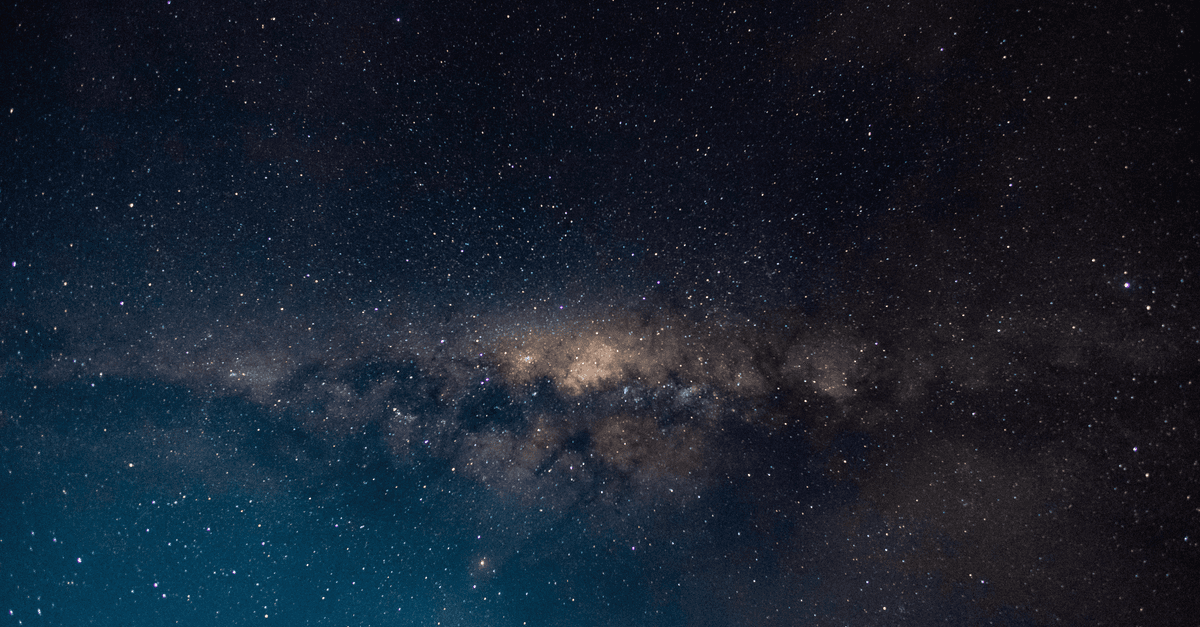
Photo: Ndumiso Mvelase / Pexels
A black hole forms when enough mass is squeezed inside its own Schwarzschild radius, the size at which the escape velocity (the speed needed to break free of gravity) equals the speed of light. For the Sun that radius is about 3 kilometers (1.9 miles). For Earth it is about 9 millimeters. The universe has found at least five ways to reach that density, and each leaves a different kind of black hole behind. This article walks through every known pathway, the mass gaps that separate them, and the questions astronomers still cannot answer.
What "forming a black hole" actually means
Gravity is always trying to pull matter inward. Normally something pushes back: the heat of fusion in a star, the quantum resistance of electrons in a white dwarf, the stiffness of nuclear matter in a supernova. About 20 km wide but containing more mass than the Sun.">neutron star. A black hole appears when every one of those supports fails, or when matter arrives faster than any support can respond.
The Schwarzschild radius is the yardstick. It grows in direct proportion to mass, so a black hole ten times heavier is ten times wider. The Sun would need to be squeezed to a ball roughly 3 kilometers across, and Earth to something smaller than a marble, according to the standard formula described in the Schwarzschild radius reference. Nothing about the Sun or Earth is close to doing that on its own, which is why ordinary planets and most stars never become black holes.
Once the matter sits inside that radius, an event horizon exists. It is not a surface you could land on. It is a boundary in spacetime, like the lip of a waterfall where the current becomes faster than the swimmer, after which every direction of travel points downstream.
That framing helps explain why formation is a question about conditions, not about a single event type. Anything that can pack enough mass into a small enough region qualifies. NASA's overview of the types of black holes sorts them by mass into four families, and the families map neatly onto different origin stories.
The five routes at a glance
| Route | Typical result | Mass of result | Status |
|---|---|---|---|
| Core collapse of a massive star | Stellar-mass black hole | A few to tens of solar masses | Well established |
| Merger of neutron stars or black holes | Larger stellar-mass or intermediate black hole | Tens to hundreds of solar masses | Observed through gravitational waves |
| Runaway mergers in dense clusters | Intermediate-mass black hole | Roughly 100 to 100,000 solar masses | Candidates, few confirmed |
| Direct collapse of a gas cloud | Heavy seed for a supermassive black hole | Roughly 10,000 to 100,000 solar masses (theory) | Supported by early JWST data, not proven |
| Collapse of early-universe density peaks | Primordial black hole | From tiny to thousands of solar masses | Hypothetical, no definitive evidence |
The rest of the article takes these in turn. The first one matters most because it produces nearly all the black holes we can account for.
Route one: a massive star runs out of fuel
NASA states that a star with more than about eight times the Sun's mass ends its life in a supernova, and that a star of roughly 20 solar masses or more can leave a stellar-mass black hole behind. That is the short version. The long version is a story about a star losing a race against its own gravity.
Why a star burns heavier and heavier fuel
A star is a standoff. Fusion in the core makes heat, heat makes pressure, and pressure holds up the weight of the outer layers. When hydrogen in the core runs low, the core contracts, heats up, and starts fusing helium. Then carbon, neon, oxygen, and finally silicon.
Think of a campfire that has to burn its own ashes. Each new fuel yields less energy per reaction than the one before, so the star must burn faster to keep up. Hydrogen burning in a very massive star lasts millions of years. Silicon burning, the last stage, lasts on the order of days, according to the figures in Woosley and Janka's review of core-collapse physics as summarized on the silicon-burning page.
Silicon burning builds a core of iron-group elements. Iron is the dead end because fusing it absorbs energy rather than releasing it. The core has no more power source, and it keeps growing as ash rains down from the shells above it.
The collapse itself
When the iron core grows to about the Chandrasekhar mass (the heaviest mass that electron degeneracy pressure can hold up), it can no longer support itself. The core falls inward at speeds reaching about 70,000 kilometers per second, roughly 23 percent of the speed of light, as described in the overview of supernovae.
The infall stops, briefly, when the center reaches the density of an atomic nucleus. Nuclear matter resists compression sharply. The collapsing material rebounds, and a shock wave tries to push outward through the star. Whether that shock succeeds decides everything that follows.
Three possible endings
If the shock revives, helped by a huge burst of neutrinos (nearly massless particles that carry away most of the collapse energy), the star's outer layers are blown off as a core-collapse supernova. What remains in the middle is a neutron star or a black hole, depending on how much mass the core kept.
If the shock stalls or only partly succeeds, material falls back onto the new compact object. A neutron star that begins just under its mass limit can swallow enough of that fallback to cross the line and collapse. This is the fallback route to a black hole, and it can follow a bright, ordinary-looking supernova.
If the shock never revives at all, the whole core collapses to a black hole with little or no visible explosion. Astronomers call this a failed supernova or direct collapse. The star simply seems to wink out.
A real candidate for a vanished star
The best-known candidate is N6946-BH1, a roughly 25-solar-mass star in the galaxy NGC 6946. It brightened modestly in 2009, then faded from view in optical light by 2015, leaving only a faint infrared source, as summarized on the N6946-BH1 page. The brightening was far too weak to be a supernova.
A failed supernova was the leading interpretation. But the story is not settled. Observations with the James Webb Space Telescope found that earlier data had blended at least three objects, and the new data fit a merger of two stars about as well as a vanished star. Astronomers cannot yet rule out the black hole explanation, nor confirm it. For now N6946-BH1 is a good example of how hard it is to catch a black hole in the act of forming.
The mass limits that sort the remnants
The boundary between a neutron star and a black hole is not a single clean number, and that has real consequences for the population of black holes.
Where neutron stars stop
Neutron stars are supported by neutron degeneracy pressure and by the repulsion of nuclear forces. The maximum mass such an object can have is called the Tolman-Oppenheimer-Volkoff limit. Theoretical estimates have landed between about 2.2 and 2.9 solar masses, and the gravitational waves from the neutron star merger GW170817 pointed to a value near 2.01 to 2.17 solar masses for a non-rotating star, according to the TOV limit overview. The heaviest known neutron star in the Milky Way, PSR J0952-0607, is estimated at 2.35 plus or minus 0.17 solar masses.
That means a compact object much above roughly two to two and a half solar masses should have no way to hold itself up. Gravitational-wave detectors have found objects near that boundary: the event GW230529 paired a roughly 1.4-solar-mass neutron star with a heavier object of about 3.6 solar masses (range roughly 2.4 to 4.4), which is probably a light black hole sitting in the lower mass gap. Where exactly the boundary sits is an active research question. For a deeper look at the objects just below the line, see neutron stars, the most extreme objects in the universe.
Why heavy stars do not always leave heavy black holes
A very massive star does not hold on to its mass. Intense stellar winds can blow off a large fraction of it before it ever collapses, and the strength of those winds depends on the star's metallicity (the share of elements heavier than helium). A low-metallicity star keeps more of itself and tends to leave a heavier black hole.
That is one reason the observed black holes from collapsed stars cluster at masses of a few to a few tens of solar masses, even though the progenitor stars started far heavier. The guide to stellar vs. supermassive black holes covers how this population connects to the giants at galactic centers.
The upper gap: pair instability
At the other end, theory predicts a forbidden zone. Stars that end up with very massive cores run into a quantum-flavored problem. In the hottest, densest cores, photons become energetic enough to turn into electron-positron pairs. That steals pressure from the star, the core contracts, and oxygen burns explosively.
In the heaviest cases, starting at roughly 130 solar masses and extending up to perhaps 250, the explosion destroys the entire star and leaves nothing behind, according to the pair-instability supernova overview. Stars of roughly 100 to 130 solar masses pulse, shedding mass in bursts until they drop below the threshold. Above about 250 solar masses, photodisintegration absorbs the energy and the star collapses straight into a black hole.
The consequence is an expected upper mass gap: stellar collapse should produce few or no black holes in a band that begins at about 65 solar masses and stretches up past 100.
Route two: merging compact objects
Black holes can also form, or grow, from collisions between objects that are already dense.
Neutron stars that merge
Two neutron stars in a tight binary lose orbital energy by radiating gravitational waves, so the orbit shrinks over millions to billions of years until they collide. If the total mass of the merged object exceeds what a neutron star can support, even a rapidly spinning one, it collapses to a black hole, sometimes after a brief delay as a hypermassive neutron star.
The landmark event is GW170817, detected on August 17, 2017. It involved a pair of neutron stars with a combined mass of roughly 2.7 to 2.8 solar masses, and the source was in NGC 4993, about 130 million light-years away, according to the GW170817 summary. Telescopes across the electromagnetic spectrum followed the afterglow.
What did the collision leave behind? The nature of the final remnant is still uncertain. Some analyses favor a black hole formed within milliseconds, others a short-lived, rapidly spinning object that later collapsed, and one team has argued for a magnetar. Treat the claim that GW170817 definitely made a black hole as unproven.
Black holes that merge
Binary black hole mergers are now routine detections. The LIGO-Virgo-KAGRA collaboration's fourth catalog, GWTC-4.0, posted in August 2025, added 128 new candidate signals from the first part of the fourth observing run, which ran from May 2023 to January 2024, according to the GWTC-4.0 paper.
Each merger is both a measurement and a formation story. Two black holes of 30 solar masses can combine into one of about 60 minus the mass radiated away as gravitational waves. If that remnant then finds another partner in a crowded environment, it can merge again, climbing a ladder known as hierarchical merging. This is the leading explanation for black holes that sit inside the pair-instability gap.
The black hole that broke the gap
The event GW190521 is the standard example. LIGO and Virgo observed it on May 21, 2019. The two black holes were about 85 and 66 solar masses, and the merged remnant came out at about 142 solar masses, with roughly 8 solar masses converted into gravitational-wave energy, as laid out in the GW190521 summary and the discovery paper's arXiv listing. The source was about 5,300 megaparsecs away.
The heavier component sits right where pair instability says a star should not leave a black hole. Two explanations compete. The first is that the 85-solar-mass object is itself the product of an earlier merger. The second is that stellar evolution models are missing something, such as a different rate for a key nuclear reaction. Alternative fits have even suggested an eccentric orbit and component masses near 102 solar masses each, so the interpretation is still being debated.
A later detection pushed further. The event GW231123 was reported with a total mass between roughly 190 and 265 solar masses, which the LVK team described as likely the heaviest binary black hole merger observed so far, as detailed in the GW231123 paper. Such a system is hard to explain without earlier generations of mergers.
Route three: intermediate-mass black holes
Between stellar-mass black holes and supermassive ones lies a gap in the census. NASA describes intermediate-mass black holes as spanning roughly one hundred to hundreds of thousands of solar masses, and notes that candidates have been hard to confirm.
Why they are scarce
Finding one is difficult. They are too light to dominate a galaxy's center and too heavy to appear as ordinary X-ray binaries. The remnant of GW190521, at roughly 142 solar masses, has been described as the first direct evidence of one from gravitational waves, but the mass sits at the very bottom of the range.
How they could form
Two ideas dominate. The first is runaway merging in dense star clusters. In the core of a globular cluster (a tight ball of up to millions of old stars), the heaviest stars sink to the middle through dynamical friction, the drag that slows a heavy body moving through a crowd of lighter ones. If they collide faster than they die, a single enormous star can build up and later collapse into a heavy black hole. For background on these clusters, see what globular clusters are.
The second idea is that the very first stars, which formed from nearly pure hydrogen and helium, were unusually massive. If some of them left black holes of hundreds of solar masses, those black holes could serve as starting points for later growth. This ties intermediate-mass black holes directly to the question of how the biggest black holes began.
Route four: how supermassive black holes get started
Nearly every large galaxy has a supermassive black hole at its center. Our own, Sagittarius A*, has a mass of about 4 million times the Sun's, according to NASA. Others are thousands of times heavier. How they got so big, so early, is one of the central open problems in astrophysics.
The time problem
Telescopes keep finding fully grown monsters in the young universe. The quasar J1342+0928 sits at a redshift of about 7.54, which corresponds to a universe only about 690 million years old, and its black hole weighs roughly 800 million solar masses, according to the discovery paper.
A black hole can only grow so fast. As matter spirals in, it heats up and shines, and the light pushes outward on the infalling gas. The balance point is the Eddington limit, the brightest a source can be before radiation pressure blows away its own fuel. A black hole growing at that limit, with a typical radiative efficiency of about 10 percent, multiplies its mass by a factor of e (about 2.7) every roughly 50 million years.
Start with a 100-solar-mass black hole left by one of the first stars. Reaching 800 million solar masses means growing by a factor of eight million, which takes about 16 of those e-folds, or roughly 800 million years of nonstop, maximum-rate feeding. The universe at that redshift had well under that time available. Light seeds can work only if nearly everything goes right.
Light seeds and heavy seeds
The comparison is like planting an acorn versus planting a sapling. A light seed is the acorn: a stellar remnant of tens to hundreds of solar masses that must grow nearly flat out for hundreds of millions of years. A heavy seed is the sapling: a black hole born already weighing roughly 10,000 to 100,000 solar masses, which makes the growth arithmetic far easier.
Heavy seeds are thought to form by direct collapse. In a rare, pristine gas cloud with few heavy elements, strong ultraviolet light from nearby galaxies can keep the gas from cooling and fragmenting into ordinary stars. With no stars to stop it, the whole cloud can collapse into one object and skip the stellar stage entirely.
What the James Webb Space Telescope has seen
Early JWST observations have given heavy seeds their best support yet. An X-ray source called UHZ1, identified in a lensed galaxy behind the cluster Abell 2744, sits at a redshift of about 10.3, roughly 500 million years after the Big Bang. Its black hole is estimated at about 10 million to 100 million solar masses if it grows at the Eddington limit, and that mass is comparable to the stellar mass of its host galaxy, far above the ratio of roughly 0.1 percent seen in the nearby universe, according to the discovery paper.
The authors argue this combination is consistent with heavy seeds from direct collapse. The mass depends on assuming Eddington-limited growth, so it is an estimate and not a direct measurement. For more on what the telescope is finding, see the explainer on what the James Webb Space Telescope has found.
Growth never stops
Whatever the starting weight, black holes keep growing in two ways. The first is accretion: gas falls into a disk around the black hole, and some of it ends up swallowed. When feeding is vigorous, the center of the galaxy lights up as an active galactic nucleus or a quasar. The explainer on quasars covers what that looks like.
The second way is merging. When galaxies collide, their central black holes sink toward the new center, form a binary, and eventually coalesce, emitting gravitational waves. The final stage is slow, because the pair must shed orbital energy to a surrounding sea of stars and gas before gravitational waves can finish the job.
Black holes and galaxies grow together
Observed black hole masses track the properties of their host galaxies, such as the speed at which stars move in the central bulge. This correlation, known as the M-sigma relation, suggests a feedback loop in which a feeding black hole heats or expels gas and so limits both its own growth and the birth of new stars. The black hole is tiny compared with the galaxy, yet it appears to help regulate it.
A cautionary tale about a "record" black hole
A reminder that masses are model-dependent. The compact galaxy NGC 1277 was first reported to host a black hole of about 17 billion solar masses, which would have made it one of the most extreme known. A later analysis using Keck data found a best-fit mass of about 1.2 billion solar masses and called even that a probable upper limit, because the galaxy's inner disk complicates the modeling, as reported in the Graham et al. paper. Other independent models have favored values near 5 billion. The spread, from about 1.2 to 5 billion solar masses against an original 17 billion, shows how a single modeling assumption can move a headline number by a factor of ten.
For a catalog of the heaviest known examples, see the biggest black holes ever found.
Route five: primordial black holes
The final route needs no stars at all. In the first instants after the Big Bang, the universe was hot, dense, and nearly smooth. If some regions were slightly denser than their surroundings, and the excess was large enough, those regions could have collapsed directly into black holes.
The conditions
The required density excess is large, around 10 percent above the average, according to the primordial black hole overview. The simplest models of cosmic inflation produce fluctuations far smaller than that, so primordial black holes need either special inflation models or a boost from a phase transition. The transition in which quarks bound into protons and neutrons lowered the threshold, which is why some calculations predict a bump in primordial black hole masses at about one solar mass.
Mass is set by the size of the region that collapses, roughly the amount of mass inside the cosmic horizon at that moment. Collapses very early make tiny black holes. Collapses later make heavier ones.
The evaporation filter
Small black holes lose mass through Hawking radiation (a faint thermal glow predicted by Stephen Hawking in 1974), and the lifetime scales with the cube of the mass. Primordial black holes lighter than about 10^12 kilograms would have evaporated long before today. Anything heavier could still exist. The explainer on Hawking radiation covers why smaller ones die faster.
Could they be dark matter?
If primordial black holes exist in the right mass range, they might make up some of the dark matter, the unseen material whose gravity shapes galaxies. A thorough review by Carr and Kuhnel found that observational limits leave only a few open windows: roughly 10^16 to 10^17 grams, roughly 10^20 to 10^24 grams, and a contentious stellar range of about 10 to 1,000 solar masses, prompted partly by LIGO and Virgo detections, according to the review abstract.
Those limits come from several kinds of searches: gravitational lensing of background stars, heating of the early universe, the merger rate seen by gravitational-wave detectors, and the survival of fragile star clusters. No definitive evidence for a primordial black hole has been found. The idea is best treated as a live hypothesis. For the broader picture of what dark matter might be, see dark matter in 2026.
What formation looks like from outside and inside
A black hole does not form with a flash that outsiders can see on a clock. General relativity gives two different pictures depending on who is watching.
For a distant observer, the collapsing surface appears to slow as it nears the horizon. Gravitational time dilation stretches the last moments out, and the light coming from the surface is shifted to longer and longer wavelengths until it fades from view. The star seems to freeze and darken instead of vanishing in a burst.
For matter falling in, nothing special happens at the horizon. It crosses in finite time by its own clock. The two accounts are not in conflict; they are two perspectives on the same spacetime. What happens afterward, deeper inside, is still an open theoretical question explored in what happens inside a black hole.
In practice, the signals of formation are indirect: the supernova or the missing supernova, a sudden loss of a star, a neutrino burst, or a characteristic gravitational-wave ringdown after a merger.
How many black holes are out there
Stellar-mass black holes are common but hard to see. Most are dark, because a black hole is only bright when it is feeding on a companion or on surrounding gas. Theoretical estimates put the Milky Way's population at roughly 100 million isolated stellar-mass black holes, as noted in the introduction to the Lam and Lu reanalysis.
Catching a lone one
One way to detect an isolated black hole is microlensing: when it passes in front of a background star, its gravity bends and brightens the star's light. A Hubble Space Telescope study of the event OGLE-2011-BLG-0462 measured a lens of about 7.1 plus or minus 1.3 solar masses at roughly 1.58 kiloparsecs (about 5,000 light-years), according to Sahu and colleagues.
This detection was contested. A separate analysis found a lower mass, between 1.6 and 4.4 solar masses, which would have allowed a neutron star. A later reanalysis with new Hubble data and improved processing concluded the object was a black hole of about 6.0 solar masses, supporting the original result. The episode illustrates how careful the community has to be with a single object.
Mergers as a census
Gravitational waves provide a different census, one of black holes in binary pairs that were close enough to merge. Each catalog release adds a few dozen to a hundred events, and the pattern of masses and spins tells astrophysicists which formation channels dominate. The explainer on gravitational waves describes how these signals are detected.
The famous giants
Event Horizon Telescope images of M87* and Sagittarius A* show supermassive black holes as dark shadows ringed by hot gas. The first image of a black hole reveals the structure of the light near a horizon, though not the process that created the hole.
What people get wrong about black hole formation
"Every big star becomes a black hole." Only the heaviest do. Stars below about eight solar masses leave white dwarfs, and many heavier ones leave neutron stars. The overview of what happens when a star dies maps the outcomes by mass.
"A black hole forms in an instant." The core collapse takes less than a second, but the full process, including the shock, fallback, and neutrino emission, plays out over seconds to hours, and the long-term evolution of the black hole continues for far longer.
"Black holes suck things in." A black hole's gravity at a given distance is no different from that of any other object of the same mass. If the Sun were replaced by a black hole of equal mass, Earth's orbit would not change, though the lights would go out.
"Supermassive black holes formed from ordinary stellar ones alone." That may be part of the story, but timing makes it hard, and early JWST data lean toward at least some heavy seeds.
"The mass gap is a hard wall." Both gaps are predictions of current models, not laws. GW190521 and GW231123 show the upper gap is leaky, and the neutron star boundary is still being measured.
"We know how most black holes formed." For stellar-mass ones, the broad picture is solid. For intermediate, supermassive, and primordial ones, plenty remains open.
Frequently asked questions
Q: What is the minimum mass needed to form a black hole from a star? A: There is no sharp minimum, but a collapsing stellar core needs to exceed the neutron star mass limit, which theory places between about 2.2 and 2.9 solar masses. Progenitor stars generally need to start with at least about 20 solar masses for a core to collapse to a black hole, according to NASA.
Q: Can the Sun become a black hole? A: No. The Sun is far too light to collapse into a black hole. It will shed its outer layers and leave a white dwarf. To become a black hole it would need to be squeezed to a radius of about 3 kilometers, which no process in a star of its mass can do.
Q: How long does it take a black hole to form? A: The collapse of a stellar core takes less than a second. The surrounding supernova, or the failure of one, unfolds over seconds to hours. Supermassive black holes, by contrast, assemble over hundreds of millions to billions of years through accretion and mergers.
Q: Can two neutron stars form a black hole? A: Yes, if their combined mass exceeds what a neutron star can support. The merger GW170817 involved about 2.7 to 2.8 solar masses, but the final remnant has not been definitively identified as a black hole.
Q: Where do supermassive black holes come from? A: Their origin is not settled. Leading ideas include heavy seeds formed by direct collapse of gas clouds, light seeds left by early massive stars, and rapid growth through mergers. JWST observations of black holes less than 500 million years after the Big Bang favor at least some heavy seeds.
Q: Are primordial black holes real? A: They are hypothetical. They could have formed from density fluctuations in the early universe, but no definitive evidence has been found. A few mass windows remain open as possible dark matter candidates, according to a major review.
Q: Why do some stars collapse without a supernova? A: If the shock wave that follows core collapse fails to push through the infalling layers, the core keeps collapsing into a black hole with little visible explosion. N6946-BH1 is a candidate, though a stellar merger remains a competing explanation.
The takeaway
Black holes are not one phenomenon with one origin. They are what happens whenever mass wins the contest against every force that resists compression, and the universe sets up that contest in several ways: a star's iron core, a pair of colliding neutron stars, a runaway cluster, a gas cloud in the first few hundred million years, and possibly the early universe itself. Each leaves fingerprints in mass, spin, and location.
The most interesting science is at the seams, where one route should end and another begin. The mass gaps are cracking, the earliest supermassive black holes keep arriving too big and too soon, and the supposedly empty middle of the mass range is beginning to fill. Every detection that looks like it breaks a rule is really measuring where the rule's edges are.
Sources
- NASA: Types of black holes
- GWTC-4.0 catalog paper (arXiv:2508.18082)
- GW231123 discovery paper (arXiv:2507.08219)
- GW190521 discovery paper (arXiv:2009.01075)
- Quasar J1342+0928 discovery paper (arXiv:1712.01860)
- X-ray quasar at redshift 10.3 and heavy-seed black holes (arXiv:2305.15458)
- Sahu et al., isolated black hole by astrometric microlensing (arXiv:2201.13296)
- Lam and Lu, reanalysis of OGLE-2011-BLG-0462 (arXiv:2308.03302)
- Graham et al., NGC 1277 black hole mass (arXiv:1601.05151)
- Carr and Kuhnel, primordial black holes as dark matter (arXiv:2006.02838)
Related Reading
Follow new articles
Add SciHub101 to your feed reader to see new science and technology stories.
About the Author
SciHub101 is an independent science and technology publication founded and edited by Buğra Sözeri, a software engineer and app developer based in Türkiye. AI tools assist with drafting and research. Source documentation in the existing archive is uneven, and articles are being reviewed and corrected. The Editorial Team byline identifies editorial responsibility; it does not certify specialist or independent human review. Where we compare products, anything built by our own team is labelled as such — see the editorial guidelines and About page for how corrections and disclosures work.
Related Articles
What Is the Cosmic Microwave Background? The Afterglow of the Big Bang
The cosmic microwave background (CMB) is thermal radiation from the universe's first 380,000 years, now cooled to about 2.7255 K. Its tiny ripples seeded every galaxy.

How Does the Moon Affect Earth? Tides, Climate, and the Conditions for Life
The Moon raises the ocean tides, slows Earth's rotation, and is drifting away at about 3.8 cm per year. Whether it also keeps Earth's tilt stable enough for a mild climate is a live scientific debate, and this article lays out both sides.
Cassiopeia A: The Youngest Supernova Remnant in the Milky Way
Cassiopeia A is the expanding debris field of a star that exploded around 1680 CE — yet almost no one on Earth recorded it. Today, X-ray and infrared telescopes reveal a forensic masterpiece: shock waves, newly minted heavy elements still glowing from the blast, and a neutron star cooling at the center. Cas A is not just a beautiful object. It is the best laboratory we have for understanding what supernovae actually do to the universe.

Supernova Explained — Star Explosions
How stars explode as supernovae — Type Ia, core-collapse, kilonovae, famous examples, and why every iron atom in your body came from one.
How Stars Are Born and Die: The Complete Story of Stellar Evolution
Every atom of iron in your blood was forged inside a dying star. Here's the full life cycle that made you possible.
What Is Nucleosynthesis? How Atoms Are Forged in Stars and Stellar Explosions
Nucleosynthesis is the process by which atomic nuclei are built from simpler components. Hydrogen and helium were made in the first three minutes after the Big Bang. Every heavier element was forged inside stars or in their violent deaths. Much of the gold and platinum is made in neutron star mergers — cosmic events detected as gravitational waves.