What Is Tidal Locking? Why We Only See One Side of the Moon
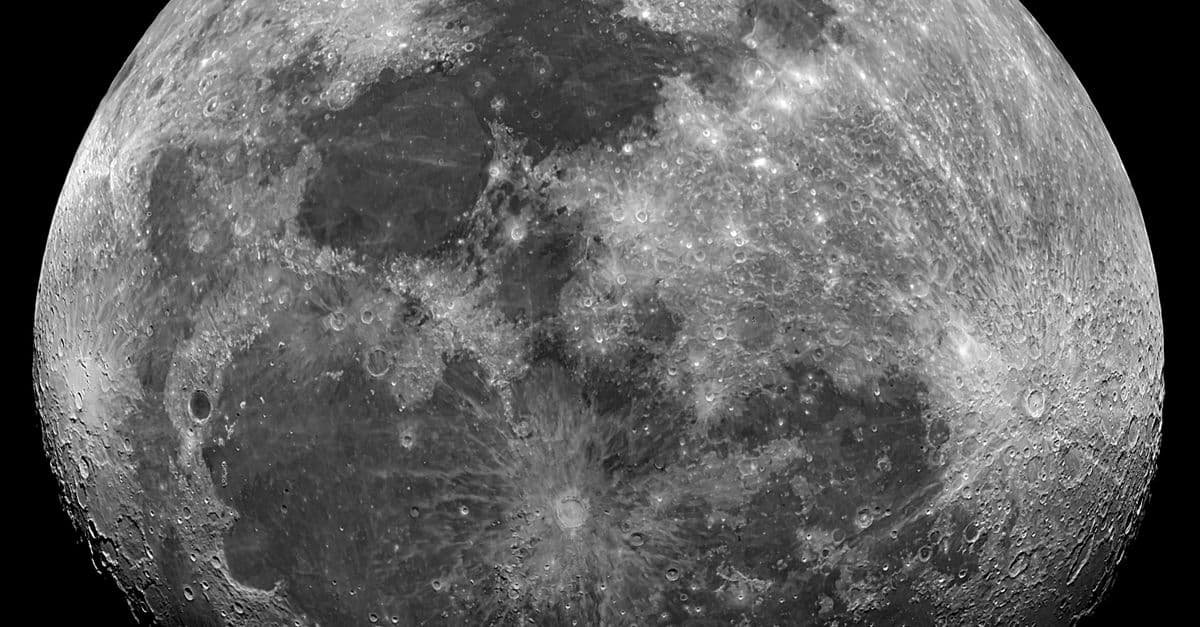
Photo: Micotino / Pexels
Every person who has ever looked at the Moon has seen the same face. The dark patches, the bright rays, and the "man in the Moon" have never rotated into a new position, and the far side stayed unseen until a Soviet probe photographed it on October 7, 1959. The reason is tidal locking: over a long time, Earth's gravity brought the Moon's rotation into step with its orbit, so it turns exactly once per trip around us. This article explains how that happens, why the Moon still shows a bit more than half its surface, and what the same process means for moons, Mercury, and planets around other stars.
Key takeaways
- Tidal locking means a body's rotation period equals its orbital period, so the same hemisphere always faces the object it orbits.
- The cause is tidal friction: gravity stretches a body, internal friction makes the stretch lag, and the resulting torque slows the spin until the lag disappears.
- Locking time scales with the sixth power of orbital distance, so a small change in distance changes the timescale enormously.
- The Moon is locked, yet libration lets observers on Earth see about 59% of its surface over time.
- Planets in the habitable zones of red dwarf stars are likely tidally locked, with a permanent day side and night side.
- Mercury is not locked 1:1. It rotates three times for every two orbits.
What tidal locking actually is
Tidal locking, also called synchronous rotation, is the state in which a body's spin period equals the time it takes to orbit its partner. Earth's Moon orbits in about 27 days and rotates in the same time, which is why NASA describes the Moon's rotation as matching its orbit. Some sources use the phrase only for this 1:1 match, while others include other stable spin-orbit ratios, a point that matters when we get to Mercury.
A useful picture is a runner on a circular track holding a ball on a string toward the center of the track. As the runner circles, the ball swings once around the center, but it always faces the center with the same side. From the center, the runner appears to carry one face of the ball toward you forever. Nothing about the ball is frozen. It is turning once per lap, just at exactly the lap rate.
It also helps to separate two ideas people often mix up. A locked moon does rotate. What it does not do is rotate relative to its partner. Seen from far away, the Moon turns steadily once per orbit. Seen from Earth, one hemisphere simply never swings out of view.
How gravity slows a spinning world
The mechanism begins with tidal force, the difference in gravity across a body. Earth pulls harder on the near side of the Moon than on the far side, and that gradient stretches the Moon slightly along the line toward Earth. The result is a tidal bulge, a gentle elongation on the near and far sides.
If the Moon were perfectly elastic and its rotation exactly matched its orbit, the bulge would sit directly on the Earth-Moon line and exert no twisting force. The trouble for a spinning body is that no real material responds instantly. Rock flexes and drags internally, so the bulge lags behind the line to Earth. In the fast-spinning young Moon, the lagging bulge was carried ahead of the line.
That misaligned bulge matters because Earth's gravity tugs on it. The tug acts as a brake. It transfers angular momentum away from the Moon's spin and dissipates energy as heat inside the Moon, gradually reducing how fast it rotates. When the spin finally matches the orbit, the bulge stays lined up with Earth, the lag disappears, and the braking torque falls to zero. The Moon then keeps a permanent bulge pointing roughly at Earth.
Think of the process like a bicycle wheel spinning against a brake pad. The pad does not need to be strong. Given enough time, a gentle, steady drag stops the wheel in a configuration where the pad no longer has anything to fight. The Moon's final state is equilibrium, not stillness.
Why distance changes the timescale so dramatically
The time for tidal locking depends on several factors, and the dependence on distance is extreme. According to the standard formula from Gladman and colleagues (1996), which builds on Peale's work from 1977, the locking time scales with the sixth power of the semi-major axis, the average orbital distance. Double the distance and the timescale grows by a factor of 64.
Other ingredients also matter, and the physics is intuitive once you picture a body being stretched.
| Factor | Effect on locking time | Why |
|---|---|---|
| Larger orbital distance | Much longer (distance to the sixth power) | Tidal stretching weakens quickly with distance |
| Faster initial spin | Longer | More rotational energy to remove |
| Greater rigidity | Longer | A stiffer body develops a smaller bulge |
| More massive partner | Shorter | Stronger tidal force |
| Larger dissipation (more internal friction) | Shorter | The torque acts more strongly on a lagging bulge |
The same article that gives the formula warns that results "may be off by orders of magnitude," because properties such as how dissipative a planet's interior is are poorly known. For that reason, any single number for how long the Moon took to lock should be treated with caution. The qualitative picture is secure: the Moon was close, rotating faster than it does now, and tidal braking brought its spin into synchrony long ago.
This steep distance dependence explains a pattern that students find surprising. Moons close to their planets are almost always locked, while distant moons often are not. The same dependence matters for exoplanets, where it sets which worlds can possibly keep their original spin.
A quick map of spin-orbit states
Locking is one member of a family of outcomes. The table sorts the cases that come up most often.
| State | What it means | Example |
|---|---|---|
| 1:1 synchronous | One rotation per orbit; one face always toward the partner | Moon and Earth |
| Mutual 1:1 | Both bodies locked to each other | Pluto and Charon |
| 3:2 resonance | Three rotations per two orbits | Mercury and the Sun |
| Unlocked, still evolving | Spin not yet matched to orbit | Earth relative to the Moon |
The common thread is that tidal braking pushes a spin toward a stable ratio, and the ratio that wins depends on the orbit's shape. A near-circular orbit favors 1:1. A strongly eccentric orbit can make a different ratio the stable one, as Mercury shows. Earth is the clearest example of a body still in transit: it spins about 27 times for each lunar orbit, and the braking has not finished.
That last point is easy to misread. Earth has not been left alone by the Moon. It is simply a much larger and faster spinner than the Moon was, and the same process that locked the Moon is still working on Earth, only far more slowly in relative terms.
Why distance matters more than almost anything else
The sixth-power dependence on orbital distance deserves a worked example, because it explains most of the pattern in the solar system and beyond. Take the distance factor alone and hold everything else equal. Doubling the orbital distance multiplies the locking time by 2 to the sixth power, which is 64. Tripling it multiplies the time by 729.
Now compare Proxima Centauri b, which orbits at about 0.048 AU, with Earth's distance of 1 AU from the Sun. The ratio is about 20.6, and 20.6 to the sixth power is roughly 76 million. Many other factors differ between the two cases, including the star's mass, the planet's interior, and its initial spin, so this is not a real prediction. It does show how a modest change in distance can turn a locking time of billions of years into one that is short compared with the age of the star.
That is why the habitable zones of dim stars are such a special case. A planet has to huddle close to a red dwarf to stay warm, and huddling close is exactly what makes locking likely. For a Sun-like star, the habitable zone sits far enough out that locking would take much longer than the age of the universe, so Earth-like planets in Earth-like orbits are not expected to be locked.
Why we see more than half of the Moon: libration
If the Moon were perfectly locked to a circular orbit and a perfectly upright axis, we would see exactly 50% of its surface. Because it is not, we see about 59% over time, an effect called libration. The word comes from the Latin for balancing, and the term captures a rocking motion that is mostly geometric.
| Type | Amplitude | Cause |
|---|---|---|
| Libration in longitude | About 7.9 degrees | The orbit is elliptical, so orbital speed varies while the spin stays steady |
| Libration in latitude | About 6.8 degrees | The Moon's axis is tilted about 6.7 degrees to its orbit |
| Diurnal libration | Under 1 degree | Earth's rotation carries the observer from one side to the other |
| Physical libration | Under 1 arcsecond as seen from Earth | Real, tiny wobbles of the Moon itself |
Longitude libration works like this. The Moon speeds up near perigee and slows near apogee, following Kepler's laws, while its spin rate stays constant. For part of each month, the Moon's orbital motion runs ahead of its spin and we see a little around one edge. Later the situation reverses and we see around the other edge. Latitude libration is the same story in the other direction: because of the axial tilt, we alternately peek over the north pole and under the south pole.
Almost all of this apparent rocking is optical, a change in viewpoint rather than a movement of the Moon. The genuinely physical libration, a real forced and free wobble of the Moon's body, is very small. Patient observers with good telescopes can use the optical effects to map regions near the limb. For a broader look at what the Moon does to Earth in return, see how the Moon affects Earth's tides, climate, and life.
The far side: what Luna 3 revealed and why it looks so different
The far side remained a mystery until October 7, 1959, when the Soviet probe Luna 3 took the first photographs. Eighteen frames were resolvable and covered about a third of the hidden hemisphere. Humans saw it directly for the first time in December 1968, when the Apollo 8 crew flew around the Moon.
Their photographs showed an unexpected difference. The near side has large dark plains called maria, lava-filled impact basins that formed between about 4.2 and 1.2 billion years ago. Maria cover about 31.2% of the near side but only about 1% of the far side. The far side is dominated by bright, heavily cratered highlands.
NASA lists a thicker crust on the far side as part of the explanation: about 40 kilometers (25 miles) on the near side versus up to about 60 kilometers (37 miles) on the far side. A thinner crust lets impacts release basaltic lava from below, building maria, while a thicker crust makes it harder for magma to reach the surface. Why the crust differs is still debated, and several ideas compete:
- A higher concentration of heat-producing elements on the near side, suggested by gamma-ray maps from the Lunar Prospector mission.
- A merger with a smaller companion moon that built up the far-side highlands, proposed by Jutzi and Asphaug in Nature in 2011, though the chemistry of that model has been questioned.
- A 2014 Penn State study linking the difference to Earth's heat during the Moon's formation, which let the far side cool and form a thicker crust.
One popular explanation is that Earth "shields" the far side. Calculations cited by NASA suggest otherwise: as seen from the Moon, Earth blocks only about four square degrees of sky, so it cannot account for the difference in cratering. For the formation story behind all of this, see how the Moon formed in a giant impact and why the Moon has so many craters.
The far side also holds one of the largest impact scars in the solar system. The South Pole-Aitken basin is nearly 2,400 kilometers (1,500 miles) across, and the basin floor includes some of the Moon's lowest elevations. China's Chang'e 4 made the first soft landing on the far side on January 3, 2019. Because the far side never faces Earth, direct radio contact is impossible. China had launched the Queqiao relay satellite in 2018 to the Earth-Moon L2 point so signals could bounce around the Moon, a trick explained in how Lagrange points hold space telescopes.
Locked moons across the solar system
Most large moons in the solar system are in synchronous rotation with their planets. Several cases show how the same physics produces very different worlds.
| Body | Partner | Key facts |
|---|---|---|
| Moon | Earth | Orbits in about 27 days; mean distance 384,400 km |
| Charon | Pluto | Orbits every 6.4 days, the same as a Pluto day; mutual locking |
| Io, Europa, Ganymede, Callisto | Jupiter | All locked; Io is heated by tides |
| Phobos | Mars | Orbits about three times a day; approaching Mars |
| Triton | Neptune | Large captured moon on a retrograde orbit |
Pluto and Charon are the textbook case of mutual locking. Charon orbits Pluto every 6.4 Earth days, exactly one Pluto day, and the two bodies always show each other the same face. From Pluto, Charon never rises or sets. It hangs over the same point in the sky, about 19,640 kilometers (12,200 miles) away. Charon is 1,214 kilometers (754 miles) across, about half Pluto's size, and that large mass ratio is why Pluto also ended up locked. See what New Horizons found at Pluto for what the system looks like up close.
Jupiter's Galilean moons are all locked, and Io shows the consequence of locked orbits that are not perfectly circular. NASA describes Io as pulled by Jupiter's gravity and by precisely timed tugs from Europa and Ganymede. The pulls keep Io's orbit slightly eccentric, so the stretching and squeezing never stops. That flexing heats the interior and powers hundreds of volcanoes, a story told in detail in Io, Jupiter's volcanic moon.
Phobos shows that locking does not guarantee a quiet future. NASA reports that Phobos circles Mars about three times a day and is nearing Mars at a rate of about 1.8 meters (six feet) every hundred years. It will either crash into Mars in about 50 million years or break up into a ring. The Moon is moving the opposite way, away from Earth, and the difference comes down to whether the moon orbits faster or slower than its planet spins. Both of Mars's moons are covered in Phobos and Deimos explained.
Triton is the odd one out. It orbits Neptune opposite to Neptune's rotation, strong evidence that Neptune captured it rather than formed with it, and its tidal evolution therefore runs differently from that of ordinary moons. Details are in Triton, Neptune's captured moon.
Mercury and the 3:2 exception
Mercury demonstrates that tidal braking does not always end at 1:1. The planet's sidereal rotation period is about 58.646 days, and its orbital period is about 87.97 days. That ratio is almost exactly three rotations for every two orbits, a 3:2 spin-orbit resonance.
For decades astronomers thought Mercury kept one face toward the Sun, the way the Moon does toward Earth. Radar observations in 1965 showed the planet in fact has a 3:2 resonance. A consequence is that a solar day on Mercury, from one sunrise to the next, lasts about 176 Earth days, which is two Mercury years.
The reason Mercury avoided 1:1 is its orbit. Mercury's eccentricity is 0.2056, the largest of any planet in the solar system. At perihelion, when the Sun's tidal pull is strongest, Mercury is moving so fast that the Sun is nearly stationary in its sky, and the planet's rotation can lock onto that moment as a stable configuration. Modeling suggests Mercury was captured into the resonance within 10 to 20 million years of forming. More about the planet is in Mercury's iron core, polar ice, and odd orbit.
The lesson is that "tidally locked" in casual use usually means 1:1, but physics permits other stable ratios, especially for eccentric orbits. That caveat will matter when we discuss exoplanets, because the same ambiguity applies to worlds we cannot yet map.
What tidal locking is doing to Earth right now
Earth is the other half of its own tidal story. The Moon raises tidal bulges in Earth's oceans and rock, and because Earth spins faster than the Moon orbits, the bulges are dragged slightly ahead of the line to the Moon. The Moon's gravity pulls back on that leading bulge, braking Earth's spin and passing angular momentum to the Moon's orbit.
The consequences are measurable. Earth's day lengthens by about 2.3 milliseconds per century, and the Moon recedes at roughly an inch per year, according to NASA. This is not a quirk of the Moon. It is the mirror image of how the Moon itself got locked: the same braking process, applied to a much larger partner.
If nothing interfered, the process would end with Earth locked to the Moon as well, a mutual lock like that of Pluto and Charon. At that point Earth's day would equal the Moon's orbital period, which the Wikipedia article on tidal locking puts at about 47 times the current length of an Earth day. In practice, that endpoint is not expected to arrive before the Sun swells into a red giant and engulfs both worlds. For the basics of how the Moon moves the sea today, see what causes tides.
Tidal locking and the search for habitable planets
Tidal locking matters most for planets around red dwarfs, small cool stars that make up about three-quarters of the fusing stars in the Milky Way. A red dwarf is so dim that a planet needs to orbit very close to stay warm enough for liquid water, and that closeness, through the sixth-power law, makes locking fast.
An illustrative example is Proxima Centauri b, the closest known exoplanet to the Sun. It orbits at about 0.048 AU, roughly 20 times closer to its star than Earth is to the Sun, with a period of about 11.2 days. It was announced by the European Southern Observatory on August 24, 2016. Its minimum mass is about 1.06 Earth masses, and its equilibrium temperature is about 234 K (minus 39 degrees Celsius). It is likely locked in a 1:1 orbit, though not certain: if its orbit were eccentric enough, a 3:2 or 2:1 resonance would be possible.
The seven worlds of TRAPPIST-1, about 40.7 light-years away, are all likely tidally locked. Their orbital periods range from 1.51 days for planet b to 18.77 days for planet h. Planets e, f, and g are the usual habitable-zone candidates, and some studies include d as well. Observations from the James Webb Space Telescope point to an airless or thin-atmosphere state for TRAPPIST-1b, and measured a dayside brightness temperature of 508 K. Planet c is consistent with having no atmosphere, though some atmospheres have not been ruled out. For planets d and e, the question remains open. The technique and its limits appear in the exoplanet atmosphere revolution.
Life on a world with a permanent day side
A planet locked to a red dwarf has an unfamiliar climate. One hemisphere bakes under a fixed star, and the other sits in perpetual darkness. The old assumption was that the night side would freeze the atmosphere out as ice. A thick enough atmosphere, or an ocean, can carry heat from day to night, so models do not require a frozen night side.
The most promising region is often the terminator, the ring between day and night where the star hangs near the horizon. Life, if present, might persist there. Planets in these systems also face a serious threat that has nothing to do with locking: red dwarfs are often flare stars, and some flares briefly double the star's brightness. Proxima Centauri's luminosity can vary by a factor of 100 over hours, and Proxima b receives roughly 10 to 60 times Earth's ultraviolet and X-ray flux, which could strip an atmosphere. Whether Proxima b has an atmosphere at all is unknown. A 2026 study reported evidence of star-planet magnetic interaction, which would imply the planet has a magnetic field.
The share of known exoplanets that look locked is also inflated by how we find them. A Wikipedia summary notes that 85% of detected exoplanets lie inside the tidal-locking zone, but that figure partly reflects detection bias, since close-in planets are easier to find. How detection methods shape the catalog is explained in how we find exoplanets, and why these stars matter to the search is in why red dwarf stars matter for life searches. The habitable-zone concept itself is introduced in what the habitable zone is.
Common confusion about tidal locking
Several misunderstandings come up whenever the topic is mentioned.
"The Moon doesn't rotate." It does. It rotates once per orbit. A body that did not rotate at all would show all its faces to Earth over a month.
"The far side is the dark side." The far side receives as much sunlight as the near side. From Earth, the Moon appears to orbit every 29 days, because Earth is also moving around the Sun, and any given spot on the Moon sees about two weeks of daylight followed by two weeks of night. The mix-up between "far" and "dark" is untangled in the dark side of the Moon, myths and facts.
"Tidal locking is permanent." It is a stable state, but it can be undone by other forces. Phobos is spiraling toward Mars, and an object that moves close enough can be torn apart.
"Locked means the same temperature everywhere." The opposite is true. A locked body with a fixed star has the most extreme day-night contrast possible, which is why atmospheric heat transport is the central question for exoplanets.
Frequently asked questions
Q: What is tidal locking in simple terms? A: Tidal locking is when a moon or planet takes exactly as long to spin once as it takes to orbit its partner, so the same side always faces the partner. It happens because gravity stretches the body, internal friction makes the stretch lag behind, and the resulting torque slows the spin until the lag disappears.
Q: Why do we always see the same side of the Moon? A: Because the Moon is tidally locked to Earth. It rotates once in about 27 days, the same time it takes to orbit Earth, so one hemisphere always faces us. Libration, a slow rocking caused by the elliptical orbit and tilted axis, lets us see about 59% of the surface over time rather than exactly half.
Q: How long does tidal locking take? A: It depends on distance, size, rigidity, and starting spin, and the dependence on distance goes as the sixth power of orbital distance. Published estimates may be off by orders of magnitude because interior properties are uncertain. Close-in bodies lock quickly and distant ones may never lock.
Q: Are all planets and moons tidally locked? A: No. Most large moons are locked to their planets, but planets orbiting stars are mostly not. Mercury is in a 3:2 resonance, rotating three times per two orbits, and Earth is not locked to the Sun or, yet, to the Moon.
Q: Will Earth ever become tidally locked to the Moon? A: In principle, the process would end with Earth locked to the Moon, with a day about 47 times the current length. The tidal braking that lengthens Earth's day by about 2.3 milliseconds per century is not expected to finish before the Sun becomes a red giant and engulfs both worlds.
Q: Could life exist on a tidally locked planet? A: It is an open question. Models suggest a thick atmosphere or ocean can carry heat to the night side, and the terminator region might be temperate. Flares from red dwarf stars and possible atmosphere loss are major concerns, and JWST has so far found little evidence of thick atmospheres on the innermost TRAPPIST-1 planets.
The takeaway
Tidal locking is gravity's slow way of making a rotating body settle into a stable relationship with its partner. For the Moon, that settling happened long ago and left us with a permanent face and a hidden hemisphere that looks nothing like it. For Charon, Io, and Phobos, it shapes interiors, volcanoes, and fates. For Mercury, it stopped halfway, at 3:2. And for the small stars that make up most of the galaxy, it probably fixes a one-sided climate on every planet near enough to be warm. The practical lesson is that the Moon's constant face is not a coincidence or a special case. It is what orbital physics does, and the open question for astronomers is whether life can cope on the worlds where that physics has locked a planet to its star.
Sources
- NASA, Moon facts: orbit and rotation, distance, crust thickness, recession rate.
- NASA, Phobos and Charon: orbital facts and fate.
- NASA, Io: gravitational pulls from Jupiter, Europa, and Ganymede.
- Wikipedia, Tidal locking, which summarizes Gladman et al. (1996) and Peale (1977) on timescales, and Colombo (1965) on Mercury.
- Wikipedia, Libration and Far side of the Moon: libration amplitudes, Luna 3, Chang'e 4, maria coverage, and asymmetry hypotheses.
- Wikipedia, Mercury, Proxima Centauri b, TRAPPIST-1, and Red dwarf.
Related Reading
Follow new articles
Add SciHub101 to your feed reader to see new science and technology stories.
About the Author
SciHub101 is an independent science and technology publication founded and edited by Buğra Sözeri, a software engineer and app developer based in Türkiye. AI tools assist with drafting and research. Source documentation in the existing archive is uneven, and articles are being reviewed and corrected. The Editorial Team byline identifies editorial responsibility; it does not certify specialist or independent human review. Where we compare products, anything built by our own team is labelled as such — see the editorial guidelines and About page for how corrections and disclosures work.
Related Articles
What Is Titan? Saturn's Moon with Rivers, Rain, and a Thick Atmosphere
Titan is the only moon with a dense atmosphere and the only world besides Earth known to have rain, rivers, and lakes on its surface, though its liquid is methane and ethane at about minus 179 degrees Celsius. NASA's Dragonfly rotorcraft is scheduled to launch no earlier than July 2028.
What Is the Solar Cycle? Sunspots and the Sun's Magnetic Heartbeat
Every 11 years or so, the Sun's magnetic activity rises and falls in a cycle that astronomers have tracked since Galileo's era. The solar cycle sets how many sunspots, flares, and coronal mass ejections occur, and it shapes space weather at Earth.
What Is Tidal Locking? How Gravity Synchronizes Worlds
Tidal locking happens when a body's rotation period equals its orbital period, so one face always points at its partner. The Moon is locked to Earth, Mercury is caught in a 3:2 resonance instead, and many planets around red dwarf stars are probably locked to their stars.
What Are Exomoons? The Hunt for Moons Beyond Our Solar System
Exomoons are moons orbiting planets beyond our solar system. None has been confirmed, despite two serious candidates, because their signals are tiny and easily mimicked. If they exist around giant planets, some could hold liquid water through tidal heating, even far from any star.
The Dark Side of the Moon — Myths and Facts
The Moon's far side isn't dark — it just faces away from Earth. Tidal locking, crater asymmetry, Chang'e missions, and what's really there.
What If Earth Had Two Moons? The Science of a Twin-Moon World
A second moon would change tides, eclipses, calendars, and possibly life itself. Here's exactly what would happen — based on real orbital physics — if we suddenly had two moons.