2I/Borisov: The First Confirmed Interstellar Comet
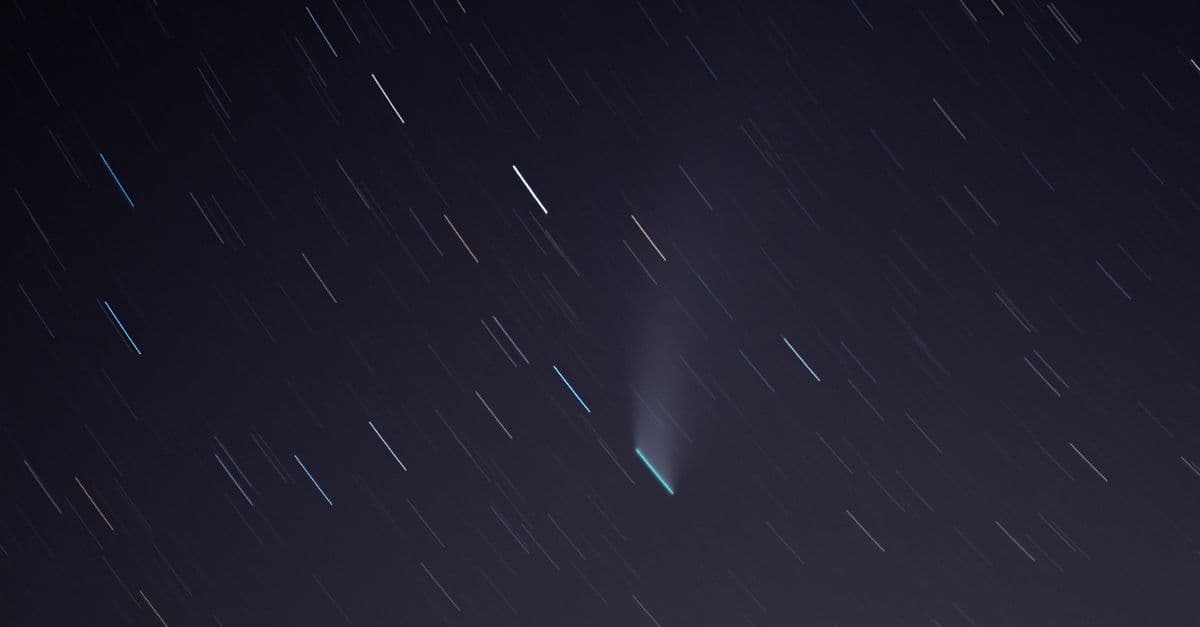
Photo: Alberto Calleja / Pexels
On August 30, 2019, Gennady Borisov aimed a homemade 0.65-meter telescope at the pre-dawn sky from a rooftop observatory in Crimea and detected a faint, fuzzy object that didn't belong. Its speed — over 30 km/s relative to the Sun — was too fast to be gravitationally bound to our solar system. Within weeks, telescopes around the world confirmed what Borisov had found: the first comet ever observed traveling between the stars.
Key takeaways
- 2I/Borisov was discovered on August 30, 2019 by amateur astronomer Gennady Borisov and confirmed as an interstellar object within two weeks.
- It reached perihelion (closest approach to the Sun) on December 8, 2019 at 2.0 AU — just outside Mars's orbit.
- Its carbon monoxide (CO) abundance relative to water was roughly 130–155%, far higher than typical solar system comets, suggesting it formed beyond the CO ice-line of another star.
- Unlike 'Oumuamua, Borisov had a visible coma and tail, behaving chemically and structurally like a well-understood comet.
- It is only the second confirmed interstellar object ever detected, after 1I/'Oumuamua in 2017.
- The pristine composition of Borisov suggests it had not made close passes near its home star, arriving essentially unaltered since its formation billions of years ago.
How Borisov Was Caught in the Act
Gennady Borisov is not a professional astronomer. He builds his own telescopes in Crimea and scans the sky as a hobby, specifically hunting near-Earth objects and comets. On the night of August 30, 2019, a streak in his data showed anomalous motion. He reported it to the Minor Planet Center, the international clearing house for solar system discoveries, and within days orbit-fitters at multiple institutions ran the numbers.
The verdict was unambiguous. The object's hyperbolic excess velocity — the speed it would retain even if it flew all the way out to infinity — was around 32 km/s. Nothing naturally produced inside our solar system achieves that. The Sun's gravity cannot bind it. The object was passing through on a one-way trajectory, an interstellar visitor borrowing our star's gravity briefly before continuing its journey across the Milky Way.
The International Astronomical Union designated it 2I/Borisov: the "2" for second interstellar object, "I" for interstellar, "Borisov" for its discoverer. The naming marked a new class of discovery in the history of astronomy.
Hyperbolic excess velocity — the speed an object retains at infinite distance from the Sun, after losing no more energy to gravity. A solar system object has zero hyperbolic excess velocity. Borisov's was approximately 32 km/s, firmly placing it in unbound interstellar territory.
Source: NASA/JPL Small-Body Database (2019) — Confirmed hyperbolic trajectory, eccentricity ~3.36.
Why This Was Different from 'Oumuamua
Two years earlier, in October 2017, astronomers spotted 1I/'Oumuamua — the first interstellar object ever detected. It was already outbound when found, fading fast. Observations were rushed and incomplete. And the object behaved strangely: it accelerated away from the Sun faster than sunlight pressure alone could explain, it had no detectable coma or dust tail, and its shape seemed elongated to an extreme degree, perhaps 10:1 in aspect ratio. The debate over what 'Oumuamua actually was — comet, asteroid, hydrogen iceberg, nitrogen slab, or something stranger — never fully resolved.
Borisov arrived under much more favorable circumstances. Discovered two months before perihelion, it gave the global astronomy community time to prepare. Major observatories including the Hubble Space Telescope, the Very Large Telescope in Chile, ALMA, and Gemini Observatory all turned their instruments toward it during the months-long window of observation.
What they saw was reassuringly ordinary: a comet. A visible coma of gas and dust surrounded the nucleus. A tail developed as the object approached the Sun. The brightness varied in ways consistent with outgassing from a rotating, roughly spherical nucleus about 0.5 km in diameter. The behavior was so textbook that if you stripped away the velocity data, you'd classify it as a run-of-the-mill short-period comet.
That familiarity was itself a discovery. It told astronomers that comets, as a class of object, are not peculiar to our solar system. The same physical processes — icy volatiles sublimating under stellar radiation, producing gas and dust — operate around other stars.
Source: Nature Astronomy, Jewitt & Luu (2019) — Initial characterization of 2I/Borisov morphology and nuclear size.
The Chemistry of Another Star System
The most scientifically significant finding about Borisov wasn't its existence — it was its chemistry.
In December 2019, the ALMA radio telescope array in Chile measured the molecular composition of the outgassing in unprecedented detail. The results, published in Nature Astronomy in 2020, were striking. Borisov's carbon monoxide (CO) abundance relative to water was between 130% and 155%. In our solar system, even the most CO-rich comets rarely exceed 30% by this measure. Comets like Halley's Comet sit closer to 3–5%.
CO ice-line — the distance from a star at which carbon monoxide freezes and can be incorporated into solid bodies. In our solar system, this boundary lies at roughly 20–30 AU. Objects forming inside the CO ice-line are CO-poor; those forming beyond it can be CO-rich.
This means Borisov almost certainly formed in the frigid outer reaches of its home star system — well beyond the CO ice-line, in a region colder than the Kuiper Belt analog in our own system. It is like receiving a geological core sample from a distant planet: the molecular ratios in the outgas are a direct record of where and under what conditions the comet condensed, potentially billions of years ago.
Some solar system comets are CO-rich, but they are comparatively rare and typically formed at extreme heliocentric distances. Borisov's home system apparently produced CO-rich comets as a more standard output — or this particular comet formed exceptionally far from its star.
Other molecular detections added nuance. Hydrogen cyanide (HCN) was detected at abundances relative to water that fall squarely within the range of normal solar system comets, around 0.06–0.16%. The ratio of dust to gas in the coma also fell within the solar system range. So Borisov was not exotic across the board — it was specifically CO-enriched, with everything else looking familiar.
Source: Nature Astronomy, Bodewits et al. (2020) — CO/H₂O abundance ratio 130–155% from ALMA observations, December 2019.
Source: Nature Astronomy, Cordiner et al. (2020) — HCN detection and comparison to solar system comet abundances.
What Pristine Means in Cometary Science
There is a particular term astronomers reach for when describing Borisov: "pristine." It requires unpacking.
Comets are time capsules. When they form in the cold outer reaches of a planetary system, they lock in volatile molecules — water ice, CO, CO₂, methanol, HCN — in roughly the proportions those molecules existed in the protoplanetary disk at that location and that epoch. Each close pass near a star partially alters that record: volatiles boil off, the surface crusts over, chemistry shifts under radiation.
A pristine comet is one that has made very few or no previous close stellar approaches. Solar system comets that arrive from the Oort Cloud for the first time are sometimes called "dynamically new" and display distinct chemical signatures — higher abundances of supervolatiles, more vigorous outgassing — compared to comets that have lapped the Sun many times.
Borisov appears to be, by this standard, almost completely unprocessed. The abundance of CO, one of the most volatile common molecules, is intact at extreme levels. If the comet had made prior close passes to its home star, much of that CO would have been lost.
Think of a library book left on a shelf for centuries versus one read hundreds of times. Borisov is the unread copy — the pages haven't yellowed and the chemistry hasn't changed. Reading it gives you the original text.
Source: The Astrophysical Journal Letters, Fitzsimmons et al. (2019) — Early spectral analysis indicating minimal processing of Borisov nucleus.
What Borisov Tells Us About Other Planetary Systems
The deeper implication of Borisov's chemistry is what it reveals about the planetary system it came from.
Astronomers infer planetary system architecture from the kinds of building blocks it produces. A system with abundant CO-rich comets in its outer reaches had a large reservoir of cold, CO-bearing material in its protoplanetary disk. That points to a star system with an extended cold outer disk — perhaps around a colder star than the Sun, or perhaps simply a more massive outer disk extending to greater radii.
The fact that Borisov's overall composition otherwise resembles solar system comets is also meaningful. It suggests the same fundamental chemistry — water ice as the dominant volatile, silicate and carbonaceous dust grains, HCN and other organic molecules — shows up in planetary systems around other stars. The universe, it appears, builds comets the same way everywhere, with local variations in the proportion of CO depending on formation distance from the host star.
This is one data point, not a population study. But it is the only data point we have. Every other piece of evidence for chemistry in other planetary systems comes from spectra of planetary atmospheres seen in transit, or absorption lines in the disk of a planet-forming star. Borisov gave astronomers direct access to the solid-phase chemistry of a body that actually condensed in another star system. The difference is like comparing satellite photographs of a foreign country to a geology sample brought from its mountains.
Source: Science, de León et al. (2019) — Characterization of Borisov spectral reflectance and comparison to D-type comets and Kuiper Belt objects.
Comparison: 2I/Borisov vs. 1I/'Oumuamua
| Property | 2I/Borisov | 1I/'Oumuamua |
|---|---|---|
| Discovery year | 2019 | 2017 |
| Discoverer | Gennady Borisov (amateur) | Robert Weryk, Pan-STARRS survey |
| Time before perihelion at discovery | ~2 months | Already outbound |
| Object type | Confirmed comet | Debated (no coma, unusual shape) |
| Coma/tail | Yes | None detected |
| CO abundance (vs. H₂O) | 130–155% | Unknown (no outgassing detected) |
| Non-gravitational acceleration | Minor (expected from outgassing) | Anomalous — unexplained excess |
| Estimated size | ~0.5 km diameter nucleus | ~100–1000 m, elongated |
| Current status | Departed solar system | Departed solar system |
The contrast between the two objects is instructive. 'Oumuamua was the mystery, Borisov was the confirmation that interstellar visitors exist and — at least sometimes — behave exactly as expected. The next question is whether the two represent the extremes of a population, or whether 'Oumuamua was a true outlier.
How We Know It Was Interstellar
A reasonable question: could Borisov have been a solar system comet on a very unusual orbit?
The answer is no, and the reasoning is airtight. The orbital eccentricity of a gravitationally bound object cannot exceed 1.0. A value of exactly 1.0 is a parabolic orbit, meaning the object has just enough energy to escape to infinity from infinity — borderline bound. Borisov's eccentricity was measured at approximately 3.36. That is not a rounding error or uncertainty. An eccentricity that high means the object had enormous kinetic energy before it ever entered the solar system. There is no mechanism within the solar system to accelerate a comet to that velocity from within.
The velocity vector also points back to the general direction of Kruger 60, a binary red-dwarf system about 13 light-years away, when traced backward accounting for stellar proper motion over the roughly 1 million years Borisov would have spent in transit. That's not a confirmed home address — the calculation has large uncertainties — but it's consistent with interstellar origin.
The non-gravitational accelerations Borisov did show — small deviations from a purely gravity-driven path caused by outgassing — are perfectly consistent with a normal comet's rocket effect. They do not require exotic explanations. They were predicted before they were measured.
Source: IAU Minor Planet Center (2019) — Confirmed orbital solution, eccentricity 3.36.
The Fragmentation and Final Act
In late February and early March 2020, as Borisov was already moving away from the Sun, Hubble images showed the nucleus beginning to fragment. A piece broke off, visible as a secondary brightness source. By April 2020, the comet had brightened slightly and showed a dust trail indicating significant outgassing from freshly exposed interior material.
This fragmentation was not entirely surprising. The nucleus was small and had just made its closest approach to the Sun in its entire history — it had never experienced significant stellar heating. The thermal stress from that encounter, minor by solar system comet standards (perihelion was at 2 AU, roughly the inner edge of the main asteroid belt), was enough to crack the object.
Borisov has since continued outbound at roughly 32 km/s. It is currently beyond the orbit of Jupiter and will cross the heliopause — the boundary of the Sun's influence — in roughly 8,000 years. It will then continue through interstellar space indefinitely, carrying its frozen chemistry across the galaxy.
For more on what interstellar visitors can tell us, see the 'Oumuamua mystery and how stars and planetary systems form.
What Borisov Tells Us About Ejection Processes in Other Planetary Systems
Borisov's CO-rich, water-ice-bearing composition does more than describe one comet. It provides the first direct chemical evidence that the processes scattering comets out of planetary systems — the same gravitational pinball that flung Borisov across interstellar space — are not peculiar to our solar system. They appear to be universal.
In our solar system, the Oort Cloud is the reservoir of long-period comets. It is a vast, roughly spherical shell extending from roughly 2,000 to 100,000 AU, populated by icy bodies that were kicked outward from the inner solar system during the early epoch of giant planet migration. The same dynamical process that stored them there also sends a fraction of them on hyperbolic trajectories out of the solar system entirely. Borisov is precisely that: a comet from the Oort Cloud analog of another star system, ejected by a gravitational interaction — most likely with a giant planet — and launched into interstellar space.
Oort Cloud analog — the hypothetical distant comet reservoir around another star, equivalent to our solar system's Oort Cloud. No exo-Oort Cloud has been directly observed, but stellar population models and the existence of interstellar objects like Borisov imply they exist around many stars.
The fact that Borisov's overall composition — CN ratios, HCN abundance, dust-to-gas ratio — falls squarely within the range of solar system comets is significant. It implies the same raw chemical feedstocks (water, silicates, organic molecules) are available across different stellar environments. What differs is the CO fraction, which reflects formation distance from the host star. The universe appears to run the same comet-assembly program; it just dials up or down the CO depending on where in the protoplanetary disk the comet condensed.
Source: Bodewits et al., Nature Astronomy (2020) — ALMA observations confirming CO/H₂O ratios and HCN abundances; the HCN ratio falling within the solar comet range is interpreted as evidence of chemically universal comet-building processes.
The ejection rate implied by Borisov's arrival is also scientifically important. For one interstellar object to be detected in the solar system in a given year, the interstellar space density of such objects must be high — modeling suggests roughly one Borisov-sized object per cubic astronomical unit of interstellar space, though the uncertainties span orders of magnitude. That density, in turn, implies that planetary systems routinely eject enormous numbers of comets over their lifetimes.
The Vera C. Rubin Observatory, currently entering full operations at Cerro Pachón in Chile, will survey the sky with unprecedented depth and cadence using its 8.4-meter mirror and 3,200-megapixel camera. Models predict that once the Rubin Observatory (formerly called LSST) reaches full operational cadence, it should detect one or more interstellar objects per year. With that detection rate, the chemical diversity of other planetary systems — how CO-rich or CO-poor their comets are, whether they carry more complex organics than ours — can be surveyed statistically rather than through a single lucky catch. Borisov opened the door; the Rubin Observatory will map the hallway behind it.
Source: Trilling et al., Astrophysical Journal Letters (2017) — Population model for interstellar objects; updated estimates based on 'Oumuamua and Borisov detections project significantly higher number densities than pre-discovery models assumed.
The Takeaway
Borisov matters because it is the only pristine sample of solid material from another planetary system that humanity has ever directly observed. Not an atmosphere, not a disk, not a reflected spectrum — an actual object, close enough for chemistry. Its extraordinary CO abundance tells a specific story: it formed in a cold, outer-disk environment around another star, locked in its volatile inventory, and traveled potentially trillions of kilometers to arrive in our neighborhood essentially unchanged. The universe, it turns out, builds comets the same way everywhere. Where it diverges — in that anomalous CO ratio — is where the chemistry of other worlds becomes legible.
Read next:
- 'Oumuamua: The Interstellar Object That Defied Explanation
- How Stars Are Born and Die: Stellar Evolution
- What Are Quasars: The Brightest Objects in the Universe
Q: Is 2I/Borisov the same as 'Oumuamua?
A: No. They are two separate interstellar objects. 1I/'Oumuamua was discovered in 2017, had no coma, and behaved anomalously. 2I/Borisov, discovered in 2019, is a confirmed comet with a visible coma and tail. They share only their interstellar origin.
Q: Where did 2I/Borisov come from?
A: The trajectory traces back roughly toward Kruger 60, a binary red-dwarf system about 13 light-years from Earth, but the calculation has significant uncertainties. It cannot be confirmed as Borisov's home star system.
Q: What made Borisov's composition unusual?
A: Its carbon monoxide abundance relative to water was 130–155%, far above the 3–30% range of CO-rich solar system comets. This suggests it formed in the cold, CO-rich outer regions of another planetary system.
Q: Could Borisov be detected again?
A: No. It is moving outbound at roughly 32 km/s and is now beyond the distance where any current telescope could detect it. It will leave the solar system permanently.
Q: How many interstellar objects have been confirmed?
A: Two: 1I/'Oumuamua (2017) and 2I/Borisov (2019). With the Rubin Observatory (LSST) coming online, astronomers expect to detect one or more interstellar objects per year once it reaches full operational capacity.
Q: Did Borisov break apart?
A: Partially. Hubble images from February–March 2020 showed the nucleus beginning to fragment as it moved away from the Sun after perihelion. The thermal stress of its closest solar approach caused a piece to separate, but the main body continued outbound.
Follow new articles
Add SciHub101 to your feed reader to see new science and technology stories.
About the Author
SciHub101 is an independent science and technology publication founded and edited by Buğra Sözeri, a software engineer and app developer based in Türkiye. AI tools assist with drafting and research. Source documentation in the existing archive is uneven, and articles are being reviewed and corrected. The Editorial Team byline identifies editorial responsibility; it does not certify specialist or independent human review. Where we compare products, anything built by our own team is labelled as such — see the editorial guidelines and About page for how corrections and disclosures work.
Related Articles
Ceres: The Asteroid Belt's Dwarf Planet Has Brine and Organics
Ceres is the largest object in the asteroid belt — so large that it qualifies as a dwarf planet. NASA's Dawn spacecraft arrived in 2015 and found something extraordinary: bright white spots in a crater, fed by a subsurface reservoir of salty brine erupting to the surface within the last 2 million years.
AGB Stars: The Carbon Factories That Seed the Universe
Most of the carbon in your body was not made in a supernova. It was made in the bloated outer layers of a dying star on the asymptotic giant branch — a phase of stellar evolution so chemically productive that a single AGB star can enrich the surrounding interstellar medium with more carbon than a thousand supernovae. These stars pulse, dredge up nuclear-processed material from their interiors, and blow it into space in slow, dense winds that eventually become planetary nebulae.
Long-Period Comets: Messengers From the Edge of the Solar System
Comet Hale-Bopp, which dominated the 1997 night sky, had not been seen by any human being before. Its previous perihelion passage was in approximately 2215 BCE, before writing systems existed in most of the world. It had spent the intervening 4,200 years falling inward from the outer solar system at speeds so slow that a bicycle could have overtaken it. When it finally arrived, its pristine composition — unchanged since the solar system formed 4.5 billion years ago — gave scientists a direct sample of the raw material from which planets were built. Long-period comets are the oldest, least-altered objects available for study. They are time capsules from the beginning.
Asteroids, Comets, and Meteors — What's the Difference?
Asteroids, comets, meteoroids, meteors, and meteorites — what each one is, where they come from, and how scientists study them.
Jupiter's Auroras: The Most Powerful Light Show in the Solar System
Jupiter's auroras are not scaled-up versions of Earth's. They are a fundamentally different phenomenon: driven not primarily by the solar wind but by the volcanic output of Io, a moon so geologically active it pumps a ton of sulfur dioxide per second into space. The resulting plasma torus is the actual engine of Jupiter's polar glow — producing auroral emissions roughly 1,000 times more energetic than anything Earth generates, visible in UV and X-ray from telescopes hundreds of millions of kilometers away.
The Apollo Program's Science Legacy: What 842 Pounds of Moon Rocks Revealed
Six Apollo landings returned 842 pounds of lunar material to Earth — 2,196 samples collected from six different sites across the nearside. Fifty-five years later, those rocks are still generating new discoveries, the laser retroreflectors are still in use, and the fundamental questions they raised about the Moon's violent origin have only deepened.