Planetary Rings Explained: Not Just Saturn
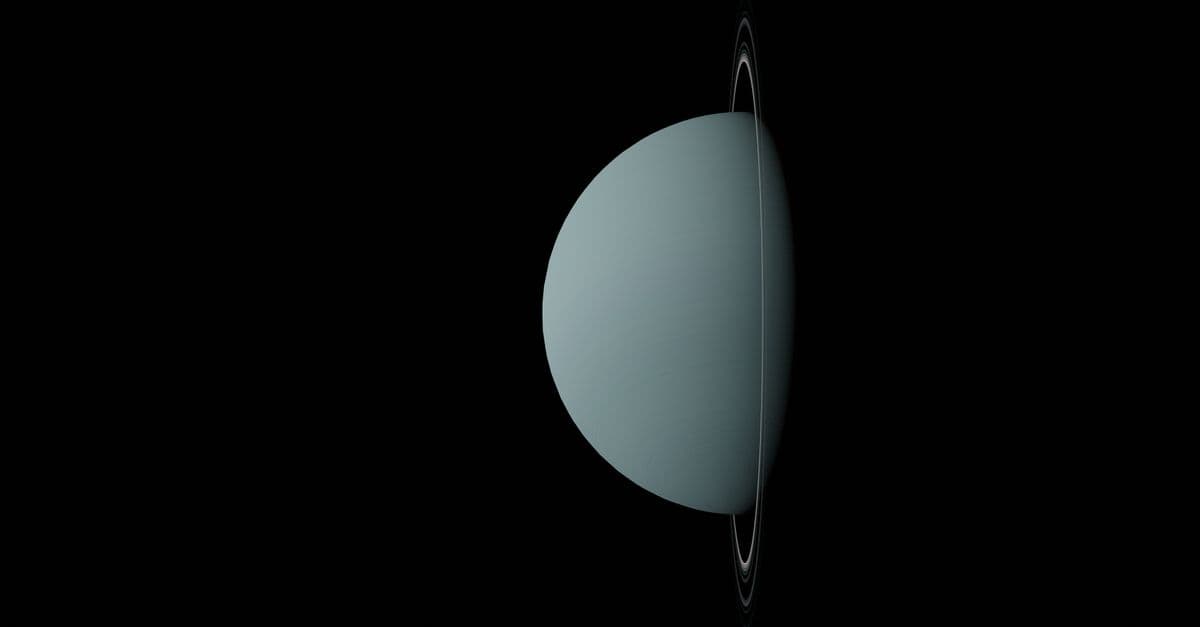
Photo: Zelch Csaba / Pexels
The Voyager 2 spacecraft was aimed at Uranus in January 1986, but astronomers already knew Uranus had rings before Voyager arrived. They knew because nine years earlier, on March 10, 1977, a team of astronomers watching Uranus occult (pass in front of) a distant star noticed the star flickering briefly before and after the planet blocked it — symmetrically, on both sides. That symmetric dimming meant rings, and rings meant Uranus was not the ring-free world everyone had assumed. The serendipitous discovery was made 43 years after Saturn's rings were first observed through Galileo's telescope, and it changed the textbooks: planetary rings were not a peculiarity of Saturn but a feature of giant planets generally. All four of them have rings. Each is strange in its own way.
Why Rings Exist at All: The Roche Limit
Before examining individual ring systems, the fundamental physics: rings exist because they sit inside the Roche limit.
Roche limit — the minimum orbital distance at which a self-gravitating body (a satellite, moon, or comet) can orbit a planet without being torn apart by the differential gravitational force (tidal force) across the body; inside this limit, tidal forces exceed self-gravity and the body is disrupted into smaller pieces that then orbit as a ring.
The Roche limit is not a fixed number but depends on the densities of both the planet and the orbiting body. For a fluid body in a circular orbit, the Roche limit is approximately:
d = 2.44 × R_p × (ρ_p / ρ_m)^(1/3)
where R_p is the planet's radius, ρ_p is the planet's mean density, and ρ_m is the density of the orbiting body.
For Saturn and a body with the density of water ice (roughly 900 kg/m³), the Roche limit is approximately 139,000 km — and Saturn's main rings end at about 140,000 km. The alignment is not coincidental: the main rings of all four giant planets lie within their respective Roche limits. Material inside the Roche limit cannot coalesce into moons; moons inside the Roche limit are torn apart.
Think of the Roche limit as a tidal dead zone: the planet's gravity gradient (the difference in pull between the near side and far side of an orbiting body) is so strong inside this boundary that self-gravity cannot hold the body together. Moonlets entering the Roche limit are fragmented; those outside it can survive and grow into moons.
Source: Roche, Mémoires de l'Académie des Sciences de Montpellier (1847) — Original derivation of the critical orbital distance within which tidal disruption exceeds self-gravitation.
Saturn: Geologically Young Ice
Saturn's rings are the most massive, most reflective, and most complex ring system in the solar system. They are also, apparently, very young — a fact that has proved unexpectedly controversial.
The rings span from about 7,000 km above Saturn's cloud tops to roughly 282,000 km from the planet's center, but most of the mass is concentrated in the main rings (the B ring, A ring, and Cassini Division system), extending from about 92,000 to 140,000 km. The rings are extraordinarily thin: their vertical extent is only about 10–30 meters in most places. This means the main rings are thinner relative to their width than a sheet of paper relative to a football field.
Composition: Saturn's main rings are 93–95% water ice, making them among the most reflective objects in the solar system (geometric albedo ~0.6). This high ice purity is what makes them bright and what constrains their age: in space, pure ice does not remain pure. Micrometeorite bombardment, solar radiation, and plasma from Saturn's magnetosphere continuously inject dark rocky material into the rings, darkening them over time. From the current degree of darkening, the rings can have been around for only about 100 to 400 million years — they are younger than the dinosaurs.
Source: Iess et al., Science (2019) — Cassini Grand Finale gravity measurements determining the mass of Saturn's main rings at approximately 1.54 × 10¹⁹ kg (roughly 40% of Mimas's mass) and constraining the rings' age to 100–400 million years based on mass and pollution estimates.
This age estimate — derived from Cassini's Grand Finale orbital passes, during which the spacecraft flew between the rings and Saturn to measure the rings' gravitational pull with extraordinary precision — created a puzzle: how did such a young ring system form around a 4.5-billion-year-old planet?
Several hypotheses are active:
Tidal disruption of a large moon: A moon several times the mass of Mimas drifted inside the Roche limit (perhaps driven by orbital resonances) and was destroyed, its icy material spreading into a ring. The moon would have needed to be mostly ice to leave such a pure ring.
Cometary tidal disruption: A large Kuiper Belt-like comet on a close flyby was tidally disrupted within Saturn's Roche limit, depositing icy material. A single large object (diameter ~60–70 km) could provide the observed ring mass.
The "young ring" interpretation may be wrong: Some models suggest the rings are old but their surface layers have been refreshed by internal processes — new icy material from ring collisions covering older, darker material — making them appear younger than they are. This interpretation is currently disfavored but not ruled out.
| Ring Feature | Distance from Center | Width | Composition | Notable Feature |
|---|---|---|---|---|
| D ring | 67,000–74,500 km | ~7,500 km | Unknown | Faint, innermost |
| C ring | 74,500–92,000 km | ~17,500 km | Ice + rock | "Dirty" ice |
| B ring | 92,000–117,580 km | ~25,500 km | 95% water ice | Most massive ring |
| Cassini Division | 117,580–122,170 km | ~4,800 km | Ice + rock | Appears empty; not empty |
| A ring | 122,170–136,775 km | ~14,600 km | Ice | Contains Encke Gap |
| F ring | ~140,180 km | ~30–500 km | Ice clumps | Shepherd moons Prometheus/Pandora |
| E ring | 180,000–480,000 km | ~300,000 km | Water ice from Enceladus | Diffuse; continuously replenished |
The E ring is particularly notable: it is continuously replenished by water ice particles from the geysers of Saturn's moon Enceladus, which erupt from the moon's south pole and inject fresh material into this outermost diffuse ring. Without Enceladus, the E ring would dissipate in about 10,000 years.
Source: Porco et al., Science (2006) — Cassini discovery and characterization of Enceladus's south polar geysers as the source of the E ring material, establishing the active cryovolcanism on the moon.
Jupiter: A Ring Built by Meteorite Impacts
Jupiter's ring system is invisible to Earth-based optical telescopes. It was discovered by Voyager 1 in 1979, detected as a faint glow against the darkness beyond the planet. The reason it was not seen before is simple: it contains almost no ice and instead consists of extremely fine dark dust, with particles typically micrometers in size.
Jupiter's ring source mechanism — uniquely among solar system ring systems, Jupiter's main ring is continuously generated by meteorite impacts on the four inner small moons: Metis and Adrastea (which orbit within or near the main ring) and Thebe and Amalthea (which produce diffuse outer gossamer rings). Impacts on these moons blast dust off the surface; since the moons orbit within Jupiter's Roche limit region, this dust spreads into ring configurations rather than reaccreting.
The main ring extends from roughly 122,500 to 129,000 km from Jupiter's center, with a sharp outer edge just inside Adrastea's orbit. The inner halo ring extends from the main ring down to about 92,000 km, and the gossamer rings from Thebe and Amalthea extend outward to about 225,000 km.
Because the dust particles are tiny and dark, they scatter sunlight forward more than backward — the rings are much easier to see in forward-scattered light (from inside the solar system looking outward) than from Earth looking toward the Sun. This is why Voyager, flying near Jupiter, saw the rings clearly while Earth-based telescopes had missed them entirely.
Jupiter's rings are ephemeral in the geological sense: the dust particles are gradually removed by radiation pressure (which pushes the tiny grains toward the planet) and by plasma drag within Jupiter's magnetosphere. Without the continuous supply of fresh dust from meteorite impacts on the inner moons, the rings would disappear within about 1,000 years.
Source: Burns et al., Science (1999) — Galileo spacecraft imaging of Jupiter's ring system revealing the moon-impact generation mechanism and the structure of the gossamer rings from Thebe and Amalthea.
Uranus: Dark, Narrow, and Found by Accident
Uranus's rings are so dark they reflect only about 2% of incoming sunlight — comparable to coal. This extraordinary darkness (making them among the darkest objects in the solar system) is what made them invisible to Earth-based optical observation for centuries despite Uranus being known since 1781. They were not discovered until 1977, and then accidentally.
On March 10, 1977, three separate teams — led by James Elliot at Cornell, Robert Millis, and Robert Nicholson — were observing from different locations as Uranus passed in front of the star SAO 158687. They expected to study the star dimming as Uranus's atmosphere blocked it, to probe the atmospheric structure. Instead, before the planet reached the star, the star flickered five times; after the planet passed, it flickered again in reverse order. The symmetric pattern meant rings — five distinct rings, one for each flicker. By 1978 a ninth ring had been identified; Voyager 2 added two more in 1986, and the Hubble Space Telescope added two outer rings in 2003–2005, bringing the total to 13 confirmed rings.
The Uranian rings are narrow — most are less than 10 km wide, compared to Saturn's rings spanning tens of thousands of kilometers. Their narrowness is maintained by shepherd moons: small moons orbiting just inside and just outside each narrow ring. The inner shepherd orbits slightly faster than the ring particles; the outer shepherd orbits slightly slower. Particles drifting inward are accelerated back by gravity from the inner shepherd; particles drifting outward are decelerated by the outer shepherd. The combined effect keeps the ring narrow, like two herding dogs keeping sheep in a lane.
Shepherd moon — a small moon whose gravitational influence confines ring material into a narrow band by accelerating inward-drifting particles and decelerating outward-drifting ones, preventing the ring from spreading.
Source: Elliot, Dunham & Mink, Nature (1977) — Discovery of Uranus's ring system from stellar occultation data, reporting nine distinct rings and their physical properties.
The most prominent Uranian ring is the epsilon (ε) ring, the outermost of the main rings, which varies in width from about 20 km at its narrowest to about 100 km at its widest. It is shepherded by the moons Cordelia (inner) and Ophelia (outer). The variation in width is related to the ring's eccentricity — the ring is not a perfect circle but slightly elliptical, and a narrow eccentric ring requires the precession of the ellipse to be coordinated across the ring's particles, a process called apsidal locking, also maintained by the shepherd moons.
Why are Uranian rings so dark? The exact composition is uncertain. They are likely composed of dark organic compounds (complex carbon-rich molecules) or space-weathered ices that have been darkened by radiation. The very low albedo suggests little fresh ice — unlike Saturn's rings, they have not been recently refreshed or are composed of inherently dark material.
Neptune: Incomplete Arcs and a Mystery Resolved
Neptune's ring system, also discovered by stellar occultation (in 1984, and confirmed by Voyager 2 in 1989), contains one of the most puzzling structures in the solar system: ring arcs. Instead of complete rings extending around the planet, Neptune has three distinct arcs — clumped sections of a ring that span only a fraction of the ring's circumference — embedded within a fainter complete ring.
The three arcs (named Liberté, Egalité, and Fraternité, in French-revolution nomenclature) each span roughly 4 to 10 degrees of longitude, despite occupying orbits that — by Newtonian mechanics — should spread the material uniformly around the ring in timescales of just a few years. The arcs are confined to their locations and have been observed to persist for decades, which requires an explanation.
Ring arc confinement — the process by which ring material is prevented from spreading uniformly around a planet's orbit; in Neptune's case, attributed to gravitational resonance with the moon Galatea trapping particles in specific longitude positions.
The leading explanation, proposed by Goldreich, Tremaine, and Borderies and confirmed by Voyager observations, is a corotation resonance with Galatea, a small inner moon. Galatea orbits just inside the Adams ring (the outermost complete ring) in a 42:43 orbital resonance with ring particles in the arcs — for every 43 orbits Galatea completes, arc particles complete 42. This resonance creates a series of potential wells in the arc's orbital path that trap particles at specific longitude locations, preventing them from spreading.
Source: Porco, Science (1991) — Analysis of Voyager 2 data establishing the corotation resonance mechanism with Galatea as the confinement mechanism for Neptune's ring arcs.
Observations from 2002 and 2003 using the Very Large Telescope (VLT) and Keck Observatory showed that the arcs had changed significantly since Voyager's 1989 flyby — particularly Liberté, which had faded substantially. The arcs appear to be losing mass and may eventually dissipate, suggesting they are a transient phenomenon. Where the arc material originated — a disrupted moonlet, a comet impact, some other source — is not definitively established.
Neptune's ring system also includes several complete, though faint, rings: Galle (innermost), LeVerrier, Lassell, Arago, and Adams. These are all dark, with albedos similar to Uranian ring material, and are far less massive than Saturn's rings.
Why Ring Systems Matter Beyond Aesthetics
Planetary ring systems are not merely spectacular — they are active laboratories for orbital mechanics, particle physics, and solar system history.
Rings as gravitational probes. The precise structure of Saturn's rings — gaps, waves, ringlets — reflects the gravitational architecture of Saturn's entire moon system. Each gap (like the Cassini Division, between the A and B rings) corresponds to an orbital resonance with a moon: material in that orbit is repeatedly perturbed at the same orbital phase and eventually cleared. Mapping ring structure is a way to map the invisible gravitational landscape of the planet's moon system.
Rings as records of impacts. Jupiter's ring documents the ongoing micrometeorite bombardment of inner moons. The balance between impact generation and particle loss gives an integrated measure of the meteorite flux in the Jovian system over the ring's lifetime.
Rings as markers for planetary evolution. Saturn's young rings — if the 100–400 million year age estimate holds — mean that the solar system's most iconic structure has formed and evolved within the Mesozoic Era of Earth history. This implies either an unusually recent event (a destroyed moon, a captured comet) or that ring systems are much more dynamic and transient than previously assumed, forming and dissipating on geologically short timescales.
The broader arc of how planets form and evolve in solar systems — from dust grains to protoplanets to the sculpted architectures of mature systems — is written partly in ring structures. For the dense stellar remnants that also maintain accretion disks around them, the physics of disk confinement and angular momentum transport shares deep similarities with planetary rings, connecting to the extreme environments described in the study of neutron stars.
The Takeaway
Every giant planet in the solar system has rings, and each system is a different answer to the same physics problem: how does material orbiting inside the Roche limit behave over time? Jupiter's rings are a real-time record of meteorite bombardment on inner moons — dusty and ephemeral. Saturn's rings are 95% water ice and appear to be younger than the dinosaurs, a geological puzzle not yet resolved. Uranus's 13 dark, narrow rings are maintained by shepherd moons discovered in the same data that revealed the rings themselves. Neptune's arcs are the most puzzling: partial rings held together by orbital resonance with a moon, and currently fading. Planetary rings are not decorative — they are the solar system's most visible evidence that orbital mechanics, tidal physics, and particle interactions shape structure at every scale.
Frequently Asked Questions
Q: Do all planets in the solar system have rings?
A: No. All four giant planets (Jupiter, Saturn, Uranus, Neptune) have ring systems. The terrestrial planets (Mercury, Venus, Earth, Mars) do not have rings. Earth does have a very faint torus of dust associated with the Moon's orbit, and Mars has diffuse dust structures associated with its moons, but neither qualifies as a ring system in the same sense. Dwarf planets Chariklo and Haumea have been found to have rings in recent years, discovered by stellar occultation.
Q: Why are Saturn's rings so much brighter than the others?
A: Saturn's main rings are composed of 93–95% water ice, which is highly reflective. The other giant planets' ring systems contain dark, carbon-rich material with very low albedo (2–5%), making them nearly as dark as coal. Saturn's rings are also much more massive than the others, spreading more reflective area across the sky. The high ice purity implies they are geologically young and have not been darkened by the space environment to the degree the other systems have.
Q: How were Uranus's rings discovered?
A: By stellar occultation in 1977. Astronomers watching Uranus pass in front of a background star noticed the star flickering briefly before and after the planet blocked it — symmetrically, suggesting rings on both sides of the planet. The discovery was accidental; the observation was designed to study Uranus's atmosphere, not search for rings. Voyager 2 confirmed the rings and added structure during its 1986 flyby.
Q: What are Neptune's ring arcs and why don't they spread out?
A: Neptune's Adams ring contains three incomplete arcs — Liberté, Egalité, and Fraternité — that occupy only a few degrees each of the full orbit rather than being distributed uniformly around the ring. They persist because of a gravitational resonance with the inner moon Galatea (42:43 orbital resonance), which creates longitude-specific potential wells trapping ring particles. The arcs are currently fading and may eventually dissipate.
Q: How old are Saturn's rings?
A: Based on Cassini spacecraft measurements from the Grand Finale mission phase (2017), Saturn's main rings are estimated to be 100 to 400 million years old — formed roughly during the Mesozoic Era of Earth history, when dinosaurs existed. This age is determined from the rate at which dark contaminants from micrometeorite bombardment are darkening the otherwise pure ice. The origin of the rings at this relatively recent epoch is actively debated.
Q: What creates Jupiter's ring?
A: Jupiter's ring is generated by micrometeorite impacts on four small inner moons: primarily Metis and Adrastea (which orbit within or near the main ring) and Amalthea and Thebe (which generate the outer gossamer rings). Impacts on these moons blast dust particles off the surfaces; since the moons orbit within Jupiter's Roche limit region, the dust spreads around the orbit rather than reaccreting. Without ongoing impacts, Jupiter's ring would dissipate within about 1,000 years.
Q: What is the Roche limit and how does it explain rings?
A: The Roche limit is the distance from a planet inside which tidal forces from the planet are stronger than the self-gravity holding a smaller body together. Inside this limit, a solid moon would be torn apart. Material that finds itself inside the Roche limit — from a disrupted moon, a captured comet, or ongoing impact debris — cannot coalesce into moons and instead remains as a ring. All four giant planets' ring systems lie within their respective Roche limits.
Read next:
Follow new articles
Add SciHub101 to your feed reader to see new science and technology stories.
About the Author
SciHub101 is an independent science and technology publication founded and edited by Buğra Sözeri, a software engineer and app developer based in Türkiye. AI tools assist with drafting and research. Source documentation in the existing archive is uneven, and articles are being reviewed and corrected. The Editorial Team byline identifies editorial responsibility; it does not certify specialist or independent human review. Where we compare products, anything built by our own team is labelled as such — see the editorial guidelines and About page for how corrections and disclosures work.
Related Articles
Pluto's Extreme Seasons: How a Dwarf Planet's Atmosphere Grows and Disappears
Pluto has an atmosphere. In 2015, New Horizons measured its surface pressure at about 1 Pascal — roughly 1/100,000th of Earth's at sea level. That atmosphere is not stable. Over Pluto's 248-year orbit, it inflates and then freezes entirely out onto the surface, cycling between a thin gaseous envelope and nothing at all. We arrived just in time to see it while it still existed.
Magnetars: The Most Magnetically Extreme Objects in the Universe
A magnetar's surface magnetic field can reach 10¹⁵ gauss — strong enough that, from the distance of the Moon, it would erase every credit card on Earth and pull the iron from your blood. On December 27, 2004, one of them briefly outshone the entire Milky Way.
The Cassini Grand Finale: What 22 Death Dives Taught Us About Saturn
In 2017, NASA deliberately destroyed the Cassini spacecraft by plunging it into Saturn. Before it died, it made 22 passes through a region no spacecraft had ever entered — the 2,000-kilometer gap between Saturn and its innermost rings. The data it collected upended what scientists thought they knew about the rings' age, mass, and origin, and revealed a magnetic field so perfectly symmetrical it has no right to exist.

The Voyager Grand Tour Explained
Voyager used rare planetary alignment, gravity assists, and durable engineering to transform knowledge of the outer Solar System.
Enceladus's Hydrothermal Vents and the Case for Life
Saturn's tiny moon Enceladus shoots plumes of water vapor and hydrogen gas into space from cracks in its icy crust. Those plumes carry direct evidence of 90°C hydrothermal vents on the ocean floor — the same kind of environment where life on Earth may have started.
Saturn's Rings Explained — Origin and Future
How Saturn got its rings, why they're disappearing, and why they're paper-thin — the full story from Galileo to Cassini's grand finale.