Katherine Johnson: The Human Computer Who Sent John Glenn to Orbit
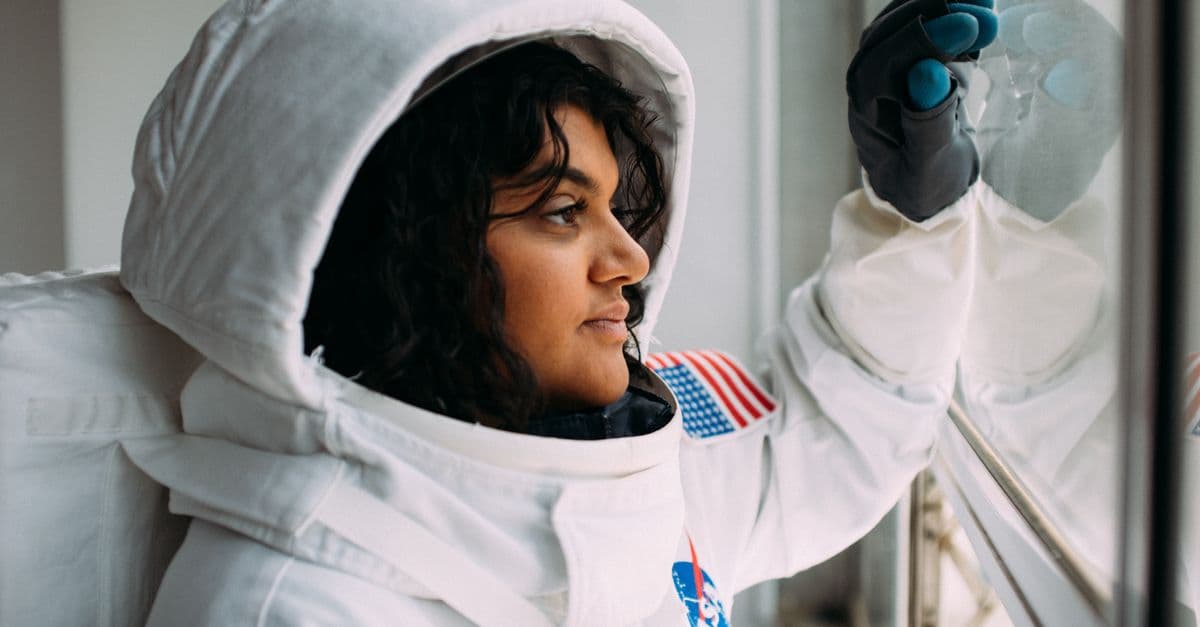
Photo: T Leish / Pexels
Katherine Johnson (1918–2020) spent thirty-three years at NASA and its predecessor agency calculating trajectories, launch windows, and orbital mechanics by hand — and later alongside early computers — for the missions that defined the Space Age. She calculated the trajectory for Alan Shepard's 1961 suborbital flight, the first American in space. She co-authored the first NASA publication authored by a woman. When John Glenn refused to enter the capsule for his 1962 orbital mission until the new IBM computers' trajectory had been verified by "the girl" — Katherine Johnson, doing the same calculations by hand — she verified them. Glenn flew. Johnson worked at NASA until age sixty-eight. She died on February 24, 2020, at one hundred and one. As a child, she counted everything.
Quick Biography
Katherine Coleman was born on August 26, 1918, in White Sulphur Springs, West Virginia, the youngest of four children of Joshua Coleman, a farmer and handyman who could not read, and Joylette Proctor Coleman, a teacher. From early childhood, Katherine counted obsessively — stairs, steps to church, dishes, forks, stars. Her mother recognized this as unusual ability. Her father drove the family 120 miles to Institute, West Virginia, each year so that Katherine and her siblings could attend school in a district that had secondary education for Black students. White Sulphur Springs did not.
She entered West Virginia State College at fifteen, an age at which most students are entering high school. The college had a small but exceptional mathematics faculty; W.W. Schieffelin Claytor, a pioneering Black mathematician and one of the early African Americans to receive a mathematics doctorate, joined the faculty and saw her talent. He created a course in analytic geometry of space specifically for her — there were no other students who could take it. She graduated summa cum laude in 1937 with degrees in mathematics and French.
She enrolled in West Virginia University's graduate mathematics program in 1939 — one of three Black students and the only woman selected to integrate the previously all-white graduate school following a court decision. She left after one semester, not because she failed, but because she was pregnant and the convention of the time was that married women with children did not pursue graduate careers. She taught school for several years.
In 1952, a relative told her that the National Advisory Committee for Aeronautics (NACA, the predecessor to NASA) was hiring Black women mathematicians as "computers" at the Langley Research Center in Hampton, Virginia. She applied, was hired, and began work in 1953 in the segregated West Area Computing section. The segregated section was abolished later that year; the computing pools were integrated, and Johnson moved to the flight research division.
She married James A. Johnson in 1959; she had been widowed from her first marriage to James Francis Goble in 1956, after fourteen years together. They had three daughters: Constance, Joylette, and Katherine, all of whom became teachers — following the professional tradition set by Johnson's own mother. James Johnson was a Korean War veteran; the two were married until his death in 2019, sixty years later. Katherine Johnson was awarded the Presidential Medal of Freedom in 2015 by President Obama. She died in February 2020 at the Londonderry Medical Center in Newport News, Virginia.
Major Scientific Contributions
The 1961 Shepard Trajectory
Alan Shepard's May 5, 1961, flight — a fifteen-minute suborbital arc in Freedom 7, the first American human spaceflight — required a precise trajectory calculation to ensure the capsule would survive reentry and land in the designated recovery zone in the Atlantic. Johnson was part of the team that computed it. The trajectory placed Shepard 302 miles downrange from Cape Canaveral and 9 miles from the recovery ship — within the predicted margin.
The John Glenn Orbital Mission (1962)
The John Glenn Friendship 7 orbital flight on February 20, 1962, is Johnson's most widely cited contribution. NASA had acquired IBM 7090 electronic computers to calculate trajectories. Glenn, who understood the limitations of early digital computers and the possibility of software errors in a new system, asked that his trajectory be verified manually by "the girl" — his term for Katherine Johnson, whose calculations he had come to trust from earlier work. According to Johnson's own account and NASA records, she spent the better part of a day running the orbital and reentry trajectory equations on her mechanical calculating equipment, verifying the computer's output. Glenn declined to fly until she confirmed the numbers matched. They did. He flew.
The episode illustrates a dimension of the human computer role that is often simplified in popular accounts. Johnson was not simply doing arithmetic that computers could not yet do; she was serving as a quality assurance function for the computers — a check on the machines based on human intelligence and judgment. The machines were faster; Johnson was trusted.
The 1969 Apollo 11 Lunar Trajectory and Backup Navigation
Johnson's contributions to Apollo 11 are more extensive than is commonly known. She contributed to the trajectory calculations for the lunar mission itself and worked on the backup navigational charts that astronauts could use if electronic systems failed during lunar orbit or on the journey to the Moon and back. The concept behind these backup charts was straightforward but the execution was demanding: a set of hand-calculated tables giving the positions of navigational stars relative to the Moon at precisely specified times, accurate enough to allow celestial navigation if all onboard digital systems failed.
The backup charts were never needed — Apollo 11's electronics performed correctly throughout. But their existence was a genuine engineering requirement, not a formality. The Apollo 11 mission had no redundant Earth-based navigation system; if the onboard computers failed and the crew could not use celestial navigation, the mission would be lost. Johnson's tables were the last line. She worked on them with the same precision she had applied to every trajectory problem for fifteen years, which meant they were correct. She has described this work in interviews with the same matter-of-fact tone she uses for everything else she did at NASA: it needed to be done, she did it, it was right.
The 1960 Navigational Report and Its Long Shadow
Johnson co-authored the report "Determination of Azimuth Angle at Burnout for Placing a Satellite Over a Selected Earth Position" with engineer Ted Skopinski in 1960 — the first NASA technical report credited to a woman. The report provided the foundational navigational equations for orbital insertion: given a desired final orbit, how do you calculate the burn angle at engine cutoff to place the satellite over a specified Earth position at a specified time? This calculation underpins every orbital rendezvous and lunar orbit insertion maneuver, not just in the 1960s missions but in the entire subsequent history of human spaceflight.
Skopinski had begun the report but found that the mathematical development was being driven by Johnson's contributions. He insisted that her name appear as co-author — a decision that was not routine at the time and that required deliberate advocacy on his part.
Earth Resources Satellites and the Later Career
Johnson's contributions to spaceflight did not end with Apollo. In the 1970s and 1980s she worked on the Earth Resources Technology Satellite (later renamed Landsat) program, which used orbital remote sensing to produce systematic observations of Earth's surface — agricultural land use, forests, coastlines, urban areas. The trajectory and orbital parameters for Earth-observing satellites require the same precision as human spaceflight trajectories, but the mission profile is different: you want the satellite in a specific repeating ground track so that the same areas are imaged on the same schedule.
Johnson's work on Earth resources satellite trajectories in the 1970s was part of a broader career transition at NASA from human spaceflight to applications satellites. The Landsat program is now recognized as one of the longest continuous Earth observation records in history; images from the first Landsat satellite have been compared to current satellite images to track deforestation, glacier retreat, urban expansion, and agricultural change over five decades. Johnson's trajectory work was part of enabling that scientific record.
Personal Life and Two Marriages
James Francis Goble and Three Daughters
Katherine Coleman married James Francis Goble in 1939, the same year she began graduate school at West Virginia University. The marriage followed conventions of the time in that Katherine left graduate school rather than continuing her education as a married woman — a decision she later described without bitterness, noting that the domestic path was simply what was expected and that it did not prevent her from returning to mathematics when opportunity arose.
James Goble worked as a chemist. They had three daughters: Constance, born 1940; Joylette, born 1943; and Katherine, born 1944. All three daughters became teachers, continuing the educational tradition established by Johnson's own mother and by Johnson herself, who had taught school in the years between leaving West Virginia University and joining NACA. The connection between Johnson's mathematical ability and the teaching vocation of her daughters is not incidental — her mother was a teacher, she was a teacher, her daughters were teachers. The educational chain is a family pattern that stretches across generations.
James Goble died of a brain tumor in December 1956, after a long illness during which Katherine had continued working at NACA while managing the household and caring for their three daughters. She was thirty-eight when she was widowed and had been working at Langley for three years. She continued working, continued caring for her daughters, and continued doing the trajectory calculations that were becoming central to the emerging human spaceflight program.
James A. Johnson and Sixty Years of Marriage
Katherine married James A. Johnson on December 13, 1959. He was a Korean War veteran and Army captain. Their marriage lasted exactly sixty years; James died in 2019, a year before Katherine. By all accounts the marriage was happy and stable. James Johnson was supportive of his wife's career at a time when that was not universal among husbands of professional women, and he is a consistent presence in her later interviews — she credits him with the emotional stability that allowed her to do her best work in the Apollo years.
The timing of the marriage was significant. Katherine married James Johnson in December 1959, one year before the Mercury program flights began in earnest. The Apollo years — 1961 through 1972 — were the peak of her technical contribution to NASA. The domestic stability of the second marriage coincided with and almost certainly supported the professional output of those years.
STEM Advocacy After NASA
Johnson retired from NASA in 1986 at the age of sixty-eight. Her retirement was not passive. In the years after her recognition — the Presidential Medal of Freedom in 2015, the Hidden Figures book and film in 2016, the naming of the Katherine G. Johnson Computational Research Facility at Langley in 2017 — she became an active advocate for STEM education for girls and for Black students. She gave speeches at schools, participated in NASA educational programs, and was explicit in interviews about why the advocacy mattered to her: she had grown up in a county without secondary school for Black children, and the barriers she had faced were systemic, not natural.
Her advocacy was not abstract. She visited classrooms, answered students' letters, and gave her name and presence to programs she believed would open doors she had had to force open herself. She continued this work into her late nineties. Her last major public appearance was in 2019, the year before her death, at the Apollo 11 fiftieth anniversary events.
Quirks and Character
She Counted Everything, Always
Johnson's counting behavior in childhood is documented in multiple interviews and in her own autobiography. She counted stairs ascending and descending, steps to church on Sunday, dishes being washed, forks at the table, stars visible at night. The counting was involuntary and persistent; she described it in interviews as simply the way her mind operated. The behavior is consistent with what developmental psychologists would recognize as an unusual early quantitative sensitivity — an automatic encoding of numerical information that most people do not experience.
Her family treated it as remarkable but not alarming. Her father, who could not read, had a notable facility with mental arithmetic himself and appears to have recognized the quantitative ability as a family trait running unusually strong in Katherine. Her mother, a teacher, understood it as something to cultivate rather than suppress. The result was a child who entered college at fifteen with a mathematical preparation well beyond her stated grade level.
She Demanded to Attend All-Male Engineering Meetings
When Johnson was assigned to the Guidance and Control Branch in the Flight Research Division, she was doing work that required attending the engineering briefings where mission parameters were discussed. The briefings were attended by the (all-male, all-white) engineers. Johnson showed up. She was not invited; she was not told she could come; she simply appeared, sat down, and continued appearing.
Her account of this, given in multiple interviews, is notable for its matter-of-factness. She said she had noticed that "no one told her she couldn't" attend. The briefings were not formally restricted; they were practically all-male by custom and assumption. Johnson treated custom and assumption as irrelevant. She continued attending until her attendance became unremarkable — until she was, functionally, one of the engineers for the purposes of the briefing room.
This was not a minor act of self-assertion in 1950s Virginia. The segregated South was structured to make exactly this kind of behavior costly; women and Black Americans who stepped across these invisible lines routinely faced formal or informal retaliation. Johnson apparently faced neither, in part because her work was simply too good to make her removal from the process conceivable to the engineers who needed her. She was there because they needed her calculations, and she stayed because she did not acknowledge the custom as a constraint.
She Had to Use a Segregated Bathroom — Until She Didn't
For the first several years at Langley, Johnson was assigned to the West Area Computing section, a segregated unit. This meant segregated bathrooms, segregated dining facilities, and a workplace organized by race in all the dimensions that Jim Crow Virginia required. The computing section's building had a sign on the bathroom; Johnson has described in interviews ignoring the signs and using the main building's bathrooms, which were not labeled because they were assumed to be white-only. She described not being told where the "colored" bathroom was, and when asked about it, saying she simply did not know where it was.
The 2016 film Hidden Figures, based on Margot Lee Shetterly's 2016 book of the same name, dramatizes this in a different form — a scene involving a long walk to a distant bathroom was added for dramatic effect and does not match Johnson's own account of the situation. Johnson herself, in a 2016 interview, said the film's portrayal was somewhat dramatized: she recalled her supervisor saying "You don't have to go to the colored bathroom" and her own response being to simply continue using the nearest facilities regardless of designation.
The discrepancy between the film's dramatization and Johnson's actual account is worth noting because it illustrates a general problem in popular historical representation — the real story, in which Johnson navigated segregation with practical intelligence and personal dignity rather than a single dramatic confrontation, is perhaps less cinematically convenient but no less remarkable.
She Worked at NASA Until Age 68
Johnson joined NACA/NASA in 1953 at age thirty-four and retired in 1986 at sixty-eight. Her career spanned the transition from propeller-driven research aircraft to the Space Shuttle. In her thirty-three years, she worked on Project Mercury, the Apollo program, the Apollo-Soyuz mission, the Space Shuttle program, and Earth resources satellite missions. She was not a temporary or peripheral figure brought in for a single famous calculation; she was a career mathematician whose work touched the major NASA programs of four decades.
Her longevity in the role was not incidental. The precision of trajectory calculation involves accumulated expertise — intuitions about when a computation "looks wrong" that are built over thousands of worked problems, familiarity with the particular error modes of specific types of calculation, and the kind of calibrated confidence in one's own numbers that only comes from having them verified against reality repeatedly. Johnson's thirty-three years meant she carried more of this expertise than almost anyone else in her field. For more on women in computing and mathematics whose contributions were long unrecognized, see Ada Lovelace's biography.
The Presidential Medal of Freedom, and the Long Wait
Johnson received the Presidential Medal of Freedom in 2015, when she was ninety-seven years old. The award was presented by President Barack Obama at a White House ceremony. The film Hidden Figures, released in 2016, introduced her to a wide general audience.
The timing — sixty-two years after she joined NASA, fifty-three years after the John Glenn mission — illustrates the pace at which the contributions of Black women to the Space Age were publicly recognized. Dorothy Vaughan and Mary Jackson, Johnson's colleagues in the West Area Computing section, received similar posthumous recognition. All three are now among the most widely known figures of the Space Race in popular culture; for most of their working lives, their names were not public. The NASA Langley Research Center's new computation research facility was named the Katherine G. Johnson Computational Research Facility in 2017. A building at Langley being named for a living person was unusual.
Famous Quotes
"I counted everything. I counted the steps to the road, the steps up to church, the number of dishes and silverware I washed... anything that could be counted, I did." From Johnson's memoir and multiple interviews. Her own account of the childhood counting behavior.
"You are no better than anyone else, and no one is better than you." Attributed to her father Joshua Coleman, which Johnson cited repeatedly in interviews as a formative principle. Her account of her father's teaching emphasized both racial equality and personal accountability.
"Girls are capable of doing everything men are capable of doing. Sometimes they have more imagination than men." Widely attributed to Johnson; the source is multiple interviews and public speeches in her later years.
"I went to work every day for 33 years happy. Never did I get up and say I don't want to go to work." From Johnson's 2015 autobiography Reaching for the Moon (written for children) and multiple adult interviews. Her consistent account of her career affect.
Legacy
Katherine Johnson's legacy operates at two levels. At the technical level, her calculations contributed directly to every major American human spaceflight mission from 1961 through the 1980s. The trajectories, launch windows, and navigational tables she computed were the mathematical backbone of the Space Race. The trust Glenn placed in her numbers over the IBM computers was not sentiment; it was a professional judgment about reliability that the record had earned.
At the cultural level, her recognition after 2016 has made her one of the most widely known figures in the history of NASA. Her story — a Black girl from a West Virginia county with no secondary schools for Black children who calculated the orbit of John Glenn by hand — is one of the most striking biographical arcs in the history of American science. The NASA facility named for her, the Presidential Medal of Freedom, and the cultural impact of Hidden Figures ensure that her contribution will be part of the standard account of the Space Age.
Her longevity is also part of the legacy. Johnson was born eight years before Goddard's first liquid-fueled rocket flight (1926), was thirty-nine when Sputnik launched (1957), calculated Glenn's orbit at forty-three, was fifty when Apollo 11 landed on the Moon (1969), and lived to see astronauts return to lunar orbit planning in her final years. She died at one hundred and one, having witnessed the entirety of the Space Age from its beginning.
FAQ
Q: What did Katherine Johnson calculate for John Glenn? For John Glenn's February 1962 Friendship 7 orbital mission, Johnson manually verified the reentry trajectory that had been calculated by IBM 7090 computers. Glenn, who did not fully trust the new computers, asked specifically that Johnson check the numbers before he flew. She confirmed them, and the mission proceeded. The trajectory placed the capsule in the correct reentry corridor and Glenn was recovered safely.
Q: What were the "human computers" at NASA? Before and during the early years of electronic computing, NASA (and its predecessor NACA) employed teams of mathematicians — "computers" was the job title — to perform calculations by hand or with mechanical calculators. At Langley, the West Area Computing section was an all-Black, all-female unit, segregated from the white computing pools. These mathematicians performed the numerical work that underpinned aeronautical research and early spaceflight, including trajectory, aerodynamic, and structural calculations.
Q: How old was Katherine Johnson when she entered college? Johnson entered West Virginia State College at fifteen, having completed her schooling in Institute, West Virginia — her family drove 120 miles each way annually because White Sulphur Springs had no secondary school for Black students. She graduated summa cum laude at eighteen with degrees in mathematics and French.
Q: What does the film Hidden Figures get wrong about Katherine Johnson? The film's most-discussed dramatization is the bathroom sequence, which presents Johnson making a long run across the Langley campus to use a segregated bathroom. Johnson's own account is different: she described not knowing where the "colored" bathroom was and using the nearest facilities regardless of designation, and her supervisor eventually told her she didn't need to use the segregated bathrooms. The dramatic confrontation was added by the filmmakers. Johnson said she appreciated the film's intent but the bathroom situation "was not as bad as shown."
Q: Did Katherine Johnson work on the Moon landing? Yes. Johnson contributed to Apollo program trajectory calculations, including the lunar mission trajectory and backup celestial navigation tables for Apollo 11 that could be used if electronic systems failed during the mission. She co-authored the 1960 report providing equations for orbital insertion over specified Earth positions, a foundational document for NASA's rendezvous and lunar orbit calculations.
Q: What happened to Johnson's first husband? Johnson's first husband, James Francis Goble, was a chemist. They married in 1939 and had three daughters: Constance, Joylette, and Katherine. James Goble died of a brain tumor in December 1956. Johnson was thirty-eight at the time, had been working at NACA for three years, and continued working while raising her daughters. She remarried in 1959 to James A. Johnson, a Korean War veteran; that marriage lasted sixty years until James Johnson's death in 2019.
Q: What did Johnson's daughters do? All three of Johnson's daughters with James Goble — Constance, Joylette, and Katherine — became teachers, continuing the educational tradition set by Johnson's mother Joylette Coleman, who had also been a teacher, and by Johnson herself, who taught school before joining NACA. The teaching vocation spanning three generations is a detail Johnson mentioned with evident pride in multiple interviews.
Q: What did Katherine Johnson do after retiring from NASA? Johnson retired from NASA in 1986. After her public recognition began in 2015 with the Presidential Medal of Freedom and accelerated with the 2016 Hidden Figures film and book, she became an active STEM education advocate, particularly for girls and Black students. She visited schools, participated in NASA educational programs, and continued public appearances into her late nineties. She attended Apollo 11 fiftieth anniversary events in 2019, one year before her death.
Sources
- Shetterly, Margot Lee. Hidden Figures: The American Dream and the Untold Story of the Black Women Mathematicians Who Helped Win the Space Race. William Morrow, 2016.
- Johnson, Katherine G. Reaching for the Moon. Atheneum Books, 2019.
- Skopinski, T.H., and Katherine G. Johnson. "Determination of Azimuth Angle at Burnout for Placing a Satellite Over a Selected Earth Position." NASA TN D-233, 1960.
- NASA Langley Research Center. Oral history interviews with Katherine Johnson, 1983 and 2008.
- Barry, John M. Rising Tide. Simon & Schuster, 1997. [For institutional segregation context]
- Murray, Charles, and Catherine Bly Cox. Apollo: The Race to the Moon. Simon & Schuster, 1989.
- Glenn, John, with Nick Taylor. John Glenn: A Memoir. Bantam, 1999.
Follow new articles
Add SciHub101 to your feed reader to see new science and technology stories.
About the Author
SciHub101 is an independent science and technology publication founded and edited by Buğra Sözeri, a software engineer and app developer based in Türkiye. AI tools assist with drafting and research. Source documentation in the existing archive is uneven, and articles are being reviewed and corrected. The Editorial Team byline identifies editorial responsibility; it does not certify specialist or independent human review. Where we compare products, anything built by our own team is labelled as such — see the editorial guidelines and About page for how corrections and disclosures work.
Related Articles
Linus Pauling: Two Nobel Prizes, the Wrong DNA Model, and the Vitamin C Obsession
Linus Pauling won two unshared Nobel Prizes, proposed the wrong triple-helix DNA structure, and spent decades promoting vitamin C megadoses that science has not validated.

Galileo Galilei: The Finger in the Museum and the Man Who Talked Back to Rome
Galileo Galilei's life, discoveries, and verified quirks: his preserved finger on display, three illegitimate children, the Inquisition recantation, and the apocryphal 'Eppur si muove'.
Emmy Noether: The Mathematician Who Unified Symmetry and Physics
Emmy Noether proved that every symmetry in nature corresponds to a conservation law. Einstein called her the most significant creative mathematical genius ever produced.

The Space Race: How Cold War Rivalry Put Humans on the Moon
The space race was a Cold War battle for supremacy, fought with rockets instead of bombs. It ended with humanity's greatest adventure.
Claude Shannon: The Bell Labs Tinkerer Who Invented Information
Claude Shannon founded information theory in 1948, proved Boolean algebra runs circuits in 1937, built a maze-solving mouse, and juggled on a unicycle through Bell Labs hallways.

Ernest Rutherford: The New Zealander Who Split the Atom
Ernest Rutherford discovered the atomic nucleus, named alpha and beta radiation, and mentored 11 future Nobel laureates. His biography, gold foil experiment, and legacy.