Vera Rubin: The Astronomer Who Found the Dark Matter Hiding in Plain Sight
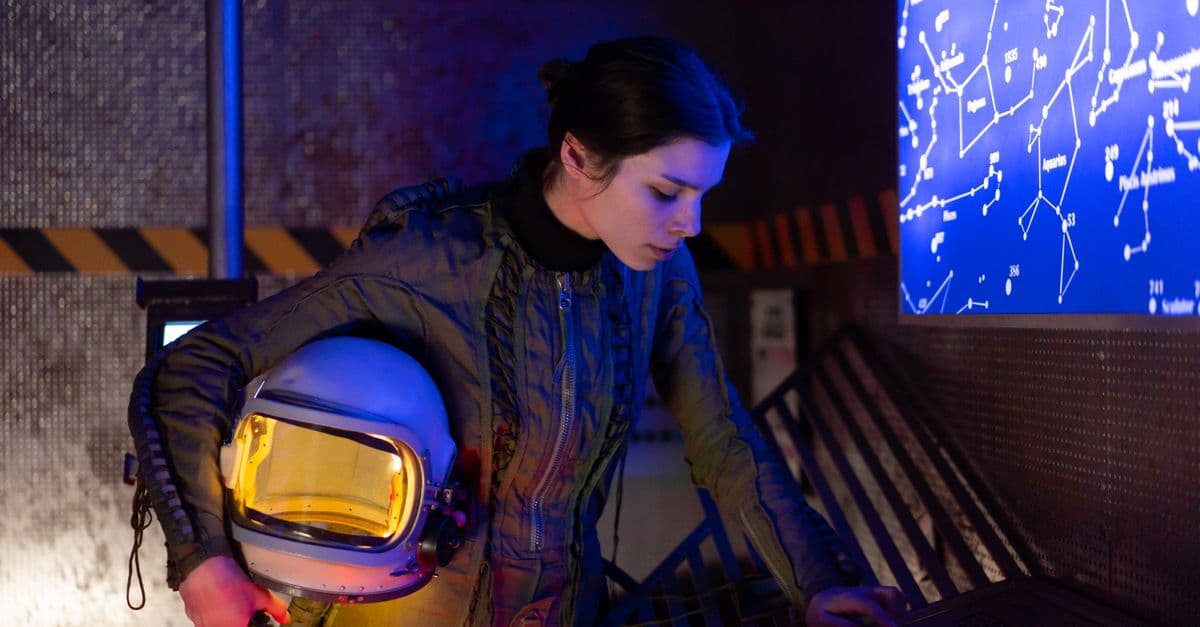
Photo: Mikhail Nilov / Pexels
Vera Rubin (1928–2016) spent years measuring the rotation speeds of stars in spiral galaxies and finding that the numbers did not work. Stars at the outer edges of galaxies were rotating far too fast to be explained by the visible matter inside them. By Newtonian gravity, the outer stars should be moving slower than inner stars — just as the outer planets of the solar system orbit the Sun more slowly than the inner ones. They were not. They were all moving at approximately the same speed, and the only explanation that held up was that each galaxy was embedded in an enormous halo of matter that could not be seen — dark matter, constituting roughly five times as much mass as all the visible stars and gas combined. Rubin did not speculate about dark matter; she measured its gravitational effects with precision and published the measurements. The astrophysical community eventually concluded she was right. She was turned away from Princeton as a prospective graduate student in 1948 because the astronomy program did not admit women. She made her own restroom sign at Palomar Observatory when she became one of the first women permitted to use the telescope there. She never received the Nobel Prize. She died in 2016 at eighty-eight, still working.
Quick Biography
Vera Florence Cooper was born on July 23, 1928, in Philadelphia, the younger of two daughters of Philip Cooper, an electrical engineer, and Rose Applebaum Cooper. The family moved to Washington, D.C., when she was ten. She discovered astronomy by watching the stars move across her bedroom window at night — she describes this directly in her autobiography and in interviews, with the specificity of a memory that organized a life. She made a cardboard telescope. Her father helped her build a better one. He took her to amateur astronomy meetings. From early adolescence, there was no question about what she would do.
She graduated from Vassar College in 1948 with a degree in astronomy — Vassar was one of very few colleges that offered astronomy to women. She applied to Princeton University's graduate program in astronomy. Princeton responded by not sending her an application, because the graduate program did not admit women. (The Princeton astronomy graduate program did not admit women until 1975.) She enrolled at Cornell University instead, studying under Philip Morrison and others. She completed her master's degree at Cornell in 1951, writing a thesis on the question of whether galaxies might have a large-scale rotation relative to the center of the universe — a question that was somewhat heterodox and attracted skeptical comment at the time. She completed her doctorate at Georgetown University in 1954, while living in the Washington area with her husband Robert Rubin, a physical chemist, and raising what would become four children. She continued working through pregnancies and childcare, driving to late-night telescope sessions, doing what was necessary to keep the science going.
She joined the department of terrestrial magnetism at the Carnegie Institution of Washington in 1965, where she would work for the rest of her career. The Carnegie DTM had good instrumentation, capable colleagues, and sufficient research time. She was fifty-four when she was elected to the National Academy of Sciences in 1981. She received the National Medal of Science from President Clinton in 1993. She was the second woman, after Cecilia Payne-Gaposchkin, to receive the Royal Astronomical Society's Gold Medal, in 1996. She never received the Nobel Prize. She died on December 25, 2016.
Personal Life: A Partnership That Made the Science Possible
Vera Cooper married Robert Joshua Rubin in 1948, while she was still at Vassar and he was a graduate student at Cornell. Robert Rubin was a mathematician and physical chemist who pursued his own career in research. The marriage lasted sixty years, until his death in 2008. The longevity of the partnership is relevant to understanding how her career worked: she had a husband who understood and supported what she was doing, at a time when the default expectation for a married woman with children was to stop.
They had four children: David (born 1950), Judith (born 1952), Karl (born 1956), and Allan. All four obtained PhDs in the natural sciences or mathematics. David became a geologist with the U.S. Geological Survey. Judith Young became an astronomer at the University of Massachusetts — Amherst, publishing substantially on molecular gas in galaxies. Karl became a mathematician, eventually a professor at Stanford. Allan earned a doctorate in science. The fact that three of the four children became scientists is remarkable; that one became an astronomer directly in her field suggests a household in which science was not the mother's professional secret but the family's shared orientation.
Rubin described in interviews the specific logistics of conducting an astronomy career while raising four children in the 1950s and 1960s — driving to observatories at night, managing telescope time around school schedules, the accumulated logistics of two scientists in one household. She did not present this as a story of heroic sacrifice; she presented it as a problem that required solving, and she solved it. She consistently credited Robert's support — his equal investment in the household — as essential. The children later described their mother making science appear desirable and interesting, not burdensome.
Robert Rubin died in 2008. Vera Rubin continued working at the Carnegie Institution for eight more years, until shortly before her death in December 2016.
Major Scientific Contributions
Galaxy Rotation Curves and the Dark Matter Evidence
The core of Vera Rubin's scientific contribution is the measurement of galaxy rotation curves — plots of the orbital speed of stars and gas as a function of their distance from the galactic center — for a large sample of spiral galaxies. The work, done primarily with astronomer Kent Ford using an image-tube spectrograph Ford had developed, began systematically in the late 1960s and continued through the 1970s.
The prediction of Newtonian mechanics, applied to galaxies, is that rotation speed should decline with distance from the center after a certain radius — just as Earth moves at 29.8 km/s around the Sun while Neptune, much further out, moves at 5.4 km/s. This expected decline — a Keplerian falloff — was not observed. Instead, the rotation curves were flat: stars at the outer edges of spiral galaxies were moving at roughly the same speed as stars closer to the center, regardless of how far out the measurements extended.
Rubin and Ford published their first detailed rotation curve results in 1970, for the Andromeda Galaxy (M31). By 1978 they had published flat rotation curves for ten spiral galaxies. By the mid-1980s, flat rotation curves had been measured for dozens of galaxies, including extremely faint and low-surface-brightness galaxies where the result could not plausibly be attributed to measurement artifacts.
The flat rotation curves implied that the mass of each galaxy did not end at the visible edge — the point where stars and gas ran out — but continued outward in a distribution that kept the gravitational pull constant well beyond the visible disk. The mass responsible for this extended gravity could not be seen in any wavelength — it emitted no light, absorbed no light, was not visible as dust or gas. It was, in the terminology then being established, dark matter.
Fritz Zwicky had inferred the existence of non-luminous matter from the dynamics of galaxy clusters in 1933, but his result had not been widely adopted. The theoretical idea of dark matter halos had been developed by Jan Oort and others. What Rubin and Ford provided was systematic observational evidence across many individual galaxies — evidence sufficiently consistent and well-measured that it could not be dismissed as an artifact of a particular galaxy's unusual structure. For an introduction to what dark matter is and the current state of the search for it, see what is dark matter.
Peculiar Velocities, the Rubin-Ford Effect, and the Great Attractor
Rubin's doctoral thesis, completed in 1954, examined whether galaxies showed a large-scale deviation from pure Hubble expansion — a residual coherent motion suggesting some rotation or bulk flow of matter. She studied the motions of 109 galaxies and found evidence of systematic deviations from the smooth Hubble expansion. Her conclusion, that galaxies in the Milky Way's vicinity had a systematic excess velocity, was treated skeptically at the time. A revised version of the paper, published in the Proceedings of the National Academy of Sciences in 1951, attracted negative comments from senior astronomers including Martin Schwarzschild, who challenged her result at a conference. She was a new PhD student; the challenge was public and her result was dismissed.
She was right. In the mid-1970s, Rubin and Ford (along with collaborators including Norbert Thonnard) documented what became known as the Rubin-Ford effect: a large-scale coherent motion of galaxies relative to the rest frame of the cosmic microwave background. This was systematic observational evidence for what cosmologists would later call the Great Attractor — a large concentration of mass in the direction of the Centaurus and Hydra constellations, revealed in the 1980s by the "Seven Samurai" group of astronomers, that is gravitationally pulling a substantial volume of the universe at roughly 600 km/s. Rubin had detected its signature two decades before it was formally identified.
The early dismissal of her 1951 thesis result and its eventual vindication is a pattern her career repeated: correct, early, dismissed, confirmed. The specific mechanism by which she was dismissed — a senior male astronomer publicly challenging a graduate student's result at a conference — is documented and has become one of the canonical examples in discussions of how early-career women are treated in science.
Contributions to the Study of Spiral Galaxy Structure
Beyond rotation curves, Rubin and her collaborators produced detailed analyses of the spatial structure of spiral galaxies, including the relationship between galaxy luminosity, mass, and rotation speed. This relationship — the Tully-Fisher relation, established by R. Brent Tully and J. Richard Fisher in 1977 and substantially enriched by Rubin's data — became a standard method for measuring distances to spiral galaxies and is used in cosmological distance measurements.
Her work on the internal kinematics of individual galaxies — the motions of stars and gas within a single galaxy, mapped in detail — also contributed to understanding how spiral structure forms and persists, and how bars and rings in galaxies relate to the underlying mass distribution.
Lesser-Known Habits and Quirks
She Was Rejected by Princeton Before She Could Apply
The Princeton rejection is documented — Rubin has described it in multiple interviews and in her own writing. After graduating from Vassar in 1948, she wrote to Princeton to request an application to the graduate program in astronomy. Princeton's response was that the program did not admit women and that no application would be sent. This was 1948; the program would not admit women for another twenty-seven years.
The practical consequence was that she went to Cornell, where she received an excellent graduate education. But the Princeton rejection exemplifies the structural situation of women in American astronomy at mid-century: not hostility encountered after entry but refusal before the gate. The program did not need to evaluate Rubin to exclude her; her sex was sufficient.
She discussed this without apparent resentment in her later career. She noted that Cornell had been excellent and that her trajectory had worked out. What she also noted — in the same interviews — was that the structural exclusion was not about her individual case. Many other women were excluded from many other programs by the same mechanism. Most of them did not find alternative routes.
She Made Her Own Women's Restroom Sign at Palomar Observatory
Palomar Observatory, operated by Caltech, was for most of its history a facility designed for and used by men. The observer's quarters had men's restrooms; there were no women's restrooms. When Rubin became one of the first women to observe at Palomar — in the early 1960s, when the male-only policy was being relaxed rather than formally ended — she solved the practical problem by cutting a skirt shape out of paper and taping it to the figure on the men's restroom door.
This anecdote is documented in multiple accounts and has become one of the canonical stories of women's integration into professional astronomy. Rubin told it herself, and the tone in her telling is consistent: practical problem, practical solution, no drama. She needed to use the restroom; she identified which one was available; she made a sign.
What is less often noted is that the institutional situation was not accidental. Palomar had been built with residential facilities for observers who were expected to be male. The absence of women's restrooms was not an oversight; it reflected a design assumption about who would be using the telescope. Rubin's sign was not just practical adaptation; it was a correction of an assumption.
Her Four Children All Got Science PhDs — and She Said It Was Because Science Looked Fun
All four of Vera and Robert Rubin's children obtained doctorates in the natural sciences or mathematics. Daughter Judith became an astronomer, working on molecular gas in galaxies at the University of Massachusetts. Son David became a geologist with the USGS. Son Karl became a mathematician at Stanford. The children later described the household as one where scientific curiosity was normalized — their mother was always working on interesting problems, and the work was described at the dinner table with genuine enthusiasm. Rubin herself said, when asked about this outcome, that she thought science must have looked appealing to them because she found it genuinely exciting. She had not pushed them toward it; she had simply been honest about enjoying it.
The practical consequence was also notable: three of her children could, in their adult careers, understand what their mother had spent her life doing. When her rotation curve work was eventually confirmed and celebrated, the family conversation about it was not between a scientist and laypeople but between scientists who understood the specific measurements and what they meant.
She Kept Working Through Rejection and Skepticism That Would Have Stopped Most People
The reception of Rubin's early work — her 1951 paper on galactic rotation dismissed and rejected; her rotation curve work initially received with skepticism — follows a pattern she encountered repeatedly. Her response to each instance was the same: continue working, produce more data, let the measurements speak.
The 1951 paper experience, in which she presented her thesis results at a meeting and was challenged by senior astronomers in public, would have discouraged many graduate students from continuing in the field. She had a one-year-old child at the time and had completed her master's degree while caring for him. She continued. The rotation curve results of the late 1960s were not immediately accepted; other astronomers proposed alternatives or treated the results as possibly artifactual. She and Ford extended the sample and improved the precision until the alternatives became untenable.
Her student and colleague Neta Bahcall noted that Rubin worked with an unusual combination of observational rigor and theoretical stubbornness: she was meticulous about what the data said and unwilling to accept an explanation that required the data to be wrong.
She Mentored Actively and Spoke Publicly About Women in Astronomy
Rubin was not content to have succeeded despite structural barriers without noting, publicly, that the barriers existed and were doing ongoing damage. She gave talks, wrote essays, and spoke in interviews about the specific ways institutions excluded women from careers in astronomy. She was not, in these discussions, angry or bitter — she was precise and factual, in the same register in which she discussed galaxy kinematics. Here is what the data show about how women are treated. Here is what that costs.
She connected this to mentorship directly. Her most often cited statement about young people was about the importance of having a mentor who took their work seriously — a statement grounded in gratitude for the mentors she had had, and in awareness of the difference such attention made. She was that mentor for many younger women astronomers.
Her connection to Katherine Johnson is notable by parallel: Johnson calculated orbital trajectories at NASA during the same years Rubin was measuring galaxy rotation at the Carnegie Institution. Both navigated structural exclusion from different institutional positions; both produced lasting work; both received formal recognition late in careers that had been delivering results for decades.
Famous Quotes
"Still more mysteries of the universe remain hidden. Their discovery awaits the adventurous scientists of the future. I like it this way." From a 1996 interview — characterizing her attitude toward the limits of current knowledge.
"In a spiral galaxy, the ratio of dark to light matter is about a factor of ten. That's probably a sobering fact." From a public lecture — her characteristic understatement about the implication that most of the universe is invisible.
"We have peered into a new world and have seen that it is more mysterious and complex than we had imagined. Still more mysteries of the universe remain hidden." From her 1996 National Medal of Science acceptance remarks — typically modest framing of a decades-long discovery.
"If I could have one wish for young people, it would be that they would have a mentor who cared about them. I am very grateful for the mentors I had." From a 2009 interview, reflecting on the importance of the people who took her work seriously early in her career.
Legacy
Dark matter remains the central unsolved problem in cosmological physics. Its existence is inferred from gravitational effects — galaxy rotation curves, galaxy cluster dynamics, gravitational lensing, the large-scale structure of the universe — and Vera Rubin's rotation curve measurements are the most direct and reproducible evidence for it. Every attempt to model the structure and evolution of the universe requires dark matter; every model that omits it fails to match the observations. The search for what dark matter actually is — whether it is a new particle, primordial black holes, or something else — is one of the most active areas in particle physics and cosmology.
Rubin's specific contribution was to turn dark matter from a theoretical inference from cluster dynamics (Zwicky's 1933 work) into an observational fact about individual galaxies, confirmed across many independent systems with high-quality spectroscopic data. The transition from possible to required — from "here is one way to explain this" to "this is what the data say and nothing else works" — is what her observational campaign achieved.
The Vera C. Rubin Observatory, located at Cerro Pachón in Chile and beginning full operations with the Legacy Survey of Space and Time (LSST), is named for her. It will repeatedly image the entire visible sky over ten years, producing the largest photometric survey in history. The naming is a recognition both of her contribution to dark matter science and of the specific trajectory of her career — turned away from Princeton, self-made sign at Palomar, National Medal of Science at sixty-five, still working at eighty-eight.
FAQ
Q: What is a galaxy rotation curve? A: A rotation curve is a plot of the orbital speed of stars and gas in a galaxy as a function of their distance from the galaxy's center. Newtonian mechanics predicts that this speed should decline at large radii (the Keplerian falloff). Rubin and Ford's measurements showed that it does not — it remains approximately flat. The flat rotation curve implies that mass continues to be distributed well beyond the visible disk of the galaxy, in a form that does not emit light: dark matter.
Q: Did Vera Rubin discover dark matter? A: Rubin provided the most systematic and compelling observational evidence that galaxies contain far more mass than their visible stars and gas account for. Fritz Zwicky had inferred a mass discrepancy in galaxy clusters in 1933, and Jan Oort had noted similar issues in the Milky Way. Rubin's contribution was to demonstrate the effect consistently across many individual spiral galaxies using high-quality rotation curve data, making the dark matter interpretation essentially unavoidable.
Q: Why did Vera Rubin not receive the Nobel Prize? A: She was never awarded the Nobel Prize before her death in December 2016, despite being widely considered a leading candidate. The Nobel Prize cannot be awarded posthumously. Dark matter has not yet been directly detected as a particle or identified with a specific physical constituent, which may have been a factor in the Nobel Committee's hesitation — the observational evidence is overwhelming, but the underlying nature of dark matter remains unknown.
Q: What was the Princeton rejection? A: When Rubin wrote to Princeton University in 1948 requesting an application to the graduate program in astronomy, she was informed that the program did not admit women and that no application would be sent. Princeton's astronomy graduate program did not admit women until 1975. She enrolled at Cornell instead, completing her master's degree there in 1951.
Q: Is the Vera Rubin Observatory named after her? A: Yes. The Large Synoptic Survey Telescope at Cerro Pachón, Chile, was renamed the Vera C. Rubin Observatory in 2020. It is conducting the Legacy Survey of Space and Time over ten years, imaging the full visible sky repeatedly and contributing to dark matter, dark energy, and transient source research.
Q: What were Vera Rubin's children's careers? A: All four children of Vera and Robert Rubin obtained doctorates in science or mathematics. David became a geologist with the U.S. Geological Survey. Judith Young became an astronomer at the University of Massachusetts, working on molecular gas in galaxies. Karl became a mathematician. Allan also holds a research doctorate. Rubin attributed this outcome to making science look genuinely exciting at home rather than to any deliberate effort to steer the children toward specific fields.
Q: What is the Rubin-Ford effect? A: The Rubin-Ford effect is a large-scale coherent motion of galaxies relative to the cosmic microwave background rest frame, first documented by Rubin and Kent Ford in work published in the mid-1970s. It was evidence for what was later identified as the Great Attractor — a massive concentration of matter gravitationally pulling a large region of the universe. Rubin had detected evidence of this structure decades before it was formally characterized by the "Seven Samurai" group in the 1980s. Her 1951 master's thesis had also pointed at large-scale deviations from simple Hubble expansion, and was dismissed at the time.
Q: What is the Tully-Fisher relation and did Rubin contribute to it? A: The Tully-Fisher relation, established by R. Brent Tully and J. Richard Fisher in 1977, is the empirical relationship between the rotation speed of a spiral galaxy and its intrinsic luminosity. Because rotation speed is measurable and luminosity can be inferred from rotation speed, the relation allows distances to spiral galaxies to be estimated. Rubin's rotation curve data substantially contributed to establishing and calibrating this relation, and the method continues to be used in cosmological distance measurements.
Sources
- Rubin, Vera C., and W. Kent Ford Jr. "Rotation of the Andromeda Nebula from a Spectroscopic Survey of Emission Regions." Astrophysical Journal 159 (1970): 379–403.
- Rubin, Vera C., W. Kent Ford Jr., and N. Thonnard. "Rotational Properties of 21 Sc Galaxies with a Large Range of Luminosities and Radii." Astrophysical Journal 238 (1980): 471–487.
- Rubin, Vera. Bright Galaxies, Dark Matters. AIP Press, 1997. (Essays and autobiography.)
- Bartusiak, Marcia. "The Woman Who Spins the Stars." Discover, October 1990.
- Overbye, Dennis. "Vera Rubin, 88, Dies; Opened Doors in Astronomy, and for Women." New York Times, December 27, 2016.
- Bahcall, Neta, and Lyman Spitzer Jr. "Vera Rubin." Proceedings of the National Academy of Sciences 115 (2018): 2362–2364. (Biographical Memoir.)
- Sanders, Robert H. The Dark Matter Problem: A Historical Perspective. Cambridge University Press, 2010.
- Vera C. Rubin Observatory / LSST Science Collaboration. rubinobservatory.org.
Follow new articles
Add SciHub101 to your feed reader to see new science and technology stories.
About the Author
SciHub101 is an independent science and technology publication founded and edited by Buğra Sözeri, a software engineer and app developer based in Türkiye. AI tools assist with drafting and research. Source documentation in the existing archive is uneven, and articles are being reviewed and corrected. The Editorial Team byline identifies editorial responsibility; it does not certify specialist or independent human review. Where we compare products, anything built by our own team is labelled as such — see the editorial guidelines and About page for how corrections and disclosures work.
Related Articles
Ada Lovelace: Poet of Mathematics and the First Computer Program
Ada Lovelace's life, discoveries, and verified quirks: Lord Byron's daughter, calling math 'poetical science', a gambling algorithm addiction, and the world's first published program.
Subrahmanyan Chandrasekhar: The Limit That Eddington Tried to Kill
Subrahmanyan Chandrasekhar's life, the Chandrasekhar limit, and verified quirks: humiliated by Eddington, derived the limit at 19 on a ship, taught 2 students who both won Nobels.
Donna Strickland: Third Woman to Win Physics Nobel, Still an Associate Professor When She Won
Donna Strickland's chirped pulse amplification technique is the laser physics behind LASIK eye surgery. Wikipedia rejected her as 'not notable' five months before her 2018 Nobel Prize.
Marie Tharp: The Woman Who Mapped the Ocean Floor and Proved Plate Tectonics Was Real
Marie Tharp mapped the entire ocean floor from shore, banned from research ships. Her discovery of the Mid-Atlantic Ridge rift valley confirmed plate tectonics — called 'girl talk' by her own colleague.

Chien-Shiung Wu: The Physicist Who Proved the Universe Is Not Left-Right Symmetric
Chien-Shiung Wu proved parity violation in 1956, overturning a 30-year assumption in physics. Lee and Yang got the Nobel. She didn't. She worked on the Manhattan Project and always wore a qipao.
Emmy Noether: The Mathematician Who Unified Symmetry and Physics
Emmy Noether proved that every symmetry in nature corresponds to a conservation law. Einstein called her the most significant creative mathematical genius ever produced.