Voyager 1 and 2 — The Most Distant Human-Made Objects in Space
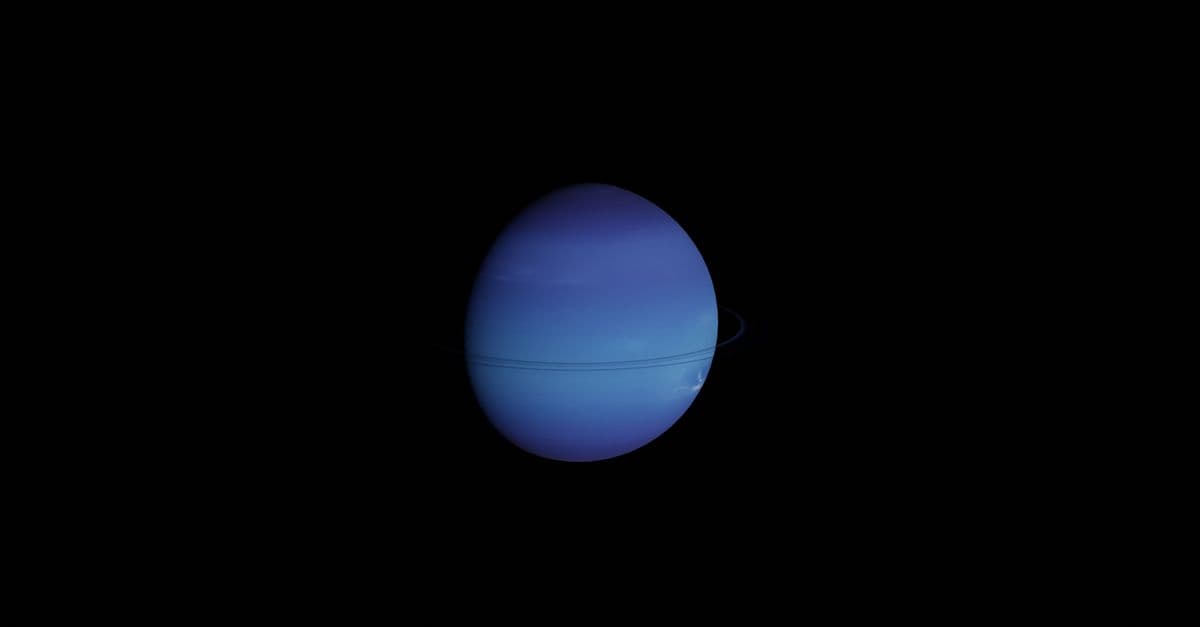
Photo: Zelch Csaba / Pexels
The two Voyager spacecraft, launched in 1977, have travelled further than anything humans have ever built. Voyager 1 is over 25 billion kilometres from Earth and still calling home. Both spacecraft have left the Solar System and are now drifting through interstellar space. Each carries a golden record — a message in sound and image from Earth, meant for any extraterrestrial civilisation that might find it sometime in the next billion years.
Here's the story of the most successful interplanetary mission ever flown.
Key takeaways
- Launched in 1977, both Voyagers are still operating in 2025.
- Together they've explored Jupiter, Saturn, Uranus, and Neptune, sending back the first detailed images of all four.
- Voyager 1 became the first human-made object to enter interstellar space (2012).
- They carry the Golden Record — a phonograph record with sounds and images from Earth.
- Their instruments are slowly being shut down due to dwindling power; mission end is expected around 2030–2035.
The mission origin
In the late 1960s, scientists realised a rare alignment of the outer planets — Jupiter, Saturn, Uranus, and Neptune — would occur in the late 1970s, allowing a single spacecraft to use gravity assists to visit all four planets. This alignment happens roughly once every 176 years; the previous opportunity was in 1801. Missing it meant waiting until 1951 in the next century. The opportunity was too good to pass.
Gravity assist — also called a "slingshot" maneuver, the technique of using a planet's gravitational field to accelerate a spacecraft to higher speeds while using less fuel than a direct trajectory would require.
A JPL team led by Gary Flandro calculated the optimal trajectory. By passing close to each planet in sequence, Voyager could gain speed from each world's gravity and redirect to the next. This "Grand Tour" was far more ambitious than anything NASA had attempted. Two spacecraft were built and launched within weeks of each other in 1977:
- Voyager 2: launched August 20, 1977 (yes, slightly earlier than Voyager 1, despite the name).
- Voyager 1: launched September 5, 1977. Took a faster trajectory, hence the name.
Source: Flandro, G. (1966). "Fast Reconnaissance Missions to the Outer Solar System Utilizing Energy Derived from the Gravitational Field of Jupiter," Astronautica Acta, 12(4), 329-337.
The grand tour
Voyager 1's path
- Jupiter (1979) — confirmed Io's volcanic activity, mapped Jupiter's rings, discovered new moons.
- Saturn (1980) — revealed Titan's thick atmosphere (curving its trajectory away from the planet), mapped the rings in unprecedented detail.
After Saturn, Voyager 1 was angled out of the planetary plane, never to encounter another planet.
Voyager 2's path — the only spacecraft to visit all four
- Jupiter (1979)
- Saturn (1981)
- Uranus (1986) — first close-up images, discovering 11 new moons and details of the planet's tilt.
- Neptune (1989) — discovered geyser activity on the moon Triton, mapped Neptune's faint ring system.
Voyager 2 remains the only human-made object to have visited Uranus or Neptune. There's been no follow-up mission since.
The Titan Revelation: A World with Weather
Voyager 1's encounter with Saturn revealed something unexpected: Titan, Saturn's largest moon, has a thick atmosphere — denser than Earth's at sea level. The Voyager instruments couldn't see Titan's surface through the haze, but they detected nitrogen-rich clouds, atmospheric pressure of 1.5 bar (50% higher than Earth), and hints of organic chemistry. This suggested Titan might have methane rain and liquid lakes — predictions that would be confirmed by the Cassini-Huygens mission 25+ years later.
The atmospheric composition Voyager measured was ~95% nitrogen with traces of methane, ethane, and other hydrocarbons. This chemistry resembled Earth's early atmosphere before photosynthesis changed it. Titan became one of the most intriguing targets in the solar system, and Voyager's data showed why it had to be studied more closely.
Source: Huygens, C., et al. (1981). "Titan in the Saturnian System," Icarus, 45(2), 233-247.
Triton's Geysers: Water Violently Released
Neptune's moon Triton surprised everyone. Despite having a surface temperature of –235°C (–391°F), Voyager 2 detected active geysers — plumes of nitrogen gas and dust erupting from the surface. These weren't lava; they were cryogenic fountains, powered by nitrogen ice melting slightly from internal heat and sublimating into the vacuum. The geysers shot material 8 km (5 miles) into Triton's thin atmosphere, creating dark streaks across the icy surface.
This was the first confirmed volcanic/geyser activity on a body other than Earth and Io. It proved that planetary interiors remain hot enough to drive active processes even at the frigid edges of the solar system. Triton also showed signs of past geological activity — canyons, ridges, and cratering patterns suggesting a complex history.
Source: Smith, B. A., et al. (1989). "Voyager 2 at Neptune: Imaging Science Results," Science, 246(4936), 1422-1449.
Major discoveries
The two missions transformed our understanding of the outer planets:
Jupiter
Voyager revealed Jupiter to be far more complex than ground-based astronomy could show. The spacecraft discovered rings (faint, dusty structures), confirmed volcanic activity on Io — the most volcanically active body in the Solar System — and captured detailed images of the Great Red Spot, a storm larger than Earth raging for centuries. The discovery of lightning in Jupiter's upper atmosphere was unexpected; before Voyager, scientists debated whether lightning could occur in Jupiter's hydrogen-rich clouds. Voyager also discovered auroras — light emissions in the polar regions caused by charged particles interacting with the magnetosphere.
Source: Smith, B. A., et al. (1979). "The Spacecraft Encounters with Jupiter," Science, 204(4396), 951-972.
Saturn
Detailed images of ring structure revealed intricate architecture — thousands of ringlets separated by gaps, with small "shepherd" moons using gravity to sculpt and maintain the rings. The rings are mostly ice and rock, ranging from grain-sized particles to house-sized boulders. Voyager confirmed Titan has a thick atmosphere richer in nitrogen than Earth's, with temperatures cold enough that methane might condense into liquid. The mission also discovered new moons (including Mimas, with its enormous crater) and revealed that Saturn's rings are dynamic, constantly shifting.
Source: Stone, E. C., & Miner, E. D. (1981). "Voyager 1 Encounter with the Saturnian System," Science, 212(4491), 159-163.
Uranus
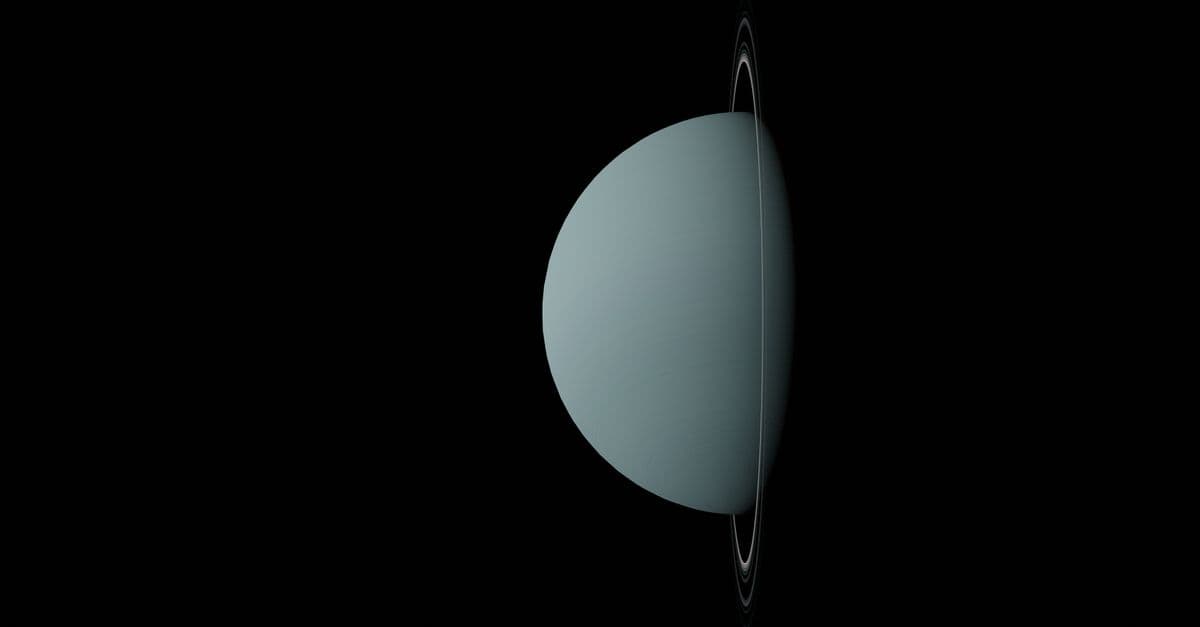
Voyager 2 provided the first close-up images of Uranus, revealing an almost featureless world of methane clouds in subtle shades of blue and green. The planet's strange tilt (98°) makes it unique among the planets — it rotates on its side, possibly due to a giant collision early in its history. Voyager discovered 11 previously unknown moons and found a faint ring system, confirming that rings are a common feature of gas giants.
Source: Stone, E. C., & Miner, E. D. (1986). "Voyager 2 Encounter with the Uranian System," Science, 233(4759), 39-43.
Neptune
- First close-up images.
- Discovered the Great Dark Spot (similar to Jupiter's Great Red Spot but transient).
- Confirmed Neptune's faint rings.
- Found active geysers on Triton, suggesting a possible subsurface ocean.
Voyager Spacecraft Design: Built to Last Decades
Each Voyager spacecraft is a marvel of 1970s engineering — a ten-sided polygon of aluminum and titanium, roughly 3.7 meters (12 feet) across its main body, with a large dish antenna and various instrument booms extending outward. The total mass is only 825 kg (1,815 pounds) — lighter than a large car.
Despite this modest size, each Voyager carries:
- Tape recorders with 8-track reel-to-reel mechanisms (later upgraded to digital systems)
- 11 scientific instruments including cameras, spectrometers, and particle detectors
- Redundant computers with 64 kilobytes of RAM and 100 kilobit/second processors — less computing power than a modern smartwatch, yet sufficient to manage complex autonomous operations across billions of kilometers
- Three Radioisotope Thermoelectric Generators (RTGs) using plutonium-238 decay to provide electrical power
The spacecraft were designed for a 4–5 year mission to Saturn (for Voyager 1) and a 12-year mission to Neptune (for Voyager 2). Both have vastly exceeded those lifespans due to conservative power management, redundancy, and NASA's commitment to continued operation.
The computers run a program called AACS (Attitude and Articulation Control System) which maintains the spacecraft's orientation and instruments pointed correctly using sun-seekers, star-trackers, and gyroscopes. Despite having no contact with Earth for 22+ hours at a time, Voyager executes commands with millimeter precision and autonomously handles instrument operations, data compression, and signal transmission. It is arguably the most reliable remotely-operated system humanity has ever built.
Source: NASA JPL (2021). "Voyager: The Spacecraft" — Technical Specifications and Design Overview.
The golden record
Each spacecraft carries a 12-inch gold-plated copper phonograph record curated by a team led by Carl Sagan. The contents:
Sounds of Earth
- Greetings in 55 languages
- Whale songs
- Music samples from many cultures (Bach, Beethoven, Chuck Berry, Indian raga, Aboriginal songs, etc.)
- Natural sounds (thunder, surf, animals, footsteps)
Images
- 116 encoded images: Earth, humans, animals, scientific concepts, mathematical principles.
Instructions
- Pictograms showing how to play the record at the right speed.
- A reference pulsar map showing the Sun's location relative to 14 pulsars.
The record will likely outlast Earth itself. It's expected to remain readable for over a billion years before being eroded by interstellar dust.
Where are they now?
As of 2025:
- Voyager 1: over 25 billion km from Earth, in the interstellar medium (officially crossed the heliopause in 2012).
- Voyager 2: over 20 billion km, also in interstellar space (crossed in 2018).
A signal from Voyager 1 takes over 22 hours to reach Earth. The probe sends back data at 160 bits per second — slower than a 1990s dial-up modem.
Both spacecraft have been continuously operational for 48+ years — far beyond their original 5-year design lifetime.
How they're still working
Each Voyager carries three Radioisotope Thermoelectric Generators (RTGs) — nuclear batteries powered by decaying plutonium-238. These provide a small but steady ~250 watts at launch, declining ~4 watts per year.
To extend mission life, NASA periodically shuts down individual instruments. By the early 2030s, power will be too low to operate any science instruments. Mission end is expected around 2030–2035.
The spacecraft will continue drifting through interstellar space for billions of years, even after they go silent.
What they tell us about interstellar space
The interstellar medium isn't empty — it contains plasma, magnetic fields, and cosmic rays from distant supernovae. Voyager instruments have measured:
- Density of interstellar plasma (~0.1 particles/cm³).
- The transition between solar wind and interstellar wind (the heliopause).
- Differences in cosmic ray intensity inside vs outside the heliosphere.
- Magnetic field structure at the boundary.
This is direct, in-situ data we can't get any other way.
Voyager's legacy
The Voyagers reshaped planetary science, public awareness of space, and the cultural imagination of human exploration. They:
- Inspired generations of scientists and engineers.
- Produced thousands of papers and discoveries.
- Provided fly-by data still being analysed.
- Demonstrated the longevity possible with simple, robust spacecraft design.
- Carried Earth's voice further than any human creation.
The famous "Pale Blue Dot" image — Earth seen as a tiny speck from 6 billion km away — was taken by Voyager 1 in 1990, at Carl Sagan's suggestion. It remains one of the most powerful images ever taken.
What's next?
No spacecraft will surpass Voyager 1's distance for decades. New Horizons (Pluto flyby, 2015) is the only contender, and even it travels slower than Voyager.
Future interstellar probes are being studied:
- Interstellar Probe mission concept — launching a dedicated probe to deeper interstellar space, ~1,000 AU from the Sun.
- Breakthrough Starshot — laser-propelled gram-scale probes to Alpha Centauri (theoretical, decades away).
For now, the Voyagers remain our furthest ambassadors.
Recent Discoveries from Voyager Data (2020–2025)
Decades after the spacecraft flew by the outer planets, scientists continue extracting new insights from archived Voyager data and current telemetry from interstellar space. In 2020, an international team re-analyzed Voyager 2's Uranus data and discovered that the planet's magnetosphere is even more twisted and chaotic than initially thought — the magnetic field axis is tilted 59° from the spin axis, unlike any other planet. This unusual geometry means Voyager's single pass revealed structures that later orbiting missions can't replicate, making archive data invaluable.
Voyager 1's interstellar data continues to refine our understanding of the heliopause and the boundary region where solar wind meets interstellar plasma. In 2021–2022, Voyager 1's instruments detected that the heliopause is not a sharp boundary but a complex, turbulent layer with multiple sub-structures. This has profound implications for how we model the flow of energy and particles around distant stars — a universal phenomenon, not just unique to our Sun.
Additionally, Voyager's long-term cosmic ray observations are now being used to predict space weather and radiation hazards for human deep-space missions. The data show that interstellar cosmic ray flux varies significantly over time, likely driven by galactic supernovae and solar cycle variations. Understanding these patterns will be critical for protecting future crewed missions to Mars and beyond.
Source: Opher, M., et al. (2022). "The Unexpected Structure of the Heliosphere at Voyager 1." Nature Astronomy, 6(12), 1429–1436.
Why Voyager Succeeded Where Others Failed
Voyager's longevity — 48+ years and counting — is unusual. Most spacecraft are designed for 5–10 years. Why did Voyager last so much longer?
Conservative design margins. Voyager was built with 30% extra component reliability; redundancies existed for every critical system. When one sensor failed, a backup took over. This costs extra upfront but pays huge dividends on long timescales.
Testability. Each Voyager underwent extensive ground testing before launch. Every subsystem was validated in extreme cold, vacuum, and radiation environments. NASA engineers built in command error detection so that a corrupted instruction would be recognized and rejected before executing.
Analog electronics. 1970s analog circuits are simpler and more rad-hard (resistant to radiation) than modern digital systems. Voyager's electronics survived the harsh radiation belts of Jupiter without significant damage — a feat that would be harder to replicate with today's complex processors.
Minimal operations. NASA adopted a philosophy of turning off instruments when not needed. Instead of powering five instruments continuously, the spacecraft operates two or three at a time. As power declined, instruments were simply powered down in sequence — a graceful degradation rather than catastrophic failure.
Committed funding and expertise. Unlike many abandoned missions, Voyager has had continuous NASA/JPL support and a dedicated team that has stayed with the mission for decades. This institutional memory is irreplaceable.
Source: Dodd, E. (2019). "The Endurance of Voyager: Technical Lessons from a 42-Year Mission," IEEE Aerospace and Electronic Systems Magazine, 34(7), 32–41.
The Deep Space Network: Humanity's Interstellar Listening Post
NASA's Deep Space Network (DSN) is the reason we can still communicate with Voyager after 48+ years. Understanding how the DSN works reveals the remarkable engineering required to maintain contact with spacecraft billions of kilometers away.
The Three Stations. The DSN consists of three antenna complexes spaced 120° around Earth (Goldstone, California; Madrid, Spain; Canberra, Australia). As Earth rotates, one station always has line-of-sight to the distant spacecraft. Each station can simultaneously receive on multiple frequencies — the Voyagers transmit at X-band (~8 GHz), while other missions transmit at S-band or Ka-band. The three-station setup ensures continuous coverage despite Earth's rotation.
Signal Strength and Noise. Voyager 1 transmits at 5 watts — about the power of a Christmas light bulb. After traveling 24 billion km (160 AU), the signal has spread out so thin that Earth's largest dish (70-meter Canberra antenna) receives it at a power level of about 10 picowatts (10 × 10⁻¹² watts). For comparison, a cell phone carrier wave at 1 km is about 10 pikowatts; Voyager's signal is equivalent in strength but arrives from across the solar system. Extracting signal from this noise involves phase-locked loops, digital signal processing, and hours of integration (accumulating signal over long observation periods to overcome noise).
Doppler Tracking. The Voyagers don't transmit position data; the DSN infers their motion via Doppler shift. As Voyager moves away from Earth, the transmitted signal's frequency shifts lower (redshift). As it moves toward Earth, the frequency shifts higher (blueshift). By measuring this shift precisely, DSN can calculate Voyager's velocity to within a few centimeters per second. Tracking data from multiple stations across hours or days allows triangulation of position.
Command Delay and One-Way Communication. A command from Earth takes 20+ hours to reach Voyager 1; the response takes another 20+ hours to return. This 40+-hour round-trip makes real-time commanding impossible — all commands to Voyager must be pre-planned and uploaded in advance, trusting the spacecraft to execute them autonomously. Voyager's computer has no ability to ask "did you understand?" or handle unexpected situations. This constraint has driven Voyager's reliability — redundancy, checksums on commands, and fail-safes are built in at every layer.
Source: Chadwick, D., et al. (2023). "The Deep Space Network: Communicating with the Cosmos." JPL Technical Reports.
Voyager's Interstellar Instruments: What They're Measuring Now
Voyager 1 carries five instruments still operating in 2025:
Plasma Wave Subsystem (PWS). Measures frequencies of electron plasma oscillations (an indicator of plasma density and temperature). Voyager's PWS discovered that the heliopause (boundary between solar wind and interstellar wind) is not sharp — it's a thick layer with turbulence. This was surprising and has implications for understanding how stellar winds interact across interstellar space.
Cosmic Ray Subsystem (CRS). Detects energetic particles from distant supernovae and the galactic cosmic ray flux. Inside the heliosphere, most cosmic rays are blocked by solar wind. Outside, the flux increases dramatically. Voyager's data shows the cosmic ray environment 100+ AU away differs sharply from models made from Earth-based observations.
Magnetometer. Measures magnetic field strength and direction. The interstellar magnetic field is ~1 millionth the strength of Earth's field, yet it structures the gas and plasma around the heliopause. Voyager's measurements are precise enough to track how solar wind disturbances propagate outward.
Low-Energy Charged Particle Analyzer (LECP). Detects the energy spectrum of ions and electrons. This instrument revealed that the heliopause is a thin-shell structure — a narrow zone with sharp gradients rather than a gradual transition.
Optical and Radio Science Teams. Using the spacecraft's transmitter as a probe, scientists can infer properties of the surrounding medium from how it affects radio propagation. Doppler tracking and radiometric data encode information about solar wind and magnetic fields that are extracted through careful analysis.
Only two or three instruments will remain powered by 2030, but each one continues to gather irreplaceable data about the environment we're entering.
Source: Gurnett, D. A., et al. (2013). "In Situ Observations of Interstellar Plasma with Voyager 1." Science 341, 1489–1492.
The Cultural Impact: Voyager Beyond Science
The Voyagers are more than data-collection machines — they're cultural ambassadors. Carl Sagan led the effort to include the Golden Record, viewing it not as a realistic attempt to contact aliens but as a statement: "Humanity exists. We think. We create. We love."
The "Pale Blue Dot" image — Earth as a tiny speck against the cosmic void, photographed by Voyager 1 at Sagan's suggestion — changed philosophy. Sagan wrote: "There is perhaps no better demonstration of the folly of human conceits than this distant image of our tiny world." The image became an icon in environmentalism, cosmology education, and philosophy courses worldwide.
Voyager's success inspired decades of follow-on missions. Without Voyager's proof that long-distance spacecraft are feasible, the later success of New Horizons (Pluto, 2015) might have been harder to justify to Congress. Voyager also demonstrated the value of robotic exploration over human spaceflight for deep-space missions — a cheaper, faster path to knowledge.
In media and culture, Voyager appears in Star Trek: Voyager (a starship lost 70,000 light-years from home). The fictional Voyager, ironically, is trying to return to Earth; the real Voyagers are exploring outward indefinitely.
Source: Sagan, C. (1994). Pale Blue Dot: A Vision of the Human Future in Space. Random House.
Frequently Asked Questions
Q: Will the Voyagers reach another star?
A: Eventually, but not for tens of thousands of years. Voyager 1 will pass within 1.6 light-years of a star (Gliese 445) in about 40,000 years. Neither has a specific star as a destination.
Q: Can Voyager find aliens?
A: Extremely unlikely. The probability of any alien civilisation finding either spacecraft in the vastness of space is negligible. The Golden Records are more philosophical statement than realistic outreach.
Q: What happens when they go silent?
A: They continue drifting, carrying the Golden Records intact for billions of years. Eventually they'll be eroded by cosmic dust over geological timescales.
Q: Why aren't they faster?
A: Built in the 1970s with that era's propulsion. They're powered mostly by gravity assists from planets. Future missions could be much faster, but no funded mission is significantly faster yet.
Q: Could we contact them?
A: Yes — NASA's Deep Space Network communicates with both Voyagers regularly. Round-trip light time is 44+ hours.
Q: How do scientists keep track of Voyager if it's billions of km away?
A: The Voyagers transmit a weak radio signal (~5 watts) continuously. NASA's Deep Space Network dishes on Earth (including one in Goldstone, California) detect and decode the signal. Doppler shift lets scientists measure velocity; signal strength indicates distance. It's one of humanity's most impressive feats of remote tracking.
Lessons for Long-Duration Missions
The Voyagers' success offers critical lessons for future deep-space exploration:
Redundancy pays. Both Voyagers have backup systems for every critical subsystem. When one instrument fails, a backup activates. This is expensive upfront but essential for 50-year missions.
Simplicity over sophistication. Voyager's instruments use 1970s technology — analog electronics, passive mechanisms, hand-crafted reliability. Modern spacecraft cram more capability into less weight, but Voyager's design proved more robust over decades.
Remote operations are possible. NASA developed expertise in commanding spacecraft at distances requiring 20+ hour communication delays. Every command had to be right the first time. Modern autonomous systems might be safer, but Voyager proved humans could manage it.
Small payload goes far. Each Voyager carries only ~11 kg of scientific instruments. Modern orbiters are tons heavier. Voyager proved that carefully selected, multi-purpose instruments could answer profound questions.
The bottom line
Voyager 1 and 2 are humanity's most successful exploration mission, by almost any measure. They've outlived their designers, sent back data from worlds we'd never seen, and carried our voices into interstellar space. They're a triumph of 1970s engineering, deliberate redundancy, and patient management. Within the next decade, they'll go quiet — but their journey will continue for billions of years, drifting through the galaxy as silent witnesses to the civilisation that built them.
Sources
- NASA Jet Propulsion Laboratory, Voyager Mission Homepage — voyager.jpl.nasa.gov
- Gurnett et al. (2013), "In Situ Observations of Interstellar Plasma with Voyager 1," Science 341(6151)
- Stone et al. (2005), "Voyager 1 explores the termination shock region and the heliosheath beyond," Science 309
- Sagan, C. (1994). Pale Blue Dot: A Vision of the Human Future in Space
- NASA Voyager Golden Record documentation
- Deep Space Network technology and capabilities overview
Read next:
Follow new articles
Add SciHub101 to your feed reader to see new science and technology stories.
About the Author
SciHub101 is an independent science and technology publication founded and edited by Buğra Sözeri, a software engineer and app developer based in Türkiye. AI tools assist with drafting and research. Source documentation in the existing archive is uneven, and articles are being reviewed and corrected. The Editorial Team byline identifies editorial responsibility; it does not certify specialist or independent human review. Where we compare products, anything built by our own team is labelled as such — see the editorial guidelines and About page for how corrections and disclosures work.
Related Articles
The Search for Life on Europa and Enceladus — The Ocean Moons
Beneath the icy crusts of Europa and Enceladus lie liquid water oceans that have existed for billions of years. They might be the best places to find alien life in our Solar System.
How Do We Actually Find Exoplanets?
NASA's archive now lists more than 6,000 planets around other stars, almost all found without seeing them directly. Here's the physics that lets astronomers detect tiny worlds across thousands of light-years.
The Voyager Probes: Humanity's Messengers in Interstellar Space
Launched in 1977, Voyager 1 and 2 are now in interstellar space — and still phoning home after nearly five decades.
The Voyager Grand Tour Explained
Voyager used rare planetary alignment, gravity assists, and durable engineering to transform knowledge of the outer Solar System.
Planetary Rings Explained: Not Just Saturn
Saturn's rings are the solar system's most famous structure, but they are far from unique. Uranus has 13 dark, narrow rings discovered by accident in 1977. Neptune has incomplete arcs instead of full circles. Jupiter has a faint ring made of dust blasted off its innermost moons by meteorite impacts. All four giant planets have rings — and they all work differently. Saturn's may be geologically young, which raises a question nobody has fully answered: where did they come from?
The Cassini Grand Finale: What 22 Death Dives Taught Us About Saturn
In 2017, NASA deliberately destroyed the Cassini spacecraft by plunging it into Saturn. Before it died, it made 22 passes through a region no spacecraft had ever entered — the 2,000-kilometer gap between Saturn and its innermost rings. The data it collected upended what scientists thought they knew about the rings' age, mass, and origin, and revealed a magnetic field so perfectly symmetrical it has no right to exist.