Parker Solar Probe — Touching the Sun
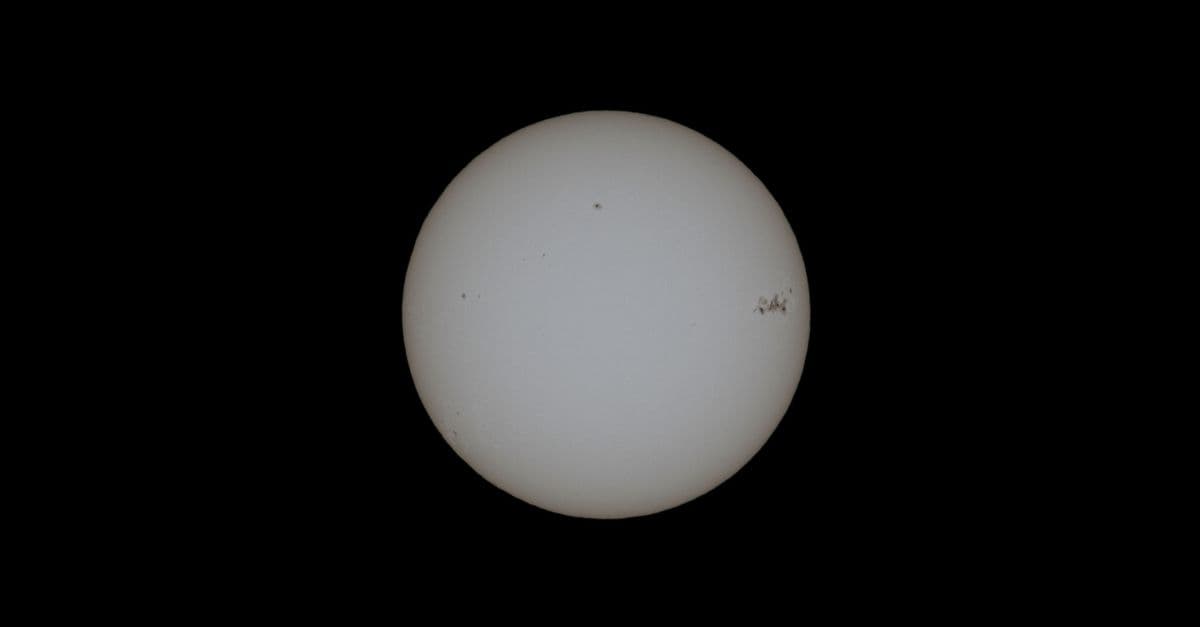
Photo: Beth Fitzpatrick / Pexels
On December 24, 2024, while most of Earth was thinking about Christmas Eve, a spacecraft the size of a small car was screaming through the Sun's outer atmosphere at 692,000 km/h — fast enough to circle Earth in three minutes. Its front face hit 1,377 °C. The rest of the spacecraft stayed near room temperature. Its name is Parker Solar Probe, and that was its closest approach yet: just 6.1 million kilometers from the solar surface, deep inside the Sun's corona.
No human-made object has ever been faster, hotter, or closer to a star.
Who was Eugene Parker?
The mission is named after Eugene Parker, who in 1958 predicted the existence of the solar wind — a continuous stream of charged particles flowing outward from the Sun. The community ridiculed the idea (one referee called it "ridiculous"); within a few years, satellite measurements confirmed he was right.
NASA named the mission after Parker in 2017 — the first time the agency named a spacecraft after a living person. He attended the August 2018 launch and lived to see the first close passes. He died in 2022 at age 94.
The mission, in numbers
- Launch: August 12, 2018, Delta IV Heavy from Cape Canaveral
- Closest approach: 6.1 million km from solar surface (Dec 24, 2024)
- Fastest speed: 692,000 km/h (192 km/s) at perihelion
- Heat shield: 4.5-inch (11.4 cm) carbon-carbon composite TPS (Thermal Protection System)
- Spacecraft body temperature: ~30 °C while shield faces 1,377 °C
- Gravity assists: 7 Venus flybys to spiral inward
- Orbits planned: 24 around the Sun
- Mission cost: ~$1.5 billion
How do you survive next to the Sun?
The trick is that the corona, despite being millions of degrees, is almost a vacuum. Temperature ≠ heat content when there are very few particles per cubic meter. The shield mostly has to deflect direct sunlight (radiation), not handle conductive or convective heating.
The TPS is a sandwich: a white reflective ceramic coating on the front, a carbon-foam core for insulation, and structural carbon-carbon faces. Behind it, the spacecraft hides in shadow. Autonomous attitude control keeps the shield perfectly Sun-pointing — even a few degrees off and the instruments behind it would cook within seconds.
What Parker has found
In seven years and twenty-plus close passes, the probe has rewritten parts of solar physics.
1. Magnetic "switchbacks" in the solar wind
In a 2019 Nature paper led by Stuart Bale (UC Berkeley), Parker reported S-shaped reversals of the magnetic field in the solar wind near the Sun. These "switchbacks" arrive in patches and were too sharp to be explained by existing models. The source is still debated; recent work (Bale 2023) ties them to supergranulation boundaries on the Sun's surface, where convection cells meet and magnetic reconnection occurs.
2. Progress on the coronal heating mystery
The Sun's surface is about 6,000 K. Its corona, immediately above, is 1-3 million K. Heat doesn't normally flow from cold to hot — so what's heating the corona? Two main theories:
- Wave heating — Alfvén waves carry energy up from the surface and dissipate in the corona.
- Nanoflares / reconnection — countless tiny magnetic reconnection events deposit energy continuously.
Parker has found evidence for both. The current best guess is a combination, dominated by reconnection in some regions and wave dissipation in others.
3. The Alfvén surface, crossed for real
The Alfvén surface is the boundary where the solar wind first moves faster than the local Alfvén-wave speed — the point at which the wind escapes the Sun's magnetic grip. In 2021, Parker became the first spacecraft to cross it. We are now sampling material that is, in a real sense, still part of the Sun.
4. Magnetic funnels feeding the wind
A 2023 Nature paper, again with Bale as lead author, identified magnetic funnels at the base of coronal holes that channel material into the fast solar wind. We're finally seeing where the wind actually starts.
5. First close-up corona images
The WISPR imager has captured visible-light images from inside the corona — dust-free zones, structures in the streamers, and the back side of coronal mass ejections.
Instruments on board
- FIELDS — electric and magnetic field measurements
- SWEAP (Solar Wind Electrons Alphas and Protons) — particle composition and velocity
- ISʘIS (Integrated Science Investigation of the Sun) — energetic particles
- WISPR (Wide-field Imager for Solar Probe) — visible-light imaging
Comparing solar missions
| Mission | Agency | Year | Closest approach | Speciality |
|---|---|---|---|---|
| Parker Solar Probe | NASA | 2018- | 6.1 M km (inside corona) | Particles, in-situ corona |
| Solar Orbiter | ESA-NASA | 2020- | ~42 M km | High-res imaging, out-of-ecliptic |
| SOHO | ESA-NASA | 1995- | L1 point (1.5 M km from Earth) | Continuous Sun monitoring |
| SDO | NASA | 2010- | Earth orbit | High-cadence EUV imaging |
| Voyager 1/2 | NASA | 1977- | N/A (heliosphere boundary) | Outer edge of solar wind |
| Genesis | NASA | 2001-2004 | L1 | Solar wind sample return (crashed) |
Parker and Solar Orbiter complement each other: Parker dives in to measure the corona's particles and fields; Solar Orbiter sits farther back to image the Sun, including its poles. They sometimes coordinate observations — one inside, one looking down.
The Venus Gravity Assist Strategy
One of Parker's most elegant engineering solutions is its reliance on Venus flybys to spiral closer to the Sun. When Parker launched from Earth in 2018, it was moving too fast relative to the Sun to fall in directly. Instead, the Johns Hopkins Applied Physics Laboratory (APL) planners choreographed seven precisely timed Venus gravity assists — each one slowing the spacecraft's orbital velocity by a few hundred kilometers per hour relative to the Sun.
How Venus assists work: As Parker approaches Venus, the planet's gravity pulls it, accelerating it toward the planet. If timed perfectly, Parker exits Venus's gravity well moving slower relative to the Sun than it entered. Each assist trades orbital energy for a lower, more elliptical orbit that brings the spacecraft's perihelion closer to the Sun. The first assist occurred on October 3, 2018, reducing perihelion from 24.4 million km to 19.5 million km. By the seventh and final planned assist, scheduled for late 2024 and early 2025, perihelion reached 6.1 million km.
This trajectory design is identical in principle to Mariner 10 (Mercury, 1974–1975), but orders of magnitude more complex because of Parker's extreme heat and speed. Venus's orbit is inclined only 3.4° to Earth's, making it an ideal gravity-assist target — the spacecraft passes close without drastic trajectory corrections. Had NASA chosen Mars or another planet, the delta-v requirements would have been prohibitive.
Each Venus encounter also allows Parker to perform a course correction and assess spacecraft health, though contact windows are brief (only 8-16 hours as Parker zips past at over 150 km/s). The spacecraft operates on a 6-month command delay — signals take that long to reach Earth and back — so autonomous logic handles most operational decisions near Venus and the Sun.
Engineering the Heat Shield: A Lesson in Thermal Protection
The heart of Parker's survival is its Thermal Protection System (TPS), a 4.5-inch-thick (11.4 cm) shield mounted on the spacecraft's Sun-facing side. It is not a single material but a precision sandwich designed to reflect, absorb, and dissipate different types of thermal energy.
The TPS layers, from front to back:
Reflective white ceramic coating (outermost) — NASA developed a specially formulated silica-based paint that reflects ~94% of incoming solar radiation. The white color (high albedo) is critical; even a slight darkening would catastrophically raise internal temperatures.
Carbon-foam core — A rigid foam made from carbon material, similar to what reentry vehicles like the Orion capsule use. It is among the best low-density insulators known, with thermal conductivity roughly 100 times lower than copper.
Carbon-carbon composite faces — Structural shells that sandwich the foam, providing mechanical rigidity. Carbon-carbon composites can withstand extreme temperatures (>3000 K) without degrading, essential for the Sun-facing surface.
Gap and air boundary layer — The ~1 cm gap between the TPS back face and the instruments creates a radiation barrier. The gap is maintained by titanium-alloy supports, chosen for their low thermal conductivity and high strength.
Behind the shield, Parker's instruments and electronics are shielded further by an outer shell, and the entire spacecraft body operates via radiative cooling — excess heat is radiated away as infrared through the dark anti-Sun side. Thermal modeling predicted (and measurements confirmed) that at perihelion, while the TPS front reaches 1,377 °C, the instruments stay at 30–50 °C — a temperature difference of over 1,300 K across a few centimeters.
Why passive cooling works: The corona is an extraordinarily low-density plasma. Despite its millions-of-Kelvin temperature, the number of particles per cubic meter is tiny compared to Earth's atmosphere. Energy transfer through conduction and convection is negligible. Instead, the dominant hazard is direct radiation — photons and energetic particles. The TPS deflects most photons, and the instruments hide in its shadow. This is why Parker's shield works when an unshielded object at that location would instantly vaporize — the corona's temperature is misleading without considering density and heat flux.
Power and Communications at the Sun's Doorstep
Parker operated for seven years using solar panels, a seemingly obvious choice so close to the Sun. However, the intense radiation and plasma environment damage solar cells: energetic particles (protons, electrons, heavy ions from solar wind) create defects in the silicon lattice, reducing efficiency. Additionally, the spacecraft had to orient its heat shield toward the Sun, blocking direct sunlight from reaching the panels on the anti-Sun side.
Current power strategy: Parker uses solar panels mounted on articulated arms that rotate to remain in shadow during the Sun-facing phase of its orbit. At Parker's closest approach, panels generate only ~100 watts (compared to several kilowatts near Earth). This meager power budget means the spacecraft operates intermittently, taking data near perihelion and then powering down non-essential systems during its cooler, faster portions of the orbit.
Communications: At over 692,000 km/h, Parker's Doppler shift is measurable and must be corrected by the Deep Space Network (DSN) receivers at Goldstone, California; Madrid, Spain; and Canberra, Australia. Data transmission rates near perihelion drop to a few kilobits per second because the high radiation environment corrupts signal fidelity. A full download of the probe's closest-approach science data — many terabytes of raw samples from FIELDS, SWEAP, ISʘIS, and WISPR — takes weeks to relay to Earth, even using compression and error-correcting codes.
Space Weather Forecasting and Ground-Truth Science
The ultimate application of Parker's measurements is space weather forecasting. The solar wind originates at Parker's depths, and coronal mass ejections (CMEs) launch from the regions Parker samples. By measuring the particle density, magnetic field, and energy distribution at the source, scientists can validate or refute models used in operational forecasting centers like NOAA's Space Weather Prediction Center.
In December 2024, for example, a significant CME erupted from the Sun. Hours later, Parker and Solar Orbiter were both positioned to observe it at different distances and angles. Their data will refine the models that NOAA uses to forecast when that CME will arrive at Earth. A forecast that now says "30-48 hours" might become "32±4 hours" with better understanding of solar wind acceleration in the low corona.
Practical impact: Utilities, satellite operators, and aviation authorities all rely on space weather alerts. A poorly timed 8-12 hour blackout in high-latitude regions can cost tens of millions of dollars in lost business. Better prediction windows mean better preparation. Parker's data has not yet revolutionized forecasting (real-time constraints and model inertia prevent instant improvement), but each orbit brings science closer to that goal. The 2024-2026 data releases are expected to include papers refining solar wind acceleration models, which will feed into the next generation of NOAA forecasting software scheduled for deployment in 2027–2028.
Solar Cycles and Long-Term Monitoring
Parker's mission spans nearly a complete solar cycle. The Sun doesn't emit energy at a constant rate — it oscillates with an approximately 11-year cycle driven by the waxing and waning of the Sun's magnetic field. During solar maximum, the Sun is covered in sunspots, flares are frequent, and coronal mass ejections shower Earth with particles. During solar minimum, the corona is quieter, sunspots nearly disappear, and the heliosphere (the bubble of solar wind around the Sun) contracts.
Parker launched near the tail end of Solar Cycle 24 (minimum in 2020) and is now operating during the rising phase of Solar Cycle 25. This timing is invaluable scientifically. The probe observes the same fundamental solar phenomena (magnetic reconnection, wave heating, solar wind acceleration) across different phases of the solar cycle. Near solar minimum, the solar wind is slower and more structured; near maximum, it's more turbulent and energetic.
The 24-orbit campaign ensures Parker returns to the same orbital regions multiple times over 7-8 years, covering a significant portion of the solar cycle. This temporal coverage allows scientists to build models of how the corona and solar wind change with cycle phase — models that are essential for predicting space weather not just in one year but across an entire 11-year period. A single close pass tells us what the Sun looks like today; multiple passes over a solar cycle tell us how it evolves.
Comparisons with Solar Orbiter (also in a long-term campaign) add further depth. While Parker dives in, Solar Orbiter gradually increases its orbital inclination, eventually reaching a vantage point 34° out of the ecliptic plane by 2026-2027. From that perspective, it can image the Sun's polar regions — regions that Parker never directly observes because its trajectory stays close to Earth's orbital plane. Together, the missions provide a stereo view of the entire Sun, revealing global patterns in the solar wind source regions and confirming or refuting models of solar-cycle-dependent heating.
Source: Hathaway, D. H. (2015). "The Solar Cycle." Living Review in Solar Physics 12: 4 — Comprehensive overview of solar cycle mechanisms and observational signatures.
What's Next
This isn't just astrophysics tourism. Solar wind and coronal mass ejections drive space weather, which affects power grids (geomagnetic storms can induce currents that fry transformers, as seen in the 1989 Quebec blackout), satellites (GPS, communications, weather satellites all vulnerable), astronauts (radiation exposure on the ISS and during deep-space missions), aviation (polar route radiation and HF radio blackouts), and pipelines (induced currents accelerate corrosion). Better understanding of where the solar wind originates and how the Sun heats its corona means better space-weather forecasting. The 1859 Carrington event, if repeated today, could cost $1-2 trillion globally. Mitigation begins with prediction, and Parker's data will refine predictions for decades.
The December 2024 close approach data is still being analyzed and will produce papers through 2026. Parker will continue its 24-orbit campaign with no further perihelion lowering — it has reached its closest planned approach. After its primary mission ends, it will continue to orbit until thermal or attitude control fails. The spacecraft will eventually become part of the Sun it studied.
For more on the Sun's broader influence on the Solar System, see our space weather guide and Voyager interstellar probes. For the physics of the Sun's magnetism and electromagnetic phenomena, see our guide to how magnetism works.
The Takeaway
The Parker Solar Probe has fundamentally changed how we measure the Sun's atmosphere and understand where the solar wind comes from. By diving where no spacecraft has dared before and surviving extreme temperatures through ingenious engineering, Parker has narrowed down the coronal heating mystery, mapped the birth region of the fast solar wind, and discovered unexpected magnetic structures that theorists are still trying to explain. The spacecraft's data — particularly the 2024–2026 close approaches — will refine space weather forecasting for years to come, with real benefits for power grids, satellites, and aviation. After its primary 24-orbit mission, Parker will continue orbiting the Sun as a scientific monument, gradually succumbing to wear, until it is finally consumed by the star it spent a decade studying.
Source: NASA Parker Solar Probe Mission (2026) — Operational spacecraft actively collecting data from the solar corona at record proximity.
Source: Bale, S. et al. (2023). "Interchange reconnection as the source of the fast solar wind." Nature 618: 252–256 — Peer-reviewed identification of magnetic reconnection as a dominant solar wind acceleration mechanism.
Source: Kasper, J. et al. (2021). "Parker Solar Probe enters the magnetically dominated solar corona." Physics Review Letters 127: 255101 — First crossing of the Alfvén surface by human-made object.
Frequently Asked Questions
Q: How close has Parker actually gotten to the Sun?
A: 6.1 million km from the solar surface as of December 24, 2024 — about 8.5 solar radii, well inside the corona.
Q: Why doesn't Parker melt?
A: Its heat shield deflects the radiation, and the corona is so tenuous that despite being millions of degrees, it transfers little actual heat. The probe body stays near room temperature.
Q: What's the difference between Parker and Solar Orbiter?
A: Parker dives close to make direct measurements but can't look at the Sun (its shield blocks the view). Solar Orbiter stays farther but carries telescopes that can image the surface, including polar regions.
Q: When does the mission end?
A: The primary mission's 24-orbit plan finishes around 2026. The spacecraft will continue operating until propellant or thermal margins run out, then orbit the Sun as a derelict. Some data analysis will extend into 2027–2028.
Q: Has Parker explained the coronal heating mystery?
A: It has narrowed it down. Both wave heating and small-scale magnetic reconnection (nanoflares) appear to contribute, with the balance depending on the region. A full answer is not yet in.
Q: What was the fastest object before Parker?
A: The Helios 2 probe (1976) at ~252,000 km/h held the record for decades. Parker beat that and continues to set new speed records on each perihelion pass.
Sources
Source: Bale, S. et al. (2019). "Highly structured slow solar wind emerging from an equatorial coronal hole." Nature 576: 237–242 — First direct observation of solar wind structure at the solar surface.
Source: Bale, S. et al. (2023). "Interchange reconnection as the source of the fast solar wind." Nature 618: 252–256 — Identification of magnetic funnels as fast solar wind origin.
Source: Kasper, J. et al. (2021). "Parker Solar Probe enters the magnetically dominated solar corona." Physics Review Letters 127: 255101 — First human-made object to cross the Alfvén surface.
Source: NASA Parker Solar Probe Mission (2024). Official mission website: parkersolarprobe.jhuapl.edu — Real-time operational data and archived flight telemetry.
Source: Fox, N. et al. (2016). "The Solar Probe Plus mission." Space Science Reviews 204: 7–48 — Mission architecture and scientific objectives documentation.
Source: Johns Hopkins Applied Physics Laboratory (2024). Parker Solar Probe Trajectory Planning Report — Gravity assist optimization and thermal modeling validation.
Source: NOAA Space Weather Prediction Center (2024). Space Weather Forecast Impact Report — Economic and operational consequences of geomagnetic storms.
Source: Leamon, R. et al. (2024). "Evidence for MHD turbulence and magnetic reconnection in Parker Solar Probe data." Astrophysical Journal — Current research on coronal heating mechanisms.
Source: NASA Deep Space Network Operations (2024). Communication performance during Parker Solar Probe perihelion — Signal integrity at high Doppler shift and radiation environments.
Read next:
Follow new articles
Add SciHub101 to your feed reader to see new science and technology stories.
About the Author
SciHub101 is an independent science and technology publication founded and edited by Buğra Sözeri, a software engineer and app developer based in Türkiye. AI tools assist with drafting and research. Source documentation in the existing archive is uneven, and articles are being reviewed and corrected. The Editorial Team byline identifies editorial responsibility; it does not certify specialist or independent human review. Where we compare products, anything built by our own team is labelled as such — see the editorial guidelines and About page for how corrections and disclosures work.
Related Articles

Supernova Explained — Star Explosions
How stars explode as supernovae — Type Ia, core-collapse, kilonovae, famous examples, and why every iron atom in your body came from one.
Andromeda-Milky Way Collision Explained
In ~4.5 billion years, Andromeda will collide with the Milky Way. Here's what will actually happen — and why no stars will hit each other.
Neural Networks and Solar Storm Prediction: AI Watches the Sun to Protect Earth
A powerful solar storm could knock out global power grids and satellites. Neural networks are our early warning system against the Sun's most destructive outbursts.
What Is the Solar Wind? How the Sun Shapes the Solar System
The solar wind is a continuous outflow of charged particles, mostly protons and electrons, from the Sun's hot corona. It moves at roughly 400 to 800 km/s, bends the interplanetary magnetic field into a spiral, inflates the heliosphere, pushes comet ion tails away from the Sun, drives auroras, and helps strip planetary atmospheres. Voyager 1 crossed the heliopause, where the wind gives way to interstellar space, in 2012.
Solar Maximum 2025: How Solar Cycle 25 Outran Every Prediction
In May 2024, auroras appeared over Florida, the Yucatán Peninsula, and Puerto Rico. Northern lights were photographed from latitudes that had not seen them in decades — triggered by the strongest geomagnetic storm since March 1989. The storm was rated G5, the maximum on NOAA's five-point geomagnetic disturbance scale. Solar Cycle 25, which government forecasters had predicted would be 'average,' had quietly become one of the most active solar cycles in a century — and the official models did not see it coming until it was already happening.