The Deepest Caves On Earth

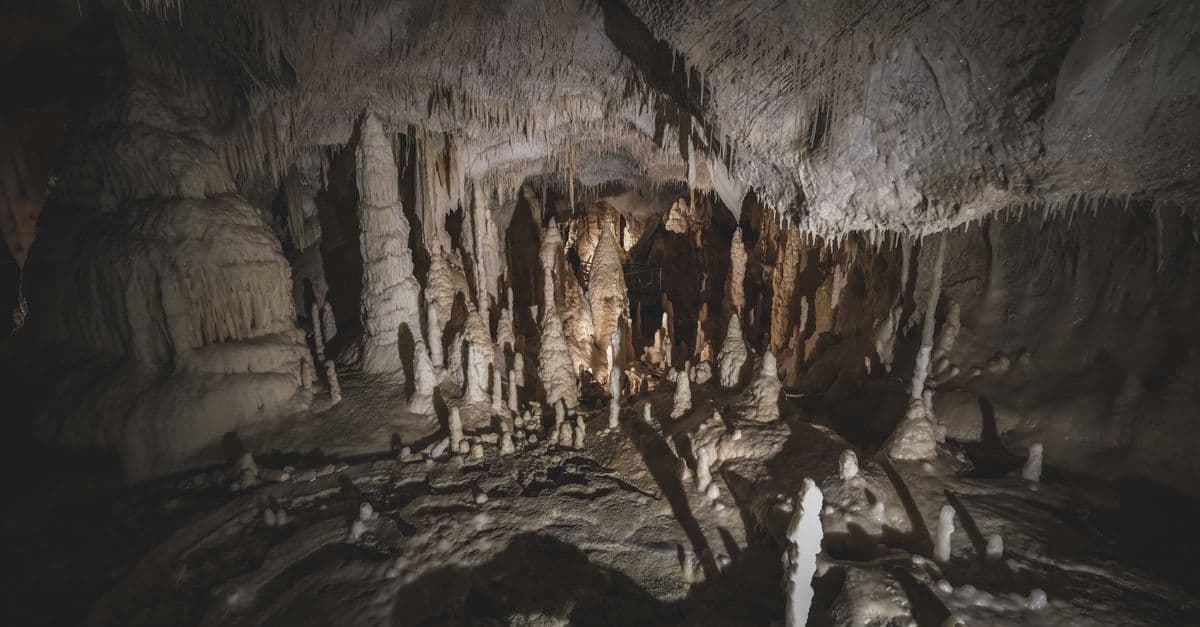
Photo: Cord Allman / Pexels
Veryovkina Cave, in the Arabika Massif of the Western Caucasus in Abkhazia, is the deepest known cave on the planet, explored to a depth of 2,212 meters (7,257 feet) by a Russian speleological expedition in March 2018, according to Guinness World Records and reporting from National Geographic. That's deep enough to bury more than five Empire State Buildings, stacked base to spire, underground. Caves this deep are not accidents of geology. They require a precise combination of soluble rock, mildly acidic water, and enormous vertical relief, and only a handful of places on Earth have all three at once.
Why almost every deep cave forms in limestone
Nearly all of the world's deepest caves form through a process called karst weathering, the dissolution of soluble bedrock, most often limestone, which is composed primarily of calcium carbonate (CaCO3). Karst is the name geologists give to landscapes and drainage systems shaped by this dissolution rather than by mechanical erosion. Rainwater absorbs carbon dioxide from the atmosphere and, even more, from the soil it passes through, forming a weak carbonic acid (H2CO3) that reacts chemically with limestone. That reaction converts solid calcium carbonate into calcium ions and bicarbonate ions, which simply wash away in solution, according to geochemical explanations of speleogenesis summarized by the U.S. National Park Service and peer-reviewed karst hydrology literature.
This slow chemical erosion is called speleogenesis, the origin and development of caves. It is not a fast process by human standards. A single passage a few meters wide can take tens of thousands to millions of years to form, as acidic groundwater exploits pre-existing joints, fractures, and bedding planes in the rock, widening them molecule by molecule. Early in a cave's life the passages are often full of water below the regional water table, a phase geologists call phreatic dissolution. As tectonic uplift or erosion lowers the water table over geological time, those flooded passages drain and the cave enters a vadose phase, where water trickles downward under gravity alone, carving vertical shafts rather than horizontal tunnels.
Limestone alone is not enough. The deepest caves on Earth also require substantial vertical relief, meaning mountainous terrain where water has a long way to fall before it reaches the water table or an impermeable rock layer that stops it. That is precisely the setting in the Western Caucasus: a young, actively uplifting mountain range built from thousands of meters of Jurassic and Cretaceous limestone, punctured by deep fractures from ongoing tectonic activity. It is why the Arabika Massif, a single limestone plateau in Abkhazia, hosts not just Veryovkina but several of the other deepest known caves on Earth within a few kilometers of each other.
How do cavers measure a cave's depth accurately?
Cave depth is the vertical distance between a cave's highest entrance and the lowest point explorers have physically reached and surveyed. Expedition teams carry laser rangefinders, precise altimeters, and traditional compass-and-tape surveying gear through every passage, recording thousands of individual measurements that are later compiled into a full three-dimensional survey, a process that can take years and multiple expeditions for the deepest systems.
Why these caves are vertical shafts, not horizontal tunnels
Picture a cave and most people imagine a walk-in tunnel, roughly horizontal, maybe with some scrambling. The deepest caves on Earth look nothing like that. They are structured as a series of near-vertical pitches, individual rope-accessed shafts stacked one after another, because they form along the same path gravity pulls water: straight down through fractured rock toward the water table.
Krubera Cave includes multiple pitches exceeding 100 meters (about 328 feet) in a single continuous vertical drop, according to expedition reports from the Ukrainian Speleological Association's "Call of the Abyss" project, the multi-year effort that pushed Krubera past the 2,000-meter mark. Descending a shaft like that means rigging rope anchors into the rock, rappelling down on a single line while wearing a harness and a helmet-mounted headlamp, then climbing back up the same rope using mechanical ascenders on the return trip. A caver moving through Krubera's deepest sections might rig and descend a dozen or more such pitches in a single push, each one a self-contained technical problem: finding solid rock for an anchor, judging rope length, checking for rockfall hazards, and communicating with teammates above and below by radio or by shouted relay, since sound and light rarely carry far in a shaft that size.
This vertical architecture also means the caves rarely run in a straight line. Water finds the path of least resistance through fractured rock, so the deepest systems zigzag between vertical shafts and short horizontal traverses called meanders, forcing cavers to squeeze through narrow constrictions between drops. Krubera's famous "Way to the Dream" section and its notorious tight squeezes are a direct result of this fracture-controlled geometry, not a design flaw in the cave.
Why do some of these caves end in flooded passages divers must swim through?
At the deepest point many of these systems reach, water table level passages fill completely, forming sumps, flooded sections that can only be pushed further by cave diving. Ukrainian diver Gennadiy Samokhin extended Krubera's known depth by diving its terminal sump to 46 meters underwater in 2007 and to 52 meters in 2012, each dive setting a new depth record for the cave, according to expedition accounts published by the Ukrainian Speleological Association.
The physical extremes explorers face at these depths
At depths exceeding 2,000 meters, cavers in systems like Veryovkina and Krubera work in conditions that would be dangerous even without the technical rope work. Air temperature in the deepest sections hovers just above freezing year-round, humidity sits near saturation, and there is no natural light of any kind below the entrance zone. Expedition teams rely entirely on carried lighting, and equipment failure at depth is a life-threatening problem rather than an inconvenience.
These conditions mean expeditions into the deepest known caves last one to two weeks underground, not hours. Support teams establish a series of underground camps at different depths, stocked in advance with food, fuel, and sleeping gear carried down in stages over multiple trips, so that the lead team pushing toward the bottom does not have to carry everything at once. Communication between camps and the surface typically relies on wired field telephones run alongside the rope lines, since radio signals do not reliably penetrate hundreds of meters of solid limestone.
Flooding is the single greatest hazard in these systems, and it is not a hypothetical one. In 2018, the same expedition that surveyed Veryovkina to its record depth was caught by a sudden flood inside the cave and had to make an emergency multi-day retreat while rising water threatened to cut off their escape route, an incident documented in detail by National Geographic's reporting on the expedition. Because these caves funnel water from a large surface catchment area down through narrow fractures, a rainstorm on the mountain above can turn a dry passage into a raging underground torrent within hours, even when the surface weather looks unremarkable from inside the cave.
Why the "deepest cave" record keeps changing
The title of deepest known cave has changed hands several times over the past few decades, and each change reflects better access and technology rather than a newly formed cave. Krubera Cave, also called Voronja Cave, became the first cave ever explored past 2,000 meters in 2006, when a Ukrainian Speleological Association expedition surveyed it to −2,080 meters, following an earlier 2001 expedition that had already made it the deepest known cave in the world at −1,710 meters, according to Ukr.S.A. expedition archives. Subsequent expeditions through the 2000s, aided by Samokhin's sump dives, pushed Krubera's surveyed depth to approximately 2,197 meters.
Veryovkina Cave, discovered in 1968 and named after caver Alexander Verëvkin, had been known for decades but not fully explored to its full depth until Russian expeditions in the 2010s pushed steadily downward, reaching 2,212 meters in March 2018. That depth, verified and reported by Guinness World Records, currently makes Veryovkina the deepest known cave on Earth, roughly 15 meters deeper than Krubera. Both caves sit in the same limestone massif, separated by only a few kilometers on the surface, which raises an open scientific question that cavers still debate: whether the passages of Veryovkina and Krubera might eventually connect underground into a single, even deeper system, something no expedition has yet confirmed.
This pattern, where a "deepest known" record shifts as exploration technology and physical access improve rather than because the underlying feature changed, closely parallels how our understanding of the fastest natural processes has been refined by increasingly precise measurement instruments over time. In both cases, the record reflects the limits of measurement as much as the limits of nature.
Life exists even at 2,000 meters underground
It is tempting to picture the deepest reaches of caves like Krubera as sterile rock and water, but researchers have documented a genuine subterranean ecosystem there. A biological expedition published a detailed survey of the "world's deepest subterranean community" in Krubera-Voronja Cave, cataloging more than a dozen species of arthropods living below the 2,000-meter mark, according to peer-reviewed fauna surveys of the cave system. One springtail species, Plutomurus ortobalaganensis, was recorded living as deep as −1,980 meters, at the time the deepest-dwelling terrestrial animal ever documented, according to reporting on the discovery.
These animals are called troglobites, species that live their entire life cycle underground and have evolved specifically for that environment, as distinct from animals that merely shelter in caves occasionally. Troglomorphism describes the suite of physical traits that mark this adaptation: reduced or completely absent eyes, loss of pigment so the body appears pale or translucent, and elongated antennae or legs that compensate for the total absence of light by improving the animal's sense of touch and vibration. Researchers found several species in Krubera showing clear troglomorphic traits, alongside aquatic crustaceans called stygobionts, animals adapted to permanently submerged groundwater habitats, found in the cave's deepest pools and sumps.
What sustains life this far from sunlight and photosynthesis is organic material washed in from the surface: leaf litter, wood fragments, and other debris carried down through the same fractures and shafts that let water descend. Bacteria and fungi break this material down first, and the arthropod community that lives at extreme depth feeds on that decomposing matter and on each other, forming a food web built entirely on imported nutrients rather than any energy source generated within the cave itself. Finding a functioning ecosystem 2,000 meters down demonstrates that the same fracture network moving water through the mountain also moves enough organic matter to keep life going in near-total isolation from the surface, powered by scraps rather than sunlight.
How do scientists even reach these animals to study them?
Biologists collecting specimens at extreme cave depth join the same rope-and-rappel expeditions as exploration cavers, carrying collection vials, hand lenses, and preservation fluid alongside standard caving gear. Specimens are typically photographed and preserved in the field, then carried back to the surface for laboratory identification, since live transport of troglobites across a multi-day underground trip is rarely practical.
What lies beyond the two deepest caves
Veryovkina and Krubera are the deepest confirmed caves, but they are not isolated outliers. Several other caves in the Arabika Massif and elsewhere in the Western Caucasus exceed 1,500 meters of surveyed depth, forming a cluster of extreme caves unmatched by any other karst region on Earth. Outside the Caucasus, the deepest caves drop off sharply in depth, generally because few other mountain ranges combine thick enough limestone, sufficient uplift, and a climate wet enough to keep dissolution active.
| Cave | Depth | Country / Region | Massif |
|---|---|---|---|
| Veryovkina Cave | 2,212 m (7,257 ft) | Abkhazia, Western Caucasus | Arabika Massif |
| Krubera (Voronja) Cave | 2,197 m (7,208 ft) | Abkhazia, Western Caucasus | Arabika Massif |
| Sarma Cave | 1,830 m (6,004 ft) | Abkhazia, Western Caucasus | Arabika Massif |
| Snezhnaja-Mezhonnogo Cave System | 1,753 m (5,751 ft) | Abkhazia, Western Caucasus | Bzybsky Massif |
| Lamprechtsofen | 1,741 m (5,712 ft) | Austria | Leoganger Steinberge |
| Gouffre Mirolda | 1,733 m (5,686 ft) | France | Haute-Savoie |
All six of the deepest known caves on Earth sit in limestone mountain ranges, and four of the six occupy the same small cluster of massifs in the Western Caucasus.
The geographic clustering matters scientifically because it confirms that depth is not simply a matter of how much limestone exists in a region. The Alps have enormous limestone deposits too, yet France's Gouffre Mirolda and Austria's Lamprechtsofen top out well over 400 meters shallower than Veryovkina. The Caucasus caves benefit from an unusually favorable combination: young, still-rising mountains that keep creating fresh vertical relief for water to exploit, paired with a climate wet enough to keep dissolution active year-round.
The gear and team structure behind a record-depth push
A single push to the bottom of Krubera or Veryovkina involves far more people than the two or three cavers who eventually stand at the deepest surveyed point. Expeditions to these caves typically run in stages over several weeks, with a rotating roster of team members handling different roles: riggers who install and check rope anchors throughout the system, haulers who ferry supplies down to underground camps, surveyors who record passage measurements as the team descends, and a lead push team that carries the specialized gear needed for the final, deepest sections.
Standard vertical caving gear includes a climbing harness, a chest ascender and hand ascender for climbing rope on the way back up, a rappel device for the way down, a helmet with a primary and backup light source, and a wetsuit or drysuit for passages with standing or flowing water. At the depths reached in Krubera and Veryovkina, cavers also carry emergency bivouac gear, food rated for extreme physical exertion in a cold, humid environment, and often a personal locator or wired-phone connection to the surface relay chain. Because a single misjudged rope length or a rockfall onto an unprotected anchor point can strand a team hundreds of meters below the nearest camp, redundancy is built into almost every system: backup lights, backup rope anchors, and backup routes wherever the passage geometry allows it.
The rope itself is a critical, finite resource. Fully rigging Veryovkina's known depth requires several kilometers of static caving rope left in place for the duration of an expedition, along with hundreds of individual bolted anchor points drilled into the limestone. Rigging a cave this deep is itself a multi-day undertaking that has to happen before any serious depth-pushing can begin, which is part of why record expeditions are measured in weeks rather than days from the moment the team enters the cave to the moment the last person exits.
What people get wrong about "the world's deepest cave"
A common misconception is that a cave's total length and its depth are the same kind of record, but they measure entirely different things. Mammoth Cave in Kentucky, in the United States, is the longest known cave system on Earth, with more than 400 miles (about 686 kilometers) of surveyed passages, according to the National Park Service, yet it is a relatively shallow horizontal system carved into flat-lying limestone with little vertical relief to exploit. Depth records like Veryovkina's belong to a completely different category of cave, one shaped by mountain relief rather than by lateral passage sprawl.
A second misconception is that the deepest point in a cave is necessarily its most dangerous point. In practice, the most hazardous sections are often mid-depth constrictions and flood-prone meanders rather than the terminal sump itself, because a flash flood anywhere in the system can cut off an entire team's exit route regardless of how deep they are at the time. This is also why expeditions to these caves are planned around seasonal weather windows, typically avoiding periods of heavy rain or snowmelt on the surface above, even though the cavers themselves may be hundreds or thousands of meters underground and unable to see the sky.
A third misconception worth correcting: these caves were not discovered and fully explored in a single expedition. Krubera's history spans more than four decades, from its first documented survey in the 1960s through the 2001, 2004, and 2006 milestone descents, to the sump dives of 2007 and 2012 that set its current depth. Deepest-cave records are the product of sustained, multi-generational exploration programs, not single dramatic breakthroughs.
The takeaway
The deepest caves on Earth exist because soluble limestone, mildly acidic rainwater, and dramatic, still-rising mountain relief combine in a handful of specific locations, most notably the Western Caucasus, to let gravity carve vertical shafts thousands of meters into the rock over geological time. Exploring them demands technical rope-climbing skill, cold-weather survival gear, and in the deepest sections, cave diving, precisely because these are vertical plunges shaped by falling water rather than the horizontal walking tunnels most people picture when they hear the word "cave." The record for deepest cave has shifted between Krubera and Veryovkina as exploration technology improved, and it will likely shift again as cavers keep pushing deeper into the same Caucasus limestone that has already produced the two deepest known points on Earth's continental crust reachable on foot and rope.
Read next:
FAQ
Q: What is the deepest known cave on Earth?
Veryovkina Cave in the Arabika Massif, Abkhazia, holds the record with an explored depth of 2,212 meters (7,257 feet), reached by a Russian speleological expedition in March 2018 and documented by Guinness World Records and National Geographic.
Q: Why are almost all of the world's deepest caves made of limestone?
Limestone, composed mostly of calcium carbonate, dissolves readily in the weak carbonic acid formed when rainwater absorbs atmospheric and soil carbon dioxide. That reaction lets water slowly widen fractures in the rock over thousands to millions of years, a karst process documented extensively in geochemical and speleology research.
Q: Why do the deepest caves require rope-climbing rather than walking?
These caves form as vertical shafts carved by water descending through fractured rock toward the water table, resulting in a series of steep pitches, some exceeding 100 meters in a single drop, that require technical rappelling and rope ascent rather than horizontal walking passages.
Q: Where are most of the world's deepest known caves located?
The Arabika Massif in the Western Caucasus mountains of Abkhazia hosts four of the six deepest known caves on Earth, including Veryovkina, Krubera, Sarma, and the Snezhnaja-Mezhonnogo system, due to its combination of thick limestone deposits, active mountain uplift, and a wet climate.
Q: How long do expeditions into the deepest caves typically take?
Expeditions into caves like Veryovkina and Krubera can last one to two weeks underground, given the technical rope work required at each vertical pitch and the logistics of stocking multi-day underground camps with food, fuel, and communication equipment carried down in stages.
Q: Is the deepest cave the same as the longest cave?
No. Depth and length measure different things. Mammoth Cave in Kentucky is the longest known cave system on Earth, with more than 400 miles (about 686 kilometers) of surveyed passages according to the National Park Service, but it is a relatively shallow horizontal system, unlike the vertical shaft caves of the Caucasus.
Follow new articles
Add SciHub101 to your feed reader to see new science and technology stories.
About the Author
SciHub101 is an independent science and technology publication founded and edited by Buğra Sözeri, a software engineer and app developer based in Türkiye. AI tools assist with drafting and research. Source documentation in the existing archive is uneven, and articles are being reviewed and corrected. The Editorial Team byline identifies editorial responsibility; it does not certify specialist or independent human review. Where we compare products, anything built by our own team is labelled as such — see the editorial guidelines and About page for how corrections and disclosures work.
Related Articles


The Largest Caves in the World: A Cavern With Its Own Jungle and Clouds
Deep in the Vietnamese jungle is a cave so large it has its own weather. Hang Sơn Đoòng — the world's largest cave passage — contains a forest, a river, and a microclimate that forms clouds beneath its ceiling, which soars high enough to fit a 40-storey skyscraper. It was only fully explored in 2009. The largest caves on Earth are among the last great unmapped spaces on the planet, carved by nothing more than slightly acidic water and a great deal of time.


The Deepest Scientific Drill Holes
The Kola Superdeep Borehole reached 12,262 m, the deepest scientific drill hole. See how deep crust drilling works, what it found, and why it stopped.