Why Naked Mole Rats Resist Cancer
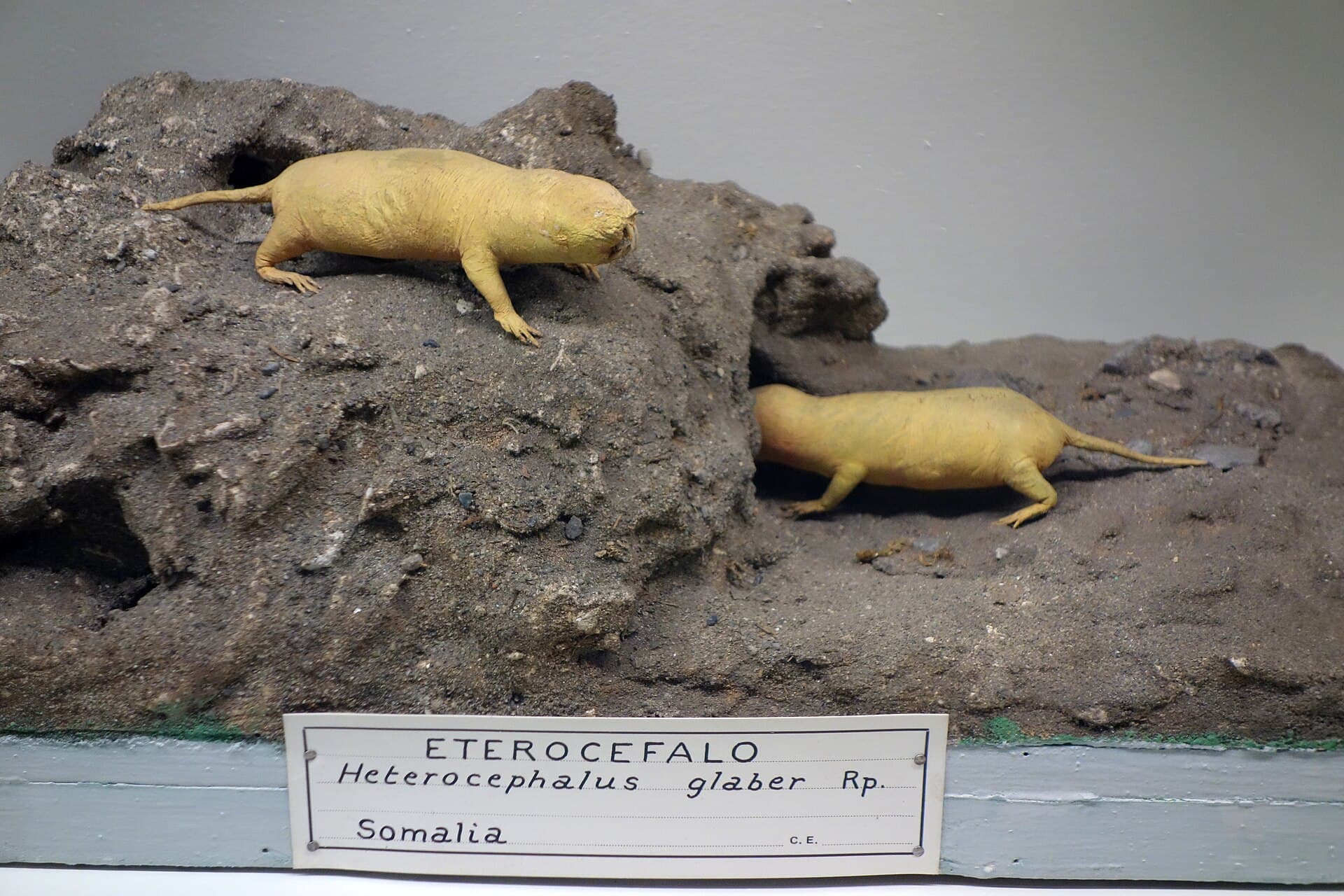
Photo: Daderot (CC0) / Wikimedia Commons / CC0
For decades, pathologists who necropsied naked mole rats from research colonies kept finding the same thing: nothing. Across roughly 2,000 documented necropsies, no invasive tumor turned up until two separate cases were finally confirmed and published in 2016 (Delaney et al., Veterinary Pathology, 2016). A hairless, thumb-sized burrowing rodent that can live past 30 years old has become one of the most closely studied animals in cancer biology, not because it never gets cancer, but because it almost never does, and biologists at the University of Rochester and elsewhere have spent over a decade tracing exactly why.
An animal that breaks the rules of aging
Body size and cancer risk are usually linked. Bigger animals have more cells, and more cells means more chances for one of them to accumulate the mutations that turn it cancerous. Elephants get around this with extra copies of a tumor-suppressor gene called p53 (Abegglen et al., JAMA, 2016); mice, which are tiny and cancer-prone, get around it by simply not living long enough for tumors to catch up with them.
Naked mole rats (Heterocephalus glaber) do neither. They weigh about 30 to 35 grams, roughly the same as a house mouse, yet they can live past 30 years in captivity, more than ten times a mouse's typical two- to three-year lifespan. Rochelle Buffenstein, who has tracked mole rat colonies for over three decades, has documented naked mole rats maintaining a stable low mortality risk for most of their adult lives rather than the accelerating risk curve typical of aging mammals, a pattern she and colleagues have described as showing little evidence of conventional physiological aging over decades of observation (Buffenstein, Journal of Comparative Physiology B, 2008).
That combination, small body, extraordinarily long life, and almost no cancer, is what pulled biogerontologists Vera Gorbunova and Andrei Seluanov into naked mole rat research in the first place. If cancer risk scales with cell number and time, a mole rat should be as cancer-prone as a mouse. It is the opposite, and that contradiction has driven one of the more productive research programs in comparative biology.
A sugar molecule that jams overcrowded cells
In 2013, Gorbunova and Seluanov's team, publishing in Nature, identified a major piece of the puzzle: naked mole rat cells secrete an unusually high-molecular-weight form of hyaluronan (also called hyaluronic acid), a long chain sugar molecule found in the fluid-filled spaces between cells throughout the body (Tian et al., Nature, 2013). Human and mouse hyaluronan chains typically run in the hundreds of kilodaltons; the naked mole rat version measured roughly five times larger, in the megadalton range.
Think of hyaluronan like packing foam between cells: in most mammals it is loose and easily broken down, but in naked mole rats it is dense and durable, and that density itself acts as a signal. When cells start dividing too fast and packing too closely together, an early hallmark of tumor formation, this oversized hyaluronan triggers a phenomenon called early contact inhibition, which tells the cells to stop dividing almost immediately, well before a mass of cells can organize into a tumor.
The Rochester team did not stop at correlation. They removed the gene for the enzyme that makes hyaluronan (HAS2) from naked mole rat cells in culture, and also knocked out the enzyme that normally breaks hyaluronan back down (hyaluronidase). Cells missing HAS2 lost their early contact inhibition and became susceptible to transformation into tumor-forming cells, while cells with excess untouched hyaluronan resisted it, direct causal evidence that the molecule itself, not some coincidental side effect, was doing the protective work.
Do naked mole rats get cancer at all, ever?
Very rarely. The first confirmed spontaneous cancer cases in captive naked mole rat colonies were documented and published only in 2016, both in male workers around 20 and 22 years old, from two separate colonies. Out of roughly 2,000 prior necropsies with no invasive tumor recorded, that is still an exceptionally low baseline compared with almost any other studied mammal, including humans and other rodents (Delaney et al., Veterinary Pathology, 2016).
A second, independent tumor-suppression layer
Naked mole rats also carry an unusual variant of a gene locus called INK4a/ARF, part of a tumor-suppressor pathway that normally works alongside the well-known p16 gene in most mammals to halt abnormal cell growth. In many species, cells eventually override this early braking system and keep dividing anyway, a step called escape from contact inhibition that is a required event on the road to most tumors. Gorbunova and Seluanov's lab found naked mole rat cells resist this escape far more strongly than mouse cells do, thanks to an altered ARF pathway that layers on top of the hyaluronan mechanism rather than replacing it (Seluanov et al., PNAS, 2009).
Having two semi-independent brakes matters because cancer is fundamentally a numbers game. A single mutation that disables one tumor-suppressor pathway is common; a cell would need to independently break both the hyaluronan-driven contact inhibition and the ARF/p16 pathway to escape control, which is a much less probable sequence of events. That redundancy, more than any single gene, may be what pushes the animal's cancer incidence so far below the mammalian baseline.
A completely separate mechanism: unusually accurate protein synthesis
A different line of research, also out of Gorbunova and Seluanov's lab, found that naked mole rat ribosomes, the cellular machines that translate genetic instructions into proteins, make far fewer errors than the ribosomes of mice. Using a reporter system that measures how often a ribosome inserts the wrong amino acid, the team found naked mole rat cells had substantially higher translational fidelity than mouse cells, despite building proteins at a comparable overall speed (Azpurua et al., PNAS, 2013).
Part of the explanation appears to be structural. Naked mole rat ribosomes carry an unusual cleavage in their 28S ribosomal RNA, one of the core structural components of the ribosome, that is not present in the equivalent structure in mice or most other mammals studied. Subsequent structural biology work using cryo-electron microscopy has confirmed this fragmented 28S rRNA forms a stable, distinctive ribosome architecture, and researchers are still working out exactly how the fragmentation changes ribosome behavior (bioRxiv, 2025 structural study).
Why would more accurate protein synthesis matter for cancer resistance? Misfolded and damaged proteins accumulate as cellular stress and contribute both to aging and to the kind of genomic instability that lets cancer cells proliferate. A cell that makes fewer translation errors builds up less of this cellular clutter over a lifetime, which several papers from the Gorbunova lab have proposed as a mechanism supporting the naked mole rat's unusually stable, long-lived proteome, working in parallel with, rather than instead of, the hyaluronan and ARF/p16 pathways (Gorbunova et al., 2020 review).
Where the mechanisms compete, and where the evidence pushes back
Not every study has confirmed the hyaluronan story cleanly, and a responsible account of the science has to include the pushback along with the original finding. A 2019 study that transformed naked mole rat cells with the same combination of viral oncogenes (SV40 large T antigen and mutant HRAS) used in the original 2013 paper found that, in their hands, the modified cells still formed colonies in soft agar, a standard lab test for whether cells have become cancer-like. The authors were careful to note they did not dispute that naked mole rat cells contain high-molecular-weight hyaluronan; they detected it themselves. Their point was narrower and more useful: hyaluronan alone may not be sufficient to block transformation under every experimental condition, and the field needs to reassess exactly how central a role it plays relative to the other mechanisms (bioRxiv replication study, 2018).
That kind of disagreement is normal, healthy science, not a debunking. The table below lays out how the leading proposed mechanisms compare, including the strength and type of evidence behind each one.
| Mechanism | What it does | Key evidence | Researchers |
|---|---|---|---|
| High-molecular-weight hyaluronan | Triggers early contact inhibition, halting overcrowded cell division before a tumor can form | Gene knockout removes protection; transplanting the gene into mice reduces their cancer incidence | Gorbunova and Seluanov lab, Nature 2013; Nature 2023 follow-up |
| Altered ARF/p16 pathway | Adds a second, semi-independent brake against escape from contact inhibition | Comparative cell-culture studies showing stronger resistance to transformation than mouse cells | Seluanov, Gorbunova, and colleagues, PNAS 2009 |
| High-fidelity ribosomal translation | Produces fewer misfolded or damaged proteins, reducing cellular stress linked to cancer and aging | Direct measurement of translation error rates; unique 28S rRNA structure confirmed by cryo-EM | Gorbunova, Seluanov, and structural biology collaborators, PNAS 2013 and later structural studies |
| Efficient DNA repair | Naked mole rat cells show more efficient nucleotide excision repair than mouse cells, limiting mutation accumulation | Comparative DNA repair assays across rodent species | MacRae, Croteau, Bohr, and colleagues |
| Replication challenge to hyaluronan sufficiency | Found that under some oncogene combinations, hyaluronan-rich naked mole rat cells still transformed in culture | Soft-agar colony formation despite confirmed presence of high-molecular-weight hyaluronan | Independent lab, bioRxiv 2018 |
The rest of the naked mole rat's unusual biology
Cancer resistance is the naked mole rat's most famous trait, but it did not evolve in isolation, and understanding the animal's broader biology helps explain why researchers think its underground lifestyle selected for such an unusual set of cellular defenses in the first place.
Naked mole rats are one of only two known eusocial mammals, meaning they live in cooperative colonies with a strict reproductive division of labor, more like a beehive or an ant colony than a typical rodent group. A single breeding female, the queen, and one to three breeding males produce nearly all of a colony's offspring, while dozens to nearly a hundred other colony members remain non-reproductive workers. Researchers reported in 2026 that queens secrete a volatile compound called isopropyl myristate during pregnancy, which appears to chemically suppress fertility in the colony's other females, a mechanistic explanation for reproductive suppression that had previously been attributed mostly to behavioral dominance (phys.org coverage of the 2026 findings).
Naked mole rats also tolerate conditions that would be lethal to most mammals within minutes. Their East African burrows have limited oxygen and elevated carbon dioxide, and the animals can survive extended periods of severe hypoxia partly by switching their metabolism to run on fructose instead of glucose, a fuel-switching strategy more typical of plant cells than mammalian ones (Park et al., Science, 2017). Thomas Park's research group has proposed that adaptations for surviving this low-oxygen, high-carbon-dioxide underground environment may have incidentally produced cells that are also unusually resistant to the kind of uncontrolled, stress-driven growth that defines cancer, since both hypoxia tolerance and cancer resistance require cells to control their metabolism and growth signaling far more tightly than usual.
The same underground pressures appear linked to another well-documented trait: naked mole rats are functionally insensitive to two specific kinds of pain, acid and capsaicin, the compound that makes chili peppers feel hot. Work from Gary Lewin's lab found naked mole rats are the only known vertebrate that shows no behavioral response to acid exposure on the skin, a finding traced to structural differences in a specific sodium channel in their pain-sensing neurons (Park et al., PLOS Biology, 2008). Carbon dioxide builds up in crowded, poorly ventilated burrows and converts to carbonic acid on moist tissue, so losing acid pain sensitivity may have been an adaptation to living somewhere that would otherwise constantly hurt.
Why this matters for human cancer research
Naked mole rats are one of biology's clearest examples of finding a problem already solved in nature that medicine is still trying to solve artificially. Human cancer therapy research spends enormous effort trying to reintroduce contact inhibition into runaway tumor cells or to reduce the cellular stress from misfolded proteins; naked mole rat cells appear to enforce both by default, using modified versions of molecules and processes already present in nearly every mammal's body.
That is precisely why the field has moved from simply cataloging the naked mole rat's resistance to testing whether it can be exported. The 2023 experiment giving ordinary mice the naked mole rat version of the HAS2 gene, and watching those mice develop fewer tumors and live longer, is the clearest proof of concept so far that a specific naked mole rat mechanism can function in a different mammal's body, not just in a petri dish of its own cells.
It also illustrates why comparative biology, studying species that are naturally resistant to human diseases, has become a serious research strategy rather than a curiosity. Elephants with extra p53 copies, bowhead whales that can live over 200 years with unusually robust DNA repair, and naked mole rats with reinforced contact inhibition are all being studied side by side as different evolutionary solutions to the same underlying problem of keeping cell division under control across a long lifespan.
What people get wrong about naked mole rat cancer resistance
The most common misconception is that naked mole rats simply never get cancer, full stop. They do, rarely, as the confirmed 2016 cases demonstrate, and that matters scientifically because it shows the resistance is a strong statistical outlier built from multiple biological mechanisms, not an absolute biological impossibility. Framing it as absolute makes the eventual counterexamples look like a debunking rather than what they actually are: useful data points that sharpen the model.
A second, related misconception is that a single gene or molecule explains the whole trait. Popular coverage of the 2013 hyaluronan paper sometimes flattened a multi-layered story into "naked mole rats found the cancer gene," but the actual research points to at least three semi-independent contributors, hyaluronan-driven contact inhibition, the ARF/p16 pathway, and high-fidelity ribosomal translation, plus supporting factors like efficient DNA repair. The 2018 replication study's finding, that hyaluronan-rich cells could still be transformed under certain lab conditions, only makes sense once you understand that hyaluronan was never claimed to work alone.
A third confusion worth clearing up is between cancer resistance and immortality. Naked mole rats are not immortal, and their mortality risk, while remarkably flat across much of adulthood compared with other mammals, is not zero. Rochelle Buffenstein's longitudinal data track a real, aging population, not a fictional creature that never dies; the animal's actual biology is unusual enough without needing to exaggerate it further.
The takeaway
Naked mole rats resist cancer because several partly independent cellular defenses stack on top of each other: an oversized form of hyaluronan that halts overcrowded cells from dividing, a reinforced ARF/p16 tumor-suppressor pathway, and ribosomes that make proteins with unusually few errors, each identified through direct laboratory experiments that removed, restored, or transplanted the relevant genes rather than relying on correlation alone. The 2016 discovery of two real spontaneous cancer cases, and a 2018 study that found hyaluronan-rich cells could still be transformed under some conditions, are not contradictions of this picture but confirmations that the resistance is real, strong, and built from redundancy rather than a single silver-bullet gene. The 2023 demonstration that the naked mole rat's hyaluronan gene reduces cancer and extends lifespan when transplanted into ordinary mice is the strongest evidence yet that at least part of this evolved solution can be borrowed, which is what keeps this odd-looking burrowing rodent at the center of serious cancer biology rather than being a footnote in it.
Read next:
FAQ
Q: What molecule protects naked mole rats from cancer?
Naked mole rat cells produce an unusually high-molecular-weight version of hyaluronan, roughly five times larger than the human form, which triggers cells to stop dividing as soon as they become overcrowded. This mechanism was identified by Vera Gorbunova and Andrei Seluanov's team and published in Nature in 2013, and it works alongside a reinforced ARF/p16 tumor-suppressor pathway and unusually accurate ribosomal protein synthesis.
Q: Do naked mole rats ever get cancer?
Extremely rarely, but yes. The first two confirmed spontaneous cancer cases in captive naked mole rat colonies were documented and published in 2016, out of roughly 2,000 prior necropsies with no invasive tumor recorded, underscoring how exceptional their baseline resistance is compared to nearly every other studied mammal.
Q: How long do naked mole rats live compared to similarly sized rodents?
Naked mole rats can live past 30 years in captivity, more than ten times longer than a mouse of similar body size, and researcher Rochelle Buffenstein has documented them maintaining a largely flat mortality risk across most of adulthood rather than the accelerating risk curve typical of aging mammals.
Q: Is naked mole rat cancer resistance based on just one gene or mechanism?
No. Researchers have identified at least three layers of defense working together: the high-molecular-weight hyaluronan mechanism, a separately modified ARF/p16 tumor-suppressor pathway, and unusually high-fidelity ribosomal protein synthesis linked to a distinctive fragmented 28S ribosomal RNA structure, with more efficient DNA repair also contributing.
Q: Could naked mole rat cancer resistance ever help treat human cancer?
It is an active area of research with real transplantation evidence, not just speculation. In 2023, researchers engineered ordinary mice to express the naked mole rat version of the hyaluronan-producing gene, and those mice showed fewer spontaneous and induced cancers along with a longer lifespan, though no approved human therapy currently exists based on this mechanism.
Q: Why are naked mole rats also insensitive to certain kinds of pain?
Naked mole rats show no behavioral response to acid exposure on the skin and altered responses to capsaicin, differences traced to structural changes in the sodium channels of their pain-sensing neurons. Researchers led by Gary Lewin have proposed this evolved because naked mole rat burrows accumulate carbon dioxide, which converts to acid on moist tissue, making acid insensitivity useful for life in crowded, poorly ventilated tunnels.
Q: Are naked mole rats the only eusocial mammal?
They are one of only two known eusocial mammal species, the other being the closely related Damaraland mole rat. Naked mole rat colonies are organized around a single breeding queen and one to three breeding males, with the rest of the colony, sometimes numbering close to a hundred individuals, remaining non-reproductive workers.
Follow new articles
Add SciHub101 to your feed reader to see new science and technology stories.
About the Author
SciHub101 is an independent science and technology publication founded and edited by Buğra Sözeri, a software engineer and app developer based in Türkiye. AI tools assist with drafting and research. Source documentation in the existing archive is uneven, and articles are being reviewed and corrected. The Editorial Team byline identifies editorial responsibility; it does not certify specialist or independent human review. Where we compare products, anything built by our own team is labelled as such — see the editorial guidelines and About page for how corrections and disclosures work.
Related Articles

Why Whales Sing Underwater
Why whales sing underwater: the SOFAR channel, low-frequency physics, Payne and McVay's 1971 discovery, and what remains unproven about whale language.

How Apoptosis Works: Why Healthy Cells Choose to Die
Apoptosis is programmed cell death. Learn how caspases, mitochondria, and Bcl-2 proteins carry it out, and what goes wrong in cancer and autoimmunity.
What Are Telomeres? Chromosome Caps, Aging, and Cancer
Telomeres are repeat-DNA caps on chromosome ends that shorten with each cell division. See how telomerase works and what telomere length does not prove.

Liquid Biopsy Explained: What Blood Can Reveal About Cancer
Liquid biopsy reads tumor DNA, cells and vesicles in blood. See what ctDNA can show, where evidence is strong, and why it does not replace tissue biopsy.

Cancer Cell Behavior in Zero-G: How Microgravity Changes Tumor Growth
ISS experiments reveal that cancer cells behave differently in microgravity, sometimes becoming more aggressive but also more vulnerable—insights accelerating cancer research.