Why Crows Remember Human Faces
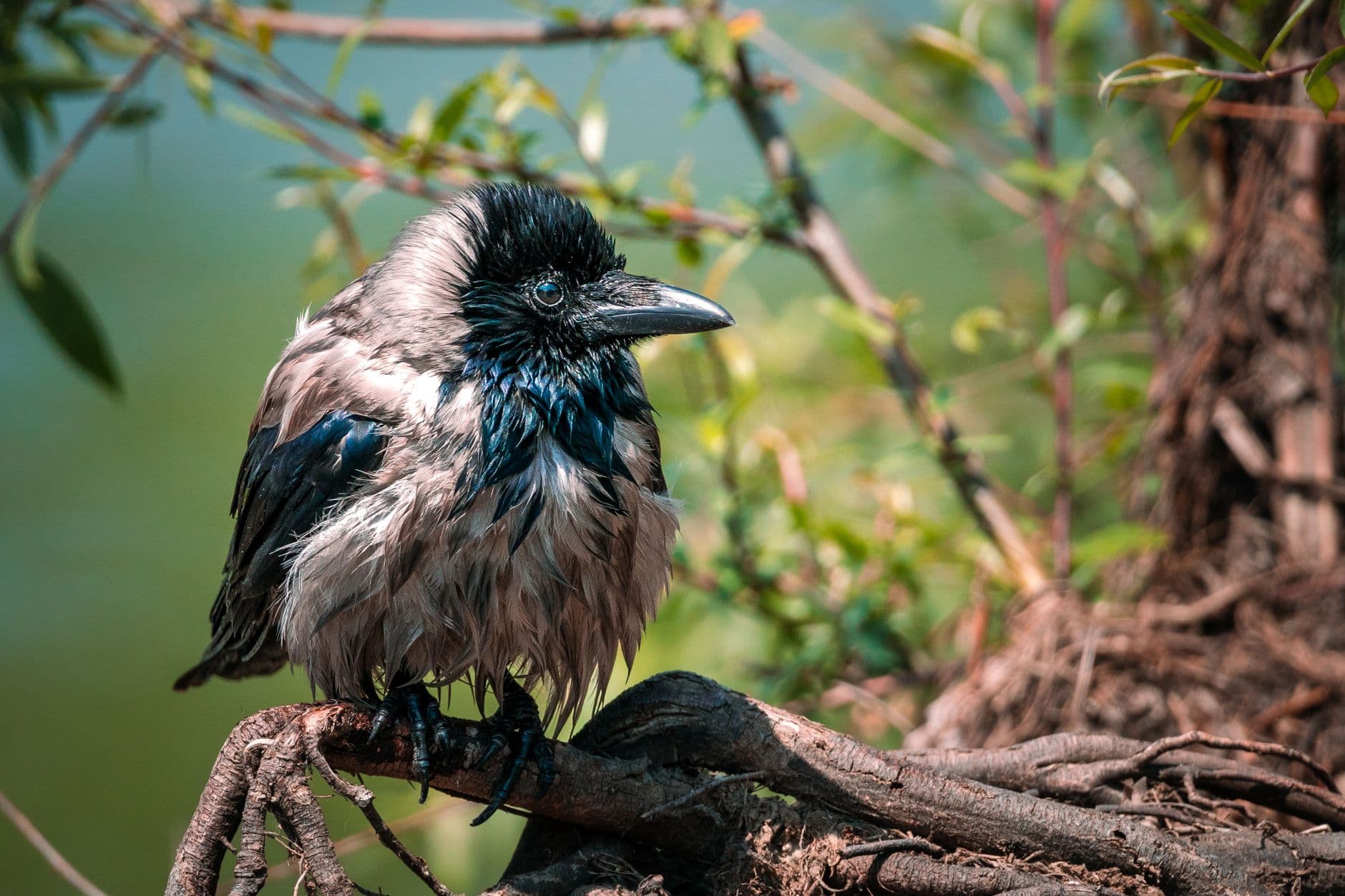
Photo: Denitsa Kireva / Pexels
Wild American crows in Seattle learned to recognize and scold a specific rubber mask worn by researchers who had trapped them, and kept doing it for at least eight years, according to a long-running study led by wildlife biologist John Marzluff at the University of Washington. The response didn't stay confined to the crows that were actually trapped: it spread through the local population, passed from parent to offspring and between unrelated birds that never experienced the original capture. This is one of the best-documented cases of an animal outside the primate line building, and socially sharing, a lasting memory of an individual human face.
What Marzluff's mask experiment actually showed
Between 2006 and 2008, Marzluff and his students trapped, banded, and released between 7 and 15 wild American crows at each of five sites around the University of Washington campus and nearby areas. To separate facial recognition from other cues like clothing or gait, researchers wore a distinctive rubber caveman mask while doing the trapping, and a Dick Cheney mask, chosen for its unfamiliarity to crows and neutrality as a control, while going about campus without bothering any birds (Marzluff et al., 2010, Animal Behaviour; University of Washington News, 2012).
The results were immediate and durable. Within the first two weeks after trapping, about 26 percent of crows at a site scolded a researcher wearing the "dangerous" caveman mask on sight, diving at the person, screaming alarm calls, and sometimes recruiting other crows to join the mobbing. By three years later, that figure had climbed to roughly 66 percent of crows at the same sites, even though most of the newly scolding birds had never been captured themselves. Researchers wearing the neutral mask, by contrast, were mostly ignored.
That gap between "trapped personally" and "learned to be afraid anyway" is the heart of the finding. A young crow that hatched after the original trapping event, and that had no direct memory of any human harming it, still treated the caveman mask as a threat because it watched its parents, siblings, or neighbors react to it that way. Corvid researchers call this social transmission of threat information, and it means the caveman mask's reputation outlived the birds who first earned it that reputation.
Can crows really tell individual human faces apart, not just human shapes in general?
Yes. Crows distinguished the specific "dangerous" mask from a neutral control mask worn by different researchers, in different clothing, at different times of day and in different locations around campus. Because the only consistent variable between encounters was the face itself, Marzluff's team concluded the birds were keying on facial features rather than gait, clothing, or general human silhouette.
Where in the crow's brain this memory lives
To find out what was happening physiologically, Marzluff teamed with University of Washington nuclear medicine researchers Robert Miyaoka, Satoshi Minoshima, and Donna Cross to scan crow brains with positron emission tomography (PET), a technique that maps which brain regions consume the most glucose, and therefore the most energy, during a given task (Marzluff et al., 2012, PNAS). Wild-caught crows were briefly injected with a radioactive glucose tracer, shown either the threatening mask or the neutral one, then scanned.
Amygdala — a brain structure, found in both mammals and birds, that processes fear and stores emotionally charged threat memories. In mammals it sits within the temporal lobe; in birds the anatomically distinct but functionally comparable structure is sometimes called the archistriatum or, in newer nomenclature, part of the arcopallium. In the crow scans, viewing the "dangerous" mask activated this fear-processing region along with the thalamus and brainstem, areas tied to heightened arousal and vigilance (University of Washington News, 2012).
A 2013 follow-up by Cross and colleagues sharpened the picture further: an innate, hard-wired fear stimulus (a red-tailed hawk, a natural crow predator) activated a different structure, the caudal nidopallium, while a learned threat, the previously antagonistic human face, activated the amygdala-equivalent region specifically. A third, novel threat, an unfamiliar person holding a dead crow, activated the hippocampus, the structure most associated with forming new memories. In other words, crow brains appear to route different categories of fear through different, specialized circuits, echoing a division of labor long documented in mammals but never before mapped this precisely in a bird.
That convergence is notable because birds and mammals last shared a common ancestor roughly 300 million years ago, and bird brains lack the six-layered neocortex that mammalian threat processing was long assumed to require. Crows getting to a similar functional outcome, a dedicated circuit for storing and retrieving specific threat memories, by a completely different anatomical route suggests this kind of processing is less about which brain layout an animal happens to inherit and more about a problem that keeps getting solved the same way whenever an animal's survival depends on tracking individual dangers.
The PET method itself is worth unpacking, because it's what let researchers watch this happen rather than just infer it from behavior. A radioactive glucose analog is injected into the bloodstream; brain tissue working hardest at that moment pulls in more of it, and the scanner maps where the tracer concentrated a short time later. That means the crow's brain activity at the moment it looked at the mask, not a general baseline, is what shows up on the scan. Running the same wild-caught birds through both the threatening-mask and neutral-mask conditions, and comparing the two scans directly, is what let Marzluff's team isolate activity specific to the dangerous face rather than activity from simply looking at any human image.
How this fits into broader corvid intelligence
Facial memory doesn't exist in isolation. It sits alongside a cluster of cognitive abilities documented across corvids, the family that includes crows, ravens, magpies, and jays, abilities that collectively make this bird family one of the most closely studied non-primate lineages in comparative psychology.
| Cognitive ability | Species studied | Evidence | Key source |
|---|---|---|---|
| Individual facial recognition | American crow | Scolding of a specific "dangerous" mask persisted 8+ years and spread to birds never personally trapped | Marzluff et al., 2010/2012, Animal Behaviour / PNAS |
| Tool manufacture | New Caledonian crow | Wild birds shape hooked tools from twigs and pandanus leaves; a captive crow named Betty spontaneously bent a straight wire into a hook to retrieve food | Hunt, 1996, Nature; Weir, Chappell & Kacelnik, 2002, Science |
| Mobbing and alarm recruitment | American crow, other corvids | Crows summon others via distinct alarm calls when a known threat appears, coordinating group defense | Marzluff et al., 2010, Animal Behaviour |
| Episodic-like memory | Western scrub-jay | Birds recall what food they cached, where, and how long ago, adjusting retrieval to avoid spoiled items | Clayton & Dickinson, 1998, Nature |
| Mirror self-directed behavior | Magpie | Initial 2008 study reported 2 of 5 magpies touching a mark visible only in a mirror; a 2020 replication attempt found no clear evidence of self-recognition | Prior et al., 2008, PLOS Biology; Soler et al., 2020, replication study |
Facial memory is one entry in a documented pattern of corvid cognition, though not every early corvid-intelligence claim has held up under replication, which is itself useful context for how confident to be in any single study.
What Betty the crow's wire-bending and scrub-jay caching experiments reveal
The facial-memory research doesn't stand alone; two other corvid studies, run independently of Marzluff's work, show the same family solving very different cognitive problems with comparable sophistication.
In 2002, Oxford researchers Alex Weir, Jackie Chappell, and Alex Kacelnik were testing New Caledonian crows on a task that required lifting a small food-filled bucket out of a vertical tube using a hooked tool. One captive female, known as Betty, ran out of hooked tools during a trial when her cage-mate made off with the only one. Left with a straight piece of garden wire, Betty spontaneously bent it into a hook, wedged the hook under the bucket's handle, and pulled the food out (Weir, Chappell & Kacelnik, 2002, Science). She wasn't trained to do this and had never been shown a wire bent that way. In a follow-up series of trials published a few years later, Betty went on to bend hooks correctly in the large majority of attempts and, when researchers switched the task so the material needed to be unbent instead, she adapted her technique to that as well (Royal Society Open Science, 2016). Wild New Caledonian crows do something related in the field: they manufacture hooked tools from twigs and strip barbed tools from pandanus leaves to winkle insect larvae out of tree bark, a behavior first documented by Gavin Hunt in 1996 (Hunt, 1996, Nature). Betty's wire-bending mattered because it happened with a novel material, in a single trial, with no prior demonstration, the kind of result that raised real questions about how much physical causality a bird brain can represent, not just imitate.
Clayton and Dickinson's 1998 scrub-jay work targeted a different question entirely: not tool use, but memory structure. Western scrub-jays were allowed to cache two food types, wax worms and peanuts, in different locations at different times. Wax worms are a preferred food but rot within about four hours; peanuts stay edible far longer. When researchers let the jays return to retrieve their caches, the birds recovered wax worms first if the delay had been short, and skipped straight to the peanuts if enough time had passed that the worms would have spoiled (Clayton & Dickinson, 1998, Nature). That meant each bird was tracking three linked pieces of information for every cache it made: what it had hidden, where it had hidden it, and how long ago, the same what-where-when structure that defines episodic memory in humans. It was the first behavioral evidence of that memory structure in any non-human animal.
Neither study used Marzluff's facial-recognition protocol, and neither species involved was American crows specifically. But together with the mask experiments, they sketch a consistent picture: corvids that solve very different problems, avoiding a specific dangerous person, extracting insects from bark, retrieving food before it spoils, all rely on encoding detailed, individuated information rather than falling back on generic rules of thumb.
Do other corvids besides crows remember faces too?
Ravens and magpies have not been tested with the same controlled mask protocol Marzluff used on crows, so a direct, peer-reviewed comparison doesn't exist yet. Anecdotal reports of ravens recognizing individual researchers are common in the corvid literature, but the crow studies remain the most rigorously documented case of facial memory in this family.
Why this ability evolved in crows specifically
American crows are unusually well positioned among wild animals to benefit from remembering individual humans. They live in the same territory, often the same neighborhood, for years; wild American crows can live past 15 years, and urban populations interact with the same residents, delivery routes, and researchers on a near-daily basis. An animal in that situation gains a clear advantage from being able to flag one specific dangerous person rather than treating every human as an undifferentiated, unknown risk.
Crows also live in extended family groups where young birds often stay near their parents for a year or more, and where unrelated crows share territory and roost communally outside the breeding season. That social structure creates exactly the conditions social transmission needs: a network of birds in regular contact who can watch one another's reactions and pick up threat information secondhand. A crow that never got trapped but watched its parents scold the caveman mask gained the survival benefit of that knowledge without paying the cost of the original bad encounter.
This is worth contrasting with animals that lack that kind of stable social network. Solitary foragers with little sustained contact between individuals have less opportunity for a warning to spread even if one animal does form an individual memory. Facial recognition without a social channel to distribute it would still help the individual crow that was trapped, but it wouldn't produce the population-wide shift Marzluff documented.
Why this matters beyond crow biology
The crow research reshaped a long-standing assumption in comparative cognition: that layered mammalian cortex is a prerequisite for sophisticated social learning and individual recognition. Crows lack that cortical architecture entirely, yet PET imaging shows their brains route threat memories through functionally specialized regions in a pattern that echoes mammalian fear circuitry, built from different anatomical material arriving at a similar outcome. That's evidence intelligence isn't a single evolutionary path but a set of problems that get solved repeatedly whenever an animal's environment rewards solving them.
There's also a very concrete, practical consequence for anyone who studies or handles wild crows: the animals remember who trapped them, and they don't forget quickly. Wildlife researchers now routinely account for the possibility that a local crow population may recognize and avoid a specific person for years after a single capture event, which can bias future observations if it isn't controlled for. Pest-control operators and property managers who have tried aggressive methods to deter crows have reported similar long-term avoidance and mobbing directed at specific individuals, though that pattern is documented mostly through anecdote and Marzluff's own public writing rather than controlled studies.
What people get wrong about crow memory
A common misreading of this research is that crows are simply reacting to "a human," full stop, the way a startled animal might flinch at any sudden movement or unfamiliar shape. The mask design specifically ruled that out: crows ignored the neutral mask worn by the same researchers, in the same locations, using the same movements as the threatening one. The variable that mattered was the face.
Another frequent misconception is that this is instinct rather than learning, something crows are simply born knowing how to do. It isn't. The caveman mask meant nothing to crows before the trapping event; the negative association had to be created through a specific bad experience and then actively taught, through observation and mobbing behavior, to birds that didn't have that experience themselves. Remove the original trapping, and there is no reason to expect a crow to react to a caveman mask at all.
A third confusion worth flagging honestly: not every dramatic claim about corvid cognition has aged equally well. The 2008 magpie mirror self-recognition study, often cited alongside the Marzluff crow research as evidence of sophisticated bird cognition, has not been consistently replicated; a 2020 attempt to repeat the mark test found no clear evidence magpies recognize themselves in mirrors. That doesn't undercut the crow facial-recognition findings, which rest on a different experimental design and have been independently followed up over more than a decade, but it's a reminder that corvid intelligence claims deserve the same scrutiny as any other scientific result, not blanket acceptance because crows are already known to be sharp.
The takeaway
Crows aren't reacting to people on instinct when they mob a specific individual: they're drawing on an individually formed facial memory, built from a real bad experience, stored in a brain region that does for crows roughly what the amygdala does for mammals, and actively taught to other crows who never had the original encounter. That combination of durable individual memory and social transmission is what makes the Marzluff research unusual, not just that crows can recognize faces, but that a single interaction with one person can shape how an entire local crow population treats that person for years afterward.
Read next:
- How Bees Communicate With Dances
- How Salmon Find Their Birth River
- Why Naked Mole Rats Resist Cancer
FAQ
Q: How long can crows remember a threatening human face?
Research led by John Marzluff at the University of Washington documented crows still scolding a mask associated with an original trapping event at least eight years later, at a site where most of the originally trapped crows had already died, meaning younger birds that learned the threat secondhand kept the behavior alive.
Q: Do crows teach other crows to recognize dangerous people?
Yes. In Marzluff's field trials, the share of crows scolding a "dangerous" mask rose from about 26 percent within two weeks of the original trapping to about 66 percent within three years, even though most of the newly reacting birds were never personally captured, evidence of social transmission through the local population.
Q: Which part of a crow's brain handles facial threat memory?
PET imaging by Marzluff, Cross, and colleagues found that viewing a threatening human face activated the crow brain's amygdala-equivalent region along with the thalamus and brainstem, structures tied to fear and heightened vigilance, despite birds and mammals having evolved separately for roughly 300 million years.
Q: Can crows tell individual humans apart from clothing or general shape alone?
No, the recognition specifically tracked facial features. In Marzluff's experiments, crows distinguished a "dangerous" caveman mask from a neutral control mask even when researchers wore different clothing and moved through different locations on campus.
Q: Why did crows evolve the ability to remember specific human faces?
Crows live in the same territory as humans for years, sometimes over a decade, in extended family groups and loose social networks that allow threat information to spread. Individually flagging a dangerous person, and passing that warning to relatives and neighbors, provides a real survival advantage over treating every human encounter as new information.
Q: Is the crow facial-recognition research the same as the magpie mirror-test findings?
No, and they shouldn't be conflated. The crow facial-recognition work has been followed up over more than a decade with consistent results. A separate 2008 study claiming magpies recognize themselves in mirrors has not been reliably replicated, including in a 2020 follow-up attempt, so it carries much weaker evidentiary support.
Q: Is crow facial memory the same kind of tool-use intelligence seen in New Caledonian crows?
No, they're separate abilities documented in separate studies. Facial memory, as shown in Marzluff's American crow research, is about encoding and socially transmitting information tied to a specific individual's threat level. Tool manufacture, as shown when the New Caledonian crow Betty spontaneously bent wire into a hook in 2002, is about representing how a physical object needs to be shaped to solve a mechanical problem. Both point to sophisticated cognition in corvids, but they rely on different tasks and, in Betty's case, a different species.
Q: Do captive or pet crows also form lasting memories of individual people?
There's no controlled study directly testing captive crows with Marzluff's mask protocol, so a formal comparison to the wild-crow findings doesn't exist. Wildlife rehabilitators and falconers frequently report captive corvids showing strong, long-lasting preferences and aversions toward specific handlers, which is consistent with the underlying cognitive capacity documented in wild crows, though it remains anecdotal rather than peer-reviewed evidence.
Follow new articles
Add SciHub101 to your feed reader to see new science and technology stories.
About the Author
SciHub101 is an independent science and technology publication founded and edited by Buğra Sözeri, a software engineer and app developer based in Türkiye. AI tools assist with drafting and research. Source documentation in the existing archive is uneven, and articles are being reviewed and corrected. The Editorial Team byline identifies editorial responsibility; it does not certify specialist or independent human review. Where we compare products, anything built by our own team is labelled as such — see the editorial guidelines and About page for how corrections and disclosures work.
Related Articles

The Bobo Doll Experiment: How Bandura Proved We Learn Aggression by Watching
In 1961, Albert Bandura showed that children copy adult aggression toward an inflatable doll. The Bobo doll experiment built social learning theory — and still shapes media violence debates.