How Bats Hunt With Echolocation
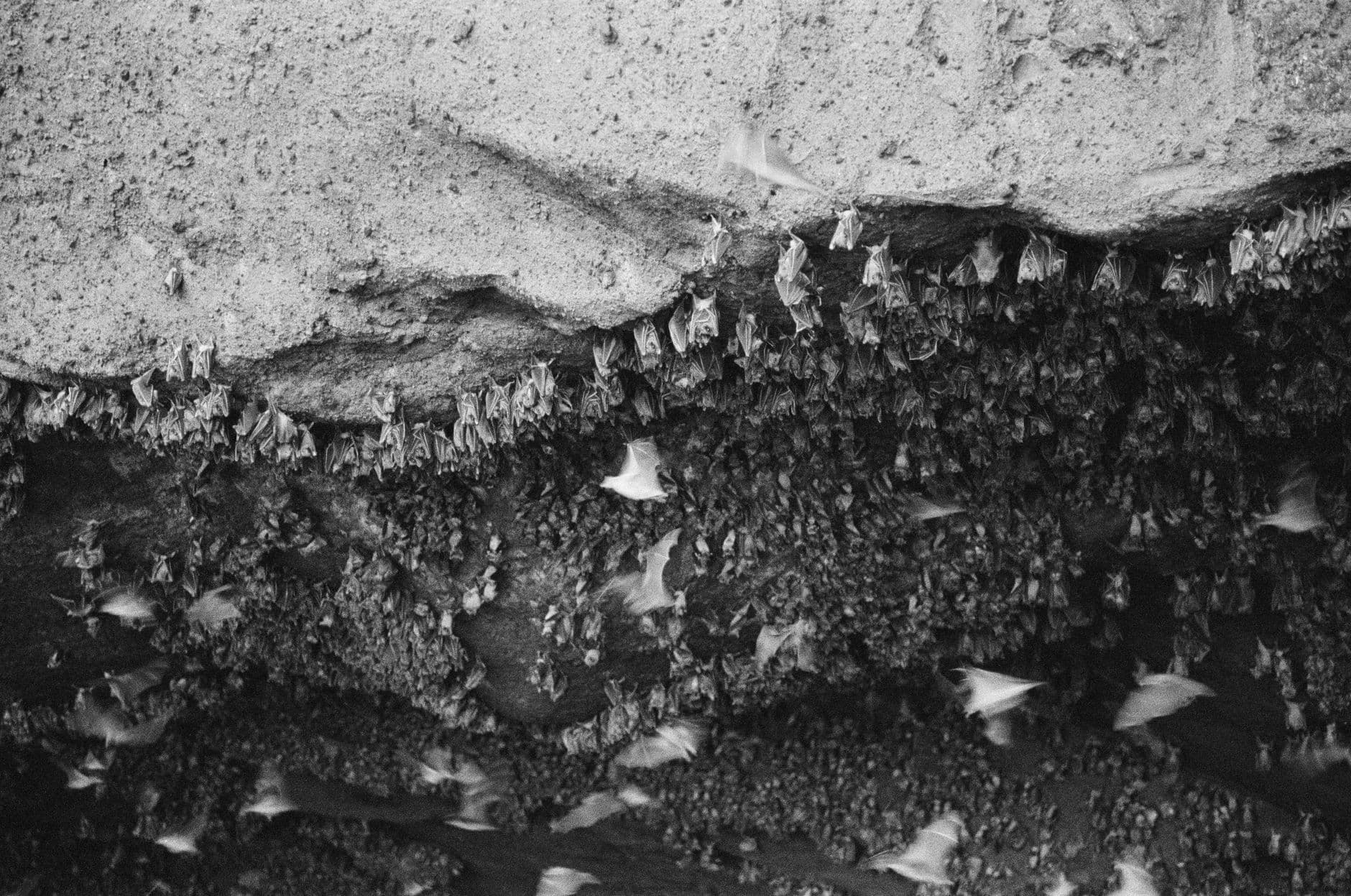
Photo: Vladimir Konoplev / Pexels
A hunting big brown bat (Eptesicus fuscus) fires off up to 200 echolocation calls per second during the "terminal buzz" it produces right before grabbing an insect out of the air, up from a cruising rate of roughly 10 calls per second. Bats do not see prey in the dark the way a night-vision camera would. They build a moving, second-by-second distance map out of sound alone, timing the echo of their own voice against a mental stopwatch precise enough to track a moth's evasive dive. This piece walks through how that system actually works, who proved it was real, and how prey species have evolved to fight back against it.
What echolocation actually is, and how we know it's real
Echolocation — using self-produced sound and its returning echo to sense the location, distance, and shape of objects — sounds almost too strange to have been believed on first discovery, and for years it wasn't. In the late 1930s, Harvard undergraduate Donald Griffin became curious about how bats navigate and fly cleanly through obstacles in total darkness. He teamed up with physicist G.W. Pierce, who had built equipment that could convert ultrasonic frequencies into a range humans can hear, and began recording bats in Pierce's lab (American Association for the Advancement of Science, "Discovering Sonar in Bats").
Working with fellow graduate student Robert Galambos, an auditory physiologist, Griffin ran a series of experiments through 1939 and into the early 1940s establishing that bats emit ultrasonic pulses and use the returning echoes, detected by their extraordinarily sensitive ears, to navigate and avoid obstacles. Griffin coined the term "echolocation" in 1944 to describe the phenomenon generally (American Association for the Advancement of Science). The idea was met with open skepticism inside the scientific community: at one conference, a colleague reportedly grabbed Galambos by the lapels, incredulous that a mammal could "see" with its ears (AAAS, "Discovering Sonar in Bats"). Griffin and Galambos were, simply, right, and controlled trials over the following decades — deafening or muzzling bats and watching their flight collapse into collisions — confirmed it beyond doubt.
That history matters for a simple reason: echolocation is one of the few animal senses that had to be proven against the intuitions of trained biologists before it was accepted as real. It is now one of the best-documented sensory systems in zoology, studied down to the level of individual neurons.
The physics of a call and its echo
Most echolocating bats produce calls between roughly 20 kHz and 200 kHz, well above the approximately 20 kHz ceiling of human hearing. Frequency and wavelength are inversely related, and a sound wave only reflects usefully off an object roughly its own wavelength or larger. That physical constraint is why bats hunting small moths and midges favor high frequencies: a 100 kHz chirp has a wavelength of about 3.4 millimeters (0.13 inches) in air, small enough to bounce cleanly off an insect's wing rather than passing around it unreflected.
The bat measures the time delay between the call it emits and the echo it receives back. Sound travels at roughly 343 meters per second (1,125 feet per second) in air at room temperature, so each millisecond of round-trip delay corresponds to about 17 centimeters (6.7 inches) of distance. Specialized neurons in the bat's inferior colliculus and auditory cortex are tuned to specific echo delays, functioning as a kind of biological stopwatch that converts arrival-time differences directly into a distance readout the bat's brain can act on in real time.
Distance is only part of the picture. Echo intensity, spectral shape, and the tiny time gap between the echo reaching each ear all feed into a combined estimate of a target's size, texture, and position in three-dimensional space, not just its range. A bat closing in on an insect is running several of these calculations simultaneously, dozens of times per second, and updating its flight path after each one.
How does a bat's ear physically pick up such faint echoes?
A bat's outer ear, the pinna, is shaped to funnel and amplify high-frequency sound into the ear canal, and in many species it moves independently of the head, shifting shape within about 100 milliseconds to sample sound from slightly different angles (Journal of Experimental Biology research on hipposiderid bats). In horseshoe bats, a fleshy noseleaf around the nostrils works alongside the pinna to reflect and focus outgoing calls, giving the bat finer directional control over both the sound it sends and the echo it receives.
Frequency-modulated versus constant-frequency calls
Not every bat echolocates the same way. Two broad call strategies dominate insectivorous bats, and each is suited to a different hunting problem.
| Call type | Example species | Call structure | What it's optimized for |
|---|---|---|---|
| Frequency-modulated (FM) sweep | Big brown bat, most vesper bats | Rapid sweep across a broad frequency range | Precise ranging and fine target detail in cluttered space |
| Constant-frequency (CF) tone | Greater horseshoe bat (Rhinolophus ferrumequinum) | Long, steady tone with a short FM tail | Detecting fluttering wingbeats via Doppler shift |
| Mixed CF-FM | Many Rhinolophus and Hipposideros species | Long CF tone followed by a brief FM sweep | Long-range detection plus fine terminal targeting |
FM bats trade detection range for precision; CF bats trade precision for the ability to pick a fluttering insect out of dense foliage.
FM bats sweep quickly through a range of frequencies within each call. Because different frequencies within the sweep arrive back at slightly different, precisely known times, the auditory system can triangulate distance with high resolution, useful for threading through branches or distinguishing two closely spaced objects. CF bats instead emit a long, steady tone and listen for Doppler shifts, the tiny frequency changes caused by a moving target, the same physical principle behind police radar detecting a speeding car.
Greater horseshoe bats take this further with a behavior called Doppler-shift compensation: they continuously adjust the frequency of their outgoing call, lowering it as they fly forward, so that the returning echo lands back within a very narrow frequency band their ears are tuned to detect with extreme sensitivity. Researchers studying the greater horseshoe bat's inferior colliculus found a disproportionately large share of auditory neurons dedicated to that narrow reference frequency band, a specialization described as an "acoustic fovea," directly analogous to the small, high-resolution patch of the retina, the fovea, that gives human vision its sharpest detail (Journal of Comparative Physiology A, on the acoustic fovea in Rhinolophus). The bat is not just hearing better in general; it has built a dedicated high-resolution channel for exactly the echo frequency its own biology produces.
Why moths evolved ears just to survive this
The evolutionary contest between bats and their prey did not end with the predator's side. Multiple moth lineages, including tiger moths and many owlet moths, independently evolved simple tympanal ears tuned specifically to the ultrasonic frequency range bats hunt with. A moth that detects an approaching bat's calls early enough can simply dive, loop, or drop out of the air before the bat locks on, a defense documented across dozens of moth families.
Some tiger moths (family Erebidae, subfamily Arctiinae) go a step further than passive listening. Species such as Bertholdia trigona actively produce their own ultrasonic clicks using a pair of ribbed structures on the thorax called tymbals, generating bursts of more than 4,500 clicks per second at the exact moment a bat would normally begin its final attack (William Conner et al., Science, 2009). Research by Conner's group at Wake Forest University, published with graduate students Aaron Corcoran and Jesse Barber, found this clicking jams the bat's sonar roughly 93 percent of the time, disrupting the precision needed for a successful capture rather than simply warning the bat away (Corcoran, Barber & Conner, Science, 2009). Conner has described Bertholdia trigona as the only animal known to actively jam a predator's sonar in this way (Wake Forest University Biology). The moth's clicking timing is not random either: the moths appear to listen for a specific change in the bat's call pattern, an increase in repetition rate and intensity, that signals they have been individually targeted, and only then begin jamming.
How do bats avoid colliding with each other in dense caves?
Colonies of Brazilian free-tailed bats (Tadarida brasiliensis) can number in the millions, creating enormous acoustic clutter as thousands of overlapping calls and echoes cross the same airspace. Researchers studying group flight in echolocating bats, including work on Japanese horseshoe bats' echo reception during coordinated flight, suggest bats partly manage this by keeping consistent individual flight paths and adjusting call timing relative to neighbors, though the complete mechanism behind collision avoidance in extremely dense swarms remains an active area of research (research on echo reception in group flight, PMC).
How bat sonar compares to other echolocating animals
Bats are the best-studied echolocators, but they are not the only ones. Toothed whales, including dolphins, and at least two groups of birds, oilbirds and some swiftlets, independently evolved echolocation, and comparing the systems shows how differently evolution can solve the same sensory problem.
| Feature | Insectivorous bats | Dolphins (e.g., bottlenose) |
|---|---|---|
| Sound source | Larynx, emitted via mouth or nose | Nasal "phonic lips" below the blowhole |
| Typical medium | Air | Water |
| Effective hunting range | About 3 to 5 meters (9.8 to 16.4 feet) | 100+ meters, depending on target size |
| Doppler tolerance | Some species actively track Doppler shift for prey detection | Signals are largely Doppler-tolerant by design |
| Signal variety | Highly flexible, many call types across species | Comparatively uniform clicks |
Sound travels roughly four times faster in water than in air, which is part of why dolphin sonar reaches much farther than a bat's despite both systems relying on the same basic echo-timing principle.
Dolphins produce clicks by forcing air through structures near the blowhole rather than through a larynx, and they receive echoes largely through fatty tissue in the lower jaw rather than an external ear. Both systems ultimately depend on the same physics: emit a sound, time its return, and use frequency changes to extract additional detail about the target, but the anatomy that makes it happen evolved completely independently in each lineage, a case of convergent evolution driven by a shared physical problem rather than shared ancestry (comparative dolphin-bat echolocation research, Bioacoustics).
What limits echolocation, and what jams it
Echolocation is not a free pass around the constraints of physics. Higher frequencies attenuate, or lose energy, faster over distance than lower ones, which is why the high-pitched calls that resolve fine detail on a moth's wing only work at short range, typically a few meters in air. That trade-off is one reason many bats combine echolocation with vision or spatial memory of familiar terrain, rather than relying on sonar alone when navigating open, unobstructed commuting routes between roost and foraging grounds.
Insects are not passive targets, either. A moth that folds its wings or dives sharply can momentarily shrink or reorient its reflective surface enough to drop out of a bat's echo entirely for a fraction of a second. That brief window of "acoustic invisibility" is frequently enough to break off a pursuit, not unlike a fighter jet releasing chaff to scatter a radar lock.
Common misconceptions about how bats hunt
A persistent myth holds that bats are effectively blind and depend entirely on echolocation to get around. In reality, most microbats can see reasonably well and use vision alongside sonar, particularly for long-range navigation in twilight or moonlight, and most fruit bats in the family Pteropodidae, including flying foxes, do not echolocate with laryngeal calls at all and rely primarily on large eyes and a strong sense of smell (a handful of pteropodid species echolocate crudely using tongue clicks instead). "Blind as a bat" is close to the opposite of accurate for most species.
A second misconception treats echolocation as a single uniform ability, as if every bat "pings" the same way sonar does in a submarine film. As the FM-versus-CF comparison above shows, bats run at least two structurally different acoustic strategies tuned to different prey and habitats, and species like horseshoe bats have evolved dedicated neural hardware, the acoustic fovea, just to extract Doppler information other bats do not use at all. Treating "bat sonar" as one mechanism erases most of what makes the system biologically interesting.
The bats that hunt by listening instead of pinging
Not every bat solves the "find prey in the dark" problem with active sonar. A separate strategy, passive listening, appears in gleaning bats that pick prey off leaves, the ground, or water rather than snatching insects in open flight, and it works by using echolocation sparingly while relying on sounds the prey itself produces.
The fringe-lipped bat (Trachops cirrhosus), found across Central and South America, is the best-documented example. It eavesdrops on the mating calls male frogs and toads use to attract females, and can distinguish among the advertisement calls of more than a dozen local frog and toad species well enough to fly straight toward a calling male within seconds of the first note (Bat Conservation International, "Trachops cirrhosus"; Smithsonian Tropical Research Institute). Because it is listening for a specific, information-rich acoustic signal rather than bouncing sound off a target, this approach can locate prey that ordinary echolocation would struggle to distinguish from background clutter, a frog sitting motionless at a pond's edge, for instance.
The strategy carries real risk, and that risk turns out to be a documented, actively-managed problem rather than a fixed instinct. Some of the frog species Trachops cirrhosus eavesdrops on are toxic, so a bat that simply chases every attractive call would occasionally poison itself. Researchers at the Smithsonian Tropical Research Institute found that juvenile fringe-lipped bats do not hatch already knowing which calls belong to safe prey. They have to learn the distinction through experience over the course of development, effectively building a "caller ID" system for which frog voices are worth pursuing and which are not (Smithsonian Tropical Research Institute, "Palatable Versus Poisonous," published in Proceedings of the Royal Society B, 2025). Once a frog stops calling, which many species do the instant they detect an approaching predator, the bat is not necessarily out of options either. Fringe-lipped bats also switch to echolocation at close range to pick out the ripples a startled frog leaves on the water's surface, stacking passive listening and active sonar into a single, sequential hunting strategy rather than treating them as two separate senses (Bat Conservation International).
That combination, listen for a passive cue, close the distance, then switch to active biosonar for the final strike, illustrates that "how bats hunt" does not reduce to a single sensory channel even within one species. It also shows evolution solving the arms race from the predator's side: prey have not only evolved bat-detecting ears and jamming clicks, some frog and toad populations have shifted their calling behavior in ways that reduce eavesdropping risk, which is itself a form of counter-adaptation to a listening predator.
Why this matters
Echolocation demonstrates that a nervous system can build a functional, real-time spatial map out of timing alone, with no image ever forming in the way human vision produces one. The bat is not "hearing a picture"; it is running continuous distance and Doppler calculations from echo delay and frequency shift, then converting that math into flight-muscle commands fast enough to intercept a maneuvering insect in total darkness. It is one of the clearest cases in biology of a hard physical constraint, wavelength, sound speed, and attenuation, directly shaping both an animal's anatomy and its behavior.
The bat-moth arms race is also a working example of coevolution in action: neither side of the sensory contest stays static, and an innovation on one side, higher call precision or terminal-buzz speed, tends to provoke a countermeasure on the other, bat-detecting ears or active sonar jamming. It is a useful reminder that "how does this sense work" questions in biology rarely have a single-mechanism answer, and that predator senses and prey defenses are best understood as one continuously evolving system rather than two separate stories.
The takeaway
Bats do not simply "use sonar" in a generic sense. They run at least two distinct acoustic strategies, FM sweeps for precision ranging and CF tones with Doppler-shift compensation for detecting fluttering wingbeats, each tuned to different prey and habitat, and they hunt against insects that have independently evolved ears and, in some tiger moths, active sonar-jamming defenses of their own. The 200-calls-per-second terminal buzz is the clearest evidence that echolocation is an active, continuously updating tracking system rather than a single ping-and-locate event, and the fact that it took a Harvard undergraduate, a physicist, and years of skepticism to prove any of it was real is a reminder of how counterintuitive animal sensory biology can be even to trained scientists.
Read next:
- How Bees Communicate With Dances
- How Mantis Shrimp See So Many Colors
- Why Deep-Sea Fish Look So Strange
FAQ
Q: How fast do bats echolocate when closing in on prey?
A hunting bat's call rate climbs from around 10 calls per second during cruising flight to as many as 200 calls per second in the terminal buzz just before capture, giving it near-continuous positional updates on a moving insect in the final fraction of a second before contact.
Q: Who discovered that bats use echolocation?
Harvard researchers Donald Griffin and Robert Galambos established the evidence for bat echolocation in a series of experiments from 1938 through the early 1940s, using ultrasound-detecting equipment built by physicist G.W. Pierce. Griffin coined the term "echolocation" itself in 1944 (American Association for the Advancement of Science).
Q: Can bats echolocate in total darkness with no visual cues at all?
Yes. Echolocation does not depend on ambient light because it relies on self-generated sound and its returning echo, which is why bats can hunt effectively in caves and on moonless nights, though many species still use vision for longer-range navigation in daylight or moonlit conditions.
Q: Do all bats use echolocation?
No. Most fruit bats in the family Pteropodidae, such as flying foxes, rely primarily on vision and smell instead of laryngeal echolocation calls. Laryngeal echolocation is concentrated in the suborder Microchiroptera, plus a few pteropodid species that echolocate crudely using tongue clicks.
Q: How do moths defend themselves against echolocating bats?
Many moth species have evolved ears tuned specifically to bat call frequencies, letting them detect and dive away from an approaching bat before it closes in. Some tiger moths, such as Bertholdia trigona, go further and produce their own ultrasonic clicks that actively jam a bat's sonar roughly 93 percent of the time (Corcoran, Barber & Conner, Science, 2009).
Q: What is Doppler shift compensation in horseshoe bats?
Horseshoe bats continuously adjust the frequency of their outgoing calls in flight so that the returning echo, shifted by their own movement and an insect's wingbeats, lands back within the narrow frequency band their ears are most sensitive to, a behavior supported by a specialized "acoustic fovea" in the auditory brainstem documented in Rhinolophus ferrumequinum.
Q: How does bat echolocation compare to dolphin echolocation?
Both use the same core principle, emitting sound and timing its echo, but the anatomy differs completely: bats produce calls with a larynx and hunt in air over a range of about 3 to 5 meters (9.8 to 16.4 feet), while dolphins produce clicks through nasal structures and can detect targets over 100 meters away in water, since sound travels roughly four times faster underwater than in air.
Follow new articles
Add SciHub101 to your feed reader to see new science and technology stories.
About the Author
SciHub101 is an independent science and technology publication founded and edited by Buğra Sözeri, a software engineer and app developer based in Türkiye. AI tools assist with drafting and research. Source documentation in the existing archive is uneven, and articles are being reviewed and corrected. The Editorial Team byline identifies editorial responsibility; it does not certify specialist or independent human review. Where we compare products, anything built by our own team is labelled as such — see the editorial guidelines and About page for how corrections and disclosures work.
Related Articles


How Octopuses Are So Intelligent: The Animal That Thinks With Its Arms
An octopus has roughly 500 million neurons — about as many as a dog — but two-thirds of those neurons are not in its brain. They are distributed across eight arms, each of which can taste, touch, decide, and act without ever consulting the central brain. This is the story of how intelligence can evolve in a completely different shape.
How Sharks Sense the World: Electroreception, Smell, and the Lateral Line
Sharks read faint electric fields, track scent plumes one nostril at a time, and feel water motion along their flanks. Some popular claims about those senses, from the mile-away drop of blood to the all-seeing predator, do not survive the data.
How Animals See the World Differently: UV, Infrared, and Polarized Light
A dog's world is not black-and-white, it is blue and yellow. Bees and many songbirds see ultraviolet patterns that are invisible to us. Pit vipers image heat. Mantis shrimp carry 12 to 16 photoreceptor types but use them in an unexpected way. Every animal lives inside a visual world shaped by which wavelengths mattered most to its ancestors.

How Bats Use Echolocation: Seeing the World in Sound
Bats build a 3D map of the world from sound echoes — a sensory system so precise it can detect a wire 0.3mm thick in total darkness.

What If We Could See in All Wavelengths of Light?
Human eyes detect a tiny slice of the electromagnetic spectrum — visible light. If we could see ultraviolet, infrared, microwaves, X-rays, and radio waves simultaneously, the world would become a chaotic visual feast revealing hidden information at every wavelength.