How Salmon Find Their Birth River
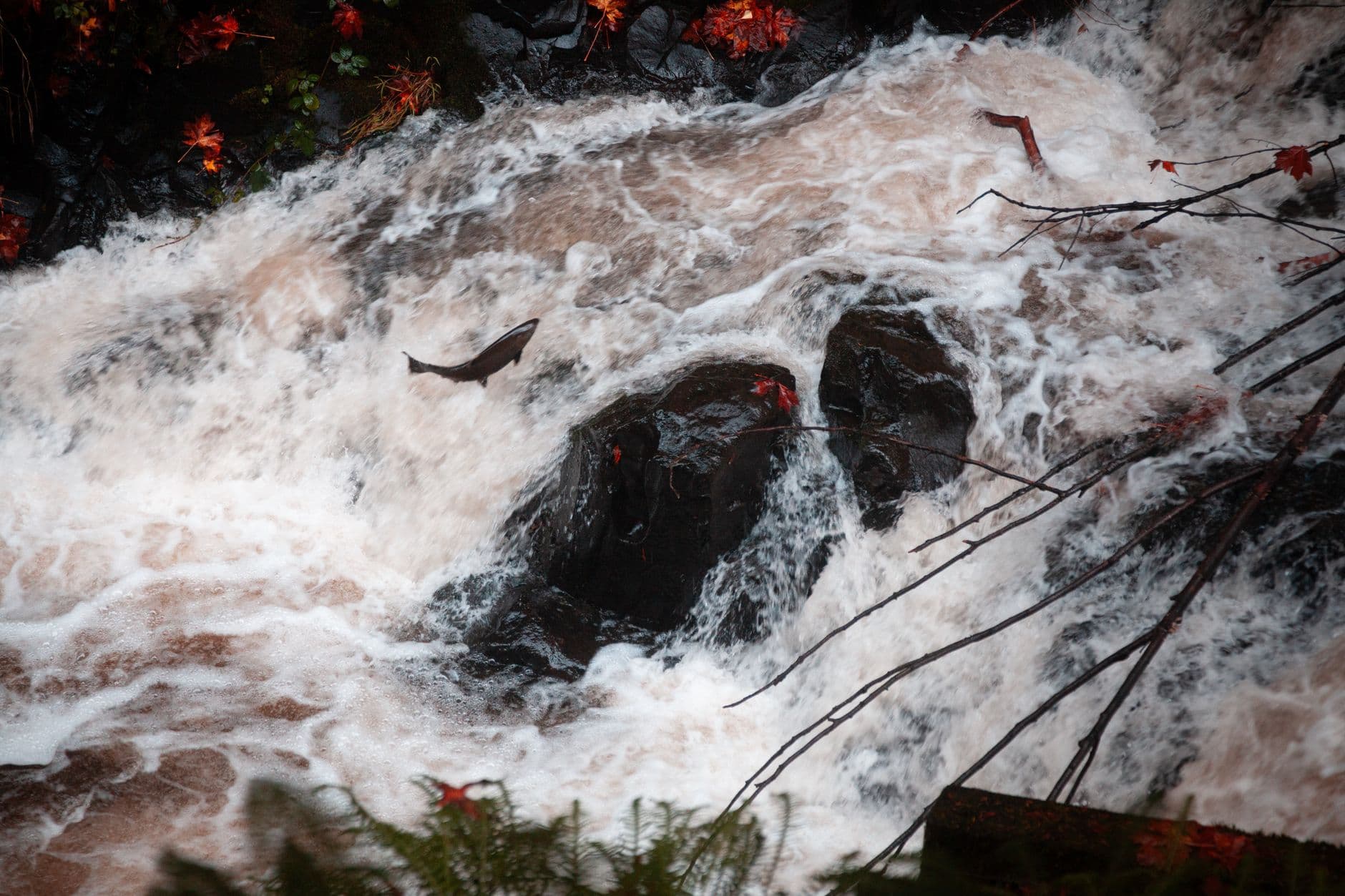
Photo: Ken Cheatham / Pexels
Sockeye salmon can leave a natal stream as a finger-length juvenile, cross thousands of kilometers of open ocean for one to four years, and return to spawn within meters of the exact gravel bed where they hatched. They do it with a two-stage biological navigation system: a coarse geomagnetic map for finding the right coastline, and a precise sense of smell for finding the right tributary. The olfactory half of that system was proposed by University of Wisconsin limnologist Arthur Hasler starting in the early 1950s; the magnetic half was confirmed decades later, beginning with Nathan Putman's 2013 analysis of Fraser River sockeye data.
The two-part problem salmon have to solve
Getting from open ocean back to a specific stream is really two separate navigation problems stacked on top of each other, and for decades biologists could only explain one of them. The first problem is orientation: how does a fish with no visual landmarks, hundreds of kilometers from any coastline, know which direction "home" even is? The second problem is discrimination: once a salmon reaches the right general coastline, how does it pick the correct river out of dozens, and then the correct tributary out of hundreds of forks upstream?
Natal homing — the term biologists use for a fish returning to spawn in the same water body where it hatched, as opposed to spawning wherever it happens to end up — was documented in Pacific salmon populations well before anyone understood the mechanism. Early 20th-century tagging studies confirmed that most returning adults showed up in their birth river far more often than chance would predict, but for decades the "how" was speculative: theories included the position of stars, sun-compass orientation, water temperature gradients, and pure random search.
Arthur Hasler began working on the problem in earnest after a 1946 family vacation in which he noticed the mineral smell of Rocky Mountain streams and reportedly hypothesized on the spot that fish might be using stream odor as a homing cue (Hasler & Wisby, 1951). That single insight became the foundation of the olfactory imprinting hypothesis, which dominated salmon-homing research for the next 30 years, and it still explains the final and most precise stage of the journey. But it left the open-ocean stage unexplained: smell cannot work across hundreds of kilometers of undifferentiated seawater where there is no chemical gradient to detect. That gap is what geomagnetic research eventually filled.
The two mechanisms are not competing explanations. They are sequential systems, each suited to a different spatial scale, and understanding why a single-sense explanation never fully worked is the key to understanding why salmon navigation took so long to solve.
Stage one: reading Earth's magnetic field as a map
Juvenile salmon that migrate out to sea, called smolts, encounter an ocean with no scent trail from home and no fixed visual reference points, just current, sunlight, and depth. What they do have, according to research led by Nathan Putman and Kenneth Lohmann, is a magnetic sense precise enough to function less like a compass and more like a coordinate system.
Geomagnetic imprinting — the hypothesis that young salmon memorize the specific intensity and inclination angle of Earth's magnetic field at their home river, then use that stored signature later in life to recognize when they have returned to approximately the right location — was formally tested in a 2013 paper in Current Biology (Putman et al., 2013). The researchers analyzed a 56-year fisheries dataset covering Fraser River sockeye salmon, which must swim around Vancouver Island through one of two channels, a northern route and a southern route, to reach the river mouth. Earth's magnetic field drifts gradually over time due to changes in the planet's molten outer core, so the magnetic signature at each channel entrance shifts slightly year to year relative to the signature at the river mouth.
Putman's team found that the proportion of salmon choosing the northern versus southern channel in a given year correlated with how closely each channel's magnetic field matched the field at the river mouth: when a channel's field diverged more sharply from the imprinted signature, fewer fish used it. The correlation held across a 56-year data series, which is not a controlled laboratory experiment but is difficult to explain by any factor other than genuine sensitivity to magnetic field values (Putman et al., 2013, Current Biology). A follow-up analysis extended the finding to pink salmon and additional sockeye populations, tightening the statistical link between geomagnetic drift and migratory route choice (Putman et al., 2014).
How would a fish actually sense a magnetic field?
The leading physical explanation involves magnetite, a naturally magnetic iron mineral, embedded in cells connected to a fish's nervous system, though the exact receptor location and signaling pathway in salmon are still being characterized. A competing or complementary hypothesis involves a light-sensitive protein called cryptochrome that may allow magnetically influenced chemical reactions in the eye. Neither mechanism is fully resolved at the cellular level even though the behavioral evidence for magnetic sensitivity is strong.
Stage two: smell memory for the final kilometers
A magnetic map is not precise enough to find one tributary among hundreds branching off a river system, and this is exactly the gap Hasler's olfactory imprinting hypothesis was built to close. The hypothesis has three parts, laid out by Hasler and Wisby in 1951: every stream has a distinctive chemical signature shaped by local soil, bedrock minerals, and plant runoff; juvenile salmon memorize that signature during a sensitive developmental window; and returning adults use the memorized signature to select the correct path at each river fork.
That sensitive window lines up with smoltification, the physiological transformation juvenile salmon undergo as they prepare to move from freshwater to saltwater, including changes to gill function, skin coloration, and behavior. Hasler's later research, including experiments summarized with coauthor Allan Scholz in the 1983 monograph Olfactory Imprinting and Homing in Salmon, showed that juvenile coho salmon artificially exposed to synthetic chemical markers such as morpholine or beta-phenylethyl alcohol during this window could later be lured, as returning adults roughly a year and a half afterward, into an unfamiliar stream deliberately scented with the same synthetic chemical (Hasler & Scholz, 1983). That result is the strongest evidence available that imprinting, not some innate genetic memory of the home stream's chemistry, is what drives the final approach.
| Migration stage | Primary sense used | Approximate spatial scale | Key evidence |
|---|---|---|---|
| Open ocean transit | Geomagnetic field sensing | Hundreds to thousands of km | 56-year correlation between field drift and channel choice (Putman et al., 2013) |
| Coastal approach | Magnetic cues plus emerging olfactory cues | Tens to hundreds of km | Transition zone, less directly studied than the other two stages |
| River and tributary selection | Olfactory imprinting on stream chemistry | Meters to a few km | Synthetic-odor imprinting experiments (Hasler & Scholz, 1983) |
Salmon do not use one navigation system for the whole trip; they hand off between a coarse long-range sense and a precise short-range one as the scale of the problem shrinks.
What does the nasal-blocking experiment actually show?
In classic experiments run by Hasler's group, researchers temporarily occluded the nasal passages of returning adult salmon so the fish could not detect waterborne odors, then released them upstream of a river fork leading to their home tributary. Fish with blocked nasal passages lost the ability to reliably select the correct branch, while fish with intact smell continued to choose correctly at rates well above chance, direct behavioral evidence that olfaction, not memory of current direction or visual landmarks, drives the final leg of the homing journey.
Straying: the exception that proves the system works
A small percentage of returning salmon do not return to their birth stream at all. Fisheries biologists call this behavior straying, and depending on species and population it typically affects a low single-digit percentage of returning adults, though the rate varies considerably by watershed and by year. Straying looks at first like a navigation failure, but most fisheries biologists treat it as a deliberate evolutionary hedge rather than an error in the imprinting system.
The logic is straightforward: a species that homes with perfect precision every generation has no way to recolonize a stream after a landslide, volcanic eruption, severe drought, or human dam construction wipes out a local spawning population. A small, consistent stray rate means that when disaster does destroy a home stream, nearby rivers already carry a trickle of genetically related salmon capable of establishing a new population. Researchers studying salmon recolonization after events like the 1980 Mount St. Helens eruption, which buried or blocked several regional streams, have pointed to natural straying as part of how salmon runs re-established themselves in altered watersheds in the years that followed.
Straying rates also respond to environmental disruption. When water chemistry along a migration route changes unexpectedly, whether from a landslide depositing new mineral sediment or from human alteration of a watershed, the imprinted scent signature a salmon carries may no longer match what it detects on return, increasing the odds that fish stray into a different, unfamiliar stream instead of pushing further toward a home signature that no longer exists in the same form.
Why a two-sense system evolved instead of just one
Relying on a single sense across the entire migration would be a fragile strategy, and the reason comes down to matching sensory range to spatial scale. Smell works by detecting a concentration gradient, and gradients only exist where there is something to diffuse from; in open ocean, hundreds of kilometers from any coastline, there is no home-stream chemical present at any concentration a salmon could detect. Magnetic sensing solves that problem because Earth's field is present everywhere and varies smoothly and predictably by location, but that same smoothness is exactly why it cannot distinguish between two river forks a few hundred meters apart. Their magnetic signatures are essentially identical at that scale.
Layering a coarse, long-range sense with a precise, short-range sense is not unique to salmon. Migratory songbirds are well documented as using a magnetic compass sense for overall heading during long-distance migration, then switching to visual landmarks, star patterns, and even smell for final destination-finding once they approach a specific nesting site (Mouritsen, 2018, in a review of avian magnetoreception published in Nature). It is broadly similar to how a driver might use a highway system and GPS coordinates to get to the right city, then switch to reading street signs and house numbers once they turn onto the correct block. No single navigation tool is efficient at both scales at once, so animals that need both tend to evolve both.
What this reveals about animal navigation research more broadly
Salmon migration is one of the best-documented cases in animal behavior of a species using Earth's magnetic field as something closer to a coordinate system than a simple compass. A compass only tells an animal which way is north; what Putman's data suggests is that salmon read specific field values, intensity and inclination together, as a stand-in for geographic position, a considerably more sophisticated use of magnetoreception than researchers assumed was possible in fish through most of the 20th century.
It also has a direct practical consequence for river management. Because the olfactory half of the system depends on a precise, memorized chemical signature, any alteration to a watershed's water chemistry, agricultural runoff changing mineral content, industrial discharge, or dam-driven changes in flow and temperature, can degrade or mask the exact scent cues a population imprinted on years earlier as juveniles. Fisheries agencies managing dam removal or river restoration projects in the Pacific Northwest have cited olfactory imprinting research directly when assessing how changes to water chemistry along a migration corridor might affect the ability of returning adults to locate historic spawning grounds.
How dams and hatchery transport short-circuit the imprinting process
Dams create a specific, well-documented failure mode for olfactory homing that has nothing to do with a salmon's senses malfunctioning and everything to do with the water itself changing. A juvenile salmon imprints on the chemical signature of its natal stream in sequential stages as it migrates downstream toward the ocean, memorizing not just the home tributary but a series of waypoints along the route. When a dam interrupts that gradual downstream journey, either by blocking passage entirely or by routing water through spillways and turbines in volumes that don't match the natural flow the fish evolved to imprint on, the chain of waypoints gets broken links in it (Keefer & Caudill, 2014, in a review of homing and straying in anadromous salmonids).
Hatchery transport makes the problem more acute. Fisheries agencies on the Columbia and Snake Rivers have, at various points, physically trucked or barged juvenile salmon around a stretch of dams to improve their odds of surviving the trip to the ocean. NOAA Fisheries' ongoing olfaction and homing research program has found that fish moved this way skip the normal, gradual sequence of imprinting events entirely, and populations subjected to this kind of transport show measurably higher straying rates as returning adults than fish that migrated the full river route under their own power (NOAA Fisheries, Fish Olfaction and Homing Research). It's a reasonable trade for a fisheries manager to make, since the transported fish are far more likely to survive predators and turbines during the trip, but it comes at a direct cost to the precision of the very sense that will eventually try to bring them home.
Ocean warming appears to interact with the magnetic side of the system too, though the mechanism is more indirect. Researchers tracking the same Fraser River sockeye channel-choice data Putman analyzed in 2013 found that the proportion of fish taking the northern route around Vancouver Island also correlated with sea surface temperature in a given year, warmer years pushed more fish toward the northern passage, on top of the underlying magnetic-drift effect (Putman et al., 2013, Current Biology). That doesn't mean warming water breaks the compass. It suggests ocean temperature is a second variable shaping which of two magnetically similar options a salmon picks, layered on top of the primary geomagnetic signal, and it's one more reason fisheries biologists treat climate-driven ocean change as a navigation-relevant variable, not just a water-quality one.
What researchers still don't fully understand
Not every part of this story is settled science, and it is worth being honest about the gaps. The precise biological receptor salmon use to detect magnetic fields, whether magnetite-based, cryptochrome-based, or some combination, has not been conclusively identified at the cellular level in salmon the way it has been more thoroughly studied in some other species. The transition zone where magnetic guidance hands off to olfactory guidance along the coastal approach is also less directly studied than either endpoint of the journey; most of the strongest evidence comes from the open-ocean stage (correlational field data) and the final-approach stage (controlled imprinting and nasal-blocking experiments), with less direct experimental work on the middle distance.
Straying rates and their exact evolutionary function are also still actively debated among fisheries biologists, since separating "adaptive recolonization strategy" from "simple imprinting imprecision" in wild populations is difficult without long-term genetic tracking across multiple generations. These are the kinds of honest uncertainties that separate documented mechanism from folk explanation, and salmon navigation research has been unusually good, by animal-behavior standards, at closing those gaps one testable experiment at a time.
The takeaway
Salmon do not simply "swim home" on some vague, unexplained instinct. They run a documented, two-stage navigation system: a geomagnetic imprint that functions like a coordinate system for ocean-scale positioning, discovered through Nathan Putman's correlational analysis of decades of Fraser River fisheries data, and a chemical smell memory for the exact final approach to a single stream, first proposed by Arthur Hasler in the 1950s and confirmed through synthetic-odor imprinting and nasal-blocking experiments. Each half of the system is suited to a different spatial scale, which is exactly why neither sense alone could ever have explained the full journey. It remains one of the clearest cases in animal behavior science of a folk mystery ("how do they know the way home?") being replaced by testable, falsifiable mechanism.
Read next:
FAQ
Q: How do salmon navigate across the open ocean with no landmarks?
Salmon are thought to imprint on the geomagnetic field intensity and inclination angle of their home river as juveniles, then use that stored magnetic signature later in life to navigate back toward the correct coastal region, even after migrating thousands of kilometers with no visual cues (Putman et al., 2013).
Q: How do salmon find the exact stream they were born in?
Once near the coast, salmon rely on olfactory imprinting, a hypothesis proposed by Arthur Hasler in 1951: young salmon memorize the unique chemical composition of their home stream and detect that same signature, even at extremely low concentrations, when choosing between tributaries on the return trip.
Q: What happens if a salmon cannot smell?
Experiments that temporarily blocked salmon nasal passages showed those fish lost the ability to reliably select their correct home tributary at river forks, while fish with intact smell continued choosing correctly, confirming that smell drives the final stage of navigation (Hasler & Scholz, 1983).
Q: Do salmon always return to the exact river where they hatched?
Most do, but a small single-digit percentage stray into different rivers depending on species and population. Fisheries biologists generally view straying as an evolutionary safety mechanism that helps salmon recolonize watersheds after disruptive events like landslides, droughts, or volcanic eruptions.
Q: Who discovered that smell guides salmon home?
Arthur Hasler, a limnologist at the University of Wisconsin, proposed the olfactory imprinting hypothesis with Warder Clyde Wisby in 1951 and spent decades experimentally supporting it. Nathan Putman and colleagues later added the geomagnetic imprinting component that explains the open-ocean portion of the journey, beginning with a 2013 study in Current Biology.
Q: Is the salmon magnetic sense the same as a compass?
Not quite. A simple compass sense only indicates direction, such as which way is north. The evidence from Putman's Fraser River research suggests salmon respond to specific combinations of magnetic field intensity and inclination angle in a way that functions more like a positional map, letting them recognize when they have returned to approximately the right location rather than just which way to swim.
Q: Do dams affect a salmon's ability to find its way home?
Yes. Dams can interrupt the gradual, waypoint-by-waypoint imprinting sequence juveniles rely on during their downstream migration, and hatchery programs that truck or barge young salmon around dam stretches skip that imprinting process almost entirely. NOAA Fisheries research has linked both effects to measurably higher straying rates in returning adults compared to fish that migrated the full river route unassisted.
Follow new articles
Add SciHub101 to your feed reader to see new science and technology stories.
About the Author
SciHub101 is an independent science and technology publication founded and edited by Buğra Sözeri, a software engineer and app developer based in Türkiye. AI tools assist with drafting and research. Source documentation in the existing archive is uneven, and articles are being reviewed and corrected. The Editorial Team byline identifies editorial responsibility; it does not certify specialist or independent human review. Where we compare products, anything built by our own team is labelled as such — see the editorial guidelines and About page for how corrections and disclosures work.
Related Articles


The Longest Animal Migrations: Records, Routes, and Navigation
The longest animal migrations ranked: Arctic terns, sooty shearwaters, gray whales, godwits, and leatherbacks, with tracking data and how they navigate.
How Birds Navigate: The Science of Migration
How do birds cross continents without GPS? Explore magnetic compasses, star maps, and quantum biology behind one of nature's greatest feats.