How Tree Frogs Stick To Wet Leaves
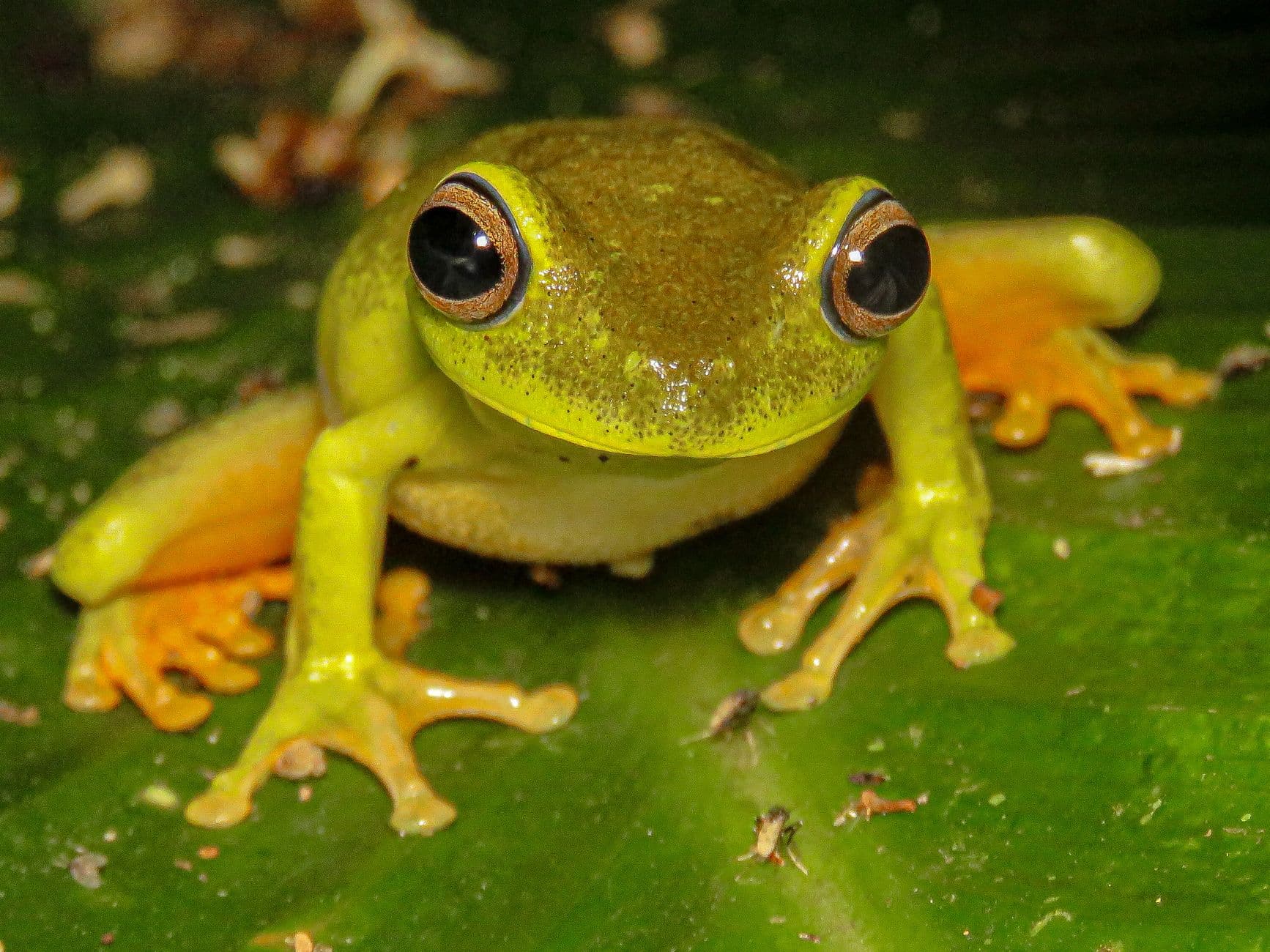
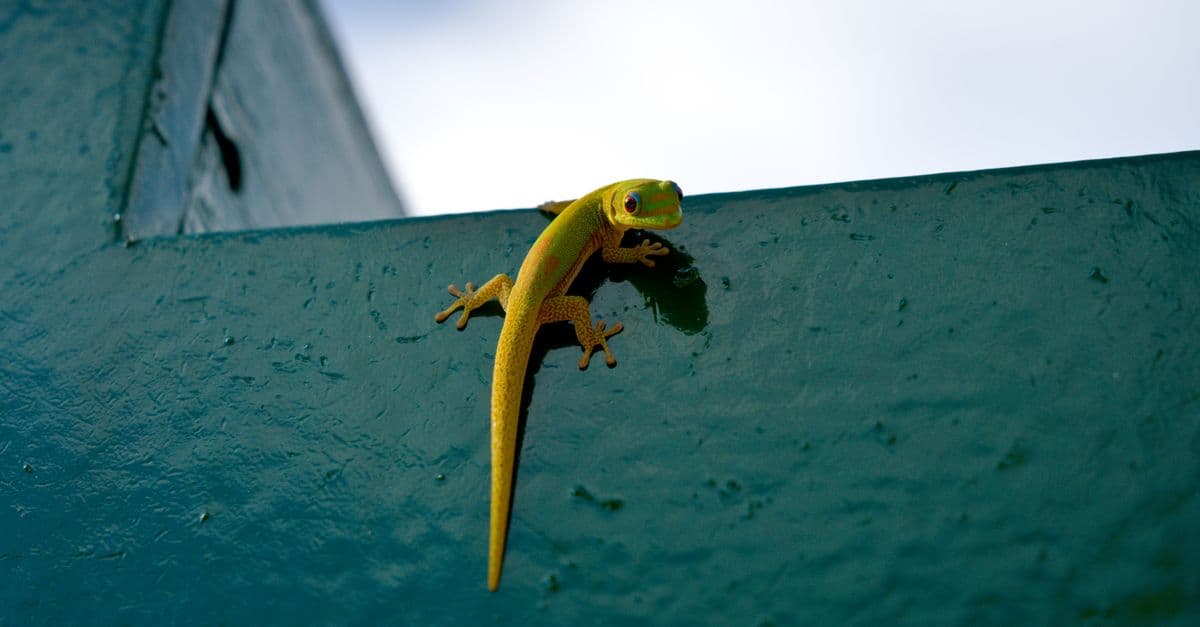
Photo: Gabriel Rondina / Pexels
A tree frog can cling to a vertical, rain-slicked leaf using a mechanism that gets better in the presence of water, the opposite of how tape, glue, and most industrial adhesives behave. The toe pad is built around a thin fluid film, a hexagonal grid of skin cells, and drainage channels that together produce what biomechanists call wet adhesion. Walter Federle's biomechanics group at the University of Cambridge, along with earlier collaborators at the University of Glasgow, has spent more than two decades mapping exactly how this system works, and later work overturned parts of the original picture of how the grip is actually generated.
The toe pad is not a suction cup, it is a fluid-management system
Flip over a tree frog and look at a toe pad under magnification, and the surface looks nothing like the smooth pads people imagine. It is a tightly packed array of flat-topped, roughly hexagonal epithelial cells, separated from each other by narrow channels that run like a honeycomb pressed flat. Those channels are not gaps left by accident. They connect directly to mucus glands beneath the skin that continuously secrete a thin fluid layer between the pad and whatever surface it touches (Federle et al., Journal of Experimental Biology, 2009).
This matters because most adhesives are built to eliminate water from a bonding surface. Superglue, tape, and epoxy all fail when a film of liquid gets between the adhesive and the substrate, because the fluid layer lets surfaces slide past each other instead of locking together. Tree frogs invert that logic entirely. Rather than trying to squeeze water out and achieve dry contact, the pad is designed to maintain a specific, thin, continuously renewed fluid layer, then extract grip from that fluid rather than in spite of it.
The scale of the structures involved is genuinely small. At the nanoscale, the toe pad surface is covered in a tightly packed array of columnar nanopillars roughly 326 nanometers in diameter, each with a shallow central dimple about 8 nanometers deep (Journal of Experimental Biology, 2009). These nanopillars sit on top of the larger hexagonal cell pattern, creating a structure with detail at two different size scales, the hexagonal cells visible under a light microscope and the nanopillars visible only under electron microscopy.
Measurements of the gap between the pad and the surface it grips, taken from living, adhering tree frogs, found pad-to-substrate distances ranging from 0 to 35 nanometers across the central regions of the hexagonal cells. That is a genuinely thin gap, thin enough that at some points the pad makes direct, essentially dry contact with the surface even while wet adhesion dominates elsewhere across the same pad.
Why researchers revised the "just capillary forces" explanation
For years the working assumption in the adhesion literature was that tree frog grip came primarily from two related fluid effects: capillary adhesion, the same surface-tension effect that makes a wet sheet of paper cling to a glass window, and viscous friction, resistance to sliding created by the fluid layer itself. Both effects are real and both contribute. But Federle's later work, using single-toe force measurements, laser tweezer microrheometry of the pad mucus, and interference reflection microscopy, found that capillary and viscous forces alone underestimate the actual attachment force tree frogs generate (Federle, Journal of the Royal Society Interface, 2006).
The additional force comes from boundary friction, close, near-solid contact between microscopic bumps on the pad epidermis and the substrate, made possible by how regular and flat the hexagonal pad microstructure is. In effect, the frog toe pad does not commit fully to either wet or dry adhesion. Microscopic protrusions on the pad surface can push through the thin mucus film and make brief, direct contact with the substrate, letting the frog toggle between wet adhesion, which works well on rough or textured surfaces like bark and leaves, and boundary friction, which behaves more like dry grip and helps on smooth surfaces such as glass (PubMed, 2006). This dual-mode behavior is the detail that separates tree frog adhesion from a simple "sticky mucus" explanation, and it is the reason the mechanism has attracted sustained attention from fluid mechanics researchers rather than just biologists.
One additional finding worth flagging as a genuine surprise: the pad mucus itself is not especially viscous. Measurements put it at only about 1.5 times more viscous than plain water, meaning the fluid is closer to a thin film of water than a thick, glue-like secretion. The adhesive performance comes overwhelmingly from how the fluid is managed geometrically, not from the fluid being inherently sticky.
Why the channels matter as much as the pads themselves
The hexagonal channels running between the cells are functionally a drainage network, and this is arguably the more important half of the mechanism. When a frog presses its toe pad onto a leaf, excess fluid is squeezed outward through these channels instead of pooling underneath the contact zone. A pooled fluid layer would create a lubricating film that destroys grip entirely, the same problem that makes a bald, smooth tire nearly useless on a wet road.
The channel network is functionally comparable to the tread grooves engineers cut into rubber tires, for exactly the same underlying reason: managing fluid volume so a thin, controlled film remains at the contact surface rather than a flooded one. Too little fluid and the pad cannot form the capillary bridges and boundary contacts that generate grip. Too much fluid and the frog effectively hydroplanes, sliding on a lubricating layer it cannot control. The channels are the regulatory mechanism that keeps the fluid layer inside that narrow functional range.
Separating the hexagonal cells at their tips also has a secondary mechanical benefit unrelated to drainage. It reduces the bending modulus, meaning stiffness against bending, of the pad epithelium as a whole. A stiff, rigid pad could not conform to large-scale surface irregularities, bumps, curves, and waxy ridges on a real leaf. By segmenting the pad into many small, independently flexible hexagonal units connected by soft channel material, the toe pad can flex and settle into the actual contour of whatever it lands on, rather than only touching at a few high points the way a rigid pad would.
Does a tree frog's grip change if a leaf gets more or less wet?
Yes, within limits. Tree frog toe pads perform best with a specific thin fluid layer thickness, and researchers studying boundary friction and fluid mechanics in the system have found that adhesive performance drops at both extremes, on surfaces that are essentially dry and on surfaces flooded with excess standing water. The system is tuned to a narrow, actively regulated fluid volume rather than operating on a simple rule where more moisture always helps.
| Adhesion system | Mechanism | Surface condition | Key structure |
|---|---|---|---|
| Tree frog toe pad | Capillary adhesion, viscous friction, and boundary friction combined | Works best wet; fails if flooded or fully dry | Hexagonal epithelial cells with mucus-filled drainage channels |
| Gecko foot | Van der Waals forces, intermolecular attraction requiring no fluid | Works dry; degrades sharply if wet | Millions of branching keratin hairs called setae, tipped in flat spatulae |
| Insect tarsal pad (ants, beetles) | Capillary and viscous forces from a secreted oily/aqueous fluid film | Works wet, similar in principle to frogs but different fluid chemistry | Dense hair tufts or smooth extensible pads (arolia) secreting adhesive fluid |
Three animal adhesion systems that solve the same climbing problem with three physically distinct strategies, one dry, two wet but chemically different from each other.
How this compares to gecko and insect adhesion
It is tempting to lump every animal that can climb a smooth vertical surface into one category, but the underlying physics differs sharply between species, and the differences matter for anyone trying to copy the mechanisms in engineering. Gecko toe pads rely on van der Waals forces, weak intermolecular attractions that require extremely close, essentially dry contact between millions of microscopic hair-like structures called setae and the surface being climbed. Because van der Waals forces depend on intimate molecular-scale proximity, water actively interferes with gecko adhesion by keeping the setae tips from making that close contact, which is why gecko grip weakens noticeably on wet surfaces.
Insects present a third variation. Many species, including ants and various beetles, secrete their own adhesive fluid through pores in specialized foot structures, either dense hair tufts or smooth, extensible pads called arolia. Insect adhesive fluid is not chemically identical to frog mucus. It is often described as having both an oily, hydrophobic component and a more water-based hydrophilic component, and insect adhesion depends heavily on capillary forces from that fluid at the contact interface, along with some deformation of the pad cuticle itself contributing additional friction. The broad category, wet adhesion using a secreted fluid, resembles what tree frogs do, but the fluid chemistry, pad micro-architecture, and relative contribution of capillary versus viscous versus deformation forces all differ between insects and amphibians. Researchers studying underwater adhesion in ladybird beetles, for instance, have found that how well the tarsal fluid wets the surface directly determines whether the beetle can hold on submerged, a variable that plays out differently than it does in tree frog systems.
The result is that "wet adhesion" is not one mechanism, it is a family of related but chemically and structurally distinct strategies that convergently evolved in frogs and insects because capillary and viscous forces are simply available physics for any small, lightweight animal trying to grip a surface using fluid. Gecko-style dry adhesion is a separate evolutionary solution to the same climbing problem, better suited to consistently dry environments but far more vulnerable to moisture.
From frog toes to robotics and medical devices
Because tree frog adhesion works reliably in wet conditions where conventional adhesives like tape and suction cups fail outright, it has become a reference model in soft robotics and climbing-robot research over the past decade. Engineering groups, including teams directly citing Federle's biomechanics work, have built synthetic hexagonal-pad surfaces designed for wet-surface climbing robots intended for tasks such as pipe inspection in humid or submerged environments (Royal Society, Philosophical Transactions A, 2019).
A second, arguably more consequential application is in medical devices that need gentle, reversible grip on moist internal tissue, an environment where traditional adhesives are either too weak once wet or leave damaging residue and cause tissue trauma when peeled off. A biomimetic adhesive that grips using controlled fluid management rather than aggressive chemical bonding is, in principle, better suited to surgical tools, wound dressings, and internally implanted devices that must attach without harming delicate wet tissue. Published biomimetics reviews describe the tree frog system specifically as a design template for "smart adhesives that adhere under wet conditions," a framing that reflects how directly the biological mechanism has translated into applied engineering research, rather than remaining a purely academic curiosity.
What researchers still do not fully understand
Despite two decades of detailed study, the tree frog adhesion system is not a fully solved problem, and it is worth being honest about the open questions rather than presenting the mechanism as a closed case. The precise balance between capillary forces, viscous forces, and boundary friction appears to shift depending on surface roughness, fluid volume, and the specific frog species studied, and researchers have not settled on a single unified model that predicts adhesive force from first principles across all these conditions (arXiv, Viscous-poroelastic interaction study, 2015). Some published work models the pad as a poroelastic material, a solid capable of absorbing and releasing fluid through its own structure, which adds a further layer of complexity beyond a simple thin-film-between-two-surfaces picture.
It is also not fully resolved how the frog actively controls mucus secretion rate in real time as it moves, climbs, or leaps, versus how much of the fluid regulation is a passive mechanical consequence of the channel geometry alone. Distinguishing active physiological control from passive fluid mechanics matters for anyone trying to replicate the system synthetically, because a synthetic version that only copies the static channel geometry might reproduce some but not all of the frog's real-world adhesive performance, particularly the rapid, reversible release that lets a frog detach a toe in milliseconds to take its next step.
Why bigger tree frogs need disproportionately larger toe pads
Body size creates a physics problem for any animal that climbs using pad adhesion, and tree frogs are a useful case study in how that problem gets solved. If a frog species were scaled up while keeping the same body proportions, weight would increase with the cube of its linear dimensions while toe pad area, a flat surface, would only increase with the square. A tree frog twice as long as a smaller relative would weigh roughly eight times as much but have only about four times the toe pad area, meaning the load carried by each square millimeter of pad would climb sharply with size if nothing else changed.
Research comparing adhesive pad area against body mass across many climbing animals, from insects to frogs to arboreal mammals, found that pad area does not scale isometrically, in direct proportion, with body mass the way simple geometry would predict. Instead, adhesive pad area scales with extreme positive allometry: larger species and larger individuals within a species grow toe pads that are disproportionately oversized relative to their body mass, not just proportionately larger (Labonte et al., PNAS, 2016). This compensates for the fact that force per unit pad area, which the wet adhesion mechanism must ultimately sustain, would otherwise become unsustainable as an animal's size increases.
Even with this compensation, larger tree frog species still do not climb as securely as smaller ones. Studies comparing multiple Trinidadian tree frog species found that species with greater body mass generate more shear force in absolute terms, and their toe pads are more efficient per unit area than isometric scaling alone would predict, but attachment security still declines somewhat with increasing body size. In practice, tree frogs partly offset this with behavior rather than anatomy alone, orienting the body head-up on an incline and adjusting posture in ways that reduce the peeling forces most likely to strip a toe pad off a leaf. The wet adhesion system, in other words, is not a fixed-performance mechanism. It is one further shaped by a size-dependent trade-off that constrains how large a species relying on toe pad adhesion for climbing can realistically get before pad-based grip stops being a viable way to move through the canopy.
Why this matters
Tree frog adhesion is a useful counterexample to the common assumption that water always ruins a grip. Most adhesives, tape, glue, sticky pads, rely on dry surface contact and fail as soon as moisture intervenes. Tree frogs demonstrate an entirely different physical strategy: engineering the fluid layer itself, through drainage channels and a finely regulated film thickness, rather than eliminating it, to generate stick.
That distinction matters for any bioinspired design problem involving wet or slippery environments, from surgical tools to underwater robotics to industrial climbing equipment for humid settings. It also matters as a broader lesson in comparative biomechanics: three different animal lineages, frogs, geckos, and insects, arrived at three physically distinct adhesion strategies to solve a similar mobility problem, and none of the three is simply a worse or better version of the others, each is tuned to a different environmental condition.
The takeaway
Tree frogs stick to wet leaves not despite the moisture but because of a specifically engineered thin fluid film, managed by a hexagonal channel network that drains excess liquid while capillary adhesion, viscous friction, and direct boundary contact between microscopic surface features do the actual gripping. Federle's research showed the mechanism is more layered than early capillary-only explanations suggested, involving a toggle between wet and near-dry contact depending on surface roughness. It is a mechanism nearly opposite to how synthetic adhesives typically work, and nearly opposite to how gecko feet work as well, which is exactly why it has become a serious reference point for wet-surface robotics and medical adhesive research rather than just a biological curiosity.
Read next:
- How Geckos Stick to Walls: Van der Waals Forces and Dry Adhesion
- How Salmon Find Their Birth River
- How Mantis Shrimp See So Many Colors
- Why Naked Mole Rats Resist Cancer
FAQ
Q: Why don't tree frogs slip off wet leaves the way a person would?
Tree frog toe pads secrete a controlled thin fluid layer through a network of channels between hexagonal skin cells, using capillary adhesion, viscous friction, and direct boundary contact between microscopic surface bumps to grip, a mechanism engineered around moisture rather than defeated by it.
Q: Does more water on a leaf help a tree frog grip better?
No, not beyond a certain point. Studies show tree frog adhesion is optimized for a specific thin fluid layer thickness, and adhesive force decreases on both very dry surfaces and surfaces flooded with excess water, because the drainage channels can only manage a limited fluid volume before the pad begins to hydroplane.
Q: What is the function of the hexagonal pattern on a tree frog's toe pad?
The hexagonal cells maximize surface contact area and flexibility while the narrow channels between them drain excess fluid away from the contact zone, preventing the pad from hydroplaning on a wet surface the way a bald tire would on a rain-slicked road, while also letting the segmented pad conform to a leaf's real surface contours.
Q: Has tree frog adhesion influenced real engineering?
Yes. Researchers, including biomechanist Walter Federle's group at the University of Cambridge, have used tree frog toe pad structure as a design reference for wet-surface climbing robots and gentle medical adhesives intended for moist internal tissue, work described in reviews published by the Royal Society.
Q: Is tree frog adhesion similar to how geckos stick to walls?
No. Gecko adhesion relies on dry, molecular-scale van der Waals forces generated by millions of microscopic hair-like structures called setae, and this mechanism actually weakens in wet conditions. Tree frog adhesion depends on a thin, actively managed wet fluid film plus close boundary contact, making the two mechanisms fundamentally different despite superficially similar climbing ability.
Q: Is tree frog wet adhesion the same mechanism insects use to climb?
Not exactly. Insects such as ants and beetles also use wet adhesion involving a secreted fluid and capillary forces, but the fluid chemistry differs, insect adhesive secretions often combine oily and water-based components, and insect pad structures range from dense hair tufts to smooth extensible pads, producing a related but distinct version of wet adhesion rather than an identical system.
Follow new articles
Add SciHub101 to your feed reader to see new science and technology stories.
About the Author
SciHub101 is an independent science and technology publication founded and edited by Buğra Sözeri, a software engineer and app developer based in Türkiye. AI tools assist with drafting and research. Source documentation in the existing archive is uneven, and articles are being reviewed and corrected. The Editorial Team byline identifies editorial responsibility; it does not certify specialist or independent human review. Where we compare products, anything built by our own team is labelled as such — see the editorial guidelines and About page for how corrections and disclosures work.
Related Articles
How Geckos Stick to Walls: Van der Waals Forces and Dry Adhesion
A gecko weighing 70 grams can hang from a ceiling by a single toe. The adhesive force available from its feet has been measured at approximately 20 Newtons — enough to support the weight of roughly 40 geckos simultaneously. No glue is involved. No suction cups. The mechanism is quantum-mechanical: trillions of nanoscale hair structures bring gecko toe pads into such intimate contact with surfaces that the quantum interactions between electrons in adjacent molecules provide enough combined force to defy gravity.