How Geckos Stick to Walls: Van der Waals Forces and Dry Adhesion
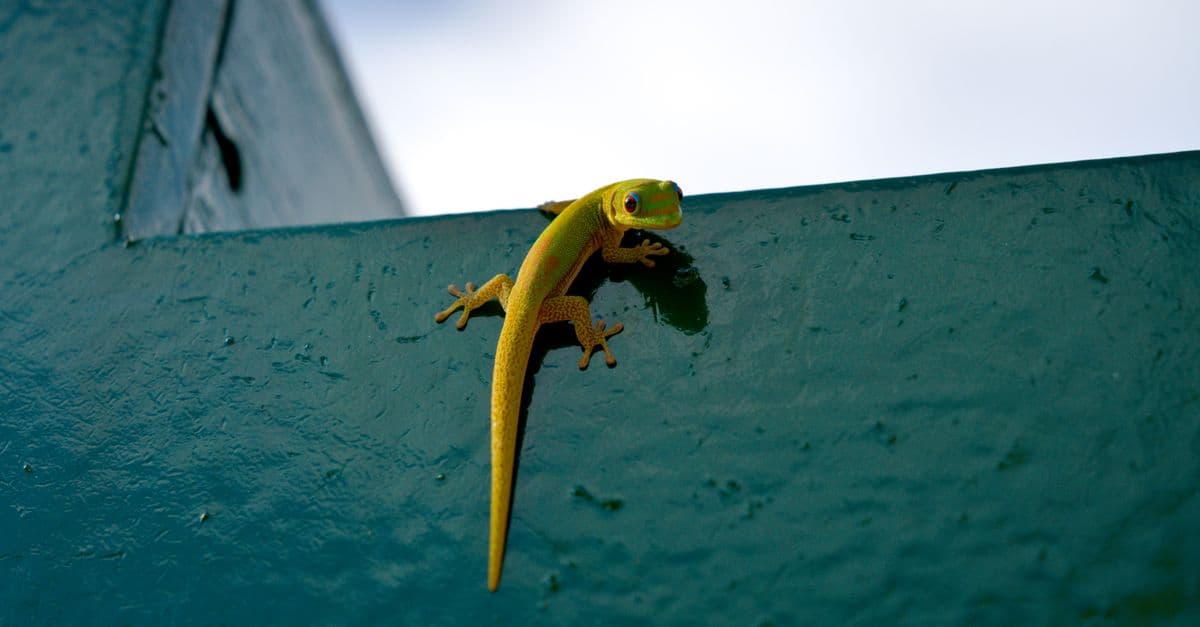
Photo: Michael Li / Pexels
A gecko weighing 70 grams can hang from a ceiling by a single toe. The adhesive force available from its feet has been measured at approximately 20 Newtons — enough to support the weight of roughly 40 geckos simultaneously. No glue is involved. No suction cups, no sticky secretions, no electrostatic charge. The mechanism is quantum-mechanical: trillions of nanoscale hair structures bring gecko toe pads into such intimate contact with surfaces that the quantum interactions between electrons in adjacent molecules provide enough combined force to defy gravity. When biologists first proposed this mechanism in 2000, it was not immediately accepted. The physics seemed too elegant. The numbers checked out.
What Holds Two Things Together: A Brief Physics Baseline
Before examining what geckos do, it helps to understand the physical forces available for adhesion at small length scales.
Van der Waals forces — weak, short-range attractive forces between atoms and molecules arising from fluctuations in electron distribution. Even electrically neutral molecules have instantaneous dipole moments as electrons move; these fleeting dipoles induce complementary dipoles in neighboring molecules, creating a net attractive force. The name covers several related interaction types, but the most relevant for gecko adhesion is the London dispersion force, which operates between all atoms and molecules regardless of polarity.
These forces are weak — orders of magnitude weaker than covalent or ionic chemical bonds. But they are universal (they act between any two adjacent atoms), and they scale with contact area. Put a sufficiently large number of atoms from one surface into extremely close proximity with a sufficiently large number of atoms from another surface, and the summed van der Waals forces become substantial.
The problem with using van der Waals adhesion for macroscopic objects is roughness. At the scale visible to the naked eye, every surface — glass, metal, wood — is rough. Two surfaces pressed together actually contact each other only at the tips of their highest asperities (surface bumps). The true contact area between two apparently smooth macroscopic surfaces is perhaps 0.01% of their geometric contact area. Van der Waals forces across 0.01% of contact area are negligible.
Geckos' solution: build a hierarchical surface structure that conforms to the roughness of any substrate, maximizing true contact area at the nanometer scale where van der Waals forces operate.
Source: Autumn, K. et al. (2000), "Adhesive force of a single gecko foot-hair," Nature, Vol. 405 — the landmark paper that measured the adhesive force of individual setae and identified van der Waals interactions as the primary mechanism, refuting earlier hypotheses involving suction or secretions.
The Hierarchy: From Lamellae to Spatulae
Gecko adhesion works through a four-level structural hierarchy, with each level handling a different length scale of surface roughness.
Lamellae — the visible ridged pads on gecko toe undersides, visible to the naked eye. These are accordion-fold structures that can conform to surface curvature at the millimeter scale, and they hyperextend to increase contact area during attachment.
Setae — hair-like structures covering the lamellar surface, visible under a light microscope. A single seta is approximately 100 micrometers (0.1 mm) long and 5 micrometers in diameter. Each square millimeter of lamellar surface contains roughly 14,400 setae. A typical Tokay gecko (Gekko gecko) has approximately 6.5 million setae on all four feet combined.
Spatulae — the spatula-shaped tips of the setae, visible only under electron microscopy. Each seta branches near its tip into 100–1,000 spatulae, each approximately 200 nanometers wide and 20 nanometers thick — smaller than a wavelength of visible light. The spatulae are the actual adhesive contact points.
The numbers are important. Six and a half million setae, each with perhaps 200 spatulae, gives approximately 1.3 billion spatulae on one gecko's feet. Each spatula brings perhaps 200 nm² of surface into contact with the substrate. The total true contact area, if all spatulae were simultaneously engaged, would be around 1.3 billion × 200 nm² ≈ 260 mm² — much larger than the naive geometric contact area of a gecko's feet, and large enough to generate substantial van der Waals adhesion.
The setae are made of beta-keratin — the same structural protein in bird feathers and reptile scales — arranged in a crystalline configuration that makes them stiff enough to maintain their shape under normal loading but flexible enough to bend and conform to surface texture without fracturing.
Source: Autumn, K. et al. (2002), "Evidence for van der Waals adhesion in gecko setae," Proceedings of the National Academy of Sciences, Vol. 99 — direct measurement of setae adhesion force in both polar (water) and non-polar (perfluorodecalin) liquids, establishing the London dispersion force mechanism by demonstrating adhesion is fluid-independent.
Directionality: Attach and Detach on Demand
If gecko adhesion were simply maximized van der Waals attraction, the gecko would be stuck. What makes the system functional for a climbing animal is that the adhesion is anisotropic — it depends on the direction of the applied force and the angle of the setae relative to the surface.
When the gecko drags its toes toward its body (proximally), the setae deflect and the spatulae are pressed into intimate contact with the surface at an optimal angle. Adhesion is strong. When the gecko curls its toes upward (hyperextending them), the angle between the setae and the surface changes dramatically — the spatulae peel off the surface from the tip, requiring only a small force to break contact. The geometry of detachment is similar to peeling tape: peeling from the end requires far less force than shearing it flat.
This is the peel zone model of gecko adhesion. The critical angle for detachment (the setal shaft angle relative to the substrate at which adhesion transitions from strong to negligible) is approximately 30°. Below this angle, adhesive; above it, non-adhesive. The gecko controls attachment and detachment simply by adjusting toe posture.
The practical consequence: a gecko can attach and detach each foot approximately 15 times per second while running vertically. Each step takes a few milliseconds to engage and a few milliseconds to release. No muscular force is required to maintain adhesion — the gecko does not have to actively hold on, only to maintain the correct toe angle. This is why a dead gecko will remain stuck to a surface: the setae remain engaged at the attachment angle until physically moved.
| Property | Value | Notes |
|---|---|---|
| Setae per mm² of lamellar surface | ~14,400 | Tokay gecko |
| Total setae (all four feet) | ~6.5 million | Tokay gecko |
| Spatulae per seta | 100–1,000 | Species-dependent |
| Single seta adhesive force | ~200 μN | Parallel shear loading |
| Maximum adhesive force (whole animal) | ~20 N | More than enough for 40× body weight |
| Critical detachment angle | ~30° | Above this angle, adhesion negligible |
| Attachment/detachment cycle time | ~15 cycles/sec | Running gecko on vertical surface |
Source: Irschick, D.J. et al. (1996), "A comparative analysis of clinging ability among pad-bearing lizards," Biological Journal of the Linnean Society, Vol. 59 — comparative study measuring whole-body adhesive forces in multiple gecko species under various loading conditions.
Self-Cleaning: Fouling Resistance Without Maintenance
Any adhesive material used repeatedly on natural substrates will accumulate contamination — dust, particles, pollen, biological debris. For a synthetic adhesive, this reduces adhesion over time. For a gecko's foot, the problem is more acute: the same spatula-substrate contact area that generates adhesion will also contact particles on dirty surfaces.
Geckos apparently solve this through self-cleaning: the ability to shed contaminating particles from the setae during normal locomotion without any dedicated cleaning behavior. The mechanism was first described by Autumn and colleagues in 2004: when contaminated gecko toe pads were tested against clean glass, adhesive force recovered substantially with successive steps, even without the gecko performing any visible toe-cleaning behavior.
The physics behind self-cleaning relies on a competition between particle-seta adhesion and particle-substrate adhesion. On most natural surfaces, the van der Waals adhesion between a particle and the substrate is greater than the adhesion between the particle and the seta surface. When the seta contacts the substrate and then detaches, the particle preferentially remains on the substrate rather than transferring to the seta.
This is a delicate balance — it works because seta geometry produces a relatively small contact area between any individual seta and a contaminating particle (they are too small for many particles and too sparse for very fine ones), while substrate contact area for the same particle is continuous. The hierarchy of seta sizes also ensures that particles of any particular size interact primarily with the seta structural elements closest to their own size, limiting adhesion.
Source: Autumn, K. et al. (2004), "Self-cleaning in gecko locomotion," Proceedings of the Royal Society of London B, Vol. 271 — experimental demonstration of self-cleaning through successive contact-detachment cycles, with adhesion force recovery quantified against glass substrates.
Where Gecko Adhesion Works — and Where It Fails
Van der Waals forces are universal — they act between any atoms in close proximity, regardless of the chemical nature of either surface. This means gecko toe pads work on hydrophilic surfaces (glass, ceramics), hydrophobic surfaces (Teflon, wax), rough surfaces (wood, brick), and smooth surfaces (metal, polished stone). The gecko does not need surface chemistry to be matched. It works almost everywhere.
But there are conditions that defeat the system.
Water. Capillary forces from a thin water layer between toe pad and surface actually enhance van der Waals adhesion in slightly moist conditions, which may explain why some gecko species prefer humid environments. However, fully submerged conditions or heavily wetted surfaces reduce adhesion — the water layer becomes thick enough to physically prevent the spatulae from achieving the nanometer-scale proximity required for van der Waals forces to dominate. Geckos are notably less effective on rain-wet smooth surfaces.
Contamination with fine particles. While self-cleaning handles typical environmental debris, very fine particles (nanometer-scale) can coat the setal surface and persist through multiple contacts, reducing effective contact area.
Highly textured surfaces. On surfaces with features at the scale of the spatula tip (tens to hundreds of nanometers), the spatulae cannot conform and contact area is reduced. This is why some studies find reduced gecko adhesion on nanopatterned surfaces despite their high geometric contact area.
Teflon-like surfaces with very low surface energy. Van der Waals forces are proportional to the polarizability of the materials in contact. Materials with very low surface energy (some fluorinated polymers) provide less interaction with the beta-keratin spatulae than expected. Some gecko species have reduced adhesion on Teflon coatings, though the force is still non-zero.
Gecko-Inspired Technology: Dry Adhesives and Climbing Robots
The gecko adhesion mechanism has attracted intense interest from materials scientists and roboticists because it offers something no current synthetic adhesive provides: strong, reversible, dry adhesion that works on diverse surfaces, self-cleans, and requires no chemical consumable.
Synthetic gecko-inspired materials were first produced in the early 2000s using lithographic techniques to create arrays of microscale polymer pillars. These initial materials demonstrated partial gecko-like adhesion but fell far short of the performance of biological setae for two key reasons: they lacked the multi-level hierarchy (lamellae → setae → spatulae), and they used softer polymers that deformed and clumped together under repeated use (a problem called "self-matting").
More recent approaches have addressed these limitations. Carbon nanotube arrays, which have the right aspect ratio and stiffness to mimic setae geometry, have been fabricated that achieve contact forces approaching biological gecko values in laboratory conditions. Hierarchical polymer structures with two or three levels of structural hierarchy achieve adhesive forces in excess of 10 N/cm² (Newton per square centimeter) — approaching the 10 N/cm² estimated for gecko lamellae.
The robot application with the most visible profile is the Stanford Gecko Gloves project and the subsequent DARPA Z-Man program, which produced climbing systems for human-weight loads using synthetic gecko adhesives. In 2014, a 70 kg (154 lb) person climbed a 7.6 m (25 ft) glass wall using Z-Man adhesive paddles — a direct demonstration that the physics scales from the 70-gram gecko to the 70-kilogram human, given sufficient pad area.
Medical applications include gecko-inspired wound closures that can adhere to wet tissue without chemical glues or mechanical staples, and endoscopic devices that can crawl along the wet, curved walls of the gastrointestinal tract.
Source: Autumn, K. and Gravish, N. (2008), "Gecko adhesion: evolutionary nanotechnology," Philosophical Transactions of the Royal Society A, Vol. 366 — review of the state of gecko biomimetics, covering synthetic materials, climbing robots, and the unsolved engineering challenges in replicating biological performance.
Source: Hawkes, E.W. et al. (2015), "Human climbing with efficiently scaled gecko-inspired dry adhesives," Journal of the Royal Society Interface, Vol. 12 — the Z-Man/DARPA paper demonstrating full-scale human climbing using hierarchical synthetic gecko adhesive pads.
How Gecko Adhesion Evolved
Sticky toe pads have evolved independently at least 11 times within lizards — in geckos, anoles, skinks, and several other lineages. This convergence mirrors the pattern seen in bioluminescence evolution: when a trait offers substantial fitness advantages across diverse ecological contexts, natural selection finds it repeatedly.
Phylogenetic analysis suggests that the ancestral gecko lineage already had relatively smooth toe pads with some degree of surface microstructure before the full setal hierarchy evolved. The evolutionary trajectory appears to go from smooth pad → fine microstructure → rudimentary setae → developed setae with spatulae, with each step providing incremental adhesion benefit. The multi-level hierarchy is not required all at once; each level alone improves on the previous state.
The earliest fossil evidence for gecko-like adhesive toe pads appears in Cretaceous amber specimens approximately 100 million years old — pads with identifiable lamellar and setae structure, suggesting the mechanism was fully developed before the K-Pg mass extinction and has been conserved since.
Source: Grismer, L.L. et al. (2012), "Molecular phylogenetics and biogeography of geckos," Zoologica Scripta, Vol. 41 — phylogenetic analysis of adhesive toe pad evolution in lizards, documenting 11 independent origins across lizard lineages.
The Takeaway
Gecko adhesion works because of physics that operates at the nanometer scale, amplified by one of evolution's more remarkable pieces of structural engineering. Millions of nanoscale hair structures, each terminating in hundreds of spatulae thinner than a wavelength of visible light, bring the gecko's foot into intimate contact with any surface at the molecular level, where quantum fluctuations in electron distributions create the attraction that holds the animal to the wall. The system is reversible, self-cleaning, works on nearly any surface, requires no chemical consumable, and can be engaged and released 15 times per second. Engineers have spent 25 years trying to replicate it and have only partially succeeded — which is, in its own way, a measure of how much natural selection has optimized the gecko's solution across 100 million years of refinement.
Frequently Asked Questions
Q: Do geckos use suction cups or glue to stick to walls?
A: Neither. Gecko adhesion relies on van der Waals forces — quantum-mechanical attractions between adjacent molecules — not suction or chemical adhesion. The forces arise from the extreme proximity achieved between nanoscale setal structures (spatulae) and the surface atoms, requiring no secretion or pressure differential.
Q: Why doesn't a gecko's foot stick permanently to surfaces?
A: Because the adhesion is highly directional. When the seta is angled toward the body (pulled proximally), spatulae contact the surface at an adhesive angle. When the gecko hyperextends its toes, the setae angle changes above approximately 30° and the spatulae peel away from the surface with minimal force — like peeling tape from an end rather than pulling it flat. Detachment is geometrically controlled, not chemically.
Q: Can gecko-inspired tape carry a human?
A: In controlled laboratory conditions, yes. The DARPA Z-Man program demonstrated a 70 kg person climbing a glass wall using synthetic hierarchical adhesive pads. The physics scales from gecko to human because van der Waals force scales with contact area, and a human simply needs proportionally larger pads. Practical gloves and shoes for field use remain an engineering challenge due to self-matting and durability issues.
Q: Do all geckos have adhesive toe pads?
A: No. Approximately 60% of gecko species have adhesive lamellae, but many species — particularly those living in sandy or burrowing habitats — have reduced or absent setae structures and rely on claws rather than adhesion for substrate contact. Adhesive pads evolved independently at least 11 times across lizard lineages and have also been secondarily lost multiple times.
Q: How do gecko feet stay clean?
A: Through a passive self-cleaning mechanism. When the spatulae contact a substrate and then detach, contaminating particles preferentially adhere to the substrate rather than to the seta surface, because the substrate provides greater continuous contact area for any given particle than the seta geometry does. The gecko does not need to wash or wipe its feet; normal locomotion progressively transfers particles from seta to substrate.
Q: Would gecko adhesion work in space?
A: Yes — and it is being actively studied for space applications. Van der Waals forces do not require atmosphere, gravity, or liquid; they work in vacuum, in microgravity, and on the varied surface compositions of spacecraft materials. NASA and ESA have investigated gecko-inspired grippers for capturing debris and maneuvering spacecraft components in orbit, where conventional grippers face major challenges.
Read next:
Follow new articles
Add SciHub101 to your feed reader to see new science and technology stories.
About the Author
SciHub101 is an independent science and technology publication founded and edited by Buğra Sözeri, a software engineer and app developer based in Türkiye. AI tools assist with drafting and research. Source documentation in the existing archive is uneven, and articles are being reviewed and corrected. The Editorial Team byline identifies editorial responsibility; it does not certify specialist or independent human review. Where we compare products, anything built by our own team is labelled as such — see the editorial guidelines and About page for how corrections and disclosures work.
Related Articles
How Ant Colonies Work: Superorganisms, Pheromones, and Swarm Intelligence
A single ant is close to useless. It has a brain with roughly 250,000 neurons — less than a fruit fly — and no capacity to plan, strategize, or solve multi-step problems alone. Put 500,000 of them together in a colony, and the collective builds climate-controlled fungal farms, wages organized warfare, manages waste disposal, and solves the traveling salesman problem with road networks that engineers have benchmarked against modern infrastructure. The colony is the organism.
How Animals Were Domesticated: Genetics, Behavior, and the Domestication Syndrome
Dogs diverged from wolves at least 15,000 years ago — possibly 40,000 years ago — and the transformation involved not just behavioral tameness but a cascade of physical changes no one selected for: floppy ears, piebald coats, shortened snouts, reduced brain volume. The same cluster of traits appears in domesticated cattle, pigs, horses, and foxes bred in a 60-year Russian experiment. This pattern has a name, a mechanistic explanation, and implications for understanding a transition that reshaped the human species.

The Strongest Animals by Relative Strength: Beetles, Ants, and the Science of Scaling
A horned dung beetle weighing less than 2 grams can pull a load equivalent to 1,141 times its own body weight — the equivalent of an average adult human dragging two fully loaded 18-wheel trucks simultaneously. A tropical mite just 1 mm long generates a pull force 1,150 times its body weight. These numbers are not accidents of evolution: they follow directly from a physical law called the square-cube relationship, which guarantees that smaller animals will always be stronger relative to their size than larger ones. Understanding why reveals something fundamental about the limits of scale in biology.
The Science of Superpowers: Could Humans Really Fly?
Comic book heroes make flight look effortless — but a serious look at biology and physics shows why human flight is one of nature's hardest engineering problems.