Why Flamingos Stand On One Leg
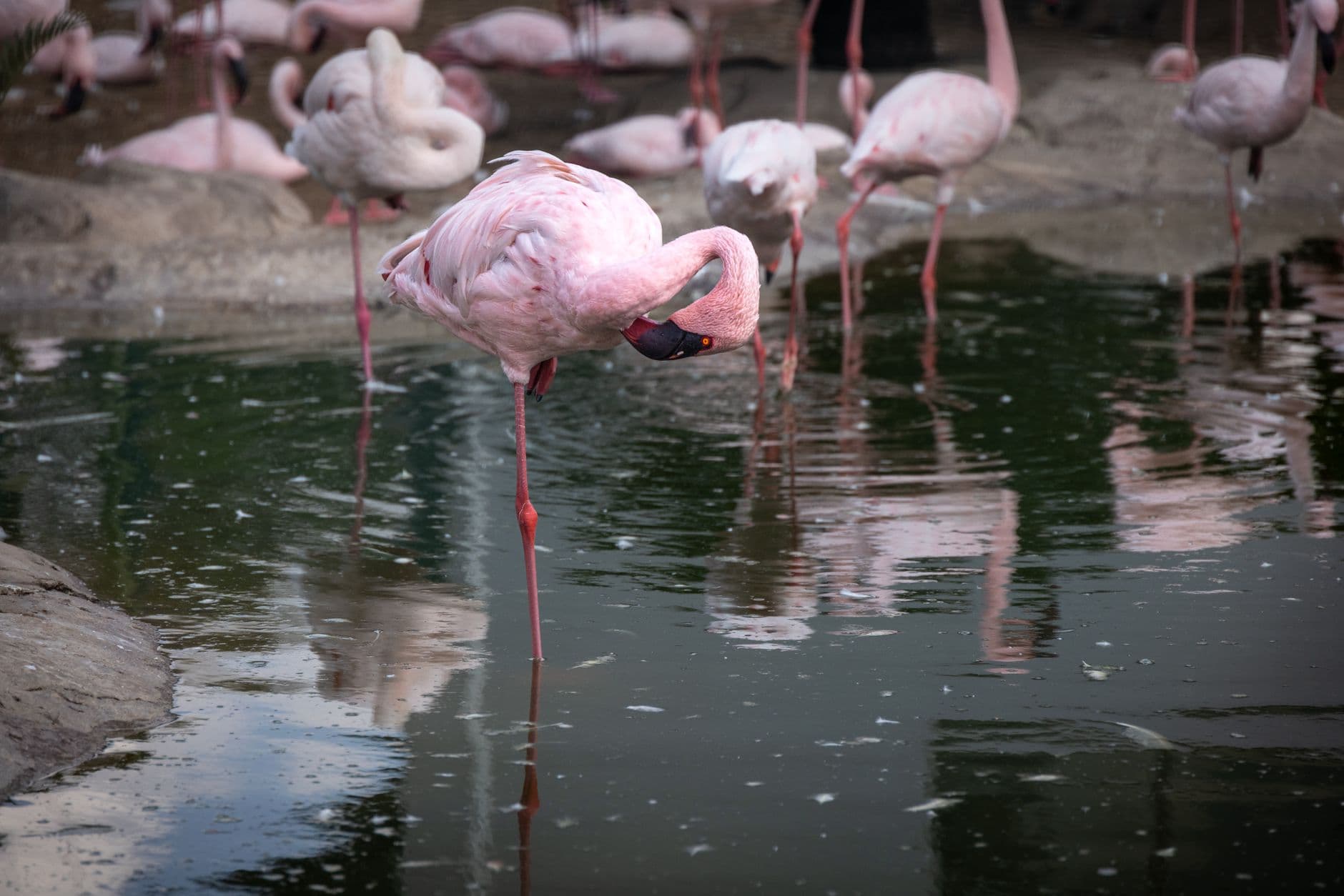
Photo: Magda Ehlers / Pexels
A flamingo standing on one leg is not fighting to keep its balance. Its leg anatomy locks passively into a stable position that needs almost no active muscle effort, a mechanism demonstrated with flamingo cadavers by biomechanists Young-Hui Chang and Lena Ting and published in Biology Letters in 2017. Separately, behavioral research by psychologist Matthew Anderson and colleague Sarah Williams, published in Zoo Biology in 2010, found flamingos favor the pose more often in cold water, pointing to heat conservation as a second, complementary reason. Both explanations hold up, and understanding how they fit together says a lot about how good behavioral biology actually gets done.
What the cadaver study actually showed
Chang, then at Georgia Tech, and Ting, at Emory University's biomedical engineering program, wanted to answer a mechanical question nobody had tested directly: does standing on one leg require a flamingo to actively hold itself up, or does its skeleton do the work on its own (Chang and Ting, Biology Letters, 2017)? They used two frozen flamingo bodies, held each one upright by a single leg, and tilted it forward and backward while tracking the knee and hip joint angles.
The result surprised even the researchers. The cadaver "could passively support body weight on one leg without any muscle activity," settling into a stable posture that looked just like a live, resting flamingo. No electrical stimulation, no muscle tension, no ongoing correction. Gravity and joint geometry did the entire job.
The mechanism works because of three things happening together: the bird's body weight sits forward of the knee joint in a way that creates a self-stabilizing moment, the joints have hard anatomical limits that prevent them from buckling, and the foot lands close to the body's midline, which locks the whole system into place. Chang described it to Georgia Tech's own science writers as similar to how a folding chair's frame geometry locks once it passes a certain angle. Push it past that point and it holds itself; nothing has to keep pushing.
The team followed the cadaver test with live birds. Eight juvenile flamingos stood on force plates while researchers tracked how much their center of pressure moved. When the birds were resting quietly with their eyes closed, their sway stayed within roughly 3.2 millimeters of a fixed point directly under the ankle joint. When they were alert and active, that sway grew to about 5.1 millimeters, and their peak movement speed jumped from around 40 to nearly 300 millimeters per second. In other words, the quiet, resting one-legged posture was measurably more still than the alert, engaged posture, exactly the opposite of what you'd expect if one-legged standing required constant micro-adjustments to avoid falling.
The stay apparatus, or why the leg won't just collapse
Engineers have a name for structures that hold a load using shape and gravity alone, without ongoing input: a "stay" mechanism. Chang and Ting's paper describes the flamingo's version as a passively engaged, gravity-driven body-weight-support system in the bird's proximal leg joints, the first time such a mechanism had been documented in a bird's hip and knee.
Think of a stepladder at its fully open position. Once the legs lock into their triangular brace, the ladder holds a person's weight without any hinge trying to close back up, because the geometry itself resists the direction gravity is pulling. A flamingo's knee and hip do something structurally similar when the leg is tilted at the right inward angle relative to the body. Tilt the same cadaver leg to a more upright, straight-down position, and the researchers found the stability disappeared; the body was no longer self-supporting. The inward lean readers see in every flamingo photo is not a stylistic detail, it is the geometry the whole trick depends on.
Why does the flamingo's angled stance matter mechanically?
The inward tilt of a flamingo's standing leg shifts its center of mass forward of the knee joint, which creates a self-locking moment at the joint. Straighten the same leg to a vertical position and that self-locking effect vanishes, meaning the bird would need active muscle engagement to avoid toppling, exactly the opposite of what the resting pose achieves.
This also explains something researchers noted as a genuine surprise: a flamingo's two-legged stance is the one that requires muscle activation, not the one-legged stance. Standing on both legs symmetrically doesn't naturally engage the same locking geometry, so the bird has to do some active work to hold that posture steady. One leg, tilted at the right angle, is mechanically the path of least resistance for a flamingo's particular joint structure. That is a strange thing to say about an animal balancing on a limb the width of a broom handle, but the mechanics back it up.
The cold-water heat conservation hypothesis
Long before Chang and Ting's mechanical study, field biologists had a competing, or really complementary, explanation rooted in thermoregulation: the body's process for keeping its internal temperature within a survivable range. Flamingo legs are almost entirely bone, tendon, and thin blood vessels, with very little insulating fat or muscle mass. Submerged in cold water, that thin, poorly insulated limb loses body heat fast through direct conduction, the transfer of heat between two surfaces in contact.
Matthew Anderson, a psychologist at Saint Joseph's University, and Sarah Williams studied captive Caribbean flamingos at the Philadelphia Zoo and published their results in Zoo Biology in 2010. They recorded which posture birds used, one leg or two, alongside air and water temperature, and whether the birds were standing on land or in water. Two findings stood out. First, the percentage of birds resting on one leg was significantly higher for birds standing in water than for birds standing on dry land, at the same air temperature. Second, the team reported a negative relationship between temperature and one-legged resting, meaning the colder it got, the more often the birds tucked a leg up.
That combination, water contact mattering more than air temperature alone, points specifically at conductive heat loss through submerged legs, not general cold discomfort. A leg in cold water loses heat far faster than a leg in cold air of the same temperature, because water conducts heat away from a body roughly 25 times more efficiently than still air. Halving the number of legs in the water at any given moment meaningfully cuts that heat loss, without requiring the bird to leave the water or stop feeding.
Why do flamingos stand on one leg more often in water than on land?
Water conducts heat away from a flamingo's thin, poorly insulated legs far faster than air does, even at the same temperature. Anderson and Williams's 2010 field study found birds standing in water switched to a one-legged stance significantly more often than birds standing on dry ground, which is the clearest evidence that heat loss, not just general cold, drives the behavior.
Anderson's team also tested and largely ruled out a third old idea: that flamingos rest one leg because the standing muscles get fatigued and need a break, similar to a person shifting their weight after standing too long. If muscular fatigue were the driver, birds that had just been resting on both legs should be quicker to switch to one leg than birds already active. Anderson found the opposite pattern in his behavioral data, birds were faster to move when they had been standing on two legs, which argues against fatigue as the primary explanation and lines up with what Chang and Ting later confirmed mechanically: one-legged standing is the low-effort posture, not the recovery posture.
Two studies, two mechanisms, one behavior
It's worth being precise about what each piece of research actually demonstrates, because they are frequently blurred together in casual explanations. Chang and Ting answered a biomechanical question: what does it cost, physically, to hold this posture? Anderson and Williams answered a behavioral-ecology question: under what conditions do flamingos choose to hold it? Neither team disproved the other. A posture can simultaneously be cheap to maintain and useful for a specific purpose, and that is exactly what the combined evidence shows.
| Explanation | What was tested | Key evidence | Status |
|---|---|---|---|
| Passive leg-locking reduces muscular effort | Cadaver mechanics + live force-plate tracking (Chang and Ting, 2017) | Cadavers stood stably with zero muscle activity; resting live birds swayed less than alert birds | Directly demonstrated |
| Cold-water heat conservation | Field observation of captive flamingos across temperature and water conditions (Anderson and Williams, 2010) | One-legged resting rose sharply as temperature dropped and was far more common in water than on land | Well supported |
| Muscular fatigue relief | Behavioral response-time comparison (Anderson, cited in Anderson and Williams, 2010) | Birds standing on two legs reacted faster, not slower, than resting birds, opposite of the fatigue prediction | Not supported |
Two independently tested mechanisms, mechanical low-effort locking and cold-water heat conservation, both hold up under scrutiny, while the older fatigue-relief explanation does not.
Why not just sit down instead?
If conserving energy and heat is the goal, a flamingo could, in principle, simply sit down on the ground or in shallow water rather than stand on one leg at all. Sitting would put even more of the bird's body in direct contact with cold water or mud, though, increasing rather than decreasing total heat loss, and it would also slow the bird's ability to react to an approaching predator, since getting back onto both feet from a fully seated position takes longer than shifting weight from one leg to the other.
One-legged standing is, in that sense, a middle position between two competing pressures: staying warm and staying ready to move. It reduces the surface area of cold-sensitive leg tissue in contact with water, while keeping the bird fully upright, alert, and able to launch into flight or a defensive posture almost immediately. Wading birds in general face this same trade-off, since feeding in shallow water exposes them to both predators moving through open terrain and steady heat loss through unfeathered legs, and several other species use variations of the same one-legged resting posture, though flamingos remain the most visually recognizable example and have received by far the most direct scientific attention.
Do other wading birds do the same thing?
Flamingos did not invent one-legged resting, and they are not even the only wading bird that does it constantly. The Smithsonian's National Zoo and Conservation Biology Institute notes that the posture shows up widely across long-legged shorebirds, herons, and egrets, all of which share the same basic anatomical problem: thin, largely unfeathered legs with a lot of surface area exposed to cold air or water relative to how much insulating tissue surrounds the bone. The Cornell Lab of Ornithology makes the same point about ducks, geese, gulls, and hawks, species with very different leg proportions and very different lifestyles, which is a strong hint that the underlying driver is closer to basic thermal physics than to anything unique to flamingo anatomy.
That breadth is exactly why flamingos ended up as the public face of the behavior rather than, say, a great blue heron doing the same thing at the edge of a pond. A heron standing motionless on one leg in shallow water is also hunting, using stillness to avoid spooking fish, so the posture reads to onlookers as predatory patience rather than a resting stance. A flamingo, by contrast, is usually not hunting when it tucks a leg up; large flocks of hundreds or thousands of birds settle into the pose simultaneously while filter-feeding or simply standing in a shared lagoon, in bright pink plumage, in open, easily photographed habitat. The behavior is the same underlying mechanism, but flamingos display it at a scale and visibility that no solitary heron ever will.
There is a second reason flamingos, specifically, became the species researchers actually tested. Captive flamingo flocks are common in zoos, easy to observe continuously across seasons, and tolerant of the kind of close-range video and force-plate work Chang, Ting, Anderson, and Williams needed. Nobody has run an equivalent cadaver-mechanics study on a heron or a gull, not because the behavior is assumed to work differently, but because flamingos happened to be the practical, well-studied test case. The takeaway isn't that flamingos are mechanically unique among birds, it's that they are the species science actually got around to checking.
What flamingo leg anatomy tells us about the rest of the bird
It is worth stepping back to note just how unusual a flamingo's leg is built, because that anatomy is the entire reason both mechanisms work at all. What looks like a flamingo's knee bending backward, a detail people frequently get wrong, is actually its ankle joint; the true knee sits higher up, hidden close to the body under the feathers. The long, thin, reddish-pink segment that most people call the "leg" is functionally closer to an elongated foot, built from fused ankle and foot bones called the tarsometatarsus.
That structure is part of why the leg has so little insulating tissue to begin with. Thin, low-mass limbs are efficient for wading through shallow lagoons and lake margins, since they minimize the drag and energy cost of walking through standing water, but the tradeoff is a limb with almost no muscle or fat to slow down heat loss once it's submerged. The same evolutionary pressure that shaped an efficient wading limb also created a limb vulnerable to conductive cooling, and behaviors like one-legged standing appear to be one adaptation that offsets that cost. It's a reminder that a single anatomical feature rarely comes with only upsides; flamingo legs are excellent for wading and comparatively poor at heat retention, and the standing posture is one behavioral patch over that tradeoff.
Flamingos' famous coloring is a useful parallel case for how deceptively simple-looking traits often turn out to have layered explanations. Flamingos hatch with gray, not pink, plumage. Their signature color comes from carotenoid pigments in the algae and brine shrimp that make up much of their diet, pigments the birds' livers convert and deposit into growing feathers over time. Nobody assumed flamingos evolved pink feathers directly; the color is a downstream effect of diet chemistry. One-legged standing has a similar layered structure, a passive mechanical foundation that happens to also serve a behavioral, heat-saving purpose, rather than a single tidy cause.
What people get wrong about the behavior
The most common misconception is treating one-legged standing as effortful, a balancing trick the bird has to actively work to maintain, similar to how a person balancing on one foot has to concentrate. Chang and Ting's cadaver and force-plate data directly contradict that framing: the resting pose is the mechanically cheaper option, and live flamingos show less body sway while resting on one leg than while alert and active on it.
A second common error is treating heat conservation and passive mechanics as competing theories where one must be wrong. Older popular science coverage often framed this as a debate to be settled, when the two studies actually measure different things entirely, one measures physical cost, the other measures behavioral trigger, and both held up under direct testing. A third, smaller misconception is assuming the behavior is purely reflexive or automatic. Anderson and Williams's data show flamingos modulate the behavior in response to real-time environmental conditions, meaning it is a flexible response the bird adjusts, not a fixed, unchangeable tic.
The takeaway
Flamingos stand on one leg because their leg anatomy passively locks into a low-effort, stable position once weight shifts onto a single limb, a mechanism Young-Hui Chang and Lena Ting demonstrated directly using cadaver and live-bird force-plate testing in 2017, and because tucking one leg against the body reduces heat loss through cold water contact, a pattern Matthew Anderson and Sarah Williams documented through field observation in 2010. The behavior isn't a balancing trick and it isn't simple habit either; it's a case where an old folk explanation turned out to be broadly correct, but only after two separate research teams tested the mechanical and behavioral questions directly instead of relying on how the posture looks from the outside. For the biology-category take on the same question, see why flamingos stand on one leg.
Read next:
FAQ
Q: Does standing on one leg tire a flamingo out?
No. Cadaver and live-bird studies published in Biology Letters in 2017 by Young-Hui Chang and Lena Ting found flamingo legs passively lock into a stable position once weight shifts to one leg, requiring little to no active muscle effort, and resting birds actually showed less body sway than alert, active birds on the same leg.
Q: Why do flamingos stand in cold water on one leg specifically?
Flamingo legs have very little insulating fat or muscle, so submerging both legs in cold water increases heat loss through direct conduction. Matthew Anderson and Sarah Williams's 2010 study in Zoo Biology found flamingos favored one-legged standing far more often in water than on land, and more often as temperature dropped.
Q: Could flamingos just sit down instead of standing on one leg?
They could, but sitting fully down would increase body contact with cold water or mud and slow their ability to react to a predator, so standing on one leg is a middle-ground posture that balances heat conservation against readiness to move.
Q: Is one-leg standing unique to flamingos?
No, several other wading and shorebird species show similar one-legged resting postures, though flamingos are the most visually iconic example and have been the primary subject of the direct mechanical and behavioral studies on the trait.
Q: Who proved that one-leg standing requires little muscular effort?
Young-Hui Chang and Lena Ting demonstrated this using flamingo cadavers and live force-plate testing in a study published in Biology Letters in 2017, showing the birds could remain stably balanced on one leg without active muscle engagement, a mechanism they described as a passive, gravity-driven stay apparatus.
Q: Is the "flamingo knee" actually a knee?
No. What looks like a backward-bending knee on a flamingo is its ankle joint; the true knee is hidden higher up, close to the body under the feathers. The long visible "leg" segment is mostly fused foot and ankle bone, not the lower leg most people assume it is.
Q: Why is the one-legged pose associated with flamingos specifically, if other birds do it too?
The Smithsonian's National Zoo and the Cornell Lab of Ornithology both note the posture is widespread across herons, egrets, ducks, geese, gulls, and hawks, driven by the same thin-leg heat-loss problem. Flamingos stand out mainly because they do it in large, visible flocks while filter-feeding rather than while hunting alone, and because captive flamingo colonies made them the practical species for direct biomechanical and behavioral testing.
Follow new articles
Add SciHub101 to your feed reader to see new science and technology stories.
About the Author
SciHub101 is an independent science and technology publication founded and edited by Buğra Sözeri, a software engineer and app developer based in Türkiye. AI tools assist with drafting and research. Source documentation in the existing archive is uneven, and articles are being reviewed and corrected. The Editorial Team byline identifies editorial responsibility; it does not certify specialist or independent human review. Where we compare products, anything built by our own team is labelled as such — see the editorial guidelines and About page for how corrections and disclosures work.
Related Articles
Why Do Flamingos Stand on One Leg? The Science
Flamingos stand on one leg because it's literally easier than two. The biomechanics, thermoregulation, and evolution behind the pink pose.
How Geckos Stick to Walls: Van der Waals Forces and Dry Adhesion
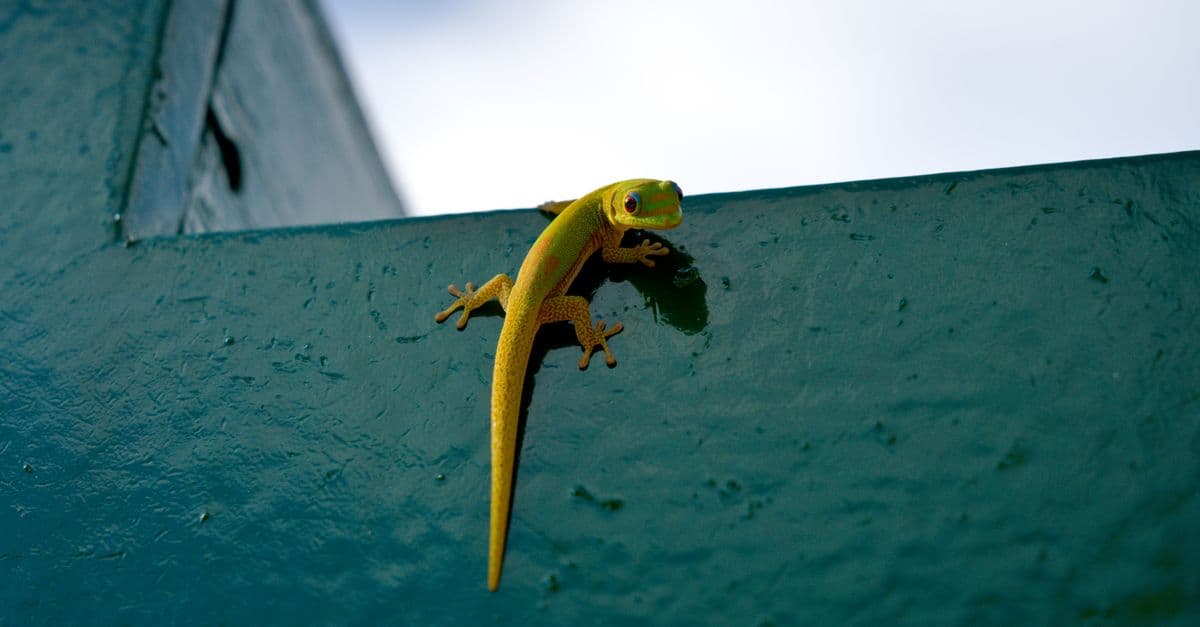
A gecko weighing 70 grams can hang from a ceiling by a single toe. The adhesive force available from its feet has been measured at approximately 20 Newtons — enough to support the weight of roughly 40 geckos simultaneously. No glue is involved. No suction cups. The mechanism is quantum-mechanical: trillions of nanoscale hair structures bring gecko toe pads into such intimate contact with surfaces that the quantum interactions between electrons in adjacent molecules provide enough combined force to defy gravity.