Why Do Flamingos Stand on One Leg? The Science
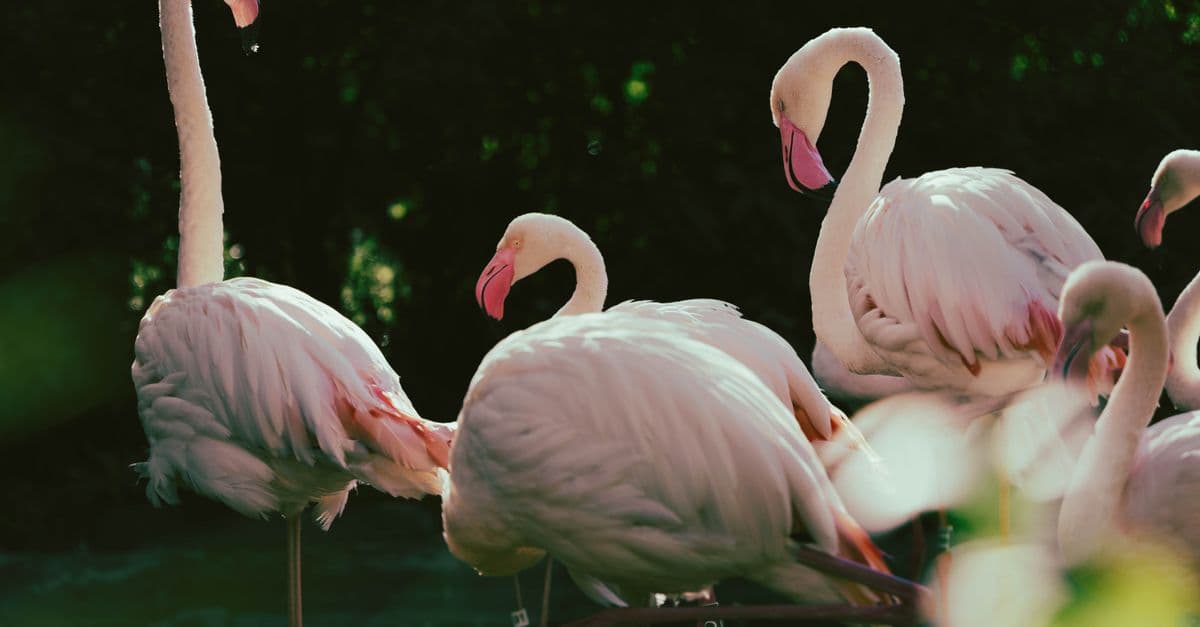
Photo: Owen.outdoors / Pexels
Charles Darwin wondered about it. Aristotle noticed it more than two thousand years earlier. Generations of zoo visitors have asked the same question while staring at a pink, motionless bird balanced impossibly on a single matchstick leg: why do flamingos stand on one leg?
For most of history, the answers were guesses — folk explanations about resting, hiding a leg from predators, or simple habit. In the last two decades, biomechanics researchers and physiologists have finally produced testable evidence, and the answer turns out to be stranger than the guesses. Standing on one leg costs a flamingo less muscular effort than standing on two, and it also helps the bird hold onto body heat while it wades in cold water for hours at a stretch. This article walks through both mechanisms in detail, what the leading experiments actually measured, how flamingo anatomy makes the trick possible, how the behavior compares to other wading birds, and what still isn't fully settled.
What Actually Happens When a Flamingo Balances on One Leg
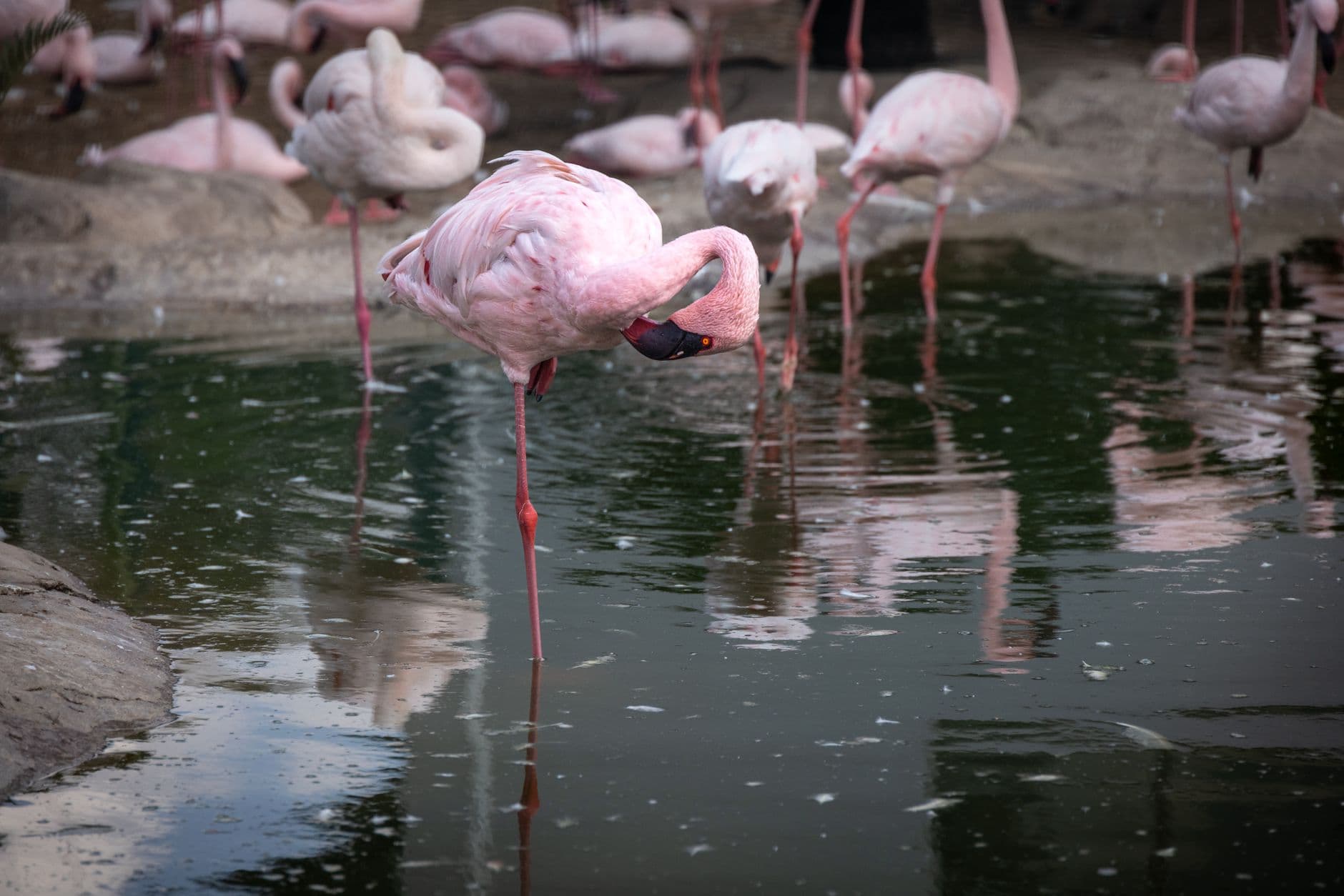
Watch a flamingo at a zoo or in a wetland for ten minutes and you'll notice something odd: it isn't wobbling. A human standing on one leg sways, overcorrects, and needs conscious effort to avoid toppling within half a minute. A flamingo just stands there — sometimes with its head tucked under a wing, sometimes fully asleep — for what can stretch into hours.
That stillness is the first clue that something mechanical, not muscular, is doing the work. If the flamingo were actively balancing the way a human does, you'd expect to see constant tiny corrections: micro-shifts of weight, feather ruffling, subtle leg tremors. Instead, once the bird settles into the pose, its posture barely changes at all.
The formal study that nailed this down came from Young-Hui Chang, a biomechanist at Georgia Tech, and Lena Ting, a neuroscientist and biomechanical engineer at Emory University and Georgia Tech. Their 2017 paper in Biology Letters, titled "Mechanical evidence that flamingos can support their body on one leg with little active muscular force," took an approach that sounds almost comically direct: they tested both living flamingos and flamingo cadavers on force plates.
That single result reframed the entire question. Researchers had spent years assuming flamingos must be doing something effortful to stay upright on one leg, and the puzzle was figuring out what. Chang and Ting's cadaver test flipped the premise: the one-legged stance requires so little active effort that a dead bird can do it. Standing on two legs, by contrast, needs continuous small muscular adjustments to keep weight balanced between two separate points of contact — which is why the cadaver couldn't manage it. Source: Chang & Ting, 2017, Biology Letters, via the Royal Society Publishing.
The Two Leading Explanations
Modern ornithology and biomechanics research have converged on two complementary — not competing — explanations. Neither one alone fully explains the behavior, and the current scientific consensus is that both are true at the same time, operating on different timescales.
Explanation One: A Passive Joint-Locking Mechanism
This is the mechanical story confirmed by the Georgia Tech/Emory cadaver experiments. When a flamingo shifts its body weight directly over a single foot, the joints of that leg — particularly the ankle, which sits roughly halfway up what most people mistake for the "knee" — settle into a geometric configuration where gravity itself keeps the joint locked in place.
Think of it the way you'd think about a stepladder. Once a stepladder's hinge is fully extended and locked, it holds your weight without any motor or spring doing continuous work; the geometry of the lock is doing the job. A flamingo's leg, once weight is centered over the standing foot, reaches an analogous locked geometry. No continuous muscular contraction is required to hold it there, because the skeleton and connective tissue are arranged so that gravity pulls the joint into the locked position rather than out of it.
This is conceptually similar to the "stay apparatus" that lets horses sleep standing up — a system of tendons and ligaments in a horse's legs that lock the joints passively so the animal doesn't collapse mid-nap. Flamingo anatomy achieves something comparable but through a different joint arrangement, and — according to the 2017 study — takes the "passive support" principle even further than the horse's stay apparatus does. Source: Chang & Ting, 2017.
The Georgia Tech team also ran a second, complementary test on eight living juvenile flamingos: they measured how much the birds swayed on a pressure plate while awake versus while asleep. If the one-legged pose demanded active muscular balancing, you'd expect more sway during sleep, when conscious control is reduced. Instead, the sleeping birds swayed roughly seven times less than the awake birds. That is the opposite of what active balancing would predict, and it's strong supporting evidence that the standing leg is doing its job passively, independent of conscious muscular effort. Source: Georgia Tech Quantitative Biosciences summary of the study; Emory News coverage.
Explanation Two: Reducing Heat Loss Through the Legs
The second explanation is older and comes from field physiology rather than biomechanics labs. Flamingos spend enormous amounts of time standing or wading in water that is frequently cold, and often caustic or alkaline as well. Their legs are long, thin, largely unfeathered, and packed with blood vessels close to the skin — in other words, they are shaped almost exactly like a radiator, which is very good for shedding heat and very bad for keeping it.
Birds and mammals that live in cold water or cold air commonly rely on a circulatory trick called countercurrent heat exchange, in which warm arterial blood flowing down into a limb runs alongside cool venous blood flowing back toward the body, transferring heat between the two streams so that the limb's core stays only slightly warmer than the water around it while the body core stays fully warm. Flamingo legs use a version of this system too, which already limits heat loss substantially. But it doesn't eliminate the problem, especially when water temperatures drop.
Tucking one leg up into the body's warm plumage removes that leg from direct contact with cold water and dramatically cuts the amount of exposed, heat-radiating leg surface at any given moment. Field observations back this up directly: flamingos are measurably more likely to adopt the one-legged stance in colder water, on colder days, and during the cooler parts of the daily cycle, and less likely to do it in warm conditions. This pattern was documented by researchers including Matthew Anderson and Sarah Williams, whose 2009 study in Zoo Biology, "Why do flamingos stand on one leg?," found that captive Caribbean flamingos stood on one leg significantly more often in cold water than warm water, and that the behavior correlated with ambient and water temperature more than with any other tested variable. Source: Anderson & Williams, 2009, Zoo Biology, Wiley Online Library.
The Anatomy That Makes the Trick Possible
To understand why the passive lock works at all, it helps to correct a very common misconception about flamingo leg anatomy. What looks like a backward-bending "knee" partway up the leg is not the knee. It is the ankle joint — the same joint you have where your foot meets your shin. A flamingo's actual knee is hidden high up inside the body, tucked against the torso and mostly invisible under feathers.
The long, thin segment most people call the "lower leg" is actually the equivalent of an elongated human foot bone (the tarsometatarsus, a fused ankle-and-foot bone unique to birds). Functionally, a flamingo is standing on tiptoe on a single elongated foot bone, with its true knee bent up near its body the whole time. This is standard bird leg architecture — herons, storks, and chickens are built the same way — but flamingos have an especially long tarsometatarsus, which is part of what gives them their stilt-legged silhouette.
When a flamingo centers its body weight directly above the standing foot, several things happen in sequence:
| Step | What Happens | Effect on Balance |
|---|---|---|
| 1. Weight shift | The bird leans its center of mass directly over one foot | Removes the need to distribute weight between two contact points |
| 2. Joint geometry locks | The ankle and hip settle into an aligned, gravity-stable configuration | Gravity pulls the joint further into the lock rather than out of it |
| 3. Tendons take the load | Passive connective tissue, not active muscle contraction, bears the static load | Muscles can relax almost completely |
| 4. Head and neck micro-adjust | Small, low-cost movements of the long neck fine-tune the overall center of mass | Keeps the whole system stable without leg muscle involvement |
| 5. Steady state reached | The bird can hold the pose indefinitely, including through sleep | No conscious balancing effort required |
Table: How a flamingo reaches and maintains the passive-lock, one-legged stance, based on the joint mechanics described in Chang & Ting (2017).
Researchers measuring postural sway found something counterintuitive: flamingos are actually more stable standing on one leg than on two. That seems backwards until you remember the cadaver result — two-legged standing requires active, continuous muscular correction to distribute weight between two feet, while one-legged standing, once the lock engages, needs almost none. Fewer active variables to manage means less opportunity for small errors to accumulate into sway. Source: Chang & Ting, 2017.
Why Doesn't the Same Trick Work for Humans?
Human leg and hip geometry doesn't allow a comparable passive lock. Our center of mass sits high, our hip and knee joints are built for a completely different gait pattern (walking and running upright on two legs is our default, not resting on one), and our ankle and knee don't settle into a stable, self-reinforcing alignment purely from gravity when we balance on one foot. That's why a human standing on one leg needs constant tiny muscular corrections — visible as wobbling — and why most people can't sustain it much past thirty seconds to a minute without active concentration. For the broader question of how human bodies compare with flying animals, see the science of superpowers and whether humans could really fly.
How Flamingos Sleep Standing on One Leg
Flamingos don't just rest in the one-legged pose, they sleep in it, and the mechanism that makes that possible is a second adaptation layered on top of the passive leg lock: unihemispheric slow-wave sleep, in which one half of the brain shows the electrical signature of sleep while the other half stays awake and alert.
This isn't unique to flamingos. It's documented across a range of birds and in aquatic mammals like dolphins and some whales, for whom it's essential because they must keep swimming and surfacing to breathe even while resting. In birds generally, the leading explanation for unihemispheric sleep is antipredator vigilance: the "awake" hemisphere keeps one eye open and pointed outward, scanning for threats, while the "asleep" hemisphere gets genuine restorative rest. Birds sleeping at the edge of a group, more exposed to potential predators, tend to keep more of that vigilant, single-eye-open sleep than birds sleeping in the center of a flock. Source: Rattenborg et al., summarized via PMC/NCBI research on unihemispheric and asymmetric sleep; Scientific American, "Sleeping with Half a Brain".
For a flamingo, the passive leg lock and unihemispheric sleep dovetail neatly. Because the standing leg doesn't need active muscular balancing, the bird doesn't need to be conscious to keep it upright — meaning even the "asleep" hemisphere isn't required to manage posture. That frees the sleeping side of the brain to actually rest, while the awake side handles vigilance, occasional small neck adjustments, and the eventual decision to switch which leg is bearing weight.
How Do Flamingos Switch Legs Without Falling Over?
They shift their center of mass briefly over both legs simultaneously, effectively "unlocking" the resting leg's joint geometry for a fraction of a second, then re-center weight onto the other leg and let its joints settle into the same passive lock. The transition happens smoothly enough that observers, and apparently the flamingos themselves, rarely treat it as a disruptive event — birds have been observed switching legs without any visible interruption to an ongoing sleep state.
Can Baby Flamingos Balance on One Leg?
Not right away. Chicks lack the coordinated leg geometry and the muscle-tendon calibration that adult flamingos rely on, and they need months of growth and practice before the passive lock becomes reliable. Anyone who has watched juvenile flamingos at a zoo or in the wild will recognize the tell: chicks wobble, stand on two legs far more often, and fall over in ways adults essentially never do. The skill develops gradually as the legs lengthen and the joint mechanics mature.
How Flamingos Compare to Other One-Legged Birds
Flamingos are the most famous one-legged standers, but they're not alone. A range of wading and long-legged birds show some version of the behavior, though usually to a lesser degree and for a narrower set of reasons.
Table: One-legged standing behavior across bird species
| Species | Frequency of One-Leg Stance | Primary Driver | Sleeps One-Legged? |
|---|---|---|---|
| Greater flamingo (Phoenicopterus roseus) | Dominant, default resting posture | Passive joint lock + thermoregulation | Yes, routinely |
| American flamingo (Phoenicopterus ruber) | Dominant, default resting posture | Passive joint lock + thermoregulation | Yes, routinely |
| White stork (Ciconia ciconia) | Common | Thermoregulation, some passive support | Yes |
| Grey heron (Ardea cinerea) | Common while resting | Thermoregulation | Yes |
| Sandhill crane (Antigone canadensis) | Common | Both mechanisms, less studied | Yes |
| Mallard duck (Anas platyrhynchos) | Occasional | Thermoregulation | Briefly |
| Domestic chicken (Gallus gallus domesticus) | Rare | Thermoregulation | Rarely |
| Human (Homo sapiens) | Not sustained | No comparable passive mechanism | No |
Caption: Comparative one-legged standing behavior across bird species and humans, based on field observation studies and the passive-lock mechanics described in Chang & Ting (2017).
Humans, for scale, can typically hold a genuinely motionless one-legged stance for around thirty seconds before active muscular correction becomes unavoidable. Flamingos can hold the pose for hours, sleep through large portions of it, and switch supporting legs periodically without ever fully waking or losing balance.
Storks and herons show real thermoregulatory one-legged standing, and there is some evidence of passive support structures in their legs as well, but nothing in the literature suggests those species rely on it as completely, or as often, as flamingos do. Flamingos appear to have pushed a shared avian leg architecture further toward a specialized, near-effortless resting posture than most of their wading-bird relatives.
Why the Habitat Flamingos Live In Makes This Adaptation Matter
The thermoregulation piece of this story only makes full sense once you understand where flamingos actually spend their time. Flamingos favor some of the most physically hostile aquatic environments on the planet: hypersaline lakes, soda lakes, and highly alkaline lagoons where the water chemistry would irritate or damage the skin of most other animals.
Lake Natron in Tanzania is the extreme example: its water can reach a pH of roughly 10.5, caustic enough to injure unprotected skin and even calcify the carcasses of animals unlucky enough to fall in. Lesser flamingos nest and feed there anyway, protected by tough, scaled leg skin that most predators and competitors simply cannot tolerate. That extreme habitat tolerance is a major reason flamingos face so little competition for the algae and brine shrimp populations that bloom in these lakes — almost nothing else wants to be there.
But hostile-water habitats are frequently also cold-water habitats, or at least habitats with sharp temperature swings between day and night, or across seasons. A bird that spends hours standing in water that is simultaneously caustic and thermally punishing has a real physiological incentive to minimize how much leg surface stays submerged at any one time. The one-legged stance, layered on top of the passive lock that makes it nearly free in muscular terms, becomes a genuinely useful adaptation for an animal that has chosen to live somewhere almost nothing else can follow it.
What Flamingos Eat, and Why It Also Explains Their Color
Since the leg-standing story inevitably raises the second most common flamingo question, it's worth answering properly: flamingos are not born pink, and their color has nothing to do with their legs. It comes entirely from diet.
Flamingos are filter feeders. They lower their heads upside down into shallow water — their bills are shaped so the upper and lower mandibles are functionally reversed compared with most birds, with the lower jaw larger and doing most of the structural work, which lets the bill operate "normally" even while the head is inverted. Comb-like structures inside the bill, called lamellae, filter out algae, diatoms, brine shrimp, and small invertebrates as the bird pumps water through its bill using its large tongue as a piston, a filtering action that can happen roughly four times per second. Source: Stanford University "Flamingo Feeding" overview.
Many of those food sources — particularly brine shrimp and blue-green algae — are rich in carotenoid pigments, the same broad chemical family responsible for the orange of carrots and the red of ripe tomatoes. Flamingos can't synthesize these pigments themselves; they absorb carotenoids like beta-carotene and canthaxanthin through digestion, and those pigments are ultimately deposited in growing feathers and skin. A flamingo denied carotenoid-rich food for an extended period gradually fades toward dull grey or white, and captive-bred chicks raised without supplemented feed never develop full adult coloration. This is precisely why zoos deliberately add synthetic canthaxanthin or natural shrimp and algae to captive flamingo diets — without it, the birds lose the color that defines them. Sources: Live Science, "Why Are Flamingos Pink?"; Smithsonian Magazine, "For Some Species, You Really Are What You Eat".
Color intensity also varies meaningfully by species and by local diet:
- Greater flamingo (Phoenicopterus roseus): typically the palest pink of the widely kept species.
- Lesser flamingo (Phoeniconaias minor): often a deeper pink, occasionally verging on crimson, reflecting a diet especially heavy in cyanobacteria.
- American flamingo (Phoenicopterus ruber): generally the brightest orange-red of the six recognized flamingo species, tied to a diet especially rich in carotenoid-dense crustaceans.
- Chilean, Andean, and James's flamingos: more variable coloration depending on regional food availability.
It's the same underlying chemical principle behind a lot of naturally occurring color in the living world: a pigment absorbed or produced through diet or metabolism, interacting with available light, produces the color an observer actually sees. It's a different mechanism from the physics that make the sky appear blue — which comes down to how sunlight scatters off molecules in the atmosphere rather than any pigment at all — but both are useful examples of how "why does X look the way it does" questions in nature usually have a specific, testable mechanism behind them rather than an arbitrary answer. For the atmospheric version of that story, see our explainer on why stars twinkle, which covers a related but distinct case of light interacting with a medium on its way to your eye.
What People Get Wrong About the One-Legged Pose
"They're hiding one leg from predators." This folk explanation predates the biomechanics research and doesn't hold up well against it. Flamingos stand one-legged constantly, including in captivity with no predators present, and the behavior correlates strongly with temperature, not with the presence or absence of threats. If predator avoidance were the primary driver, you'd expect the behavior to spike in the presence of predators and drop in safe enclosures — the opposite of what's observed.
"It's just resting one leg because the other is tired." This gets the mechanism backwards. The 2017 cadaver study specifically showed that the standing leg requires less active effort than a two-legged stance would, not more. There's no leg being "rested" from fatigue in the way a human might shift weight after a long day standing; the one-legged pose is closer to the flamingo's low-energy default than a recovery position.
"All wading birds do this for the same reason." Partially true, but overstated. Storks, herons, and cranes share some thermoregulatory motivation and possibly some passive-support anatomy, but none has been shown in the literature to rely on a fully passive locking mechanism to the degree flamingos do. For ducks and chickens, the occasional one-legged stance appears to be driven almost entirely by heat conservation, with far less of the mechanical "free" stability flamingos get from their leg architecture.
"Flamingos are just weird, and the leg thing is an isolated oddity." The opposite is closer to the truth. The one-legged stance sits inside a cluster of related adaptations, unusual leg and bill anatomy, tolerance for extreme alkaline habitats, diet-dependent coloration, and unihemispheric sleep, that together let flamingos occupy an ecological niche few other large birds can use. Treating the leg posture in isolation misses how tightly it's connected to the rest of the animal's biology.
Conservation Context: Why Understanding This Behavior Matters Beyond Curiosity
Flamingo populations depend heavily on a small number of highly specific, chemically extreme wetland habitats, which makes them unusually vulnerable to habitat disruption compared with more generalist bird species. Lesser flamingos, for example, rely disproportionately on a handful of East African soda lakes for both feeding and breeding, and changes to water chemistry, water level, or algal bloom timing at those sites can have outsized effects on regional flamingo populations. The International Union for Conservation of Nature currently lists the lesser flamingo as Near Threatened, citing habitat degradation and disturbance at key breeding lakes as primary concerns. Source: IUCN Red List, Lesser Flamingo assessment.
Understanding exactly how flamingos manage heat loss through their legs, and how sensitive that mechanism is to water temperature, gives conservation researchers a more precise tool for assessing habitat quality. A wetland that forces flamingos to spend unusually large amounts of time in the energy-costlier two-legged stance, because water temperatures or chemistry make the normal thermoregulatory strategy less effective, may be signaling a subtler form of habitat stress than population counts alone would reveal. This is one of the more practical payoffs of what might otherwise look like a purely curious question about bird posture.
What This Means
The single-leg pose that makes flamingos instantly recognizable turns out to be less about survival theater and more about efficient engineering. Flamingo leg anatomy creates a passive, gravity-stable lock at the ankle joint that lets the bird support its full body weight with close to zero active muscular effort, a mechanism confirmed directly by testing that dead flamingos can be balanced the same way live ones can. Layered on top of that mechanical advantage, tucking one leg into warm body plumage measurably reduces heat loss in the cold, alkaline waters flamingos favor, and field data show the birds lean into the one-legged stance more often specifically when conditions are cold. Neither explanation alone tells the whole story, but together they explain why what looks like an improbable balancing act is, for the flamingo, close to the most comfortable way it can stand.
FAQs
Q: Do flamingos get tired standing on one leg? A: No. Research by Chang and Ting (2017) found the standing leg requires very little active muscular effort thanks to a passive joint-locking mechanism, so the pose is not tiring the way sustained one-legged balance would be for a human. Source: Biology Letters.
Q: How do flamingos switch legs without falling over? A: They briefly shift their center of mass over both legs at once, unlocking the resting leg's joint geometry, then re-center their weight onto the other leg and let it settle into the same passive lock. The transition is smooth enough that it rarely interrupts sleep.
Q: Do other birds stand on one leg for the same reason as flamingos? A: Partially. Storks, herons, and cranes also show one-legged standing linked mainly to thermoregulation, and some may have partial passive-support anatomy, but none has been documented to rely on as complete a passive lock as flamingos do.
Q: Why can't humans balance on one leg the way flamingos do? A: Human leg and hip geometry doesn't create a comparable gravity-stable lock. Our center of mass sits higher and our joints are built for upright bipedal walking rather than static single-leg support, so balancing on one leg requires continuous active muscular correction.
Q: How long can a flamingo stand on one leg? A: Hours at a stretch, including through full sleep cycles, with birds periodically switching which leg bears the weight. No firm upper limit has been established in healthy adult birds.
Q: Will a captive flamingo lose its pink color if its diet changes? A: Yes. Coloration depends on dietary carotenoid pigments like beta-carotene and canthaxanthin absorbed from food such as brine shrimp and algae. Without adequate carotenoid intake, plumage fades toward grey or white within months, which is why zoos deliberately supplement captive flamingo diets. Source: Live Science.
Q: Do baby flamingos stand on one leg? A: Not reliably. Chicks lack the developed leg geometry and coordination adults rely on for the passive lock, so they wobble, fall, and favor two-legged standing until their legs and joints mature over the following months.
Q: Is standing on one leg related to how flamingos sleep? A: Yes. Flamingos use unihemispheric slow-wave sleep, resting one brain hemisphere while the other stays alert, and the passive leg lock means posture doesn't require conscious control from either hemisphere, letting the sleeping side rest fully. Source: PMC/NCBI review of unihemispheric sleep in birds.
Q: Are flamingos actually more stable on one leg than on two? A: Yes, according to postural sway measurements. Because two-legged standing requires continuous active correction to balance weight between two contact points, it introduces more opportunity for small errors than the largely passive one-legged stance does.
Q: Why do flamingos live in such harsh, alkaline water? A: Extreme habitats like Tanzania's Lake Natron, with a pH that can reach roughly 10.5, exclude most predators and competitors. Flamingos tolerate this water thanks to tough leg skin, giving them near-exclusive access to the algae and brine shrimp that bloom there.
Read next:
Follow new articles
Add SciHub101 to your feed reader to see new science and technology stories.
About the Author
SciHub101 is an independent science and technology publication founded and edited by Buğra Sözeri, a software engineer and app developer based in Türkiye. AI tools assist with drafting and research. Source documentation in the existing archive is uneven, and articles are being reviewed and corrected. The Editorial Team byline identifies editorial responsibility; it does not certify specialist or independent human review. Where we compare products, anything built by our own team is labelled as such — see the editorial guidelines and About page for how corrections and disclosures work.
Related Articles
Phineas Gage — The Man Who Lived With a Brain Injury
How an iron rod through his frontal lobe in 1848 made Phineas Gage neuroscience's most famous patient — and what's myth vs fact.
How Viruses Jump From Animals to Humans
Zoonotic spillover explained: how viruses like SARS-CoV-2, HIV, Ebola, and MERS crossed from animals to humans — and why it keeps happening.
Animal Sleep: How Different Species Sleep (And Why Some Barely Sleep at All)
Elephants sleep 2 hours a night. Koalas sleep 22 hours. Dolphins sleep with one eye open. Sleep is stranger across the animal kingdom than you imagined.
The Science of Superpowers: Could Humans Really Fly?
Comic book heroes make flight look effortless — but a serious look at biology and physics shows why human flight is one of nature's hardest engineering problems.
How Did Dinosaurs Evolve Into Birds? The Theropod-Bird Transition
Birds are not the descendants of dinosaurs. Birds are dinosaurs — a lineage of small feathered theropods that survived the end-Cretaceous extinction and now numbers approximately 10,000 living species. The transition from ground-running theropod to flying bird is documented in extraordinary fossil detail, and nearly every defining feature of modern birds turns out to have a dinosaurian precursor.