Tyndall's Blue-Sky Experiment (Light Scattering)
In the winter of 1868, John Tyndall, professor of natural philosophy at the Royal Institution in London, sent the Royal Society a paper with an unusually confident title: "On the Blue Colour of the Sky, the Polarization of Skylight, and on the Polarization of Light by Cloudy Matter generally." The paper was received on 16 December 1868 and published in the Proceedings of the Royal Society the following year. In it, Tyndall described how he had made a small, artificial sky inside a glass tube. A powerful beam from an electric lamp passed through a dilute vapour; the light itself broke the vapour's molecules apart, and the debris condensed into particles so small that, at first, nothing could be seen. Then a faint, unmistakably sky-blue haze appeared along the path of the beam. Viewed through a polarizing prism from the side, that blue light behaved just as daylight from the open sky does: it was strongly polarized, most strongly at right angles to the beam.
Tyndall called these hazes "actinic clouds" (actinic meaning produced by the chemical action of light). The experiment turned two puzzles that he described as standing enigmas of meteorology — the colour of the sky and the polarization of skylight — into things that could be produced, varied, and measured on a laboratory bench. It did not finish the job. Tyndall's interpretation was partly wrong, and the mathematical explanation belongs to Lord Rayleigh. But the experiment is the reason the scattering of light by fine particles is still called the Tyndall effect, and it is a model of how to bring a sky-sized question indoors.
Two enigmas before 1868
The question of why the sky is blue is old. Leonardo da Vinci's notebooks suggested that the blue arose from illuminated moisture particles seen against the darkness beyond. Isaac Newton tried to explain sky colours with the same theory he used for thin films and soap bubbles, treating tiny water droplets as thin plates that reflected blue preferentially. That idea survived for more than a century, and it was wrong: it predicted the wrong polarization and the wrong behaviour of colour with droplet size.
The second enigma was polarization. In 1809 the French physicist François Arago discovered that light from the clear sky is partly polarized, with the strongest polarization in a band about 90 degrees away from the sun. Arago, Jacques Babinet and David Brewster then found "neutral points" in the sky where the polarization vanished. Nobody could explain why the atmosphere should polarize light in this geometric pattern.
There were also hints from the laboratory. In the 1850s the German physiologist Ernst Brücke studied "turbid media" — water clouded with a little dissolved mastic resin, for example — and noted that such suspensions look bluish when lit from the side and yellowish or reddish when you look through them toward the light. Goethe had made similar observations earlier in his theory of colours. What was missing was a controlled way to make particles of known history, watch them grow, and track both colour and polarization as they grew. That is what Tyndall supplied.
Who John Tyndall was
Tyndall (1820–1893) was born in Leighlinbridge, County Carlow, in Ireland. He worked as a surveyor for the Ordnance Survey and on railway projects before studying in Marburg, Germany, where he took a doctorate. In 1853 he became professor of natural philosophy at the Royal Institution, where Michael Faraday was the presiding figure; Tyndall later succeeded Faraday as superintendent. Our profile of Michael Faraday covers that institution and its culture of public demonstration.
By 1868 Tyndall already had a major discovery behind him. Between 1859 and 1861 he had measured how gases absorb radiant heat and shown that water vapour and carbon dioxide absorb infrared strongly while nitrogen and oxygen barely do — foundational work for the science of the greenhouse effect. That research had trained him to worry about dust and impurities in air samples, because a few stray particles could ruin a measurement. His blue-sky work grew out of the same habits.
The apparatus: an experimental tube and an electric lamp
The core of the setup was a horizontal glass "experimental tube," closed at the ends by glass plates, which could be evacuated with an air pump and then filled with a mixture of air and a small amount of a volatile substance. Tyndall's favourite vapours included amyl nitrite and other organic compounds; in his reports he described many of them, along with the different colours and cloud forms they produced.
Before entering the tube, the air passed through a train of purifiers to strip out dust and moisture. This detail matters. Tyndall wanted to be sure that any particles that appeared in the tube were created there by the light, not carried in from the room.
The light came from an electric arc lamp, its beam made roughly parallel or brought to a gentle focus by a lens and sent along the axis of the tube. Because the arc lamp is intense and rich in short wavelengths, it could drive photochemical reactions in the vapour. The products of those reactions had low volatility, so they condensed into a cloud. Crucially, the cloud began with particles far smaller than a wavelength of visible light and grew over seconds to minutes. Tyndall could watch a single cloud pass through the whole range from "too small to see" to "ordinary white mist."
What Tyndall saw
At first the tube looked dark: the beam passed through without revealing its path. Then, in a darkened room, the track of the beam lit up with a delicate blue. Tyndall compared its colour with the zenith sky and judged it as deep and pure.
As the decomposition continued and the particles grew, the colour whitened. Eventually the tube was filled with an ordinary-looking white cloud. That sequence — blue when the particles are small, white when they are large — was the key qualitative result. It showed that the colour of scattered light is not a property of a particular substance but of particle size relative to the wavelength. The same chemical produces a blue sky or a white cloud depending only on how big its particles have become.
He then examined the light coming from the side of the beam with a Nicol prism, a polarizer made of calcite. While the cloud remained blue, the light scattered at right angles to the beam was, in his words, perfectly polarized; rotating the prism could extinguish it. Light scattered at other angles was partially polarized. As the particles grew and the cloud whitened, the polarization weakened. Tyndall followed the polarization from its first appearance in the barely visible blue to its loss when the particles became too coarse.
That pattern matched the sky. The strongest polarization of skylight is found about 90 degrees from the sun, exactly as the tube showed maximum polarization at 90 degrees from the beam. One laboratory setup reproduced both enigmas at once.
Optically empty air
A corollary of the experiment turned out to be at least as important. When Tyndall sent his beam through carefully purified air with no vapour added, the path of the beam was invisible. He called such air "optically empty." Ordinary room air, by contrast, made the beam glow with scattered light from suspended dust.
Tyndall used this as a test. A strong beam became a detector for floating particles: if you could not see the beam's track, the air was effectively dust-free. He showed that air could be made optically empty by filtering it through cotton wool, by passing it through flame, or by letting a sealed box stand still so that dust settled onto its greased walls.
This led him into the debate over spontaneous generation. Following Louis Pasteur's swan-neck flask work, Tyndall used optically empty chambers to show that broths exposed only to dust-free air stayed sterile, while those exposed to ordinary air spoiled. Working with hay infusions that resisted ordinary boiling, he also developed fractional, repeated heating to kill heat-resistant forms of bacteria — a technique now called tyndallization. The same beam of light that made a blue sky in a tube therefore became a tool in early microbiology.
Where Tyndall was wrong
Tyndall's experiment showed that very small particles scatter blue light and polarize it. He concluded that the sky is blue because the atmosphere contains a population of such particles — fine aerosols and water-related particles — suspended in the air.
That conclusion was natural, but it was incomplete. Within a few years, John William Strutt (later Lord Rayleigh) took up the problem mathematically. In 1871 he published papers in the Philosophical Magazine, including "On the light from the sky, its polarization and colour," in which he treated scatterers much smaller than a wavelength. Using a dimensional argument and then the elastic-solid theory of light, he showed that the intensity of scattered light varies as the inverse fourth power of the wavelength (1/λ⁴) and that the light scattered at 90 degrees should be completely polarized. Both results matched Tyndall's observations.
Rayleigh at first did not commit to what the scatterers in the sky were. In 1899 he went further and argued that the molecules of air themselves were enough to produce the observed blue — no dust was required. Rayleigh's formula connects the brightness of skylight to the number of molecules per unit volume, so the blue sky became, in principle, a way to count molecules. Measurements of sky brightness gave a rough estimate of Avogadro's number.
A loose end remained. In a perfectly uniform medium, light scattered by neighbouring molecules would interfere destructively, and there would be no sideways scattering at all. The answer came from statistical physics. In 1908 Marian Smoluchowski proposed that random fluctuations in the density of a gas cause scattering, and in 1910 Albert Einstein produced a quantitative theory of scattering by density fluctuations. For an ideal gas, Einstein's fluctuation theory reproduces Rayleigh's formula. Molecules scatter not because they are tiny solid spheres but because their numbers in any small volume fluctuate randomly.
So the modern verdict is precise. Tyndall's lab clouds scattered light in the regime that Rayleigh described. The real clear sky gets most of its blue from air molecules, with aerosols adding haze and whitening. Tyndall's name stayed attached to the scattering of light by colloidal particles; Rayleigh's name attached to the small-scatterer law.
The arithmetic of blue
Rayleigh's 1/λ⁴ dependence is steep. Compare violet light near 400 nanometres with red light near 700 nanometres: the ratio of wavelengths is 1.75, and 1.75⁴ is about 9.4. For blue near 450 nanometres compared with 700, the ratio is about 5.9. Short wavelengths are scattered several times more strongly than long ones.
That one relationship explains the familiar sequence of sky colours:
- The midday sky. Wherever you look away from the sun, you see sunlight that has been scattered toward you by the air. That light is enriched in short wavelengths, so it looks blue.
- The sun's disc. Direct sunlight has lost some blue to scattering, so the sun looks slightly yellowish from the ground even though it is close to white in space.
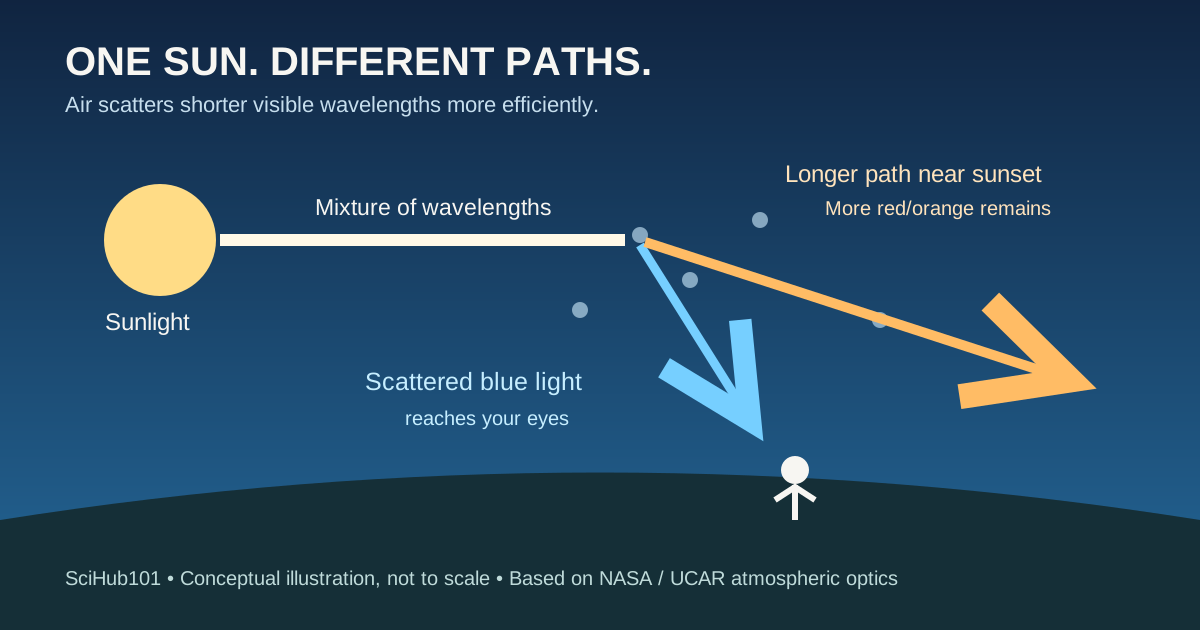
- Sunrise and sunset. When the sun is low, its light crosses a much longer path through the atmosphere. More of the short wavelengths are scattered out of the direct beam, leaving oranges and reds.
- Polarization. Light scattered at 90 degrees is strongly polarized. That is why a polarizing filter on a camera darkens the sky most at right angles to the sun, and why some insects, notably bees and desert ants, can use sky polarization to navigate.
Real skies never reach the 100 per cent polarization of an ideal Rayleigh scatterer. Multiple scattering, reflection from the ground, and aerosols all reduce it, and the anisotropy of nitrogen and oxygen molecules caps it below complete polarization even in perfectly clean air.
Why the sky is not violet
If scattering keeps increasing toward shorter wavelengths, why isn't the sky violet? Several effects combine:
- The solar spectrum. Sunlight arriving at the top of the atmosphere carries less energy in the violet than in the blue, so there is less violet available to scatter.
- Human vision. The eye's three cone types respond to the scattered mixture of wavelengths, not to a single wavelength. The combined spectrum of skylight stimulates the cones in a way the brain reads as sky blue, and the eye's sensitivity falls off toward the violet end.
- Ozone at twilight. Ozone absorbs weakly across the orange-red part of the visible spectrum in the Chappuis bands. After sunset, when sunlight takes a long, grazing route through the ozone layer, this absorption helps keep the zenith sky blue instead of grey. The American physicist Edward Hulburt pointed this out in 1953.
A common misconception is that the sky is blue because air is blue in the way a dye is coloured, or because the sky reflects the ocean. Neither is true. Air absorbs very little visible light, and the sky is just as blue over deserts as over seas.
Small particles, large particles, and white clouds
Tyndall's growing clouds illustrated a principle that later theory made exact. When particles are much smaller than the wavelength, Rayleigh's law holds and blue dominates. When particles approach and exceed the wavelength, scattering becomes much less dependent on colour, and most of it goes forward. In 1908 the German physicist Gustav Mie published a complete solution of Maxwell's equations for scattering by a sphere of any size. Mie theory covers everything from Tyndall's newborn blue cloud to fog droplets.
Cloud droplets are typically several to tens of micrometres across, far larger than the wavelength of visible light. They scatter all colours about equally, so clouds look white — or grey when they are thick enough to shade their own bases. Haze from fine pollution or volcanic aerosol whitens the sky for the same reason. On Mars, fine reddish dust makes the daytime sky look butterscotch, while sunsets there appear bluish near the sun because the dust scatters blue light in the forward direction. NASA rovers have photographed those blue Martian sunsets.
The Tyndall effect today
In chemistry teaching, the "Tyndall effect" means the visible scattering of a light beam by a colloid. Shine a laser pointer through a glass of salt water and you see little or nothing; shine it through diluted milk or a gelatin sol and the beam's track is visible. The test separates true solutions, where solute particles are molecular in size, from colloids, where dispersed particles range up to roughly a micrometre.
The same physics appears in many instruments:
- Nephelometers and turbidimeters measure light scattered at an angle from a beam to estimate how many particles are suspended in water or air. Water-quality turbidity is commonly reported in nephelometric turbidity units (NTU).
- Ultramicroscopes, developed by Richard Zsigmondy and Henry Siedentopf in 1902–03, light colloidal particles from the side so that each appears as a point of scattered light against a dark field, even when it is too small to resolve. Zsigmondy won the 1925 Nobel Prize in Chemistry for work on colloids.
- Dynamic light scattering instruments measure fluctuations in light scattered by nanoparticles or proteins to infer their sizes.
- Lidar systems send laser pulses into the atmosphere and time the light scattered back by molecules and aerosols to map dust, smoke and cloud layers.
Visual examples are everywhere. Crepuscular rays through a forest, a car headlight beam in fog, and the visible beam of a projector in a dusty room all show scattered light. The blue tint of thin smoke against a dark background and the yellow-brown look of the same smoke against a bright sky are the sideways-scattered and transmitted halves of Tyndall's experiment.
Recreating the experiment at home
A simple version needs a clear container of water, a little milk, and a flashlight. Add a few drops of milk to a litre of water and stir. Shine the flashlight through the side in a dark room. Looking from the side, the water has a faint bluish tint; looking through the water toward the light, the beam looks yellowish or orange. Add more milk and the bluish tint gives way to white, just as Tyndall's clouds whitened as their particles grew.
A polarizing sunglass lens adds the second half of the result. Look at the beam from the side and rotate the lens; at some angle, the scattered light will dim noticeably. Milk fat droplets are fairly large, so this home version is much less pure than Tyndall's, but the trend is clear. Read alongside our explainer on why the sky is blue, it shows how much of atmospheric optics fits in a kitchen.
How the experiment fits the history of optics
Tyndall's work came just after James Clerk Maxwell published his electromagnetic theory of light in the 1860s, and before Heinrich Hertz confirmed it with radio waves in the late 1880s. Rayleigh's first derivation did not depend on Maxwell's equations; he used an elastic-solid model of the luminiferous ether. Later he showed that the electromagnetic theory gives the same 1/λ⁴ result. The ether itself would be challenged by the Michelson-Morley experiment in 1887.
It also links to the wave theory of light established by Thomas Young's double-slit work and by Fresnel. Scattering only makes sense once light is understood as a wave with a definite wavelength; a particle picture of the kind Newton favoured has no natural reason for blue to scatter more than red.
The takeaway
Tyndall's actinic-cloud experiment made the sky portable. By creating particles from nothing inside a beam of light and watching them grow, he showed that colour and polarization of scattered light depend on particle size relative to wavelength, and that the newborn, smallest particles reproduce both the blue and the polarization of skylight. His belief that floating particles colour the real sky was later refined by Rayleigh's 1/λ⁴ law and by the fluctuation theory of Smoluchowski and Einstein, which put the molecules of air themselves at the centre. Even so, his methods — the beam as a particle detector, optically empty air, the careful control of what enters a tube — spread into chemistry, microbiology and atmospheric science, and his name still labels the glowing track of a light beam through a colloid.
Frequently Asked Questions
Q: What exactly did Tyndall put in his tube? A: He filled an evacuated glass tube with purified air carrying a small amount of a volatile compound — amyl nitrite was one he used — and sent a concentrated electric-lamp beam through it. Light decomposed the vapour, and the products condensed into particles that started far smaller than a wavelength and then grew.
Q: Did Tyndall prove that air molecules make the sky blue? A: No. He attributed the colour to fine suspended particles. Rayleigh's 1871 theory gave the 1/λ⁴ law, Rayleigh argued in 1899 that air molecules alone could produce the blue, and Smoluchowski (1908) and Einstein (1910) explained the scattering through density fluctuations.
Q: Why did the blue cloud turn white? A: As particles grew to sizes comparable with and larger than visible wavelengths, scattering stopped favouring short wavelengths. Large particles scatter all colours about equally, so the cloud whitened and its polarization weakened.
Q: How much more is blue scattered than red? A: Under Rayleigh's law, light near 450 nanometres is scattered roughly six times more than light near 700 nanometres, and violet near 400 nanometres about nine times more.
Q: What is the difference between the Tyndall effect and Rayleigh scattering? A: Rayleigh scattering is the specific law for scatterers much smaller than the wavelength. The Tyndall effect is the broader, practical term for a light beam becoming visible as it passes through a colloid or particle-laden gas, which can include both small-particle and larger-particle scattering.
Q: Why is the sky dark from space or at very high altitude? A: Scattering needs something to scatter from. With little or no air above you, there is almost nothing to send sunlight toward your eye from other directions, so the sky looks dark even with the sun shining.
Q: Did Tyndall's experiment matter outside optics? A: Yes. The idea of optically empty, dust-free air helped him support Pasteur's case against spontaneous generation, and his work with resistant bacterial spores led to the repeated-heating method known as tyndallization.
Sources
- Tyndall, J. (1869). "On the Blue Colour of the Sky, the Polarization of Skylight, and on the Polarization of Light by Cloudy Matter generally." Proceedings of the Royal Society of London, 17 (received 16 December 1868).
- Strutt, J. W. (Lord Rayleigh) (1871). "On the light from the sky, its polarization and colour." Philosophical Magazine, 41; reprinted in Rayleigh, Scientific Papers, vol. 1, Cambridge University Press.
- Rayleigh (1899). "On the transmission of light through an atmosphere containing small particles in suspension, and on the origin of the blue of the sky." Philosophical Magazine, 47.
- Einstein, A. (1910). "Theorie der Opaleszenz von homogenen Flüssigkeiten und Flüssigkeitsgemischen in der Nähe des kritischen Zustandes." Annalen der Physik, 33.
- Hulburt, E. O. (1953). "Explanation of the Brightness and Color of the Sky, Particularly the Twilight Sky." Journal of the Optical Society of America, 43.
- Royal Society Archive, letter from John Tyndall to Sir John Herschel, December 1868 (HS/17/413).
- "Professor Tyndall on the Chemistry of Light — New Experiments and Conclusions," reprinted via PubMed Central.
Read next:
Follow new articles
Add SciHub101 to your feed reader to see new science and technology stories.
About the Author
SciHub101 is an independent science and technology publication founded and edited by Buğra Sözeri, a software engineer and app developer based in Türkiye. AI tools assist with drafting and research. Source documentation in the existing archive is uneven, and articles are being reviewed and corrected. The Editorial Team byline identifies editorial responsibility; it does not certify specialist or independent human review. Where we compare products, anything built by our own team is labelled as such — see the editorial guidelines and About page for how corrections and disclosures work.
Related Articles
Why Is the Sky Blue? Scattering, Sunsets, and Perception
Why is the sky blue? Learn how air scatters sunlight, why sunsets turn red, and how dust and human color vision change the colors we see overhead.
How Rainbows Form — Light and Water Drops
Rainbows explained: refraction, dispersion, the 42° angle, secondary bows, Alexander's dark band, and supernumeraries. Discover how it works, why it...
Hess's Balloon Flights: How Cosmic Rays Were Found (1912)
In 1912 Victor Hess carried electroscopes to 5,350 m in a balloon and found radiation rising with height. Here is how the flights worked and what they proved.