How Rainbows Form — Light and Water Drops
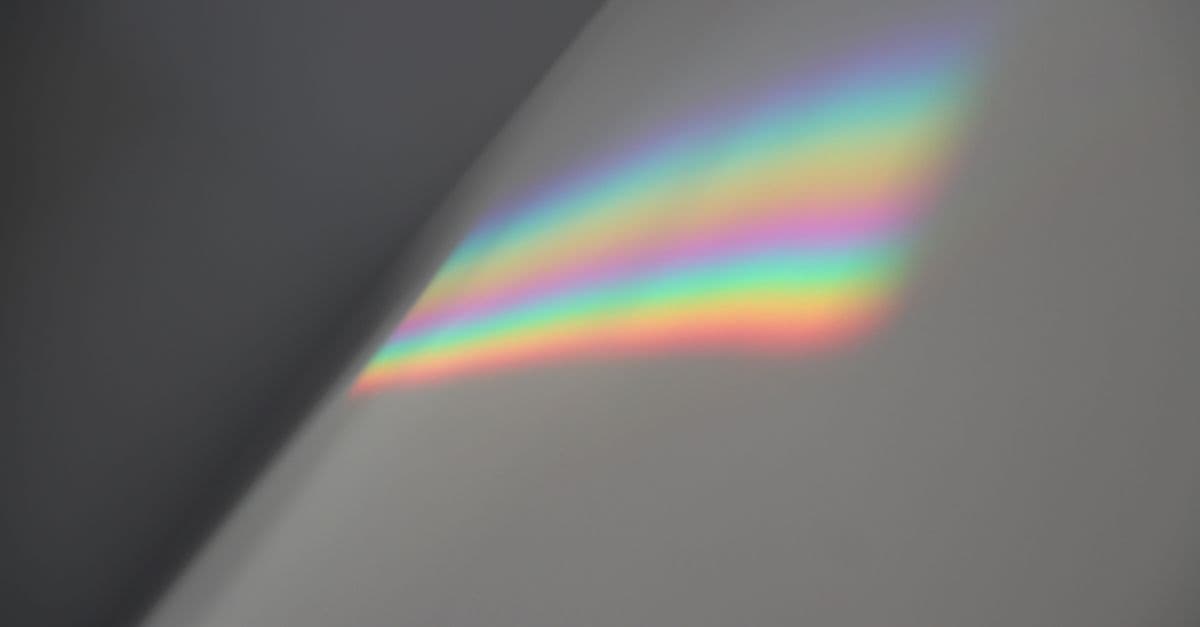
Photo: Klaus G / Pexels
A rainbow looks like a single object hanging in the sky, but it isn't one. It's an optical event, rebuilt fresh in your eyes every time you look, out of billions of individual water drops each acting as a tiny prism. Sunlight enters a drop, bends, bounces off the back wall, and bends again on the way out — and the exact geometry of that bounce, worked out mathematically by René Descartes in 1637, is why the bow always sits at 42 degrees from the point opposite the sun. Once you understand that one angle, nearly everything else about rainbows — why they're arcs, why a second bow sometimes appears with its colors flipped, why the sky is oddly dark between them — falls out as a direct consequence.
What a rainbow actually is
A rainbow is not a physical object with a location the way a tree or a building has a location. It's a pattern formed by millions of individual raindrops, each of which reflects sunlight back to your eye at one specific angle. Because every observer stands in a slightly different spot, every observer is looking at a different set of droplets — meaning, in a very literal optical sense, no two people ever see the same rainbow.
This distinction matters because it explains almost every counterintuitive thing about rainbows. You cannot walk toward one and get closer to it, because the rainbow you see is defined by your position relative to the sun and the droplets, not by any fixed point in space. As you walk, the droplets that were producing your rainbow stop cooperating, and a new set of droplets farther along takes over. The "end of the rainbow" recedes exactly as fast as you approach it, which is also the physical reason the leprechaun's pot of gold was always an impossible errand.
The formal explanation for the primary bow's shape came from René Descartes, who in 1637 used geometric ray-tracing through a spherical drop to show that the primary rainbow forms at close to 42 degrees and predicted a second, fainter bow near 52 degrees (Coffeeshop Physics, "The discovery of rainbows"). Descartes got the geometry essentially right, but he had no explanation for why the bow showed distinct colors — that piece came more than 40 years later.
Refraction and dispersion: the two tricks inside a drop
Every water drop that contributes to a rainbow performs the same three-step optical trick on a beam of sunlight passing through it.
- Refraction at entry. The light ray crosses from air, which has a refractive index of about 1.00, into water, which has a refractive index of roughly 1.33. Crossing that boundary slows the light down and bends its path. Because the amount of bending depends slightly on wavelength — a phenomenon called dispersion — violet light (short wavelength) bends more sharply than red light (long wavelength) at this first surface.
- Internal reflection at the back wall. The ray crosses the inside of the spherical droplet and reflects off the curved back surface, much like light bouncing off the silvered back of a mirror, except the "mirror" here is simply the boundary between water and air, and only a fraction of the light reflects — most continues straight through and is lost to the rainbow.
- Refraction again at exit. As the ray leaves the drop back into air, it bends a second time, and that second bending stretches the color separation further apart.
The result is that a single beam of white sunlight goes into the drop and comes out as a fan of separated colors, spread across roughly 2 degrees of angle. That's a small spread for one droplet, but multiplied across the billions of droplets in a shower, all oriented at slightly different angles relative to you, it becomes the wide band you see.
Why doesn't every drop send light straight at you?
Most of the light entering a raindrop refracts, reflects once, and exits at a huge range of possible angles depending on exactly where the ray struck the drop's surface. But geometric optics shows that rays entering near a specific "critical" zone of the drop's edge all bunch up and exit clustered around one particular angle — called the rainbow angle or the angle of minimum deviation. Because so many rays converge on nearly the same exit angle, the light intensity spikes sharply there and drops off elsewhere. That bright spike at one specific angle, and nowhere else, is what makes a rainbow a crisp band instead of a smear of dim, evenly distributed light.
The 42-degree angle
For the primary rainbow, the brightest exit angle sits at about 42 degrees measured from the antisolar point — the spot directly opposite the sun, marked by the shadow of your own head if you're standing in a field with the sun behind you. Red light concentrates at roughly 42.4 degrees; violet at roughly 40.6 degrees, with orange, yellow, green, and blue occupying the angles between them (The STEM Professor, "Refraction and the Formation of Rainbows").
Because every droplet sitting at that same 42-degree angle from the antisolar point sends red light toward your eye, and every droplet at a slightly tighter angle sends violet, you see a continuous ring of color rather than a scattered mess. The order is fixed by physics, not convention: red on the outside of the primary bow, violet on the inside, with orange, yellow, green, and blue arranged between them in that order every single time.
This single fact — that the rainbow angle is fixed by the refractive index of water, not by the distance to the rain — is why a rainbow always appears to be the same angular size in the sky no matter how far away the shower producing it happens to be. A rain shower 200 meters away and a rain shower 5 kilometers away both produce a bow at 42 degrees; only the apparent brightness and crispness change with distance, not the geometry.
Why is the sun always at your back for a rainbow?
Because the rainbow angle is measured from the antisolar point, the sun has to be behind you (below 42 degrees of elevation) for a bow to appear in front of you. If the sun is directly overhead, the antisolar point is straight down, below the horizon, and no rainbow can form no matter how much it's raining. That's why rainbows cluster around early morning and late afternoon, when the sun sits low in the sky.
The secondary rainbow
Look carefully above a bright primary rainbow and you'll sometimes spot a second, fainter arc with its colors flipped — violet on the outside this time, red on the inside. This is the secondary rainbow, and it comes from light that reflects twice inside each droplet instead of once, before finally exiting toward your eye. Descartes' original ray-tracing predicted this second bow at close to 51 to 52 degrees from the antisolar point, a prediction later confirmed with more precise instruments (arXiv, "Rainbow Formation: From Descartes to Venus," A.D. Zaikin).
The extra bounce inside the drop does two things: it inverts the order of the colors, and it throws away a larger fraction of the light at each internal reflection, so less of the original beam survives to reach your eye. That's why the secondary bow is consistently dimmer and thinner-looking than the primary — typically estimated at around 40% as bright — and why it disappears first as a shower thins out, even though both bows are being produced by the exact same droplets at the exact same moment.
Tertiary and quaternary rainbows: the ones almost nobody sees
Three internal reflections produce a tertiary rainbow, and four produce a quaternary rainbow, but both exit the droplet facing back toward the sun rather than away from it, so an observer has to be looking almost directly at the sun — through bright glare — to catch them. That geometric problem, combined with how much light is lost at each additional bounce, made these bows so rare that only about five credible sightings were reported across 250 years of recorded observation before photography caught up with the physics.
That changed on May 15, 2011, when photographer Michael Großmann captured the first confirmed photograph of a natural tertiary rainbow near Kämpfelbach in southwestern Germany, using a specially filtered camera pointed toward the sun to cut the glare. Researchers analyzing his images also identified what they believe is the first photographic record of a natural quaternary rainbow in the same event, and the findings were significant enough that the journal Applied Optics devoted a special September 2011 issue to them (ScienceDaily, "Triple rainbows exist, photo evidence shows"; EarthSky, "Triple and quadruple rainbows in 1st-ever photos").
Alexander's dark band
Between the primary and secondary rainbows sits a noticeably darker strip of sky, wedged between roughly 42 and 51 degrees from the antisolar point. This gap is named Alexander's band, after Alexander of Aphrodisias, who described the effect around 200 CE. Inside the primary bow, droplets scatter light of every color back toward your eye at once, which sums to a bright, near-white glow. Outside the secondary bow, a similar overlap of scattered light keeps the sky reasonably bright. But in the narrow gap between the two bows, the geometry of both the single-reflection and double-reflection rays sends almost no light your way, so that strip of sky reads noticeably darker than the sky on either side of it. Once someone points Alexander's band out to you in a photograph of a double rainbow, it becomes impossible to miss again.
Supernumerary rainbows
Look just inside the violet edge of a bright, crisp primary rainbow and you may notice one or more extra pastel bands — soft pink and green fringes that repeat a few times before fading. These are supernumerary rainbows, and geometric ray-tracing alone cannot explain them. They come from wave interference: two light rays that enter a droplet at slightly different points travel slightly different path lengths through the drop, and when they exit close together, they can reinforce each other (making a bright band) or cancel each other out (making a dark gap), producing the repeating pastel fringes.
Supernumeraries only show up clearly when the droplets producing the bow are small — roughly 1 millimeter or less — and fairly uniform in size, conditions more common in light drizzle or fine mist than in a heavy downpour with a wide range of drop sizes. Because supernumeraries can only be explained by treating light as a wave rather than a simple ray, early 19th-century physicist Thomas Young cited them as observational support for the wave theory of light in his 1804 Bakerian Lecture, at a time when the particle theory of light still had serious defenders.
Why rainbows are arcs, and sometimes full circles
Geometrically, a rainbow is a cone of light with its point at the antisolar point and the observer's eye at the apex looking out along the cone's surface. Where that cone intersects your field of view, it traces out a full circle 42 degrees in radius. On the ground, the horizon almost always slices through the bottom of that circle, leaving you the familiar arc.
Get above the horizon that's normally cutting the circle off — from an airplane window, a tall building, or a mountaintop, with rain falling in the valley below and the sun at your back — and the full 360-degree circular rainbow becomes visible, uninterrupted by any horizon line. It's the same physics, just an unobstructed view of the entire cone instead of the bottom half.
The height of the sun controls how much of that circle can appear above the horizon at all. As the sun climbs higher in the sky, the antisolar point sinks lower below the horizon, and the visible arc shrinks. Once the sun rises above 42 degrees of elevation, the entire rainbow drops below the horizon and becomes physically impossible to see from the ground — which is the real reason rainbows are essentially never seen around local solar noon in summer, and why they cluster in the low-sun hours of morning and late afternoon instead.
Reflection rainbows and twinned rainbows
Two rarer variants are worth knowing because they're easy to mistake for camera artifacts. A reflection rainbow forms when sunlight bounces off a lake or other still body of water before striking raindrops, producing a second, usually fainter bow that arcs upward from a different geometric center than the primary — it isn't simply the primary bow's reflection in the water, but a genuinely separate bow built from reflected sunlight. A twinned rainbow, by contrast, shows two primary bows sharing the same base but splitting apart higher up, caused by two rain showers with slightly different drop-size distributions sitting along the same line of sight, each producing a marginally different rainbow angle.
Moonbows
A moonbow is the same optical event as a daytime rainbow, produced by moonlight instead of sunlight, and it obeys exactly the same 42-degree geometry. The practical difference is brightness: moonlight reaching the ground is only a small fraction of full daylight, so the light scattered back by raindrops during a moonbow is far too dim for human color vision (which needs relatively bright light to distinguish hues) to register any color at all. To the naked eye a moonbow almost always looks pale white or silvery-grey. Point a camera at it and use a long exposure, though, and the sensor collects enough light over time to reveal the full spectrum, which is why nearly every photograph of a moonbow shows vivid color that the photographer swears they didn't actually see standing there. Moonbows are most commonly reported near waterfalls with heavy, persistent spray — Victoria Falls and Cumberland Falls in Kentucky are both well-documented moonbow sites — because a waterfall guarantees a steady curtain of droplets even on a clear, rain-free night around the full moon.
Fogbows: the "white rainbow"
A fogbow, sometimes called a white rainbow, forms through the same basic entry-reflect-exit path inside a droplet, but with fog or mist droplets that are dramatically smaller than raindrops — typically under 0.05 millimeters across, compared with roughly 0.5 millimeters or more for a typical raindrop that produces a colored bow (Atmospheric Optics, "Fogbow"). At that small size, diffraction — the bending and spreading of light waves around an obstacle roughly their own size — becomes a major factor alongside refraction, and it smears the different color bands so heavily that they overlap almost completely. The result reads to the eye as a broad, mostly white or pale-tinted arc rather than a crisp spectrum, sometimes with a faint bluish tinge on the outer edge and a faint reddish-brown tinge on the inner edge if you look closely.
Fogbows are common around ships at sea, in mountain fog banks, and in the fine spray thrown up by waterfalls, and they're frequently mistaken by casual observers for a strange lighting effect or a camera glitch rather than a legitimate, physically distinct relative of the ordinary rainbow.
No two people see the same rainbow
Because a rainbow depends on the specific geometric relationship between the observer, each individual droplet, and the sun, two people standing even a meter apart are technically looking at light reflected from two overlapping but non-identical sets of droplets. Move your head a few centimeters and, strictly speaking, you are looking at a slightly different rainbow than you were a moment ago, built from a slightly different population of drops. In that narrow but real optical sense, every rainbow anyone has ever seen has been theirs alone — nobody else, not even someone standing shoulder to shoulder with them, has ever seen precisely that arc.
How rainbows compare to other sky optics
Table: Rainbows and their optical relatives
| Phenomenon | Cause | Position in sky | Colors | Typical conditions |
|---|---|---|---|---|
| Primary rainbow | Refraction plus one internal reflection in water drops | 42° from the antisolar point | Full spectrum, red outside | Sun behind observer, rain shower ahead |
| Secondary rainbow | Two internal reflections | 51° from the antisolar point | Reversed order, red inside | Bright, well-lit primary bow conditions |
| Tertiary / quaternary rainbow | Three or four internal reflections | Near the sun, facing it | Very faint spectrum | Extremely rare; needs solar glare shielding |
| Supernumerary bows | Wave interference between drop rays | Just inside the primary bow | Pastel pink and green fringes | Small, uniform droplets, light drizzle or mist |
| Fogbow | Same reflection path, much smaller droplets | 42° from the antisolar point | Mostly white, faint edge tints | Fog, mist, or waterfall spray |
| Moonbow | Same optics as a rainbow, moonlight source | 42° from the anti-lunar point | Faint, usually appears white | Bright moon plus rain or waterfall spray |
| 22° halo | Refraction through hexagonal ice crystals | Ring around the sun or moon | Faint, reddish on inner edge | High cirrus clouds, ice crystals |
| Sun dogs (parhelia) | Refraction through flat hexagonal ice plates | 22° to either side of the sun | Red toward sun, blue away from it | Low sun plus cirrus ice clouds |
| Glory | Backscatter and diffraction from tiny droplets | Rings around the antisolar point | Concentric colored rings | Observer above cloud or fog, sun behind |
The dividing line worth remembering: rainbows, secondary bows, fogbows, and moonbows all require liquid water droplets and light coming from behind the observer. Halos and sun dogs require ice crystals instead of liquid water, and they form in a ring around the sun rather than opposite it — a genuinely different mechanism that just happens to also produce colored arcs in the sky. Glories require the observer to be positioned above the cloud or fog layer, looking down at their own shadow, which is why they're most often reported from airplane windows and mountain summits rather than from the ground.
What people get wrong about rainbows
"The rainbow is a physical thing sitting at a location." It isn't. It's a direction-dependent pattern rebuilt continuously from whichever droplets happen to sit at the right angle relative to your eye and the sun at that instant. Nothing is "there" in the sense that a cloud or a building is there.
"Newton discovered rainbow colors." Newton explained why white light splits into color using prisms and dispersion, but Descartes had already worked out the 42-degree geometry decades earlier, in 1637, without being able to explain color at all. Rainbow science is a layered achievement built by more than one person over more than a century.
"A rainbow has exactly seven colors." A rainbow's spectrum is continuous — an unbroken gradient with no natural boundaries between shades. Newton settled on seven named bands (red, orange, yellow, green, blue, indigo, violet) partly to draw an analogy with the seven notes of a musical scale, a cultural and pedagogical choice rather than a discovery about where nature actually draws lines.
"Rainbows only happen with actual rain." Any suspended or falling water droplets in the right geometric position work: garden hose spray, waterfall mist, ocean surf, even the fine droplets kicked up by a lawn sprinkler on a sunny afternoon can all produce a small, close rainbow if the sun angle and droplet size cooperate.
"You could theoretically walk to the end of a rainbow if you were fast enough." Speed is irrelevant. The rainbow's position is defined relative to your own eye and the sun, not fixed in the landscape, so it recedes as you advance regardless of how quickly you move. There is no finish line to reach.
FAQs
Q: Can I ever reach the end of a rainbow? A: No. The rainbow you see is produced by droplets at a specific angle relative to your own eye and the sun, so as you move, a completely new set of droplets takes over the job. There is no fixed spot to walk toward.
Q: Why is red on the outside of the primary rainbow but on the inside of the secondary rainbow? A: The secondary bow involves an extra internal reflection inside each droplet, and that additional bounce inverts the geometry of how each color exits the drop, flipping the color order compared with the primary bow.
Q: Are there ever third or fourth rainbows? A: Yes. Tertiary (three internal reflections) and quaternary (four internal reflections) rainbows exist, but they form facing toward the sun rather than away from it, making them extremely hard to see through solar glare. The first confirmed photographs of both were only captured in 2011, in Germany.
Q: Why is the sky noticeably brighter inside a primary rainbow than outside it? A: Inside the primary bow's arc, droplets scatter light of every wavelength back toward the observer simultaneously, which sums to a bright, near-white glow. Outside the arc, the geometry sends very little light back toward the eye, so the sky looks comparatively dim.
Q: Can rainbows form in fog, mist, or spray rather than rain? A: Yes. Fogbows form in fog or mist and appear mostly white because the tiny droplets cause heavy diffraction that smears the colors together, while spraybows form from waterfall mist, garden hoses, and ocean surf and can show full color if the droplets are large enough.
Q: How many colors does a rainbow actually contain? A: A continuous spectrum with infinitely many gradations, not a fixed count. Newton grouped it into seven named bands (red, orange, yellow, green, blue, indigo, violet) largely for a cultural analogy with the seven notes of a musical scale, not because nature draws seven distinct boundaries.
Q: What is a moonbow, and why does it usually look white? A: A moonbow is a rainbow produced by moonlight instead of sunlight, following identical 42-degree geometry. Because moonlight is far dimmer than sunlight, the human eye's color vision generally can't register hue at that brightness, so moonbows usually appear pale white or silvery, though long-exposure photographs reveal full color.
Q: What causes the dark band between the primary and secondary rainbow? A: Called Alexander's dark band, it's the region between about 42 and 51 degrees from the antisolar point where neither the single-reflection geometry of the primary bow nor the double-reflection geometry of the secondary bow sends significant light back toward the observer, so that strip of sky reads darker than the sky on either side.
Q: Do rainbows require rain specifically, or just water droplets? A: Any liquid water droplets suspended or falling in the right position relative to the sun and the observer can produce a rainbow, including waterfall spray, ocean surf, garden hose mist, and lawn sprinkler droplets, not only falling rain.
Q: Why can't you see a rainbow around midday in summer? A: The rainbow's antisolar point sits directly opposite the sun, and once the sun climbs above roughly 42 degrees of elevation, that point falls below the horizon, taking the entire rainbow with it. That's why rainbows cluster in the low-sun hours of early morning and late afternoon.
The takeaway
A rainbow is what happens when a huge number of otherwise unremarkable water droplets, each doing nothing more exotic than refracting and reflecting light, happen to line up geometrically so that one wavelength at a time converges toward your eye at one specific angle. Descartes worked out that geometry with nothing but a spherical glass model and careful reasoning in 1637, and Newton supplied the missing piece about color decades later — between them, they turned a sight people had mythologized for millennia into predictable, testable physics. The secondary bow, Alexander's dark band, supernumeraries, fogbows, and moonbows are all just variations on that same 42-degree trick, produced by drops of a different size, a different number of internal bounces, or a dimmer light source. Once you know where to look, you start noticing all of them.
Read next:
Follow new articles
Add SciHub101 to your feed reader to see new science and technology stories.
About the Author
SciHub101 is an independent science and technology publication founded and edited by Buğra Sözeri, a software engineer and app developer based in Türkiye. AI tools assist with drafting and research. Source documentation in the existing archive is uneven, and articles are being reviewed and corrected. The Editorial Team byline identifies editorial responsibility; it does not certify specialist or independent human review. Where we compare products, anything built by our own team is labelled as such — see the editorial guidelines and About page for how corrections and disclosures work.
Related Articles
Supermassive Black Holes — Galactic Engines
Supermassive black holes anchor galaxies, power quasars, and shape cosmic evolution. From Sgr A* to M87*, here's what we know — and what we don't.
How Magnetism Works — From Atoms to Earth
How magnetism works: electron spin, magnetic domains, ferromagnetism, Earth's geodynamo, animal navigation, and MRI, explained mechanism by mechanism.

Why Is Glass Transparent? The Physics of Light Passing Through
Glass is transparent because visible photons lack the energy to excite its electrons and its uniform, grain-free structure scatters almost nothing sideways.
How Mirrors Work — The Physics of Reflection
Mirrors don't actually flip left and right — they flip front to back. The physics of reflection, from bronze polish to the 39-meter ELT telescope.
Why Is the Sky Blue? Scattering, Sunsets, and Perception
Why is the sky blue? Learn how air scatters sunlight, why sunsets turn red, and how dust and human color vision change the colors we see overhead.
Newton's Prism: White Light is Many Colors Combined
In 1666, Isaac Newton used prisms to split white sunlight into its component colors and recombined them into white again. The experiments changed how we think about light and color.