Newton's Prism: White Light is Many Colors Combined
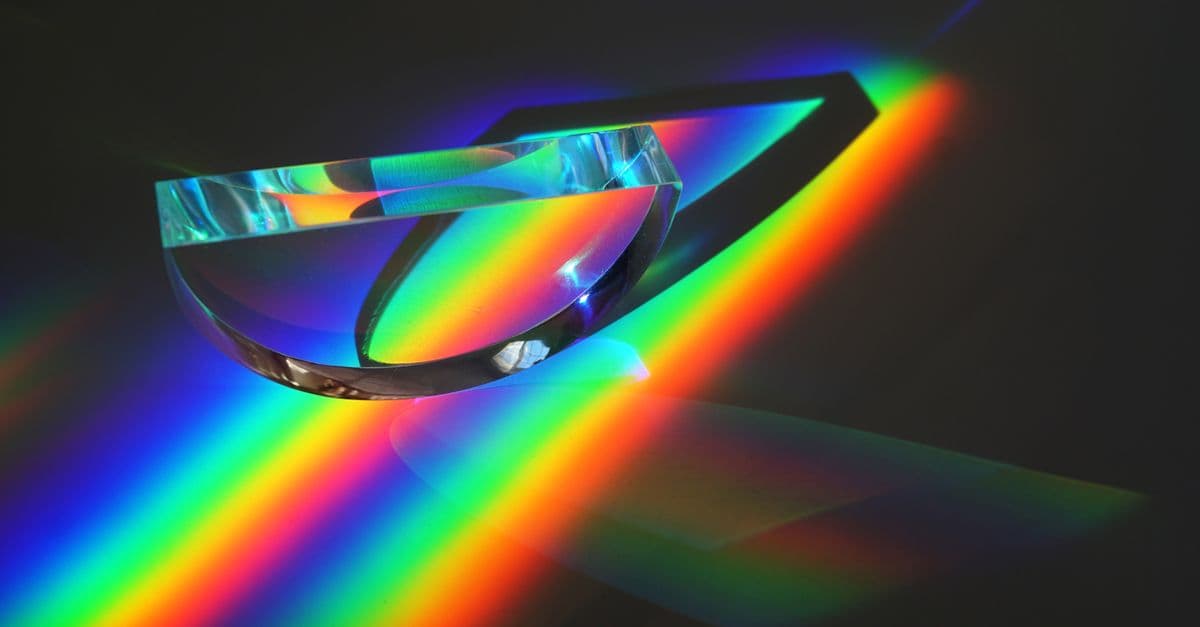
Photo: Nancy Zjaba / Pexels
In 1666, with Cambridge closed by the Great Plague, Isaac Newton worked at his family home at Woolsthorpe in Lincolnshire and noticed that the band of color a prism throws on a wall is the wrong shape. Chasing that small oddity led him to a large conclusion. White light is not simple. It is a mixture of colors, and a prism does not create those colors but sorts them.
What people believed before Newton
Before Newton, the dominant account of color was a modification theory with roots in Aristotle. White light was pure and simple, and color was something that happened to it when it passed through glass, water, or a dyed surface. A prism, on this view, stained the light the way a stained-glass window does. The appeal is obvious. Hold a glass to the sun and colors appear, so it seems natural to credit the glass.
The view had real staying power. As late as 1810, Johann Wolfgang von Goethe defended an Aristotelian view of color in his Theory of Colours, in open opposition to Newton. The disagreement was not about whether prisms produce colors on a wall. It was about what that fact means.
Newton's strategy was to test the modification theory directly. If the glass adds color to white light, then sending already-colored light through a second prism should add more. And if the colors are already in the white light, a prism should only be separating them, and some other optical element should be able to put them back together.
The puzzle of the oblong image
The first experiment was not new. Newton darkened a room, made a small hole in the window shutter, and let a narrow beam of sunlight pass through a glass prism onto the opposite wall. The result was the familiar band of colors.
What caught his attention was its shape. The law of refraction, known since the early 17th century, predicted that sunlight coming from a disc about half a degree wide should form a roughly circular patch after passing through the prism. Instead, the image was strongly elongated. In Opticks, Newton reports a spectrum about ten inches long and roughly two inches wide, which he summarizes as "about five times longer than broad" (Book I, Part I, Proposition II, Experiment 3). A prism that merely bent light as a block of glass should have produced something close to round.
Standard biographical accounts record that in 1666 he observed that a prism's spectrum at minimum deviation is oblong, and concluded that color is intrinsic to light. For the narrow task of explaining the oblong shape, the simplest hypothesis was that the beam contains rays that the glass bends by different amounts. That is a hypothesis, not a proof, and Newton knew it. The proof came from a pair of experiments that were designed to fail if he was wrong.
The experiment that isolates a color
The experiment Newton called the experimentum crucis, the crucial experiment, is described in Opticks as Experiment 6 of the second proposition in Book I. The phrase itself was coined by Robert Hooke.
The setup is a chain of three steps:
- First prism. Sunlight through the shutter hole passes through a prism and spreads into a spectrum on a board.
- First board. A small hole in that board lets only a narrow slice of the spectrum through, say the red or the blue end. Newton could pick the slice by turning the first prism a little.
- Second prism and second board. The selected beam goes through a second prism, and a second board with a hole behind it lets him measure where each color lands.
The outcome was clear. The light from the blue end of the first spectrum "was again more refracted in the second Prism than the Light which went to the red end," in Newton's words, and, crucially, each selected beam stayed the same color. A single color going through a second prism did not fan out into more colors. Red stayed red and blue stayed blue, each bent by its own fixed amount.
This is why the experiment is "crucial." The modification theory predicts that more glass should do more staining. Newton's result says the opposite: once the colors are separated, further passage through glass changes nothing about them except their direction. The prism had not made the colors. It had pulled apart what was already there.
Putting white light back together
Taking something apart does not prove it was once whole. Newton therefore also ran the reverse. In Experiment 10 (in the proposition on compounding whiteness), he placed a lens in the path of the spread-out colors and brought them to a focus on a sheet of paper. There, he reports, "the whole Light appear[s] now upon the Paper like a little white Circle," and the whiteness "is composed of the converging Colours." When he intercepted some of the colors, the whiteness disappeared, and letting them through again brought it back. Other experiments used a second prism, or two prisms together, to make the diverging colors meet again and "compound white."
This second half of the argument is easy to miss and just as important. A prism that stained light could not be reversed by a lens. Newton's lens restores the original white light because the colors were all there to begin with.
From these experiments he drew two statements, both in Opticks, that capture the whole argument:
"If the Sun's Light consisted of but one sort of Rays, there would be but one Colour in the whole World."
"The whiteness of the Sun's Light is compounded of all the primary Colours mix'd in a due Proportion."
Neither sentence says the prism does anything exotic. Both say that sunlight has structure.
What "refrangibility" means
Newton needed a word for the property that tells one color's ray from another's, and he chose refrangibility: the degree to which a ray bends when it crosses from air into glass. Red rays were the least refrangible and violet the most. Everything about the spectrum follows from this one fact. Each color bends by its own amount, so a beam of mixed colors spreads out like runners separating on a track, and the spread is what makes the long, oblong image.
Newton added a point that still surprises students. In the definitions after Proposition II, he wrote: "For the Rays to speak properly are not coloured." In them, he says, there is nothing but a certain power and disposition to stir up the sensation of a color in the observer. That is a sophisticated statement for 1704. It separates the physical property of the light, how much it bends, from the experience of seeing red or blue, which happens in the eye and brain.
What modern physics adds: dispersion and wavelength
Newton worked entirely in geometric optics, tracing rays rather than waves. He favored a corpuscular picture of light, in which light is made of particles, while his contemporary Christiaan Huygens favored waves. Neither picture was needed to explain the spectrum, and this is why the experiments held up when the theories of light changed.
In the modern account, Newton's refrangibility corresponds to wavelength. For visible light passing through most transparent materials, the refractive index decreases as wavelength increases, a behavior called normal dispersion. Blue light, with its shorter wavelength, therefore refracts more strongly than red. Glass bends light according to Snell's law, which relates the angle of the incoming ray to the angle inside the glass through the refractive index n. Because n differs slightly from color to color, the angles differ too.
A quick illustration, using made-up but glass-like numbers rather than measurements of a particular glass: light striking a flat glass surface at 45 degrees refracts to about 27.9 degrees if n is 1.51 and about 27.5 degrees if n is 1.53. A difference of 0.4 degrees at one surface looks tiny. A prism has two angled surfaces, the beam travels to a wall several meters away, and the small difference in angle grows into a band of colors that is easy to see.
| Color | Approximate wavelength (nm) | Approximate frequency (THz) | Bends |
|---|---|---|---|
| Violet | 380 to 450 | 670 to 790 | Most |
| Blue | 450 to 485 | 620 to 670 | More |
| Cyan | 485 to 500 | 600 to 620 | |
| Green | 500 to 565 | 530 to 600 | Middle |
| Yellow | 565 to 590 | 510 to 530 | |
| Orange | 590 to 625 | 480 to 510 | Less |
| Red | 625 to 750 | 400 to 480 | Least |
Source for the wavelength and frequency ranges: Wikipedia, "Visible spectrum." The bands are conventional and the spectrum is continuous.
Two later developments finished the job. In 1865, James Clerk Maxwell showed that light is an electromagnetic wave, which is how electricity, magnetism, and light became one subject, as the four fundamental forces article describes. And the idea that light comes in quanta, covered in What Is Light? Photons and Wave-Particle Duality, explained how light can behave as both wave and particle. Newton's observations needed no correction through any of these changes, only new explanations.
Why seven colors?
Ask a child to name the colors of the rainbow and you will probably hear the seven Newton listed in Opticks: red, orange, yellow, green, blue, indigo, violet. The count is partly a choice. The spectrum is continuous, and the bands in the table above are conventions. Newton himself divided the colored spectrum by analogy with music. In Proposition III, Experiment 7, he says the sides of the spectrum "were by the said cross Lines divided after the manner of a Musical Chord," matching color boundaries to the intervals of the octave.
Two cautions follow from the historical record. Reviews of Newton's color vocabulary suggest that his "indigo" corresponds to what we now call blue, and his "blue" to what we call cyan. And the human eye is relatively insensitive in the indigo range, so many people with normal color vision cannot pick out indigo as a separate band. Seven is a respectable teaching number, but nothing in nature insists on it.
The argument with Robert Hooke
Newton presented his work to the Royal Society in 1672, and the reception was rough. The paper sparked a bitter dispute with Robert Hooke over the corpuscular theory of light. Hooke favored a wave picture of light, and he had published a famous study of the microscopic world, Micrographia, in January 1665, which also touches on light. He was a formidable experimenter and not a person to concede a point quietly.
Newton was sensitive to criticism and responded sharply. The dispute is widely credited with making him reluctant to publish further on optics. He held back the full account until after Hooke's death on March 3, 1703. Opticks appeared in 1704, in English rather than Latin, which made it readable for an audience beyond university scholars. A Latin edition followed in 1706 for readers across Europe.
The story has a lesson that goes beyond Newton's temper. A crucial experiment, such as the two-prism test, can settle a narrow question while leaving the broader argument about the nature of light open. Both the particle and wave pictures could explain the spectrum. What the experiments excluded was a specific idea, that the prism manufactures color.
What Newton got wrong: the lens problem
Great experiments do not make their authors right about everything. Newton concluded that correcting chromatic aberration, the color fringing that lenses produce because different colors focus at different distances, was impossible. This is an understandable inference from a world in which all the glasses he tested seemed to spread colors in similar proportion. He built his first reflecting telescope in late 1668, a design that uses a curved mirror rather than a lens, and a mirror reflects all colors at the same angle, so it does not disperse light that way.
The belief that chromatic aberration could not be fixed shaped telescope building for decades and was debated through the 18th century. Chester Moor Hall, an English barrister and amateur optician, is often credited with the first achromatic doublet, a pairing of a crown glass lens and a more dispersive flint glass lens whose color errors cancel. He kept his work secret. John Dollond learned of the design and received a patent in 1758, leading to bitter disputes among opticians (Wikipedia, "Achromatic lens"). Newton's central discovery was untouched. The correction exploited the same fact, that glasses disperse light, by finding two glasses that disperse it differently.
From spectrum to spectroscopy
The spectrum Newton made was a bright smear, because he used a round hole. A narrower slit and better optics reveal something he could not see.
In 1802, William Hyde Wollaston first noticed dark features in the solar spectrum. In 1814, Joseph von Fraunhofer independently rediscovered them, mapped more than 570 lines, and labeled the most prominent with the letters A through K (Wikipedia, "Fraunhofer lines"). Nobody knew why the lines were there. In about 1859, Gustav Kirchhoff and Robert Bunsen found that several of the dark lines match the bright emission lines of heated elements, and concluded that elements in the Sun's atmosphere absorb those wavelengths. A flame spectrum became a chemical fingerprint, which is the story told in How the Spectroscope Revealed What Stars Are Made Of.
The most dramatic case is helium. On August 18, 1868, Jules Janssen saw a bright yellow line at about 587.5 nanometers in the Sun's chromosphere during a total eclipse in India. That October, Norman Lockyer saw a similar line and concluded it came from an unknown element, which he named helium for the Greek word for the Sun. William Ramsay isolated helium on Earth on March 26, 1895, 27 years after the solar observation (Wikipedia, "Helium"). An element was discovered in the sky before it was found on the ground.
The same principle now tells astronomers what stars are made of and how they move, which is the foundation of stellar classification. It all grows from the observation that light separated by color carries information.
Rainbows: nature's prism experiment
A rainbow is Newton's experiment performed by raindrops. Sunlight enters a water droplet, reflects once off the back, and leaves. Different colors leave at slightly different angles, and the light is most intense about 42 degrees from the antisolar point (the point directly opposite the Sun), with red on the outer edge of the arc and violet on the inner edge. A secondary bow forms about 10 degrees farther out, at roughly 50 to 53 degrees, from two reflections inside the drop. Its colors appear in reverse order, and the dark band of sky between the two bows is named Alexander's band.
René Descartes explained the geometry of the bows in 1637 and calculated their angles. His account did not explain the colors, which needed dispersion. Newton supplied that. For the full geometry, see How Rainbows Form. The pastel swirls on a soap film are a different mechanism, interference rather than dispersion, covered in Why Soap Bubbles Show Rainbow Colors.
Light beyond the spectrum
In 1800, William Herschel used a prism to split sunlight and placed thermometers in the different colors. The temperature rose most beyond the red end, where no light was visible. He called the invisible rays "calorific rays." The term infrared came later. The full story is told in Herschel's Infrared Discovery. The visible spectrum that Newton resolved turned out to be a narrow strip of a much wider electromagnetic spectrum.
Try it yourself
You do not need a darkroom or a Cambridge shutter. A glass prism, or a clear glass of water on a sunny windowsill, will show colors on a wall, although a prism is far easier to control. Four observations map directly onto Newton's findings:
| What you do | What you see | What it shows |
|---|---|---|
| Shine a narrow beam through a prism onto a wall | An elongated band of colors, not a round dot | Each color bends by a different amount |
| Block all but one color with a card with a slit, then send it through a second prism | The color stays the same and is only displaced | The prism does not create colors |
| Put a lens in the spread beam and move a white card back and forth | A bright, whitish spot where the colors converge | The colors recombine into white light |
| Mark where the beam would land with no prism, then compare red and violet | Violet lands farther from the unbent path than red | Violet is the most refrangible, red the least |
Never look directly at the Sun, and use a beam of sunlight reflected onto a wall or a screen. The point is the geometry on the wall, not the Sun itself.
Why the experiments were so convincing
It helps to look at the design rather than the result. Newton's work has three features that good experiments share, and they explain why a few pages of observations settled a question that centuries of argument had not.
It isolates one variable. In the two-board test, the only thing that changes between the first and second prism is which slice of the spectrum enters the second. If the colors were created by glass, the identity of that slice should not matter. It did. Each color behaved in its own fixed way, so the variable that mattered was the light, not the glass.
It is reversible. Most arguments about what a process does to an object are hard to settle because the process cannot be undone. Here it could. Splitting white light and then recombining it with a lens or a second prism is like taking a clock apart and rebuilding it to see whether it still keeps time. If the parts go back together and the clock runs, you were looking at the real parts.
It makes a risky prediction. The modification theory predicted that isolated colors would change again when they passed through more glass. Newton's alternative predicted that they would not. Only one of them could survive, and a prediction that can fail is worth more than one that cannot. This is the logic that the scientific method puts at its center.
The design also leaned on a simple, controllable apparatus: a dark room, a small hole, a prism, and two boards. Replicating it needed patience and a sunny day rather than a laboratory budget, which meant the result could, in principle, be checked by people who disliked it.
What people get wrong about Newton's prism
"The prism makes the colors." This is the belief Newton disproved. The prism changes the direction of each color by a different amount, and that separation is what you see.
"Mixing light is like mixing paint." It is not. Combining colored lights adds wavelengths, which is why red, green, and blue lights can make white on a screen. Mixing paints removes wavelengths, because pigments absorb part of the light that reaches them, so mixing many paints tends toward a dark, muddy color. The difference is explained in How Pigments Create Color in Paintings.
"Newton proved light is made of particles." He favored a particle model, but the prism results were consistent with waves too. The wave picture got strong support from Young's double-slit experiment in 1801, covered in Young's Double-Slit Experiment: Light as a Wave.
"There are exactly seven colors." There are infinitely many wavelengths between red and violet. Seven is a convention, and historians suggest Newton's own color names do not match ours.
"Newton's color work was fully accepted at once." It was not. It drew sharp criticism in 1672, and Goethe was still arguing against it in 1810.
FAQ
Q: What was Newton trying to prove with his prism experiment? A: Newton was testing whether the colors in refracted light came from the prism or from the light itself. His crucial experiment showed that a single color, isolated from the spectrum, passes through a second prism without changing color. Experiments with a lens or a second prism recombined the colors into white light, so the colors had been in white light all along.
Q: What does refrangibility mean? A: Refrangibility is Newton's term for how much a ray of light bends when it passes from air into glass. Red light is the least refrangible and violet the most. In modern terms it corresponds to wavelength: glass has a slightly different refractive index for each wavelength, a property called dispersion.
Q: Why did Newton name seven colors? A: He divided the spectrum by analogy with the divisions of a musical chord, in Proposition III, Experiment 7 of Opticks. The spectrum is continuous, so the number of named colors is a convention. Reviews of his terms suggest that his indigo corresponds to modern blue, and his blue to cyan.
Q: Did Newton's prism experiment prove that light is a wave or a particle? A: No. The results were consistent with both pictures. Newton preferred a corpuscular theory, in which light is made of particles, while Hooke and Huygens favored waves. Young's double-slit experiment in 1801 gave strong support to the wave picture, and later quantum theory showed that light has both wave and particle properties.
Q: How did Newton's theory differ from the modern one? A: His central conclusions have held up: white light is a mixture, each color has a fixed refrangibility, and prisms do not create color. What changed is the explanation. Modern physics treats light as an electromagnetic wave whose wavelength sets how much it bends in glass, and it separates the physical property from the sensation of color, an idea Newton already hinted at with "the Rays to speak properly are not coloured."
Q: How does Newton's prism connect to spectroscopy? A: Spreading light by wavelength is the basis of spectroscopy. Fraunhofer mapped more than 570 dark lines in the solar spectrum in 1814, and Kirchhoff and Bunsen explained around 1859 that they match the light absorbed by specific elements. Astronomers now use spectra to identify the composition and motion of stars.
The takeaway
Newton's prism experiments are a model of how to ask nature a question that can come out only one way. Instead of arguing about what glass does to light, he isolated a color, sent it through a second prism, and watched it refuse to change, then used a lens to put the whole spectrum back together. The result was a new picture of light as a structured mixture, and the same logic now powers every instrument that reads a star's chemistry from its colors. Newton was wrong about lenses and about some details of light itself, but the experiments did not depend on his theories, which is exactly why they outlasted them.
Sources
- Newton, I. (1704). Opticks: or, A Treatise of the Reflections, Refractions, Inflections and Colours of Light. London. Full text at Project Gutenberg. Quotations in this article come from Book I, Part I, Propositions II and V, and the experiments cited there.
- Newton, I. (1672). "A Letter of Mr. Isaac Newton... Containing His New Theory about Light and Colors." Philosophical Transactions of the Royal Society 6(80): 3075-3087.
- Wikipedia, "Opticks", for publication dates, the Hooke dispute, and Goethe's response.
- Wikipedia, "Visible spectrum" and "Rainbow", for wavelength ranges, rainbow angles, and the history of Newton's color names.
- Wikipedia, "Fraunhofer lines", "Helium", "Achromatic lens", and "Dispersion (optics)".
- Kirchhoff, G. and Bunsen, R. (1860). "Chemical Analysis by Spectrum-Observations." Philosophical Magazine 20(4): 89-109.
- Westfall, R.S. (1980). Never at Rest: A Biography of Isaac Newton. Cambridge University Press.
- Shapiro, A.E. (1993). Fits, Passions and Paroxysms. Cambridge University Press.
- Sepper, D.L. (1994). Newton's Optical Writings: A Guided Study. Rutgers University Press.
Read next:
Follow new articles
Add SciHub101 to your feed reader to see new science and technology stories.
About the Author
SciHub101 is an independent science and technology publication founded and edited by Buğra Sözeri, a software engineer and app developer based in Türkiye. AI tools assist with drafting and research. Source documentation in the existing archive is uneven, and articles are being reviewed and corrected. The Editorial Team byline identifies editorial responsibility; it does not certify specialist or independent human review. Where we compare products, anything built by our own team is labelled as such — see the editorial guidelines and About page for how corrections and disclosures work.
Related Articles
Faraday's Induction: From Magnets to Electricity
In 1831, Michael Faraday discovered that changing magnetic fields induce electric currents. This fundamental discovery enabled electric motors, generators, and transformed civilization.
Yutu-2 Rover Geological Findings: Exploring the Moon's Far Side
China's Yutu-2 rover explored the Moon's far side, discovering subsurface layers and geological features revealing the Moon's complex evolution.
Herschel's Infrared Discovery: Light Beyond What We See
In 1800, William Herschel used prisms and thermometers to discover infrared radiation, proving that visible light is just a tiny fraction of the spectrum. A revelatory experiment on the nature of light.
Why Is Glass Transparent? The Physics of Light Passing Through
Glass is transparent because visible photons lack the energy to excite its electrons and its uniform, grain-free structure scatters almost nothing sideways.
How Mirrors Work — The Physics of Reflection
Mirrors don't actually flip left and right — they flip front to back. The physics of reflection, from bronze polish to the 39-meter ELT telescope.
Why Is the Sky Blue? Scattering, Sunsets, and Perception
Why is the sky blue? Learn how air scatters sunlight, why sunsets turn red, and how dust and human color vision change the colors we see overhead.