Yutu-2 Rover Geological Findings: Exploring the Moon's Far Side
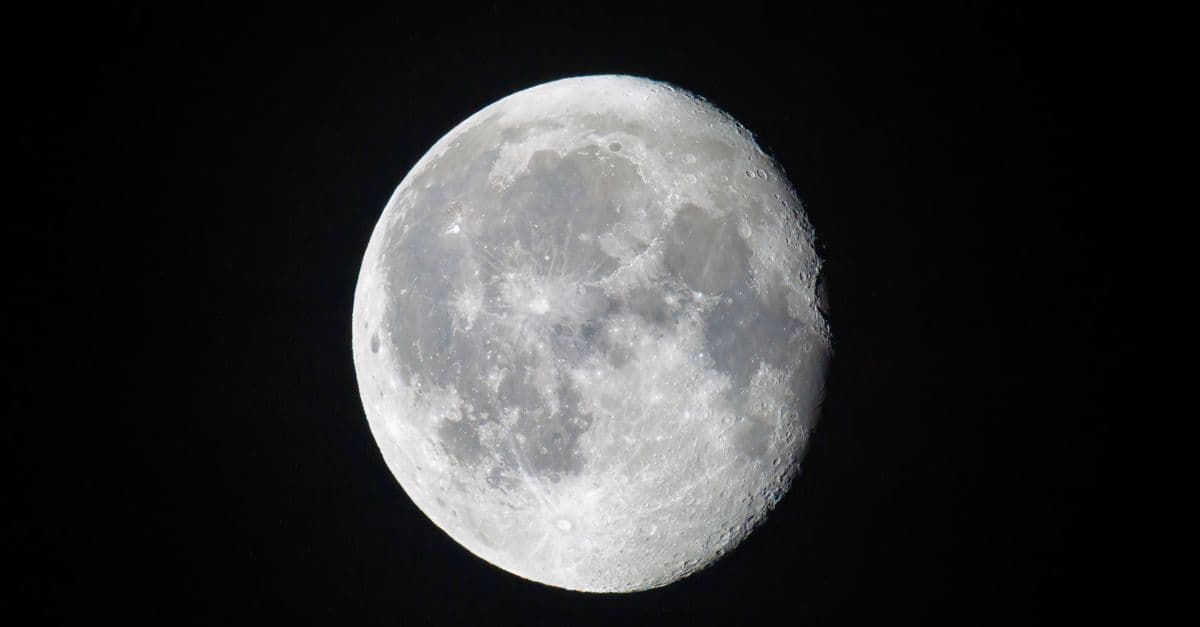
Photo: David Kanigan / Pexels
China's Yutu-2 rover touched down on January 3, 2019, inside Von Kármán crater on the Moon's far side, and it has been returning ground-level geology from that hemisphere ever since. Its ground-penetrating radar imaged debris layers and buried lava flows tens of meters down. Its spectrometer picked up minerals that might come from the lunar mantle. Here is what the instruments measured, which results are firm, and which are still argued over.
Why the far side is a different place
The Moon keeps one face toward Earth, but the Moon wobbles slightly (a motion called libration), so about 59 percent of its surface is visible from Earth at one time or another. The rest stayed unseen until October 7, 1959, when the Soviet probe Luna 3 photographed it for the first time (Wikipedia: far side of the Moon). Half a century later, orbiters had mapped the whole thing, yet nobody had touched it.
What those maps showed was lopsided. Dark volcanic plains called maria cover about 31.2 percent of the near side and only about 1 percent of the far side, which is why the far side looks so bright and so heavily cratered. The leading explanations include a thicker far-side crust that kept lava from reaching the surface and a higher concentration of heat-producing elements on the near side, with debate continuing about how much each contributed (Wikipedia: far side of the Moon). A rover could, for the first time, check what lies under the surface rather than guess from orbit.
If you have heard the phrase "dark side of the Moon," our piece on the dark side of the Moon: myths and facts explains why that name is wrong. The far side gets just as much sunlight as the near side. It is simply hidden from us.
A hemisphere shielded from Earth's radio noise
The far side has a second distinction. The Moon's bulk blocks radio transmissions from Earth, which makes the far side an attractive place for radio astronomy. Chang'e-4's lander carried a low-frequency instrument covering 0.1 to 40 MHz, a band that is hard to observe from Earth because of the ionosphere and human interference (Wikipedia: Chang'e 4). The same shielding creates an engineering problem: nothing on the far side can talk to Earth directly.
The mission: landing, relay, and rover
The Chang'e-4 mission launched on a Long March 3B from Xichang on December 7, 2018 (UTC), entered lunar orbit on December 12, and landed at 02:26 UTC on January 3, 2019, becoming the first soft landing on the far side (Wikipedia: Chang'e 4). The China National Space Administration described a variable-thrust engine slowing the probe from about 1.7 kilometers per second, a pause to hover at roughly 100 meters to scan for hazards, and a vertical descent onto a flat patch (CNSA). The rover rolled off about 12 hours later.
| Item | Value | Source |
|---|---|---|
| Launch | December 7, 2018, 18:23 UTC | Wikipedia: Chang'e 4 |
| Landing | January 3, 2019, 02:26 UTC | Wikipedia: Chang'e 4 |
| Landing site | 45.44° S, 177.60° E, Von Kármán crater | Wikipedia: Chang'e 4; CNSA |
| Site name | Statio Tianhe (named February 2019) | Wikipedia: Chang'e 4 |
| Rover mass | 140 kilograms | Wikipedia: Yutu-2 |
| Rover size | 1.5 × 1.0 × 1.0 meters, six wheels | Wikipedia: Yutu-2 |
| Design life | Three months for the rover, 12 months for the lander | Wikipedia: Chang'e 4 |
Queqiao: the relay satellite that makes the far side talkable
To send commands to a rover that can never see Earth, China parked a relay satellite named Queqiao in a halo orbit around the Earth-Moon L2 point, about 65,000 kilometers from the Moon, where it can see both the far side and Earth. It carries a 4.2-meter antenna and launched in May 2018, months before the lander (Wikipedia: Chang'e 4).
Think of Queqiao as a cell tower on a hilltop that is visible from two valleys that cannot see each other. The rover talks to the lander, the lander talks to Queqiao, and Queqiao talks to ground stations in China. Without that chain, the Moon's own bulk would be a wall between operators and machine. (Our guide to how radio telescopes work explains why the same wall is a gift to astronomers.)
Where on the Moon it landed
Von Kármán crater is about 180 to 186 kilometers wide and sits inside the South Pole-Aitken (SPA) basin (Wikipedia: Von Kármán crater). The SPA basin is roughly 2,500 kilometers across, one of the largest known impact structures in the Solar System, with crust about 30 kilometers thick beneath its floor compared with 60 to 80 kilometers around it (Wikipedia: South Pole-Aitken basin). A giant impact thinned the crust, which is why scientists hoped the basin might expose deeper material.
What the rover carried
Yutu-2 is a small, solar-powered, six-wheeled vehicle that relies on radioisotope heater units to survive lunar nights. Its science payload covered four jobs.
| Instrument | What it does | Key specification |
|---|---|---|
| Panoramic Camera (PCAM) | 360-degree stereo imaging for terrain and rock context | 420 to 700 nm |
| Lunar Penetrating Radar (LPR) | Sends radio pulses into the ground and records the echoes | About 30 m depth at 30 cm resolution; over 100 m at 10 m resolution |
| Visible and Near-Infrared Imaging Spectrometer (VNIS) | Identifies minerals from reflected sunlight | 450 to 950 nm |
| Advanced Small Analyzer for Neutrals (ASAN) | Counts energetic neutral atoms from the solar wind | Provided by the Swedish Institute of Space Physics |
The lander carried its own set: a neutron and dosimetry experiment from Kiel University, a low-frequency radio spectrometer, a terrain camera, and a sealed 3-kilogram biological experiment (Wikipedia: Yutu-2; Wikipedia: Chang'e 4).
Ground-penetrating radar, in plain terms
Imagine tapping a wall and listening: a hollow patch sounds different from a solid one. Ground-penetrating radar does the same with radio waves. A transmitter sends a pulse down, and every boundary between materials with different electrical properties sends part of the pulse back, like echoes in a canyon. The time delay between sending and hearing each echo, converted using the speed of radio waves in the ground, gives the depth.
The Chang'e-4 radar has two channels, a 500 MHz channel for fine detail near the surface and a 60 MHz channel that reaches deeper but with less resolution (Li et al. 2020, Science Advances, via PubMed Central). Higher frequency means a shorter wavelength and sharper pictures, and lower frequency means deeper penetration. Every radar designer trades one for the other.
What the radar saw under the surface
The first major radar result, published in Science Advances on February 26, 2020, used data from the rover's first two lunar days (a lunar day lasts about 29.5 Earth days, roughly two weeks of sunlight followed by two of night). Over a route of about 106 meters, the 500 MHz channel detected features to a two-way travel time of about 500 nanoseconds, more than three times the roughly 150 nanoseconds seen at the Chang'e-3 site on the near side (Li et al. 2020).
That deeper penetration means the ground at the Chang'e-4 site is low-loss, meaning it absorbs little radar energy, and it is porous and granular. The authors reported a loss tangent (a measure of how much energy the material absorbs) of (5 ± 2) × 10⁻³ and an average wave speed of 0.16 meters per nanosecond (Li et al. 2020).
Three layers in the top 40 meters
The authors divided the upper 40 meters into three units.
| Depth | Unit | What the radar suggests |
|---|---|---|
| 0 to 12 m | Regolith | Mostly fine material with sporadic large rocks |
| 12 to 24 m | Coarse ejecta | Rocks and boulders about 0.2 to 1 m wide, interbedded with fine layers |
| 24 to 40 m | Alternating layers | Coarse and fine layers, with boulders concentrated near the top |
Below roughly 40 meters, the signal faded out, and the authors concluded that the top of the mare basalt layer lies deeper than 40 meters. They estimated bulk density near 5.8 meters depth at about 1.90 ± 0.08 grams per cubic centimeter using one model and 1.67 ± 0.07 using another (Li et al. 2020).
One common mix-up is worth correcting. Yutu-2's radar is sometimes confused with SHARAD, which is the name of a different radar on NASA's Mars Reconnaissance Orbiter. The rover carries the Lunar Penetrating Radar, and its published frequencies are 60 and 500 MHz.
Where the debris came from
The layered material is ejecta, rock thrown out when asteroids and comets hit the surface. The authors identified three likely sources for the material at the landing site: the craters Finsen, Von Kármán L, and Von Kármán L′. Finsen is Eratosthenian in age, meaning it formed less than 3.2 billion years ago (Li et al. 2020).
How thick is the ejecta blanket? The paper gives three estimates that do not agree: 34 to 78 meters from the dark-halo craters method, more than 39 meters from non-dark-halo craters, and about 8.1 meters from a power-law model. The paper reports all three without reconciling them, which is a healthy sign that the interpretation is still open. This is the sort of detail that headlines drop. The radar saw layers; deciding which impact deposited which layer is harder.
For the broader story of why the Moon's surface is so thoroughly battered, see why the Moon has so many craters.
Deeper still: buried lava flows
A second paper, in Nature Communications on July 9, 2020, used the rover's first nine months of radar data to look deeper. It reported buried ejecta overlaid by at least four distinct lava-flow layers, probably from the Imbrium Epoch, ranging from about 12 meters to about 100 meters thick. The authors estimated the mare basalts' average loss tangent at 0.0040 to 0.0061 and called the result direct evidence of multiple lava-infilling events inside the crater (Lai et al. 2020).
At first glance the two papers appear to conflict. One says basalt starts deeper than 40 meters; the other describes lava layers beginning around 12 meters thick. They are looking through different windows. The first used the high-frequency channel, which sees fine detail near the surface and runs out of signal. The second used the deeper-looking channel. Think of a flashlight and a floodlight: the flashlight shows the nearby floor in sharp detail, while the floodlight lights up the far end of the room in blurry fashion.
The mantle question: what the spectrometer measured
The spectrometer, VNIS, works by splitting reflected sunlight into colors. Different minerals absorb light at characteristic wavelengths, so the pattern of dips in the spectrum acts like a fingerprint. Olivine and pyroxene both absorb strongly near 1 micrometer, and pyroxene also absorbs near 2 micrometers, which lets analysts separate them.
In a May 2019 paper in Nature, Chunlai Li and colleagues reported that VNIS spectra suggested low-calcium pyroxene and olivine, which "may originate from the lunar mantle." Their geological reading was that a nearby impact roughly 72 kilometers across, probably Finsen, had excavated the material from below the SPA basin floor and deposited it near the landing site (Li et al. 2019, Nature, via Europe PMC).
A rival interpretation: impact melt, not mantle
Not everyone read the evidence the same way. A National Science Review paper by Hongmei Lin and colleagues analyzed spectra from a surface rock and from the regolith at 10 sites during the first three lunar days. They estimated the rock's mineral makeup at 38.1 ± 5.4 percent low-calcium pyroxene, 13.9 ± 5.1 percent olivine, and 48.0 ± 3.1 percent plagioclase, which classifies it as an olivine-norite (Lin et al. 2020, via Europe PMC).
Because the rock is rich in plagioclase and relatively poor in olivine, the authors argued it fits the lower crust better than the mantle. They proposed it may have crystallized from the melt pool created by the SPA impact itself, a mixture of crust and mantle. A grain size under 3 millimeters is consistent with relatively fast cooling in a shallow pool of melt.
To follow the argument, picture a layer cake. If you throw a rock at the cake hard enough, it digs out a crater and sprays frosting, sponge, and jam into the air. Some of that mix cools into a crumbly crust at the bottom of the hole. A scientist who finds a chunk of jam-flavored crust has to decide whether it came straight from the jam layer or from the mixed-up splatter. That is the mantle versus impact-melt dispute in miniature, and the VNIS data alone cannot settle it.
What the Chang'e-6 samples added
China's Chang'e-6 mission landed on June 1, 2024, in the Apollo basin inside the SPA basin, and its return capsule landed in Inner Mongolia on June 25, 2024, carrying the first samples from the far side (Wikipedia: South Pole-Aitken basin). Laboratory dating of norite clasts in those samples identified two impact events, at 3.87 and 4.25 billion years ago. The authors interpret 4.25 billion years as the best match for the SPA impact itself (Su et al. 2025, National Science Review, via Europe PMC).
Samples in a lab can be measured to a precision no rover can match, but they come from one spot. Yutu-2 provides the context, meaning what the rock looked like in the field, which layers surrounded it, and how it sat on the surface. For a sense of how much information a single sample return can carry, see our article on Moon rocks as scientific treasure.
Regolith and rocks: the engineering data
The mineral story gets the headlines, but engineers care about a different set of numbers. Lunar regolith forms when impacts grind rock into progressively finer material and churn it vertically and horizontally in a process called gardening (Wikipedia: lunar regolith). Future landers and habitats must sit on it, drive across it, and keep it out of their machinery.
Temperature and thermal properties
Temperature probes on Chang'e-4 gave the first in situ measurements of regolith temperatures on the far side. A National Science Review analysis in 2022 estimated an average particle size around 15 micrometers, thermal conductivity of about 1.53 × 10⁻³ watts per meter per kelvin at the surface rising to about 8.48 × 10⁻³ at one meter depth, and bulk density of about 471 kilograms per cubic meter at the surface and 824 in the upper 30 centimeters (Xiao et al. 2022, via Europe PMC).
Those conductivity values are tiny, which means the top of the regolith is a superb insulator. A thermos works the same way, by trapping a thin layer of almost nothing. This matters for habitat design: a meter of regolith between you and the surface evens out the huge temperature swings of the lunar day and night.
How firm is the ground?
In March 2024, a Nature Communications paper used Yutu-2's wheel slippage on steep terrain as an accidental soil test. The rover climbed toward a fin-shaped rock at a spot called Longji during its 41st lunar day, and the wheels' behavior gave estimates of the regolith's strength. The authors estimated an internal friction angle of 21.5 to 42.0 degrees, cohesion of 520 to 3,154 pascals, and an external friction angle of 8.3 to 16.5 degrees. Shear properties resembled those of Apollo 12 samples, with higher cohesion than most nearside regolith studied by earlier missions (Ding et al. 2024, via Europe PMC).
The same paper's spectra showed the fin-shaped rock to be rich in iron and magnesium and a low-calcium pyroxene, and linked it to ejecta from a different crater than the earlier rock, suggesting that several source regions contributed material to the landing area. For readers curious about soil mechanics and why lunar dust causes trouble, our explainers on lunar soil analysis and why Moon dust is dangerous go deeper.
Radiation at the surface
The lander's neutron and dosimetry experiment made the first direct measurements of radiation dose on the lunar surface. The average absorbed dose rate in silicon was 13.2 ± 1 micrograys per hour, and the neutral-particle share was 3.1 ± 0.5 micrograys per hour (Zhang et al. 2020, Science Advances, via Europe PMC). A microgray is one millionth of a gray, the SI unit of absorbed dose. Wikipedia's mission summary notes that this is two to three times higher than on the International Space Station, because the Moon has no magnetic field and almost no atmosphere to shield the surface (Wikipedia: Chang'e 4).
A separate Science Advances study reported the first surface measurements of low-energy cosmic rays, in the 10 to 100 MeV per nucleon range, around the solar minimum between cycles 24 and 25. The measured proton flux was within error of near-Earth spacecraft values (a ratio of 1.05, with an uncertainty of 0.15), and the study noted an enhancement in the helium-3 to helium-4 ratio near 12 MeV per nucleon (Luo et al. 2022, via Europe PMC).
Why does this matter for people? Radiation is one of the main limits on how long astronauts can stay on the Moon without protection. Our overview of cosmic rays and particle physics explains where these particles come from, and the same data feed shielding designs for the missions in the Artemis program.
Oddities along the route
Two finds made headlines beyond the science press, and both turned out to be easier to explain than the first reports suggested.
In September 2019, the rover photographed a gel-like substance in a small crater. Later analysis suggested it was rock melted by an impact, not anything exotic (Wikipedia: Yutu-2). Impacts melt rock instantly, and the melt can cool into glass, a material that is common on the Moon.
Between December 2021 and January 2022, the rover imaged a boulder on the horizon that the press nicknamed the "Mystery Hut" or "Moon Cube." After about a month of driving, Yutu-2 reached it and found an irregularly shaped rock that resembled a rabbit, with a carrot-like rock nearby, an apt coincidence given that Yutu means "Jade Rabbit" (Wikipedia: Yutu-2). The lesson: a blocky shape at a distance can turn out to be an ordinary boulder up close, which is the whole argument for roving rather than relying on orbital photos.
How long has Yutu-2 lasted?
The rover was designed to work for three months. The record since then is unusual enough to put in a table.
| Date | Milestone | Source |
|---|---|---|
| January 2019 | Landing, rover deployed about 12 hours later | Wikipedia: Yutu-2 |
| November 20, 2019 | Passed the Lunokhod 1 record of about 321 Earth days | Wikipedia: Yutu-2 |
| January 2022 | More than 1,000 meters driven | Wikipedia: Yutu-2 |
| 2023 | Rover slows down | Wikipedia: Yutu-2 |
| March 2024 | Rover stops moving for several months | Wikipedia: Yutu-2 |
| September 19, 2024 | Odometer reads 1.613 kilometers | Wikipedia: Yutu-2 |
| January 2025 | SpaceNews reports the rover is likely immobile | Wikipedia: Yutu-2, citing SpaceNews |
| September 2025 | Wikipedia lists the rover as still operating after small movements | Wikipedia: Yutu-2 |
The reports from late 2024 and 2025 do not agree cleanly. The most careful reading is that Yutu-2 has barely moved since early 2024, that its total traverse is a little over 1.6 kilometers, and that its status as of 2025 depends on the source. The record for longest-lived lunar rover is not in dispute: it has operated for several years against a three-month plan (Wikipedia: Yutu-2).
Why did it last? The landing site has plenty of sunlight for solar charging, the radioisotope heater units keep the electronics from freezing through the long lunar nights, and the rover drove slowly and cautiously. Slow, boring operation is a good survival strategy on another world.
What Yutu-2 cannot tell us
Honest accounting of limits is part of the story.
- It cannot date rocks. Radiometric ages need laboratory instruments. Chang'e-6 samples did that job, and Yutu-2 only supplies context.
- It cannot prove a mantle origin. The spectra support low-calcium pyroxene and olivine, but both the mantle and the impact-melt interpretations fit.
- It cannot see far below 100 meters. Even the deeper radar channel runs out of signal.
- It covers a few hundred meters of terrain per lunar day. One crater floor does not represent the entire far side.
- It has no drill or sample return. All its mineral data come from reflected light.
A rover is a probe, not a laboratory. Its strength is breadth and context; the weakness is precision.
How it compares with Mars rovers
Mars rovers such as Curiosity and Perseverance carry drills, onboard chemistry labs, and caching systems for samples. Yutu-2 is a lighter machine whose payload leans on remote sensing: radar, a camera, and a spectrometer. Our guide to Mars rovers from Sojourner to Perseverance shows how different the toolkits are. Each design makes sense for its target. The Moon is close enough to attempt sample return directly, as Chang'e-6 did, while Mars sample return is far harder.
What comes next on the far side
The scientific questions Yutu-2 raised lead to bigger projects. China's lunar exploration program lists Chang'e-7, a south-polar mission to search for resources. It was scheduled to launch on August 23 to 24, 2026, but China's space agency said the probe "does not meet launch conditions" and gave no new date, so the launch now looks like 2027 (Wikipedia: Chang'e 7). The program also lists Chang'e-8, a 2028 mission planned to test in situ resource utilization and 3D printing (Wikipedia: Chinese Lunar Exploration Program). The program also targets a crewed landing around 2029 or 2030 and an International Lunar Research Station with Russia and other partners, with construction at the south pole from 2031. These are plans, and plans have slipped before.
Elsewhere, NASA's Artemis program has been reshaped. Per NASA, Artemis III is now a crewed demonstration in low Earth orbit targeted for 2027, with Artemis IV planned as the return to the lunar surface (NASA: Artemis III). The far side's geology, radiation, and radio quiet will matter to every program that follows.
Why a rover from 2019 still shapes lunar science
Yutu-2 gave researchers three things nobody had: a first radar cross-section of the far side, a first set of in situ mineral spectra from inside the SPA basin, and first surface dose measurements. Every later analysis, including how to read the Chang'e-6 samples, uses those as reference points.
Common misunderstandings
"Yutu-2 explored the dark side of the Moon." The far side is not dark. It receives the same sunlight as the near side over the lunar day. Yutu-2 even has to survive the same two-week night.
"Yutu-2 proved that mantle rock sits on the surface." The 2019 Nature paper described spectral signs that "may originate from the lunar mantle." A later study read one rock as impact melt. The question is open.
"The radar found water ice." It did not. Yutu-2 landed near 45 degrees south, far from the polar cold traps where ice is expected, and the published radar results discuss layered rock and regolith. If you are curious how ice is hunted, our explainer on lunar ice detection methods covers the techniques.
"Yutu-2 can drill." It cannot. Its instruments observe from the surface and send radio waves down.
"Yutu-2 sent data directly to Earth." It could not. Every message goes through the lander and the Queqiao relay.
Frequently asked questions
Q: How does Yutu-2 communicate with Earth? A: Signals pass from the rover to the Chang'e-4 lander, then to the Queqiao relay satellite in a halo orbit around the Earth-Moon L2 point, and then to ground stations. The Moon blocks any direct link from the far side to Earth.
Q: How deep can Yutu-2's radar see? A: The published specification is about 30 meters at 30-centimeter resolution for one channel and over 100 meters at 10-meter resolution for the other. The 2020 Science Advances analysis imaged the top 40 meters using the 500 MHz channel.
Q: What minerals did Yutu-2 detect? A: Its spectrometer indicated low-calcium pyroxene, olivine, and plagioclase. One analyzed rock was estimated at 38.1 percent low-calcium pyroxene, 13.9 percent olivine, and 48.0 percent plagioclase, which classifies it as an olivine-norite.
Q: Did Yutu-2 find mantle material? A: Possibly. A 2019 Nature paper said the spectra suggest minerals that may originate from the mantle, while a 2020 analysis argued the rock more likely crystallized from the SPA impact melt pool. Both papers agree the material was likely thrown to the site by a nearby impact.
Q: How far has Yutu-2 traveled? A: About 1.6 kilometers. The odometer read 1.613 kilometers on September 19, 2024, and the rover has moved very little since early 2024.
Q: Why is the far side so different from the near side? A: Maria cover roughly 1 percent of the far side compared with 31.2 percent of the near side. Explanations include thicker far-side crust and uneven distribution of heat-producing elements, and researchers still debate the relative weight of each.
The takeaway
Yutu-2's real contribution is that it replaced guesses with measurements. Under the landing site lies a stack of debris and lava: regolith at the top, coarse ejecta from nearby impacts below it, and basalt flows that filled the crater in several episodes. The spectrometer showed minerals consistent with deep rock, and the scientific argument over whether that rock is mantle or impact melt shows how much remains to learn from a single crater.
The deeper lesson is about how planetary science works. A rover supplies context, a sample return supplies precision, and an orbiter supplies coverage. Chang'e-6 dated the SPA impact to 4.25 billion years ago only because researchers could place the samples within a geological story that rovers and orbiters had already begun to tell. Yutu-2's long, slow drive across a far-side crater floor is one chapter in that story, and its measurements of radiation and regolith will inform every crew that eventually follows.
Sources
- Li, C. et al., "The Moon's farside shallow subsurface structure unveiled by Chang'E-4 Lunar Penetrating Radar," Science Advances 6(9), February 26, 2020: PubMed Central copy
- Li, C. et al., "Chang'E-4 initial spectroscopic identification of lunar far-side mantle-derived materials," Nature 569, May 15, 2019 (DOI 10.1038/s41586-019-1189-0): Europe PMC record
- Lai, J. et al., "First look by the Yutu-2 rover at the deep subsurface structure at the lunar farside," Nature Communications 11, July 9, 2020: Europe PMC record
- Lin, H. et al., "Olivine-norite rock detected by the lunar rover Yutu-2 likely crystallized from the SPA-impact melt pool," National Science Review 7(5), 2020: Europe PMC record
- Zhang, S. et al., "First measurements of the radiation dose on the lunar surface," Science Advances 6(39), September 25, 2020: Europe PMC record
- Xiao, X. et al., "Thermophysical properties of the regolith on the lunar far side," National Science Review 9(11), 2022: Europe PMC record
- Luo, P. et al., "First measurements of low-energy cosmic rays on the surface of the lunar farside," Science Advances 8(2), January 2022: Europe PMC record
- Ding, L. et al., "Lunar rock investigation and tri-aspect characterization of lunar farside regolith by a digital twin," Nature Communications 15, March 8, 2024: Europe PMC record
- Su, B. et al., "South Pole-Aitken massive impact 4.25 billion years ago revealed by Chang'e-6 samples," National Science Review 12(6), 2025: Europe PMC record
- China National Space Administration, Chang'e-4 landing announcement: cnsa.gov.cn
- NASA, Artemis III mission page: nasa.gov/mission/artemis-iii
- Background: Yutu-2, Chang'e 4, Far side of the Moon, Lunar regolith, and South Pole-Aitken basin (Wikipedia)
Read next:
Follow new articles
Add SciHub101 to your feed reader to see new science and technology stories.
About the Author
SciHub101 is an independent science and technology publication founded and edited by Buğra Sözeri, a software engineer and app developer based in Türkiye. AI tools assist with drafting and research. Source documentation in the existing archive is uneven, and articles are being reviewed and corrected. The Editorial Team byline identifies editorial responsibility; it does not certify specialist or independent human review. Where we compare products, anything built by our own team is labelled as such — see the editorial guidelines and About page for how corrections and disclosures work.
Related Articles
Newton's Prism: White Light is Many Colors Combined
In 1666, Isaac Newton used prisms to split white sunlight into its component colors and recombined them into white again. The experiments changed how we think about light and color.
Volta's Battery: The Electrochemistry Behind the First Cell
The redox chemistry, electrode potentials, and metal chemistry that made Volta's zinc-copper pile the first device to produce continuous electric current
Chang'e 5: Modern Moon Landing and Sample Return
December 2020: China's Chang'e 5 mission landed on the Moon, collected 1.731 kg of samples, and returned them to Earth—the first automated sample return in 44 years.
Lunar Magnetometer Discoveries: Evidence of the Moon's Magnetic Past
Apollo magnetometers revealed anomalous magnetic fields on the Moon surface, proving the Moon once possessed a magnetic field—a surprising discovery about our satellite's geological history.
Martian Soil Analysis: Mars Geology from Rover Studies
Rover soil analysis shows Mars' surface is crushed basalt, oxidized iron, water-bearing minerals, and perchlorate salt. Here is what each finding means.
Moon Rocks: Scientific Treasure from Lunar Exploration
Apollo moon rocks are among Earth's most valuable scientific specimens, revealing planetary formation, solar system history, and the nature of celestial bodies.