Laser Invention: From Masers to Coherent Light
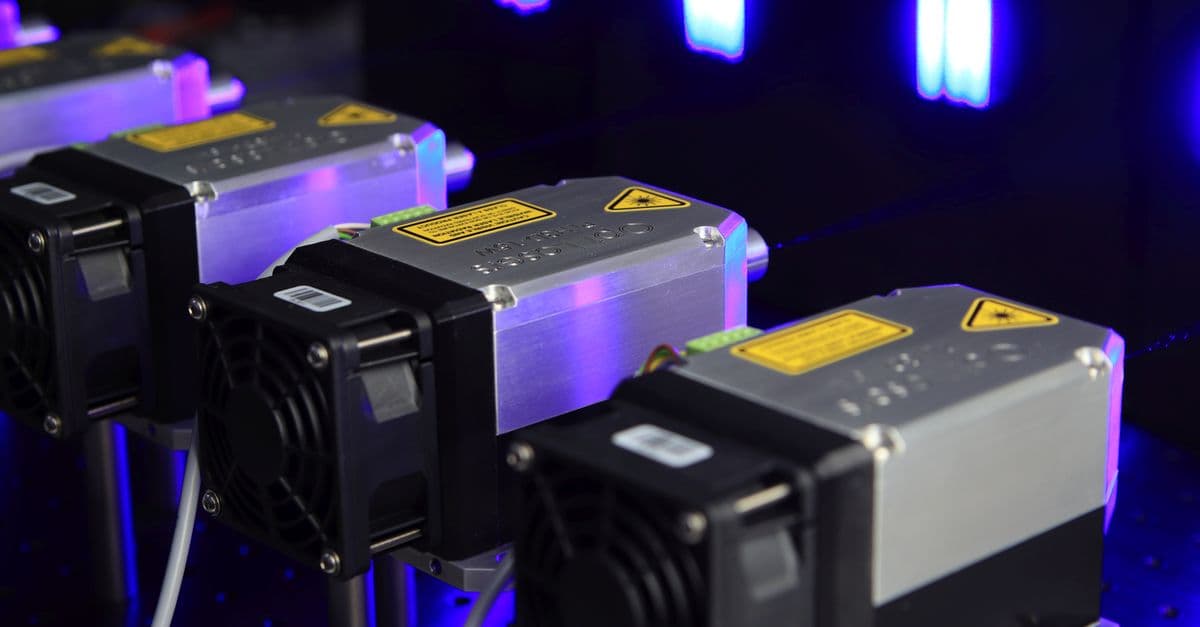
Photo: Opt Lasers from Poland / Pexels
On May 16, 1960, a physicist named Theodore Maiman fired a flash lamp at a pink synthetic ruby rod inside a small metal cylinder at Hughes Research Laboratories in Malibu, California, and produced the first working laser. The idea behind it was 43 years old by then. Albert Einstein had described the physics in 1917, and a decade of maser research had proven it worked at microwave frequencies. This article traces how that chain of theory, hardware, and rivalry turned into the laser, and why the device nobody thought had a use became one of the most commercially important inventions of the 20th century.
What a laser actually is, and why Einstein started it
A laser is a device that produces a narrow, focused beam of light in which all the photons (particles of light) move in step, at the same wavelength and in the same direction. That property is called coherence. Ordinary light, from a bulb or the sun, is incoherent. Its photons fly off in random directions and phases, like a crowd leaving a stadium. Laser light behaves more like a marching band, every photon in lockstep, which is why a laser beam can travel kilometers without spreading out while a flashlight beam blurs into uselessness after a few meters.
The physics behind that behavior goes back to Albert Einstein's 1917 paper "Zur Quantentheorie der Strahlung" ("On the Quantum Theory of Radiation"), published in Physikalische Zeitschrift. Einstein argued that atoms interact with light in three ways, not two. Physicists already knew atoms absorb light and spontaneously emit it. Einstein showed there had to be a third process: stimulated emission, in which a photon passing near an already-excited atom triggers that atom to release a second photon identical to the first, matched in wavelength, phase, and direction (American Physical Society; Physics World). That single mechanism, one photon cloning itself off an excited atom, is the entire engine of every laser built since. Chain that reaction through millions of atoms and you get a cascade of identical, synchronized photons: a beam.
Einstein needed stimulated emission to make his own derivation of Planck's blackbody radiation law come out correctly. Without it, the math only reproduced the older, experimentally wrong Wien distribution. He wasn't trying to invent a machine. He was closing a gap in thermodynamics. It took another 40 years of engineering before anyone could force stimulated emission to dominate over the natural competing processes and turn the theory into a device.
Why the maser came first, and why it wasn't enough
Stimulated emission is easy to describe and hard to dominate. In any normal collection of atoms, more atoms sit in their low-energy ground state than in an excited state, so incoming photons are far more likely to be absorbed than to trigger new emissions. To get amplification, you need a population inversion: artificially pump more atoms into the excited state than remain in the ground state, so stimulated emission outpaces absorption. Getting a population inversion at microwave frequencies turned out to be more tractable than doing it at visible-light frequencies, which is why the maser came first.
Charles Townes, working at Columbia University, worked out a practical way to generate stimulated emission at microwave frequencies starting around 1951 and built a working device by the end of 1953. His maser (Microwave Amplification by Stimulated Emission of Radiation) used a beam of excited ammonia molecules sorted and focused into a resonant microwave cavity, where they dumped their excess energy as a coherent stream of microwaves (Britannica). Soviet physicists Aleksandr Prokhorov and Nikolay Basov independently worked out the same theory of maser operation at around the same time. Townes, Prokhorov, and Basov shared the 1964 Nobel Prize in Physics for the discovery (Britannica).
The maser was a genuine breakthrough, and it immediately found work as an extraordinarily low-noise microwave amplifier for radio astronomy and early satellite communication. But it operated at microwave wavelengths, roughly centimeters long, which is far too coarse for most of the jobs people eventually wanted lasers to do: cutting fine material, reading a compact disc, or carrying data down a hair-thin glass fiber. The obvious next question, the one that turned a laboratory curiosity into a race, was whether the same trick could work at the much shorter wavelengths of visible or infrared light.
How Maiman actually built the first laser
In 1957, Townes proposed to Bell Labs physicist Arthur Schawlow that they try to extend the maser principle into the infrared and visible spectrum. Townes and Schawlow published the theoretical blueprint for what they called an "optical maser" in the December 15, 1958, issue of Physical Review, and Bell Labs filed a patent application on the concept that same year (Britannica). Their paper described the key architectural idea that makes an optical laser possible: instead of a microwave cavity, use a long, narrow gain medium with a fully reflective mirror at one end and a partially reflective mirror at the other, so that light bounces back and forth, gets amplified by stimulated emission on every pass, and eventually leaks out through the partial mirror as a coherent beam. That mirrored cavity is called an optical resonator, and it's still the core architecture inside nearly every laser made today.
Several labs, including Bell, IBM, and TRG (Technical Research Group, a startup working with government funding), were racing to build a working device from that blueprint. Maiman, however, was not part of that formal race in the way people expected. Working essentially alone at Hughes with a much smaller budget than his competitors, he chose a different gain medium: synthetic ruby, an aluminum oxide crystal doped with chromium ions, rather than the gas-discharge systems most other groups favored. His design used a helical flash lamp, similar to a photographer's high-intensity strobe, wrapped around a small cylindrical ruby rod about one centimeter in diameter and a few centimeters long, silvered on both flat ends to form the resonant cavity (National Inventors Hall of Fame).
The flash lamp pumped chromium ions in the ruby to a higher energy state. As those ions relaxed, they released photons at a wavelength of 694.3 nanometers, deep red light. Some of those photons bounced between the mirrored ends of the rod, triggering stimulated emission in other excited ions along the way, building an amplifying cascade until a burst of coherent red light escaped through the partially silvered end. On May 16, 1960, with lab assistant Irnee D'Haenes, Maiman fired the device and produced the first laser light ever generated (ETHW Milestones; Smithsonian). Unlike the continuous hum of the ammonia maser, Maiman's ruby laser fired in short pulses because the flash lamp only pumped the crystal briefly before it had to recharge, but the light it produced was unmistakably coherent.
How does a laser actually amplify light?
A laser pumps energy into a gain medium (a crystal, gas, or semiconductor) until more atoms sit in an excited state than in their resting state, a condition called population inversion. Photons bouncing between two mirrors trigger those excited atoms to release identical photons through stimulated emission, and the cascade builds into a coherent, single-wavelength beam that exits through one partially reflective mirror.
Why did Maiman succeed before better-funded labs?
Maiman used a solid ruby crystal instead of the gas-discharge approaches favored at Bell Labs, IBM, and TRG, which let him build a simpler, cheaper apparatus. He also correctly calculated that a lower-purity, more heavily doped ruby than physicists assumed was needed would still work, a detail that a scientific paper he submitted to Physical Review Letters was rejected over just weeks before his successful demonstration (Hackaday).
The patent war that outlasted the invention
Crediting "the" inventor of the laser is genuinely difficult, because different people hold different firsts. Townes and Schawlow published the theory first. Gordon Gould, a Columbia graduate student who had discussed stimulated emission with Townes, coined the word "laser" and described his own detailed laser concept in a notebook he had notarized in November 1957, then presented it publicly in a 1959 conference paper titled "The LASER, Light Amplification by Stimulated Emission of Radiation." Gould filed his own patent application in April 1959 (Britannica). Maiman built the first working device.
The U.S. Patent Office initially sided with Bell Labs, awarding Townes and Schawlow a patent in 1960 and denying Gould's application. Gould believed his earlier notebook entries proved he had conceived the laser first, and he spent nearly three decades in patent litigation to prove it. The dispute became one of the longest-running patent fights in American technology history. Gould eventually won, starting in 1977, when he was awarded a series of four patents covering key elements of laser technology, including optically pumped and gas discharge lasers, that ultimately paid him tens of millions of dollars in licensing royalties from companies across the industry he had helped start (Britannica; History of Information).
Maiman himself had a rockier public reception than the "eureka moment" story suggests. Physical Review Letters, the leading American physics journal, rejected his paper describing the working ruby laser, so his first published account of the breakthrough appeared instead in the British journal Nature in August 1960, a striking illustration of how uncertain even expert reviewers were about which approach would actually work (Optica). Hughes Aircraft's own press office, by contrast, oversold the device, and early newspaper coverage framed the laser as a potential death ray, a science-fiction framing that took years of engineering demonstrations to live down.
| Milestone | Year | Person or team | What it established |
|---|---|---|---|
| Theory of stimulated emission | 1917 | Albert Einstein | The physical mechanism that makes coherent light amplification possible |
| First working maser | 1953 | Charles Townes, Columbia University | Proved stimulated emission could be harnessed at microwave frequencies |
| "Optical maser" theory paper | 1958 | Charles Townes and Arthur Schawlow, Bell Labs | Published blueprint for extending the maser to visible/infrared light |
| Laser concept and patent filing | 1957 (notebook), 1959 (patent) | Gordon Gould, Columbia | Coined the term "laser"; began a patent fight that lasted almost 30 years |
| First working laser | May 16, 1960 | Theodore Maiman, Hughes Research Laboratories | First device to actually produce coherent visible light |
| First gas laser | 1960-1961 | Ali Javan, William Bennett, Donald Herriott, Bell Labs | First continuous-wave laser, using helium and neon gas |
| First semiconductor laser diode | 1962 | Robert Hall's team, General Electric, plus IBM and MIT Lincoln Lab teams | Miniaturized the laser into a form that could later be manufactured cheaply |
Table: Key milestones in the theoretical and engineering history of the laser, 1917 to 1962.
From lab curiosity to invisible infrastructure
For roughly a decade after 1960, the laser was famous for having no obvious job. It was widely, and somewhat unfairly, called "a solution looking for a problem." That changed once engineers connected the laser to two separate bottlenecks: how fast information can travel, and how precisely energy can be delivered to a single point.
The fiber-optic communication bottleneck was the biggest one. A laser diode can be switched on and off billions of times per second, encoding digital data as pulses of light, and that light can travel down a hair-thin strand of glass with far less signal loss than an electrical signal traveling down copper wire. Laser diodes are now the light source inside the undersea cables that carry the overwhelming majority of international internet traffic between continents, and inside the metropolitan fiber networks that deliver broadband to homes and offices. Commercial fiber-optic communication began scaling in the 1970s, once low-loss glass fiber and reliable semiconductor lasers matured together.
The precision-energy bottleneck showed up across manufacturing and medicine. Laser cutting, welding, drilling, and marking became standard in automotive, aerospace, and electronics manufacturing starting in the 1980s, because a focused beam can cut, fuse, or vaporize material with no physical tool touching the workpiece, which means no mechanical stress and extremely tight tolerances. In medicine, short-pulse lasers reshaped eye surgery in the 1990s, most visibly through LASIK vision correction, where a laser reshapes the cornea in a procedure measured in seconds. Barcode scanners, one of the earliest mass-market laser applications, appeared commercially in the 1970s, using a low-power laser to sweep a beam across a printed pattern and read reflected light. CDs, DVDs, and Blu-ray discs each read microscopic pits stamped into a spinning disc using progressively shorter-wavelength lasers, a direct consequence of the fact that a laser's focused spot size shrinks as its wavelength shortens, letting each new format pack more data into the same physical disc.
Why did lasers take a decade to find commercial uses?
The first lasers were expensive, fragile, and pulsed rather than continuous, so they could not do sustained industrial or communication work. Engineers needed two more advances, continuous-wave gas lasers (achieved in 1960-1961 at Bell Labs by Ali Javan's team) and compact semiconductor laser diodes (1962), before lasers became practical enough and cheap enough for mass manufacturing, medicine, and telecommunications.
What people get wrong about laser history
The most common misconception is that Maiman "invented the laser" in the sense of having a flash of original insight nobody else was pursuing. In reality, he built the first working device from a theoretical blueprint that Townes and Schawlow had already published two years earlier, in a field where at least four other well-funded labs were actively racing toward the same goal using different gain media. Crediting Maiman with the entire invention erases both the theorists who made it possible and the parallel engineering effort that made his win a matter of timing and design choices rather than solitary genius.
A second misconception treats "laser" as a single technology rather than a family of devices that share one physical principle. A ruby laser, a helium-neon gas laser, a semiconductor laser diode inside a barcode scanner, and a high-power carbon-dioxide laser used for industrial cutting all rely on stimulated emission and an optical resonator, but they differ enormously in wavelength, power, cost, and continuous-versus-pulsed operation. Asking "how powerful is a laser" without specifying which kind is a bit like asking "how fast is a vehicle" without saying whether you mean a bicycle or a jet.
A third misconception, fed by decades of film and television, is that lasers are primarily weapons. The vast majority of laser applications in the world today are quiet and invisible: the laser diodes inside fiber-optic routers, the laser reading heads inside optical drives, the laser rangefinders inside surveying equipment and smartphones, and the low-power laser diodes inside laser printers, which use a rotating mirror to trace an image onto a photosensitive drum. Weapons-grade lasers exist, but they represent a tiny fraction of laser research funding and an even smaller fraction of laser units manufactured each year.
A fourth, subtler misconception is assuming Einstein "invented" the laser theoretically in 1917 the way an engineer designs a device. Einstein's paper was a statistical-mechanics argument aimed at fixing an inconsistency in the derivation of blackbody radiation. He had no reason to expect stimulated emission would ever be technologically useful, and the 40-year gap between his paper and Maiman's ruby rod reflects how much independent engineering had to happen: microwave cavity design, crystal growth, flash-lamp pumping, and precision optics, before the physics became a device.
The takeaway
The laser is a clean example of how transformative technology actually gets built: one theorist closes a gap in physics, a chain of engineers spend decades proving the idea works at increasingly difficult scales, and a device that looks like a sudden breakthrough turns out to be the last domino in a forty-year sequence. Maiman's ruby rod mattered enormously, but it mattered because Einstein, Townes, Schawlow, and Gould had already done the theoretical work, and because gas lasers and semiconductor diodes arrived within two years to make the technology practical rather than merely demonstrable. The lesson generalizes well beyond optics: when an invention looks instant, that usually means you're not seeing the decades of groundwork it stood on.
Read next:
- How the Transistor Changed Everything
- History of Computing: From the Abacus to Artificial Intelligence
- The Invention of the Internet
Frequently Asked Questions
Q: Who invented the laser? A: No single person invented the laser in isolation. Albert Einstein described the underlying physics of stimulated emission in 1917. Charles Townes and Arthur Schawlow published the theoretical blueprint for an optical laser in 1958. Gordon Gould coined the term "laser" and filed an early patent in 1959. Theodore Maiman built and demonstrated the first working laser on May 16, 1960, at Hughes Research Laboratories.
Q: What was the first laser made of? A: Maiman's first laser used a synthetic ruby crystal, aluminum oxide doped with chromium ions, shaped into a small rod with silvered ends, pumped by a helical photographic flash lamp wrapped around it.
Q: Why was the maser invented before the laser? A: Producing a population inversion, the condition where more atoms are excited than at rest, was easier to achieve and sustain at microwave wavelengths than at the much shorter wavelengths of visible light. Charles Townes solved the microwave case in 1953, roughly seven years before anyone solved the optical case.
Q: What does "laser" stand for? A: Laser is an acronym for Light Amplification by Stimulated Emission of Radiation, a term Gordon Gould coined in a 1959 conference paper describing his own laser concept, a year before Maiman built a working device.
Q: Was there a patent dispute over the laser? A: Yes. The U.S. Patent Office initially awarded a patent to Townes and Schawlow's employer, Bell Labs, in 1960 and rejected Gordon Gould's competing application. Gould spent nearly three decades in litigation before winning a series of patents starting in 1977 that earned him significant licensing royalties.
Q: How is laser light different from ordinary light? A: Ordinary light sources emit photons in random directions and phases. A laser produces coherent light, photons that share the same wavelength, phase, and direction, which lets the beam stay narrow and focused over long distances instead of spreading out.
Q: What was the first practical use of the laser? A: Early lasers were largely experimental for about a decade. Among the first widely deployed commercial applications were laser barcode scanners in the 1970s and laser-based fiber-optic communication systems, which began scaling commercially in the same decade once continuous-wave gas lasers and semiconductor laser diodes had matured.
Q: What is the difference between a ruby laser and a gas laser? A: A ruby laser uses a solid crystal as its gain medium and, in its original 1960 form, only produced short pulses of light because its flash-lamp pump needed time to recharge between firings. A gas laser, such as the helium-neon laser Bell Labs demonstrated in 1960-1961, uses an electrically excited gas mixture and can produce a continuous beam rather than pulses.
Q: Why did some scientists initially reject Maiman's laser paper? A: Physical Review Letters, the leading American physics journal at the time, declined to publish Maiman's account of the working ruby laser, reportedly because reviewers were skeptical of some of his technical claims. Maiman instead published his first account in the British journal Nature in August 1960.
Q: Are all lasers dangerous weapons? A: No. The overwhelming majority of lasers manufactured today are low-power devices used in laser printers, optical disc drives, barcode scanners, fiber-optic communication, and surveying equipment. High-power industrial and military lasers exist, but they represent a small fraction of total laser production and use.
Sources
- Britannica, "Laser: History"
- American Physical Society, "Einstein Predicts Stimulated Emission"
- Physics World, "A Century Ago Einstein Sparked the Notion of the Laser"
- National Inventors Hall of Fame, "Theodore Harold Maiman"
- Engineering and Technology History Wiki, "Milestones: First Working Laser, 1960"
- Smithsonian Institution, "Ruby Crystal from Maiman Laser"
- Optica, "Theodore Harold Maiman" obituary
- History of Information, "The Complicated Discovery of the Laser"
- Hackaday, "First Light: The Story of the Laser"
Follow new articles
Add SciHub101 to your feed reader to see new science and technology stories.
About the Author
SciHub101 is an independent science and technology publication founded and edited by Buğra Sözeri, a software engineer and app developer based in Türkiye. AI tools assist with drafting and research. Source documentation in the existing archive is uneven, and articles are being reviewed and corrected. The Editorial Team byline identifies editorial responsibility; it does not certify specialist or independent human review. Where we compare products, anything built by our own team is labelled as such — see the editorial guidelines and About page for how corrections and disclosures work.
Related Articles
Microchip Invention: Kilby, Noyce, and the Integrated Circuit
The microchip emerged from parallel breakthroughs by Jack Kilby and Robert Noyce. This guide explains the invention that made modern computing possible.
GPS Invention: Satellites, Atomic Clocks, and Relativity
GPS was not one person's invention. It came from satellites, atomic clocks, relativity, military navigation, and decades of engineering.
The Invention of the Laser — SciHub101
How Townes and Schawlow's 1958 paper, Maiman's 1960 ruby device, and a 30-year patent war produced the most versatile tool in modern science.
Camera Invention: From Camera Obscura to Digital Sensors
The camera evolved from the camera obscura to chemical photography and digital sensors. This guide explains the chain of inventions.
Microscope Invention: Leeuwenhoek, Hooke, and the Hidden World
The microscope opened the hidden world of cells and microbes. This article explains lenses, early makers, Leeuwenhoek, Hooke, and modern microscopy.
Telephone Invention: Bell, Gray, Meucci, and the Patent Race
The telephone's invention involved Alexander Graham Bell, Elisha Gray, Antonio Meucci, patents, and the race to transmit speech electrically.