The Barcode: How Stripes on a Package Changed Global Commerce
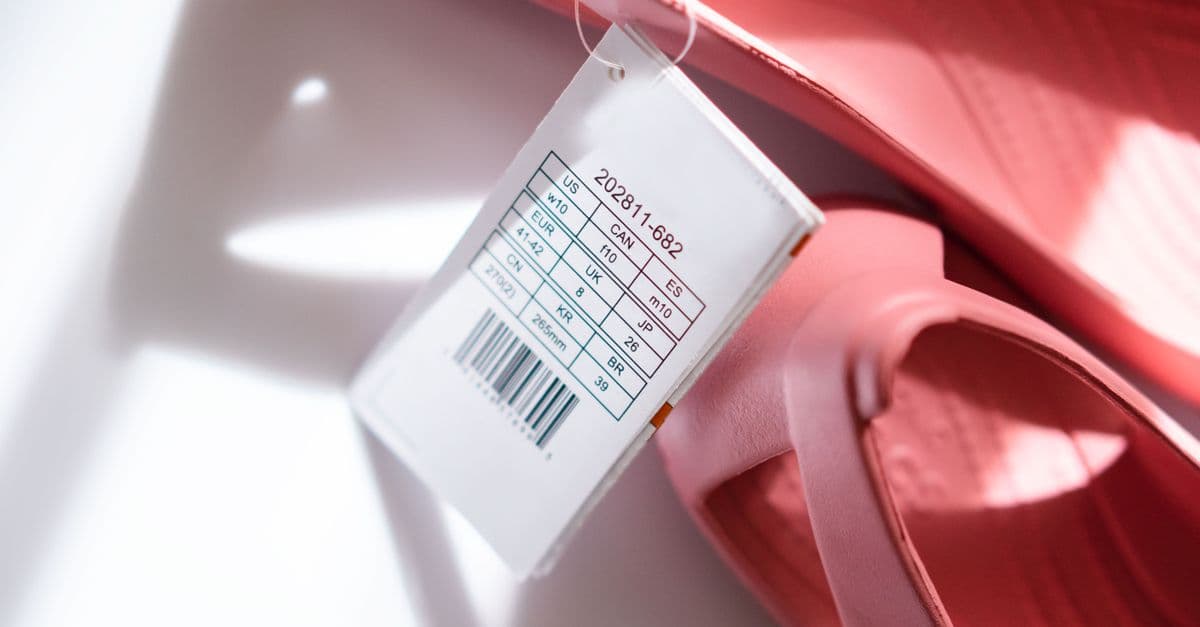
Photo: Atlantic Ambience / Pexels
On June 26, 1974, at 8:01 a.m., a cashier named Sharon Buchanan dragged a 10-pack of Wrigley's Juicy Fruit gum across a glass scanner at a Marsh supermarket in Troy, Ohio. A laser read the stripes. A register printed the price. The moment lasted less than a second, but it marked the end of manual price entry in retail and the beginning of a data infrastructure that now underpins global commerce. The barcode is so ordinary that most people stopped seeing it. That invisibility is exactly what success looks like.
A Food Executive's Throwaway Request
The barcode story begins not with an inventor but with a complaint. In 1948, the president of a Philadelphia food chain called Food Fair approached the dean of the Drexel Institute of Technology with a problem: was it possible to automatically capture product information at checkout, without a cashier typing every price by hand? The dean showed no interest. But a graduate student named Bernard Silver was in the hallway and overheard the conversation.
Bernard Silver — an electrical engineering graduate student at Drexel Institute of Technology who co-invented the barcode after overhearing a food retailer's request for an automated checkout system in 1948.
Silver found the problem worth pursuing and brought it to his friend Norman Joseph Woodland, a mechanical engineering instructor at Drexel who had recently completed his bachelor's degree. Woodland was already a skilled inventor — he had worked on the Manhattan Project as an undergraduate — and the challenge of encoding product identity into a scannable mark suited his thinking precisely.
Their first attempts used ultraviolet-fluorescent inks. The ink could be printed invisibly and read under UV light, encoding product data that a photocell detector could parse. The idea worked in principle but failed in practice: the ink was chemically unstable and faded too quickly to be commercially viable. They needed a different approach.
Source: National Inventors Hall of Fame (2024) — Inductee biography for Bernard Silver; background on the Food Fair encounter and early UV ink experiments.
The Beach and the Bull's-Eye
In the winter of 1948, Woodland flew to Florida, rented an apartment near his grandparents, and sat on the beach thinking about the problem. He was familiar with Morse code — he had learned it as a Boy Scout — and he began tracing dots and dashes in the sand with his fingers. As he dragged his fingers downward, the dots and dashes stretched into thin and thick lines. Then, thinking about how a circular pattern could be read from any direction, he curled the lines into concentric rings.
That beach sketch became the bull's-eye barcode: a circular target of alternating light and dark rings that could be scanned from any angle because the geometry was radially symmetric. The idea was elegant. It was also, as it turned out, ahead of the technology available to read it reliably.
Bull's-eye barcode — the original Woodland-Silver barcode design consisting of concentric circular rings encoding data, readable from any scan direction; later abandoned in favor of the rectangular UPC because circular printing was prone to smearing.
Woodland and Silver filed a patent application on October 20, 1949. US Patent 2,612,994, titled "Classifying Apparatus and Method," was granted on October 7, 1952. The patent described both linear and circular barcode configurations, proposed using a bright light source to illuminate the code, and envisioned a photomultiplier tube to detect the reflected light. Lasers did not yet exist; Woodland and Silver were imagining the scanning technology as much as the code itself.
Source: US Patent and Trademark Office — Patent 2,612,994, Woodland and Silver, granted October 7, 1952.
From Patent to Philco to RCA: The Long Commercial Gap
The patent was a genuine technological achievement, but it was commercially premature. The electronics required to decode a barcode scan in real time — at the speed of a retail checkout — did not exist at the scale or price point retail required. Woodland and Silver approached IBM, where Woodland was now employed, but IBM assessed the technology as not yet commercially feasible.
In 1952, they sold the patent to Philco for $15,000 — roughly $170,000 in 2026 purchasing power. Philco later sold it to RCA. The patent sat largely dormant for over a decade. Woodland continued working at IBM, aware that he had sold the foundation of something important before the world was ready for it.
Source: Logistics Hall of Fame (2024) — Profiles of Norman Joseph Woodland, George Laurer, and Bernard Silver; patent sale details confirmed.
The technology that made the barcode practical arrived in 1960: the laser. Theodore Maiman demonstrated the first working laser at Hughes Research Laboratories in May 1960, using a synthetic ruby crystal. Within a decade, the helium-neon gas laser — compact, continuous-wave, and emitting a coherent red beam — had become available at a price and size that could conceivably fit inside a retail scanner. The other missing piece was the microprocessor, which arrived in the early 1970s and made real-time barcode decoding computationally feasible.
For a deeper look at the technology that made scanning possible, see The Laser.
The UPC Competition: IBM vs. RCA
By the late 1960s, the American grocery industry was actively seeking an automated checkout system. Checkout labor costs were rising. Inventory accuracy was poor. A joint industry committee — eventually the Ad Hoc Committee on a Uniform Grocery Product Code — was formed to define a standard. The requirement was clear: one code, readable by any manufacturer's scanner, printable with existing packaging technology, small enough to fit on a soup can, and accurate enough that fewer than one in 20,000 scans would produce an undetected error.
RCA, which owned the Woodland-Silver patent, promoted the bull's-eye design. They demonstrated it at a Kroger store in Cincinnati in 1972, running a test with bull's-eye-coded items. The system worked, but the circular codes smeared during high-speed printing on packaging lines, making reliable scanning inconsistent.
IBM entered the competition with a rectangular design developed by engineer George Laurer, working at the IBM facility in Research Triangle Park, North Carolina. Laurer recognized that the printing flaw in the circular design was structural: the concentric rings required ink to spread evenly in all directions, and packaging lines did not provide that control. A vertical rectangle of parallel bars, however, only needed consistent ink width in one direction — left to right — which packaging presses could achieve reliably.
George Laurer — IBM engineer who designed the rectangular Universal Product Code (UPC) symbol in 1973, working with Norman Woodland and mathematician David Savir to add a check digit that caught scanning errors.
Laurer worked with Woodland — now his IBM colleague — and mathematician David Savir to solve the error-correction problem. They added a twelfth digit to the eleven digits of product data: a check digit calculated from the other eleven using a weighted modular arithmetic formula. Any single-digit scanning error would produce a check digit mismatch, and the system would reject the scan and prompt a rescan. This brought error rates to well below the industry's one-in-20,000 target.
The Universal Product Code symbol Laurer designed was officially adopted by the industry committee on April 1, 1973. It encoded 12 digits: one for the number system (0 for standard grocery items), five for the manufacturer, five for the product, and one for error checking. The physical symbol was a maximum of 1.5 square inches. It could be read from any lateral angle because the vertical bars presented the same pattern regardless of left-to-right scan direction.
Source: IBM corporate history archive (2024) — "The UPC" historical documentation; George Laurer biography and UPC adoption timeline.
| Year | Event |
|---|---|
| 1948 | Bernard Silver overhears Food Fair president's request at Drexel; approaches Norman Woodland |
| 1949 | Woodland and Silver file patent application for "Classifying Apparatus and Method" |
| 1952 | Patent 2,612,994 granted; sold to Philco for $15,000 |
| 1960 | Theodore Maiman demonstrates first working laser; scanning becomes physically conceivable |
| 1966 | Grocery industry forms committee to define a uniform product code standard |
| 1972 | RCA demonstrates bull's-eye barcode at Kroger test store in Cincinnati |
| 1973 | George Laurer's rectangular UPC symbol adopted as industry standard (April 1) |
| 1974 | First UPC barcode scan: Wrigley's Juicy Fruit gum, Marsh Supermarket, Troy, Ohio (June 26) |
| 1981 | US Department of Defense adopts Code 39 barcode for military supply chain |
| 1994 | QR code invented by Masahiro Hara at Denso Wave in Japan |
| 2004 | GS1 DataBar introduced, allowing barcodes on produce and smaller items |
| 2024 | Barcode reader market valued at $8.91 billion globally |
June 26, 1974: The First Scan
The Marsh supermarket in Troy, Ohio was not chosen at random. NCR (National Cash Register), which had developed the Electronic System 255 scanner for the rollout, was headquartered in nearby Dayton. The Hobart Corporation, which made the conveyor systems, was based in Troy itself. The NCR research facility was in Cambridge, Ohio. The store was, in effect, chosen because it was surrounded by the companies that needed to watch the test succeed.
Clyde Dawson, Marsh's Director of Research and Development, selected the specific item that would make history. He chose the 10-pack of Wrigley's Juicy Fruit from a cart full of candidates — not randomly, he later explained, but because Wrigley had been among the first companies to put UPC codes on their packaging and Dawson wanted to acknowledge the work they had done. The price was 67 cents (ordinarily 69 cents; Marsh had a two-cent promotional discount that day).
Source: History.com (2024) — "Pack of chewing gum becomes first-ever item scanned with a UPC barcode," June 26, 1974.
Sharon Buchanan, the cashier chosen for the scan, ran the gum across the scanner at 8:01 a.m. The NCR Electronic System 255 read the code. The sale registered correctly. The gum went home with a customer. The pack is now preserved at the Smithsonian Institution's National Museum of American History.
Source: Smithsonian Institution — National Museum of American History, object record: "Supermarket Scanner," accession NMAH_892778.
How a Laser Reads a Barcode
The optical mechanism of a laser barcode scanner is simpler than most people expect. A helium-neon or diode laser emits a narrow, coherent beam of red light (typically at 650 nanometers wavelength). A rotating mirror or oscillating mirror assembly sweeps that beam back and forth across the barcode many times per second — a modern scanner may make 1,000 to 3,000 passes per second.
Coherent light — light in which all photons have the same wavelength and are in phase with one another, meaning the beam stays narrow over distance rather than spreading; essential for precise barcode reading.
When the beam strikes a white bar (or the white spaces between bars), the light reflects diffusely back to the scanner's photodetector. When the beam strikes a black bar, the dark ink absorbs most of the light and very little reflects back. The photodetector converts reflected light intensity into an electrical signal — high voltage for white, low voltage for black — producing a square wave whose timing corresponds to bar widths. The decoder chip measures the timing of that square wave and maps it against the UPC encoding scheme (called UPC-A) to extract the 12-digit product number.
Think of it like a turntable needle reading vinyl: the groove geometry (narrow, wide) converts to signal (high, low), and the signal converts to information (music, data). The barcode swap groove geometry for stripe width and a stylus for a photon beam.
The decoded product number is then transmitted to the point-of-sale system, which looks the number up in a database to retrieve the price, product description, and inventory record. The barcode itself contains no price — only an identity. Prices live in the database. This is why a store can change a price without touching a single product: only the database entry needs updating.
Source: GS1 US (2024) — Technical documentation on UPC-A encoding and barcode reading principles.
What the Barcode Actually Changed
The grocery industry's immediate gains from barcode adoption were measurable and large. Before the UPC, a supermarket cashier manually entered every price from memory or from a sticker on the product. Error rates were high. Price changes required physically restickering every affected item on shelves. Inventory was tracked through periodic manual counts — time-consuming, inaccurate, and labor-intensive.
After barcodes: checkout error rates dropped to near zero for scanning errors (though human errors in price-database entry remained). Inventory updates became automatic with each scan. A manager could see, in real time, that a particular soup flavor had sold 47 units that morning without walking the aisle.
The deeper transformation was in supply chain visibility. When retailers could see exactly what sold, when, and in what quantity, they could transmit that data upstream to suppliers. Suppliers could adjust production schedules in response to actual sales rather than estimated forecasts. The "bullwhip effect" — the tendency of demand fluctuations to amplify as they propagate upstream through a supply chain — could be dampened because real demand data was now visible at every link.
Source: GS1 (2024) — "50 Years of the Barcode" report; supply chain impact documentation.
Walmart's logistics dominance in the 1980s and 1990s was built, in significant part, on barcode-enabled supply chain data. Walmart required its suppliers to adopt Electronic Data Interchange (EDI) standards linked to barcode scanning, allowing Walmart's inventory systems to automatically reorder products as they sold. The retailer's ability to operate with lower inventory levels than competitors — while maintaining fewer stockouts — derived directly from the barcode's capacity to generate real-time sales data.
The barcode also migrated far beyond retail. The US Department of Defense adopted Code 39 barcodes for military supply chain management in 1981. Hospitals use barcodes to match medications to patients, reducing dispensing errors. Airlines use them on boarding passes and luggage tags. FedEx and UPS built their entire package-tracking infrastructures on barcode scanning at every logistics node.
QR Codes, 2D Symbols, and What Came After
The one-dimensional barcode — a series of parallel vertical bars — encodes data in a single dimension: bar width. By the early 1990s, the need to encode more data in a smaller space drove the development of two-dimensional (2D) codes.
2D barcode — a barcode that encodes data in both horizontal and vertical dimensions, allowing far more information to be stored in the same physical area; QR codes and Data Matrix codes are the dominant 2D formats.
The QR (Quick Response) code was invented by Masahiro Hara at Denso Wave, a Toyota subsidiary, in 1994. It was designed to track automotive parts in manufacturing — a context where fast scanning from a moving line mattered. The QR code could store up to 7,089 numeric characters or 4,296 alphanumeric characters in a single symbol, compared to 12 digits for UPC-A. Denso Wave made the QR code standard publicly available without patent enforcement, mirroring Volvo's famous open-patent decision with the three-point seatbelt. The smartphone camera's ability to read QR codes without a dedicated scanner gave the format a second life in the 2010s.
The GS1 DataBar, introduced in 2004, allowed barcodes to appear on produce and small items where a full UPC symbol would not fit — addressing a 30-year limitation of the original standard.
Traditional UPC barcodes are being gradually phased toward GS1 Digital Link barcodes (also called "sunrise 2027" format), which encode a web address alongside the traditional product ID, enabling consumers to access product information, ingredient details, and provenance data by scanning a single symbol.
Source: GS1 (2024) — Sunrise 2027 initiative documentation; GS1 Digital Link technical specification.
What People Get Wrong About the Barcode
The most common misconception is that the barcode contains the product price. It does not. The UPC barcode encodes only a 12-digit product identifier. The price — along with product name, weight, and all other attributes — lives in the retailer's database. The scanner reads the identifier, the system looks it up, and the price appears on screen. This is why the same can of soup costs different amounts at different stores even though the barcode on the label is identical.
A second misconception is that Norman Woodland invented the barcode alone, or that George Laurer invented the UPC separately from Woodland. The history is continuous: Woodland and Silver created the foundational concept and patent. Laurer, working alongside Woodland at IBM, solved the practical printing problem that made the rectangular UPC implementable. All three are properly credited as inventors of the system that deployed.
A third misconception concerns the Wrigley gum scan: many accounts describe it as a surprise or a demonstration. It was neither. The NCR system had been installed specifically for the occasion. Clyde Dawson deliberately selected the Wrigley product. The event was precisely staged — which does not diminish its significance, but it was not a spontaneous checkout at a regular grocery run.
FAQs
Q: Who invented the barcode?
A: Norman Joseph Woodland and Bernard Silver invented the original barcode concept at Drexel Institute of Technology, filing their patent in 1949 and receiving it in 1952. George Laurer at IBM later designed the rectangular UPC symbol that became the commercial standard in 1973. All three are recognized as co-inventors of the system that actually deployed globally.
Q: Why was the first barcode scan on a pack of chewing gum?
A: Clyde Dawson, Marsh Supermarket's Director of Research and Development, chose the Wrigley's Juicy Fruit specifically to acknowledge Wrigley's early adoption of UPC barcodes on their packaging. The choice was deliberate, not random. The scan occurred at 8:01 a.m. on June 26, 1974, at a Marsh store in Troy, Ohio, chosen partly because it was near the NCR and Hobart facilities needed to support the test.
Q: Does a barcode contain the product price?
A: No. A UPC barcode encodes only a 12-digit product identifier. The price, product name, and all other attributes are stored in the retailer's point-of-sale database. The scanner reads the identifier and the system retrieves the associated information. This is why prices can be changed without touching product packaging.
Q: What is the difference between a barcode and a QR code?
A: A standard UPC barcode is one-dimensional — it encodes data only in the width and spacing of vertical bars. A QR code is two-dimensional, encoding data in patterns in both horizontal and vertical directions. QR codes can store up to roughly 4,000 alphanumeric characters versus 12 numeric digits for a UPC. QR codes were invented by Masahiro Hara at Denso Wave in 1994, originally for automotive parts tracking.
Q: How does a laser barcode scanner actually work?
A: A laser beam sweeps back and forth across the barcode. Dark bars absorb light; white spaces reflect it. A photodetector converts the reflected light pattern into an electrical signal whose timing corresponds to bar widths. A decoder chip reads the signal timing and maps it to the barcode's encoding scheme to extract the product number. The process takes milliseconds and occurs thousands of times per second in modern scanners.
Q: Why did the rectangular UPC beat the circular bull's-eye design?
A: The circular bull's-eye barcode, promoted by RCA using the original Woodland-Silver patent, smeared during high-speed printing on packaging lines because the concentric rings required consistent ink spread in all directions. The rectangular UPC's parallel vertical bars only required consistent ink width in one direction, which packaging presses could achieve reliably. IBM's George Laurer demonstrated this advantage in competitive testing in the early 1970s.
Q: How many barcodes are scanned per day worldwide?
A: GS1 estimates that more than 10 billion GS1 barcodes are scanned every day worldwide across retail, logistics, healthcare, and other sectors. The barcode reader market was valued at approximately $8.91 billion in 2024.
The Takeaway
Woodland's finger-drag in the sand — a gesture that produced a pattern he recognized from Morse code — was the seed. But the barcode required two decades of technological maturation (the laser, the microprocessor), a competitive industry standardization process, and the engineering rigor of George Laurer's rectangular solution before it could become infrastructure. The lesson is not that the idea was obvious in hindsight. The lesson is that a genuinely useful idea can sit dormant for twenty years waiting for the enabling technologies to catch up — and that the moment those technologies arrive, the idea deploys everywhere, almost simultaneously, and becomes so embedded in daily life that it disappears from view entirely.
Read next:
Weekly digest
Stay ahead of the curve
Get the best science, AI, and tech stories delivered to your inbox every week. No spam — unsubscribe any time.
About the Author
SciHub101 is an independent science and technology publication founded and edited by Buğra Sözeri, a software engineer and app developer based in Türkiye. Articles are drafted against peer-reviewed literature and primary sources, fact-checked, and edited by a human before publication. Where we compare products, anything built by our own team is labelled as such — see the editorial guidelines and About page for how corrections and disclosures work.
Related Articles
The Seatbelt: How Nils Bohlin's 1959 Design Saves a Million Lives
Nils Bohlin's three-point seatbelt, introduced by Volvo in 1959 and given free to the world, remains the single most effective automotive safety device ever made.
Magnetic Tape Recording: The Wire, the Ribbon, and the Revolution
From Poulsen's 1898 telegraphone to the AEG Magnetophon to Ampex and the digital era, magnetic tape recording shaped music, broadcasting, computing, and data storage for a century.
Cybersecurity Threats in 2026: What the Data Actually Shows
Ransomware attacks tripled year-over-year between Q1 2024 and Q1 2025. The average time attackers spend exploiting a known vulnerability dropped from 700 days in 2020 to 44 days in 2025. AI is now on both sides of every attack. Here is what the current threat landscape looks like, what is driving it, and what organizations and individuals can do about it.
What If the Internet Went Down for a Week?
A scientific scenario analysis of a 7-day global internet outage — payments, hospitals, supply chains, and the $10B+/day economic cost.

AI & Supply Chains: Decarbonizing Global Logistics
How machine learning route optimization, demand forecasting, and supplier scoring are cutting carbon out of global logistics, and where those gains still fall short.