The Rocket: From Gunpowder Tubes to Reusable Spacecraft
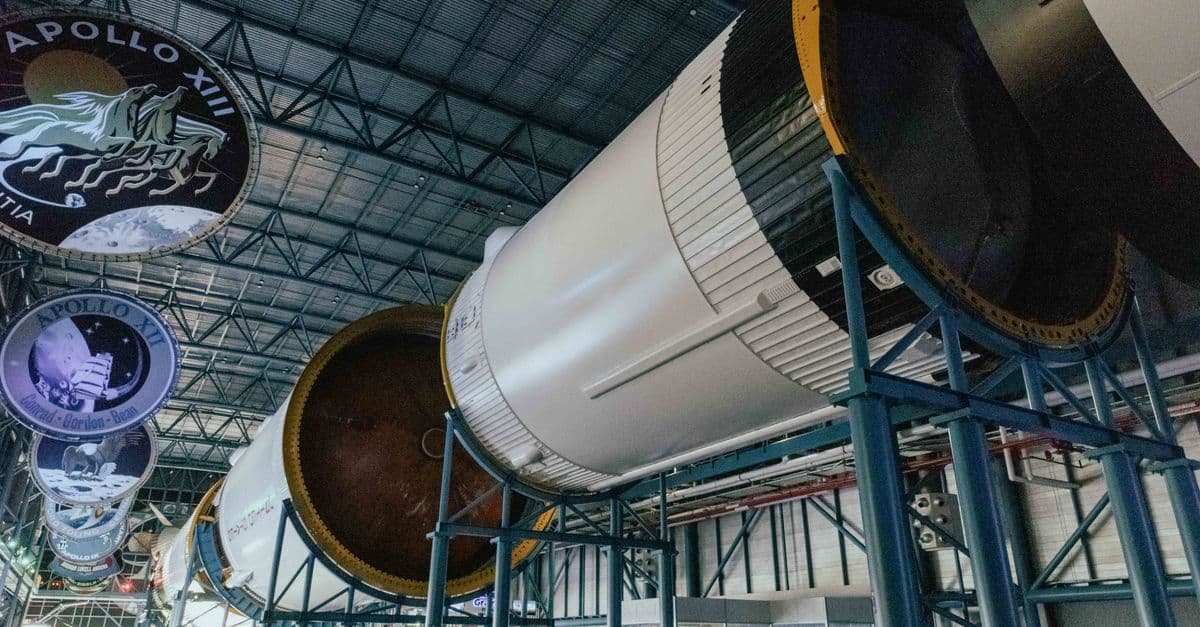
Photo: David Yu / Pexels
A schoolteacher in rural Russia wrote the math for spaceflight in 1903. An American physicist proved it worked on a frozen Massachusetts farm in 1926. A German engineering team built the first machine to actually reach space in 1942. And in December 2015, a privately funded rocket booster landed itself upright on a concrete pad after delivering satellites to orbit. The rocket is arguably the single technology that transformed humanity from a one-planet species into a multiplanetary one — and nearly everything about how it works was figured out before a single person had ever seen outer space.
What a Rocket Actually Is — and Why It Needs No Air
Definition: A rocket is a vehicle or device propelled by the reaction force produced when high-pressure exhaust gases are expelled through a nozzle. Unlike a jet engine, which draws in atmospheric oxygen to combust fuel, a rocket carries both its fuel and its oxidizer. This self-contained chemistry is what makes spaceflight possible.
Most people grow up thinking rockets work by "pushing against the air" — the same intuitive picture that makes a balloon fly across a room when you release it. That picture is partially right. The balloon analogy captures Newton's third law: every action produces an equal and opposite reaction. But rockets do not need air to push against. They work in a vacuum, which is precisely the point.
The key distinction is oxidizer. A car engine burns gasoline using oxygen drawn from the surrounding atmosphere. A rocket engine burns propellant using oxygen it carries with it, either as liquid oxygen (LOX) or as an oxidizer chemically bound inside solid propellant. Remove the atmosphere entirely — as you must above roughly 100 km (62 miles) — and a rocket keeps burning while a jet engine flames out immediately.
This self-sufficiency comes at a steep weight penalty. On the Saturn V moon rocket, about 85 percent of the total launch mass was propellant. The rocket equation, as we'll see, demands it.
Source: NASA (2024) — "What is a Rocket?" educational explainer, Glenn Research Center.
The Equation That Made Everything Possible
In 1903, Konstantin Tsiolkovsky, a self-taught mathematician teaching school in the town of Kaluga, Russia, published a paper titled "The Exploration of Cosmic Space by Means of Reaction Devices" in the journal Nauchnoye Obozreniye (Science Review). In it he derived what is now called the Tsiolkovsky rocket equation.
The equation is written as: Δv = v_e × ln(m₀/m_f)
In plain English: the maximum change in velocity a rocket can achieve depends on two things — the exhaust velocity of the gases leaving the nozzle, and the ratio of the rocket's initial mass (fully fueled) to its final mass (empty of propellant). The natural logarithm relationship has a brutal implication: to go twice as fast, you don't need twice as much propellant, you need exponentially more. To achieve orbital velocity around Earth (roughly 7,800 m/s or 17,500 mph), a single-stage rocket would need to be almost entirely propellant.
Tsiolkovsky's solution, also described in the same paper, was staging: build the rocket in sections, discard each section once its fuel runs out, so the remaining rocket isn't dragging dead weight. He also specified liquid hydrogen and liquid oxygen as the ideal propellants — a combination NASA would use 64 years later on the Saturn V's upper stages.
Tsiolkovsky never built a rocket. He had no workshop, no funding, and worked in a country that had little interest in rocketry at the time. His ideas circulated only in Russian and remained largely unknown to the Western pioneers who would put them into practice.
Source: Wikipedia — "Tsiolkovsky rocket equation," citing the original 1903 publication in Nauchnoye Obozreniye.
The Three Visionaries: Tsiolkovsky, Oberth, and Goddard
The story of the rocket's invention runs through three men working independently on three continents, none of whom knew much about the others' progress until their ideas had already converged.
Konstantin Tsiolkovsky (1857–1935) established the theoretical framework. Deaf from the age of nine after a childhood bout of scarlet fever, he educated himself through Moscow libraries and spent his career teaching mathematics while writing theoretical works on rocketry, space colonization, and even orbital mechanics. He is considered the father of theoretical astronautics.
Hermann Oberth (1894–1989) made the ideas accessible to European engineers and the wider public. In 1923, the Romanian-German physicist published Die Rakete zu den Planetenräumen ("The Rocket into Interplanetary Space") — a book that began as a doctoral thesis rejected by the University of Heidelberg the previous year. In it, Oberth proved four propositions: that the technology of the time could build a machine capable of escaping Earth's atmosphere; that such a machine could reach orbital or escape velocity; that it could carry humans; and that its construction could eventually be economically viable. The book sold out and catalyzed rocketry societies across Germany, including the Verein für Raumschiffahrt (Society for Space Travel), which would later produce Wernher von Braun.
Robert Goddard (1882–1945) was the builder. A physicist at Clark University in Worcester, Massachusetts, Goddard had been obsessed with spaceflight since reading H.G. Wells as a teenager. He worked with both solid and liquid propellants for years, filing patents on multi-stage rockets and liquid-fuel designs as early as 1914. On March 16, 1926, at his aunt Effie's farm in Auburn, Massachusetts, Goddard lit the igniter on a small rocket fueled by liquid oxygen and gasoline, stepped behind a propped-up wooden door for cover, and watched the device — later nicknamed "Nell" — rise 12.5 meters (41 feet) in a 2.5-second flight before coming to rest 56 meters (184 feet) away in a cabbage field.
The flight was neither graceful nor far. It looked nothing like what would follow. But it was the first time a liquid-propellant rocket had ever left the ground.
Source: Smithsonian National Air and Space Museum — "Robert Goddard and the First Liquid-Propellant Rocket," airandspace.si.edu.
Source: Smithsonian Pioneers of Flight — "Hermann Oberth Publishes The Rocket into Interplanetary Space," pioneersofflight.si.edu.
| Year | Milestone | Who |
|---|---|---|
| 1903 | Rocket equation published | Tsiolkovsky |
| 1923 | The Rocket into Interplanetary Space published | Oberth |
| 1926 | First liquid-fuel rocket launch | Goddard |
| 1942 | First rocket to reach "technical" space (50 miles) | V-2 / von Braun |
| 1944 | First rocket to cross the Kármán line (100 km) | V-2 |
| 1957 | First orbital satellite (Sputnik) | Soviet Union |
| 1961 | First human in space (Gagarin) | Soviet Union |
| 1967 | Saturn V first test flight (Apollo 4) | NASA |
| 1969 | First crewed lunar landing (Apollo 11) | NASA |
| 2015 | First orbital-class booster vertical landing | SpaceX |
How a Liquid-Fuel Rocket Engine Actually Works
Think of a liquid-fuel rocket engine as an extremely sophisticated blowtorch pointed backward, operating under conditions that would destroy any ordinary material — chamber pressures exceeding 200 atmospheres, combustion temperatures above 3,300°C (6,000°F), and flow rates that drain a fuel tank the size of a swimming pool in minutes.
The propellants — typically a fuel (liquid hydrogen, kerosene, or methane) and an oxidizer (liquid oxygen) — are stored in separate tanks and pumped by turbopumps into the combustion chamber. The turbopumps are themselves powered by a portion of the propellant, making the system partially self-sustaining. In the combustion chamber, fuel and oxidizer meet and ignite, creating rapidly expanding gases. Those gases exit through a converging-diverging nozzle. The convergence accelerates the flow to the speed of sound; the divergence then accelerates it further, to supersonic exhaust velocities of 2,500 to 4,500 m/s (5,600 to 10,000 mph).
The thrust produced is equal to the exhaust mass flow rate multiplied by the exhaust velocity, plus a pressure correction term. In Robert Goddard's 1926 rocket, the engine was mounted at the top, with the fuel tanks below — an unconventional arrangement he thought would improve stability. Modern rockets universally place engines at the bottom, where gravity-fed or pressure-fed propellant flows downward, simplifying plumbing.
What "Specific Impulse" Measures
Engineers compare rocket engines using a figure called specific impulse (Isp), measured in seconds. Specific impulse is the thrust produced per unit weight of propellant consumed per second — essentially a fuel efficiency rating. A higher Isp means more thrust per kilogram of propellant burned.
Solid propellants: Isp roughly 250–280 seconds. Kerosene-LOX (used in SpaceX Merlin engines): roughly 311 seconds in vacuum. Hydrogen-LOX (used in Space Shuttle Main Engines and Saturn V upper stages): roughly 450 seconds. Hydrogen-LOX is more efficient, but liquid hydrogen is extremely difficult to store — it must be kept below -253°C (-423°F) and has a very low density, requiring enormous tanks.
Source: NASA Glenn Research Center — "Specific Impulse," grc.nasa.gov.
The V-2: Engineering Genius in the Service of Terror
The first rocket to actually reach space was built by a team led by Wernher von Braun at Peenemünde Army Research Center on the Baltic coast of Germany. The A-4 — later renamed Vergeltungswaffe 2, or V-2 by Nazi propaganda — was a 14-meter (46-foot) ballistic missile burning ethanol and liquid oxygen, producing 25,000 kg (55,000 lb) of thrust.
On October 3, 1942, an A-4 test vehicle reached an altitude of approximately 80 km (50 miles) — what was then considered "technical" outer space. On June 20, 1944, a V-2 crossed the Kármán line at 100 km (62 miles), becoming the first human-made object to reach outer space by the modern definition. It arrived there as a weapon.
Hitler ordered mass production in December 1942. By the war's end, roughly 3,000 V-2s had been fired against targets in London, Antwerp, and elsewhere, killing an estimated 9,000 civilians. A further 12,000 concentration camp prisoners and forced laborers died building them at the Mittelwerk underground factory — more than were killed by the weapons themselves. The moral reckoning around the V-2 and its chief architect, von Braun, has never been fully resolved.
After the war, the United States recruited von Braun and over 100 German rocket engineers through Operation Paperclip, a classified program that brought them to work at what became NASA. The Soviet Union did the same with other Peenemünde personnel. The Cold War space race was, in a direct technical lineage, built on V-2 engineering.
Source: V-2 Rocket — Wikipedia, citing EDN and Smithsonian sources on October 3, 1942 test.
Source: Smithsonian Magazine — "Wernher von Braun's V-2 Rocket," smithsonianmag.com.
Sputnik, the Space Race, and the Saturn V
On October 4, 1957, the Soviet Union launched Sputnik 1 — an 84-kg (184-lb) aluminum sphere — into low Earth orbit using an R-7 intercontinental ballistic missile. Sputnik did nothing more complex than transmit a radio beep. Its political and psychological effect on the United States was seismic.
The Space Race that followed produced the most powerful rocket ever built. The Saturn V, designed by von Braun's team at NASA's Marshall Space Flight Center, stood 110.6 meters (363 feet) tall, weighed 2.8 million kilograms (6.2 million pounds) fully fueled, and generated 34.5 million newtons (7.6 million pounds) of thrust at liftoff — equivalent to the power output of 85 Hoover Dams. Its first unmanned test flight, Apollo 4, launched on November 9, 1967, from Launch Complex 39A at Kennedy Space Center.
The Saturn V's five first-stage F-1 engines remain the most powerful liquid-fuel rocket engines ever flown, each producing roughly 6.7 million newtons (1.5 million pounds) of thrust individually. All 13 Saturn V launches succeeded. Not one was lost.
Source: NASA — "What Was the Saturn V?" nasa.gov/learning-resources.
Source: NASA — Apollo 4 mission summary, nasa.gov/mission/apollo-4.
Patent Disputes and the Question of Credit
Robert Goddard was famously secretive — a consequence of being publicly mocked by the New York Times after a 1920 Smithsonian report. An editorial dismissed his claim that a rocket could work in a vacuum, arguing incorrectly that there was nothing for it to push against. (The Times published a correction on July 17, 1969 — the day after Apollo 11 launched.) That ridicule made Goddard reluctant to publish results, preferring patents to papers.
Goddard held over 200 rocket-related patents by his death in 1945, including patents on multi-stage rockets, gyroscopic guidance, and liquid-fuel engine design. After the war, the U.S. government and aerospace companies that had built heavily on Goddard's patented concepts settled with his estate for $1 million in 1960.
The priority question between Tsiolkovsky, Oberth, and Goddard is genuinely complex. Tsiolkovsky published the theoretical framework first, but in Russian with minimal international reach. Oberth developed the ideas independently and made them accessible. Goddard ran independent experiments without knowing Tsiolkovsky's work in detail. The three men arrived at overlapping conclusions through separate paths — the classic pattern in invention history, where a technology becomes inevitable before any single person makes it happen.
Source: NASA History — "95 Years Ago: Goddard's First Liquid-Fueled Rocket," nasa.gov/history.
Unintended Consequences: Weapons, Satellites, and GPS
The rocket's first practical application was not space exploration — it was killing. The V-2 demonstrated that a rocket-propelled warhead could travel 320 km (200 miles) in under five minutes, arriving faster than any warning system could respond. That capability drove Cold War ballistic missile programs that, at their peak, had over 60,000 nuclear warheads on alert worldwide.
The same technology that threatened human civilization built the infrastructure it now runs on. Every GPS satellite orbits because a rocket placed it there. Every weather forecast relies on data from satellites that rockets launched. The internet's backbone relies partly on satellite communications. The GPS system — which became fully operational in 1995 — exists only because the United States developed reliable enough rockets to place 24 satellites in medium Earth orbit with enough precision to provide 10-meter (33-foot) positioning accuracy.
Communications satellites, Earth observation platforms, space telescopes including the Hubble Space Telescope: each represents a multi-billion-dollar industry that traces its entire existence back to the question of how to reach orbit.
The rocket also accelerated materials science. NASA's demand for lightweight, heat-resistant materials drove development of composites, ceramic coatings, and alloys that now appear in aircraft, medical devices, and consumer electronics. The microchip, miniaturized in part because spacecraft need small, light electronics, owes some of its trajectory to the space program.
Source: Union of Concerned Scientists — Satellite Database, ucsusa.org.
The People Who Made It Happen — and Their Complicated Legacies
Konstantin Tsiolkovsky died in 1935, celebrated in Soviet Russia as a prophet of the space age. He never saw a liquid-fuel rocket fly.
Robert Goddard worked in secrecy through the 1930s with Guggenheim Foundation funding, conducting increasingly sophisticated launches in Roswell, New Mexico. He died of throat cancer in August 1945, two months after Germany's surrender, never knowing how directly his work had influenced the V-2.
Wernher von Braun remains the most contested figure in rocket history. His brilliance as an engineer is unquestioned; he became the public face of NASA's rocket program, received the National Medal of Science in 1975, and was the subject of a Disney television series in the 1950s. His culpability for the forced labor that built the V-2 is documented and acknowledged. He was a member of both the Nazi party (joined 1937) and the SS (joined 1940). Whether his post-war work redeems, complicates, or simply coexists with that record is a question historians continue to argue.
Sergei Korolev, the Soviet counterpart to von Braun, was the anonymous engineer behind Sputnik, Vostok (which carried Gagarin), and the Soviet lunar program. His identity was classified by the Kremlin for decades; he was known publicly only as "the Chief Designer." He died of colon cancer in January 1966 during surgery, leaving the Soviet lunar program rudderless.
For cross-reference on the scientists behind spaceflight, see Konstantin Tsiolkovsky and the history of the microchip for the parallel miniaturization story.
SpaceX and the Reusability Revolution
Between 1969 and 2015, every orbital rocket — including the Space Shuttle — either crashed into the ocean, burned up in reentry, or was expended. The first stage, containing the expensive engines, was destroyed on every launch. SpaceX, founded by Elon Musk in 2002, bet the company on changing that.
On December 21, 2015, a Falcon 9 booster delivered 11 Orbcomm OG2 satellites to orbit, then re-oriented, reignited its engines, and landed vertically at Landing Zone 1 at Cape Canaveral — the first orbital-class rocket booster ever to do so. The recovered booster was later displayed outside SpaceX's headquarters in Hawthorne, California.
By mid-2026, SpaceX had completed over 400 Falcon 9 booster landings and routinely reflew the same booster 15 or more times. A single Falcon 9 booster has flown over 30 missions. The per-kilogram cost to low Earth orbit dropped from roughly $54,500 (Space Shuttle era) to approximately $2,700 on a reused Falcon 9 — a 95 percent reduction.
SpaceX's Starship — a fully reusable two-stage vehicle using methane and liquid oxygen — is designed to carry 100+ tonnes to low Earth orbit, a payload capacity exceeding the Saturn V. Its development program has involved multiple high-altitude test flights and integrated launch tests, with the system aimed at both lunar missions under NASA's Artemis program and eventual Mars colonization.
Source: Space.com — "SpaceX Lands Orbital Rocket Successfully in Historic First," space.com/31420.
Source: SpaceflightNow — "SpaceX completes 400th Falcon booster landing," spaceflightnow.com (2025).
Where Rockets Stand Today
The rocket has not changed in fundamental principle since Goddard's 1926 demonstration. Propellant combustion, reaction thrust, and the Tsiolkovsky equation still govern every launch. What has changed is scale, materials, guidance, and — most recently — reusability.
As of 2026, orbital-class rocket launches occur roughly once every two to three days globally, a cadence that would have been considered science fiction in the Apollo era. SpaceX, Rocket Lab, United Launch Alliance, Arianespace, ISRO, CNSA, and JAXA all operate commercial and government launch services. Smallsat constellations — particularly SpaceX's Starlink, which by 2026 numbers over 7,000 operational satellites — are transforming broadband internet access in underserved regions.
The next frontier is cost. If Starship achieves its projected economics, the cost of access to orbit could fall another order of magnitude, making space manufacturing, in-space refueling, and large-scale lunar activity economically plausible within a generation.
Tsiolkovsky's 1903 equation still tells you exactly how much propellant you'll need. You just need a lot less money to buy it.
Source: NASA — "Wernher von Braun," nasa.gov/people/wernher-von-braun.
FAQs
Q: Who invented the liquid-fuel rocket?
A: Robert Goddard built and flew the first liquid-fuel rocket on March 16, 1926, in Auburn, Massachusetts. Konstantin Tsiolkovsky derived the theoretical framework in 1903, and Hermann Oberth published key design principles in 1923. All three worked independently.
Q: When did the first rocket reach outer space?
A: A German V-2 rocket crossed the Kármán line (100 km / 62 miles) on June 20, 1944, becoming the first human-made object to reach outer space by the modern definition. An earlier V-2 test on October 3, 1942, reached approximately 80 km — "technical" space by some definitions.
Q: How does a rocket work in the vacuum of space with nothing to push against?
A: A rocket doesn't push against the surrounding medium. It works by Newton's third law: expelling mass (exhaust gases) at high velocity in one direction generates an equal and opposite reaction force on the rocket. This works equally well in a vacuum.
Q: What is the Tsiolkovsky rocket equation?
A: The equation relates a rocket's achievable velocity change (Δv) to its exhaust velocity and the ratio of its initial mass to its final mass: Δv = v_e × ln(m₀/m_f). The logarithmic relationship means achieving higher velocities requires exponentially more propellant, which is why rockets are mostly fuel by mass.
Q: Why did SpaceX's reusable rockets change the industry?
A: Reusability dramatically reduces per-launch cost. The Falcon 9 first stage costs roughly $30 million to manufacture; a reflight amortizes that cost across multiple missions. SpaceX reduced the cost to orbit from roughly $54,500 per kilogram (Space Shuttle era) to approximately $2,700 per kilogram on a reused Falcon 9.
Q: What is the most powerful rocket ever built?
A: The Saturn V, which launched Apollo missions between 1967 and 1972, remains the most powerful rocket ever flown, generating 34.5 million newtons (7.6 million pounds) of thrust at liftoff. SpaceX's Starship is designed to exceed it in payload capacity.
Read next:
Weekly digest
Stay ahead of the curve
Get the best science, AI, and tech stories delivered to your inbox every week. No spam — unsubscribe any time.
About the Author
SciHub101 is an independent science and technology publication founded and edited by Buğra Sözeri, a software engineer and app developer based in Türkiye. Articles are drafted against peer-reviewed literature and primary sources, fact-checked, and edited by a human before publication. Where we compare products, anything built by our own team is labelled as such — see the editorial guidelines and About page for how corrections and disclosures work.
Related Articles
The Roller Coaster: From Russian Ice Slides to 240 km/h Steel
Roller coasters evolved from 17th-century Russian ice slides to 240 km/h steel machines. Here's the full engineering and cultural history of the world's most engineered thrill.

The Refrigerator: How Mechanical Cooling Changed Food, Medicine, and Cities
From Jacob Perkins's 1834 vapor-compression patent to Einstein's no-moving-parts design, discover the full history of refrigeration and how it reshapes human civilization.
The Jet Engine: How Two Engineers on Opposite Sides of a War Changed Flight
Frank Whittle patented the jet engine in 1930. Hans von Ohain flew one in 1939. Neither knew the other existed. Their parallel invention and eventual friendship is the story of modern aviation.

Robert Goddard: The Engineer Who Built the First Liquid-Fueled Rocket
Robert Goddard launched the first liquid-fueled rocket in 1926, held 214 patents, and was ridiculed by the NYT — which retracted its criticism hours before Apollo 11 landed.
SpaceX Starship Explained — Rocket Built for Mars
SpaceX Starship is the largest rocket ever built — 121m tall, fully reusable, designed for Mars. How Raptor engines, orbital refueling, and Flight 13 work.

SpaceX and the New Space Race: 2026 Status
How SpaceX transformed rocket economics, Starship milestones, Starlink, and the intensifying US-China space competition in 2026.