The Roller Coaster: From Russian Ice Slides to 240 km/h Steel
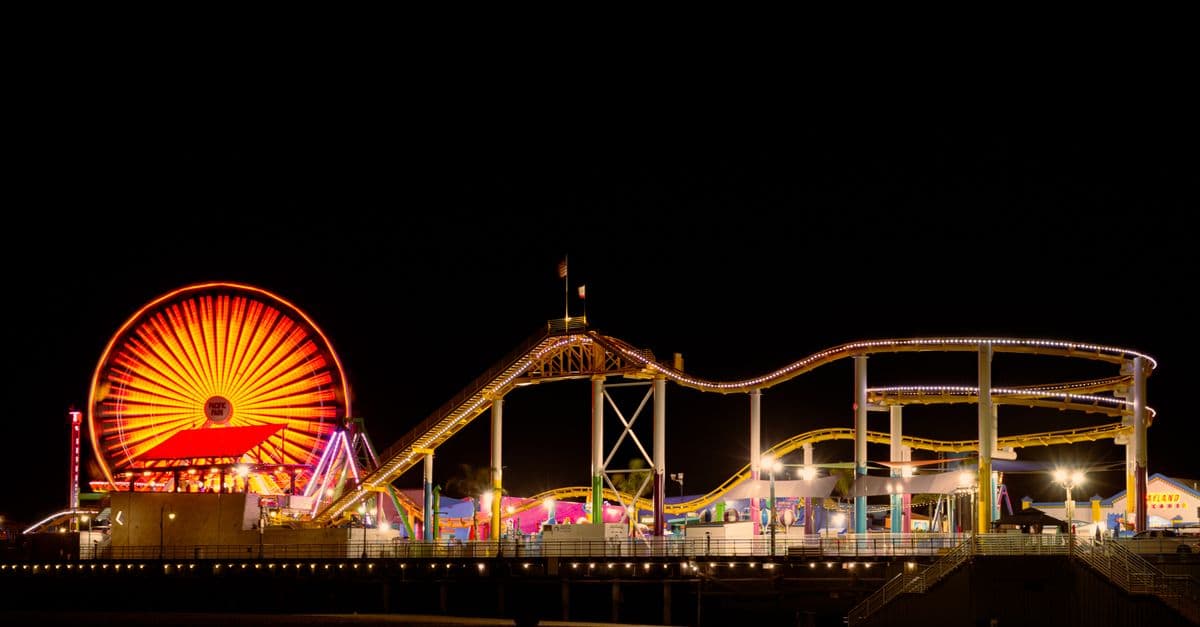
Photo: Andrei Serikov / Pexels
A roller coaster is a controlled fall — engineered to bring a rider as close as possible to the sensation of freefall while maintaining the statistical safety of a commercial vehicle. The first version was a wooden ramp covered in ice, built in 17th-century Russia as a winter diversion for the aristocracy. The latest version, Formula Rossa at Ferrari World in Abu Dhabi, reaches 240 km/h (149 mph) using a hydraulic launch system and generates forces on its riders comparable to those experienced by fighter jet pilots. Between those two endpoints lies three centuries of engineering refinement, cultural transformation, and an ongoing competition between amusement parks to push every metric — speed, height, drop angle, inversion count — to a new extreme.
The Physics of a Roller Coaster
Before the history, the mechanism. A roller coaster is an energy conversion system. At the start of a traditional coaster, a chain lift or launch mechanism adds potential energy to the train by raising it or accelerating it. From that point forward, the ride is largely governed by conservation of energy: potential energy (height) converts to kinetic energy (speed) and back, with some energy lost to air resistance and friction at each cycle.
The sensation of weightlessness at the top of a hill happens because the track curves away from the rider faster than gravity pulls them down. At that moment, the normal force from the seat (what you feel as weight) approaches zero. Engineers call this "airtime," and maximizing quality airtime is one of the central objectives of coaster design. Inversions — loops, corkscrews, zero-G rolls — produce the opposite sensation by redirecting centripetal force through the body from unexpected angles.
Think of the train as a marble in a tube shaped by the track. Gravity is constant; the tube's geometry determines everything the marble experiences. The coaster engineer's job is to shape the tube so the marble's path feels like flying without actually becoming uncontrolled.
The wheel assembly is critical to modern coasters. Three sets of wheels grip the track on three faces: road wheels (on top), upstop wheels (underneath, preventing the car from flying off on airtime hills), and guide wheels (on the sides, preventing lateral displacement). This three-point grip allows designers to build overbanked turns, beyond-vertical drops, and elements that would simply fling passengers off a traditional ride.
Russian Ice Slides: The 17th-Century Origin
The most direct ancestors of the modern roller coaster are the ice slides of Russia — wooden scaffolding structures covered with packed snow and ice, down which sleds carrying passengers descended at speeds that, for the 17th century, were genuinely startling.
Source: National Roller Coaster Museum — Roller Coaster History
Built around Saint Petersburg from the mid-1600s onward, these structures typically stood 20 to 25 meters (65 to 82 feet) high, with a descent angle steep enough to achieve sled speeds of 50 to 70 km/h (roughly 30 to 43 mph) on packed ice. They were initially a diversion of the Russian aristocracy and upper merchant class, with separate slides for male and female riders — women and children riding in small sleds, men standing. The rides became popular enough that wooden structures were maintained year-round by some operators, eventually with summer variants using wheeled cars on wooden rails rather than sleds on ice.
French visitors to Russia brought the concept back to Western Europe, where it was known as "les montagnes russes" (Russian mountains) — a name still used in many European languages for roller coasters. By the early 19th century, Paris had several fixed wheeled-car gravity rides operating as commercial entertainment. The key French innovation was the addition of a continuous track that returned the car to the starting point rather than requiring passengers to climb back up on foot.
The first coaster with a looping element — the Centrifugal Railway, built in Paris around 1846 — operated briefly but caused enough rider injuries from the abrupt transition into the vertical loop that it was shut down. The loop problem would not be adequately solved until the 1970s, when the teardrop-shaped vertical loop (wider at the bottom than the top, reducing G-forces at the crest) replaced the circular loop design.
LaMarcus Thompson and the American Roller Coaster (1884)
The American roller coaster begins, specifically, on June 16, 1884, at Coney Island in Brooklyn, New York, when LaMarcus Adna Thompson opened the Switchback Railway. Thompson, an Ohio businessman who had made money in hosiery manufacturing, had visited European gravity rides and seen their commercial potential.
The Switchback Railway was modest by later standards: two parallel tracks with two 45-foot (13.7 m) towers at each end. Passengers rode from one tower to the other at a top speed of roughly 10 km/h (6 mph), then climbed the second tower to ride back. The ride cost five cents. In its first season, Thompson reportedly earned $600 per day — a substantial sum in 1884. He had identified a market that had not yet articulated its own desire.
Thompson patented improvements rapidly, including gravity-return tracks that eliminated the need for passengers to climb back up. By 1888 his L.A. Thompson Scenic Railway Company had built nearly 50 coasters across the United States and Europe. The scenic railway concept — tracks designed to pass through tunnels and past painted panoramic scenes — was Thompson's attempt to add narrative to the physical sensation.
Competitors multiplied. Phillip Hinkle introduced the chain-lift hill in 1885, which replaced the gravity-only ascent and allowed much steeper initial drops because the train could be positively driven to the top regardless of its starting momentum. This single mechanical addition — a powered chain engaging a hook on the bottom of the train — defined the classical coaster's profile for the next century.
The Golden Age: Cyclone, Thunderbolt, and Wooden Coasters (1920s–1950s)
By the 1920s, Coney Island had become the world's foremost amusement park district, with multiple competing parks (Luna Park, Dreamland, Steeplechase) operating dozens of rides. The wood-and-steel coasters of this era — built by firms like Prior & Church and the Philadelphia Toboggan Company — pushed heights and speeds to levels that wooden construction could sustain.
The Cyclone, opened at Coney Island on June 26, 1927, established a benchmark that enthusiasts still cite. Designed by Vernon Keenan and Harry Baker, it stood 26 meters (85 feet) at its peak, achieved speeds of approximately 97 km/h (60 mph) on its first drop, and packed 12 drops into a 91-second ride along 2,700 feet (823 m) of track. Charles Lindbergh, who had just completed the first solo transatlantic flight, rode the Cyclone in 1927 and reportedly said it was "more thrilling than flying." The Cyclone still operates today at Coney Island, a National Historic Landmark.
Source: Heart of Coney Island — Thompson Scenic Railways History
The Great Depression and World War II devastated the amusement park industry. Many parks closed; others reduced maintenance budgets to the point where rides deteriorated. The Coney Island park district never fully recovered its pre-Depression attendance levels. By the 1950s, the classical wooden coaster was associated in the public imagination with run-down, slightly dangerous fairground entertainment.
The Matterhorn Breakthrough: Tubular Steel (1959)
The transformation of the roller coaster from a declining fairground attraction to a centerpiece of modern themed entertainment begins on June 14, 1959, at Disneyland in Anaheim, California.
Source: WDW Magazine — How Disneyland's Matterhorn Changed Theme Parks Forever
Walt Disney wanted a mountain ride inside a 147-foot replica of the Swiss Matterhorn. The challenge was geometric: conventional angle-iron rails could not be bent tightly enough to fit two intertwining tracks inside the mountain's footprint. Arrow Development, a California engineering firm led by Karl Bacon and Ed Morgan, solved the problem by fabricating the tracks from tubular steel — hollow steel cylinders that could be bent into curves of far smaller radius than angle iron.
The tubular steel track was a fundamental engineering breakthrough. Round steel tubes bend smoothly in any plane without distorting, whereas angle iron (L-shaped cross-section) bends cleanly only along its primary axis. The result was a track that could execute spiral curves, banked turns, and directional changes impossible with the prior material. Simultaneously, the wheel assembly that Arrow developed to grip tubular track allowed upstop wheels to function reliably around tight curves — meaning the train could safely execute elements that would have thrown passengers from an older-style coaster.
Source: Steel Roller Coaster — Wikipedia
"Virtually every roller coaster since Matterhorn can trace its lineage to Arrow's breakthrough innovation," the Los Angeles Times observed in a retrospective. The Matterhorn also introduced the now-standard practice of computer-aided track layout — Imagineers used early computing tools to model the train's path through the structure. The combination of tubular steel track and computer design opened the path to every subsequent coaster innovation.
A Timeline of Key Milestones
| Year | Ride / Innovation | Significance |
|---|---|---|
| 1600s | Russian ice slides, St. Petersburg | First documented gravity-ride entertainment |
| 1846 | Centrifugal Railway, Paris | First looping coaster; closed after rider injuries |
| 1884 | Switchback Railway, Coney Island | First American roller coaster (LaMarcus Thompson) |
| 1885 | Chain-lift hill (Phillip Hinkle) | Enabled powered ascent, steeper first drops |
| 1927 | Cyclone, Coney Island | Benchmark wooden coaster; still operating |
| 1959 | Matterhorn Bobsleds, Disneyland | First tubular steel coaster; invented by Arrow Development |
| 1975 | Corkscrew, Knott's Berry Farm | First modern inverting coaster for a general park audience |
| 1989 | Magnum XL-200, Cedar Point | First hypercoaster (over 200 ft); started "coaster wars" era |
| 2000 | Steel Dragon 2000, Japan | World's longest coaster at 2,479 m (8,133 ft) |
| 2010 | Formula Rossa, Ferrari World Abu Dhabi | World's fastest coaster, 240 km/h (149 mph) |
The Hypercoaster Era and the Coaster Wars (1989–Present)
The Magnum XL-200, opened at Cedar Point in Sandusky, Ohio on May 6, 1989, was the first roller coaster to exceed 200 feet (61 m) in height and the first officially designated hypercoaster. Built by Arrow Dynamics (Arrow Development's successor), it stood 205 feet (62.5 m) at its peak, dropped 195 feet at a 60-degree angle, and reached a top speed of 116 km/h (72 mph).
Source: Magnum XL-200 — Wikipedia
The Magnum's success triggered what the industry calls the "coaster wars" — a period in which major parks competed intensively to build the next height, speed, or length record. Cedar Point itself became the most contested battleground, eventually housing more record-breaking coasters than any other park in the world. The Magnum was surpassed in height by Paramount's The Big One (UK, 1994), then by Superman: Ride of Steel (1997), then by Millennium Force at Cedar Point (2000, 310 feet), then by Steel Dragon 2000 in Japan (318 feet), and so on.
Each record required solving new engineering problems. At 300 feet, the speed at the bottom of the first drop exceeds 140 km/h, and conventional wheel assemblies heat from friction. Track must be designed for thermal expansion over a 50-degree temperature range. The structural loads on support columns increase non-linearly with speed, requiring more steel per unit of height.
Rocky Mountain Construction (RMC), a coaster builder founded in 2001, introduced a hybrid design that combined wooden coaster support structures with modern steel track systems. This approach allowed operators to repurpose aging wooden coasters into modern, high-performance rides with inversions — something traditional wooden track cannot safely execute. RMC's "I-box" track system uses a steel box-beam rail instead of tubular steel or traditional wooden rails, enabling sharper transitions and more complex geometries.
Formula Rossa at Ferrari World Abu Dhabi, which opened on November 4, 2010, holds the current record for highest launch speed. Its hydraulic launch system accelerates riders from 0 to 240 km/h (0 to 149 mph) in 4.9 seconds — a rate of acceleration of approximately 1.7 g. At that speed, riders are required to wear protective glasses; aerodynamic forces on the face at 240 km/h are significant enough to cause discomfort without eye protection.
Patent Disputes and the Intellectual Property of Motion
The roller coaster industry has generated a consistent volume of intellectual property litigation, primarily over track profile patents, wheel assembly designs, and launch mechanism technologies.
Arrow Development's tubular steel track system was broadly patent-protected in the 1960s, which is one reason competing firms were slow to enter the steel coaster market. When key Arrow patents expired, German firm Schwarzkopf and Swiss firm Intamin moved aggressively into the market in the 1970s, introducing the modern vertical loop (in its teardrop configuration) and the first successful looping coasters for general park audiences.
Source: Steel Roller Coaster — Wikipedia
The linear induction motor (LIM) and linear synchronous motor (LSM) launch systems — which accelerate trains using electromagnetic force rather than hydraulics or cable — have been the subject of ongoing licensing disputes. Premier Rides and Intamin both developed competing electromagnetic launch systems in the 1990s, and the patent landscape around launch technology influenced which parks could build which types of rides.
Unintended Consequences: Safety, Physics, and the Headache Problem
The roller coaster's unintended consequences are almost entirely about the body. As coasters pushed G-forces higher in the 1990s and 2000s, a class of injuries associated with rapid head movement — particularly lateral whipping from poor over-the-shoulder restraints — became a documented problem. The industry largely solved this by replacing the over-the-shoulder restraints common on older looping coasters with vest-style or lap-bar-only harnesses on modern designs, which allow head freedom while constraining the torso.
There is also a neurological dimension. Sustained high G-forces compress the spine, and the combination of G-force profile and vibration on some older coasters is associated with a specific type of post-ride headache linked to cerebrospinal fluid pressure changes. Research into this is ongoing, but the trend toward vest-style restraints and smoother magnetic braking systems has reduced reported incidents significantly.
The 4D wing coaster — introduced by S&S Worldwide in 2012 — takes the body mechanics question in a new direction. On a 4D coaster, passenger seats are mounted on arms that extend to the sides of the track, and the seats rotate independently of the train's movement based on a second rail. Riders experience not just the coaster's track geometry but a choreographed sequence of seat rotations, potentially spinning through 360 degrees at calculated moments. The sensation is explicitly designed to disorient proprioception — the body's sense of its own position in space.
Where the Roller Coaster Stands Today
There are approximately 5,000 roller coasters operating worldwide, according to the Roller Coaster Database (RCDB), which tracks verified operational rides. The United States has the largest concentration of coasters globally, with several hundred parks hosting multiple installations.
Source: Roller Coaster Database — RCDB
The record metrics as of 2026: Formula Rossa holds the speed record at 240 km/h. Kingda Ka at Six Flags Great Adventure (New Jersey) holds the height record at 139 meters (456 feet). Steel Dragon 2000 in Japan holds the length record at 2,479 meters (8,133 feet). These records are contested with some regularity as parks commission new rides.
The current direction of coaster innovation is less about absolute record-breaking than about ride experience quality. The "magnetic braking" systems (eddy current brakes, LSM brakes) that replaced the friction-fin braking of 1990s coasters allow much smoother speed control and dramatically reduced mechanical noise. Computer-controlled dispatch systems allow precise spacing between trains, increasing throughput. On-ride camera systems, now standard at most major parks, have become significant revenue streams.
The roller coaster has traveled from a Russian nobleman's ice-covered wooden scaffold to a hydraulically launched steel machine generating 1.7 g in under 5 seconds. The physics connecting them is identical. The engineering required to exploit those physics has changed in every dimension.
FAQs
Q: What was the first roller coaster? A: The most direct ancestors were the Russian ice slides of the 17th century, built near Saint Petersburg. These were wooden scaffolding structures covered with snow and ice, down which sleds descended at speeds up to 70 km/h. The first American roller coaster is typically dated to LaMarcus Thompson's Switchback Railway at Coney Island, which opened on June 16, 1884.
Q: What made the Matterhorn Bobsleds historically significant? A: It was the world's first roller coaster to use tubular steel track, opening at Disneyland on June 14, 1959. The tubular steel track design, developed by Karl Bacon and Ed Morgan of Arrow Development, allowed curves and elements impossible with prior angle-iron construction, and became the foundation of every subsequent steel coaster design.
Q: What is a hypercoaster? A: A hypercoaster is a steel roller coaster with a height of 200 feet (61 m) or more, typically featuring multiple airtime hills rather than inversions. The Magnum XL-200 at Cedar Point, which opened in 1989, was the first official hypercoaster. The category was defined largely in retrospect as a marketing distinction.
Q: What is the world's fastest roller coaster? A: Formula Rossa at Ferrari World Abu Dhabi, which opened in November 2010. It reaches 240 km/h (149 mph) via a hydraulic launch system in approximately 4.9 seconds.
Q: Why do modern roller coasters use lap bars instead of over-the-shoulder restraints? A: Over-the-shoulder restraints on older looping coasters caused lateral head impacts during rough transitions, contributing to headaches and ear injuries. Modern lap bar and vest-style restraints constrain the torso while allowing head freedom, reducing impact incidents and generally providing a smoother ride experience.
Q: What is an RMC hybrid roller coaster? A: A design by Rocky Mountain Construction that replaces the wooden rails of a traditional wooden coaster with a steel I-box track system, while retaining the wooden support structure. This allows the coaster to perform high-speed inversions and sharp directional changes impossible with wood-on-wood systems, often dramatically transforming older wooden coasters.
The Takeaway
The roller coaster's engineering history is a record of constraints successively broken: the material constraint of wood, solved by steel; the geometry constraint of angle-iron, solved by tubular construction; the power constraint of chain lifts, solved by launch systems; the smoothness constraint of friction braking, solved by magnetic braking. Each constraint, once resolved, made a new set of experiences possible, which drove a new set of commercial demands, which motivated the next engineering challenge. The ride that began as a Russian aristocrat's winter novelty became, over three centuries, one of the most precisely engineered machines designed for the sole purpose of making a human body feel alive.
Read next:
Weekly digest
Stay ahead of the curve
Get the best science, AI, and tech stories delivered to your inbox every week. No spam — unsubscribe any time.
About the Author
SciHub101 is an independent science and technology publication founded and edited by Buğra Sözeri, a software engineer and app developer based in Türkiye. Articles are drafted against peer-reviewed literature and primary sources, fact-checked, and edited by a human before publication. Where we compare products, anything built by our own team is labelled as such — see the editorial guidelines and About page for how corrections and disclosures work.
Related Articles

The Saxophone: How a Belgian Misfit Instrument Changed Music
The saxophone was patented in 1846 by Adolphe Sax, a man who nearly died 12 times before age 20. Here's how his misfit instrument conquered jazz.
The Rocket: From Gunpowder Tubes to Reusable Spacecraft
How the liquid-fuel rocket was invented — from Tsiolkovsky's 1903 equation to Goddard's 1926 launch, the V-2, Apollo, and SpaceX's reusable boosters.
Airplane Invention: The Wright Brothers and Controlled Flight
The Wright brothers solved controlled powered flight, but gliders, engines, wind tunnels, and earlier aviation pioneers all mattered.
The Internal Combustion Engine — History, Mechanics, and What Comes Next — SciHub101
From Lenoir's 1860 coal-gas motor to Diesel's compression ignition, the internal combustion engine powered a billion vehicles. Here is how it works and where it is going.
Structural Battery Composites Explained: When Materials Carry Loads and Store Energy
Structural batteries combine mechanical load-bearing and electrochemical storage in one composite system. Learn the materials science, accounting challenges, prototypes and limits behind the idea.