Structural Battery Composites Explained: When Materials Carry Loads and Store Energy

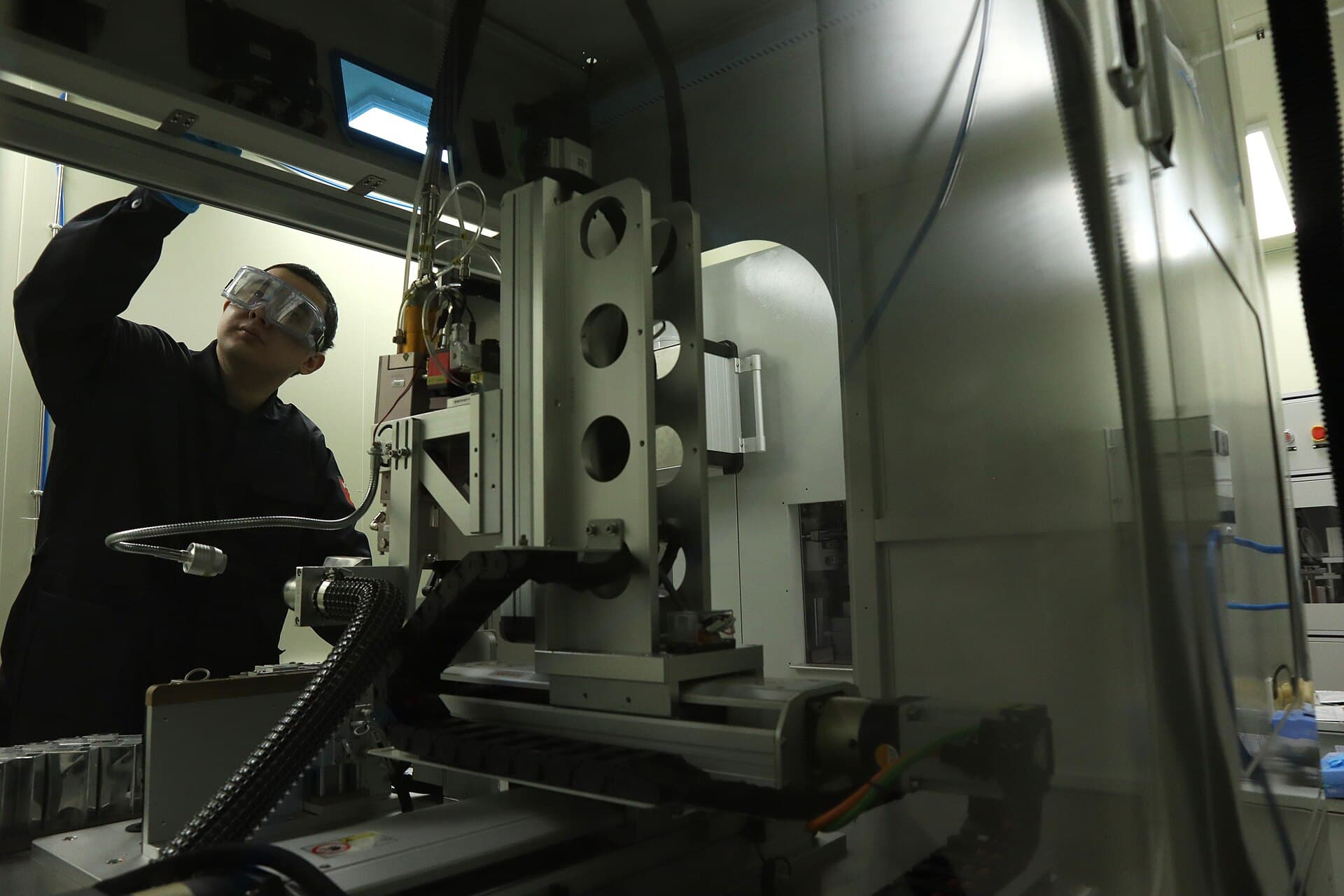
Photo: U.S. Department of Energy / doe-oakridge (Public domain) / Wikimedia Commons / Public domain
An electric vehicle carries two heavy things that do different jobs: a body that holds the loads and a battery that stores the energy. A structural battery composite tries to merge them, so that the same carbon fiber that stiffens a panel also stores charge. The idea is old, the laboratory results are real, and the hard part is the arithmetic of what counts as a saving. This article explains how these materials are built, what the published numbers mean, and why almost none of them are products.
What a structural battery is, and what it is not
A structural battery is a multifunctional material or structure that acts as an electrochemical energy store while keeping mechanical integrity (Wikipedia: Structural battery). The phrase covers three different designs, and mixing them up is the source of most confusion in headlines.
The first is the embedded approach. Off-the-shelf thin lithium-ion cells are bonded or co-cured into a laminate or sandwich panel. A 2021 review in Molecules by Danzi and colleagues notes that in this design the cells carry no load themselves, so it mainly optimizes volume rather than weight (Danzi et al., 2021).
The second is the monolithic or multifunctional-material approach. Carbon fibers act as electrodes and as reinforcement, and the polymer matrix acts as the electrolyte and the structural binder, so a single composite does both jobs (Danzi et al., 2021). The third uses all-solid-state electrolytes as an alternative way to build the same idea.
A structural battery pack enclosure, in which a metal or composite case carries vehicle loads around separate cells, is a fourth thing that people sometimes call "structural." It is a packaging choice and does not make the cells themselves load-bearing.
| Design | What carries the load | What stores the energy | Typical trade-off |
|---|---|---|---|
| Embedded cells in a panel | Laminate face sheets and core | Conventional thin cells | Saves volume; the cells add mass and can weaken the panel |
| Carbon-fiber structural electrodes | Carbon fibers and polymer matrix | The same fibers, with a cathode and electrolyte | Potential mass saving; low energy and hard manufacturing |
| Structural pack enclosure | The case around the cells | Conventional cells | Simpler; cells stay replaceable but are not part of the structure |
Why combine structure and storage: the multifunctional efficiency test
The pitch is duplicated mass. A vehicle carries structure to support loads and cells to store energy, and every kilogram of either has to be carried by the other. If one material did both jobs, the total could in principle fall. The question is how much of each job it has to give up.
Researchers formalize this with a multifunctional efficiency, defined by O'Brien and coworkers as η_mf = η_s + η_e, where η_s is the structural efficiency (how stiff the material is for its mass compared with a reference structural material) and η_e is the energy efficiency (how much energy it stores for its mass compared with a reference battery). The review notes that η_mf must exceed 1 for the material to be advantageous (Danzi et al., 2021). The review also points out the key implication: integrating an electrical device into a structure does not by itself reduce mass.
Here is an illustrative case, with made-up round numbers to show the logic. Suppose a structural battery material is 60% as stiff per kilogram as the best conventional carbon laminate (η_s = 0.6) and stores 40% as much energy per kilogram as a good conventional cell (η_e = 0.4). The sum is 1.0, which is break-even. A material that reached 0.5 and 0.7 would score 1.2 and would save mass, while one that reached 0.3 and 0.3 would be heavier than keeping the structure and battery separate.
A useful analogy is a Swiss Army knife. A knife that is almost as good a blade as a dedicated knife and almost as good a screwdriver as a dedicated screwdriver is worth carrying only if the sum of its compromises is smaller than the weight of carrying both tools. Many structural battery claims do not state which reference material the efficiencies are measured against, so they cannot be checked against that test.
A short history of the idea
Structural power research grew out of work on structural capacitors and carbon fiber electronics. The milestones in the Danzi review give the outline (Danzi et al., 2021).
| Year | Milestone |
|---|---|
| 1999 | Chung and Wang proposed using carbon fibers in electronic devices |
| 2001 | Luo and Chung built structural capacitors with a carbon fiber epoxy matrix and a paper interlayer |
| 2006 | Wetzel and colleagues investigated layered structural capacitors, batteries, and fuel cells |
| 2010 | Ekstedt and colleagues built a laminated carbon fiber structural battery with an open-cell potential of 3.3 V |
| Later | Leif Asp and coworkers developed a 3D-fiber structural battery concept; other groups, including the STORAGE project teams, pursued structural electrolytes |
A demonstration in this line used a carbon fiber negative electrode and a lithium iron phosphate (LFP) positive electrode to light an LED (Wikipedia: Structural battery). Lighting an LED shows that the electrochemistry works. It says nothing about how much load the sample can carry while doing it.
How a carbon-fiber structural battery is built
A conventional lithium-ion cell has a negative electrode (usually graphite), a positive electrode (often a metal oxide or iron phosphate), a separator that stops them touching, and a liquid electrolyte that lets lithium ions move between them. A structural version re-assigns those parts to materials that can carry load. If you want a mental model, think of reinforced concrete in which the steel bars also act as the plumbing: each fiber has to be a good beam and a good pipe.
Structural anode. Carbon fibers can store lithium by intercalation, which means slipping lithium ions between layers of carbon, as commercial graphite anodes do. The same fibers conduct electrons and carry tensile load (Wikipedia: Structural battery). Not all fibers are equally good at it. The Danzi review reports that unsized intermediate-modulus fibers reached up to 177 mAh/g in one study, while high-modulus fibers stayed below 30 mAh/g, and that intermediate-modulus PAN-based fibers reached 200 to 250 mAh/g after the first discharge in another (Danzi et al., 2021). Stiffer fibers are better structurally and worse electrochemically, which is the central tension of the field in one sentence.
Structural cathode. A carbon fiber does not store much lithium at the positive-electrode potential, so it is coated with an active material such as LFP. Researchers at Deakin University in Australia coated LFP onto unidirectional carbon fiber tow by vacuum-bag hot pressing at 120 °C and about 1 bar for two hours. The coated electrode reached a specific capacity of 144 mAh/g at a slow rate of 0.1 C and 108 mAh/g at 1.0 C, with a tensile strength of 538.7 MPa. That test used a coin cell with liquid electrolyte and a glass microfibre separator, not a structural polymer electrolyte (Choi et al., RSC Advances 2023).
Structural electrolyte. The polymer matrix has to pass lithium ions between fibers and also transfer load between them, which is the hardest requirement, discussed in the next section.
Separator. A thin insulating layer keeps the two electrodes from shorting while ions pass through it (Wikipedia: Structural battery).
The electrolyte dilemma: stiff or conductive, rarely both
Ions move well in liquids and poorly in rigid solids, and structure needs rigidity. The Danzi review gives the numbers. Liquid electrolytes reach about 10 mS/cm of ionic conductivity but are detrimental to mechanical performance. The target for a structural electrolyte is a stiffness of 0.1 to 1 GPa with a conductivity of about 1 mS/cm. Polymer electrolytes tested by Snyder and colleagues reached less than 10^-4 S/cm at a compressive stiffness below 10 MPa, and the review describes a negative logarithmic trade-off between conductivity and modulus (Danzi et al., 2021).
One promising route is the bicontinuous electrolyte, which contains a rigid porous polymer network interpenetrated by a liquid electrolyte. Shirshova and coworkers made epoxy-based versions, and the review reports one formulation with 0.8 mS/cm conductivity and 180 MPa stiffness, and another with 0.23 mS/cm at the same stiffness, with resin content of 30 to 50% performing best (Danzi et al., 2021).
| Electrolyte type | Ionic conductivity | Stiffness | Comment |
|---|---|---|---|
| Liquid | About 10 mS/cm | Negligible | Good for ions, no structural contribution |
| Polymer, Snyder et al. | Below 0.1 mS/cm | Below 10 MPa | Soft and poorly conductive |
| Bicontinuous epoxy, best case | 0.8 mS/cm | 180 MPa | Closer to target; below the 0.1 to 1 GPa stiffness goal |
| Structural target | About 1 mS/cm | 0.1 to 1 GPa | Not yet routinely reached in one material |
In a 2024 study of structural positive electrodes, a solid-liquid structural battery electrolyte had an ionic conductivity of 2.9 × 10^-4 S/cm, roughly ten times lower than the 4.3 × 10^-3 S/cm of a 1 M liquid electrolyte. The authors say this makes a direct comparison with liquid-electrolyte batteries unfair (Chaudhary et al., Advanced Science 2024).
The cathode bottleneck
The negative electrode got most of the early attention because carbon fiber is already a lithium host. The positive electrode is now widely described as the limiting piece. The 2024 paper from Asp's group states that it has received less attention than other components and is the current bottleneck (Chaudhary et al., 2024).
That study built carbon-fiber positive electrodes coated with LFP, reduced graphene oxide, and carbon black by electrophoretic deposition from ethanol, and tested them in the structural electrolyte. The reported results include 112 mAh/g at a C/20 rate and a tensile modulus of about 80 GPa. At the lowest loading, the paper reports an energy density of 342 Wh/kg at a power of 1.6 kW/kg, with lower values of 275 and 218 Wh/kg at higher loadings. Higher loadings reduce capacity because thicker coatings limit electrolyte access to the pores (Chaudhary et al., 2024).
Those 342 Wh/kg are a half-cell result for one electrode and say nothing about a finished battery. The same paper computed an electrochemical efficiency of 0.66 relative to the theoretical 170 mAh/g of LFP, a structural efficiency of 0.49 against a T800 carbon composite at 163 GPa, and a multifunctional efficiency of 1.15. A value above 1 is the authors' claim of potential mass savings. It is a promising number, but it applies to a half-cell electrode with specific assumptions, which brings us to how to read such figures.
What lithium does to the fiber
Charging a carbon-fiber anode pushes lithium into the fiber, and the fiber swells. The Danzi review reports radial expansion of 8 to 13% when fully lithiated, and a study by Jacques and colleagues found that the first lithiation reduced fiber strength by about 20% (Danzi et al., 2021). Swelling of a fiber inside a rigid matrix is a recipe for debonding at the fiber-matrix interface, which is where load is transferred.
A 2025 study in ACS Omega examined negative carbon fiber electrodes made from T800S fibers in a bicontinuous electrolyte, cycled for 100 to 200 cycles at a slow current of 18.6 mA/g. Capacity retention varied widely with the formulation: one retained an average of 79% after 200 cycles, another only 29% after 140 cycles with a sharp drop after about 30, and a third 64% after 200 cycles. With current collectors on both sides of the electrode, two other formulations retained above 90% after 100 cycles (Schneider et al., ACS Omega 2025).
Two details from that study are worth keeping. Longitudinal modulus was not significantly affected by cycling, which suggests the fibers were not badly damaged at low charging rates. But fiber-matrix debonding grew in some systems, and transverse properties, the weak direction in any composite, could not be reliably measured (Schneider et al., 2025). The conditions were gentle, so the result does not predict behavior at the faster charging a vehicle would demand.
Embedded cells: what they cost the structure
The embedded route is closer to practical, and its numbers show the trade-off plainly. Each result below is from the Danzi review, where the original authors are named (Danzi et al., 2021).
- Satellite panels. Varta PoliFlex cells reach about 200 Wh/kg as standalone cells, with a maximum operating temperature of 60 °C.
- Thin-film cells in carbon fiber laminates. Pereira and colleagues embedded thin-film lithium cells of about 200 Wh/kg and found that the structural cell delivered about 7.2 Wh/kg, roughly 3.6% of the battery's standalone figure, once the laminate was counted. The maximum tensile load without degradation was about 50% of the laminate's ultimate tensile strength.
- Marine sandwich hulls. Thomas and colleagues used Kokam cells and reported specific energy above 30 Wh/kg at 1 C, peaking at 45 Wh/kg for the modular stiffener, but flexural strength dropped by about 60%.
- Pouch cells in laminates. Galos and colleagues embedded lithium polymer batteries (40 × 30 × 4 mm, 500 mAh) and measured laminate stiffness drops of 18% for one battery up to 45% for three, with tensile strength down about 60%.
- Interlocking rivets. Ladpli and colleagues cut fatigue loss after 1,000 cycles from about 25% without rivets to about 3% with them, at the price of roughly 40% lower specific energy and 60% lower volumetric energy than a pouch cell.
The pattern is consistent: every route that makes the cells load-bearing costs either energy or strength, and often both.
How to read an energy density claim
Part of the confusion about structural batteries is that "energy density" can refer to very different mass boundaries. A fair comparison needs the same boundary on both sides.
| Basis | Example from the studies above | What it includes | What it leaves out |
|---|---|---|---|
| Active electrode material, half cell | 342 Wh/kg, LFP-coated carbon fiber cathode (Chaudhary et al. 2024) | The electrode coating and fiber in a half cell against lithium | Anode, separator, electrolyte, packaging; a full cell |
| Structural battery, full laminate | 35 Wh/kg_str with 3.1 GPa modulus (Liu et al., in Danzi review) | The structural cell as a composite | A real structure's reinforcement, protection, wiring |
| Embedded cell in a panel | 7.2 Wh/kg after embedding (Pereira et al.) | The cell plus the laminate that surrounds it | Nothing; this is a system-style figure |
| Standalone commercial cell | About 200 Wh/kg (Varta PoliFlex) | The cell alone | Any structure |
An energy density of several hundred Wh/kg on an electrode basis and a few tens of Wh/kg on a laminate basis can both be correct for the same technology. The two numbers answer different questions, and only the second one can be set against a battery pack. A related caution is that the stiffness figure has to be quoted in the same direction as the load. Composites are strong along the fiber and weak across it, and a modulus of about 80 GPa along the fibers says nothing about transverse behavior.
For context on what conventional cells deliver and why they age, see how lithium-ion batteries work and why lithium-ion batteries age.
Manufacturing and thermal limits
Composite parts are usually made by laying up fibers and curing a resin at elevated temperature. Batteries are fragile in heat. The Danzi review points out that battery operating temperatures, often below 60 °C with some components below 180 °C, are lower than typical composite curing temperatures above 100 °C (Danzi et al., 2021). Gasco and colleagues found that thin cells suited curing only up to 132 °C, with a sealant that melted near 100 °C and a lithium anode that tolerated under 180 °C.
Other production problems follow from the design. Electrodes expand and contract during cycling, which creates internal stress and micro-damage. Weak bonding between cells and face sheets, and interlayer shear, are recurring failure points. Mechanical loading reduces electrochemical capacity, and fatigue damages the connection tabs (Danzi et al., 2021).
Quality control is a separate problem. A composite plant checks fiber alignment, resin content, and voids, while a battery plant checks capacity, impedance, and moisture. A structural battery needs both, on the same part, and a panel that passes a resistance test can still hide a delamination, while one that passes a load test can have a poor cell inside it.
Safety and failure modes
A structural battery can have ordinary battery hazards, such as an internal short that generates heat, and ordinary structural hazards, such as impact damage, in the same part. Dendrite formation and crack nucleation during cycling are named in the review as areas needing further study (Danzi et al., 2021). If the load path and the electrical path run through the same fibers, damage to one can disturb the other.
Safety designs can include electrical isolation, monitoring, segmentation of the structure into separate cells, nonflammable electrolytes, and thermal barriers. Each adds mass that a laboratory energy-density figure does not include. A structural battery also still needs battery management and thermal control, which sit outside the composite. Anyone assessing a specific design needs qualified testing under the applicable standards, which this article cannot supply.
Where structural batteries are being tried
The review lists the applications under study: unmanned aerial vehicles, where endurance gains matter; satellites, with embedded cells in sandwich panels; marine and unmanned underwater hulls; electric vehicle roofs and interior panels; electric aircraft and ferries; and CubeSat power integration. A life-cycle assessment by Zackrisson and colleagues suggested a reduced climate impact for an electric vehicle roof replacement (Danzi et al., 2021).
Other architectures sit outside the carbon-fiber mainstream. A zinc-anode, manganese-oxide-cathode design with a fiber and polymer composite electrolyte was demonstrated in an unmanned aerial vehicle (Wikipedia: Structural battery). A 2025 paper in Small reported cement-based aqueous nickel-zinc structural batteries supplying a solar-powered highway tunnel lighting system (Ding et al., Small 2025). These suggest that "structural" can mean a building material as well as an aircraft skin.
Drones are a natural target because mass dominates their endurance, a theme in how drones work. Spacecraft face a different problem set, including the temperature swings discussed in how spacecraft survive extreme temperature swings, and qualification is mission-specific. Vehicle applications connect to the broader picture in how EV batteries work.
Prototype evidence versus product evidence
The development path can be described as a ladder, and the rung matters more than the number.
- Material coupon. A small sample tested for stiffness or capacity, usually with liquid electrolyte and a half cell. Most published numbers sit here.
- Laminate. A larger, repeatable specimen with both electrodes and a structural electrolyte, tested electrically and mechanically.
- Integrated panel. A panel with connections, sealing, and management electronics.
- Subscale demonstrator. A drone wing, satellite panel, or vehicle roof tested in operation.
- Qualified product. A part that has passed the standards, crash, fire, fatigue, inspection, and repair requirements for its sector.
The studies cited here are overwhelmingly at the first two rungs. The cement-based tunnel lighting system and the UAV demonstration are higher, but they use different chemistries and are not direct evidence for carbon-fiber panels in cars. None of the sources reviewed for this article reports a certified commercial vehicle or aircraft structure built from monolithic structural battery material.
Certification adds its own requirements. Test protocols have to combine loading with electrical cycling, because damage can accumulate differently if a panel is charged before an impact than if it is impacted before charging. Inspection has to find both hidden composite damage and electrical faults, and repair has to deal with a part that is simultaneously a beam and a battery. Recycling is harder when fibers, matrix, electrodes, and electrolyte are bonded into one material. Lifecycle assessments need to count curing energy, cell formation, maintenance, and end of life, because "structural" does not automatically mean low carbon.
Common misunderstandings
"A structural battery is a battery pack in the floor." A load-bearing pack enclosure is a different thing. In a true structural battery the electrochemical material itself carries load.
"Higher Wh/kg means a better structural battery." Only if the mass boundary matches. A half-cell electrode figure and a laminate figure are not comparable, and neither says whether the structure is stiff enough.
"Putting the battery in the structure always saves weight." The review states that integration does not by itself reduce mass. Savings depend on η_mf exceeding 1, which needs both stiffness and energy to be good enough.
"If it lights an LED, it is nearly a product." An LED needs very little power, and the demonstration may not involve any structural loading. The gap between that and a certified panel is large.
"Structural batteries are inherently safer because they have no separate cells." Combining the functions creates new failure paths, such as an impact that damages both the load path and the electrical separation.
Frequently asked questions
Q: What is a structural battery? A: It is a multifunctional material or structure that stores electrical energy while keeping mechanical integrity. In the monolithic design, carbon fibers serve as electrodes and reinforcement, and the polymer matrix serves as the electrolyte and load-transferring binder.
Q: How can carbon fiber store energy? A: Carbon fibers can host lithium ions between their carbon layers, as graphite does in a standard anode, and they conduct electrons. A positive electrode is made by coating fibers with an active material such as lithium iron phosphate. Laboratory cells have reported up to roughly 250 mAh/g for anode fibers and about 100 to 145 mAh/g for coated cathodes.
Q: Do structural batteries make electric vehicles lighter? A: They can in principle, but only if the material's combined structural and energy efficiency exceeds 1. A 2024 study reported a multifunctional efficiency of 1.15 for a half-cell electrode, a promising figure that applies to specific assumptions and not to a vehicle.
Q: Why is the electrolyte such a problem? A: Ions move easily through liquids, which are not structural, and poorly through stiff solids. Reported polymer electrolytes reach below 0.1 mS/cm at under 10 MPa stiffness, while the target is about 1 mS/cm at 0.1 to 1 GPa. Bicontinuous epoxy electrolytes have reached 0.8 mS/cm at 180 MPa.
Q: Does charging damage the carbon fibers? A: Fibers swell by about 8 to 13% radially when fully lithiated, and one study found about 20% strength loss after the first lithiation. A 2025 study found longitudinal modulus was not significantly affected by cycling at low rates, but fiber-matrix debonding grew in some formulations.
Q: Are structural batteries commercially available? A: The sources reviewed describe laboratory coupons, small cells, and a few demonstrators. They do not report certified commercial vehicle or aircraft structures made from monolithic structural battery composites.
Q: How do structural batteries differ from sodium-ion or lithium-ion cells? A: Those names describe the chemistry that moves ions. Structural batteries describe the architecture, and they can use lithium, sodium, potassium, or zinc chemistries. The review reports a sodium carbon-fiber anode at roughly 90 mAh/g, below lithium's values, and a potassium anode whose first-cycle capacity of 133 mAh/g settled near 40 mAh/g after about 20 cycles. See sodium-ion batteries explained for how that chemistry compares.
The takeaway
The core insight is that a structural battery has to win a sum, not a single number. Stiffness per kilogram and energy per kilogram are each compared with the best conventional alternative, and the material helps only if the two efficiencies together exceed 1. Published half-cell electrodes can show energy densities in the hundreds of Wh/kg, while embedded cells in laminates give figures in the single or low double digits, and both are honest numbers answering different questions.
The obstacles are concrete and well mapped: electrolytes that conduct or carry load but rarely both, cathodes that are harder to build on fibers than anodes, fibers that swell and debond when lithium goes in, and curing temperatures that cells cannot survive. Treat a headline result as evidence for one rung of the ladder from coupon to qualified product, and ask which rung it is.
Sources
- Danzi et al., Molecules, 2021, definitions, history, and performance figures.
- Chaudhary et al., Advanced Science, 2024, LFP-coated carbon fiber cathodes.
- Schneider et al., "Interface Evolution and Long-Term Performance of Negative Carbon Fiber Structural Electrodes," ACS Omega, 2025, cycling and interface results.
- Choi et al., RSC Advances, 2023, carbon fiber-coated LiFePO4 cathodes.
- Wikipedia: Structural battery, overview and architectures.
This article is educational and does not provide engineering, certification, or product-purchasing advice.
Read next:
Follow new articles
Add SciHub101 to your feed reader to see new science and technology stories.
About the Author
SciHub101 is an independent science and technology publication founded and edited by Buğra Sözeri, a software engineer and app developer based in Türkiye. AI tools assist with drafting and research. Source documentation in the existing archive is uneven, and articles are being reviewed and corrected. The Editorial Team byline identifies editorial responsibility; it does not certify specialist or independent human review. Where we compare products, anything built by our own team is labelled as such — see the editorial guidelines and About page for how corrections and disclosures work.
Related Articles

Sodium-Ion Batteries Explained: Chemistry, Advantages, Trade-Offs and Uses
Sodium-ion batteries move sodium instead of lithium ions. See how the cathode, hard-carbon anode and electrolyte work, the numbers, and where they fit.

George de Mestral: The Engineer Who Invented Velcro After a Hike
George de Mestral invented Velcro in 1955 after examining cockleburs under a microscope during a 1941 hunting trip. His biomimicry insight became one of the most widely used fasteners on Earth.

Nanotechnology Explained: The Science of Building at the Atomic Scale
Nanotechnology engineers matter at the level of individual atoms. It's already in your sunscreen, cancer treatments, and phone.