The Sewing Machine: Howe, Singer, and the First Patent War
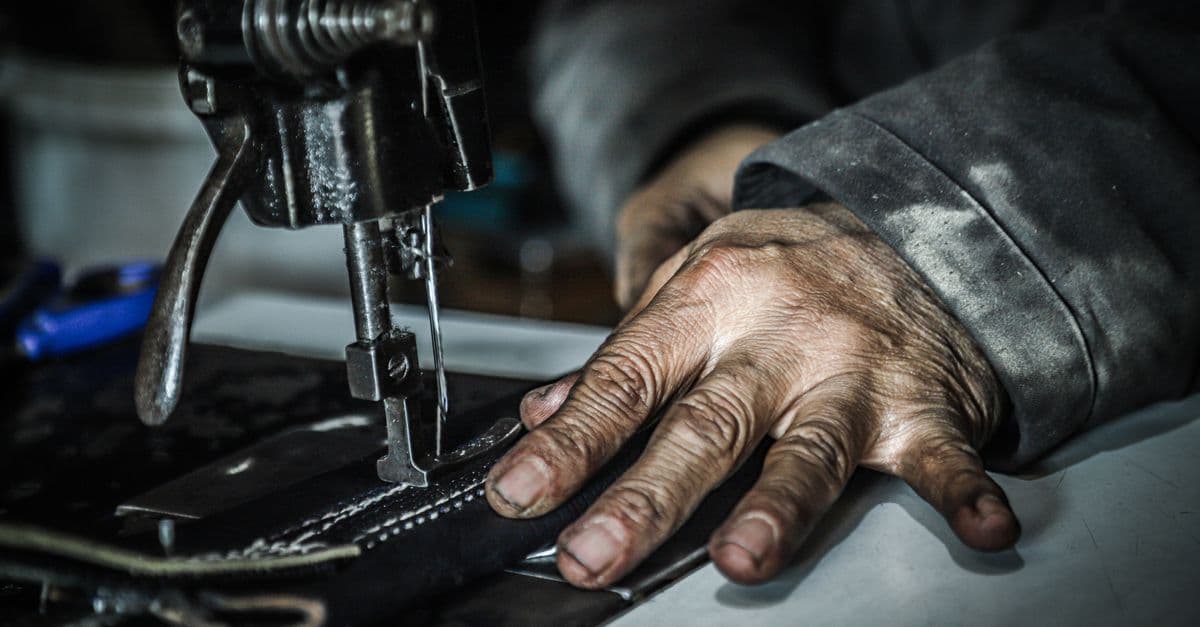
Photo: Furkan Işık / Pexels
In September 1846, a Massachusetts inventor named Elias Howe received a patent on a machine that could produce a lockstitch 250 times faster than a skilled seamstress working by hand. Nobody bought it. For the next decade, Howe watched other men refine, manufacture, and profit from versions of his design while he struggled to enforce his rights. The resulting legal conflict produced the first major patent pool in American history — a legal structure still used in the technology industry today — and made one of the combatants, Isaac Singer, both the most successful industrialist of his era and one of the most personally scandalous figures of the 19th century.
What a Sewing Machine Does
A sewing machine is a mechanical device that drives a threaded needle through layers of fabric to produce a continuous stitch. The essential problem it solves is the speed and consistency of the stitch: hand-sewing required a skilled worker to manually form each stitch by pushing a needle through fabric, catching the thread on the far side, and pulling it back. The constraint was the human hand.
A mechanized lockstitch machine separates the thread into two supplies — one on the needle passing through the fabric from above, one on a shuttle or bobbin mechanism operating below the fabric — and interlocks them on each stitch cycle. The resulting stitch is mechanically symmetric, does not unravel when the thread is cut, and can be produced at rates of several hundred stitches per minute rather than the approximately 40 stitches per minute achievable by an expert hand.
Definition: A lockstitch is formed when the thread from the needle, after passing through the fabric, loops around a second thread supplied by a shuttle beneath the fabric. The two threads lock together within the fabric layer, forming a stitch that cannot be pulled loose from either side.
The Story: From Patent to Patent War
The Lockstitch Problem and Elias Howe (1844–1846)
Attempts to mechanize sewing predated Howe by several decades. The English inventor Thomas Saint filed a patent for a chain-stitch machine in 1790, and the French inventor Barthélemy Thimonnier built working chain-stitch machines in the 1830s — only to have his workshop destroyed by Parisian tailors who feared the machines would eliminate their livelihoods.
Elias Howe was born on July 9, 1819, in Spencer, Massachusetts. He worked as a machinist and watched his wife sew by hand for long hours, which reportedly inspired his focus on the problem. Between 1844 and 1845, working in the Boston machine shop of Ari Davis, Howe developed a machine with three key innovations: a needle with the eye at its point (rather than the tail, as in hand-sewing), a shuttle operating beneath the fabric to form the lockstitch, and an automatic feed mechanism.
The US Patent Office granted Howe US Patent No. 4,750 on September 10, 1846. His machine could produce 250 stitches per minute — five times faster than hand-sewing by the most skilled workers.
Source: Library of Congress — Elias Howe Issued a Patent for the Sewing Machine, September 1846
Howe immediately encountered a problem that has recurred throughout the history of technology patents: he had the patent but lacked the capital, manufacturing capacity, and distribution to commercialize it. He traveled to England, where a corset manufacturer named William Thomas bought the English rights for £250, but the arrangement collapsed. Howe returned to the United States in 1849 to find that at least a dozen manufacturers had begun producing sewing machines that incorporated his lockstitch principle without paying him royalties.
Source: Elias Howe — Wikipedia
| Year | Event | Significance |
|---|---|---|
| 1790 | Thomas Saint patents chain-stitch machine (UK) | First documented sewing machine patent |
| 1830s | Barthélemy Thimonnier builds chain-stitch machines | First factory use; workshop destroyed by rioting tailors |
| 1844–45 | Elias Howe develops lockstitch machine | Three innovations: eye-pointed needle, shuttle, auto-feed |
| 1846 | US Patent No. 4,750 issued to Howe | First lockstitch sewing machine patent in USA |
| 1849 | Howe discovers widespread infringement in USA | Begins years of litigation |
| 1851 | Isaac Singer patents improved sewing machine | Foot treadle, vertical needle, horizontal fabric surface |
| 1854 | Court rules Singer infringes Howe's patent | Howe vindicated legally; litigation continues |
| 1856 | Sewing Machine Combination formed | First patent pool in US history |
| 1877 | Last Combination patent expires | End of the patent pool; smaller manufacturers flourish |
| 1889 | Singer Manufacturing Co. produces 1.3M machines in one year | Mass production milestone |
Isaac Singer: The Improver Who Dominated (1851–1875)
Isaac Merritt Singer was born on October 27, 1811, in Pittstown, New York. Before he was an industrialist, he was an itinerant actor and sometime machinist who bounced between theatrical companies and mechanical shops. In 1850, in a Boston machine shop where he had been hired to repair a Lerow and Blodgett sewing machine, Singer identified several improvements he thought he could make.
Within 11 days — according to Singer's own account — he developed a machine with a vertical needle (replacing the curved needle in some competitors' designs), a horizontal sewing surface (making it easier to guide fabric), and a foot treadle that left both hands free to position material. Singer applied for a patent on August 12, 1851.
Source: Smithsonian Magazine — How Singer Won the Sewing Machine War
Singer partnered with lawyer Edward Clark, who contributed business acumen that proved as important as the engineering. Clark introduced two commercial innovations. The first was installment buying: a Singer machine cost $125, which was prohibitive for most household buyers. Clark offered it for $5 down and $3 monthly, which made it accessible to middle-class and working-class families and introduced the installment plan as a consumer finance model.
The second was a trade-in program — buyers could exchange an old machine of any make toward a new Singer. This created customer relationships and removed competitors' products from circulation simultaneously.
The Litigation: Howe vs. Singer (1849–1854)
Howe had spent years unable to enforce his patent because he lacked funds for litigation. He eventually secured financial backing and brought infringement suits against Singer and other manufacturers. The case centered on whether Singer's design infringed the essential claims of Howe's 1846 patent.
The court ruled in Howe's favor in 1854. Singer's machine incorporated the eye-pointed needle and the lockstitch shuttle — both of which were in Howe's patent — and the court found this constituted infringement. Singer and Howe reached a settlement requiring Singer to pay Howe a royalty of $25 per machine.
Source: RK Dewan — Sewing Machine Patent Feud: Howe vs Singer
The Sewing Machine Combination: America's First Patent Pool
The Howe-Singer litigation was not an isolated dispute. By the mid-1850s, the sewing machine industry had become a maze of overlapping patents held by multiple manufacturers. Any machine that combined the best available features — which was what the market demanded — necessarily incorporated elements covered by multiple patents. The industry faced what is now called a patent thicket: a dense collection of overlapping IP rights that made production legally risky for everyone.
The solution, negotiated in October 1856, was the Sewing Machine Combination, formed by the Albany Agreement of October 24, 1856. The four dominant patent holders — Howe Machine Company, Singer Manufacturing Company, Wheeler and Wilson Manufacturing Company, and Grover and Baker — cross-licensed their patents to each other and formed a cartel that required all other domestic sewing machine manufacturers to pay a $15 licensing fee per machine.
The Combination is recognized by legal historians as the first patent pool in United States history. It demonstrated that the patent system, under certain conditions, produced not competition but monopoly — and that the monopoly could be codified through a collective licensing agreement rather than requiring any single party to hold all necessary IP.
The Sewing Machine Combination of 1856 was the first patent pool in United States history — a legal mechanism later used in the aviation, automobile, and semiconductor industries. Its Albany Agreement structured how competing patent-holders could share technology without litigating each other to exhaustion.
The Combination lasted until 1877, when its last covered patent expired. Within years of its dissolution, dozens of smaller manufacturers entered the market and prices fell sharply. The number of sewing machines in American homes grew rapidly after the patent cartel ended.
Source: IPWatchdog — America's First Patent Thicket: Sewing Machine War of the 1850s
How the Lockstitch Mechanism Works
The lockstitch mechanism in a modern sewing machine is mechanically elegant. The needle carries the upper thread down through the fabric and continues below the throat plate (the metal plate through which the needle passes). As the needle begins its upward return, a loop of upper thread forms around the needle's eye.
A rotating hook assembly below the throat plate — timed precisely to the needle's cycle — passes through this loop and expands it around the bobbin case, which holds the lower thread. As the needle continues upward, the loop tightens, locking the upper and lower threads together within the fabric layer. The feed dogs — toothed metal grips beneath the fabric — advance the material by a precise increment for the next stitch.
The timing between needle, hook, and feed dog must be exact to within fractions of a millimeter. This precision engineering, mass-produced, is what made the sewing machine one of the more difficult mechanical products to manufacture in the 1850s — and what made Singer's manufacturing operation, which achieved large-scale standardized production earlier than most competitors, a decisive commercial advantage.
Source: Smithsonian Institution — 1846 Elias Howe Jr.'s Sewing Machine Patent Model
The People: Howe, Singer, and Their Very Different Fates
Elias Howe spent most of the 1850s in poverty while others profited from his invention. After his patent was upheld in 1854, he collected substantial royalties — reportedly $2 million over the remaining 20 years of the Combination's life, though the exact figures vary by source. He died on October 3, 1867, at age 48, shortly after the patent's expiration, leaving a relatively modest estate. He is largely absent from popular history despite being the originating inventor.
Source: Linda Hall Library — Scientist of the Day: Elias Howe
Isaac Singer died rich, famous, and scandalous. His personal life was extraordinary in its complexity. He had married Catherine Maria Haley in 1830 and had two children with her before leaving. He subsequently maintained a long-term relationship with Mary Ann Sponsler, with whom he had eight children, while simultaneously beginning a relationship with Mary McGonigal, with whom he had five more. When Mary Ann discovered the McGonigal family in 1862, she had Singer arrested for bigamy.
Singer fled to London with McGonigal, then eventually to Paris, where he married his fourth wife, the French-born Isabella Boyer, in 1863. He eventually settled in Torquay, Devon, England, where he died on July 23, 1875. He fathered at least 26 children by five women. His estate was valued at approximately $13 million — the equivalent of several hundred million dollars in modern terms — which he divided unevenly among 20 of his living children.
Source: ISMACS — Bluebeard Isaac Merritt Singer: The Scandalous Personal Life
Singer Manufacturing Company continued without its founder and became one of the largest manufacturing enterprises in the world. In 1889, Singer manufactured 1.3 million sewing machines in a single year. The company's red and gold trademark became one of the first globally recognized consumer brands.
The Sewing Machine as a Feminist Tool
The sewing machine arrived at a specific moment in the history of women's labor. In 1860, the vast majority of garment production was done by hand at home, by women who spent enormous portions of their waking lives in the physical labor of making and mending clothing. The machine did not immediately liberate domestic sewers — it often added pressure, because it enabled commercial garment producers to lower piece-work rates and demand higher output — but it did reduce the time required to make a garment.
The Singer machines marketed directly to households — through installment plans, door-to-door salesmen, and illustrated catalogs — targeted women buyers explicitly. Singer's marketing was among the first in American commerce to treat women as autonomous economic agents capable of making and financing purchase decisions. The trade-in programs and credit arrangements were structured around the assumption that a woman would manage the transaction.
Second-wave feminist writers in the 1970s and 1980s identified the sewing machine as ambiguous: a labor-reducing technology that in practice increased the volume of sewing demanded rather than reducing the total hours women spent on it, while simultaneously enabling women to participate in the cash economy as seamstresses and factory workers.
Source: Mill Museum — Sewing Revolution: The Machine That Changed America
Unintended Consequences
Industrial garment production and the global sweatshop. The sewing machine enabled the factory-based garment industry. By the late 19th century, large-scale clothing factories in New York, London, and Manchester employed thousands of workers — predominantly immigrant women — in conditions that produced the sweatshop as a social phenomenon. The Triangle Shirtwaist Factory fire in New York City on March 25, 1911, killed 146 workers (mostly young immigrant women) and became the defining event of early American labor-safety legislation.
Source: US Department of Labor — Triangle Shirtwaist Factory Fire
The global garment supply chain. The mechanization of sewing that began with Howe and Singer's machines has, over 175 years, migrated to wherever labor costs are lowest. Bangladesh's ready-made garment industry employed over 4.5 million workers as of 2023, 85% of them women, generating $41.9 billion in export revenue and accounting for approximately 65% of Bangladesh's total foreign exchange earnings. The industrial sewing machine — now computer-controlled, with automated thread-cutting and programmable stitch patterns — is still the core production tool.
Source: Economics Observatory — What's happening in Bangladesh's garment industry?
The patent pool model. The Sewing Machine Combination's Albany Agreement was not forgotten by later industries. Patent pools — collective cross-licensing arrangements that allow manufacturers to use each other's essential patents without constant litigation — were later applied in the automobile industry (1915 cross-licensing agreement among US manufacturers), aviation, and the semiconductor industry. The MPEG LA patent pool for video compression is a direct descendant of the same legal structure that settled the sewing machine wars of the 1850s.
Where the Sewing Machine Stands Today
The consumer sewing machine market is served by brands including Singer (now owned by SVP Group, a private equity-backed holding company), Brother, Janome, and Bernina. The global sewing machine market was valued at approximately $5.4 billion in 2022.
At the industrial end, automated sewing equipment increasingly incorporates computer numerical control, robotic material handling, and machine vision for quality inspection. Full automation of sewing remains difficult because fabric is flexible and deformable — unlike metal or plastic — making it resistant to the gripper and positioning systems that work well in other manufacturing contexts. As of 2025, the assembly of a standard T-shirt still required human hands at multiple stages. Research into fully automated garment assembly has continued, with companies including SoftWear Automation developing systems capable of sewing T-shirts without human operators, but full deployment at industrial scale had not occurred.
Q: Who invented the sewing machine? Elias Howe invented the lockstitch sewing machine and received US Patent No. 4,750 on September 10, 1846. His design incorporated three innovations: a needle with the eye at its point, a shuttle below the fabric for the lockstitch, and an automatic fabric feed. Earlier machines existed (Thomas Saint's 1790 patent, Thimonnier's 1830s chain-stitch machines), but Howe's lockstitch patent was the foundational commercial invention in the US.
Q: What did Isaac Singer invent? Singer did not invent the sewing machine from scratch — he improved Howe's existing design. Singer's key contributions were a vertical needle combined with a horizontal sewing surface, a foot treadle that freed both hands to guide fabric, and a thread tension controller. He also invented the installment-plan consumer financing model that made the machine affordable to ordinary households.
Q: What was the Sewing Machine Combination? The Sewing Machine Combination, formed by the Albany Agreement of October 24, 1856, was the first patent pool in United States history. It brought together the four dominant patent-holders — Howe, Singer, Wheeler and Wilson, and Grover and Baker — who cross-licensed their patents and collectively charged other manufacturers a $15 per machine royalty. It lasted until 1877, when its final patent expired.
Q: How does a lockstitch sewing machine work? A lockstitch machine carries an upper thread through the fabric on a needle. As the needle begins to retract, a rotating hook assembly below the fabric passes through the thread loop and expands it around a bobbin carrying the lower thread. As the needle rises fully, the loop tightens, locking the two threads together within the fabric. Feed dogs advance the material for the next stitch. The timing between needle, hook, and feed dog must be mechanically precise.
Q: How many children did Isaac Singer have? Isaac Singer fathered at least 26 children by five women across multiple simultaneous and sequential relationships. He was married at least twice (with contested legitimacy given the simultaneous relationships) and maintained long-term arrangements with additional partners. When Mary Ann Sponsler discovered his parallel family with Mary McGonigal in 1862, she had Singer arrested for bigamy. Singer fled to London, then Paris, then settled in England, where he died in 1875.
Q: How important is the sewing machine to the global economy today? The industrial sewing machine underpins the entire global apparel industry. Bangladesh alone employs over 4.5 million garment workers — 85% women — generating $41.9 billion in export revenue in 2023. Vietnam, Cambodia, China, and other manufacturing-cost-competitive countries host comparable industries. The global apparel market was valued at approximately $1.79 trillion in 2024. The sewing machine, in its industrial computer-controlled form, remains the core production technology throughout this supply chain.
The Takeaway
The sewing machine's history contains most of the themes that recur in subsequent technology patent disputes: the originating inventor who lacks the capital to commercialize his own invention, the improver who dominates through better manufacturing and marketing, the legal resolution that benefits all incumbents at the expense of new entrants, and the eventual dissolution of the cartel that unleashes competitive innovation. Howe was right about the technology and impoverished by it for years. Singer was reckless in his personal life and a commercial genius. The Combination they were both forced into gave the world not just cheaper sewing machines but the template for patent pools that the technology industry still uses. And the industry that resulted — industrialized garment manufacturing — now employs tens of millions of workers in the developing world, mostly women, operating descendants of machines whose core mechanism Howe designed in a Boston workshop in 1845.
Read next:
Weekly digest
Stay ahead of the curve
Get the best science, AI, and tech stories delivered to your inbox every week. No spam — unsubscribe any time.
About the Author
SciHub101 is an independent science and technology publication founded and edited by Buğra Sözeri, a software engineer and app developer based in Türkiye. Articles are drafted against peer-reviewed literature and primary sources, fact-checked, and edited by a human before publication. Where we compare products, anything built by our own team is labelled as such — see the editorial guidelines and About page for how corrections and disclosures work.
Related Articles

The Smartphone: From IBM Simon to On-Device AI
The smartphone's full history: IBM Simon 1992, BlackBerry, iPhone 2007, Android 2008, Apple-Samsung patent wars, and today's 1.17 billion annual shipments.

The Search Engine: From Archie to AI-Augmented Search
How the search engine evolved from a 1990 McGill University FTP indexer to Google's PageRank and today's AI-augmented search. The full history explained.

Telephone Invention: Bell, Gray, Meucci, and the Patent Race
The telephone's invention involved Alexander Graham Bell, Elisha Gray, Antonio Meucci, patents, and the race to transmit speech electrically.
The Invention of the Steam Engine — SciHub101
How Thomas Newcomen's 1712 atmospheric engine and James Watt's 1769 separate condenser transformed fire into motion and launched the Industrial Revolution.

The Automobile: How the Car Changed Everything
From Karl Benz's 1886 Patent-Motorwagen to today's electric vehicles, discover how the automobile was invented, who built it first, and why it reshaped civilization.