The Invention of the Steam Engine
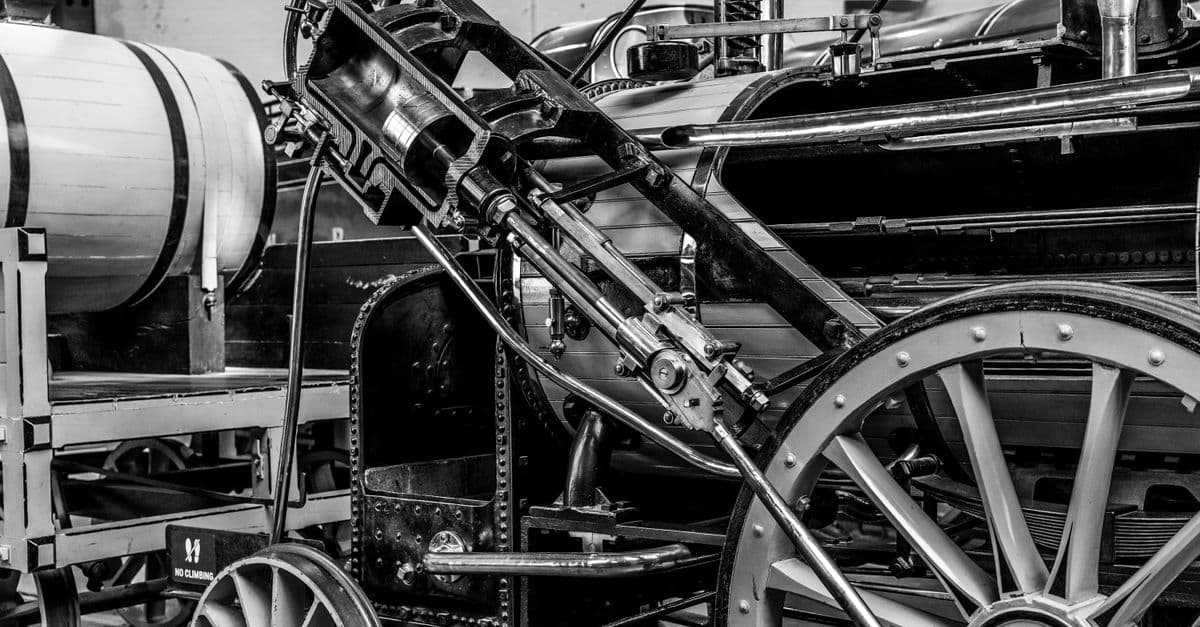
Photo: Karam Alani / Pexels
The steam engine converts heat from burning fuel into mechanical motion by using steam pressure to push a piston back and forth inside a cylinder. Thomas Newcomen built the first practically useful steam engine in 1712 to pump water from a flooded coal mine in Staffordshire, England. James Watt's 1769 invention of the separate condenser made Newcomen's design roughly four times more fuel-efficient, enabling engines compact and economical enough to power factories, mills, and eventually railways. Steam turbines derived from this lineage still generate approximately 85% of the world's electricity today.
Before Newcomen: The Ancient Aeolipile and the Mine Pumps
The observation that steam could produce mechanical force is ancient. Hero of Alexandria, a Greek mathematician and engineer working in Alexandria around 100 CE, described a device he called the aeolipile: a hollow sphere mounted on an axle and connected to a boiler below. Steam entered the sphere through the axle and escaped through two curved nozzles on opposite sides, causing the sphere to spin by reaction — the same principle as a modern rocket nozzle or the jets of a garden sprinkler. Hero appears to have regarded it as a curiosity or a temple demonstration piece; there is no record of it performing useful work.
Aeolipile — Hero of Alexandria's reaction steam turbine, c. 100 CE; a pivoting sphere driven by steam jets, demonstrating that steam energy could produce rotary motion but applied to no practical purpose in its time.
The gap between Hero's device and Newcomen's engine is roughly 1,600 years. The difference was not scientific understanding but economic necessity. Hero had no problem that a steam engine could solve. The Roman economy ran on water power, animal power, and slave labor. No mine needed pumping on a scale that slave chains and ox-drawn wheels could not handle.
By the seventeenth century, England's coal industry faced exactly such a problem. As surface coal deposits depleted, mines went deeper. Deeper mines flooded. The economic value of the coal below the water was sufficient to justify extraordinary pumping effort. Thomas Savery, an English military engineer and inventor, recognized this opportunity and patented a steam-powered pump in 1698 under the optimistic title "The Miner's Friend."
Source: Savery, T. (1702). The Miner's Friend; or, An Engine to Raise Water by Fire. London. Savery's own promotional pamphlet describing his steam pump's operation and advantages, held in the British Library.
Savery's pump used no piston. Steam was forced into a closed vessel; when the steam was condensed by pouring cold water over the vessel's exterior, the resulting partial vacuum sucked water up from below through a pipe. A second shot of steam then pushed the water up and out. The device worked in demonstrations, but in mines it faced two fatal limits: it could only raise water about 30 feet (9 meters) by suction, and at greater depths the steam pressure required to push water higher risked exploding the boiler, which Savery's era lacked the metallurgy to prevent reliably. Several Savery engines exploded in service.
The pressure problem is not merely metallurgical. Savery's engine used steam pressure directly on water. This approach — called a "pressure engine" — requires high steam pressures to achieve useful lift. Newcomen's genius was to eliminate that requirement entirely.
How Newcomen's Atmospheric Engine Actually Worked
Thomas Newcomen (1664–1729) was a Baptist preacher and ironmonger from Dartmouth, Devon, who had commercial dealings with Cornish tin mines. He was aware of the pumping problem and of Savery's patent. Between roughly 1698 and 1712, Newcomen, working with plumber John Calley, developed a fundamentally different machine.
Newcomen's atmospheric engine did not use steam pressure to do work. It used atmospheric pressure.
Here is the mechanism, step by step: A large brass cylinder, open at the top, was mounted upright above a boiler. A piston fitted inside the cylinder. The piston was connected by a chain to one end of a large overhead rocking beam — like a seesaw, pivoted in the middle, with the pump rod hanging from the other end. When steam filled the cylinder from the boiler below, the piston rose under the weight of the pump rod on the other side of the beam. Then an operator injected a spray of cold water into the steam-filled cylinder. The steam condensed almost instantly, creating a partial vacuum below the piston. Atmospheric pressure — 14.7 pounds per square inch (101 kilopascals) at sea level — pressed down on the piston from above, driving it down with considerable force. This downstroke was the power stroke; it raised the pump rod on the other side of the beam, lifting the water.
This is analogous to a syringe where the plunger is pushed in not by hand force but by atmospheric pressure — you simply remove the air inside the barrel to let the atmosphere do the pushing.
The design had profound advantages over Savery's pressure pump. Since the steam never went above atmospheric pressure (roughly 1 bar), boiler explosions were essentially eliminated. The cylinder itself acted as a condenser, so no external pressure vessel was needed. The mechanism was large, slow, and consumed enormous quantities of coal, but it worked reliably.
Source: Dickinson, H.W. (1938). A Short History of the Steam Engine. Cambridge University Press. The classic technical history; Dickinson's description of the Newcomen engine mechanism remains the standard reference in engineering history.
The first documented Newcomen engine began operation in 1712 at the Conygree Coalworks near Dudley Castle in Staffordshire. It had a cylinder roughly 21 inches (53 centimeters) in diameter and could make about 12 strokes per minute, lifting water from about 153 feet (46 meters) below the surface. Contemporary accounts describe it as replacing the work of 500 horses that had previously operated a horse-powered pump (a "horse gin") around the clock.
By 1733, approximately 125 Newcomen engines were operating across Britain. By 1775, the number was around 600, concentrated in coal and tin mines. The engine spread to continental Europe — notably to Belgian coal mines — and to North America by mid-century.
James Watt's Separate Condenser: The Insight That Changed Everything
The Newcomen engine had one catastrophic inefficiency that a young instrument maker at the University of Glasgow identified in the winter of 1763–1764.
James Watt (1736–1819) was asked to repair a small model Newcomen engine that had been used for lectures by the university's natural philosophy professor. The model barely worked — it consumed its steam almost immediately and could barely complete a stroke. Watt studied the problem. He measured the temperatures involved. He read Joseph Black's work on latent heat — the discovery that steam requires and releases a large quantity of heat in changing between liquid and gas states, without a change in temperature. This concept, which Black had elucidated at Glasgow in the 1750s and 1760s, gave Watt the conceptual tool he needed.
Latent heat — the heat absorbed or released by a substance during a phase change (such as liquid to steam) at constant temperature; identified by Joseph Black and critical to understanding why the Newcomen engine was so inefficient.
The Newcomen engine, Watt realized, wasted most of its fuel heating and cooling the cylinder with every stroke. The cylinder had to be heated to fill with steam, then chilled with cold water to condense the steam. Heating and cooling a large mass of iron with every stroke consumed far more heat than the engine extracted as useful work. Black's latent heat numbers told Watt the scale of the waste: the cylinder was drinking in heat to vaporize water on the upstroke and then throwing that heat away on the downstroke.
Watt's solution came to him during a Sunday walk on Glasgow Green in the spring of 1765 — or so he later recalled. He would keep the cylinder hot all the time by condensing the steam not inside the cylinder but in a separate vessel. This separate condenser would be kept cold. Steam would rush from the hot cylinder into the cold condenser at the end of each power stroke, condense there, and the cylinder would never be chilled. The cylinder temperature would remain near the steam's temperature throughout the cycle.
The engineering implementation took years and considerable capital. Watt received a patent for the separate condenser on January 5, 1769 (British Patent No. 913). Getting from patent to working machine required a reliable backer.
Source: Watt, J. (1769). British Patent No. 913 — "A New Invented Method of Lessening the Consumption of Steam and Fuel in Fire Engines." Patent text available via the UK Intellectual Property Office historical archive.
Boulton, Watt, and the Commercial Engine
Matthew Boulton (1728–1809) was one of the great manufacturers of eighteenth-century Britain. His Soho Manufactory near Birmingham made metal goods — buckles, buttons, ormolu, silverware — at industrial scale, driven by water power. He had access to capital, skilled workers, precision metal-working equipment, and commercial connections across Britain and Europe.
Boulton had become aware of Watt and his engine concept through correspondence and mutual contacts in the Lunar Society of Birmingham — a remarkable informal gathering of scientists, engineers, industrialists, and thinkers including Joseph Priestley, Erasmus Darwin, and Josiah Wedgwood. In 1774, Watt moved to Birmingham and became Boulton's partner.
The partnership of Boulton and Watt formally commenced in 1775, when Parliament extended Watt's 1769 patent for an additional 25 years — an unusual legislative favor that gave the firm a monopoly on improved steam engines until 1800. The extension was lobbied for by Boulton, who recognized that the 1769 patent, with only six years remaining, was not sufficient protection to justify the manufacturing investment.
The Boulton and Watt firm produced its first commercial engines in 1776. The engines were dramatically more fuel-efficient than Newcomen's design — Boulton and Watt claimed their engines used roughly three to four times less coal per unit of work. They sold the engines not at a fixed price but on a royalty model: customers paid one-third of the coal savings the Boulton and Watt engine produced compared to a Newcomen engine doing the same work. This meant the firm's income was tied to its engines' actual performance — a powerful incentive for quality and efficiency.
Source: Mokyr, J. (2009). The Enlightened Economy: An Economic History of Britain 1700–1850. Yale University Press. Chapter 4 provides the economic analysis of the Boulton-Watt royalty model and its implications.
The early Boulton and Watt engines still operated on the atmospheric principle — the piston was pushed by atmospheric pressure into a vacuum created by steam condensation. Watt's next major innovation changed this.
The Timeline of Steam Engine Development
| Year | Event |
|---|---|
| c. 100 CE | Hero of Alexandria describes the aeolipile in Pneumatics |
| 1698 | Thomas Savery patents "The Miner's Friend" steam pump |
| 1712 | Thomas Newcomen's first atmospheric engine operates at Dudley Castle, Staffordshire |
| 1763–1764 | James Watt repairs a model Newcomen engine at Glasgow; identifies the inefficiency |
| 1765 | Watt conceives the separate condenser principle |
| 1769 | Watt receives British Patent No. 913 for the separate condenser |
| 1774 | Watt moves to Birmingham; Boulton and Watt partnership forms |
| 1776 | First commercial Boulton and Watt engines delivered |
| 1781 | Watt patents the sun-and-planet gear, converting reciprocating motion to rotary motion |
| 1782 | Watt patents the double-acting engine (steam on both sides of the piston) |
| 1784 | First rotative Boulton and Watt engine drives a mill in Nottingham |
| 1800 | Boulton-Watt patent expires; competitors enter the market |
| 1804 | Richard Trevithick's high-pressure steam locomotive runs on rails in Wales |
| 1814 | George Stephenson builds his first steam locomotive |
| 1829 | Stephenson's Rocket wins the Rainhill Trials; railway age begins |
| 1882 | Thomas Edison's Pearl Street Station uses steam engines to generate electricity |
| 1884 | Charles Parsons patents the steam turbine |
| 1914 | Steam turbines displace reciprocating steam engines in most power generation |
| Present | Steam turbines (nuclear, coal, gas, and geothermal) generate ~85% of world electricity |
From Newcomen's mine pump to the turbines inside nuclear power plants: 300 years of thermodynamic evolution.
Watt's Later Innovations
The 1769 separate condenser patent was the breakthrough, but Watt continued innovating throughout the 1770s and 1780s.
The original Newcomen-pattern engines, including Watt's early versions, produced only reciprocating (back-and-forth) motion — suitable for pumping but not for driving the rotating machinery of a mill or factory. In 1781, Watt patented the sun-and-planet gear, a mechanism that converted the up-and-down motion of a piston into continuous rotary motion. The mechanism used two gears — one fixed to the end of the connecting rod (the "planet"), one fixed to the output shaft (the "sun") — arranged so that the planet's circular path around the sun produced rotation of the output shaft. Watt used this rather than a simple crank because a crank was covered by an existing patent.
In 1782, Watt patented the double-acting engine, in which steam was admitted to both sides of the piston alternately, producing a power stroke in both directions. This roughly doubled the power output per cylinder volume and made the engine's motion smoother. To connect the piston rod to the beam in a double-acting engine without a chain (which can only pull, not push), Watt invented the parallel motion linkage in 1784 — a set of linked rods that constrains the piston rod to move in a straight vertical line despite being connected to the arc-moving end of a rocking beam. Watt considered the parallel motion his most elegant invention.
Governor — a feedback device that automatically regulates engine speed; Watt's centrifugal governor (1788) used two rotating arms with balls attached; as speed increased, centrifugal force raised the balls, which closed the steam valve, reducing speed — the first practical automatic feedback control device in engineering history.
Watt's centrifugal governor deserves special mention as a conceptual milestone. It is an early example of a closed-loop control system — a machine component that monitors its own output and adjusts its own input without human intervention. The governor predates the formal theory of control systems (cybernetics) by 150 years, but it embodies the same principle that governs thermostats, autopilots, and the feedback loops in modern computers.
Source: Mayr, O. (1970). The Origins of Feedback Control. MIT Press. Mayr's analysis places Watt's governor in the history of automatic control and engineering theory.
The Industrial Revolution Wave
The Boulton and Watt patent expired in 1800. Almost immediately, a new generation of engineers built higher-pressure engines that Watt had refused to pursue — he considered high-pressure steam too dangerous. Richard Trevithick (1771–1833), a Cornish mining engineer, was among the most important. His high-pressure engines used steam at several atmospheres above ambient pressure, driving the piston not by atmospheric force but by steam force directly. This allowed dramatically smaller and lighter engines for the same power output.
Trevithick mounted one of his high-pressure engines on a carriage and drove it around Camborne, Cornwall, on Christmas Eve 1801 — the world's first self-propelled steam road vehicle. In 1804, he ran a steam locomotive on iron rails at the Merthyr Tydfil ironworks in Wales, proving that a steam engine on rails could haul a substantial load. The concept of steam locomotion was demonstrated, though Trevithick's commercial ventures largely failed.
George Stephenson refined the steam locomotive over the following two decades. His Rocket won the Rainhill Trials in 1829, reaching a speed of 29 miles per hour (47 kilometers per hour) — faster than any land vehicle previously recorded. The railway age that followed transformed not only transport but geography itself: cities expanded, agricultural land values changed, industrial regions formed around railway lines, and the spatial organization of industrial economies shifted permanently.
Source: Rolt, L.T.C. (1960). George and Robert Stephenson: The Railway Revolution. Longmans. The standard biography and technical history of the Stephenson locomotives.
The steam engine and the Industrial Revolution share a circular relationship. Coal mines needed steam engines to pump water, enabling deeper mining that produced more coal, which fueled more steam engines. Cotton mills powered by steam engines produced cheap cloth that created markets, generating capital that funded more steam engines. This self-reinforcing dynamic — the steam economy bootstrapping itself — is what historians mean when they refer to the Industrial Revolution as a "takeoff" rather than a gradual improvement.
Between 1760 and 1840, British industrial output roughly doubled. Between 1840 and 1880, it doubled again. GDP per capita in Britain, which had been essentially flat for centuries, began growing at a rate of approximately 1% per year from the early nineteenth century — a rate that, compounded over generations, produced the material prosperity of modern industrial societies.
Why We Never Left the Steam Age
Steam's transformation from reciprocating engine to turbine is the story of how a Victorian technology survived into the twenty-first century by changing its form while keeping its physics.
Charles Parsons patented the steam turbine in 1884. Rather than pushing a piston back and forth, a steam turbine directs high-pressure steam against a series of curved blades mounted on a shaft, causing the shaft to spin directly. The efficiency gains over reciprocating engines are substantial: a modern steam turbine can convert roughly 40–45% of the heat energy in steam into mechanical work, compared to around 10–15% for a good reciprocating steam engine.
Steam turbine — a rotary engine in which steam is directed through a series of blade stages on a rotor; each stage extracts some energy from the steam, so efficiency improves as the number of stages increases; the dominant prime mover in electricity generation worldwide.
Today's nuclear power plant, coal-fired power station, gas-fired combined-cycle plant, and geothermal plant all operate on Rankine cycle thermodynamics — the same fundamental cycle that Watt's separate condenser was designed to optimize. Water is heated to produce steam; steam expands to drive a turbine; steam is condensed and the water is heated again. The fuel source varies — uranium fission, coal combustion, natural gas combustion, geothermal heat. The mechanism for converting heat to electricity is the steam turbine in all cases.
Source: International Energy Agency (2024). World Energy Statistics and Balances. IEA, Paris. Steam-driven generation accounts for approximately 85% of global electricity production when coal, nuclear, gas, and geothermal steam plants are aggregated.
Solar photovoltaic and wind generation work differently — they convert sunlight and wind directly to electricity without a heat cycle. Their rapid growth in the 2010s and 2020s represents the first significant departure from steam-dominated electricity generation since Parsons' turbine. But they remain a minority of global electricity output, and at current rates, steam turbines will remain the plurality technology for electricity generation well into the 2030s.
The steam engine that Newcomen first ran in Staffordshire in 1712 to pump water from a coal mine is the conceptual ancestor of the steam turbines in the Hinkley Point C nuclear power station currently under construction in Somerset, England — approximately 220 miles (354 kilometers) from Dudley Castle. The technology has transformed beyond recognition, but the principle — boil water, use steam to do work, condense steam, repeat — has not changed in 300 years.
For a complementary look at how stored chemical energy changed transportation in the twentieth century, see the electric battery. For the broader energy technology context, see the photovoltaic solar cell.
The Men Who Did Not Get Credit
Thomas Newcomen died in 1729 with his engine working in mines across Britain, but he had spent most of his working life in Savery's patent shadow. The Newcomen engine operated legally only because Savery's 1698 broad patent covered any steam-powered water-raising device; Newcomen's partners paid Savery a royalty for years and, after Savery's death, paid it to the patent's holders. Newcomen never received the independent recognition his design merited during his lifetime.
Jonathan Hornblower patented a compound steam engine in 1781 — an engine using two cylinders in which steam expanded successively, extracting more work from the same steam. This is the fundamental principle of all modern multi-stage turbines. Boulton and Watt sued Hornblower for patent infringement; their broad interpretation of Watt's 1769 patent effectively blocked compound engine development until the patent expired in 1800. The result was that an important efficiency innovation was suppressed for nearly two decades.
Source: Hills, R.L. (1989). Power from Steam: A History of the Stationary Steam Engine. Cambridge University Press. Covers Hornblower's compound engine and the Boulton-Watt patent litigation in detail.
Arthur Woolf (1766–1837) took up the compound engine after 1800 and developed it into a highly efficient design that became standard in Cornish mining. His engines achieved efficiencies roughly double those of Boulton and Watt's engines at their best. Woolf received some recognition in Cornwall but remains largely unknown outside specialist engineering history. The pattern — important innovators in the long history of steam who worked in the shadows of the famous patents — is consistent throughout the technology's development.
Unintended Consequences
The steam engine made Britain the first industrial nation. It also made Britain the first country to face industrial pollution on a modern scale. The coal burning that drove the steam economy covered manufacturing cities with soot. London's notorious fogs — a mix of coal smoke, water vapor, and industrial emissions — were a direct product of steam-age coal consumption. Charles Dickens described the skies above Coketown in Hard Times (1854) as "a blur of soot and smoke." The great London smog of December 1952, which killed an estimated 4,000 to 12,000 people, was the lethal culmination of 200 years of coal burning.
Child labor in mines and factories expanded dramatically as the Industrial Revolution increased the scale and pace of production. The Mines Act of 1842, which prohibited underground work by women and boys under 10, was a direct response to the documented conditions revealed by a Parliamentary commission. The steam engine did not create child labor — it had existed in pre-industrial agriculture and craft trades — but it industrialized it, making the conditions worse and the scale larger.
The steam engine also changed the geography of population. Industrial cities grew at rates that pre-industrial infrastructure could not support. Manchester grew from roughly 25,000 inhabitants in 1772 to 300,000 by 1850. The social pathologies of rapid, unregulated urbanization — disease, poverty, crime, and the destruction of traditional communities — are part of the steam engine's legacy alongside the prosperity it eventually produced.
Frequently Asked Questions
Q: Who invented the steam engine?
A: No single inventor. Thomas Savery patented a steam pump in 1698. Thomas Newcomen built the first practically useful atmospheric engine in 1712. James Watt's 1769 separate condenser patent and subsequent innovations made the engine efficient enough for general industrial use. Richard Trevithick and George Stephenson extended steam power to transportation. The steam turbine — the form still used today — was invented by Charles Parsons in 1884.
Q: How efficient was Watt's steam engine compared to Newcomen's?
A: Watt's separate condenser engine used roughly three to four times less coal to do the same pumping work as a Newcomen engine of equivalent size. A typical Newcomen engine converted less than 1% of the fuel's energy into useful work. Watt's best engines achieved around 3–5% thermal efficiency. A modern steam turbine in a combined-cycle power plant can achieve 40–45% efficiency — but this comparison spans 250 years of materials science and thermodynamic theory.
Q: What was the Boulton and Watt royalty model?
A: Rather than selling engines at a fixed price, Boulton and Watt charged customers one-third of the coal savings their engines produced compared to a Newcomen engine of equivalent capacity. Customers paid annually, and the payment was based on measured fuel consumption. This model tied the firm's income to engine performance and was unusual for the period; most capital goods were sold outright.
Q: Did James Watt invent the steam engine?
A: Watt did not invent the steam engine. He invented the separate condenser (1769), the double-acting engine (1782), and several other key innovations that transformed Newcomen's atmospheric engine into a versatile, efficient machine. The popular attribution of the steam engine's invention to Watt is historically imprecise but reflects his decisive role in making it commercially viable and universally applicable.
Q: Why do steam turbines still generate most of the world's electricity?
A: Because the Rankine cycle — heating water to steam, expanding it through a turbine, condensing it, and repeating — is an efficient and scalable way to extract mechanical work from any heat source. Nuclear fission, coal combustion, natural gas combustion, and geothermal heat all produce heat that can drive a steam cycle. The turbine machinery is mature, reliable, and understood. Solar and wind bypassed the steam cycle but cannot yet substitute for it at scale.
Q: What did James Watt invent other than the steam engine improvements?
A: Watt invented the centrifugal governor (1788), an automatic feedback device that regulated engine speed without human intervention; the parallel motion linkage (1784), an elegant mechanical linkage that allowed a piston rod to move in a straight line while connected to a curved-path beam; and the concept of horsepower as a unit for measuring engine output, which he introduced as a marketing tool to help customers compare his engines to the horse-powered alternatives they were replacing.
Read next:
Follow new articles
Add SciHub101 to your feed reader to see new science and technology stories.
About the Author
SciHub101 is an independent science and technology publication founded and edited by Buğra Sözeri, a software engineer and app developer based in Türkiye. AI tools assist with drafting and research. Source documentation in the existing archive is uneven, and articles are being reviewed and corrected. The Editorial Team byline identifies editorial responsibility; it does not certify specialist or independent human review. Where we compare products, anything built by our own team is labelled as such — see the editorial guidelines and About page for how corrections and disclosures work.
Related Articles

The Invention of the Transistor
How three physicists at Bell Labs in 1947 built a device smaller than a paperclip that would become the foundation of every computer ever made.

The Radar — How Bouncing Radio Waves Changed War and Weather
From Hülsmeyer's 1904 ship detector to Watson-Watt's Chain Home network, radar reshaped warfare, aviation safety, and meteorology in under a century.

How Thermodynamics Explains Everything: From Steam Engines to the Heat Death of the Universe
Four laws govern how energy moves, transforms, and degrades, from the steam engine to every living cell. Thermodynamics explains why engines have limits and why time has a direction.

How Does a Refrigerator Work? The Cool Science Behind Everyday Chill
Refrigerators don't make cold — they move heat out of one place into another. Here's how the four-step refrigeration cycle keeps your food fresh, and why it works.
The Invention of the Solar Cell
How Bell Labs' 1954 silicon breakthrough, a 1958 satellite, and a 99.9% price collapse turned sunlight into the world's cheapest source of electricity.

The Automobile: How the Car Changed Everything
From Karl Benz's 1886 Patent-Motorwagen to today's electric vehicles, discover how the automobile was invented, who built it first, and why it reshaped civilization.