How AI Data Centers Use Electricity
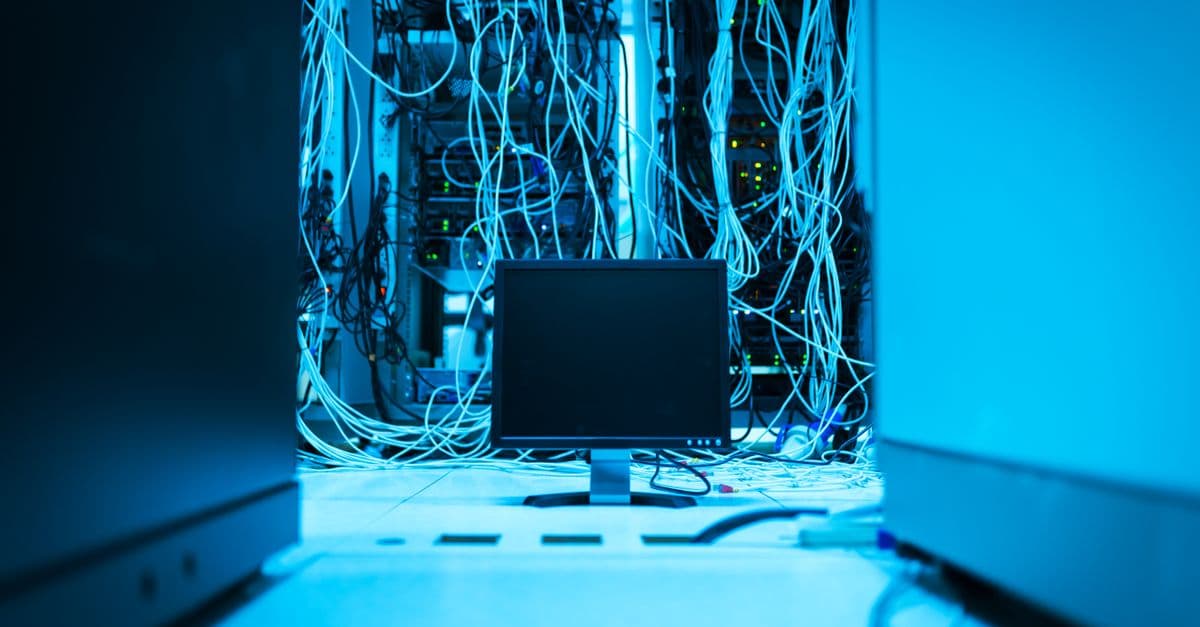
Photo: panumas nikhomkhai / Pexels
AI data centers do not spend most of their electricity on chips doing math. They spend it on GPUs (graphics processing units, the parallel-math chips that run AI models), the cooling systems that remove the heat those GPUs generate, the networking gear that keeps thousands of chips synchronized, and the power-conversion losses in between. Global data center electricity use hit roughly 415 terawatt-hours in 2024, about 1.5% of world electricity consumption, and the International Energy Agency projects that figure will more than double to around 945 terawatt-hours by 2030 (IEA, "Energy Demand from AI," 2025). This guide breaks down exactly where that electricity goes and why the power grid, not chip supply, has become the real bottleneck on how fast AI can grow.
Why AI data centers draw so much more power than ordinary ones
A traditional enterprise data center runs web servers, databases, and email, workloads that spike with user traffic and idle overnight. An AI training cluster does the opposite: it runs thousands of GPUs at near-maximum utilization around the clock for weeks or months at a stretch, because a training run that gets interrupted has to restart from a checkpoint, and every idle hour on a rented GPU cluster costs money whether or not it is computing.
That constant, saturated workload is the core reason AI facilities need so much more contracted power than earlier-generation data centers. A single Nvidia H100 GPU, one of the workhorse chips for large-model training, draws up to about 700 watts at full load (Nvidia H100 datasheet). A training cluster built from tens of thousands of those chips, plus the CPUs, memory, and networking switches that keep them fed with data, can draw hundreds of megawatts continuously, a load comparable to a small city, sustained for months rather than in the brief spikes typical of conventional computing.
The IEA reports that electricity consumption from AI-focused data centers surged roughly 50% in 2025 alone, far outpacing the 3% growth rate of global electricity demand overall (IEA, "Data centre electricity use surged in 2025," 2026). New AI campuses are increasingly designed for 100 to 300 megawatts of contracted power, and some announced projects target a full gigawatt, a scale that did not exist in commercial computing five years ago, according to the same IEA analysis.
What actually consumes the electricity inside an AI data center
Compute chips (GPUs and their supporting CPUs) are the largest single draw, but they typically account for only 40% to 60% of a facility's total power bill once cooling, networking, storage, and backup systems are included. Cooling alone can add another 10% to 40% depending on climate and cooling technology, and power conversion, stepping high-voltage grid electricity down to the low voltages chips need, loses several more percent at every transformer stage.
Training versus inference: where the real electricity bill hides
Training a large language model is the phase most people picture when they think about AI's energy use: banks of GPUs churning through trillions of words of text for weeks, adjusting billions of numerical parameters (the internal values a neural network tunes during training to encode what it has learned) with every pass. It is genuinely energy-intensive, but it is also a one-time cost per model version.
Inference, the process of actually running a trained model to answer a user's prompt, is not a one-time cost. It happens every time anyone sends a query, and modern AI products serve billions of queries per day. Epoch AI, an independent research organization that studies AI trends, estimated in 2025 that a typical GPT-4o query consumes about 0.3 watt-hours of electricity, roughly ten times lower than an earlier widely cited estimate of 3 watt-hours, based on measured GPU power draw and realistic utilization assumptions rather than worst-case theoretical peaks (Epoch AI, "How Much Energy Does ChatGPT Use," 2025).
That figure sounds small in isolation, less electricity than an LED light bulb uses in a few minutes, per Epoch AI's own comparison, but multiply it by scale and the math changes. A separate analysis noted that at roughly one billion queries a day, cumulative inference electricity use overtakes the one-time training cost of a model within 150 to 200 days (Towards Data Science energy analysis, 2025). That crossover is why most researchers who study AI energy demand now argue inference, not training, will dominate the industry's long-run electricity footprint, simply because training happens once per model while inference runs continuously for the model's entire deployed lifetime.
Why do longer AI responses use so much more electricity?
Inference cost scales with the number of tokens (word-like chunks of text) a model processes and generates. Epoch AI's analysis found that queries with very long inputs, in the 10,000 to 100,000 token range such as pasting in a long document, can jump to 2.5 to 40 watt-hours per query, because the model must process the entire context before generating a single word of the answer, and reasoning-style models that generate lengthy internal chains of thought before answering also consume meaningfully more energy per response than a short direct answer.
Cooling: the second-biggest line item after compute itself
Every watt of electricity a GPU consumes eventually leaves the chip as heat, and that heat has to go somewhere. Think of a data center's cooling system like the radiator in a car: the engine (the GPUs) generates far more heat than it could survive without a system actively pulling that heat away and dumping it somewhere else, whether that is outside air, water, or a refrigerant loop.
For decades, air cooling, fans pushing cold air across server racks in alternating hot and cold aisles, was the industry standard, and it works fine up to roughly 15 to 20 kilowatts of heat per rack. Modern AI racks blow past that ceiling entirely. Industry rack-density surveys put average power density at roughly 27 kilowatts per rack in 2026, with many AI-specific deployments running 50 to 70 kilowatts and the densest systems reaching beyond 200 kilowatts per rack (industry rack density surveys, 2026), a jump covered in more depth in how the largest data centers in the world manage their cooling loops.
Liquid cooling, running coolant directly against the hottest chips through cold plates rather than relying on ambient air, has become close to mandatory for current-generation GPU racks as a result. The efficiency payoff shows up in a metric called Power Usage Effectiveness (PUE), a ratio comparing a facility's total power draw to the power that actually reaches computing equipment. Facilities on direct-to-chip liquid cooling commonly report a PUE between 1.10 and 1.20, meaning only 10% to 20% of total electricity goes to overhead like cooling and conversion losses, compared to notably higher overhead at legacy air-cooled sites (Schneider Electric; Network World, 2026). A lower PUE is not a cosmetic efficiency metric; it directly determines how much of a gigawatt-scale power contract an operator can turn into actual computing rather than fighting heat.
The power grid, not the GPU supply, is now the bottleneck
For most of the 2010s, the limiting factor on data center growth was how fast a company could build and lease floor space. That is no longer true. Grid interconnection queues, the regulatory and technical process by which a large new electricity consumer gets approved to draw power from the regional grid, are now delaying AI data center projects by years in some U.S. regions, because transmission infrastructure built decades ago was never designed to absorb a single new customer demanding hundreds of megawatts continuously.
The IEA's 2025 analysis notes that data centers "tend to concentrate in specific locations," which makes their integration into local grids disproportionately difficult even though data centers account for less than 10% of total global electricity demand growth between 2024 and 2030 (IEA, "Energy Demand from AI," 2025). A facility does not need to represent a large share of a country's total demand to strain a specific regional grid if it shows up as a single 300-megawatt customer in a town that previously drew a fraction of that.
Operators are responding two ways. Some are turning to on-site power generation, including natural gas turbines and small modular nuclear reactors, rather than waiting years for grid connections; the pipeline of conditional agreements between data center operators and small modular reactor developers grew from about 25 gigawatts at the end of 2024 to roughly 45 gigawatts by late 2025 (IEA, "Energy Demand from AI," 2025). Others are absorbing the cost of grid upgrades directly rather than passing them to ordinary electricity ratepayers, an arrangement that has become a public commitment for several major AI infrastructure companies as of 2026.
How much electricity does it take to power one large AI data center?
A single large AI campus now commonly contracts for 100 to 300 megawatts of continuous power, with the newest gigawatt-scale campuses drawing as much electricity as a mid-sized city around the clock. That is a categorically different scale than the tens of megawatts a large enterprise data center needed a decade earlier, driven almost entirely by GPU density and constant utilization rather than floor space.
Why grid strain from AI differs from ordinary demand growth
Ordinary electricity demand growth, more homes, more electric vehicles, more air conditioning, spreads across a grid gradually and predictably, giving utilities years to plan new generation and transmission capacity. AI data center demand does not behave that way. A single facility can add the electricity demand of a small city to a specific substation within an 18-to-24-month construction window, far faster than most transmission upgrades can be planned, permitted, and built.
This mismatch is why data center electricity growth generates disproportionate grid-planning headlines relative to its overall share of global demand. The IEA's regional breakdown shows the United States adding roughly 240 terawatt-hours of data center demand between 2024 and 2030, a 130% increase, concentrated heavily in the specific states and counties where hyperscale operators have chosen to build (IEA, "Energy Demand from AI," 2025). China is projected to add about 175 terawatt-hours over the same period, a 170% increase, showing the pattern is not unique to any one country's grid.
The practical consequence is that AI's electricity story is really a story about geography as much as total volume. A grid operator managing a region with two or three gigawatt-scale AI campuses faces a fundamentally different planning problem than a grid operator managing the same total demand spread across millions of ordinary residential and commercial customers, which is why interconnection queues, not generation capacity in the abstract, have become the sharpest constraint on new AI infrastructure.
Why hyperscalers are suddenly buying nuclear power
Grid interconnection delays have pushed the largest AI infrastructure buyers toward a strategy that would have looked unusual a decade earlier: signing long-term contracts directly with nuclear power plant operators, including both existing reactors and small modular reactors (SMRs) still under development. As of mid-2026, hyperscalers have signed roughly 13 nuclear power purchase agreements covering approximately 9.8 gigawatts of capacity, the largest wave of private-sector nuclear procurement since the 1970s (Presenc AI, "Hyperscaler Nuclear PPA Tracker 2026," 2026).
Microsoft signed a 20-year, $16 billion power purchase agreement with Constellation Energy to restart the Three Mile Island Unit 1 reactor (835 megawatts), which had been shut since 2019, with first power targeted for 2027 (smrintel.com, "Every Nuclear-Powered Data Center Deal," 2026). Meta is the largest cumulative nuclear buyer by committed capacity, at roughly 6.6 gigawatts spread across agreements with TerraPower, Oklo, Vistra, and Constellation. Google has a master agreement with Kairos Power for an initial 50-megawatt SMR demonstration plant, scaling toward about 500 megawatts across multiple sites by 2030, and Amazon has committed close to $700 million across SMR development deals with X-Energy plus a separate power purchase agreement with Talen Energy's Susquehanna nuclear plant for its Cumulus data center campus (smrintel.com, 2026; Presenc AI, 2026).
The logic behind these deals is straightforward even though the reactors will not deliver electrons for years. Nuclear plants produce large, steady baseload power, exactly the flat, always-on demand curve an AI training cluster needs, without competing for the same natural gas turbines and grid interconnection slots that every other large power buyer is also chasing. Most of these deals target first power between 2027 and 2031, which means they are a bet on future capacity, not a solution to today's interconnection queue, but they signal that hyperscalers now see securing their own dedicated generation as more reliable than waiting for a traditional utility upgrade.
How much water do AI data centers use?
Cooling an AI data center, whether through air handling, evaporative cooling towers, or liquid cooling loops, consumes water as well as electricity, and the scale has grown fast enough to draw regulatory attention. Google reported consuming 10.9 billion gallons (about 41 billion liters) of water for data center cooling in 2025, up 34% year over year, while Amazon reported roughly 2.5 billion gallons (9.5 billion liters) globally at a self-reported water use efficiency of 0.12 liters per kilowatt-hour, which the company describes as about seven times better than an industry average of roughly 0.84 liters per kilowatt-hour (Axis Intelligence, "AI Data Center Water Usage Statistics 2026"). A single 100-megawatt facility can consume on the order of 2 million liters (roughly 530,000 gallons) of water per day depending on climate and cooling method, and one Texas-focused study projected the state's data centers alone could use up to 399 billion gallons of water annually by 2030, up from about 49 billion gallons in 2025 (Houston Advanced Research Center and University of Houston study, cited in Axis Intelligence, 2026). That trajectory has pushed water use, alongside electricity, into permitting fights in the specific counties where new AI campuses are proposed.
Common misconceptions about AI electricity use
Assuming training is the main electricity cost. Training a frontier model is genuinely energy-intensive, tens of gigawatt-hours for a model on the scale of GPT-4, but it is a one-time cost per model version. Inference, answering user queries, happens continuously across the model's entire deployed life and, according to Epoch AI's analysis, overtakes cumulative training energy within roughly 150 to 200 days at billion-query daily scale (Epoch AI, 2025; Towards Data Science, 2025).
Treating per-query energy figures as fixed. A single ChatGPT-style query using roughly 0.3 watt-hours is an average for a typical short exchange, not a universal constant. Long-context queries, reasoning models that generate extended internal chains of thought, and multimodal requests involving images or video can use several times to over 100 times more electricity per query than a short text answer (Epoch AI, 2025).
Believing more efficient chips will offset rising demand. Each new generation of GPU delivers more computing performance per watt, but total industry electricity demand has still grown roughly 15% per year through 2030 in the IEA's base case, because efficiency gains have consistently been outpaced by growth in model size, query volume, and the number of deployed AI applications (IEA, "Energy Demand from AI," 2025). This mirrors a pattern seen elsewhere in computing history and is closely related to why thermal throttling slows devices even as chip efficiency improves generation over generation.
Assuming data center power problems are only about total supply. Global data centers represent under 10% of total electricity demand growth through 2030 worldwide, yet they generate outsized grid-planning concern because that demand concentrates geographically in specific substations and regions rather than spreading evenly, a distinction covered from the facility-scale angle in the largest data centers in the world.
Where the electricity actually goes, at a glance
| Component | Typical share of facility power | What drives the cost |
|---|---|---|
| GPU and CPU compute | 40%-60% | Chip count, utilization, generation |
| Cooling (air or liquid) | 10%-40% | Rack density, climate, cooling method |
| Networking and storage | 5%-15% | Cluster size, data movement between GPUs |
| Power conversion and backup | 5%-15% | Transformer stages, UPS overhead, redundancy |
Actual splits vary by facility design, climate, and cooling technology; direct-to-chip liquid cooling shifts the ratio toward compute by cutting cooling overhead (Schneider Electric; Network World, 2026).
What this means
AI's electricity story is not really about chips getting hungrier every year, though they are. It is about a workload that runs at sustained, near-continuous maximum load, at facilities that concentrate hundreds of megawatts in single locations, on a grid that was built for demand patterns that spread out gradually over decades rather than arriving in 18-month bursts. Training gets the headlines because the numbers are dramatic and easy to summarize, but inference, the quiet, repeated cost of answering billions of queries a day, is on track to be the larger long-run draw. The binding constraint on how much AI computing the world can build is shifting from how many GPUs a company can buy to how many megawatts a grid operator can actually deliver to a substation on time.
Frequently Asked Questions
Q: How much electricity does an AI data center use? A: Large AI campuses now commonly contract for 100 to 300 megawatts of continuous power, with the newest gigawatt-scale facilities drawing as much electricity as a mid-sized city around the clock. Global data center electricity use overall reached about 415 terawatt-hours in 2024, roughly 1.5% of world electricity consumption (IEA, 2025).
Q: Does training or running an AI model use more electricity? A: Training a frontier model is a large one-time cost, tens of gigawatt-hours for a GPT-4-scale system, but inference, the process of answering user queries, runs continuously for the model's entire deployment. At high query volumes, cumulative inference energy overtakes training energy within about 150 to 200 days (Epoch AI, 2025; Towards Data Science, 2025).
Q: How much electricity does a single ChatGPT-style query use? A: Epoch AI's 2025 analysis estimates a typical GPT-4o query at about 0.3 watt-hours, roughly ten times lower than an earlier widely cited figure of 3 watt-hours, and comparable to running an LED light bulb for a few minutes. Long-context or reasoning-heavy queries can use several times more.
Q: Why is the power grid, not chip supply, the bottleneck for AI data centers? A: A single AI campus can add hundreds of megawatts of demand to a specific substation within a 18-to-24-month construction window, faster than most transmission and generation upgrades can be planned and built. Grid interconnection queues are now delaying projects by years in some U.S. regions even though data centers represent under 10% of total global electricity demand growth through 2030 (IEA, 2025).
Q: Will more efficient chips solve AI's electricity demand problem? A: Not on their own. Each new GPU generation improves performance per watt, but the IEA's base case still projects roughly 15% annual growth in data center electricity demand through 2030, because growth in model size, deployed applications, and query volume has consistently outpaced efficiency gains.
Sources
- International Energy Agency, "Energy Demand from AI" and "Data centre electricity use surged in 2025," 2025-2026.
- Epoch AI, "How Much Energy Does ChatGPT Use," 2025.
- Towards Data Science, "Let's Analyze OpenAI's Claims About ChatGPT Energy Use," 2025.
- Schneider Electric and Network World industry reporting on liquid cooling and PUE, 2026.
- Nvidia H100 GPU technical datasheet.
- Presenc AI, "Hyperscaler Nuclear PPA Tracker 2026," 2026.
- smrintel.com, "Every Nuclear-Powered Data Center Deal: Google, Amazon, Meta & Microsoft," 2026.
- Axis Intelligence, "AI Data Center Water Usage Statistics 2026," 2026.
Read next:
Follow new articles
Add SciHub101 to your feed reader to see new science and technology stories.
About the Author
SciHub101 is an independent science and technology publication founded and edited by Buğra Sözeri, a software engineer and app developer based in Türkiye. AI tools assist with drafting and research. Source documentation in the existing archive is uneven, and articles are being reviewed and corrected. The Editorial Team byline identifies editorial responsibility; it does not certify specialist or independent human review. Where we compare products, anything built by our own team is labelled as such — see the editorial guidelines and About page for how corrections and disclosures work.
Related Articles

How Passkeys Replace Passwords
Passkeys promise phishing-resistant login without memorized passwords. This guide explains public-key cryptography, device sync, recovery, and real security tradeoffs.
Fusion Energy Startups Explained: Why Private Fusion Is Accelerating
Fusion startups are betting on magnets, lasers, and pulsed systems. See how each design works, what milestones are verified, and what is still unproven.
How Electricity Works — Electrons and Current
How electricity works: voltage, current, resistance, AC vs DC, power generation, the grid, and why birds don't get electrocuted.

Countries with the Most Data Centers (2025 Ranked)
The United States hosts more data centers than any other country by every count, but the totals vary from about 3,800 to 5,400 depending on the database. Here is the ranking, why facility counts and megawatts tell different stories, and what the IEA says about data centre electricity.
History of Electricity: Faraday, Tesla, Edison, and the Force That Powers the World
Electricity was a scientific curiosity in 1800. Within 100 years it was lighting cities and running factories.
How Google DeepMind Uses AI to Cut Data Center Energy Consumption
DeepMind's reinforcement learning system cut Google's data center cooling energy by 40%—a case study in applying AI to climate-critical infrastructure.