What Is Machine Learning? Explained Simply, with Real Examples

Photo: Google DeepMind / Pexels
Traditional programming works like this: a programmer writes explicit rules, the computer follows them. Want to sort emails into spam and not-spam? Write rules: "if the email contains 'free iPhone'..." Reality, of course, is messy. Spammers adapt; rules multiply; nothing keeps up.
Machine learning flips this. Instead of writing rules, you give the computer examples, and it figures out the rules itself by spotting patterns in the data. That's the core idea — and it's behind every voice assistant, recommendation engine, and self-driving car you've used.
Key takeaways
- Machine learning is a subset of AI where computers learn patterns from data rather than following explicit rules.
- The three main types: supervised, unsupervised, and reinforcement learning.
- It powers most modern AI tools — search engines, voice assistants, image recognition, language translation.
- Performance depends massively on data quality and quantity.
- It's not magic — ML systems can fail, hallucinate, or amplify biases in their training data.
How it differs from traditional programming
| Traditional Programming | Machine Learning |
|---|---|
| Programmer writes rules | Programmer provides data |
| Computer follows rules | Computer learns rules from data |
| Output: structured logic | Output: a trained model |
| Best for clear, defined problems | Best for messy, real-world problems |
If you can write the rules cleanly (calculator, payroll system), traditional programming wins. If the task involves recognising patterns humans struggle to specify ("is this email spam?", "is this an X-ray showing pneumonia?"), machine learning wins.
The three main types
1. Supervised learning
The most common kind. The model is shown labelled examples: input → correct output. It learns to map inputs to outputs.
Examples:
- Email classification: emails labelled spam/not-spam → predict for new emails.
- Medical imaging: X-rays labelled pneumonia/healthy → predict for new patients.
- Translation: sentence pairs (English ↔ Turkish) → translate new sentences.
- Speech recognition: audio clips labelled with transcripts → transcribe new audio.
The quality depends entirely on the labels: garbage in, garbage out.
2. Unsupervised learning
The model is given data without labels and must find patterns or groupings on its own.
Examples:
- Customer segmentation: cluster shoppers by buying behaviour.
- Anomaly detection: spot unusual transactions in financial data.
- Topic modelling: discover what subjects appear in news articles.
- Compression: find the most efficient way to represent data.
Useful when you don't know in advance what to look for, or labels are too expensive to obtain.
3. Reinforcement learning
The model takes actions in an environment and learns from rewards and penalties. Over time, it discovers strategies that maximise reward.
Examples:
- AlphaGo learning to play Go (rewarded for winning).
- Robot arms learning to pick up objects.
- Game-playing AI in video games.
- Self-driving cars learning to navigate.
Reinforcement learning is closer to how humans learn — through trial and error in a world that responds.
Neural networks and deep learning
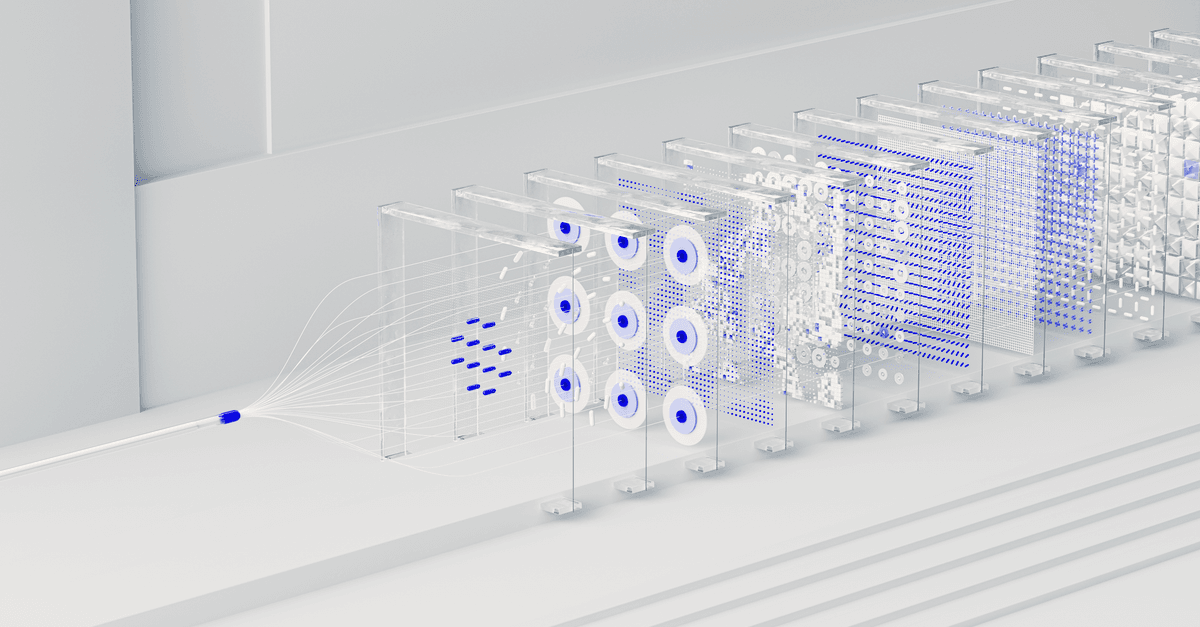
A neural network is one specific architecture for machine learning. It's loosely inspired by biological neurons: many simple units, each receiving inputs, multiplying them by weights, and producing an output.
When you stack many layers of neurons together, you get a deep neural network — and the field of "deep learning" was born. Deep learning is responsible for most of the modern AI boom: image recognition, speech recognition, language models, self-driving perception.
Why "deep" matters: each layer learns to recognise increasingly complex patterns. In an image classifier:
- Layer 1: simple edges and colours.
- Layer 2: shapes and textures.
- Layer 3: parts (eyes, wheels).
- Layer 4: full objects (faces, cars).
You don't program these layers. You feed in millions of labelled examples, and the network figures out the hierarchy itself.
The training process
A typical training cycle:
- Initialisation. Start with random weights — the network knows nothing.
- Forward pass. Feed in an example. The network produces a (probably wrong) answer.
- Loss calculation. Compare the answer to the correct label. Calculate how wrong it was.
- Backpropagation. Adjust weights backward through the network to make the answer better next time.
- Repeat. Millions of times, with millions of examples.
Eventually, the weights settle into a configuration that produces good answers. That trained model can then be deployed.
Real-world applications
Machine learning is in nearly every digital product:
- Search engines rank results based on learned relevance signals.
- Recommendation systems (Netflix, Spotify, Amazon) predict what you'll like.
- Voice assistants transcribe and parse speech.
- Photo tagging recognises faces and objects in your gallery.
- Translation tools convert between languages.
- Fraud detection flags suspicious credit card transactions.
- Medical diagnostics read X-rays and pathology slides.
- Autonomous vehicles combine vision, language, and reinforcement learning to navigate.
- Generative AI (ChatGPT, DALL·E, Sora) creates new text, images, and video.
Roughly speaking: any time a system "predicts" or "recognises" something useful from data, ML is probably involved.
Where ML goes wrong
ML systems fail in distinctive ways:
Bias
If training data reflects historical inequalities, the model will learn them. A hiring algorithm trained on past resumes may favour men if the historical workforce was disproportionately male. A facial recognition system trained mostly on light-skinned faces may misidentify dark-skinned faces.
Distribution shift
Models perform best on data similar to what they were trained on. Show them something out-of-distribution and they fail unpredictably. A self-driving car trained in California may misbehave in a Pittsburgh snowstorm.
Adversarial attacks
Tiny pixel changes invisible to humans can trick image classifiers into misclassifying objects (a stop sign as a speed limit sign). Adversarial robustness is an open research problem.
Hallucinations
Language models can confidently generate plausible-sounding falsehoods. They aren't checking against ground truth; they're predicting plausible text.
Overfitting
Models that memorise training data instead of learning patterns perform brilliantly on training but poorly in the real world.
What "AI" really means
People use "AI" and "machine learning" interchangeably, but they're not exactly the same:
- Artificial Intelligence (AI) is the broad goal of making machines do tasks that require intelligence.
- Machine Learning (ML) is a specific approach to AI: learning from data.
- Deep Learning (DL) is a specific approach to ML: using deep neural networks.
- Generative AI is a recent ML category: models that create new content.
Most modern "AI" is in fact ML, often deep learning. Earlier rule-based AI (expert systems, classical chess engines) is rarely the focus today.
Feature engineering and data preprocessing
Before a machine learning model even touches data, human engineers must prepare it. This unglamorous work — feature engineering and preprocessing — often accounts for 80% of an ML project's effort.
Feature engineering means deciding which aspects of the raw data to feed the model. Example: predicting house prices from raw image data.
- Bad features: raw pixel values (millions of numbers, no clear pattern).
- Good features: square footage, bedrooms, location, age (humans know these matter).
The model works on features, not raw data. Smart feature engineering can make simple models outperform complex ones applied to poor features.
Data preprocessing includes:
- Cleaning (handling missing values, outliers)
- Normalisation (scaling numbers to a consistent range)
- Encoding (converting categories like "red/blue" to numeric representations)
- Balancing (ensuring minority classes aren't ignored)
Source: Bengio, Y., Courville, A., & Vincent, P. (2013). Representation learning: A review and new perspectives. IEEE TPAMI, 35(8), 1798–1828.
Training, validation, and testing: the data split
A critical mistake: training a model on all available data and evaluating it on the same data. The model will overfit — memorising the training set rather than learning generalizable patterns.
The proper workflow:
- Training set (60–70%): Used to adjust weights during backpropagation.
- Validation set (10–15%): Used to tune hyperparameters (learning rate, number of layers, etc.). Not used in weight updates.
- Test set (15–20%): Held back entirely until the end. Only used to report final performance.
Why this matters: A model can achieve 99% accuracy on training data but 60% on test data — a red flag for overfitting. Validation performance tells you if hyperparameter choices are working. Test performance tells you how the model will perform in the real world.
This discipline is so important that competitions (Kaggle, grand challenges) enforce strict separation and withhold test labels to prevent fiddling.
Transfer learning: standing on the shoulders of giants
Training a neural network from scratch requires enormous data and compute. Transfer learning bypasses this: take a model trained on a massive dataset, then fine-tune it on your smaller dataset.
Example: ImageNet models (trained on 14 million images) achieve superhuman vision. Rather than train from scratch on your 10,000 medical X-rays, you:
- Load a pre-trained ImageNet model.
- Replace the last layer (designed for "cat vs. dog") with one for "pneumonia vs. healthy."
- Train only the last few layers on your X-rays.
Result: you need 100x less data and 100x less compute than starting from scratch. This is why most practical ML is transfer learning, not starting from random weights.
Source: Yosinski, J., Clune, J., Bengio, Y., & Liphardt, H. (2014). How transferable are features in deep neural networks? NIPS.
Interpretability: the black box problem
Deep neural networks are black boxes — we can't easily explain why they made a particular prediction. A face recognition system says "this is person X" but can't tell you which features (eyes, nose, scar) drove the decision.
This is a real problem in high-stakes domains:
- Healthcare: A doctor using an AI diagnostic tool needs to understand the reasoning.
- Finance: Loan denial based on an ML model should be explainable to the applicant.
- Criminal justice: Sentencing recommendations based on AI need interpretability.
Methods to improve interpretability:
- LIME (Local Interpretable Model-Agnostic Explanations): approximate the model locally with a simple, interpretable model.
- SHAP (SHapley Additive exPlanations): attribute each prediction to specific input features.
- Attention visualisation: for language models, show which words the model "attended to."
- Simpler models: trade some accuracy for interpretability (decision trees, linear models).
There's a tradeoff: interpretable models (linear regression, decision trees) often underperform black boxes (deep neural networks) in accuracy. Practitioners must choose based on context.
Source: Ribeiro, M. T., Singh, S., & Guestrin, C. (2016). Why Should I Trust You?: Explaining the Predictions of Any Classifier. KDD.
Computational cost and efficiency
Training a large neural network is expensive:
- GPT-3 (2020): ~$5-10 million in compute (175 billion parameters, trained for months on TPUs).
- Large vision model: hundreds of thousands of dollars in GPU hours.
- Inference (running a trained model): still costs money at scale (OpenAI charges per API call because running inference on millions of queries is expensive).
This has created a moat: only well-funded organisations can train frontier models from scratch. Smaller teams use transfer learning or fine-tune pre-trained models.
Efficiency matters:
- Knowledge distillation: compress a large model into a small one (smaller model learned from larger model).
- Quantisation: reduce precision of weights (32-bit → 8-bit), reducing compute and memory.
- Pruning: remove unnecessary weights from trained models.
These techniques allow models to run on-device (phones, embedded systems) rather than requiring cloud compute.
Source: Strubell, E., Ganesh, A., & McAllester, D. (2019). Energy and Policy Considerations for Deep Learning in NLP. ACL.
Common failure modes and edge cases
Label noise: If training labels are wrong, the model learns the wrong patterns. Hiring systems trained on biased historical data will perpetuate bias.
Class imbalance: If 99.9% of examples are negative and 0.1% positive, a model that predicts "always negative" achieves 99.9% accuracy but is useless. Requires careful resampling or weighting.
Concept drift: The relationship between input and output changes over time. A model trained on 2020 spending patterns may fail in 2023. Requires periodic retraining.
Adversarial inputs: As noted earlier, tiny perturbations can fool models. Spam filters, for instance, are in an ongoing arms race with spammers.
Scale: Models trained on small datasets (tens of thousands) sometimes fail to scale to large datasets (billions). Assumptions change as data grows.
Specific ML Algorithms: Beyond Neural Networks
While deep learning dominates headlines, many simpler algorithms are still the workhorses of industry. Different algorithms suit different problems:
Decision trees and random forests — interpretable, fast, work well with structured data (tabular data with rows and columns). A bank might use a random forest to approve loans because the model can explain its reasoning.
Support Vector Machines (SVM) — find optimal boundaries in data to separate classes. Highly effective for text classification, handwriting recognition, and bioinformatics.
k-Means clustering — partition data into k groups with similar characteristics. Used for customer segmentation, image compression, and anomaly detection.
Linear regression and logistic regression — foundational methods for predicting continuous values or binary outcomes. Despite their simplicity, they remain competitive when feature engineering is good.
Gradient boosting (XGBoost, LightGBM) — build an ensemble of weak learners sequentially, each correcting previous errors. Often beats deep learning on tabular data and is the standard in Kaggle competitions.
The reality: practitioners don't always reach for the most complex tool. A random forest or gradient boosted model often outperforms a neural network if features are well-engineered and data is moderate-sized. Neural networks shine when data is massive and unstructured (images, text, audio). Choosing the right algorithm requires understanding the problem, data shape, and computational budget.
Source: Chen, T., & Guestrin, C. (2016). "XGBoost: A Scalable Tree Boosting System." KDD, 785–794 — Seminal paper on gradient boosting, still widely used in production ML.
The ML Pipeline: From Data to Deployment
ML in practice involves much more than training a model. The full pipeline includes:
1. Problem definition: What exactly are you trying to predict or discover? Is it a regression (continuous value), classification (category), clustering, or ranking problem? Clear problem scoping prevents wasted effort.
2. Data collection: Gather representative data. Bias here propagates downstream. A medical AI trained only on data from one hospital may fail at another with different patient demographics.
3. Exploratory data analysis: Visualise, summarise, and understand your data before training anything. Outliers, missing values, and unexpected patterns reveal problems early.
4. Feature engineering and preprocessing: Transform raw data into meaningful features. Domain expertise matters enormously here.
5. Model selection: Choose an algorithm. Start simple, add complexity only if needed.
6. Hyperparameter tuning: Adjust learning rates, tree depths, regularisation strength, etc. Grid search or random search explores the hyperparameter space.
7. Training and validation: Train on training data, monitor validation performance. Stop early if validation performance degrades (sign of overfitting).
8. Testing and evaluation: Report final performance on held-out test data. Calculate metrics appropriate to your problem (accuracy for classification, RMSE for regression, precision/recall for imbalanced data).
9. Deployment: Move the model to production. Challenges include latency requirements, computational constraints (mobile vs. cloud), and versioning.
10. Monitoring and retraining: Models degrade over time as data distribution shifts. Monitor performance in production. Retrain periodically with fresh data.
Most ML projects fail not because the algorithm is wrong but because the data pipeline is broken, the problem is poorly specified, or deployment infrastructure is weak.
Source: Sculley, D., et al. (2015). "Hidden technical debt in machine learning systems." NIPS, 2503–2511 — Influential paper on the gap between research and production ML.
Ethical AI and Responsible Machine Learning
As ML systems make decisions affecting real people, ethics matters. Several concerns:
Fairness and bias — Models inherently reflect their training data. A hiring algorithm trained on biased historical data will perpetuate bias. Fairness is not automatic; it requires active effort: diverse data, debiasing techniques, regular audits. But "fairness" is complex — different stakeholders define it differently, and mathematical definitions can conflict.
Privacy — Models trained on personal data (medical records, browsing history) risk leaking private information. Techniques like differential privacy add noise to data during training to make it harder to extract individual information. Federated learning trains models across decentralized devices without centralizing raw data.
Transparency and explainability — People affected by ML decisions deserve explanations. A job applicant denied by an algorithm should know why. This is increasingly a legal requirement (EU's Right to Explanation).
Environmental impact — Training large models consumes enormous electricity. GPT-3 training used about 1,300 MWh of electricity (equivalent to the annual consumption of ~130 homes). Efficiency and sustainable compute matter.
Accountability — When an ML system fails, who is responsible? A self-driving car hitting a pedestrian raises liability questions. Accountability frameworks are still developing.
These aren't just ethical niceties — they're business-critical. Biased hiring systems expose companies to lawsuits; privacy breaches destroy trust; poorly explained decisions face regulatory backlash. Responsible ML is increasingly a competitive advantage.
Source: Mitchell, S., et al. (2019). "Model cards for model reporting." FAT* — Framework for transparent AI documentation and accountability.
The Takeaway
Machine learning is fundamentally about learning patterns from examples rather than writing explicit rules. The three main flavours — supervised, unsupervised, and reinforcement — solve different problems. Success depends on data quality, thoughtful feature engineering, and disciplined train/validation/test separation. Modern systems harness transfer learning to avoid training from scratch. A full ML pipeline requires careful problem definition, data collection, feature engineering, model selection, and deployment monitoring — areas where most projects actually fail. Beyond neural networks, algorithms like random forests and gradient boosting remain essential for structured data. But ML is not magic: models overfit, amplify biases, hallucinate, and fail on out-of-distribution inputs. Ethical considerations — fairness, privacy, transparency, environmental cost — are increasingly non-negotiable. Understanding these limits and responsibilities is as important as understanding the possibilities.
Frequently Asked Questions
Q: How much data does ML need?
A: It depends. Simple tasks (digit recognition) need ~10,000 labelled examples. Modern language models train on hundreds of billions of words. Generally, more data equals better performance, with diminishing returns at very large scales.
Q: Can ML systems be wrong?
A: Always. A well-trained model is right probabilistically. There's no certainty in ML output — only estimates with associated uncertainty.
Q: Is ML the same as AI?
A: Most modern AI is built on ML, but they're not synonymous. AI is the goal; ML is one important method. Other methods (symbolic reasoning, classical search algorithms) are still used in some systems.
Q: Will ML replace programmers?
A: It's automating boilerplate code and helping with documentation, but writing new software architectures, debugging complex systems, and aligning code with business needs still require human judgment.
Q: Can I build my own ML model?
A: Yes — frameworks like TensorFlow, PyTorch, and tools like Hugging Face make it accessible. For simple tasks, you can train a useful model in an afternoon on a laptop. For frontier models, you need millions of dollars of compute.
Q: How do I know if my model is actually working?
A: Separate your data into training, validation, and test sets. If performance is high on training but low on test, the model is overfitting. If both are low, the model isn't learning. Cross-validation (multiple train/test splits) provides more reliable estimates.
Read next:
Follow new articles
Add SciHub101 to your feed reader to see new science and technology stories.
About the Author
SciHub101 is an independent science and technology publication founded and edited by Buğra Sözeri, a software engineer and app developer based in Türkiye. AI tools assist with drafting and research. Source documentation in the existing archive is uneven, and articles are being reviewed and corrected. The Editorial Team byline identifies editorial responsibility; it does not certify specialist or independent human review. Where we compare products, anything built by our own team is labelled as such — see the editorial guidelines and About page for how corrections and disclosures work.
Related Articles
How Do Neural Networks Work? The Architecture Behind Modern AI
Neural networks are loosely inspired by the brain — but they're really just stacks of math doing pattern recognition. Here's how they work, why they're so powerful, and what's actually going on inside.

GPT-4: Large Language Models Explained
What OpenAI disclosed about GPT-4, what it scored on exams and benchmarks, why next-token prediction got that far, where it still fails, and what replaced it.

How Image Recognition Works: The Science of Convolutional Neural Networks
In 2010 the best image classifier missed the right label in its top five guesses about 28% of the time. By 2015 that was 3.57%. Here is what changed, and how a CNN actually sees.

How Large Language Models Work: Transformers, Attention, and Why They Hallucinate
Meta trained Llama 3 on more than 15 trillion tokens using 7.7 million H100 GPU-hours. Here is how next-token prediction at that scale turns into a conversation partner.

Edge AI: How AI Runs on Your Phone
Server-side chatbots run on racks of GPUs in data centers. Face ID, voice dictation, and a growing number of language features run on a chip the size of a fingernail in your pocket. The science of shrinking large models to fit is called edge AI.

How Diffusion Models Work: Stable Diffusion, DALL-E, and the Science of AI Art
Type a sentence, get a picture. Behind Stable Diffusion and DALL-E sits one idea borrowed from thermodynamics: destroy images with noise in small steps, train a network to undo each step, then run the process backward from static.