Migration Science: How Animals Navigate Thousands of Miles Without GPS
Photo: Klub Boks / Pexels
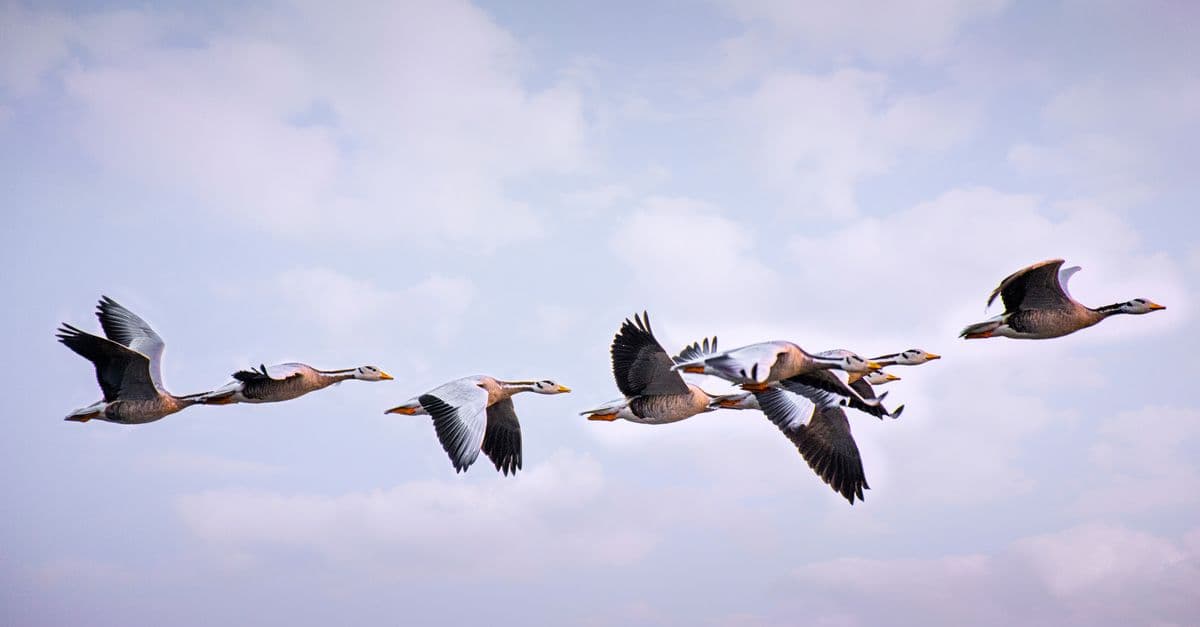
In September 2022, a bar-tailed godwit flew from Alaska to Tasmania non-stop — 13,560 kilometers in 11 days without food, water, or landing. Its digestive organs had shrunk; it was pure muscle and fat, a creature redesigned for extreme endurance. The Arctic tern makes an even longer annual migration (70,000 km round trip), and monarch butterflies navigate 4,000 kilometers to sites they've never seen. Yet animals lack GPS, maps, or written instructions. They navigate using magnetic fields, star maps, sun compasses, smell, sound, and mechanisms scientists are still unraveling — a sensory suite so sophisticated that it makes human navigation technology seem crude by comparison.
Key takeaways
- The bar-tailed godwit holds the record for longest non-stop flight: over 13,000 km without food, water, or rest.
- Animals use at least five independent navigation systems: magnetic fields, star maps, sun compass, odor gradients, and infrasound.
- Birds have magnetic crystals in their beaks and possibly quantum-entangled molecules in their eyes that respond to Earth's magnetic field.
- Monarch butterflies use a time-compensated sun compass — they adjust for the sun's movement across the sky using an internal clock.
- Salmon return to their birth stream using smell alone, detecting their natal water chemistry from miles offshore.
The magnetic sense: navigation by invisible force field
Earth's magnetic field is a three-dimensional structure that varies in strength, inclination, and declination across the globe. For an animal that can sense it, this field provides something analogous to a coordinate system — a way to determine not just direction (north-south) but also latitude.
Evidence for magnetoreception in animals is now overwhelming. Birds displaced hundreds of kilometers from their intended route navigate back to the correct position, not just the correct direction. This "true navigation" (as opposed to simple compass orientation) requires knowing both where you are and where you want to be — and that requires map information, which the magnetic field can provide.
The mechanism may be twofold. Iron-rich magnetite crystals have been found in the beaks of homing pigeons, in the lateral lines of fish, and in the noses of trout — microscopic biological compass needles that physically respond to magnetic fields. But there is also a quantum mechanism. Cryptochrome proteins in bird eyes may undergo quantum entanglement-based electron spin changes in response to magnetic fields, producing visual signals that appear as overlaid patterns on the bird's normal visual field. This "magnetic vision" would mean a migratory bird literally sees the Earth's magnetic field superimposed on its view of the sky — a compass built into vision itself.
Sun compasses and star maps
For animals active during the day, the sun provides directional information. But the sun moves — rising in the east, transiting south, setting in the west — so using it as a compass requires knowing what time it is. Many migratory animals have solved this with a "time-compensated sun compass": an internal biological clock synchronized to local daylight cycles, which automatically corrects for the sun's position throughout the day.
Monarch butterflies use this system precisely. Their sun compass, located in the antennae rather than the eyes, allows them to maintain a southwesterly heading during their 4,000 km migration from Canada to Mexico. If their circadian clock is shifted by keeping them in artificial light/dark cycles, their navigation shifts by the predicted amount — smoking-gun evidence for the clock-compass link.
For nocturnal migrants, the stars substitute for the sun. Young birds raised without exposure to the night sky show disoriented migration; those raised in a planetarium where the sky was artificially rotated calibrate their compass to the artificial north. Stephen Emlen's classic experiments with indigo buntings in the 1960s established that birds learn the center of stellar rotation (which corresponds to true north) during their first summer and use it as a fixed reference ever after.
Smell, sound, and the olfactory map
The pigeon's ability to home from hundreds of miles away has been studied for over a century without full resolution. One leading model — championed by Floriano Papi and colleagues in Italy — is the "olfactory map hypothesis." Pigeons build a mental map of their home area based on airborne odors, associating different wind directions with the smells carried on them. When displaced, they sample local odors, compare them to their mental map, and determine which direction leads home.
Salmon use olfactory navigation in a more literal and dramatic way. Pacific salmon (Oncorhynchus spp.) spend years at sea, then return to spawn in the exact stream where they hatched — sometimes navigating through thousands of kilometers of open ocean and then up river systems with hundreds of tributaries. How? They memorize the precise chemical signature of their birth stream during a brief "imprinting" window as juveniles, then track that chemical gradient home as adults. Studies blocking salmon olfaction eliminate the ability to home; restoring it restores the ability. The salmon carries a chemical key that unlocks the memory of its birthplace.
Infrasound and the acoustic landscape
An emerging area of research suggests that some animals use infrasound — sound frequencies below 20 Hz that humans cannot hear — as a navigation cue. Infrasound is generated by waves breaking on coastlines, mountains deflecting wind, and even the resonance of Earth's own vibrations. Because it travels thousands of kilometers with little attenuation, the infrasonic "soundscape" of an ocean or continent is geographically structured — different regions have distinct infrasonic fingerprints.
Homing pigeons deprived of their olfactory sense can still navigate, suggesting an alternative system. Research by Jon Hagstrum at the USGS suggests they may use infrasound from their home loft as a beacon — essentially hearing home from hundreds of kilometers away. This would explain anomalous pigeon releases near freeway interchanges and mountains that disrupt infrasound propagation and consistently cause navigational errors. Sound plays other roles in animal biology too, as in the science of why cats purr.
Redundancy and multi-system navigation
Sophisticated migrators use multiple navigation systems simultaneously — a strategy that ensures success even if one system fails. A migratory bird doesn't rely on magnetic sense alone, or stars alone, or the sun alone. It uses them all, cross-checking one against the other.
This redundancy is critical because migration is high-stakes: an error of even a few degrees compounds across thousands of kilometers. A bird that drifts 5° off course during a 10,000 km journey ends up 900 km from the target — a catastrophic miss.
| Navigation Mechanism | Primary Users | Accuracy Range | Limitations |
|---|---|---|---|
| Magnetic sense | Birds, fish, sea turtles | ±5-10° | Affected by geomagnetic storms |
| Star compass | Night-migrating birds, some insects | ±5-10° | Clouds, light pollution |
| Sun compass | Day-migrating birds, monarchs, bees | ±5-10° | Requires internal clock accuracy |
| Olfactory map | Pigeons, salmon, mammals | ±50-100 m (local) | Requires wind patterns, odor memories |
| Infrasound | Pigeons, possibly whales | ±1-5 km | Topography affects propagation |
| Visual landmarks | Some birds, insects, mammals | ±100 m-1 km | Requires familiar terrain |
Multi-system redundancy means migrators can succeed even when individual systems degrade or become unavailable.
Source: Wiltschko & Wiltschko, "Magnetic Orientation in Animals," Journal of the Royal Society Interface, 2019 — Comprehensive review of magnetoreception mechanisms and navigation system redundancy in vertebrates.
Physiological adaptations enabling extreme migration
Migration isn't just a navigation feat — it's a physiological transformation. Animals preparing for long journeys undergo dramatic rewiring of metabolism, physiology, and behavior.
The godwit's metamorphosis
Before its 13,560 km journey, the bar-tailed godwit undergoes hyperphagia — obsessive feeding, consuming roughly 30% of its body weight in fat stores. Simultaneously, organs not needed for flight shrink: the digestive system, kidneys, and reproductive organs can shrink to 1-10% of normal size. This creates room for fat reserves while reducing weight (smaller organs still require energy to maintain, so minimizing them improves fuel efficiency).
During the flight itself, the godwit operates in an altered state: hypothermia (lowered body temperature), reduced metabolic rate, and suppressed immune function. All non-essential functions pause. Flying muscles consume 90%+ of available energy. The bird does not sleep during the entire 11-day journey — it essentially enters a state between sleep and wakefulness, with one brain hemisphere resting at a time.
Other extreme adaptations
Hummingbirds (ruby-throated) crossing the Gulf of Mexico (800 km) undergo similar changes: massive fat loading (doubling body weight to ~6 grams), then a flight requiring continuous wing beats at 50 Hz for 18+ hours without rest or feeding.
Arctic terns undertake the longest migration (70,000 km annually), experiencing perpetual daylight during Arctic summer and perpetual night during Antarctic summer. Their internal clocks become dissociated — no longer tied to a 24-hour cycle because circadian cues don't exist at the poles.
Salmon undergo a metamorphosis so complete it was once thought they were different species. Silvery ocean fish become dark, hump-backed, hook-jawed spawning machines. Their digestive systems degrade (they stop eating entirely), their eyes change, their muscle composition shifts, and their nervous systems rewire to execute a pre-programmed repertoire of spawning behaviors.
Source: Alerstam et al., "Long-distance migration: evolution and determinants," Oikos journal, 2003 — Physiological trade-offs and energetic constraints in long-distance animal migration.
Climate change: the mismatch catastrophe
Spring warming is shifting the timing of insect outbreaks earlier — sometimes by 2-3 weeks compared to decades ago. This creates a fatal desynchronization for migratory birds.
Insectivorous warblers migrate north by photoperiod (day length is a reliable cue that doesn't vary year-to-year). But insects are triggered by temperature (a cue that does vary with climate). In recent decades, insects are peaking before birds arrive. The birds show up to empty forests — no caterpillars, no insects to feed themselves or their chicks. Nestlings starve.
Breeding populations of European flycatchers have crashed ~90% in some regions precisely correlating with this phenological mismatch. GPS tracking studies show the birds arriving on schedule — their navigation is perfect — but the ecosystem they arrive to has transformed. Their food is gone.
Polar bears face the opposite problem: Arctic sea ice is melting earlier, shortening the hunting season. Bears must fast longer or travel further, exhausting themselves before reproduction.
These examples reveal a crucial insight: migration is not just navigation, but ecological synchrony. A bird can have perfect magnetic sense, perfect star navigation, and still fail if the world has changed too much. Evolution calibrated these systems over millions of years to a relatively stable climate. Rapid change (1-2°C per century) is faster than evolutionary adaptation can follow.
Source: IPCC Report, "Climate Change and Biodiversity: Species and Ecosystems" (2022) — Documentation of phenological mismatch and population declines in migratory species linked to climate change.
Genetic Programming vs. Learned Navigation: Nature's Dual Strategy
One of the most debated questions in migration biology concerns the relative roles of genetics and learning. How much of migration is programmed into the genome, and how much is learned through experience or social transmission?
The evidence suggests a sophisticated division of labor. Innate programs encode fundamental parameters: migration direction, distance, timing, and response to seasonal triggers like changing day length. A first-year European blackcap raised in isolation (with no parents, no other birds) still migrates southward at the right time for the right duration, suggesting the basic migration program is genetically hardwired. Similarly, monarch butterflies navigate 4,000 km to sites they've never encountered, with zero parental teaching — their destination is an "instinct," somehow encoded at the level of neural circuits and motor responses.
However, genetic encoding alone cannot account for the complexity of real migration. A bar-tailed godwit breeding in Alaska must follow an optimal route to its New Zealand wintering ground — a route with specific stopover sites, timing windows, and weather considerations. This route is learned, not innate. GPS tracking studies show that juvenile godwits on their first migration often take suboptimal routes, deviating from the efficient path their parents followed. By their second year, they've corrected toward the optimal path. This is trial-and-error learning, with survival stakes: juveniles that make poor route choices have lower survival odds.
Cultural transmission of migration knowledge represents a third layer. Geese and cranes learn migration routes by following parents and older birds. The older birds teach landmarks, stopover sites, optimal timing, and predator-avoidance strategies. Young birds imprint on these routes and follow them for life. This creates a non-genetic inheritance of knowledge — loss of experienced birds (through selective hunting, for example) can erase migration routes that took generations to learn. Conversely, humans can teach wild birds new routes: in Europe, trained humans have led young whooping cranes along new migratory paths using microlight aircraft, effectively "rewriting" their innate migration destination to avoid dangerous areas.
The reconciliation between genetic and learned navigation appears to be that genes encode a flexible template. A bird is born with: (1) a compass direction (north/south/southwest), (2) a distance range (this far, no farther), (3) seasonal triggers (migrate when day length decreases), and (4) a learning mechanism that allows refinement based on experience. The learning mechanism is itself genetic — the ability to learn is hardwired — but the content of what's learned is acquired.
This explains what researchers call piloting versus navigation. True navigation means knowing where you are and where you want to go even in unfamiliar territory. Piloting means following familiar landmarks. Most migratory animals use both: they navigate via magnetic sense, stars, and sun compass in unfamiliar territory; but on well-traveled routes, they fall back on landmark recognition and learned stopover sites. This hybridity provides robustness — if one system fails, the other works.
Research by Jon Hagstrum at the USGS suggested that homing pigeons primarily use piloting based on learned landscape features rather than pure navigation. When displaced to unfamiliar territory, pigeons show initial disorientation, then gradual reorientation as they recognize landmarks and construct a mental map. They're not calculating position via magnetic sense; they're remembering what home looks like and navigating toward familiar sights.
The evolutionary advantage of this hybrid strategy is clear: genetic programs ensure basic migration happens without teaching (valuable for species with short lifespans or no parental care), but learned routes and refinement allow optimization across generations. A species can adapt to changing conditions (new stopover sites, shifted timing) without waiting for genetic evolution — the changes can spread through cultural transmission in just a few generations.
However, this also creates vulnerability. When humans dramatically alter landscapes (draining wetlands, urbanizing stopover sites), animals cannot quickly evolve new routes. Young birds learn from parents, but if the learned route now leads to a developed area where food has vanished, the knowledge becomes lethal. Climate change presents a similar paradox: the genetic trigger (day length) remains reliable, but the ecosystem it evolved to synchronize with (insect emergence, breeding conditions) has become decoupled. The animal's innate program is maladapted to the new reality.
Source: Able, K. P., & Bingman, V. P. (2016). "The Development of Bird Navigation: A Comparison of Innate and Learned Mechanisms" — Proceedings of the Royal Society B — Synthesis of genetic programming and learning in avian migration.
Sensory capabilities we're only beginning to understand
New research continues to reveal navigation mechanisms previously unknown:
Magnetic field navigation via quantum mechanics
Recent evidence suggests cryptochromes (light-sensitive proteins in bird eyes) may use quantum entanglement to sense magnetic fields. Electrons in these proteins exist in superposition states (two places at once) until disturbed — a disturbance by magnetic fields could trigger a cascade that creates visual patterns overlaid on normal vision. A bird would literally see magnetic field lines, like a map projected onto its visual field.
This is speculative but testable. If true, it would mean birds have a sixth sense based on quantum mechanics — sensitivity to physical phenomena humans can barely measure with instruments.
Polarized light and UV sensing
Many insects (honeybees, butterflies, ants) can perceive polarized light — patterns in skylight polarization that vary with sun position. Some also see UV light invisible to humans. These visual cues provide compass information orthogonal to magnetic sense: if magnetic sense fails, polarized light still works.
Infrasound pathways
Infrasound (frequencies <20 Hz) travels thousands of kilometers with minimal attenuation, unlike audible sound. Mountains, coastlines, and atmospheric features generate distinct infrasonic signatures. Some evidence suggests migrating whales may navigate using ocean infrasound — a global acoustic map of sea basins.
Kin selection and learned routes
In geese and some cranes, older birds teach younger birds the route. This creates cultural transmission of migration knowledge — a non-genetic form of inheritance. Young birds following experienced birds can learn landmarks, timing cues, and stopover sites. Disruption of these social structures (via targeted hunting of elders, for example) can erase migration knowledge accumulated over generations.
Source: Alerstam et al., "Extreme Endurance Flights by Migrating Birds," Journal of Avian Biology, 2005 — Analysis of navigation mechanisms and sensory integration in long-distance migrants.
Threats to migration: light, noise, and habitat loss
Light pollution
Many nocturnal migrants orient by stars. Artificial light discolors the sky, drowns out stars, and directly disorients birds. Tall illuminated buildings attract disoriented migrants, resulting in collisions. Estimates suggest up to 1 billion birds die annually in North America from building collisions during migration — a mortality scale rivaling habitat loss.
Habitat loss along migratory corridors
Stopover sites are critical: birds cannot fly 13,000 km without resting and refueling. Wetlands, coastal mudflats, and grasslands where migrants rest are disappearing to agriculture and development. A shorebird arriving at a traditional stopover site to find it converted to a parking lot must divert to a suboptimal site or continue exhausted — reducing survival odds.
Geomagnetic storms
Intense geomagnetic activity (aurora-triggering storms) temporarily disrupts Earth's magnetic field. During these events, migratory birds show disoriented behavior, flying off-course or clustering in confusion. Studies show increased collision and mortality during geomagnetic storms in urban areas.
Frequently Asked Questions
Q: How do young animals know where to migrate if they've never done it before?
A: Many species have genetically encoded migration directions and distances programmed into their brains. First-year European blackcaps raised in complete isolation (no parental teaching, no social learning) still migrate in the correct direction for the correct duration at the correct time. Other species (geese, cranes) learn migration socially, following experienced adults who teach landmarks, timing, and stopover sites across generations.
Q: What is the longest migration of any animal?
A: The Arctic tern (Sterna paradisaea) holds the record: approximately 70,000 km round trip annually, from Arctic to Antarctic and back. But distance isn't the only measure of extremity. The bar-tailed godwit's non-stop 13,560 km journey (no food, water, or rest for 11 days) is perhaps the most physiologically extreme. The ruby-throated hummingbird's 800 km Gulf of Mexico crossing is the most distance-to-body-weight extreme.
Q: Can magnetic fields affect human navigation?
A: Humans appear to have residual magnetoreception from our evolutionary past — a 2019 study at Caltech found measurable brain electrical activity when human subjects were exposed to rotating magnetic fields. However, there is no evidence that humans can consciously perceive or voluntarily use this signal for navigation. Our conscious sense of direction relies on visual landmarks, learned maps, and devices.
Q: Why do some birds crash into windows and buildings during migration?
A: Nocturnal migrants navigate using stars, moon position, and polarized light. Artificial light (skyscrapers, street lamps, billboards) disrupts this system — a phenomenon called light pollution mortality. Glass buildings are invisible to birds at night; they don't see the barrier and collide at full speed. Estimates suggest 100 million to 1 billion birds die annually from building collisions in North America during spring and fall migration.
Q: How does a monarch butterfly "know" Mexico if it's never been there?
A: The Mexican overwintering site (specific high-altitude forests in Michoacán) is entirely genetically programmed. Monarchs have never been there in their individual lifetime; their parents died before returning on the southbound journey the previous spring; and they receive no social guidance or teaching. The direction (southwest), distance (~3,000 km), and stopping point are encoded in their genome — one of nature's most remarkable demonstrations of innate navigation behavior.
Q: What happens if a migrator gets lost?
A: It depends on the species and circumstances. Some birds can recalibrate using multiple backup systems (if magnetic sense fails, use stars; if stars fail, use sun). Others show compass-based rather than map-based navigation — they know the direction but not necessarily the location, potentially overshooting or undershooting the target. In the worst case, the migrant exhausts energy reserves, succumbs to predators, or perishes from disease, injury, or starvation.
The takeaway
Animal migration is one of nature's most extraordinary achievements — enabled by navigation systems evolved over millions of years and now under assault from rapid environmental change. A bar-tailed godwit's 13,560 km non-stop flight, a monarch butterfly's 4,000 km journey to a site it's never seen, and an Arctic tern's 70,000 km annual cycle demonstrate sensory sophistication we are only beginning to understand. Yet these systems are fragile, finely tuned to seasonal rhythms and environmental cues that climate change and habitat loss are rapidly altering. As we study how animals navigate, we're also learning how much the modern world is disrupting that navigation — and what we risk losing if we don't protect the ecosystems and skies these incredible journeys depend upon.
Read next:
Follow new articles
Add SciHub101 to your feed reader to see new science and technology stories.
About the Author
SciHub101 is an independent science and technology publication founded and edited by Buğra Sözeri, a software engineer and app developer based in Türkiye. AI tools assist with drafting and research. Source documentation in the existing archive is uneven, and articles are being reviewed and corrected. The Editorial Team byline identifies editorial responsibility; it does not certify specialist or independent human review. Where we compare products, anything built by our own team is labelled as such — see the editorial guidelines and About page for how corrections and disclosures work.
Related Articles
How Bats Use Echolocation: Seeing the World in Sound
Bats build a 3D map of the world from sound echoes — a sensory system so precise it can detect a wire 0.3mm thick in total darkness.

Neural Networks Decoding the Brain: How AI Reads Neural Activity
Deep learning systems can now turn brain recordings into text, speech, and rough images. Here is how it works, what it needs, and where it stops.
How Do Birds Migrate Thousands of Miles: Navigation, Fat, and Flight
An Arctic tern chick hatches in Greenland, fledges, and within weeks makes its first 70,000 km round-trip migration to Antarctica — a journey it has never made before, with no experienced adult to follow. By the end of its 30-year life, it will have flown the equivalent of three trips to the Moon and back. The mechanisms behind this feat involve quantum physics, internal clocks, and a navigation system more sophisticated than anything human engineers have yet replicated.
Corvid Intelligence: Why Crows and Ravens Are Nature's Problem Solvers
Crows make tools, plan for the future, recognize 500+ human faces, and hold grudges for years. Their intelligence rivals great apes — in a 400-gram brain.
How Spiders Make Silk: The Strongest Material in the Natural World
Spider silk is tougher than steel and Kevlar by weight — yet a spider produces it from liquid protein at room temperature in milliseconds, no factory required.
Animal Sleep: How Different Species Sleep (And Why Some Barely Sleep at All)
Elephants sleep 2 hours a night. Koalas sleep 22 hours. Dolphins sleep with one eye open. Sleep is stranger across the animal kingdom than you imagined.