What Is Generative AI and How Is It Changing Industries?
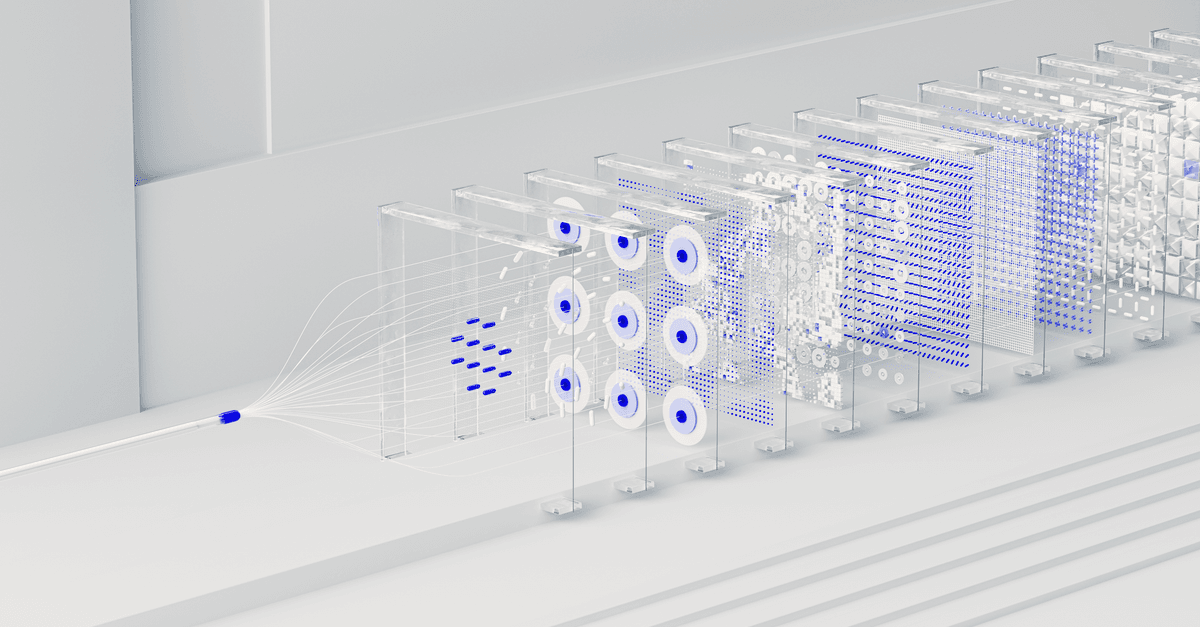
Photo: Google DeepMind / Pexels
Generative AI is the class of machine learning systems that produce new content — text, images, audio, video, code, or molecular structures — rather than classifying or predicting from existing data. It is not a single technology but a family of model architectures sharing one property: trained on enough examples, they can synthesize plausible new outputs in the same domain. Understanding what separates generative from conventional AI explains both why the technology spread so quickly and where its real limits lie.
Generative vs. Discriminative AI: The Core Distinction
Most AI systems deployed before 2020 were discriminative — they learned a boundary between categories and assigned new inputs to one side or the other. A spam filter, a fraud detector, a medical image classifier: all take an input and return a label. They answer "what is this?" but cannot answer "make me one of these."
Discriminative model — a model that learns the conditional probability P(label | input), mapping inputs to output classes. A dog-versus-cat image classifier is discriminative.
Generative model — a model that learns the probability distribution P(data), enabling it to sample new data points from that distribution. A generative image model learns what cat images look like, then produces new ones.
In formal terms, discriminative models learn to draw decision boundaries in data space; generative models learn to model the data distribution itself. The practical consequence is enormous: a generative model can produce text that was never written before, images that have never been photographed, proteins that have never existed.
This distinction also explains generative AI's most visible failure mode. A discriminative spam filter that is uncertain defaults to a probability output — it can express doubt. A generative language model that is uncertain still produces fluent, confident-sounding text because it is not outputting a label but sampling from a learned distribution. The model has no built-in uncertainty flag, which is why hallucination — generating plausible but factually wrong content — is a structural property of the technology, not a fixable bug.
The Three Main Model Families
Generative AI is not one architecture. Three model families dominate the landscape, each suited to different content types.
Large Language Models (LLMs)
Large language models learn to predict the probability of the next token in a sequence, trained on text at a scale previously impossible. Models like GPT-4, Claude 3.5 Sonnet, Gemini 1.5 Pro, and LLaMA 3 fall into this category.
The key insight behind LLMs is that next-token prediction at scale produces a model that implicitly encodes grammar, factual knowledge, reasoning patterns, and stylistic conventions found in the training data. The task is simple; the emergent capabilities are not.
LLMs power chatbots, code assistants, document summarizers, search augmentation, and autonomous agents. The text generation segment alone held 48% of the generative AI market share in 2025.
Diffusion Models
Diffusion model — a generative model that learns to reverse a gradual noise-addition process. Training teaches the model to denoise images step by step; at inference, it starts from pure noise and progressively denoises toward a coherent image guided by a text prompt or other conditioning signal.
Stable Diffusion, DALL-E 3, Midjourney, and Adobe Firefly are diffusion models. The same principle extends to video (Sora, Runway Gen-3), audio (AudioLDM, Stable Audio), and 3D assets.
Diffusion models displaced earlier generative image architectures (GANs) rapidly after 2022 because they produce higher-fidelity outputs, are more controllable via text conditioning, and do not suffer from training instability. Midjourney's v6 model, released in 2024, produces images that a significant fraction of viewers cannot reliably distinguish from photography.
Generative Adversarial Networks (GANs)
GAN (Generative Adversarial Network) — a model architecture where two networks train against each other: a generator produces fake samples, and a discriminator tries to distinguish them from real ones. The generator improves by fooling the discriminator; the discriminator improves by catching fakes.
GANs were the dominant generative image architecture from 2014 (Ian Goodfellow's original paper) through 2021. StyleGAN3 produces photorealistic human faces. GANs remain in use for specific applications — video deepfake synthesis, data augmentation in healthcare — but diffusion models have largely displaced them for general image generation due to better stability and text-conditioning.
| Model family | Primary domain | Key examples | Key advantage |
|---|---|---|---|
| LLMs (transformers) | Text, code | GPT-4, Claude 3.7, Gemini 2.0, LLaMA 3 | Broad knowledge, reasoning, instruction following |
| Diffusion models | Images, video, audio | Stable Diffusion, DALL-E 3, Sora, Midjourney | High fidelity, text-guided generation |
| GANs | Images, video | StyleGAN3, DeepFaceLab | Speed at inference; specific synthesis tasks |
| Autoregressive image models | Images | Parti, ImageGPT | Unified architecture with text models |
| Flow models | Images, molecular structures | Glow, RoseTTAFold All-Atom | Exact likelihood estimation, scientific applications |
Source: Grand View Research (2025), "Generative AI Market Size and Forecast Report 2026–2034" — documents market segmentation by model type and application domain.
Real-World Applications Across Industries
The market evidence supports broad adoption. The global generative AI market was valued at USD 53.7 billion in 2025 and is projected to reach USD 83.3 billion in 2026, growing at approximately 31.6% annually. By 2026, 71% of organizations report regularly using generative AI in at least one business function.
Software Development
Code generation is the application where productivity gains are most measurable. GitHub Copilot, powered by OpenAI Codex models, reported in 2023 that developers using the tool accepted about 30% of its suggestions, with some studies finding 55% faster task completion for specific well-defined coding tasks.
The workflow shift is structural: developers increasingly write natural-language specifications and review generated code rather than writing every line. This shifts the skill premium from syntax knowledge to systems thinking, debugging, and requirements clarity.
Healthcare and Drug Discovery
AlphaFold 3, released by Google DeepMind in 2024, extended protein structure prediction to DNA, RNA, and small molecule interactions — directly relevant to drug design. The model's predictions are used in hundreds of active drug discovery programs as of 2025.
Generative models also produce synthetic medical data to augment training datasets where real patient data is scarce or privacy-protected. A 2023 Stanford study showed that synthetic radiology images generated by diffusion models improved diagnostic classifier performance when real training data was limited.
Content Creation and Marketing
The content creation segment held 35.7% of the generative AI market share in 2026. Marketing teams use LLMs for first-draft generation, A/B testing copy variants, and translating content into multiple languages. Image generation accelerates visual asset production for advertising, e-commerce product photography, and social media.
A documented tension: concerns around copyright (training on copyrighted work without licensing), authenticity (synthetic content that appears human-produced), and job displacement in creative fields.
Finance
The financial services sector leads all industries in ROI from generative AI, at 4.2 times return per dollar invested in 2025. Applications include document analysis (earnings reports, regulatory filings), fraud narrative generation (explaining why a transaction was flagged), customer-facing chat (answering account queries), and risk report drafting.
Source: McKinsey Global Survey (2025), "The state of AI in early 2026: Generative AI adoption accelerates" — documents the 71% adoption figure and sector-by-sector ROI estimates.
Source: Jumper et al. / Google DeepMind (2024), "Accurate structure prediction of biomolecular interactions with AlphaFold 3," Nature — describes AlphaFold 3's extended capabilities across molecular types.
The Limits: What Generative AI Cannot Reliably Do
Understanding the real limits of generative AI is as important as understanding its capabilities.
Hallucination is the most widely documented failure mode. LLMs generate tokens based on statistical plausibility, not truth-checking. They will invent citations, misstate dates, and fabricate facts in fluent, confident prose. Retrieval-Augmented Generation (RAG) reduces but does not eliminate hallucination by grounding responses in retrieved documents.
Reasoning under novelty remains inconsistent. LLMs solve problems similar to those in their training data reliably; novel reasoning chains — where each step depends on the previous in ways not seen in training — degrade unpredictably. Benchmarks like ARC-Challenge and GPQA distinguish memorization from genuine reasoning, and frontier models still score well below human experts on the hardest items.
Physical grounding is absent. Language models have no direct experience of the physical world. They can describe how a bicycle works from their training data, but they have not ridden one and cannot generalize to the physical details of a new bicycle design the way an engineer can.
Compute cost at scale limits deployment. A single query to a frontier LLM costs approximately $0.001–$0.03 in inference compute (2025 prices, varying by model and provider). Serving a billion daily queries at even $0.001 per query costs $1 million per day. For high-volume applications, compute cost constrains what is economically viable.
Copyright and provenance remain legally unresolved. Multiple lawsuits (Getty Images v. Stability AI, The New York Times v. OpenAI, and others) challenged training on copyrighted data as of 2025–2026. No final judicial resolution exists; the risk of retroactive licensing obligations or training restrictions is real.
Source: Maynez et al. (2020), "On Faithfulness and Factuality in Abstractive Summarization," Google Research — one of the foundational studies documenting hallucination in neural text generation.
The Multimodal Direction
The boundary between model families is dissolving. GPT-4o, Gemini 1.5 Pro, and Claude 3.5 Sonnet process text, images, and audio in a single model. Multimodal models that can see, hear, and read — and generate across all three modalities — are the dominant architecture direction in 2025–2026.
Multimodal model — a model trained on multiple data types (text, images, audio, video) simultaneously, learning representations that span modalities. A multimodal model can answer questions about an image, generate images from text descriptions, or transcribe and summarize audio, within the same architecture.
The commercial implication is that AI systems become more general-purpose: a single model can be an assistant, an image annotator, a code reviewer, and a document analyzer. Enterprise cost per capability drops as the number of specialized models needed decreases.
Risks and the Governance Landscape
The risks of generative AI are documented and partially quantified. Synthetic text and images lower the cost of misinformation production; a single person with API access can produce convincing fake news articles, fake legal documents, or synthetic impersonation audio at negligible cost.
The EU AI Act, which came into full effect in 2025, classifies general-purpose AI models with more than 10^25 FLOPs of training compute as high-impact, requiring additional transparency, red-teaming, and reporting obligations. US federal AI governance remained fragmented as of mid-2026, with sector-specific guidance from FDA (healthcare AI), SEC (financial AI), and FTC (consumer AI) rather than a unified federal framework.
Source: European Commission (2024), "EU Artificial Intelligence Act" — the primary EU AI governance framework, effective August 2025, with tiered obligations for general-purpose AI models.
What This Means
Generative AI's genuine novelty is not that it automates tasks — every technology since the Industrial Revolution has automated tasks. Its novelty is that it automates tasks that previously required human judgment, language, and creativity as inputs. A tool that can produce a reasonable first draft of a contract, a functional code snippet, or a diagnostic image label changes the economic calculus for any knowledge worker whose output is primarily text, code, or images. The productivity gains are real and measurable. The hallucination risk is real and measurable. The path forward requires using generative AI as a first-draft tool with human review, not as an autonomous decision-maker — a distinction that organizational deployment is still learning to enforce.
How Generative Models Actually Generate — The Core Mechanism
The phrase "generates new content" is accurate but explains nothing about the mechanism. Two fundamentally different processes underlie the major model families, and understanding them clarifies both why generative AI works as well as it does and why it fails the way it does.
Autoregressive generation is the mechanism behind large language models. The model produces output one token at a time, in sequence, where each new token is conditioned on all previous tokens. Think of it as a chain: the model reads "The capital of France" and generates "is." It now reads "The capital of France is" and generates "Paris." It reads the whole accumulating sequence and generates the next fragment, indefinitely, until it produces a stop token. Each step involves the full attention mechanism computing relevance between every token in the current context, making the process computationally intensive but also allowing the model to maintain coherent long-range dependencies — "it" at the end of a 500-word paragraph can still correctly refer to a noun introduced at the beginning.
The training objective that creates this capability is next-token prediction on massive corpora. The model never sees the "correct" output as a whole; it learns to predict each successive token from all preceding tokens. At scale, this forces the model to internalize statistical patterns at every level — spelling, grammar, sentence structure, paragraph coherence, factual associations, and reasoning conventions — because all of these are embedded in the sequential structure of human text. The same architecture that predicts "Paris" in a geography completion learns to predict syntactically coherent continuations of legal briefs, working Python code, and academic arguments, because all of these appeared in training data and all have discoverable sequential patterns.
Diffusion is the mechanism behind image, video, and audio generation models. It operates on a completely different principle. During training, the model is shown images at various stages of a noise-addition process — from a clean image to increasingly scrambled random noise — and learns to predict what noise was added at each step. This trains the model to reverse the noise process: given a noisy image and a step index, predict the slightly less noisy image. At inference time, the model starts from pure random noise and iteratively denoises it over 20 to 100 steps, guided by a conditioning signal such as a text description. Each denoising step moves the image from the noise distribution toward the learned distribution of real images that match the condition.
The text-conditioning mechanism in modern diffusion models (like Stable Diffusion 3, DALL-E 3, and Flux) uses a text encoder (typically a transformer) to convert the prompt into a vector embedding, which is then injected into the denoising network at each step via cross-attention. The denoising network "reads" the text embedding at every step and adjusts the denoising direction to move the image toward visual features associated with the text. This is why "a photograph of a red fox sitting in snow, golden hour lighting" produces an image that honors those specific constraints — the text embedding steers the iterative process continuously.
| Property | Autoregressive (LLMs) | Diffusion (image/video) |
|---|---|---|
| Generation order | Sequential, left to right | Iterative, whole output at once |
| Training objective | Predict next token | Predict noise added at each step |
| Conditioning | In-context (the prompt itself) | Cross-attention to text embedding |
| Failure mode | Hallucination, repetition | Artifacts, anatomical errors, prompt-drift |
| Speed | Fast for short outputs; slow for very long outputs | Fixed cost per step count; can parallelize |
Source: Ho, J. et al. (2020), "Denoising Diffusion Probabilistic Models," NeurIPS — the foundational diffusion model paper establishing the noise-prediction training objective that underlies all major image generation systems.
The Open Questions: Hallucination, Provenance, and Cost
Generative AI's most significant unsolved problems are not engineering challenges likely to be fixed in the next software release. They are structural properties that follow from the way these systems are built and trained.
Hallucination — the confident generation of factually wrong content — is not a bug caused by insufficient training data or imprecise prompting. It is a consequence of the autoregressive objective. The model learned to produce statistically plausible next tokens, not to verify claims against a ground-truth knowledge base. When asked "What papers did Professor X publish on quantum error correction?", the model generates professor names, paper titles, and journal names that are statistically consistent with academic citations — because it has seen thousands of academic citation patterns in training data. The generated citation is coherent in format and plausible in content. Whether it describes a paper that actually exists is a separate question the model has no mechanism to check.
Retrieval-Augmented Generation (RAG) reduces hallucination by giving the model access to retrieved documents that it can quote directly, reducing the need to generate facts from statistical association alone. But RAG does not eliminate hallucination for content not in the retrieved context, and retrieval itself can fail — returning irrelevant or outdated documents that the model then faithfully cites. As of 2026, no deployed system has fully eliminated hallucination, and evaluation benchmarks like FELM and FActScore continue to show that frontier models hallucinate on 5–15% of fact-intensive queries, depending on the domain.
Source: Min, S. et al. (2023), "FActScore: Fine-grained Atomic Evaluation of Factual Precision in Long Form Text Generation," EMNLP — introduces FActScore as a benchmark for measuring hallucination rates in long-form generation; documents hallucination rates for major models at evaluation time.
Data provenance and copyright represent a legal and ethical dispute that remains unresolved at both the judicial and regulatory level. Training a generative model on copyrighted text, images, or code involves reproducing those works in the training process and creating a model capable of generating outputs similar to those works. Whether this constitutes copyright infringement, fair use, or something that existing law does not cleanly address depends on jurisdiction and is actively litigated. Getty Images sued Stability AI in US and UK courts in 2023, alleging that training Stable Diffusion on Getty's licensed image catalog without permission infringed copyright. The New York Times sued OpenAI in December 2023, alleging that GPT-4 can reproduce New York Times articles verbatim under certain prompting conditions. As of mid-2026, neither case has produced a final judgment with binding precedent for the industry.
The practical consequence for organizations deploying generative AI is legal risk that cannot be fully quantified. A company using an LLM to generate marketing copy could theoretically face liability if the model reproduces substantial portions of copyrighted text. Indemnification clauses in API terms of service (offered by Google, Microsoft, and OpenAI to enterprise customers) shift but do not eliminate this risk. Several countries, including Japan and Singapore, have enacted explicit copyright exceptions for AI training data; the EU's approach under the AI Act requires transparency about training data but is still being interpreted.
Compute cost and energy are constraints that shape which applications are economically viable. A single inference call to a frontier LLM costs approximately $0.001 to $0.03 in 2026 pricing, depending on model and provider. This sounds negligible per call, but it accumulates rapidly at scale: a consumer application with 1 million daily active users making three queries each spends $3,000 to $90,000 per day on inference alone. Training costs are orders of magnitude higher — a frontier pretraining run costs $50 million to $150 million in compute. The International Energy Agency estimated in 2024 that data center electricity demand would roughly double by 2030 relative to 2022, with AI workloads as the primary driver of that growth.
This cost structure has two significant consequences. First, it creates competitive moats: organizations that can afford frontier training runs can produce capabilities that cannot be replicated by organizations without equivalent capital. Second, it means that applications requiring many API calls per user interaction — multi-turn reasoning agents, code review pipelines, real-time conversational AI at massive scale — are economically viable only with cost reductions from hardware efficiency gains or smaller models that maintain sufficient capability.
Source: International Energy Agency (2024), "Electricity 2024: Analysis and Forecast to 2026" — documents projected AI-driven growth in data center electricity demand; used extensively in policy discussions on AI energy footprint.
Frequently Asked Questions
Q: What is the difference between generative AI and traditional AI?
A: Traditional AI (discriminative AI) classifies or predicts from given inputs — a spam filter, a recommendation engine, a fraud detector. Generative AI produces new content by learning the statistical distribution of its training data. The difference is between "what is this?" (discriminative) and "make me one of these" (generative).
Q: Is ChatGPT a generative AI model?
A: Yes. ChatGPT is built on GPT-4 and GPT-4o, both large language models that generate text token by token using learned probability distributions. It belongs to the transformer-based LLM family of generative models.
Q: Can generative AI models understand what they are saying?
A: Not in the way humans understand. LLMs learn statistical associations between tokens from training data; they do not have beliefs, intentions, or grounded experience of the world. They produce text that is coherent and often factually accurate because coherent, accurate text was prevalent in training data — not because they "know" facts in a philosophical sense.
Q: What is hallucination in AI and why does it happen?
A: Hallucination is when a generative AI produces content that is fluent and confident but factually wrong — inventing citations, misquoting statistics, or describing events that never occurred. It happens because LLMs generate tokens based on statistical plausibility, not truth verification. The model has no internal fact-checker; it completes patterns.
Q: How large is the generative AI market in 2026?
A: The global generative AI market was valued at USD 53.7 billion in 2025 and is projected to reach USD 83.3 billion in 2026, according to multiple market research sources including Grand View Research and Fortune Business Insights.
Q: What are the main risks of generative AI?
A: The primary documented risks are: hallucination (factually wrong confident outputs), misuse for misinformation and synthetic fraud, copyright infringement from training data, bias amplification from biased training data, and concentration of capability in a small number of well-resourced organizations. These risks are not speculative — all have been documented in research and legal proceedings as of 2026.
Read next:
Follow new articles
Add SciHub101 to your feed reader to see new science and technology stories.
About the Author
SciHub101 is an independent science and technology publication founded and edited by Buğra Sözeri, a software engineer and app developer based in Türkiye. AI tools assist with drafting and research. Source documentation in the existing archive is uneven, and articles are being reviewed and corrected. The Editorial Team byline identifies editorial responsibility; it does not certify specialist or independent human review. Where we compare products, anything built by our own team is labelled as such — see the editorial guidelines and About page for how corrections and disclosures work.
Related Articles
What Is Quantum AI and Why Experts Say It Changes Everything: Hype Versus Reality in 2026
Quantum artificial intelligence — the intersection of quantum computing and machine learning — sounds transformative. Quantum computers could theoretically solve certain optimization problems exponentially faster than classical computers. Machine learning on quantum hardware could accelerate training or enable entirely new algorithms. Tech companies and venture capitalists have invested billions in the idea. Yet in 2026, quantum AI remains almost entirely theoretical. No commercially useful quantum-enhanced machine learning system exists. No real-world problem has been solved by quantum AI faster than classical AI. Most quantum computers are laboratory instruments available to a handful of researchers. The hype far exceeds the reality. However, the research is genuine, and if quantum computing matures, the potential impact on AI is real. This article untangles what quantum AI actually is, what promises are realistic, which are science fiction, and what the honest timeline looks like.

The Future of Work: How AI Will Change Jobs by 2030
Every major wave of automation in the past 200 years has destroyed job categories and created new ones, always with the same confident predictions that this time the displacement would be permanent and total. The evidence from electrification, computing, and the internet is that mass unemployment did not follow. AI presents genuinely new challenges — it automates cognitive work, not just physical — but the historical pattern and current data provide a more nuanced picture than either the techno-utopian or doomsday forecasts.

What Is Generative AI Art? How Diffusion Models and GANs Learn to Create
Generative AI art is produced by machine learning models trained to learn patterns from existing images and generate new images based on text descriptions or other prompts. The two dominant approaches are diffusion models (which start with noise and progressively refine toward an image) and GANs (Generative Adversarial Networks, which pit a generator against a discriminator in competition). For artists, understanding how these systems work is essential—both for using them effectively and for understanding their limitations and biases. This article explains diffusion, GANs, latent space, fine-tuning, and what these technologies can and cannot do.

Generative AI Art: How Diffusion Models Actually Work
Diffusion models are revolutionizing visual art creation. Here's the science behind how AI learns to paint.

How AI Models Are Trained: The Full Pipeline Explained
Training a large language model is not a single act — it is a five-stage industrial process that begins with petabytes of scraped text, passes through weeks of GPU computation consuming millions of dollars of electricity, and ends with a model that can hold a coherent conversation. Each stage has a specific job, a distinct failure mode, and a measurable cost. Here is how the whole pipeline works, from raw data to deployed product.

AI Benchmarks Explained: How We Measure Machine Intelligence
AI benchmarks determine which models get deployed and trusted. Understanding how they work — and how they fail — is essential context for any AI claim.