The Atomic Clock: The Device That Defines Time Itself
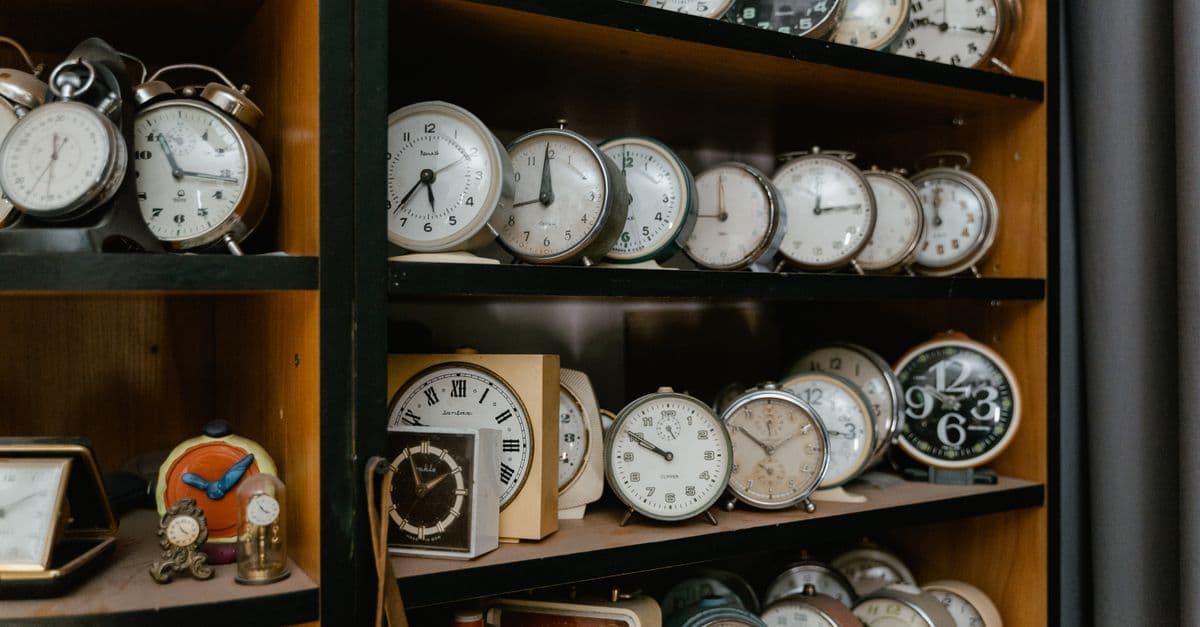
Photo: Tima Miroshnichenko / Pexels
When your phone shows the time, it is ultimately reading a clock that has not gained or lost a second in over three centuries of cumulative operation. The atomic clock doesn't tick. It counts the oscillations of an atom — specifically, the number of times per second a cesium-133 atom transitions between two energy states. That number is 9,192,631,770, and it is now, by international definition, what one second means. The device that established this standard was built in 1955 by two British physicists at a laboratory south of London, using techniques borrowed from wartime radar research.
What Timekeeping Problems Made the Atomic Clock Necessary
Every timekeeping device before the atomic clock measured time by counting repetitions of a mechanical or electrical oscillation. Pendulum clocks counted the swings of a pendulum; quartz crystal clocks counted the vibrations of a piezoelectric crystal. Both were limited by the same fundamental problem: the thing being counted was affected by the environment. A pendulum's period changes with temperature (thermal expansion alters its length). A quartz crystal's vibration frequency drifts with temperature, aging of the crystal, and mechanical stress.
Frequency stability — the degree to which an oscillator maintains a consistent rate over time. Expressed as a fractional frequency deviation: a quartz clock with stability of 10⁻⁸ loses or gains about 1 second per 3 years. The best mechanical astronomical clocks of the 1940s were stable to about 10⁻⁹ — one second per 30 years. The problem was that both navigation and the emerging science of geodesy (precise mapping of Earth's surface) required better.
Second — historically defined as 1/86,400 of a mean solar day (24 hours × 60 minutes × 60 seconds). By the early 20th century, this definition had been refined to an astronomical standard tied to Earth's orbit, but Earth's rotation is not perfectly uniform — it slows slightly due to tidal friction and varies seasonally. By the 1940s, these variations were large enough to limit the accuracy of timekeeping.
Source: NIST, "Beams of Atoms: The First Atomic Clocks" (2023); Louis Essen, Wikipedia.
The Story Behind the Discovery
Isidor Rabi and the Conceptual Foundation (1939)
The conceptual basis for the atomic clock was laid by Isidor Isaac Rabi at Columbia University in 1937–1938. Rabi had developed a technique called atomic and molecular beam magnetic resonance: a beam of atoms passes through two magnetic fields and a microwave field tuned to a specific frequency. When the microwave frequency matches the atom's natural resonance frequency — the energy difference between two internal quantum states — the beam is strongly affected (atoms change state and are detected). When the frequency is off, the beam is unaffected.
Rabi recognized in 1939 that this resonance frequency could be used as a frequency standard — a reference to which any oscillator could be compared and locked. He presented the idea at the Annual Meeting of the American Physical Society in January 1945.
Source: NIST, "Beams of Atoms: The First Atomic Clocks"; Rabi's Nobel Prize biography, NobelPrize.org. Note: Rabi received the Nobel Prize in Physics in 1944 for the resonance method itself, not for the clock application.
The atom's natural resonance frequency is set by quantum mechanics: the energy difference between the two states is fixed by the fundamental constants of nature. An atom of cesium-133 in interstellar space vibrates at the same frequency as an atom in a laboratory on Earth. Unlike a pendulum or crystal, it is not affected by temperature, pressure, or material aging. It is, in principle, a universal constant.
Louis Essen, Jack Parry, and the NPL Clock (1955)
Louis Essen was a metrologist at the National Physical Laboratory (NPL) in Teddington, England, who had made his reputation in the 1940s by building the world's most accurate quartz crystal clocks using techniques derived from his wartime work on microwave radar cavities.
In 1953, Essen visited the National Bureau of Standards (NBS) in Washington, D.C., where a group led by Harold Lyons was working on an ammonia-based atomic clock. NBS's ammonia clock was less accurate than Essen's own quartz clocks, which discouraged him. But Essen recognized that cesium, with its single valence electron and accessible microwave transition frequency, would be a far better choice than ammonia.
Returning to NPL, Essen proposed a cesium beam clock to his management. The project was approved, and Essen worked with J.V.L. (Jack) Parry to build the device. The clock used a beam of cesium-133 atoms evaporated from a heated oven, passed through an inhomogeneous magnetic field (to select atoms in one particular quantum state), exposed to microwave radiation at approximately 9,192 MHz, and then detected by a second magnetic field after the microwave interaction.
The first operation of the NPL cesium clock occurred on May 24, 1955. On June 3, 1955, the BBC time signal incorporated input from Essen's clock — the first time atomic time was available publicly.
Source: Science Museum Group Collection, "Caesium Atomic Clock, 1955"; Louis Essen, ETHW biography; Physics World, "Celebrating Louis Essen and the Birth of Atomic Time" (2023).
The clock was accurate to 1 second in 300 years — approximately 30 times better than the best quartz crystal clocks of the time, and 300 times better than the best pendulum clocks. It was nicknamed the "Flying Bedstead" by BBC engineers because of its unwieldy size: more than a meter long, requiring banks of external electronics and vacuum pumps.
Source: National Physical Laboratory, "Louis Essen" biography page (npl.co.uk).
The International Competition
Essen was not working alone. NBS in the US was developing its own cesium clock in parallel. The competition was not adversarial — there was significant correspondence and occasional collaboration between the groups — but there was genuine national prestige at stake. The NPL clock was first to operate; NBS's NBS-1 followed in 1957.
Between 1955 and 1967, NPL, NBS, and laboratories in Canada, Germany, and the Soviet Union accumulated data comparing their cesium standards to the astronomical definition of the second. The accumulated data revealed a precise relationship: one astronomical second corresponded to approximately 9,192,631,770 cycles of the cesium transition.
Source: BIPM (Bureau International des Poids et Mesures), history of the second definition; Caesium standard, Wikipedia.
How the Atomic Clock Actually Works
The Cesium Beam Clock
The operational principle of a cesium beam clock is elegant once you understand the underlying quantum mechanics.
Hyperfine transition — a transition between two very slightly different energy states of an atom's ground state, caused by the interaction between the electron's spin and the nuclear spin. In cesium-133, the two ground states differ by the orientation of the outermost electron's spin relative to the nucleus's spin. The energy difference between these states corresponds exactly to a microwave photon with a frequency of 9,192,631,770 Hz.
The clock works as follows: cesium atoms are heated in an oven to produce a beam of vapor. The beam passes through a "state selector" — an inhomogeneous magnetic field that bends atoms in one hyperfine state into the detector path and deflects atoms in the other state away. The selected atoms then pass through a microwave cavity fed with a signal at approximately 9.19 GHz. If the microwave frequency exactly matches the cesium transition frequency, atoms absorb microwave energy and change state. A second state selector detects this state change, and the detection signal is used in a feedback loop to keep the microwave oscillator precisely on the atomic resonance.
The microwave oscillator, steered to the cesium resonance, provides the stable frequency output. A counter divides this frequency down to produce 1-pulse-per-second output signals and timekeeping.
The analogy: imagine a guitar tuned by comparison to a tuning fork rather than by ear. The cesium atom is the tuning fork — its "note" is fixed by physics and cannot change. The microwave oscillator is the guitar string, continuously adjusted to match. As long as the feedback loop functions, the oscillator stays locked to the atomic resonance, and the clock keeps perfect atomic time.
Source: NIST, "How Does an Atomic Clock Work?" (2023); Atomic clock, Wikipedia.
The Cesium Fountain Clock
The cesium beam clock of 1955 could not fully exploit the narrow linewidth of the atomic resonance because the atoms were moving fast (thermal velocity around 200 m/s), which limits how long they interact with the microwave field and broadens the resonance through the Doppler effect. In the 1990s, a new design addressed both problems.
The cesium fountain clock cools cesium atoms to microkelvin temperatures using laser beams (a technique called laser cooling, developed by Claude Cohen-Tannoudji, William Phillips, and Steven Chu, who shared the 1997 Nobel Prize in Physics for this work). The cold atoms are then launched upward in a "fountain" inside a vacuum chamber, slow down under gravity, stop at the peak, and fall back down — spending about one second in the microwave cavity on the way up and another second on the way down, for a total interaction time of about one second. This extended interaction time gives an extremely narrow resonance linewidth and corresponding precision.
NIST-F1, the first US cesium fountain clock (operational from 1999), was accurate to 1 second in 20 million years. Its successor, NIST-F2, achieves accuracy of 1 second in 300 million years.
Source: NIST, "NIST-F2 Atomic Clock" (2014); NIST, "Beams of Atoms" historical overview.
| Clock Type | Year | Accuracy | Technology |
|---|---|---|---|
| Best pendulum clock | 1940s | 1 sec / 30 years | Mechanical |
| NPL cesium beam (Essen) | 1955 | 1 sec / 300 years | Cesium beam |
| NBS-1 | 1957 | 1 sec / ~1,000 years | Cesium beam |
| NIST-F1 | 1999 | 1 sec / 20 million years | Cesium fountain |
| NIST-F2 | 2014 | 1 sec / 300 million years | Cesium fountain |
| Sr optical lattice clock | 2023 | 1 sec / 15 billion years | Optical lattice |
Optical Lattice Clocks: The Next Generation
The cesium clock uses microwave frequencies (∼9.19 GHz). Optical lattice clocks use transitions in the visible or near-visible light range — frequencies around 10¹⁴ to 10¹⁵ Hz, roughly 100,000 times higher than microwave frequencies. Because a clock's precision scales with the frequency being counted (more ticks per second means finer resolution), optical clocks are inherently capable of far greater precision.
Optical lattice — a periodic potential created by interfering laser beams that traps neutral atoms at the nodes of the interference pattern, like eggs in an egg carton. By choosing a "magic wavelength" of trapping laser at which the atomic transition frequency is insensitive to the laser intensity, the atoms can be held in place without perturbing the clock transition.
The leading optical lattice clock candidates use strontium-87 or ytterbium-171. The strontium clock transition frequency (429,228,004,229,873.4 Hz) is known with fractional uncertainty below 10⁻¹⁸ — the clock would neither gain nor lose one second in approximately 15 billion years, longer than the current age of the universe.
Source: NIST, "Second: The Future" (2024); ScienceAlert, "This New Clock Is So Precise It Could Soon Redefine The Second" (2023); BritBrief, "New Strontium Optical Clock Could Redefine the Second by 2030" (2024).
The Redefinition of the Second
The second's current definition dates to October 13, 1967, when the 13th General Conference on Weights and Measures (CGPM) adopted the following:
"The second is the duration of 9,192,631,770 periods of the radiation corresponding to the transition between the two hyperfine levels of the ground state of the cesium-133 atom."
This replaced the previous definition based on Earth's orbit (the ephemeris second). The cesium definition has been in force for nearly 60 years.
Source: BIPM, 13th CGPM Resolution 1 (1967); Caesium standard, Wikipedia.
The 2022 CGPM voted to prepare for a redefinition of the second using optical clock transitions, with a target date of the 29th CGPM meeting in 2030. The redefinition will specify a particular optical transition (most likely strontium or ytterbium) and its frequency in Hz. The challenge is achieving agreement among national metrology laboratories — NPL, NIST, PTB (Germany), SYRTE (France), NMIJ (Japan) — on which transition to use and demonstrating sufficient reproducibility across different laboratory implementations.
Source: NIST, "Second: The Future" (2024); EurekAlert, "The World's First Use of an Optical Lattice Clock to Keep National Standard Time" (2022).
The People Involved
Isidor Rabi (1898–1988)
Rabi was born in Rymanów, in what is now Poland, and emigrated to the United States as an infant. He studied chemistry at Cornell but switched to physics for his PhD at Columbia, where he spent most of his career. His molecular beam magnetic resonance technique, developed in the 1930s, is the direct ancestor of both the atomic clock and nuclear magnetic resonance (NMR) spectroscopy — the physics underlying MRI scanners.
Rabi received the Nobel Prize in Physics in 1944. His suggestion in January 1945 that atomic resonances could serve as frequency standards — made during a talk at the American Physical Society meeting — directly inspired subsequent atomic clock development at NBS and NPL.
Source: Rabi Nobel Prize biography, NobelPrize.org; Columbia University Physics Department history.
Louis Essen (1908–1997)
Essen joined NPL in 1929 after studying physics at the University of Nottingham. His early career focused on radio frequency metrology — measuring frequencies with high precision. During World War II, he worked on radar cavity resonators, and this experience with microwave resonance directly informed his cesium clock design.
Essen was a meticulous and sometimes combative scientist. In later life, he became known for heterodox views on the theory of relativity, arguing that experimental evidence for time dilation was insufficient — a position not accepted by the scientific community. His actual experimental contribution — the NPL cesium clock — is uncontested.
He never received the Nobel Prize, which is sometimes cited as an oversight, given that the atomic clock's impact on navigation, telecommunications, and fundamental physics has been at least as consequential as many recognized inventions.
Source: Louis Essen biography, ETHW; SPIE Photonics Focus, "Louis Essen: Time Lord of Precision Atomic Clocks" (2023); NPL, "Famous Scientists: Louis Essen."
Jack Parry
J.V.L. Parry was Essen's collaborator on the NPL cesium clock. He is less historically prominent than Essen, but the photograph of the two men standing beside the original clock — Essen on the right, Parry on the left — is one of the iconic images of 20th-century metrology. Parry's contributions to the clock's practical design and electronics are documented in the original NPL papers but have been less celebrated than Essen's conceptual leadership.
Source: ResearchGate, photograph documentation; Science Museum Group Collection notes.
The GPS Dependency
The Global Positioning System is, at its core, a timing system. Each GPS satellite carries multiple atomic clocks (typically cesium and rubidium). A GPS receiver determines its position by measuring the time delay between signals received from four or more satellites simultaneously. Because the signals travel at the speed of light (299,792,458 m/s), a timing error of one microsecond (10⁻⁶ second) translates to a position error of 300 meters.
GPS satellites carry atomic clocks accurate to about 20–30 nanoseconds (2–3 × 10⁻⁸ seconds) per day, which is sufficient for meter-level positioning. Ground control stations regularly update the satellite clocks by comparing them to atomic clocks at the U.S. Naval Observatory and NIST.
Source: U.S. Naval Observatory, GPS timing information; NIST, "GPS and Timing."
Without atomic clocks, GPS as currently implemented would not function. The timing precision required for meter-level position determination is orders of magnitude beyond anything achievable with quartz oscillators. By extension, all systems that depend on GPS — civil aviation, maritime navigation, precision agriculture, financial transaction timestamping, mobile phone networks, the power grid's frequency management — depend ultimately on the cesium clock Essen and Parry built in 1955.
Modern telecommunications networks use atomic clock signals distributed over fiber optic links to synchronize base stations. Financial markets use atomic time to timestamp transactions to microsecond precision, enabling high-frequency trading and regulatory compliance. The entire infrastructure of modern networked civilization is synchronized to atomic time.
Source: ITU-T G.811 standard for telecommunications timing; SEC Rule 613 requirements for market data timestamp precision.
Unintended Consequences
Relativistic Corrections Become Engineering Requirements
General relativity predicts that clocks run faster at higher altitudes (where gravitational time dilation is weaker) and slower when moving quickly (special relativistic time dilation). These effects are small but not negligible for atomic clocks.
GPS satellites orbit at approximately 20,200 km altitude at speeds of about 3.9 km/s. The gravitational effect causes their clocks to run 45 microseconds per day faster than identical clocks on Earth's surface. The velocity effect causes them to run 7 microseconds per day slower. The net effect is that GPS satellite clocks run approximately 38 microseconds per day fast relative to ground clocks.
This correction is hardwired into every GPS satellite and every GPS receiver. Without it, GPS positioning errors would accumulate at roughly 10 km per day. Einstein's general relativity is not an academic abstraction; it is an engineering requirement in consumer navigation devices.
Source: NASA, "Relativity and GPS" (2023); Clifford M. Will, "Was Einstein Right? Putting General Relativity to the Test" (1993).
The Leap Second Problem
Because atomic time (International Atomic Time, TAI) is uniform and Earth's rotation is slightly irregular, the two gradually diverge. Coordinated Universal Time (UTC) — the civil time standard — inserts "leap seconds" to keep UTC within 0.9 seconds of astronomical time (UT1). Since 1972, 27 leap seconds have been inserted.
Leap seconds cause significant problems for computer systems that expect time to increment monotonically. Several major internet outages have been attributed to leap second handling bugs, including incidents affecting Cloudflare, Reddit, and Linux systems. The 2022 CGPM voted to eliminate the leap second by 2035, replacing it with a larger correction applied less frequently.
Source: BIPM, "Leap Second" announcement; ITU-T, Leap Second proposal documentation.
Dark Matter Detection
Optical lattice clocks precise enough to detect relativistic effects at the level of 10⁻¹⁸ are also sensitive to potential signals from dark matter. Some theoretical models predict that dark matter particles would cause momentary fluctuations in fundamental constants as a dark matter "clump" passed through a laboratory. A network of optical clocks distributed around the world could, in principle, detect correlated anomalies consistent with such a passage.
This is speculative but active research: the MAGIS-100 experiment at Fermilab and the AION project at Oxford are exploring long-baseline atom interferometry that could serve as both gravitational wave detectors and dark matter sensors.
Source: Fermilab MAGIS-100 experiment documentation; Physical Review Letters, dark matter detection using atomic clocks (2020).
Where the Atomic Clock Stands Today
Every national metrology institute maintains atomic clocks that contribute to International Atomic Time (TAI), the global time scale maintained by the Bureau International des Poids et Mesures (BIPM) in Paris. TAI is computed as a weighted average of contributions from approximately 450 atomic clocks in more than 80 laboratories worldwide.
Optical lattice clocks — the next-generation standard — have been operating experimentally at NIST (strontium), PTB (ytterbium), SYRTE (strontium), and NMIJ (strontium and ytterbium) since the 2010s. In June 2022, Japan's NICT became the first institution to use an optical lattice clock to keep national standard time, transitioning from cesium fountain to strontium optical.
Source: EurekAlert/NICT, "The World's First Use of an Optical Lattice Clock to Keep National Standard Time" (2022); NIST, "Second: The Future."
The 29th CGPM in 2030 is expected to adopt a new definition of the second based on an optical transition, ending the cesium era that began with Essen's flying bedstead in 1955. The new definition will be more accurate by roughly three orders of magnitude — the difference between a clock accurate to 1 second in 300 million years and one accurate to 1 second in 15 billion years.
For a fuller account of how GPS turned atomic time into navigation infrastructure, see GPS.
What People Get Wrong About Atomic Clocks
The most widespread misconception is that an atomic clock works by measuring the vibration or oscillation of an atom in the mechanical sense — as if the atom were a tiny tuning fork. Atoms don't vibrate in this way. What the clock measures is the frequency of electromagnetic radiation that causes transitions between two specific quantum states of the atom. The "oscillation" is in the microwave or optical field that interacts with the atom, not in the atom's physical position.
A second confusion: that atomic clocks are physically located in GPS satellites. They are — each GPS satellite carries cesium and rubidium atomic clocks — but the master time standard is maintained on the ground at the U.S. Naval Observatory and NIST. The satellite clocks are regularly updated from these ground references.
A third error: conflating TAI (International Atomic Time) with UTC (Coordinated Universal Time). TAI and UTC differ by exactly 37 seconds as of 2024 (due to 27 accumulated leap seconds since 1972). Your phone shows UTC, adjusted to your local time zone. TAI is the underlying scientific standard used in physics and metrology. Leap seconds are inserted into UTC to keep it aligned with Earth's rotation; TAI never has leap seconds.
Frequently Asked Questions
Q: How does an atomic clock keep time? A: An atomic clock keeps time by counting the oscillations of electromagnetic radiation that cause transitions between two energy states of a specific atom — cesium-133 in the current standard. A microwave oscillator is locked to the cesium transition frequency of 9,192,631,770 Hz using a feedback loop: if the oscillator drifts off frequency, atoms stop changing state and the feedback corrects the oscillator. The result is a frequency source stable to parts in 10¹⁶ or better, which is used to count seconds.
Q: Why cesium? A: Cesium-133 has several practical advantages. It has a single isotope (no separation required), a single valence electron (simple electronic structure), a relatively accessible transition frequency in the microwave range (making it technically tractable with 1950s electronics), and a transition frequency that is relatively insensitive to external magnetic fields in the geometry used. Other elements (rubidium, hydrogen) are used in portable or less precise atomic clocks; the cesium transition was chosen for the primary standard because of its long-term stability.
Q: What is the difference between accuracy and stability in a clock? A: Accuracy refers to how closely a clock agrees with the true definition of the second. Stability refers to how consistently a clock ticks at the same rate over short periods, regardless of whether that rate is exactly correct. A clock can be highly stable (very consistent rate) but inaccurate (the rate is consistently slightly off). Atomic clocks are both stable and accurate; quartz oscillators are very stable over short periods but drift over time.
Q: How does GPS use atomic clocks? A: GPS determines position by measuring the time taken for signals to travel from multiple satellites to a receiver. Because signals travel at the speed of light, the receiver can compute distances from each satellite and triangulate its position. Position accuracy of a few meters requires timing accuracy of about 10 nanoseconds. This requires atomic clocks in the satellites; quartz oscillators would introduce position errors of hundreds of meters.
Q: What will change when the second is redefined in 2030? A: The numerical value of the second — 9,192,631,770 cesium transitions — will be replaced by a value based on an optical transition frequency. For everyday users, nothing will change: clocks, GPS, and computers will continue to work identically. The change matters for physics research and precision metrology, where the extra three orders of magnitude of accuracy will enable experiments in gravitational physics, dark matter detection, and fundamental constants measurement that current cesium clocks cannot support.
Q: Are there atomic clocks in everyday consumer devices? A: Not typically. Consumer devices — phones, computers, watches — use quartz oscillators that synchronize to atomic time via network protocols (NTP for computers, GPS for phones). Some specialized telecom equipment and scientific instruments contain chip-scale atomic clocks (CSACs), which are atomic clocks small enough to fit on a circuit board, but these are not yet in mass consumer devices. The accuracy of consumer quartz clocks is maintained by periodic synchronization to atomic time servers.
Read next:
Follow new articles
Add SciHub101 to your feed reader to see new science and technology stories.
About the Author
SciHub101 is an independent science and technology publication founded and edited by Buğra Sözeri, a software engineer and app developer based in Türkiye. AI tools assist with drafting and research. Source documentation in the existing archive is uneven, and articles are being reviewed and corrected. The Editorial Team byline identifies editorial responsibility; it does not certify specialist or independent human review. Where we compare products, anything built by our own team is labelled as such — see the editorial guidelines and About page for how corrections and disclosures work.
Related Articles
The Invention of the Electric Battery
From Alessandro Volta's 1800 voltaic pile to the 2019 Nobel Prize for lithium-ion: how the battery became the defining technology of the portable power age.

The Automotive Airbag: From a Near-Miss on a Country Road to 67 Million Recalled Vehicles
John Hetrick patented the airbag in 1952 after swerving to avoid a deer. It took 37 more years for a US mandate—and the Takata scandal nearly destroyed trust in the device that saves 50,000 lives a year.

The Invention of GPS
How Bradford Parkinson, Ivan Getting, and Roger Easton built a satellite navigation system for nuclear bombers that became the infrastructure of everyday life.
The Mechanical Clock: How Humanity Learned to Slice Time
From the verge escapement of 1275 to atomic clocks accurate to one second in 300 million years — the 750-year story of how timekeeping reshaped civilization.