Why Does Ice Float? The Physics of Water
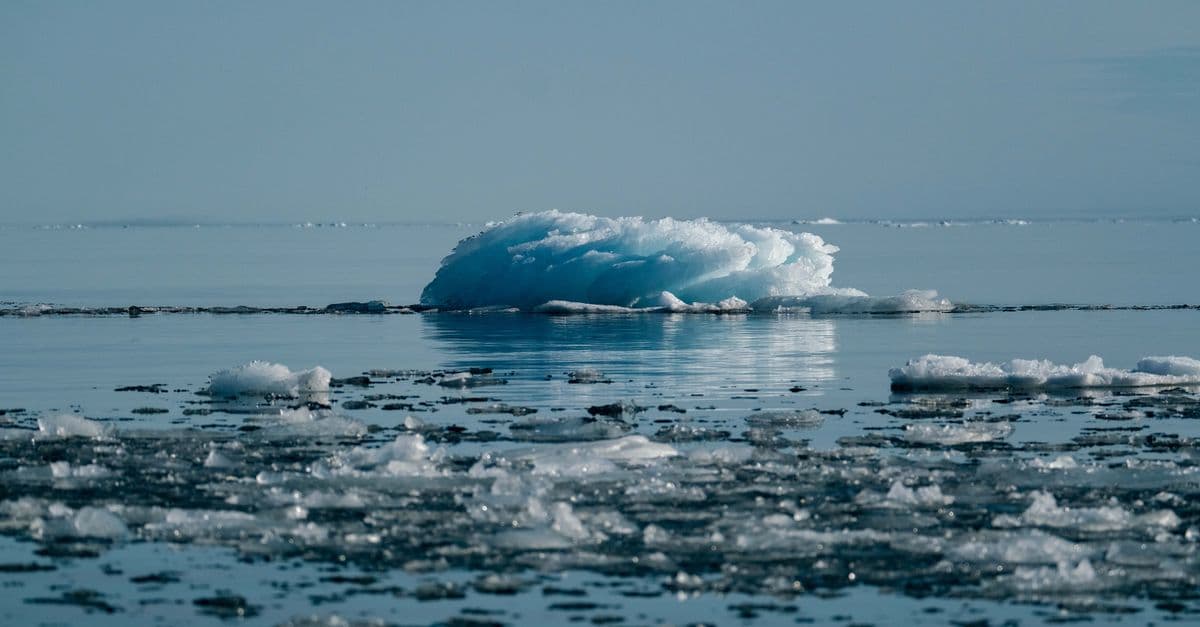
Photo: Francesco Ungaro / Pexels
Drop an ice cube in a glass of water and it floats. Most people accept this without a second thought — but it's actually one of the strangest behaviors in chemistry. Nearly every other substance on Earth becomes denser when it solidifies. Solid metal sinks in liquid metal. Solid wax sinks in liquid wax. Yet solid water floats on liquid water, and this seemingly small quirk is the reason life on Earth is possible.
This article explains the molecular physics behind floating ice — and why, if water acted like a normal substance, our oceans would be frozen solid.
The Anomaly: Water's Density Curve
For most materials, density increases steadily as temperature drops. Molecules slow down, pack more tightly, and the solid form ends up denser than the liquid.
Water doesn't follow this rule. Here's what its density curve actually looks like:
- At 25°C: 997.0 kg/m³
- At 10°C: 999.7 kg/m³
- At 4°C: 999.97 kg/m³ (maximum density)
- At 0°C (liquid): 999.84 kg/m³
- At 0°C (ice): 916.7 kg/m³ — about 9% less dense
So water gets denser as it cools, but only down to 4°C. After that, density actually decreases until freezing, and then drops sharply when ice forms. Ice is roughly 9% less dense than the liquid water it came from — which is why icebergs float with about 10% of their volume above the water and 90% below.
The Molecular Explanation: Hydrogen Bonds
The culprit is the hydrogen bond. A water molecule (H₂O) is shaped like a bent triangle: an oxygen atom with two hydrogen atoms sticking out at about 104.5°. The oxygen end has a partial negative charge; the hydrogen ends are partially positive. This polarity means the slightly positive hydrogen of one molecule is attracted to the slightly negative oxygen of another.
In liquid water, these hydrogen bonds are constantly forming and breaking. On average, each water molecule is bonded to about 3.4 others at any moment, and they can pack relatively closely.
When water freezes, something different happens. Each molecule locks into place with exactly four hydrogen bonds in a rigid tetrahedral arrangement, forming a hexagonal crystal lattice. This lattice is more ordered but also more open — it has more empty space than the chaotic liquid state. Same molecules, more volume = less density.
This is the opposite of how most freezing works. When metals solidify, atoms pack into tight crystal structures with less space than in their liquid state. Water's hydrogen bonds force the molecules apart even as they organize.
Why This Single Quirk Makes Life Possible
If water behaved like a normal substance — denser as a solid than as a liquid — life on Earth as we know it would not exist. Here's why:
Lakes Freeze Top-Down, Not Bottom-Up
When the air temperature drops in winter, the top layer of a lake cools first. Normal substance: that cool layer would sink and the lake would freeze from the bottom up. Water: the surface cools to 4°C and sinks, then cools further to near 0°C and rises back up because it's now less dense. Ice forms on the top.
Once a layer of ice forms, it acts as an insulator. The water beneath stays liquid at around 4°C, even when the air above is well below freezing. Fish, amphibians, plants, and microorganisms survive the winter in this protected pocket.
If ice sank instead, lakes would freeze solid from the bottom up. Aquatic life couldn't survive a single winter. Most freshwater ecosystems would not exist.
Oceans Would Freeze Permanently
Scale this up to the oceans. Earth's geothermal heat is too small to keep oceans liquid if they froze from the bottom. Once frozen, the bottom ice would be insulated by the cold water above — and only the top few centimeters would ever thaw in summer. Earth would become a frozen world, and complex life almost certainly wouldn't evolve.
Climate Stability
Floating sea ice strongly affects Earth's climate via albedo — the fraction of sunlight reflected back to space. Ice reflects up to 90% of incoming sunlight; open ocean reflects only ~6%. The Arctic and Antarctic ice caps stabilize global temperatures. As they shrink under climate change, the planet absorbs more heat, accelerating warming. Our climate change explainer covers this feedback loop in more detail.
Water's Other Weird Properties
Hydrogen bonding makes water unusual in several other ways:
- High specific heat capacity (~4.18 J/g·K) — water absorbs a lot of energy before warming, which is why oceans buffer Earth's temperature.
- High boiling point for its molecular mass — H₂O boils at 100°C while similar-mass molecules like H₂S boil at -60°C.
- Universal solvent — water dissolves more substances than any other liquid, enabling the chemistry of life.
- High surface tension — supports insects walking on water, capillary action in plants.
- High heat of vaporization — sweating cools efficiently because evaporating water carries away huge amounts of heat.
All of these stem from the same hydrogen bonding behavior.
Substances That Also Expand on Freezing
Water isn't completely alone in this anomaly, but the club is small:
| Substance | Density Anomaly | Mechanism |
|---|---|---|
| Water (H₂O) | Ice ~9% less dense than liquid | Hydrogen bonding forms open hexagonal lattice |
| Gallium (Ga) | Solid ~3% less dense than liquid | Covalent bonding in solid phase |
| Bismuth (Bi) | Solid ~3.3% less dense than liquid | Open crystal structure |
| Silicon (Si) | Solid ~9% less dense than liquid | Tetrahedral covalent bonding |
| Germanium (Ge) | Solid ~5% less dense than liquid | Similar to silicon |
| Antimony (Sb) | Solid less dense than liquid | Open rhombohedral structure |
Notice a pattern: most of these (silicon, germanium) form tetrahedral structures similar to water's ice lattice. Tetrahedral bonding tends to create open, less-dense solids.
Gallium is famously used in physics demos because it melts in your hand at 30°C, and a chunk of solid gallium will float in a puddle of its own melt.
Saltwater, Pressure, and Edge Cases
A few extra wrinkles worth knowing:
- Saltwater freezes at about -2°C (depending on salinity) because dissolved salt disrupts ice's lattice — this is "freezing-point depression."
- Sea ice is less salty than the water it freezes from — most salts are excluded from the lattice as crystals form.
- At very high pressure, water forms denser ice phases (ice II, III, V, VI, etc.) that don't float. The ice we know on Earth's surface is "ice Ih" (hexagonal ice).
- Icebergs reveal about 10% above water, hence the metaphor "tip of the iceberg." The exact ratio depends on density of the surrounding water — about 11% for typical seawater.
The Bottom Line
Water's floating ice isn't just a fun fact for science classes. It's a chemical accident — a side effect of hydrogen bonding geometry — that happens to be necessary for liquid water to persist on a planet with seasonal temperatures, and therefore for any biology we recognize. If hydrogen bonds were just slightly different in angle or strength, Earth could be a frozen world.
The next time an ice cube bobs in your drink, remember: it's the same physics that keeps the oceans liquid.
FAQs
Q: Why does ice float when most solids sink? A: When water freezes, hydrogen bonds force molecules into an open hexagonal lattice with more empty space than liquid water. The result: ice is about 9% less dense than liquid water and floats.
Q: At what temperature is water densest? A: 4°C (39°F). This is why lakes don't freeze from the bottom — the densest water sinks to the bottom at 4°C, while colder, less-dense water rises to the surface and freezes there.
Q: What percentage of an iceberg is above water? A: About 10–11%. The 90% submerged portion is what makes icebergs hazardous for ships, as in the case of the Titanic in 1912.
Q: Would life exist if ice sank instead of floated? A: Almost certainly not. Lakes and oceans would freeze from the bottom up, and aquatic ecosystems would not survive winters. Earth's oceans might be permanently frozen.
Q: Does saltwater also expand when frozen? A: Yes, but it freezes at a lower temperature (about -2°C for typical seawater) and the salt is largely excluded from the ice. The ice that forms is less salty and still floats.
Q: Are there other substances that expand when they freeze? A: Yes — gallium, bismuth, silicon, germanium, and antimony all expand slightly on freezing. Like water, they form open crystal structures, often involving tetrahedral or covalent bonding.
Sources
- Eisenberg, D. & Kauzmann, W. (2005). The Structure and Properties of Water. Oxford University Press.
- Chaplin, M. (2024). "Water Structure and Science." Water resource at London South Bank University.
- Bartels-Rausch, T. et al. (2012). "Ice structures, patterns, and processes." Reviews of Modern Physics 84(2).
- National Snow and Ice Data Center — sea ice and iceberg references.
- Ball, P. (2000). Life's Matrix: A Biography of Water. Farrar, Straus and Giroux.
Related reading: Climate Change Explained · Ocean Acidification Explained · How Photosynthesis Works
Follow new articles
Add SciHub101 to your feed reader to see new science and technology stories.
About the Author
SciHub101 is an independent science and technology publication founded and edited by Buğra Sözeri, a software engineer and app developer based in Türkiye. AI tools assist with drafting and research. Source documentation in the existing archive is uneven, and articles are being reviewed and corrected. The Editorial Team byline identifies editorial responsibility; it does not certify specialist or independent human review. Where we compare products, anything built by our own team is labelled as such — see the editorial guidelines and About page for how corrections and disclosures work.
Related Articles

How Glasses Work — Correcting Vision Explained
How glasses, contacts, and laser surgery correct myopia, hyperopia, astigmatism, and presbyopia — the physics and biology of clear vision.

Why Yawning Is Contagious — The Science
Contagious yawning catches 50-60% of adults. Empathy, mirror neurons, social bonding — what the research really says about why we copy yawns.
How Water Works: The Unique Chemistry of H₂O
Water is the strangest common substance on Earth — it expands when it freezes, climbs up trees, and makes life possible through a single molecular quirk.
Radiocarbon Dating: How Carbon-14 Tells Us the Age of Ancient Things
Carbon-14 dating lets scientists calculate the age of once-living organisms with remarkable accuracy. Here is the physics behind how a radioactive isotope became archaeology's most powerful clock.
Mpemba Effect — Does Hot Water Freeze Faster?
Can hot water really freeze faster than cold water? The Mpemba effect is one of physics' weirdest puzzles — here's what 60 years of research reveals.

Complete Science Guide 2026 — Physics, Chemistry, Climate Explained
The complete science guide: physics, chemistry, climate science, materials, quantum mechanics — explained simply with deep dives into 250+ topics.