How Water Works: The Unique Chemistry of H₂O
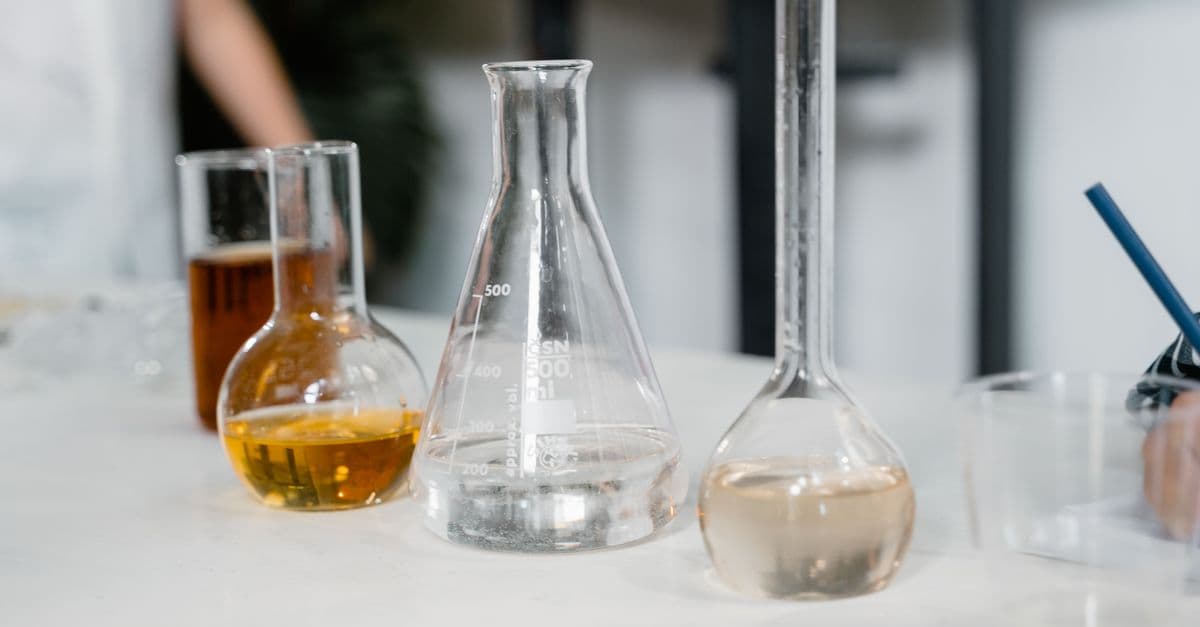
Photo: MART PRODUCTION / Pexels
Hydrogen sulfide (H₂S) is built almost the same way as water, with one sulfur atom in place of oxygen, yet it boils at about −60°C. Water, a much lighter molecule, boils at 100°C. That gap of roughly 160°C is the first clue that something unusual holds water molecules together. The something is the hydrogen bond, and it explains why ice floats, why oceans store heat, why salt vanishes in a glass, and why sap can climb a redwood.
Here are the molecule, the bonds, and the numbers behind each property.
Key takeaways
- Polarity: Water's bent geometry (an H–O–H angle of about 104.5°) and oxygen's pull on electrons give each molecule a permanent dipole, with a negative oxygen end and two positive hydrogen ends.
- Hydrogen bonding: Each molecule can take part in up to four hydrogen bonds, two as donor and two as acceptor. This network raises the boiling point, heat capacity, and surface tension far above what molecular mass alone predicts.
- Why ice floats: Ice has a hexagonal lattice that holds molecules farther apart than liquid water does. Ice at 0°C is about 0.917 g/cm³ against about 0.9998 g/cm³ for liquid water.
- Heat storage: Water's specific heat of about 4.18 J/(g·°C) is roughly five times that of dry sand or granite, which is why oceans moderate climate.
- Solvent, not "universal": Water dissolves salts, sugars, and many biomolecules, but it pushes oils and fats together. That push, the hydrophobic effect, helps fold proteins and build cell membranes.
- Cohesion: Surface tension near 72 mN/m lets insects stand on water, and cohesion lets trees pull water upward through narrow tubes.
Water's key numbers at a glance
Before the explanations, here are the headline values that the rest of this article accounts for. All are for standard conditions unless noted, and sources appear in the sections that use them.
| Property | Value | Why it is notable |
|---|---|---|
| Bond angle | about 104.5° | Bent shape makes the molecule polar |
| Dipole moment | 1.8546 D | Strong pull on ions and other polar molecules |
| Boiling point | 99.98°C | About 160°C above H₂S |
| Density of ice at 0°C | about 0.917 g/cm³ | Ice floats |
| Density maximum | about 3.98°C | Liquid water is densest above freezing |
| Specific heat | about 4.184 J/(g·°C) | Five times dry sand |
| Heat of vaporization | 2,257 kJ/kg | Sweat cools |
| Surface tension | about 72 mN/m | Insects stand on water |
| Kw at 25°C | about 10⁻¹⁴ | Neutral pH is 7 |
Why should water be a gas, and why is it not?
Chemists can often guess how a molecule behaves from its mass and shape. Heavier molecules of the same family usually boil at higher temperatures, because they have more electrons and attract each other more strongly. Water breaks that rule so badly that it is the standard example of an exception.
| Substance | Molar mass (g/mol) | Normal boiling point | Source of cohesion |
|---|---|---|---|
| Methane (CH₄) | about 16 | about −162°C (111 K) | Weak dispersion forces |
| Water (H₂O) | 18.015 | 99.98°C | Hydrogen bonds |
| Hydrogen sulfide (H₂S) | 34.081 | −60.28°C (212.87 K) | Mainly dispersion forces |
Boiling points: NIST Chemistry WebBook for H₂S and methane; water value for standard conditions from the Wikipedia "Properties of water" entry. Molar masses from NIST.
Water is lighter than H₂S by almost half, yet it boils about 160°C higher. Methane, with nearly the same mass as water, boils at roughly −162°C, which would put it among the gases on any winter day. If water followed the trend of its heavier cousins, oceans would not exist as liquid at the temperatures where life evolved. Something extra is binding the molecules, and it works at the level of a single pair of neighbors.
What makes the H₂O molecule a tiny electric dipole?
A water molecule has two hydrogen atoms bonded to one oxygen atom. If the three atoms sat in a straight line, the two bond polarities would cancel, and water would behave like carbon dioxide, a gas that barely sticks to itself. Instead the molecule is bent. The H–O–H angle is 104.45° according to the Wikipedia "Properties of water" entry, which also gives 104.48° for the gas phase, so the exact figure shifts slightly with environment. If the basics of atoms and bonds feel rusty, how atoms and molecules work covers the groundwork.
The bend comes from electron geometry. Oxygen has four electron pairs in its outer shell: two bonding pairs shared with hydrogen and two lone pairs. VSEPR theory (Valence Shell Electron Pair Repulsion) says these four pairs spread out roughly tetrahedrally, with an ideal angle of 109.5°. Lone pairs take up more room than bonding pairs, so they squeeze the H–O–H angle down to about 104.5°.
Oxygen is also far more electronegative than hydrogen, meaning it drags the shared electrons toward itself. The oxygen end of the molecule ends up slightly negative (written δ−) and each hydrogen slightly positive (δ+). Because the molecule is bent, those charges do not cancel. The result is a permanent dipole moment of 1.8546 debye, the value listed in the Wikipedia entry for the gas phase.
Think of each molecule as a tiny bar magnet, but one made of electric charge rather than magnetism, with a plus end and a minus end. Bar magnets in a pile snap into head-to-tail chains. Water molecules do something similar, only with a geometry set by the two lone pairs and two hydrogens.
How do hydrogen bonds link water molecules into a network?
A hydrogen bond forms when a hydrogen atom attached to a strongly electronegative atom (oxygen, nitrogen, or fluorine) is attracted to a lone pair on a neighboring electronegative atom. In water, the δ+ hydrogen of one molecule points at the δ− lone pair of the next.
Each water molecule has two hydrogens to donate and two lone pairs to accept, so it can take part in up to four hydrogen bonds at once. In ice, nearly every molecule achieves all four. In liquid water, the average is somewhat lower, because thermal motion keeps distorting and breaking bonds. A fair picture of the liquid is a crowd where everyone is holding hands but constantly letting go and grabbing someone else.
How strong is a hydrogen bond?
Individual hydrogen bonds are weak next to covalent bonds. The arXiv paper on water's hydrogen bond strength describes them as having strengths considerably less than covalent bonds but greater than ambient thermal energy. Estimates for liquid water are usually quoted at a few tens of kilojoules per mole at most, against several hundred for an O–H covalent bond, so a hydrogen bond is roughly an order of magnitude or more weaker.
Estimates vary with method, and no single standard definition of hydrogen bond energy exists, so any single figure is a useful round number, not a constant of nature.
Weakness is not the same as unimportance. One liter of water holds about 55.5 mol of molecules, which is roughly 3.3 × 10²⁵ of them. Every one of those molecules is a hydrogen-bond partner for several others. The cost of pulling a whole liter apart into vapor is therefore enormous, even though each single bond is easy to break.
How fast do the bonds break and re-form?
The network is not fixed. The Wikipedia "Properties of water" entry notes that bonds break and reform on timescales faster than about 200 femtoseconds (2 × 10⁻¹³ s). Other measures, such as how long a given pair stays together, run to picoseconds (10⁻¹² s). Either way, the liquid rearranges itself trillions of times per second while keeping its overall structure.
A better mental model than a rigid lattice is a stadium crowd doing the wave. The pattern holds together, but no individual stays put. That combination of persistent structure and constant reshuffling is what lets water flow like a liquid while still acting like a connected material.
The arXiv paper adds a theoretical angle. Its author argues that water's hydrogen bonds sit in a narrow window: a little stronger and water would behave more like a glass, a little weaker and it would be a gas that stayed liquid only below zero degrees. That claim is a modeling argument, not an experiment, but it frames why this particular strength matters for life.
Why does ice float?
Most substances contract when they freeze, so the solid sinks in its own liquid. Water does the reverse. The Wikipedia "Ice" entry gives ice at 0°C and standard pressure as about 0.917 g/cm³, against about 0.9998 g/cm³ for liquid water. Freezing expands the volume by roughly 9 percent, and the USGS Water Science School notes that about 10 percent of an iceberg or ice cube sits above the waterline.
The reason is structure. In ordinary ice, called ice Ih, each oxygen is hydrogen-bonded to four neighbors arranged tetrahedrally. That geometry builds puckered hexagonal rings stacked into an open lattice with empty channels. It is a good way to satisfy all four bonds per molecule, but it is a poor way to pack spheres. Liquid water has a more disordered arrangement in which molecules can crowd closer together on average, even though they hold fewer bonds each.
Picture two dance floors. In the first, everyone stands at arm's length holding hands with four partners in a rigid pattern, and the pattern leaves open spaces. In the second, people jostle and let go, so more bodies fit into the same room. The first is ice, the second is liquid water.
Why is water densest at 4°C and not 0°C?
Liquid water is densest at about 3.98°C. The Wikipedia entry gives 0.99997495 g/mL there, compared with 0.99984283 g/mL at 0°C. As water cools from room temperature, ordinary thermal contraction increases its density, just as for any liquid. Below about 4°C, a second effect takes over: local pockets of tetrahedral, ice-like order begin to form, and those pockets are bulkier. The two effects trade off, and density peaks where they balance.
The arXiv paper on hydrogen bond strength describes the same mechanism, noting that when the bonds form strongly, local clusters expand and density drops. The USGS lists 0.9998395 g/mL at 4.0°C in its text and 0.99987 g/cm³ at 0°C in its table, which differs slightly from the Wikipedia figures; the small spread comes from different reference tables and rounding, not a real disagreement about the shape of the curve.
What does floating ice do for life?
If ice sank, lakes and ponds would freeze from the bottom up in winter, and the ice could build up year after year. Instead the first ice forms at the surface and insulates the water below. The Wikipedia "Ice" entry notes that because ice floats, bodies of water freeze from the top down, leaving liquid water and aquatic life beneath. For a longer treatment, see the separate article on why ice floats and water is weird.
Whether this was strictly required for life is a question for planetary science, not chemistry. It is safer to say it makes aquatic overwintering much easier than it would otherwise be, and that most liquids behave differently.
How many kinds of ice exist?
The Wikipedia "Ice" entry says ice can form at least nineteen known crystalline phases, depending on temperature and pressure, with ice Ih the ordinary form on Earth. Ice XII was discovered in 1996, Ices XIII and XIV in 2006, and Ice XV in 2009. Water can also freeze into amorphous ice, which has no regular lattice. The same entry notes that interstellar water is dominated by amorphous ice, which may make it the most common form of water in the universe.
How does water store so much heat?
Specific heat is the energy needed to raise one gram of a substance by one degree Celsius. For liquid water, the Wikipedia entry lists 4,184 J/(kg·K) at 20°C, or 4.184 J/(g·°C). Here is how that compares with materials found around it.
| Material | Specific heat (J/(g·°C)) | Water is about... |
|---|---|---|
| Water, liquid (20°C) | 4.184 | |
| Ice (0°C) | 2.09 | 2 times ice |
| Wet soil | 1.48 | 2.8 times |
| Granite | 0.79 | 5.3 times |
| Dry sand | 0.80 | 5.2 times |
| Dry soil | 0.80 | 5.2 times |
| Iron (20°C) | 0.46 | 9 times |
Solids from the Engineering ToolBox table (kJ/(kg·K) equals J/(g·°C)); water from the Wikipedia "Properties of water" entry. Ratios computed here.
The reason is that heat added to water does not all go into faster molecular motion. Some of it goes into stretching and breaking hydrogen bonds, which store energy without raising temperature. The network works like a spring-loaded buffer, absorbing energy first and heating up later.
What does that do to climate?
NASA's ocean warming indicator page says about 90 percent of the excess heat from planetary warming over the past century has been absorbed by the ocean, and notes that water's high heat capacity lets it store a lot of heat. In ordinary weather, the same property makes coastal air temperatures change more slowly than inland ones, because the nearby sea warms and cools slowly.
Your own body uses the same trick. Blood and tissue are mostly water, so rapid heat production during exercise raises body temperature less than it would in a body made of a lower heat capacity material. The article on how the body regulates temperature covers the rest of the system.
Why do melting and boiling take so much energy?
The Wikipedia entry lists the heat of fusion at 333.55 kJ/kg and the heat of vaporization at 2,257 kJ/kg at the normal boiling point. Compare those with the 4.184 kJ per kilogram per degree Celsius needed for warming:
- Melting 1 kg of ice takes as much energy as warming 1 kg of liquid water by about 80°C.
- Boiling 1 kg of water takes about 5.4 times the energy needed to heat it from 0°C to 100°C.
That second number is why sweat cools you so well. Each gram of water that evaporates carries away about 2.26 kJ at 100°C, and somewhat more at skin temperature, because the latent heat rises as temperature falls. The full mechanism is laid out in how sweat cools the body.
The same large number explains the stability of the water cycle. Evaporating water from oceans soaks up heat, and condensation in clouds releases it again elsewhere, moving energy around the planet.
Why does water dissolve so much, and what will it not dissolve?
Water is often called the universal solvent. The phrase is a convenient exaggeration, but it points at something real: water dissolves more substances than almost any other common liquid, and the reasons are the same dipole and hydrogen-bond ability described above.
Ionic compounds. When table salt meets water, the oxygen ends of water molecules turn toward positive sodium ions and the hydrogen ends turn toward negative chloride ions. Each ion becomes wrapped in a shell of water molecules, which stabilizes it. Dissolving happens when the energy gained from these hydration shells pays for breaking the crystal lattice. This is also why seawater is full of dissolved minerals; the chemistry is laid out in why the ocean is salty.
Polar molecules. Molecules with their own polar groups dissolve by forming hydrogen bonds with water. Ethanol mixes with water in any proportion because its –OH group can hydrogen-bond. Sugars dissolve for the same reason.
Biomolecules. Proteins, nucleic acids, and carbohydrates carry many polar and charged groups, so they stay soluble and keep their shapes in water. Digestion is largely a chain of reactions in water; see how digestion works for the sequence. The same applies to fermentation, where yeast and bacteria do their chemistry in aqueous mixtures.
| Substance | Dissolves in water? | Why |
|---|---|---|
| Table salt (NaCl) | Yes | Ions are stabilized by hydration shells |
| Sugar | Yes | Many –OH groups hydrogen-bond with water |
| Ethanol | Yes, fully miscible | Polar –OH group |
| Vegetable oil | No | Nonpolar chains cannot hydrogen-bond |
| Candle wax | No | Long nonpolar hydrocarbons |
What is the hydrophobic effect?
Nonpolar molecules do not dissolve in water, and the reason is subtler than "they don't mix." Water molecules next to a nonpolar surface cannot form hydrogen bonds toward it, so they rearrange into a more ordered cage around the intruder. According to the Wikipedia "Hydrophobic effect" entry, that cage restricts water's motion and costs entropy, and at room temperature this entropy penalty drives the effect. Clumping the nonpolar molecules together shrinks the surface exposed to water, so the cage shrinks too.
The same entry gives some numbers: mobility of water in the solvation shell of small nonpolar particles is restricted by about 10 percent, by about 30 percent for dissolved xenon at room temperature, and by a factor of two to four for larger nonpolar molecules. At 25°C, the reorientational correlation time of water near large nonpolar solutes rises from 2 to 4–8 picoseconds.
That push is not a side effect. It is a construction tool in living things. Hydrophobic side chains such as valine, leucine, and phenylalanine cluster in a protein's core, away from water, while charged and polar groups sit on the surface. The effect also holds the two layers of a cell membrane together, with their oily tails facing inward. Capsaicin, the molecule that makes chilies burn, is nonpolar too, which is why a glass of water does little to ease the heat; the full story is in how spicy food works.
The Wikipedia entry also notes that the effect weakens as temperature falls, which produces "cold denaturation" of some proteins. That is a good reminder that water's solvent role is entangled with temperature in ways that matter for biology.
Does pure water conduct electricity?
Only poorly. Conduction needs mobile charges, and pure water has very few. Dissolved salts supply many more, which is why tap water and seawater are far better conductors than distilled water. The next section explains the small population of ions that pure water does contain.
Why can water act as an acid and a base?
Water is amphoteric: it can donate a proton or accept one. In a tiny fraction of molecules at any moment, one water molecule hands a proton to its neighbor:
2 H₂O ⇌ H₃O⁺ + OH⁻
The equilibrium constant Kw is about 10⁻¹⁴ at 25°C, according to the Wikipedia entry, which is why neutral pH is 7 at that temperature, with hydroxide near 10⁻⁷ mol/L. That small number underpins the whole pH scale; the discovery of that scale is covered in acid-base chemistry and the pH scale.
Why do protons move so quickly in water?
An excess proton in water does not travel the way a sodium ion does. In 1806, Theodor Grotthuss proposed a "bucket line" picture in which each molecule passes a hydrogen ion along to the next. Modern work describes it in terms of shifting hydrogen-bond patterns, with the extra proton shared among clusters often written as H₉O₄⁺ (the Eigen cation) and H₅O₂⁺ (the Zundel cation). The details are still debated, including work by Noam Agmon and others.
The effect shows up in electrical mobility. The Wikipedia entry on the Grotthuss mechanism lists H⁺ at 3.62 × 10⁻³ cm²·s⁻¹·V⁻¹, against 0.762 × 10⁻³ for potassium and 0.519 × 10⁻³ for sodium. That makes the proton about seven times as mobile as sodium. The hydrogen-bond network acts like a relay, so charge travels farther than any single proton does.
Splitting water into hydrogen and oxygen, which requires driving this proton chemistry with electricity, is described in how electrolysis splits water.
What gives water its surface tension, and how do trees use it?
Molecules at the surface of water have no neighbors above them, so hydrogen bonds pull them inward and sideways. The result is a surface that behaves like a stretched skin. HyperPhysics gives the surface tension of water as 72.8 dynes/cm at 20°C and 72 dynes/cm at 25°C. Because 1 dyne/cm equals 1 mN/m, that is about 72 mN/m, and the Wikipedia entry gives 71.99 mN/m at 25°C. HyperPhysics lists mercury at 465 dynes/cm, so mercury's surface tension is more than six times as high, but mercury is a liquid metal, and among common molecular liquids water's value is unusually high.
A water strider stays on top because its weight is not enough to penetrate the surface, and the geometry of its legs spreads that weight out, as HyperPhysics describes. Soap lowers surface tension by inserting molecules with a polar head and a nonpolar tail into the surface layer, which is why soapy water spreads and wets surfaces that clean water beads up on. Soap-film colors are a related effect, explained in why soap bubbles show rainbow colors.
How far can capillary action lift water?
Adhesion, the attraction between water and the walls of a tube, combined with cohesion, the attraction among water molecules, makes water climb narrow tubes. Jurin's law gives the height:
h = 2γ cos θ / (ρ g r)
where γ is surface tension, θ is the contact angle, ρ is density, g is gravitational acceleration, and r is the tube radius. Take γ = 0.0728 N/m, assume perfect wetting (cos θ = 1), ρ ≈ 998 kg/m³, and g = 9.81 m/s². Then:
- A tube with a 10 μm radius lifts water about 1.5 m.
- A tube with a 1 μm radius lifts water about 15 m.
These are calculations from the formula, not measurements from a specific plant. They show that pure capillary rise, even in extremely narrow channels, falls well short of what the tallest trees need.
How does water reach the top of a 100 m tree?
Trees use a different mechanism, called cohesion-tension theory. Per the Wikipedia entry, John Joly and Henry Dixon proposed it in 1894. Evaporation from leaves forms tiny curved water surfaces in the pores of leaf cell walls. Surface tension at those curves creates negative pressure, or tension, in the water column, which pulls on a continuous chain of water molecules running down through the xylem to the roots. Hydrogen bonds supply the cohesion that keeps the chain from snapping.
The Wikipedia entry says this mechanism can lift water as high as about 100 m, and calls cohesion-tension the most widely accepted theory of water transport in vascular plants, while noting it has faced objections. Early direct pressure-probe measurements had trouble demonstrating negative pressures, though later measurements mostly support the theory, and alternatives involving multiple forces have been proposed.
What limits the height of trees?
A 2004 paper in Nature by George Koch, Stephen Sillett, Gregory Jennings, and Stephen Davis studied coast redwoods in northern California, including the tallest known tree at 112.7 m (about 370 ft). By tracking how leaf traits change with height, they estimated a maximum height of 122 to 130 m (roughly 400 to 426 ft), assuming no mechanical damage. The proposed limit is hydraulic: gravity and the friction of moving water raise leaf water stress with height, limiting leaf growth and photosynthesis even when the soil is wet.
Notice what that means. The ceiling on the tallest living things is set partly by the strength of a hydrogen-bonded water column under tension. Photosynthesis in those leaves also depends on the water arriving; see how photosynthesis works.
How cold can liquid water get before it freezes?
Pure water does not always freeze at 0°C. If it has no surface or particle to start a crystal, it can stay liquid below freezing, a state called supercooling. The Wikipedia "Supercooling" entry says pure water at standard pressure can be supercooled down to its homogeneous nucleation point of almost 224.8 K (−48.3°C). Supercooled droplets often exist in stratus and cumulus clouds, and when an aircraft flies through them they freeze abruptly, which is why wings need ice protection. Freezing rain is also caused by supercooled droplets.
The odd structure shows up here too. The arXiv paper on hydrogen bond strength notes that low-density structuring appears at low and supercooled temperatures and underlies many of water's unusual properties. Whether hot water can freeze faster than cold water under some conditions is a separate, contested question, discussed in the Mpemba effect article.
Adding salt works differently. Dissolved ions interfere with ice formation and lower the freezing point, which is the principle behind road salting, explained in why salt melts ice on roads.
How different is heavy water?
Heavy water (D₂O) replaces the ordinary hydrogen atoms with deuterium, a hydrogen isotope that carries one neutron. The chemistry is nearly the same, but the physical constants shift, which makes it a useful test of how much mass matters.
| Property | Ordinary water (H₂O) | Heavy water (D₂O) |
|---|---|---|
| Density at about 25°C | 0.99705 g/mL | 1.107 g/mL |
| Melting point | 0.00°C | 3.82°C |
| Boiling point | 99.98°C | 101.4°C |
| Temperature of maximum density | 3.98°C | 11.6°C |
H₂O values from the Wikipedia "Properties of water" entry; D₂O values from the Wikipedia "Heavy water" entry.
D₂O is about 11 percent denser than ordinary water at room temperature, and its density peaks near 11.6°C instead of 3.98°C. The Wikipedia entry on heavy water adds that it can be lethal to multicellular organisms at concentrations over 50 percent, because replacing that much of an organism's water disrupts cell function. It is used as a solvent in proton NMR spectroscopy because deuterium does not contribute to the proton signal, and as a neutron moderator in CANDU reactors, which lets them run on natural uranium.
The takeaway from the comparison is that a modest change in nuclear mass shifts hydrogen-bond behavior enough to move the freezing point by almost 4°C. That sensitivity is further evidence that the bonds sit in a delicate range.
What do people commonly get wrong about water?
"Water boils at exactly 100°C." Only under particular pressure. The Wikipedia entry gives 99.98°C at standard conditions, and the boiling point falls with altitude because air pressure falls.
"Hydrogen bonds are weak, so they barely matter." Each bond is weak, but a liter holds about 3.3 × 10²⁵ molecules, and the sum of those bonds decides boiling point, heat capacity, and surface tension.
"Water is a universal solvent." It dissolves a great many things, but it does not dissolve oils, waxes, or most hydrocarbons. That limit is a feature: it is what lets cell membranes exist.
"Ice floats because it is lighter." It floats because it is less dense, and that is the consequence of an open lattice, not of a lighter molecule. Each molecule of ice is identical to each molecule of liquid water.
"Water has only one liquid state and one solid state." The Wikipedia entry on ice counts at least nineteen crystalline phases plus amorphous forms, and liquid water has its own structural complexity.
Why is life on Earth water-based?
Water's combination of properties is hard to match. It is liquid across a range of temperatures common on Earth's surface, its polarity dissolves ions and many biomolecules, its hydrogen-bond network supports the structure of proteins and membranes, and its high heat capacity buffers temperature swings. It is also abundant: the USGS says about 71 percent of Earth's surface is water-covered, and about 96.5 percent of Earth's water is in the oceans (data in the table the USGS cites from Shiklomanov, 1993).
Other solvents have been proposed for hypothetical life, such as ammonia or hydrocarbons in cold environments, but none has been shown to combine all these properties. Whether life elsewhere in the universe also relies on water is an open question in astrobiology. The search for habitable worlds leans on this logic; see what the habitable zone is for how that idea is applied. Water's role also links to a modern concern: as seawater absorbs carbon dioxide, its chemistry shifts, a story told in ocean acidification explained.
FAQ
Q: Why does water have such a high boiling point for its molecular weight? A: Hydrogen bonding. Methane (CH₄), with nearly the same molar mass as water, boils at about −162°C, and H₂S, which is almost twice as heavy, boils at −60.28°C. Water's hydrogen bonds take far more energy to break than the weak dispersion forces between methane molecules, which is why water boils at 99.98°C under standard conditions.
Q: Is heavy water different from regular water? A: Yes. Heavy water (D₂O) contains deuterium instead of ordinary hydrogen. It is about 11 percent denser than H₂O at room temperature, freezes at 3.82°C, and boils at 101.4°C. It is used in proton NMR spectroscopy and as a moderator in CANDU reactors, and the Wikipedia entry notes it can be lethal to multicellular organisms above about 50 percent replacement.
Q: Can water stay liquid below 0°C? A: Yes. Without a nucleation site, pure water can be supercooled. The Wikipedia entry on supercooling gives a homogeneous nucleation limit of about −48.3°C at standard pressure, and supercooled droplets are common in clouds. Once any seed crystal or disturbance appears, supercooled water can freeze quickly.
Q: Can water act as both an acid and a base? A: Yes, water is amphoteric. One molecule can donate a proton while another accepts it, giving H₃O⁺ and OH⁻. At 25°C, the equilibrium constant Kw is about 10⁻¹⁴, which is why neutral pH is 7 at that temperature.
Q: Why does ice float if solids are usually denser than liquids? A: Ice forms an open hexagonal lattice in which each molecule holds four hydrogen bonds, and that structure leaves empty space. Ice at 0°C is about 0.917 g/cm³, against about 0.9998 g/cm³ for liquid water, so it takes up roughly 9 percent more volume than the water it came from.
Q: How do trees lift water more than 100 meters? A: Evaporation from leaves creates tension in a continuous column of hydrogen-bonded water in the xylem, pulling water upward from the roots. This is cohesion-tension theory, proposed by Joly and Dixon in 1894. A 2004 Nature paper estimated that this kind of hydraulic limit caps redwood height at about 122 to 130 meters.
Q: Why is life on Earth water-based? A: Water is liquid at common surface temperatures, dissolves ions and many biomolecules, supports protein and membrane structure through hydrogen bonds and the hydrophobic effect, buffers temperature with a high heat capacity, and is abundant. Whether life elsewhere also uses water is still an open question.
The takeaway
Water's strangeness traces back to one trade: a bent molecule with a built-in charge imbalance, and a bond strength that is neither too weak to matter nor too strong to let the liquid flow. From that trade come an ocean that stores heat, ice that floats, a solvent that carries both salts and proteins, and a cohesion strong enough to hold a column of sap 100 meters tall.
The deeper lesson is that ordinary matter can hide extraordinary behavior. Not one of these properties needs a special ingredient. Each is the same hydrogen bond, counted in different ways.
Sources
- NIST Chemistry WebBook: hydrogen sulfide, methane
- USGS Water Science School: Water density and How much water is there on Earth?
- Koch, Sillett, Jennings, and Davis, The limits to tree height, Nature 428:851-854 (2004)
- NASA, Ocean Warming
- HyperPhysics, Surface Tension
- Water's hydrogen bond strength, arXiv:0706.1355
- Engineering ToolBox, Specific heat of solids
- Wikipedia: Properties of water, Ice, Supercooling, Heavy water, Hydrophobic effect, Grotthuss mechanism, Cohesion-tension theory
Read next:
Follow new articles
Add SciHub101 to your feed reader to see new science and technology stories.
About the Author
SciHub101 is an independent science and technology publication founded and edited by Buğra Sözeri, a software engineer and app developer based in Türkiye. AI tools assist with drafting and research. Source documentation in the existing archive is uneven, and articles are being reviewed and corrected. The Editorial Team byline identifies editorial responsibility; it does not certify specialist or independent human review. Where we compare products, anything built by our own team is labelled as such — see the editorial guidelines and About page for how corrections and disclosures work.
Related Articles

The Gut Microbiome Explained: How Bacteria Affect Your Health
Your gut contains roughly 38 trillion bacteria — about as many as you have human cells. They're not passengers. They're running processes you depend on.
How Vitamins and Minerals Work in the Body
We eat them in milligrams or micrograms. But the difference between enough and not enough can mean the difference between health and serious disease.
Origin of Life: How Life Began on Earth
How did chemistry become biology? Origin of life explained: Miller-Urey, the RNA world, hydrothermal vents, LUCA, and the questions science has not settled.
Sugar Science: How Glucose and Fructose Affect Your Body Differently
Not all sugars are equal. Glucose and fructose follow completely different metabolic pathways — and understanding the difference explains why the source of sugar in your diet matters as much as the amount.

How Digestion Works: From Mouth to Gut
Every bite you take embarks on a 30-foot journey through an assembly line of acids, enzymes, and bacteria that extracts energy and nutrients while discarding the rest — here's how it actually works.

How Preservatives Keep Food Safe: The Chemistry Explained
Before refrigerators, salt and vinegar kept people alive. Today, a few molecules in the parts-per-million range prevent millions of cases of food poisoning a year. Here's how.