How the Moon Was Formed: Evidence for a Giant Impact
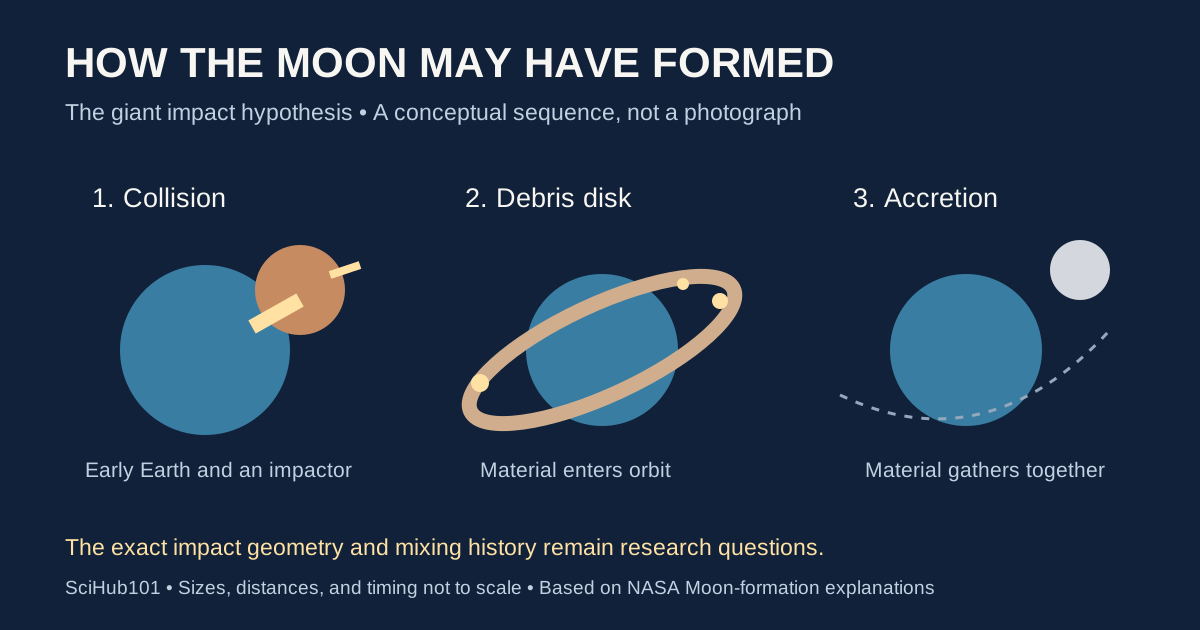
Illustration: SciHub101 / Original illustration
The leading explanation for how the Moon was formed begins with a collision involving the young Earth. Material thrown into space became the Moon, but the precise impact and assembly process remain subjects of research. Scientists reconstruct this event from rocks, the Moon's interior, its orbit, and computer models. The useful question is therefore not just whether a dramatic collision sounds plausible. It is whether one scenario can explain these different clues together. NASA's overview of lunar formation
What the giant impact hypothesis proposes
In a familiar version of the hypothesis, a roughly Mars-sized body, commonly called Theia, struck the early Earth. Material from the collision reached orbit and formed a satellite. Variants differ in the impactor, collision conditions, amount of mixing, and route from hot debris to a recognizable Moon. Theia is a reconstructed participant in a model, not an object astronomers have directly identified. NASA on the Moon's possible origin
It helps to think of the reconstruction as solving a puzzle with several constraints. A candidate picture that matches one edge but cannot fit the others is incomplete. Likewise, a model that creates a moon must also explain its composition and orbital properties. Getting a satellite to appear in a simulation is a starting point, not the final test.
The broad collision explanation should be distinguished from any particular animation of it. An animation usually chooses one impact angle, velocity, and internal structure for the bodies. Those choices illustrate a scenario. They do not supply a recording of an ancient event.
What lunar samples reveal
Apollo astronauts returned 382 kilograms (842 pounds) of lunar samples. Their compositions and signs of an early molten Moon helped shift scientific thinking toward an impact origin. This mass belongs specifically to Apollo returns, rather than a combined tally of Apollo and Soviet Luna material. NASA's account of the Apollo evidence
Earth and Moon rocks also have closely similar oxygen-isotope signatures. Isotopes are forms of an element with different numbers of neutrons. Those similarities constrain the relationship between the bodies' source materials, but they do not mean that every rocky body has a wholly unique fingerprint or that one measurement settles every formation detail. NASA's lunar formation evidence
Think of isotopic evidence as ingredients in two recipes. Finding closely similar ingredients makes a shared source worth investigating. It does not, by itself, tell you which bowl each ingredient came from or how vigorously the mixtures were stirred. An impact model must explain both the similarities and the processes that could create them.
This is why composition can support the broad hypothesis while challenging a specific version. A collision that produces enough debris may still put the wrong mixture into orbit. The evidence is doing two jobs: narrowing the family of explanations and testing the details within that family.
Why the Moon's small core matters
The Moon has a small metallic core; it is not a body with no core. Its interior, together with its rocky mantle and crust, gives researchers information that surface appearance alone cannot provide. The comparatively small core is an important constraint on how much iron-rich material entered the Moon. NASA's description of the lunar interior
An ordinary photograph cannot establish that internal distribution. A bright cratered surface tells us about the surface, while a formation account needs to explain the whole body. A useful explanation therefore combines geology and geophysics rather than treating the Moon as simply a fragment with the same proportions as modern Earth.
The small core is consistent with a Moon rich in rocky material, but consistency is not an exact match to every model. The distinction matters: a theory can gain support from a feature without specifying a unique collision. Researchers must ask what other observations the same scenario predicts.
Why simulations disagree about the timeline
Some simulations assemble the Moon from an orbiting debris disk. A NASA and Durham University study instead explored scenarios where a substantial satellite could be launched into orbit within hours. These are competing model outcomes, not an established stopwatch reading for the real event. NASA's account of the rapid-formation simulations
A related proposal involves a synestia, an extended, hot, rotating structure of vaporized rock created by an energetic impact. Researchers have modeled how a Moon might form within that structure while satisfying chemical and dynamical constraints. Its name describes a proposed physical configuration; it is not a second observed Moon-forming event. Lock and colleagues, Journal of Geophysical Research: Planets (2018)
Each model is a conditional statement: if these starting conditions and material descriptions are appropriate, this outcome follows. Increasing the numerical detail makes that statement more informative. It does not eliminate uncertainty in starting conditions that cannot be directly observed.
There are also different clocks inside the phrase “Moon formation.” Launching material into orbit, assembling a satellite, and cooling its molten interior are separate processes. Quoting one duration for all three conceals that distinction. A careful timeline identifies which process the estimate describes.
Why tidal locking is a later part of the story
The Moon rotates once per orbit, keeping approximately the same face toward Earth. This synchronized rotation is called tidal locking. It describes the Moon's present rotation-orbit relationship, not a requirement that it was born already showing Earth the same face. NASA's explanation of tidal locking
A useful analogy is walking around a table while always facing its center. You have rotated relative to the room even though the same side of your body faces the table. Similarly, saying that the Moon does not rotate mistakes a constant Earth-facing side for a lack of rotation.
Formation and later orbital evolution must fit together, but they are distinct questions. Nor does reconstructing the Moon's origin establish that a large moon is necessary for complex life. That stronger biological claim would need evidence beyond a successful lunar formation model.
The takeaway
The giant impact hypothesis earns support by connecting several kinds of evidence. Lunar samples, internal structure, and orbital behavior constrain the answer together. The precise collision and assembly route remain uncertain, so a named model should be presented as a testable scenario. The Moon's origin is a reconstruction whose strength comes from fitting independent clues.
Correction note, October 15, 2026: Removed the incorrect first-proposed-in-1984 claim, fixed the Apollo sample attribution, and replaced definitive formation durations and life requirements with explicitly qualified evidence.
Read next:
Follow new articles
Add SciHub101 to your feed reader to see new science and technology stories.
About the Author
SciHub101 is an independent science and technology publication founded and edited by Buğra Sözeri, a software engineer and app developer based in Türkiye. AI tools assist with drafting and research. Source documentation in the existing archive is uneven, and articles are being reviewed and corrected. The Editorial Team byline identifies editorial responsibility; it does not certify specialist or independent human review. Where we compare products, anything built by our own team is labelled as such — see the editorial guidelines and About page for how corrections and disclosures work.
Related Articles
How the Universe Began: Evidence for the Big Bang
Thirteen billion years ago, all of space, time, and matter emerged from an infinitely hot, infinitely dense point. Here's the evidence that proves it — and what still puzzles us.
How We Detect Exoplanets: Methods Explained
For millennia, humanity could only speculate about worlds orbiting other stars. Today we've found over 5,500 of them. Here are the ingenious techniques astronomers use to catch them.
Mars Explained: Geology, Water, Atmosphere, and the Challenge of Colonization
Mars is the most explored planet beyond Earth — home to the largest volcano in the solar system, a canyon that would span North America, and tantalizing evidence that it once hosted flowing water. Here is what science has revealed.
How the Solar System Formed: From Spinning Dust to Eight Planets
About 4.6 billion years ago, a cloud of gas and dust collapsed under its own gravity — and out of that collapse came the Sun, eight planets, hundreds of moons, and everything else in our cosmic neighborhood.
How Stars Die: Supernovae, White Dwarfs, and the Cosmic Recycling of Elements
Every atom of carbon in your body was forged in a dying star. Stellar death is not an ending — it is the engine of cosmic chemistry and the origin of everything you are made of.
How Gravity Works: From Newton to Einstein's General Relativity
For two centuries, Newton's gravity was the gold standard. Then Einstein showed that gravity isn't a force at all — it's the curvature of spacetime itself. Here's what that actually means.