Solar and Lunar Eclipse Explained
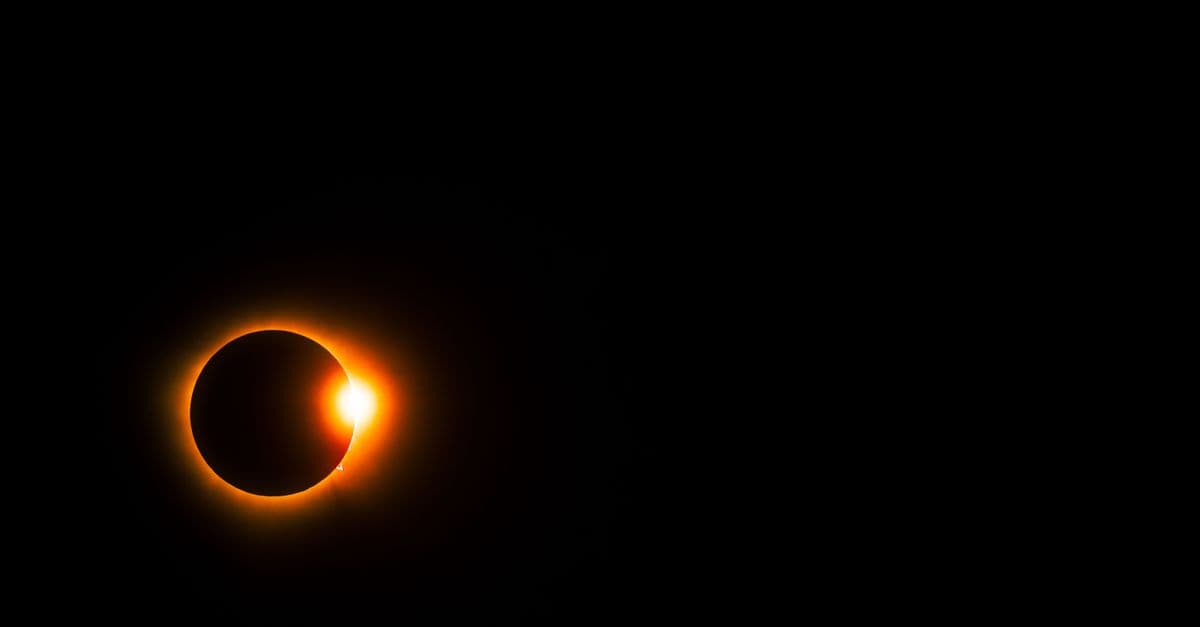
Photo: Israel Torres / Pexels
Eclipses are the kind of cosmic coincidence that astronomy keeps handing us. The Sun is about 400 times wider than the Moon, but it's also about 400 times farther away — so the two look almost exactly the same size in our sky. That single coincidence makes total solar eclipses possible, and it won't last forever.
Solar vs Lunar Eclipses: The Basic Geometry
- Solar eclipse: the Moon passes between the Sun and Earth, casting its shadow on part of Earth's surface. Only daytime; only at new Moon.
- Lunar eclipse: Earth passes between the Sun and Moon, casting its shadow on the Moon. Only at night for the observer; only at full Moon.
The Moon's shadow has two parts: the umbra (full shadow — total eclipse) and the penumbra (partial shadow — partial eclipse).
Types of Solar Eclipse
| Type | What you see | Why |
|---|---|---|
| Total | Sun fully covered; corona visible; up to 7m 31s | Moon at or near perigee, exact alignment |
| Annular | "Ring of fire" — Sun's edge visible around Moon | Moon at or near apogee, slightly smaller than Sun |
| Partial | Sun bitten by Moon, not fully covered | You're in the penumbra, not the umbra |
| Hybrid | Total in some places, annular in others | Earth's curvature changes geometry along the path |
A total eclipse is one of nature's most stunning events: the temperature drops, animals fall silent, the corona — the Sun's million-degree outer atmosphere — becomes visible. The longest possible totality is about 7 minutes 31 seconds, but most are 2–4 minutes.
Types of Lunar Eclipse
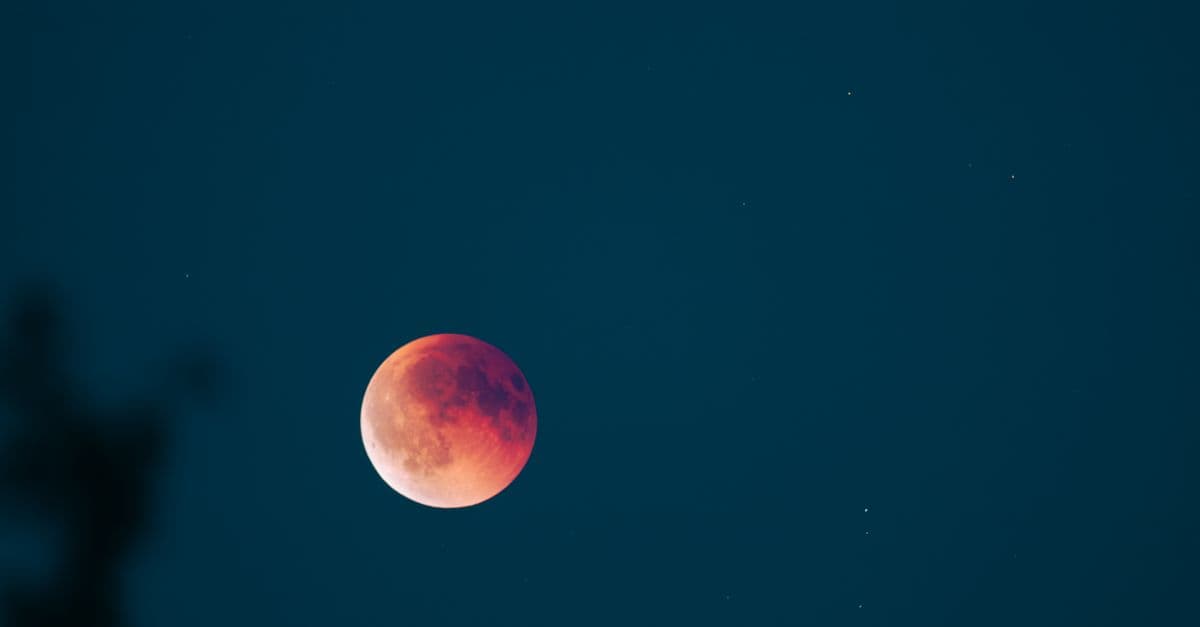
- Total lunar eclipse: Moon fully inside Earth's umbra; turns deep red ("blood Moon"). The red color is the sum of every sunrise and sunset on Earth — sunlight refracted through Earth's atmosphere, with the blue scattered out (the same Rayleigh scattering that paints the daytime sky blue).
- Partial lunar eclipse: only part of the Moon in the umbra.
- Penumbral lunar eclipse: Moon only enters the penumbra — a subtle dimming, often hard to notice.
Why Eclipses Don't Happen Every Month
If the Moon orbited in Earth's orbital plane (the ecliptic), we'd get a solar eclipse every new Moon and a lunar eclipse every full Moon — about 24 a year. We don't, because the Moon's orbit is tilted by about 5° relative to the ecliptic. Most months, the Moon's shadow misses Earth (or Earth's shadow misses the Moon).
Eclipses happen only when full or new Moon coincides with the Moon being near one of its nodes — the two points where its orbit crosses the ecliptic. The result: 2–5 solar eclipses and 2–3 lunar eclipses per year globally.
The Saros Cycle
Eclipses repeat in a pattern called the Saros cycle: 18 years, 11 days, and ~8 hours. After one Saros, the Earth–Sun–Moon geometry returns to nearly the same configuration, and a similar eclipse happens — but shifted by about 8 hours of Earth rotation, so the visibility path moves ~120° in longitude. Three Saros cycles (~54 years) bring the eclipse back to roughly the same part of the world.
The Babylonians figured out the Saros cycle around 700 BCE and used it to predict eclipses. Chinese records of eclipses go back to roughly 2137 BCE. The Greek philosopher Thales of Miletus is credited with predicting the solar eclipse of May 28, 585 BCE, which famously stopped a battle between the Lydians and Medes — both sides interpreting the darkness as a sign to make peace.
Famous Eclipses in Science History
- May 29, 1919: Sir Arthur Eddington photographed stars near the eclipsed Sun from Príncipe and Sobral. The stars' positions were shifted by exactly the amount Einstein's general relativity predicted. Eclipse confirmed Einstein.
- August 21, 2017: the "Great American Eclipse" — totality crossed the contiguous US from Oregon to South Carolina. Estimated 215 million Americans viewed it directly or via media.
- April 8, 2024: the next North American total solar eclipse, crossing Mexico, the US (Texas to Maine), and Canada.
- August 2, 2027: an exceptionally long totality (over 6 minutes!) crossing Egypt, Saudi Arabia, Yemen, and Iraq.
- August 12, 2045: the best US total solar eclipse since 1918 — long totality, dry late-summer skies.
Solar vs Lunar Eclipse: Comparison
| Feature | Solar | Lunar |
|---|---|---|
| Moon phase | New | Full |
| Observer side | Daytime side of Earth | Nighttime side |
| Visibility area | Narrow path (~100 km wide) | Half of Earth at once |
| Frequency at a given location | Rare (~1 every 375 years) | Common (several per decade) |
| Duration | Up to 7.5 min totality | Up to 1.7 hr totality |
| Safe to view directly? | No without filter | Yes, completely safe |
| Color change | Sky darkens, corona visible | Moon turns red |
| Cause | Moon blocks Sun | Earth's shadow on Moon |
Eclipses on Other Worlds
Mars has two moons, Phobos and Deimos, both too small to fully cover the Sun. NASA's Curiosity rover has photographed Phobos transiting the Sun — beautiful, but no totality. Jupiter and Saturn have many moons large enough to cause shadows on their planets, visible as black dots crossing the cloud tops.
The Coincidence That Makes Total Solar Eclipses Possible
The Sun's diameter is about 1.39 million km, the Moon's is 3,474 km — a ratio of about 400. The Sun is 150 million km away on average; the Moon, 384,400 km — also a ratio of about 400. The two ratios are nearly equal, so they appear roughly the same angular size: about half a degree.
That coincidence is temporary. The Moon is moving away from Earth at 3.8 cm per year due to tidal interactions. In about 600 million years, the Moon will be too far to fully cover the Sun's disk — total solar eclipses will end, and only annular eclipses will remain. Humans, if they're still around, will have to settle for the "ring of fire."
Safe Viewing: This Matters
A solar eclipse is the only astronomical event with a real risk of permanent eye damage. The Sun's brightness can burn your retina with no warning pain. Rules:
- NEVER look at the partial Sun directly — not with sunglasses, not with smoked glass, not through a phone or camera.
- Use ISO 12312-2 certified eclipse glasses or a proper solar filter on telescopes/binoculars.
- Pinhole projection is a safe, easy alternative: project the Sun's image onto a card through a small hole.
- During totality only (the brief minutes when the Sun is fully covered), you can look directly — but the moment a sliver of Sun reappears, glasses go back on.
Children, in particular, need supervision. Retinal damage is permanent.
What Scientists Learn From Eclipses
- Corona physics: the Sun's corona is normally invisible from the ground, drowned out by photospheric brightness. Total eclipses let coronagraph-free imaging of structure, jets, and magnetic loops.
- Earth's atmosphere: rapid sunlight changes during totality affect atmospheric chemistry and wind patterns; 2024 saw extensive citizen-science campaigns.
- Stellar deflection: still used as an extreme test of general relativity (though now mostly done with radio interferometry and precise satellites like ESA's Gaia).
- Solar Orbiter and Parker Solar Probe now provide a permanent "fake eclipse" view from space.
Frequently Asked Questions
Q: Why don't eclipses happen every month? A: The Moon's orbit is tilted about 5° from Earth's orbit around the Sun. Most months, the Moon passes above or below the ecliptic plane, and its shadow misses Earth (or vice versa). Eclipses only happen when the Moon is at one of its nodes during a full or new Moon.
Q: Why does the Moon turn red during a total lunar eclipse? A: Earth's atmosphere bends sunlight into the shadow. Blue light is scattered away (the same effect that makes the daytime sky blue), so only red light reaches the Moon. You're literally seeing the sum of every sunset on Earth.
Q: How can I safely watch a solar eclipse? A: Use ISO 12312-2 eclipse glasses, a solar filter on optical instruments, or a pinhole projector. Never look at the partial Sun without protection. During totality only, direct viewing is safe for those few minutes.
Q: Will total solar eclipses ever stop happening? A: Yes — in about 600 million years, the Moon will have receded enough that it can no longer completely cover the Sun. Only annular eclipses will remain.
Q: Why was the 1919 eclipse so important? A: It confirmed Einstein's general relativity. Eddington measured the apparent shift of stars whose light passed near the Sun, and the shift matched Einstein's prediction, not Newton's. The result made Einstein a global celebrity.
Q: How often does a total solar eclipse happen at any given spot on Earth? A: On average, about once every 375 years at any specific location. That's why eclipse-chasers travel: most people who see totality see it because they went looking for it.
Related Reading
- How the Moon Formed: The Giant Impact Hypothesis
- What Is the Sun Made Of?
- What Is a Photon? Light's Particle Side
- Why Is the Sky Blue? The Physics Explained
Sources
- Espenak, F. & Meeus, J., Five Millennium Canon of Solar Eclipses: -1999 to +3000 (NASA, 2006).
- Dyson, F. W., Eddington, A. S., & Davidson, C., "A determination of the deflection of light by the Sun's gravitational field," Philosophical Transactions of the Royal Society A (1920).
- NASA Eclipse Website — eclipse predictions and historical records.
- Stephenson, F. R., Historical Eclipses and Earth's Rotation (Cambridge, 1997).
- American Astronomical Society — eclipse safety guidance (ISO 12312-2 reference).
Follow new articles
Add SciHub101 to your feed reader to see new science and technology stories.
About the Author
SciHub101 is an independent science and technology publication founded and edited by Buğra Sözeri, a software engineer and app developer based in Türkiye. AI tools assist with drafting and research. Source documentation in the existing archive is uneven, and articles are being reviewed and corrected. The Editorial Team byline identifies editorial responsibility; it does not certify specialist or independent human review. Where we compare products, anything built by our own team is labelled as such — see the editorial guidelines and About page for how corrections and disclosures work.
Related Articles
The Dark Forest — Three-Body Problem Explained
Liu Cixin's chilling answer to the Fermi paradox: the universe is a silent hunt, and broadcasting your location is suicide. Here's the theory.
Why Pluto Is Not a Planet — IAU Reclassification Explained
Why Pluto was demoted in 2006: the IAU's three-part planet definition, the discovery of Eris, New Horizons data, and the ongoing scientific debate.
Why Does the Moon Have Phases? The Science Explained
Half the Moon is always sunlit; phases are how much of that lit half we see as the Moon orbits Earth. The synodic month lasts 29.5 days, moving through new, crescent, quarter, gibbous, and full phases. Phases are NOT Earth's shadow—that's an eclipse. The Moon always shows us the same near side due to tidal locking, a gravitational dance between Earth and Moon.
What Causes Tides? Moon, Sun, and Earth
What causes ocean tides? The Moon's differential gravity, why there are two high tides daily, spring and neap tides, and tidal locking — explained.
The Dark Side of the Moon — Myths and Facts
The Moon's far side isn't dark — it just faces away from Earth. Tidal locking, crater asymmetry, Chang'e missions, and what's really there.
What If the Moon Disappeared Tomorrow?
If the Moon vanished overnight, Earth's tides, axial tilt, and life itself would change forever. Here's the science of what happens next.