The Tallest Waterfalls in the World: Angel Falls and the Hidden Giants
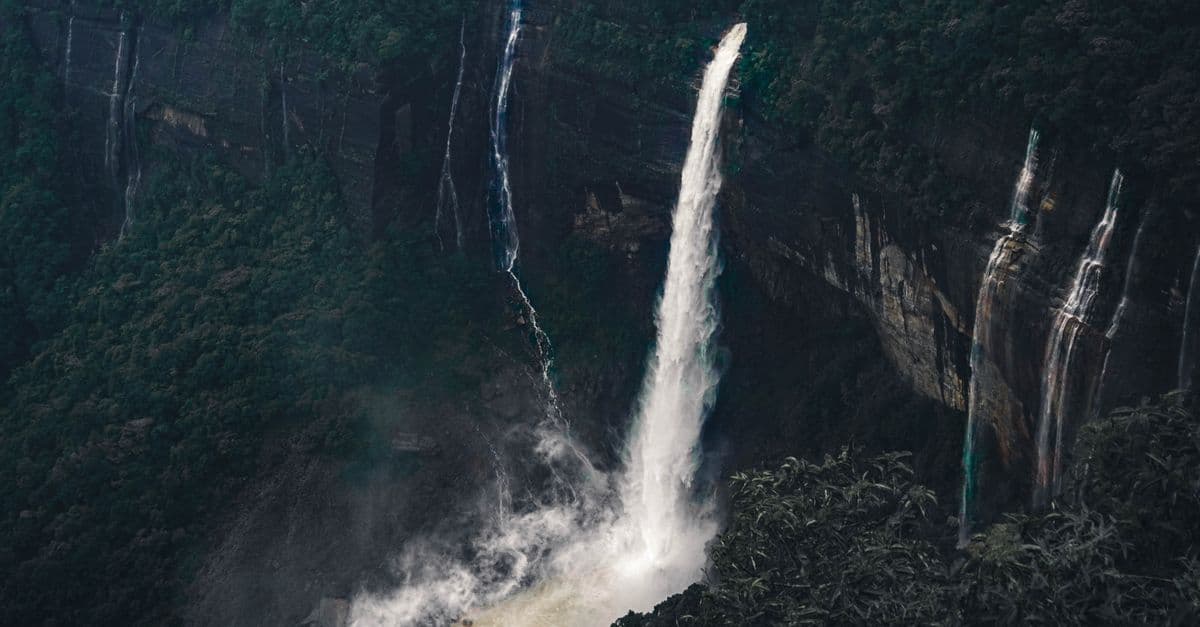
Photo: Sankha Subhra Bhattacharjee / Pexels
The tallest waterfall on land is Angel Falls in Venezuela, dropping 979 meters (3,212 feet), with its longest single, uninterrupted plunge measured at 807 meters (2,648 feet). The water free-falls so far that in the dry season much of it breaks apart and evaporates into mist before ever reaching the pool below. Yet the tallest waterfall on the entire planet is one no tourist will ever photograph. It flows underwater, between Greenland and Iceland, and it is more than three times taller than Angel Falls.
Ranking waterfalls sounds simple until you try to do it. Height alone hides a mess of disagreements about what counts as "one" waterfall, how a tiered cascade should be measured, and whether a survey team eyeballed the drop from a helicopter or walked it with laser rangefinders. This piece works through the tallest waterfalls on record, the geology that makes extreme height possible in only a handful of places on Earth, and the reason the true record-holder is not on any list a hiker could reach.
The Short Answer: Tallest Waterfalls (on Land)
Table 1. The five tallest waterfalls in the world by total height, as ranked by the World Waterfall Database.
| Rank | Waterfall | Total Height | Country | Note |
|---|---|---|---|---|
| 1 | Angel Falls (Kerepakupai Merú) | 979 m (3,212 ft) | Venezuela | Tallest uninterrupted single drop: 807 m |
| 2 | Tugela Falls | 948 m (3,110 ft) | South Africa | Five tiers; a 2016 survey claimed up to 983 m |
| 3 | Tres Hermanas (Cataratas las Tres Hermanas) | 914 m (3,000 ft) | Peru | Three sections on the remote Cutivireni River |
| 4 | Olo'upena Falls | 900 m (2,953 ft) | USA (Molokai, Hawaii) | Sea cliff; accessible only by air or boat |
| 5 | Yumbilla Falls | 896 m (2,938 ft) | Peru | Four-tier cascade, confirmed by survey in 2007 |
Heights are contested because waterfalls can be measured as one continuous drop, as the sum of several separate tiers, or as anything in between, which is why Angel Falls, a single plunge off a sheer cliff, is the least ambiguous "tallest" on the list.
Angel Falls: A Drop So Tall the Water Vanishes
Angel Falls pours off the edge of Auyán-tepui, one of the flat-topped sandstone mountains (tepuis) that rise out of the rainforest in southeastern Venezuela's Canaima National Park. The name most commonly used internationally comes from Jimmie Angel, a US aviator who flew over and logged the falls in November 1933 while searching for a rumored gold seam; the local Pemón name, Kerepakupai Merú, means "waterfall of the deepest place" (Britannica; World Waterfall Database).
The drop is so immense, nearly a kilometer, that the water does not survive the fall intact. Wind shear and simple free-fall time tear the stream into spray well before it reaches the base, and during Venezuela's dry season much of that spray evaporates completely, so the falls appear to dissolve into a column of mist rather than crash into a pool. It is a striking demonstration of a basic physics problem that only shows up at extreme heights: a thin column of falling water is mostly surface area, and surface area is what evaporation and air resistance act on.
These tepuis are not ordinary mountains. They are the eroded remnants of the Guiana Shield, a slab of Precambrian sandstone laid down roughly 1.7 to 2 billion years ago and later uplifted and carved by hundreds of millions of years of weathering, which places them among the oldest things on Earth (geologyscience.com; World Atlas). Their sheer, vertical cliff faces are exactly the geometry a record-height waterfall needs: a broad, flat plateau at the top and a nearly vertical wall on at least one side.
Why Tall Waterfalls Need Tall, Flat Mountains
A waterfall's height is not really a property of the water. It is a property of the land. A river only produces a record-height drop where a plateau or steep escarpment gives it a long, unbroken vertical wall to fall down in one motion. That is why the tallest waterfalls in the world cluster in a small number of very specific landscapes: the tepuis of Venezuela, the Drakensberg escarpment behind Tugela Falls in South Africa, the remote Andean gorges behind Peru's Tres Hermanas and Yumbilla, and the sheer volcanic sea cliffs of Molokai behind Olo'upena.
Waterfall (geomorphology) — a point along a river or stream where water descends a steep, often near-vertical drop in the channel bed, typically created where the river crosses from resistant "caprock" onto softer, more erodible rock beneath it. Almost every major waterfall on Earth, from Niagara to Angel Falls, sits at exactly that kind of geological boundary.
Waterfalls form through differential erosion. A layer of hard, resistant rock, the caprock, sits above softer rock. The river wears the soft rock away faster than the hard rock above it, undercutting the caprock until it collapses, which keeps the drop vertical rather than letting it slump into a ramp (Scheingross & Lamb, Journal of Geophysical Research: Earth Surface, 2017). At Niagara Falls, the caprock is a tough Silurian dolomite called the Lockport Formation sitting over softer shale; the shale erodes out from underneath, the dolomite lip cantilevers out over open air, and eventually a slab breaks off. This is also why waterfalls are not permanent features of a landscape: the whole assembly migrates slowly upstream over geological time, a process called headward erosion, or knickpoint retreat. Niagara Falls has retreated roughly 11 km upstream from its original position at the Niagara Escarpment over the roughly 12,000 years since the last glacial retreat, a documented rate close to a meter per year before engineering work slowed it (Scheingross & Lamb, 2017).
None of this by itself explains extreme height, though. Caprock-and-shale erosion happens at thousands of waterfalls worldwide, and most of them are a few meters to a few dozen meters tall. What separates Angel Falls from a roadside cascade is the scale of the plateau behind it: a tepui summit sitting nearly a kilometer above the surrounding jungle floor, uplifted over hundreds of millions of years and left standing as the softer rock around it wore away entirely. Height, in other words, is a story about how much land has already eroded away everywhere except directly beneath the falling water.
It also explains a common point of confusion: the world's most powerful waterfalls, by sheer volume of water, are not the tallest ones. Niagara Falls carries an average flow of roughly 2,400 cubic meters of water per second, Iguazu Falls carries about 1,756 cubic meters per second, and Victoria Falls carries about 1,088 cubic meters per second, and all three are under 110 meters tall (Wikipedia, Iguazu Falls / Victoria Falls / Niagara Falls flow data; victoriafallsafrica.com). Angel Falls, by contrast, carries a comparatively modest flow, because a river that drains a small tepui-top catchment simply does not gather the water volume that a wide, low-lying river basin like the Zambezi or Niagara does. Height and volume are separate records measuring separate things: a tall waterfall is a thin stream falling a long way, and a powerful one is a huge stream falling a short way. The terrain behind extreme vertical relief on land connects to the same processes covered in the highest and lowest points on Earth.
How is a waterfall's height actually measured?
Surveyors either measure the vertical drop of a single uninterrupted plunge, or they sum the drops of every distinct tier or step in a cascade to get a "total height." A single-drop measurement, like Angel Falls' 807-meter plunge, is far less ambiguous than a multi-tier total, which is why tiered falls such as Tugela generate competing height claims from different survey teams.
The Contenders: Tugela, Tres Hermanas, Olo'upena, and Yumbilla
Tugela Falls, in South Africa's Royal Natal National Park, drops off the Drakensberg escarpment in five distinct free-leaping tiers. The officially cited combined height is 948 meters (3,110 feet), but a 2016 expedition by Czech researchers using modern surveying equipment measured it at 983 meters, which would edge out Angel Falls entirely (Wikipedia, Tugela Falls; drakensbergexperience.co.za). The dispute has never been fully resolved, largely because Tugela is not one continuous plunge, it is five falls in a row separated by rock ledges and short cascades, so where exactly you start and stop each segment's measurement changes the total by tens of meters. Most databases, including the widely cited World Waterfall Database, still list Angel Falls as the record holder specifically because its 807-meter single drop is unambiguous in a way that Tugela's five-part total is not.
Tres Hermanas Falls ("Three Sisters"), at roughly 914 meters (3,000 feet), sits in Otishi National Park in Peru's remote Junín region, fed by the Cutivireni River and falling in three main sections down a steep Amazonian gorge (Wikipedia, Tres Hermanas Falls). It is arguably the least-visited waterfall on this list; the surrounding rainforest terrain is difficult enough to access that most height data comes from satellite and aerial survey rather than ground measurement, which is itself a sign of how remote genuinely record-height waterfalls tend to be.
Olo'upena Falls, on the island of Molokai in Hawaii, drops roughly 900 meters (2,953 feet) down a nearly vertical sea cliff on the island's remote north shore. There is no hiking trail to it: the only way to see Olo'upena is from a boat offshore or from the air, because the cliffs behind it are among the tallest sea cliffs on Earth (worldculturepictorial.com). Those cliffs formed from catastrophic landslides that sheared off huge sections of Molokai's volcanic shield roughly 1.5 million years ago, leaving an almost sheer wall where smaller streams now plunge directly into the Pacific.
Yumbilla Falls, also in Peru, in the Amazonas region, drops about 896 meters (2,938 feet) in four tiers. It stayed essentially unknown to the outside world until a 2007 survey by Peru's Geographical Institute confirmed and publicized its height, and it remains one of the more recently "discovered" entries on any tallest-waterfalls list, despite having presumably existed at that height for a very long time (Wikipedia, Yumbilla Falls).
Beyond the top five, a handful of other waterfalls regularly appear on extended lists and are worth knowing by name, even if none challenge the top tier for height.
Table 2. Other notable tall waterfalls and what makes each one distinctive.
| Waterfall | Height | Location | Why it's notable |
|---|---|---|---|
| Vinnufossen | 845 m (2,772 ft) | Norway | Tallest waterfall in Europe; fed by glacial meltwater |
| Kaieteur Falls | 226 m (741 ft) | Guyana | Not among the tallest, but the largest single-drop waterfall by water volume anywhere in the world |
| Sutherland Falls | 581 m (1,904 ft) total, three tiers | New Zealand | Tallest waterfall in Oceania, in Fiordland National Park |
Kaieteur's inclusion here is deliberate: it is a useful reminder that "tall" and "big" are different superlatives. Kaieteur is less than a quarter the height of Angel Falls, yet it moves enough water in a single uninterrupted drop that it is often cited as the world's largest waterfall by the combination of height and flow rate together, a completely different ranking axis from the one this article focuses on (Britannica, Kaieteur Falls).
The Hidden Champion: The Denmark Strait Cataract
Every waterfall discussed so far shares one assumption: that a waterfall is something you can see, air on one side and falling water in the middle. Drop that assumption and the record changes completely.
In the Denmark Strait, the roughly 480-kilometer-wide (300-mile) channel between Greenland and Iceland, cold, dense water flowing south from the Nordic Seas meets warmer, lighter water from the Irminger Sea. Because cold, salty water is denser than the warmer water around it, it does not mix on contact. It sinks beneath the warmer layer and pours over a submerged ridge in the seafloor, falling roughly 3,500 meters (11,500 feet) down into the deep Atlantic before leveling out (NOAA Ocean Service; Live Science).
That is more than three and a half times the height of Angel Falls, and by volume it is not close. NOAA estimates the transport of water through the cataract at over 3.5 million cubic meters per second, roughly 2,000 times the average flow of Niagara Falls (NOAA Ocean Service; Live Science).
That slowness is the key to understanding why it does not look, sound, or behave like anything you would recognize as a waterfall standing on a riverbank. There is no air, no gravity-driven acceleration through open space, and no splash. The water is falling through water, and the surrounding fluid resists its motion the entire way down, the same way a marble sinks slowly through honey rather than dropping like it would through air. The cataract is technically a waterfall because it satisfies the basic definition, water moving downward under gravity across a vertical drop, but it is driven entirely by density differences in ocean temperature and salinity rather than by a river running off a cliff edge. Oceanographers call this general process thermohaline circulation, the density-driven overturning of ocean water that helps distribute heat around the planet and plays a measurable role in regional climate patterns in the North Atlantic.
It is invisible to any camera or hiking trail because there is no surface to photograph and no shoreline to stand on. It is a useful reminder that some of the most extreme physical features of this planet are not hidden in inaccessible jungle or on remote cliff faces, they are hidden in plain sight beneath water we sail across every day, the same lesson found in the deepest places in the ocean.
Does the Denmark Strait cataract count as an official "world record" waterfall?
Most record-keeping bodies, including Guinness World Records, restrict their "tallest waterfall" category to visible, above-surface waterfalls, so Angel Falls typically holds that specific title. Oceanographers and NOAA nonetheless describe the Denmark Strait cataract as the largest waterfall on Earth by height and volume when the definition is not restricted to the surface.
What People Get Wrong About "Tallest"
The most common mistake in any tallest-waterfall discussion is treating height as a single, settled number, the way a mountain's elevation above sea level is settled. It is not. Height depends on whether a survey team measures one continuous plunge or sums several tiers, whether they use ground-based laser rangefinders or estimate from satellite imagery, and even on seasonal water levels, since a waterfall that dries into a trickle in one season and roars in another can visually appear taller or shorter depending on flow. That variability is exactly why Tugela Falls has been cited anywhere from 948 to 983 meters by different survey teams, and it is why serious databases favor Angel Falls' unambiguous single 807-meter drop over Tugela's disputed five-tier total.
A second common confusion is mixing up "tallest" with "biggest," "widest," or "most powerful," four genuinely different records that happen to sound similar in casual conversation. Angel Falls is tallest. Victoria Falls, at 108 meters (354 feet) tall and 1,708 meters (5,604 feet) wide, forms the largest single continuous sheet of falling water on Earth. Iguazu Falls, spanning roughly 2,700 meters (1.7 miles) across 275 separate cascades on the Argentina-Brazil border, is the widest waterfall system. Niagara Falls, at under 60 meters (about 190 feet) tall, has the highest average flow rate of any of the three (Wikipedia, Victoria Falls; iguazufalls.com). None of these is "wrong" to call a record-holding waterfall; they are simply holding different records, and conflating them is how casual conversation ends up with three different waterfalls all claiming to be "the world's biggest."
A third confusion, and the one this article leads with, is assuming that "waterfall" necessarily means something you can see and stand near. The Denmark Strait cataract shows that the underlying physical definition, gravity-driven vertical descent of water across a steep drop, does not require air, sunlight, or a viewing platform. Scientists studying ocean circulation use the same vocabulary, cataract, overflow, plunge, that hydrologists use for surface rivers, because the fluid mechanics genuinely are analogous, just playing out in salt water instead of air.
Finally, people often assume waterfall height is permanent, a fixed geographic fact like a mountain's coordinates. It is not, on a long enough timescale. Every waterfall on this list is actively eroding upstream through headward erosion, some faster than others depending on rock hardness and water volume. Given enough geological time, a caprock lip collapses, a plateau erodes back, and heights that seem fixed today are a snapshot of an ongoing process measured in millimeters to meters per year rather than a permanent record.
Frequently Asked Questions
Q: What is the tallest waterfall in the world? A: On land, Angel Falls in Venezuela, at 979 meters (3,212 feet) total, with a single uninterrupted drop of 807 meters (2,648 feet), the tallest of any kind by that stricter measure. The tallest waterfall overall, including underwater features, is the Denmark Strait cataract between Greenland and Iceland, where dense cold water sinks and falls roughly 3,500 meters beneath the ocean surface.
Q: Why does Angel Falls turn into mist? A: The drop is nearly a kilometer, giving the water eight to ten seconds of free fall, plenty of time for wind at the cliff face to break the thin stream apart into spray. During Venezuela's dry season, roughly November through April, much of that spray can evaporate before reaching the bottom pool, making the falls appear to dissolve into a column of mist rather than land as a coherent waterfall.
Q: Is Tugela Falls taller than Angel Falls? A: It depends on whose measurement you trust. The officially cited figure for Tugela Falls in South Africa is about 948 meters, but a 2016 survey by Czech researchers using modern equipment measured it at 983 meters, which would edge out Angel Falls. Most databases still list Angel Falls as the record holder because Tugela falls in five separate tiers rather than one clean plunge, and multi-tier totals are inherently harder to pin down than a single measured drop.
Q: What's the difference between the tallest and most powerful waterfall? A: Tallest means the greatest vertical drop, typically a thin stream off a very high cliff, as at Angel Falls. Most powerful, or highest-volume, means the greatest flow rate of water, typically a wide waterfall with a comparatively modest drop, like Niagara Falls at roughly 2,400 cubic meters per second. They are separate, unrelated records: height measures the terrain, and flow rate measures the size of the river basin feeding the falls.
Q: Can a waterfall really exist underwater? A: Yes. A waterfall, by its basic physical definition, is water falling vertically under gravity across a steep drop in the surface it is flowing over. That happens underwater whenever a denser current, colder or saltier than the water around it, flows over a submerged ridge and sinks beneath a lighter layer. The Denmark Strait cataract is the largest known example, taller and far higher-volume than any waterfall above the surface, though it moves roughly 60 times more slowly than Niagara Falls because the surrounding seawater resists its descent the entire way down.
Q: How do scientists measure the height of a remote waterfall like Tres Hermanas? A: For waterfalls in genuinely inaccessible terrain, like the Amazonian gorge behind Tres Hermanas in Peru, height is typically estimated from satellite imagery and aerial or drone survey rather than a ground-based laser measurement, since reaching the base and top of the falls on foot can be impractical. This is one reason remote waterfalls sometimes have less precisely confirmed heights than more accessible record-holders like Angel Falls.
Q: Why do so many of the tallest waterfalls form on tepuis and escarpments specifically? A: Extreme waterfall height requires a river to run across a broad, flat, elevated plateau and then fall off a steep, largely vertical edge in one motion. Tepuis in Venezuela, the Drakensberg escarpment in South Africa, and steep volcanic sea cliffs in Hawaii all provide exactly that geometry, a high flat top and a sheer drop, which is why record-height waterfalls cluster in these specific landscape types rather than appearing at random across the globe.
Q: Is Niagara Falls one of the tallest waterfalls in the world? A: No. Niagara Falls stands under 60 meters (about 190 feet) tall, nowhere near the top tallest-waterfall rankings, which start above 800 meters. Niagara's fame comes instead from its enormous average flow rate, roughly 2,400 cubic meters of water per second, making it one of the most powerful waterfalls on Earth by volume rather than one of the tallest by height.
Q: What is the tallest waterfall in Europe? A: Vinnufossen in Norway, at 845 meters (2,772 feet), holds that title. It is fed largely by glacial meltwater from the Vinnufonna glacier, which means its flow, and to a lesser extent its visible height, varies noticeably with the seasons as the glacier melts more heavily in summer.
Q: Will Angel Falls always be the tallest waterfall on land? A: Not necessarily forever, though the timescale involved is geological rather than human. Every waterfall on this list is undergoing slow headward erosion, in which the falling water gradually undercuts and collapses the resistant caprock at its lip, causing the falls to retreat upstream over thousands to millions of years. Height rankings reflect the terrain as it exists today, not a permanent, unchanging fact about the landscape.
The Takeaway
Angel Falls earns its title honestly: a single, unbroken, 807-meter plunge off some of the oldest exposed rock on the planet, tall enough that gravity and wind finish the job air resistance starts, turning falling water into drifting mist before it ever lands. But the more interesting lesson sits one level down, in how contested and definition-dependent "tallest" turns out to be the moment you look closely, and in how the true record for height and volume combined belongs to a waterfall that has no shoreline, no mist, and no name most people have ever heard, sinking silently through the North Atlantic between Greenland and Iceland. The physics of falling water does not care whether anyone is there to watch it fall.
Read next:
- The Highest and Lowest Points on Earth
- The Deepest Places in the Ocean
- The Tallest Mountains on Earth
Sources
- Britannica — Angel Falls
- World Waterfall Database — Kerepakupai Merú (Angel Falls)
- Wikipedia — Tugela Falls
- Drakensberg Experience — Tugela Falls height dispute
- Wikipedia — Tres Hermanas Falls
- Wikipedia — Yumbilla Falls
- World Culture Pictorial — world's tallest waterfalls overview
- NOAA Ocean Service — Where is Earth's Largest Waterfall?
- Live Science — the Denmark Strait cataract
- Scheingross & Lamb (2017), "A Mechanistic Model of Waterfall Plunge Pool Erosion into Bedrock," Journal of Geophysical Research: Earth Surface
- geologyscience.com — Mount Roraima geology and formation
- World Atlas — What Is A Tepui?
- Wikipedia — Niagara Falls
- Wikipedia — Victoria Falls
- Iguazu Falls official visitor site — comparison with other waterfalls
- Britannica — Kaieteur Falls
- Wikipedia — Vinnufossen
- Wikipedia — Sutherland Falls
Bottom line: Angel Falls is the tallest waterfall you can stand beneath, but the true giant hides in the dark of the Denmark Strait, proof that Earth's most extreme features are not always the ones we can see.
Last verified: July 2026
Follow new articles
Add SciHub101 to your feed reader to see new science and technology stories.
About the Author
SciHub101 is an independent science and technology publication founded and edited by Buğra Sözeri, a software engineer and app developer based in Türkiye. AI tools assist with drafting and research. Source documentation in the existing archive is uneven, and articles are being reviewed and corrected. The Editorial Team byline identifies editorial responsibility; it does not certify specialist or independent human review. Where we compare products, anything built by our own team is labelled as such — see the editorial guidelines and About page for how corrections and disclosures work.
Related Articles

The Largest Empires in History: The One Where the Sun Never Set
At its peak around 1920, the British Empire governed roughly a quarter of the planet's land and a fifth of its people — about 35 million square kilometres spread so widely that, somewhere within it, the sun was always shining. It is the largest empire by area in human history. But by a different measure, a 13th-century empire that grew from a few thousand horsemen was even more astonishing: the largest contiguous land empire ever, conquered in a single lifetime.
The Longest Mountain Ranges in the World: The 65,000-Kilometre Range You'll Never See
The Andes stretch 7,000 kilometres down the spine of South America — the longest mountain range on land, and a wall so high it creates deserts on one side and rainforests on the other. But it's not even close to the longest range on the planet. That title belongs to a mountain chain ten times longer, winding 65,000 kilometres around the globe entirely beneath the oceans, where most of Earth's volcanic activity quietly happens.
The Largest Lakes in the World: The Caspian Paradox and the Inland Seas
The largest lake on Earth is called a sea. The Caspian Sea covers about 371,000 to 374,000 square kilometres — larger than Germany — and is bordered by five countries that argued for over two decades about whether it's legally a lake or a sea, because the answer decides who owns its oil. Behind it stretch the true freshwater giants, including a single North American lake big enough to cover the entire United Kingdom.
The Deepest Lakes in the World: Lake Baikal and the Crack in a Continent
Lake Baikal in Siberia plunges to 1,642 metres — deep enough to swallow the world's tallest building twice over with room to spare. It is not just the deepest lake on Earth; it holds about a fifth of all the planet's unfrozen fresh water and has existed for 25 million years, longer than any other lake. The deepest lakes share a common origin: they sit in places where the Earth's crust is literally being pulled apart.

The Tallest Mountains on Earth: Everest, Mauna Kea, and Chimborazo Compared
Mount Everest is not the tallest mountain on Earth — and it is not the closest point on Earth's surface to outer space. Both claims belong to other peaks depending on how you define 'tallest.' At 8,848.86 meters (29,031.7 feet) above sea level, Everest wins the elevation contest. But Mauna Kea in Hawaii stands 10,210 meters (33,500 feet) from seafloor base to summit. And Chimborazo in Ecuador, a relatively modest 6,263 meters above sea level, sits 6,384.4 km from Earth's center — 2.1 km farther than Everest's summit.