Triceratops and the Horned Dinosaurs: Frills, Horns, and the Fossil Evidence

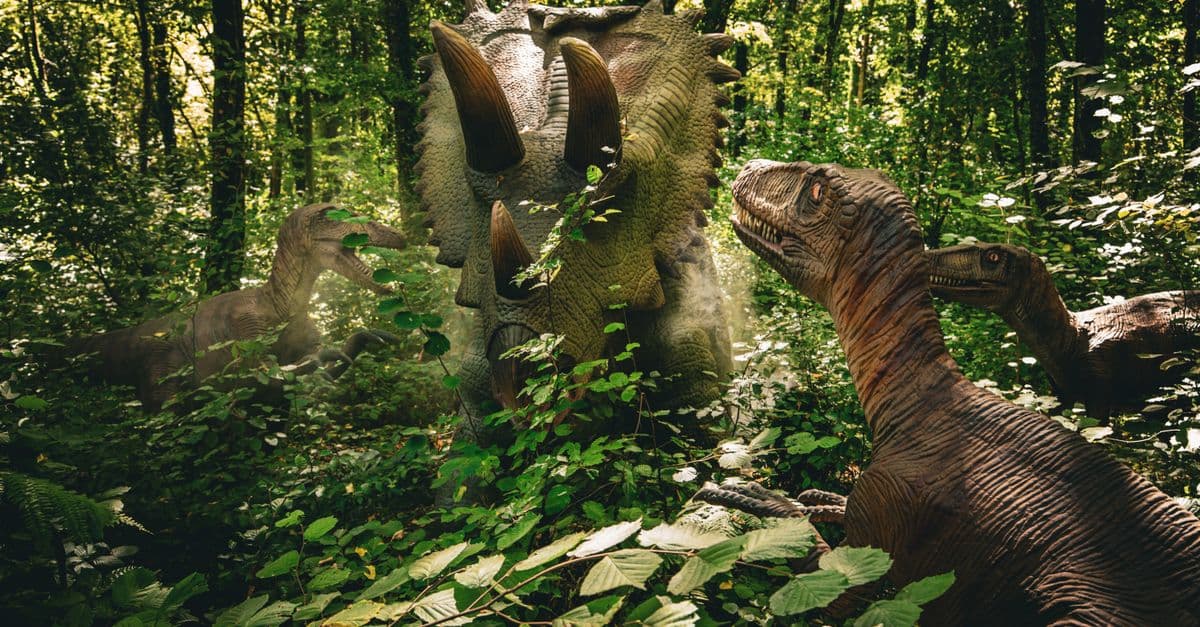
Photo: RDNE Stock project / Pexels
Triceratops is one of the most recognized dinosaurs in the world, and also one of the most frequently misrepresented. The frill — the large bony structure extending behind the skull — is routinely depicted as a defensive shield. The horns are assumed to be weapons used primarily against Tyrannosaurus rex. The evidence for both assumptions is thinner than the depictions suggest. What the fossil record actually shows is a group of animals that invested enormous energy in elaborate cranial ornamentation, probably used it primarily for communication and display within their own species, and evolved that ornamentation in such diverse forms — across more than 30 named genera — that it constitutes one of the most remarkable adaptive radiations in dinosaur history.
What Are Ceratopsians?
Ceratopsian — a member of Ceratopsia, the "horn-faced" clade of ornithischian dinosaurs, characterized by a rostral bone at the tip of the upper jaw (forming the upper half of the distinctive parrot-like beak), a frill of varying size extending from the back of the skull, and — in the more derived members — nasal and orbital horns.
Ceratopsians are divided into two main groups:
Protoceratopsids — the small, early members of the group, typically without horns but with a modest frill and the characteristic beak. Protoceratops andrewsi from the Cretaceous of Mongolia is the best-known member. Adults reach approximately 1.8 m in length and 180 kg. They are extraordinarily common in the Djadokhta Formation of Mongolia and China, preserved in vast numbers in the Gobi Desert.
Ceratopsids — the large, fully horned forms, found exclusively in North America and Asia, ranging from the Late Cretaceous approximately 90–66 Ma. This group includes Triceratops, Styracosaurus, Centrosaurus, Pachyrhinosaurus, Chasmosaurus, and about 35 other named genera. They are characterized by large body size, fully developed nasal and/or orbital horns, and large, elaborate frills.
Within ceratopsids, there is a further division into two subfamilies:
Centrosaurinae (short-frill ceratopsids): The frill is relatively short and wide. Horn development emphasizes the nasal horn, which is typically large and prominent, while the brow horns (over the eyes) are reduced. Centrosaurus, Styracosaurus, and Pachyrhinosaurus are centrosaurines.
Chasmosaurinae (long-frill ceratopsids): The frill is elongated, extending far behind the skull. Horn development emphasizes the brow horns, which are long and forward-pointing, while the nasal horn is reduced. Triceratops, Torosaurus, Chasmosaurus, and Pentaceratops are chasmosaurines.
Source: Dodson, P. et al., in The Dinosauria (2nd ed., University of California Press, 2004) — Systematic review of ceratopsian diversity, phylogeny, and anatomy.
Source: Sampson, S.D. et al., Science (2010) — Description of four new ceratopsian species from the Cretaceous of Utah, expanding knowledge of centrosaurine diversity.
Triceratops: Anatomy in Detail
Triceratops horridus and Triceratops prorsus — the two valid species — are known from more individual specimens than almost any other large dinosaur. Over 50 individual skulls have been described from the Lance and Hell Creek Formations of western North America (Late Maastrichtian, approximately 68–66 Ma), making Triceratops the best-represented large ceratopsid in the fossil record.
The animal's most immediately striking feature is the skull. Triceratops has one of the largest skulls of any land animal in Earth's history — up to approximately 2.5 m long, representing roughly one-third of the entire body length. This proportion is extraordinary: in most large tetrapods, the skull is a small fraction of body length.
The three horns are anatomically distinct. The nasal horn sits above the beak at the front of the snout. The two brow horns (supraorbital horns) sit above the eye sockets and curve forward and upward, reaching lengths of up to 1 m in large adults. The horns have a bony core (the horn core, made of bone and part of the skull) covered in life by a keratin sheath, which would have extended the functional length of each horn beyond the bony core alone. Keratin does not fossilize, so the horn cores we see in specimens underestimate actual horn length.
The frill is a solid bony structure in Triceratops — unlike the frills of chasmosaurines like Pentaceratops or Torosaurus, which have large oval openings (fenestrae) that reduce weight. The Triceratops frill's edge is decorated with small, blunt epoccipitals (bony projections that run along the frill margin). In preserved specimens with soft-tissue traces, the surface of the frill shows a rich vascular supply — blood vessels running through the frill surface — consistent with a structure involved in thermoregulation or flushing visible color for display.
| Feature | Triceratops horridus | Triceratops prorsus |
|---|---|---|
| Nasal horn shape | Shorter, slightly curved | Longer, more erect |
| Brow horn orientation | Slightly backward-curving in young | Forward-curving in adults |
| Frill outline | Relatively straight edge | More rounded edge |
| Temporal range | ~68–67 Ma | ~67–66 Ma |
| Geographic distribution | Lance, Hell Creek Fm (N. America) | Hell Creek Fm (N. America) |
Body length estimates for Triceratops run to approximately 8–9 m, with mass estimates ranging from 6 to 12 tonnes for large individuals. The range is wide because body proportions are uncertain — complete post-cranial skeletons associated with identified skulls are rare.
Source: Scannella, J.B. & Fowler, D.W., Journal of Vertebrate Paleontology (2009) — Ontogenetic study of Triceratops skulls, documenting progressive changes in horn and frill morphology through growth.
What Were Horns and Frills Actually For?
This is the central functional question in ceratopsian research, and the answer is more complex — and less settled — than most popular accounts suggest. Three main hypotheses have been advanced: intraspecific display and species recognition, defense against predators, and intraspecific combat. These are not mutually exclusive, and evidence exists for more than one function.
Intraspecific Display and Species Recognition
The display hypothesis is currently the best-supported. The key evidence comes from the extraordinary diversity of horn and frill morphology across ceratopsian genera.
In the Campanian (approximately 83–72 Ma) of what is now Alberta and Montana, multiple ceratopsian species coexisted in the same formations. Centrosaurus, Styracosaurus, Chasmosaurus, and Coronosaurus all lived in overlapping geographic and temporal ranges. If horns were purely defensive, there would be little reason for the ornaments to differ so dramatically between species living in the same place at the same time, facing the same predators. The diversity of ornamentation — each species with a unique combination of horn lengths, horn curvature, frill shape, and frill decoration — is precisely the pattern expected if the structures function primarily as species-recognition signals. An animal that can instantly distinguish a conspecific (member of its own species) from a closely related competitor gains significant reproductive advantages.
A 2009 analysis by Padian and Horner in Proceedings of the Royal Society B examined ornamentation across ceratopsians, pachycephalosaurs, and hadrosaurs and argued that the structures consistently showed the pattern predicted by signal function rather than combat or defense: high individual variation, thin construction (frills are not solid bone slabs but relatively thin sheets), and anatomical placement that maximizes visibility rather than protective coverage.
The vascular supply in frill surfaces supports display: a structure that can be flushed with blood — changing color transiently — functions well as a visual signal. Modern iguanas use exactly this mechanism, flushing their dewlaps with blood for display.
Horn-to-Horn Combat
Combat use is harder to confirm but not implausible. Modern bovids (bison, cattle, wildebeest) use horns extensively in intraspecific male-male competition. The forward-pointing configuration of Triceratops brow horns is geometrically consistent with locking horns against an opponent facing in the opposite direction.
Direct evidence of combat injury on ceratopsian bone exists. A study by Peterson and colleagues (2009) examined Triceratops skulls for bite marks and healed injuries. They found healed puncture wounds on frill margins with dimensions and spacing consistent with Triceratops horn tips — evidence of horn-inflicted combat wounds that healed during the animal's lifetime. A healed wound demonstrates that the animal survived the injury, which means the horn-to-horn contact was not invariably lethal — more consistent with ritualized combat (like modern deer antler-locking) than outright lethal weapon use.
Defense Against Predators
The defensive hypothesis — that horns protected Triceratops from T. rex — is the most intuitive but the least directly supported by fossil evidence. Triceratops and T. rex did coexist in the Hell Creek and Lance Formations, and ceratopsian bones do show T. rex bite marks. But the frill is not anatomically positioned to be an effective shield: it covers the neck but does not extend far enough laterally to protect the flanks, and it is relatively thin. A determined T. rex could presumably get around or through a frill given time.
The horns could deter attack — a predator that must approach a charging animal with three horns faces higher risk than one approaching an unhorned herbivore — but deterrence and defensive function are distinct. There is no fossil evidence (healed T. rex injuries attributed to ceratopsian horns) that the deterrence effect was commonly activated.
Source: Padian, K. & Horner, J.R., Proceedings of the Royal Society B (2011) — Analysis of ornamental structures across multiple dinosaur groups, arguing for signal/display function over combat or defense as primary role.
Source: Peterson, J.E. et al., PLOS ONE (2009) — Survey of healed injuries on Triceratops frills and squamosals, identifying wounds consistent with intraspecific horn combat.
The Torosaurus Controversy
Torosaurus latus was described in 1891 by Othniel Charles Marsh from fragmentary skull material from the Lance Formation. It is distinguished from Triceratops primarily by its frill: Torosaurus has an extremely elongated frill (up to 2.6 m long, making it potentially the largest skull of any known land animal) with two large oval openings (fenestrae), while Triceratops has a solid, shorter frill.
In 2010, John Scannella and Jack Horner published a paper in the Journal of Vertebrate Paleontology proposing a radical hypothesis: Torosaurus is not a separate genus but represents the fully mature growth stage of Triceratops. Under this interpretation, young Triceratops developed solid frills, and as they aged into full adulthood, the frill elongated and developed fenestrae — transforming into what previous paleontologists had called Torosaurus.
The hypothesis is testable: if it is correct, no juvenile Torosaurus should exist (because juveniles would have been classified as Triceratops), and the bone histology of supposed Torosaurus specimens should consistently show mature (slow-growing) bone — the kind found in fully adult animals. Scannella and Horner reported that the bone microstructure of their Torosaurus specimens was consistent with mature adults.
The counter-argument, published by Nicholas Longrich and Daniel Field in 2012, examined a broader sample of specimens and found what they argued was evidence for juvenile Torosaurus individuals — animals too small and with bone histology too immature to have already passed through a "Triceratops" phase. If juveniles of Torosaurus exist, they cannot be the same animal as Triceratops.
The debate is genuinely unresolved. Most current workers treat Triceratops and Torosaurus as separate genera pending more complete evidence, while acknowledging that Scannella and Horner's core observation — that Triceratops frills changed substantially during growth — is correct. The frill openings (fenestrae) do appear to develop in older individuals of Triceratops; whether they ever progressed fully into the Torosaurus morphology is the contested question.
This kind of debate — over whether two named taxa are actually different growth stages of the same animal — is called synonymy. It is more common in paleontology than in most fields because juveniles and adults of the same species can look very different, and isolated specimens from different life stages are easily misidentified as different species.
Source: Scannella, J.B. & Horner, J.R., Journal of Vertebrate Paleontology (2010) — The original Torosaurus-as-Triceratops-adult hypothesis, with bone histology evidence.
Source: Longrich, N.R. & Field, D.J., PLOS ONE (2012) — Counter-argument with evidence for juvenile Torosaurus specimens.
Growth Changes: How Triceratops Changed Through Life
One of the most important developments in ceratopsian research over the past two decades is the detailed documentation of ontogenetic change — how Triceratops morphology changed through growth from hatchling to adult. Fossil material representing multiple growth stages has allowed researchers to trace this trajectory.
Juvenile Triceratops skulls (some as small as 40 cm long) show proportionally larger eyes, shorter horns, and a proportionally smaller, more rounded frill compared to adults. The brow horns in young individuals curve backward — pointing toward the rear of the skull — and progressively straighten and curve forward as the animal grows. The frill expands dramatically relative to skull length through the growth series, and the epoccipitals (frill-edge ornaments) become larger and more defined.
These changes have two implications. First, they mean that many specimens that were once classified as separate species were actually juveniles of known species — and the ceratopsian diversity of the Late Cretaceous may be somewhat overstated because juvenile forms were named as distinct taxa. Second, the ontogenetic trajectory itself is interesting: the dramatic transformation from backward-pointing to forward-pointing horns as an animal grows is consistent with a display function, because the display signal becomes most pronounced exactly at sexual maturity, when competition for mates would be most intense.
Source: Horner, J.R. & Goodwin, M.B., Journal of Vertebrate Paleontology (2006) — Ontogenetic study of Triceratops growth series, documenting changes in horn orientation and frill proportions from juvenile to adult.
Herding Evidence: What the Bone Beds Show
The image of vast Triceratops herds thundering across Cretaceous floodplains is compelling but not directly supported by evidence for Triceratops specifically. The herding evidence in ceratopsians comes primarily from centrosaurines, not chasmosaurines.
Centrosaurine bone beds in Alberta are the strongest evidence for herding behavior in any ceratopsian. The Hilda mega-bonebed in Alberta, described by David Eberth and colleagues in 2010, covers approximately 2.3 km² and contains the remains of thousands of Centrosaurus apertus individuals — adults, subadults, and juveniles — mixed together in a pattern consistent with a catastrophic mass-mortality event (most likely a flooding event during a seasonal migration). The presence of multiple age classes (from young to old) in a single deposit is the key diagnostic criterion: a random accumulation of carcasses over time would show age-class sorting, while a catastrophic event killing a mixed-age herd produces the mixed-age assemblage seen.
The Hilda bonebed represents the largest confirmed ceratopsian bonebed known and provides the most compelling evidence that centrosaurines lived in large mixed-age herds. Similar bonebeds have been described for Pachyrhinosaurus and other centrosaurines.
For Triceratops, the herding evidence is weaker. Triceratops fossils are typically found as isolated individuals or in small groups — consistent with either solitary behavior or small family groups rather than large herds. This may reflect a genuine behavioral difference between centrosaurines (colonial herders) and chasmosaurines (more solitary or small-group animals), or it may reflect sampling differences in the formations where they are found.
Source: Eberth, D.A. & Getty, M.A., New Mexico Museum of Natural History and Science Bulletin (2005) — Analysis of centrosaurine bone beds in Alberta, with evidence for herding behavior.
Source: Currie, P.J. et al., Canadian Journal of Earth Sciences (2005) — Description of the Hilda mega-bonebed, establishing it as a mass-mortality event of a Centrosaurus herd.
Ceratopsian Diversity: More Than Just Triceratops
Triceratops dominates popular perception, but it represents only one of more than 35 named ceratopsian genera. The diversity of horn and frill morphology across the group is staggering — and its evolutionary meaning is still being deciphered.
Styracosaurus albertensis had a nasal horn approximately 60 cm long and six to eight prominent spikes radiating from the frill margin. Each spike was up to 55 cm long. The total visual display area created by frill plus spikes was enormous relative to body size.
Pachyrhinosaurus had no nasal horn at all in adults — instead a large, rugose "boss" (a mass of rough bone) on the snout. This is unusual among ceratopsids and may represent a derived form in which horn development was suppressed or redirected.
Pentaceratops sternbergii had the largest skull of any known land animal: approximately 3 m long, including the elongated frill. A 2006 specimen from New Mexico set the size record. The skull alone would have weighed several hundred kilograms.
Kosmoceratops richardsoni, described in 2010 from the Cretaceous of Utah, had 15 distinct horns and horn-like structures on its skull and frill — more than any other known dinosaur. The complexity of ornamentation in a single individual illustrates how intense selection pressure for display elaboration was in some ceratopsian lineages.
The geographic distribution of ceratopsid diversity is itself informative. Nearly all ceratopsids come from the Laramidia landmass — the western portion of North America during the Cretaceous, when a shallow sea (the Western Interior Seaway) divided the continent. The high diversity of ceratopsids in a relatively restricted geographic area has been interpreted as evidence for rapid speciation driven partly by geographic isolation within Laramidia and partly by sexual selection driving rapid divergence in ornamentation.
For the full context of Late Cretaceous dinosaur ecology that Triceratops inhabited, see Tyrannosaurus Rex: The Science Behind the Legend and What Killed the Dinosaurs? The Asteroid Impact Evidence.
Source: Gates, T.A. et al., Journal of Vertebrate Paleontology (2010) — Description of Kosmoceratops richardsoni, with phylogenetic analysis of southern Laramidian ceratopsid diversity.
What People Get Wrong About Triceratops
The most common error is treating the frill as a defensive shield. Anatomically, the Triceratops frill covers the neck from above and behind but provides limited lateral protection. A predator attacking from the side or below is not blocked by the frill. If defense were the primary driver of frill evolution, a wider, more laterally extensive structure would be expected. The thin, lightly vascularized frill with its display-compatible surface morphology is more consistent with a signal structure than a shield.
The second misconception is that Triceratops was a solitary animal because it is found in smaller numbers than some other ceratopsians. The Hell Creek Formation is densely sampled, and Triceratops is by far the most abundant large animal in it — but isolated specimens predominate. Small-group or family-group living is consistent with the evidence; large-herd living is less so, but absence of evidence is not evidence of absence.
The Torosaurus-equals-Triceratops debate is often presented as settled in popular science media — it is not. Both interpretations remain scientifically active, and the correct answer awaits a more complete developmental series than currently exists.
For context on the Bone Wars era that produced many of the first ceratopsian descriptions, see The Bone Wars Explained.
The Takeaway
Ceratopsians are the most ornamentally diverse dinosaur group in the fossil record: more than 35 named genera, each with a unique combination of horn and frill morphology, evolved in a single geological period and a relatively restricted geographic area. The ornamentation almost certainly served primarily as species recognition and intraspecific display — the signal function is best supported by the pattern of variation. Defensive and combat functions are plausible secondary uses but less directly confirmed. Triceratops specifically is known from more skull specimens than almost any other large dinosaur, and those specimens have documented dramatic morphological changes through growth, complicating both species identification and the debate over Torosaurus. The herding evidence is strongest for centrosaurines; Triceratops behavior is less certain.
Frequently Asked Questions
Q: What was Triceratops's frill actually for?
A: The current best-supported hypothesis is species recognition and intraspecific display — the frill's rich vascular surface is consistent with color-flushing for visual communication, and the high diversity of frill shapes between closely related ceratopsian species living in the same area suggests a species-identification signal rather than a defensive structure. Defensive and intraspecific combat uses are not ruled out, but the evidence for them is less direct.
Q: Is Torosaurus the same animal as Triceratops?
A: Unresolved. Scannella and Horner (2010) proposed that Torosaurus represents the fully adult growth stage of Triceratops, with the frill elongating and developing openings in old age. Longrich and Field (2012) presented evidence for juvenile Torosaurus specimens incompatible with this interpretation. Most current workers treat them as separate genera while acknowledging that Triceratops frill morphology did change substantially with age. The question requires a more complete growth series to resolve definitively.
Q: Did Triceratops live in herds?
A: The herding evidence is stronger for centrosaurine ceratopsids (particularly Centrosaurus and Pachyrhinosaurus, which are found in large mixed-age bone beds) than for Triceratops. Triceratops fossils are typically found as isolated individuals, consistent with solitary or small-group behavior. Whether this reflects actual behavioral difference or a sampling artifact of the Hell Creek Formation is debated.
Q: How big was Triceratops compared to T. rex?
A: Triceratops reached approximately 8–9 m in length and 6–12 tonnes in mass, comparable in overall size to but somewhat lighter than the largest T. rex individuals. The two species coexisted in the Hell Creek Formation approximately 68–66 Ma and were likely predator and prey. Triceratops is the most common large herbivore in formations where T. rex is found, making it the probable primary prey item of the apex predator.
Q: How many species of horned dinosaurs existed?
A: More than 35 named genera of ceratopsid dinosaurs are currently recognized, along with numerous protoceratopsid genera from Asia. New ceratopsian species are described regularly; approximately four to five new ceratopsians were described per year during the 2010s. The actual diversity may be higher because many specimens are known from fragmentary material.
Q: What was the largest horned dinosaur?
A: By skull size, Torosaurus latus or Pentaceratops sternbergii — both have skulls approaching 3 m in length, making them the largest skulls of any known land animal. By body mass, estimates are uncertain, but large Triceratops individuals likely approached 10–12 tonnes. Pachyrhinosaurus species and some centrosaurines were also very large.
Source: Dodson, P. et al., in The Dinosauria (2nd ed., 2004) — Systematic review of Ceratopsia.
Source: Scannella, J.B. & Horner, J.R., Journal of Vertebrate Paleontology (2010) — Torosaurus-as-adult-Triceratops hypothesis.
Source: Eberth, D.A. & Getty, M.A., New Mexico Museum of Natural History and Science Bulletin (2005) — Centrosaurine bone bed herding evidence.
Read next:
Follow new articles
Add SciHub101 to your feed reader to see new science and technology stories.
About the Author
SciHub101 is an independent science and technology publication founded and edited by Buğra Sözeri, a software engineer and app developer based in Türkiye. AI tools assist with drafting and research. Source documentation in the existing archive is uneven, and articles are being reviewed and corrected. The Editorial Team byline identifies editorial responsibility; it does not certify specialist or independent human review. Where we compare products, anything built by our own team is labelled as such — see the editorial guidelines and About page for how corrections and disclosures work.
Related Articles
How Dinosaurs Laid Eggs and Nested: The Fossil Evidence
Dinosaur reproduction left behind an extraordinary fossil record — not just egg shells and embryos, but entire nesting colonies, brooding adults frozen above their clutches, and embryos that preserve the original pigment cells of colored eggshells. Oviraptor was accused of stealing eggs for 70 years before a 1990s discovery proved it was actually brooding its own. Maiasaura colonies show parental care rivaling modern birds. And we now know some dinosaur eggs were blue-green, not white.
The Bone Wars Explained: Cope, Marsh, and the Fossil Race That Built Paleontology
Between 1877 and 1892, two American paleontologists — Edward Drinker Cope and Othniel Charles Marsh — waged a personal and scientific war so destructive that they dynamited fossil sites, bribed each other's workers, and published species descriptions from train cars to claim priority. They were also, together, astonishingly productive: they named over 130 new dinosaur species, established the frameworks of American vertebrate paleontology, and made fossil hunting front-page news. The field they left behind was built on rivalry as much as science.
Why Did Some Dinosaurs Have Horns?
Triceratops horns likely evolved for mate competition, display, and species recognition, with combat as a secondary use. This guide explains the fossil evidence behind ceratopsian horns.
Marine Reptiles of the Dinosaur Age: Mosasaurs, Plesiosaurs, and Ichthyosaurs
While dinosaurs ruled the land and pterosaurs owned the sky, the Mesozoic oceans were controlled by three groups of reptiles that had returned from land to sea and evolved into apex predators of staggering power. Mosasaurs, plesiosaurs, and ichthyosaurs were not dinosaurs. They were something the Mesozoic produced separately — and in doing so, they repeatedly reinvented the dolphin, the shark, and the whale, from scratch.
The Three Periods of Dinosaurs: Triassic, Jurassic, and Cretaceous
Dinosaurs did not exist in a single monolithic era. They ruled Earth across three distinct geological periods spanning 165 million years — longer than the time separating us from the last non-avian dinosaur. Each period had its own continents, climates, ecosystems, and dominant species. Understanding what changed across the Triassic, Jurassic, and Cretaceous is the key to understanding why dinosaurs became what they became.
Velociraptor: The Real Science Behind the Jurassic Park Icon
The Velociraptor in Jurassic Park stands 1.8 meters tall, hunts in coordinated packs, and opens doors. The actual animal was the size of a turkey, covered in feathers, and probably hunted alone. Almost nothing about cinema's most famous raptor matches the fossil record — yet the real animal is, in its own way, more interesting than the fiction.