Lavoisier's Combustion Experiments: How Oxygen Ended the Phlogiston Era
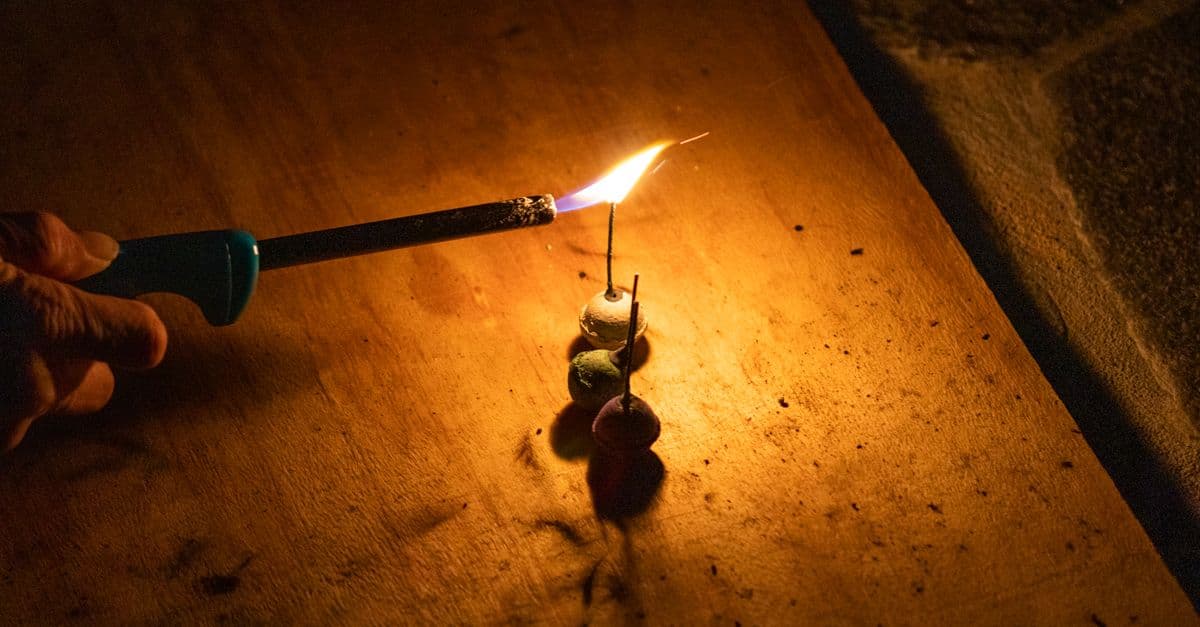
Photo: Griffin Wooldridge / Pexels
In 1772, Antoine-Laurent Lavoisier sealed a small piece of phosphorus inside a glass vessel, placed it on a precision balance, and burned it. The vessel weighed more after combustion than before. This was, at the time, a scandal — the dominant theory of combustion predicted the opposite. Lavoisier repeated the experiment with sulfur, with metals, with charcoal, with mercury, and in each case the balance told the same story. Something from the air was being absorbed. The theory that had organized chemistry for nearly a century was wrong. Over the following two decades, Lavoisier would replace it entirely.
The Theory He Was Dismantling: Phlogiston
Phlogiston — a hypothetical substance, proposed by Johann Joachim Becher in 1667 and systematized by Georg Ernst Stahl after 1703, postulated to be released by all combustible materials during burning; phlogiston-rich materials burned vigorously, phlogiston-poor ones did not burn at all, and when a material had released all its phlogiston, combustion ceased.
The phlogiston theory was genuinely useful. It organized a large body of experimental observations into a coherent framework. When wood burns, it releases phlogiston to the air — which is why a wood fire in a closed space eventually goes out: the air becomes "saturated" with phlogiston and can absorb no more. When metals are calcined (heated in air to form a powdery "calx"), they release phlogiston. When the calx is reduced back to metal by heating with charcoal, the charcoal donates its phlogiston to the calx, restoring the metal.
This model had one increasingly embarrassing problem: quantitative measurements showed that metals gain weight when calcined, not lose it. If calcination involves releasing phlogiston, the metal should become lighter. Instead it becomes heavier. The phlogistonists had several responses — they proposed that phlogiston had negative mass, or that it was carried out of the metal by water vapor that simultaneously carried more weight into the calx — but none were satisfying.
Lavoisier encountered this problem explicitly and recognized it as the key vulnerability of the entire framework.
Source: Stahl, G.E. (1723), Fundamenta Chymiae Dogmaticae et Experimentalis — the canonical statement of phlogiston theory, establishing the framework that dominated European chemistry for most of the 18th century.
Source: Partington, J.R. (1962), A History of Chemistry, Vol. 3, Macmillan — the standard reference history for 18th-century chemistry, covering phlogiston theory and the chemical revolution.
Lavoisier's Method: The Balance as the Arbiter
What distinguished Lavoisier from his contemporaries was not access to unique equipment or discovery of unknown substances. It was his insistence on quantitative measurement as the final arbiter of chemical truth.
Quantitative chemistry — the practice of measuring reactants and products by mass, volume, or molar quantity, and using those measurements to establish conservation laws and stoichiometric ratios; before Lavoisier, most chemistry was qualitative — describing what happened, not how much.
The balance was Lavoisier's primary instrument. He owned some of the best precision balances available in 18th-century Europe, capable of detecting mass differences of a few grains (roughly 60 milligrams). This was extraordinary precision for the era. He weighed everything: before, during, and after reactions. He sealed his reaction vessels to prevent the escape or entry of gases, then weighed the sealed system before and after.
This approach embodied what we now call the law of conservation of mass — that in a chemical reaction, the total mass of reactants equals the total mass of products. Lavoisier did not discover this as an abstract principle; he established it empirically, experiment by experiment, by consistently finding that sealed reaction systems weighed the same before and after the chemical transformation within them.
Source: Lavoisier, A.L. (1789), Traité Élémentaire de Chimie (Paris: Cuchet) — Lavoisier's landmark textbook, laying out the oxygen theory, the conservation of mass principle, and a new system of chemical nomenclature; the "Elements of Chemistry" in its 1790 English translation by Robert Kerr.
The Phosphorus and Sulfur Experiments (1772)
In late 1772, Lavoisier conducted what he later described as "decisive" experiments with phosphorus and sulfur. He burned each in sealed vessels, weighed the system before and after, and compared.
Phosphorus burned in air to produce a white powder (phosphoric acid anhydride, what we now call phosphorus pentoxide, P₄O₁₀). The sealed vessel plus its contents weighed more after combustion than before — by an amount consistent with a significant fraction of the contained air having been absorbed. Sulfur, when burned to produce sulfuric acid vapor, showed the same result.
This was the antithesis of what phlogiston theory predicted. If combustion involves releasing phlogiston from the burning material, the products should weigh less than the original. Lavoisier's sealed vessels showed the products weighed more. Something from the air was combining with the burning material.
Lavoisier deposited a sealed note with the French Academy of Sciences on November 1, 1772 — a common practice for establishing priority — stating that he had found that sulfur and phosphorus gain weight when burned, and that this weight increase comes from a prodigious quantity of air that is fixed in the products. He did not yet know what part of the air was responsible.
Source: Lavoisier, A.L. (1772), sealed note deposited with the Académie des Sciences, November 1, 1772 — reproduced in Guerlac, H. (1961), Lavoisier: The Crucial Year, Cornell University Press — analysis of the 1772 experiments and their significance.
The Red Mercury Calx Experiments (1774–1775)
The most celebrated series of Lavoisier's combustion experiments involved mercury. When mercury is heated in air (below its boiling point, which is relatively low for a metal), it forms a red powder — mercuric oxide, which 18th-century chemists called "red calx of mercury" or mercurius calcinatus per se.
The calx could be regenerated back into metallic mercury by heating it to a higher temperature, without adding anything. This was known. What Lavoisier investigated was the gas released when the calx decomposed back to mercury.
In 1774, Joseph Priestley visited Lavoisier in Paris and described his own recent experiments: he had heated red mercury calx and obtained a gas in which a candle burned more brightly than in ordinary air, and in which a mouse lived longer. Priestley called this gas "dephlogisticated air" — he interpreted it as air from which phlogiston had been removed, making it capable of absorbing more phlogiston from a candle flame. Priestley believed in phlogiston completely and interpreted every observation through that lens.
Lavoisier repeated Priestley's experiment with his characteristic precision. He measured the volume of gas released when a known weight of mercury calx was decomposed. He showed that the gas was a distinct component of ordinary air, not a modified form of the whole. He showed that when mercury burns in ordinary air, this same gas component is consumed, and that when enough of it is consumed, combustion ceases — because the component is exhausted, not because the air becomes phlogiston-saturated.
Source: Priestley, J. (1775), Experiments and Observations on Different Kinds of Air, Vol. II — Priestley's account of his discovery of oxygen (which he called dephlogisticated air) and his interpretation within the phlogiston framework.
Source: Lavoisier, A.L. (1775), "Mémoire sur la nature du principe qui se combine avec les métaux pendant leur calcination," read to the Académie des Sciences, April 26, 1775 — the paper presenting Lavoisier's analysis of the mercury calx experiment and introducing the concept of a specific "eminently respirable" component of air.
The quantitative precision of Lavoisier's method was what Priestley's approach lacked. Priestley observed the qualitative effect — brighter flames, longer-living mice — and fit it into his existing framework. Lavoisier measured volumes, masses, and ratios, and found that the observations demanded a new framework.
By 1779, Lavoisier had named the active component of air "oxygen" (from the Greek for "acid-former" — he incorrectly believed all acids contained oxygen, but the name stuck). He defined it as an element — one of the few dozen substances that could not be decomposed further by chemical means — and built the oxygen theory of combustion on its properties.
Oxygen theory of combustion — Lavoisier's explanation, developed between 1774 and 1783, that combustion consists of the combination of a fuel with oxygen from the air, producing heat and combustion products; the heat and light of fire come from this combination, not from the release of a hypothetical phlogiston.
The Hydrogen Experiments and Water's Composition
In 1783, Lavoisier and the mathematician Pierre-Simon Laplace collaborated on an experiment of equivalent importance to the mercury calx work: the synthesis of water from hydrogen and oxygen.
Henry Cavendish had already shown in 1781 that burning "inflammable air" (hydrogen) in air produced water as a product. Lavoisier and Laplace reproduced this and, critically, extended it in both directions: they showed not only that burning hydrogen produces water, but that water can be decomposed into hydrogen and oxygen by passing steam over hot iron. The iron oxidizes (gaining mass by combining with the oxygen), and hydrogen gas is released.
These complementary experiments established that water is not an element — it is a compound of hydrogen and oxygen in a fixed mass ratio. This overturned another cornerstone of received wisdom: water had been one of the four classical elements (earth, water, air, fire) since antiquity.
Source: Lavoisier, A.L. & Laplace, P.S. (1783), "Mémoire sur la chaleur," read to the Académie des Sciences — presenting heat measurements in chemical reactions, including hydrogen combustion; Lavoisier, A.L. (1783), "Réflexions sur le Phlogistique" — his direct attack on phlogiston theory.
Conservation of Mass: The Principle Behind the Method
Lavoisier stated the conservation of mass explicitly in his 1789 textbook, but he had been using it implicitly throughout his experimental work for fifteen years before that.
The principle is deceptively simple: in any chemical reaction, the total mass of all the reactants equals the total mass of all the products. Mass is neither created nor destroyed. If you start with 10 grams of reactants in a sealed container, you end with 10 grams of products.
In practice, this principle only works if you account for all reactants and products, including gases. This was the trap earlier chemists fell into: when a metal is calcined in an open crucible and gains weight, it looks like mass is being created from nothing. When charcoal burns and leaves almost nothing behind, it looks like mass has been destroyed. Both effects are explained by gases: the calcined metal has absorbed oxygen from the air (gained mass); the burned charcoal has combined with oxygen to form carbon dioxide and water vapor, both of which escape as gases (the ash that remains is a tiny residue of mineral impurities).
Lavoisier's sealed-vessel technique controlled for the gases, making the conservation principle testable.
Source: Lavoisier, A.L. (1789), Traité Élémentaire de Chimie, pp. 52–56 (Robert Kerr translation, 1790) — explicit statement of mass conservation: "We may lay it down as an incontestible axiom, that in all the operations of art and nature, nothing is created; an equal quantity of matter exists both before and after the experiment."
| Experiment | Phlogiston prediction | Lavoisier's observation | Explanation |
|---|---|---|---|
| Phosphorus burns in sealed flask | Loses mass (phlogiston released) | Gains mass | Absorbs O₂ from air |
| Mercury calx heated alone | Gains mass (phlogiston from air?) | Loses mass, releases O₂ | O₂ released from HgO |
| Hydrogen burns | Loses mass (phlogiston released) | Produces water (mass conserved) | H₂ + O₂ → H₂O |
| Charcoal burns in open air | Most mass lost (phlogiston) | Conservation in sealed vessel | C + O₂ → CO₂ (gas escapes) |
| Metal calcined in sealed flask | Loses mass | Gains mass; sealed system conserved | Metal + O₂ → metal oxide |
The New Chemical Nomenclature
The oxygen theory required a new language. The old nomenclature — "phlogisticated air," "dephlogisticated air," "fixed air," "inflammable air," "calx" — was built around phlogiston theory. It would confuse and mislead if retained alongside the new framework.
In 1787, Lavoisier, along with Louis-Bernard Guyton de Morveau, Claude Louis Berthollet, and Antoine François de Fourcroy, published the Méthode de Nomenclature Chimique. This introduced a systematic chemical naming convention that persists into modern chemistry:
- Compounds formed by a nonmetal with oxygen ended in "-ic acid" (sulfuric acid, phosphoric acid) or "-ous acid" for lower oxidation states
- Metal oxides were named as the metal plus "oxide"
- Elements were given names based on their properties or origins, not on theoretical frameworks
This was not merely cosmetic. Changing the names changed the conceptual framework. A student learning "sulfuric acid" rather than "phlogiston-free vitriolic acid" was learning a different ontology — one in which elements combine according to discoverable rules, not one in which a hypothetical substance flows between materials.
Source: Lavoisier, A.L. et al. (1787), Méthode de Nomenclature Chimique (Paris: Cuchet) — the foundational text of modern chemical nomenclature, introducing systematic naming conventions for elements, oxides, acids, and salts.
The Timeline of the Chemical Revolution
| Year | Event |
|---|---|
| 1667–1703 | Becher and Stahl develop phlogiston theory |
| 1757 | Joseph Black discovers fixed air (CO₂) — first identified gas distinct from air |
| 1766 | Cavendish discovers inflammable air (hydrogen) |
| October 1772 | Lavoisier burns phosphorus and sulfur in sealed flasks; deposited sealed note November 1 |
| 1774 | Priestley discovers dephlogisticated air (oxygen); visits Lavoisier in Paris |
| April 1775 | Lavoisier presents mercury calx experiment to Académie; introduces concept of distinct respirable air component |
| 1778 | Lavoisier establishes oxygen theory of combustion definitively |
| 1779 | Lavoisier names the "eminently respirable" gas "oxygène" |
| 1783 | Lavoisier and Laplace synthesize and decompose water; Lavoisier writes "Réflexions sur le Phlogistique" |
| 1787 | New chemical nomenclature published |
| 1789 | Traité Élémentaire de Chimie published — the first modern chemistry textbook |
| 1794 | Lavoisier guillotined on May 8, during the Reign of Terror |
| 1796 | James Watt and Matthew Boulton erect a memorial inscription; Lagrange says "It took only a moment to cut off that head, though a hundred years may not produce another like it" |
Priestley's Refusal and the Sociology of Scientific Revolution
Joseph Priestley discovered oxygen before Lavoisier named it, and he never accepted the oxygen theory of combustion. He died in 1804, still a committed phlogistonist, having spent the last years of his life in Pennsylvania arguing against Lavoisier's framework.
This is instructive. Priestley was not stupid or uninformed. He was one of the ablest experimentalists of the 18th century. He had discovered multiple new gases, demonstrated that plants produce oxygen in sunlight (photosynthesis, though he did not call it that), and made discoveries that would earn him election to the Royal Society. But he was also deeply committed to the phlogiston framework, and he interpreted every observation — including his own discovery of oxygen — within it.
The philosopher Thomas Kuhn described this pattern in his 1962 work The Structure of Scientific Revolutions: paradigm shifts often do not occur because scientists are persuaded by new evidence; they occur because a generation of scientists trained in the old paradigm gradually dies off, replaced by younger scientists trained in the new one. Priestley's refusal illustrates Kuhn's point precisely.
Lavoisier's contemporaries in France — Berthollet, Fourcroy, Guyton de Morveau — converted to the oxygen theory relatively quickly, in part because Lavoisier's quantitative methods made the phlogiston theory's problems impossible to paper over in their own experiments. The British chemists, with Priestley as their most prominent voice, resisted much longer.
Source: Kuhn, T.S. (1962), The Structure of Scientific Revolutions, University of Chicago Press — seminal work on scientific paradigm shifts, using the phlogiston-to-oxygen transition as a central example.
Lavoisier's Execution and the Loss to Science
Antoine-Laurent Lavoisier was not only a chemist. He was a fermier-général — a tax collector working under the French crown's system of tax farming, in which private individuals paid the crown for the right to collect taxes and kept the excess as profit. This made him wealthy and made him an enemy in 1793–1794, when the Reign of Terror consumed French public life.
He was arrested in November 1793 and tried by the Revolutionary Tribunal in May 1794 on charges of tax fraud and conspiracy with enemies of the republic. The trial lasted less than a day. His request for time to complete his scientific work was reportedly refused by the presiding judge with the words, "The Republic has no need of scientists."
Lavoisier was guillotined on May 8, 1794. He was 50 years old. Lagrange's remark — that it took only a moment to cut off the head that had taken a century to produce — was widely cited in the years that followed. He was rehabilitated by the French state 18 months later, when the court found the charges against him false and his property was returned to his widow.
Source: Donovan, A. (1993), Antoine Lavoisier: Science, Administration and Revolution, Cambridge University Press — the standard scientific biography, covering both his chemistry and his political fate.
What People Get Wrong About Lavoisier and Phlogiston
"Lavoisier discovered oxygen." He did not. Oxygen was discovered — independently — by Carl Wilhelm Scheele in 1771–72 (who called it "fire air") and by Joseph Priestley in 1774 (who called it "dephlogisticated air"). Neither published quickly enough to establish clear priority; Scheele published first. What Lavoisier did was correctly interpret what oxygen is and what role it plays in combustion. Discovery and correct interpretation are different achievements.
"Phlogiston was a foolish theory." For its time, phlogiston was a reasonable organizing framework. It successfully explained a wide range of qualitative combustion phenomena, connected the chemistry of fires and metals, and was held by some of the most capable chemists in Europe. Its failure was quantitative, not qualitative: once chemists started weighing things precisely, the theory's inconsistencies became impossible to rationalize away.
"Lavoisier established conservation of mass independently." Russian chemist Mikhail Lomonosov conducted sealed-vessel experiments in the 1740s–1750s and stated a version of mass conservation, but his work was largely unknown in Western Europe. The effective establishment of mass conservation as a working principle of chemistry, supported by extensive quantitative experiments, was Lavoisier's achievement — even if the principle was not entirely novel.
"The transition to oxygen theory was rapid." In France, with Lavoisier's personal advocacy and the force of his quantitative methods, the transition among younger chemists was relatively fast — perhaps ten to fifteen years. In Britain, with Priestley's vigorous opposition, it was much slower. Full acceptance across European chemistry took until roughly the early 1800s.
FAQs
Q: What is the phlogiston theory, and why was it wrong?
A: Phlogiston theory proposed that combustible materials contain a substance called phlogiston, which is released during burning. It was wrong because quantitative measurement showed that metals and other materials gain mass when burned, not lose it — the opposite of what phlogiston release would predict. The correct explanation is that combustion involves the combination of fuel with oxygen from the air, producing oxides and other products heavier than the original fuel.
Q: Did Lavoisier discover oxygen?
A: No. Carl Wilhelm Scheele discovered oxygen in 1771–72 and Joseph Priestley in 1774, both independently. Lavoisier correctly identified oxygen as a distinct element responsible for combustion, named it, and built a quantitative theory around its properties. The distinction between discovering a substance and correctly interpreting its role is important: Priestley discovered oxygen but interpreted it within the wrong framework; Lavoisier did not discover it first but gave it its correct chemical identity.
Q: What does conservation of mass mean, and how did Lavoisier establish it?
A: Conservation of mass states that in a chemical reaction, the total mass of all reactants equals the total mass of all products — mass is neither created nor destroyed. Lavoisier established this by conducting reactions in sealed vessels, weighing the complete system before and after reaction, and consistently finding that the total mass remained unchanged. By accounting for all gases (including absorbed oxygen and produced carbon dioxide), he showed that apparent violations of mass conservation were simply the result of unaccounted-for gases.
Q: Why is Lavoisier called the "father of modern chemistry"?
A: Because he transformed chemistry from a qualitative, theory-laden discipline into a quantitative, systematic science. He established the oxygen theory of combustion, formulated conservation of mass as an empirical principle, co-developed the first systematic chemical nomenclature (which is the basis of modern naming conventions), produced the first modern chemistry textbook, and identified a list of elements that included most of those recognizable in the modern periodic table. No single figure before or after had as wide a foundational impact on the discipline.
Q: What is the relationship between Lavoisier's work and the modern understanding of combustion?
A: Modern combustion chemistry is directly built on Lavoisier's framework. Combustion is the rapid oxidation of a fuel — the combination of fuel molecules with oxygen, releasing energy as heat and light. The products are oxides of the fuel's constituent elements (carbon dioxide and water for hydrocarbon fuels). Mass is conserved. These are precisely the conclusions Lavoisier reached in the 1770s and 1780s. The modern version adds kinetics (reaction rates), thermodynamics (energy accounting), and molecular mechanisms, but the conceptual foundation is Lavoisier's.
Q: Was Lavoisier's execution politically motivated or scientifically motivated?
A: Politically motivated, unambiguously. The charges were fiscal — relating to his role as a tax collector under the old regime — not scientific. There is no evidence that his chemistry was a factor in his arrest or trial. He was one of dozens of former fermiers-généraux executed during the same period of the Terror. His scientific reputation was recognized even by the Revolutionary government that executed him; the prosecution was the product of political vendetta and the judicial chaos of 1793–94, not hostility to science.
The Takeaway
Lavoisier did not just disprove phlogiston. He replaced it with a framework precise enough to build on — a chemistry of measured masses, identified elements, and reactions governed by conservation laws. The sealed flask and the precision balance were his instruments; mass and elemental composition were his currencies. By forcing chemistry to account for every gram of reactant and product, including the invisible gases that 17th-century chemists had ignored, he made the science quantitative and therefore predictive. The oxygen theory of combustion that emerged from those sealed flasks in the 1770s is still the theory you learn on the first week of any chemistry course.
Read next:
Weekly digest
Stay ahead of the curve
Get the best science, AI, and tech stories delivered to your inbox every week. No spam — unsubscribe any time.
About the Author
SciHub101 is an independent science and technology publication founded and edited by Buğra Sözeri, a software engineer and app developer based in Türkiye. Articles are drafted against peer-reviewed literature and primary sources, fact-checked, and edited by a human before publication. Where we compare products, anything built by our own team is labelled as such — see the editorial guidelines and About page for how corrections and disclosures work.
Related Articles
The Lenski Long-Term Evolution Experiment: Evolution in Real Time
Since 1988, Richard Lenski has grown E. coli for 80,000+ generations. The result: a living record of evolution, including a once-impossible citrate mutation, visible in real time.

The Köhler Chimpanzee Insight Experiment: When Apes Understand
Wolfgang Köhler's 1913–1917 experiments on the Canary Islands showed that Sultan the chimpanzee solved tool problems through sudden insight — not trial and error. Here's how it worked.

The Wöhler Urea Synthesis: The Experiment That Killed Vitalism
In 1828, Friedrich Wöhler made urea from inorganic materials, proving organic compounds need no 'life force' to exist — and founding modern organic chemistry.

How Wildfires Spread — The Physics Behind the Flames
Wildfires spread through three heat-transfer mechanisms — radiation, convection, and conduction — turbocharged by wind, dry fuel, and a fire's own self-generated weather. Understanding the physics explains why modern wildfires outrun every suppression strategy thrown at them.