How Wildfires Spread — The Physics Behind the Flames
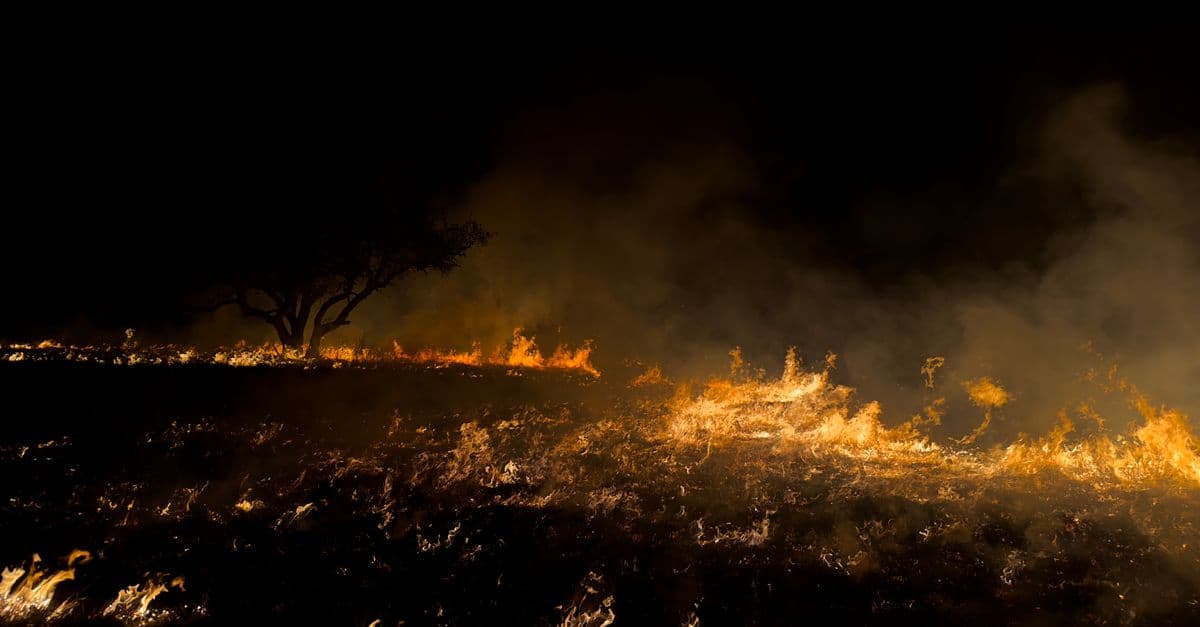
Photo: Elizabeth Lizzie / Pexels
How do wildfires spread fast enough to overtake cars on a highway? The answer is physics: three modes of heat transfer, a feedback loop that keeps recruiting fresh fuel, and, in extreme cases, a fire large enough to create its own weather. During the 2018 Camp Fire in Northern California, reports described the burned area growing by more than a football field every second at peak. Once you understand the mechanics, that pace stops looking mysterious and starts looking like what the physics allows.
The fire triangle and the fire behavior triangle
Every flame needs three ingredients at once: fuel, oxygen, and enough heat to start the reaction. Take one away and combustion stops. In a wildfire the fuel is vegetation: grass, shrubs, litter, dead wood, and the tree canopy. Oxygen comes from the surrounding air, which is effectively unlimited. Heat arrives from lightning, a spark from equipment, or a campfire that was not fully put out.
The fire triangle explains why a fire exists. It does not explain how it behaves, which is why fire professionals use a second triangle. The National Park Service's summary of wildland fire behavior frames it around three legs: fuels, weather, and topography. The landscape's fuel, the day's weather, and the shape of the ground together determine whether a fire smolders, creeps, or runs.
Of the three, fuel is the only one people can change. Weather and terrain arrive as given. That is why land managers focus on thinning and prescribed burning, and why a fire that finds continuous, dry, heavy fuel on a windy slope is hard to stop by any means.
Why fuel moisture matters more than temperature
Before wood can burn, heat has to drive the water out of it. That costs energy, and the energy comes from the fire itself. The Park Service puts it plainly: moisture level is the most important consideration in fuels. Live trees hold a lot of water, and dead logs and fine dead grass hold very little.
An analogy helps. Imagine trying to light a campfire with damp logs versus dry kindling. The chemistry of burning is identical. What differs is the energy bill: the damp wood spends most of the fire's heat boiling off water, while the dry kindling spends it heating wood to ignition.
Fine fuels such as grass, needles, and twigs dry out in hours when humidity falls and wind blows. Thick logs take weeks or months. Fire scientists therefore track fuel moisture separately for fine and heavy fuels. A landscape can look green and still carry a fast-moving grass fire if the grass layer is cured (dried out and dead), and a forest can carry a slow, smoldering ground fire even when the canopy is wet.
This is also why fire danger ratings track fuel moisture, humidity, and wind rather than temperature alone. A hot, humid day can be safer than a cool, dry, windy one.
The three ways heat moves ahead of a fire
A fire spreads by heating the fuel in front of it until that fuel ignites. Heat can travel to that fuel in three ways, and each one matters at a different distance.
| Mode | How heat moves | Typical role in wildfire spread |
|---|---|---|
| Radiation | Infrared energy emitted by flames in all directions | Preheats nearby fuel before flames touch it; dominant over short distances |
| Convection | Hot gases carried by moving air | Tilts flames into fuel, lofts embers, and drives uphill spread |
| Conduction | Direct contact through solids | Matters in the ground layer and inside thick logs; slowest mode |
Radiation is the warmth you feel on your face from a bonfire before any smoke reaches you. In a wildfire, a wall of burning shrubs radiates energy at unburned vegetation just ahead, drying it and raising its temperature without any flame contact. Radiation weakens quickly with distance, so it mostly prepares fuel within a few flame lengths.
Convection is heat carried by gas. Burning fuel produces a column of hot, buoyant air that rises, and cooler air flows in at the base to replace it. When wind pushes that flow sideways, flames and hot gases lean directly onto fuel ahead of the front. On a slope, the rising hot air moves up the hillside along the ground, which is why the Park Service notes that fire typically moves faster uphill than downhill or on flat ground.
Conduction is heat moving through direct contact. It dominates inside thick fuels and in the duff (the layer of partly decayed organic material on a forest floor), where fire can smolder for days. It is rarely what drives a fast-moving front.
Wind: the accelerant that changes the geometry
Wind does more than push a fire in one direction. It changes the fire's shape and the way heat reaches the fuel.
In still air, flames burn nearly vertically, and most of their heat rises away from the ground. Add horizontal wind and the flames tilt forward. That does three things at once. It shortens the gap between the flames and the fuel ahead, so radiation lands more strongly. It brings hot gases into direct contact with unburned vegetation. And it supplies fresh oxygen, so the fire burns hotter.
Wind also dries fuel ahead of the fire, and it carries embers (more on those below). Each effect feeds the others, which is why fire behavior often responds to wind speed in a sharply nonlinear way rather than a gentle, proportional one. Fire models commonly capture this with a rate-of-spread equation that grows quickly with wind speed.
The 2018 Camp Fire shows the practical outcome. Reports at the time described the fire growing by roughly 10,000 acres in about 90 minutes on the afternoon of November 8, 2018, which equals more than one football field per second. That figure describes the area consumed, not the speed of the flame front itself. Both ideas are useful. The area figure shows how quickly the fire overwhelmed the town of Paradise, and the caveat reminds us that the flame front moved at a human-scale speed while thousands of ember-ignited spot fires multiplied the area burning.
Ember spotting: how fires jump firebreaks
Embers are what let a fire ignore roads, rivers, and cleared lines. The process is called spotting. A burning fire produces firebrands (burning bark, leaves, twigs, and fragments), and the rising column lifts them. Wind then carries them downwind, where they land and may start new fires.
How far they travel depends on the balance between an ember's weight and the updraft that holds it aloft. Heavy pieces fall quickly and land near the fire. Light, flat, aerodynamic pieces can stay up much longer. Researchers studying Australia's Black Saturday fires in 2009 reported spot fires roughly 30 to 40 kilometers downwind of the main fire front, a range CSIRO has cited. Elsewhere, distances of up to about 19 kilometers have been reported in North American conifer forests. These are extreme values, and typical spotting in most fires is much shorter.
Why do some regions see farther spotting than others? CSIRO's wind tunnel work points to ribbon bark, a stringy eucalyptus bark that forms long, aerodynamic strips. In a 2015 laboratory study, the most durable ribbon-bark shapes burned for up to about 22 minutes, long enough for spotting beyond 20 kilometers, so the longest observed jumps are not fully explained by lab results. Models usually do not include these large, highly aerodynamic firebrands, which is why field observations still matter.
In towns, embers matter more than the flame front. A shower of embers can ignite roof gaps, gutters filled with dry leaves, wooden decks, and vents, and it can do so minutes or hours before the main fire arrives. Houses often burn because of embers in the wildland-urban interface, the zone where homes meet wildland vegetation, rather than because flames reach them.
Pyroconvection: when a fire makes its own weather
A big enough fire stops being only a surface event. Its heat release drives a convective column that rises through the atmosphere, much like the updraft in a thunderstorm. This is pyroconvection.
As the column rises, it cools, and water vapor from the fuel and the entrained air condenses into a cloud. When the cloud grows tall enough, it is called a pyrocumulus. If it deepens further and produces ice, lightning, and strong downdrafts, it becomes a pyrocumulonimbus, or pyroCb: a thunderstorm powered by a fire.
A pyroCb is dangerous for firefighters in three ways. It can produce lightning that starts new fires away from the original front. It can generate violent downdrafts that spread outward at the ground in unpredictable directions. And it can inject smoke into the upper troposphere and sometimes the stratosphere, the layer of the atmosphere above where most weather occurs.
Australia's 2019 to 2020 Black Summer showed the scale. According to Peterson and colleagues in npj Climate and Atmospheric Science, the season produced a pyroCb "super outbreak." Of the 38 pyroCbs observed, more than half injected smoke directly into the stratosphere.
Canada's 2023 season was similarly extreme. A study led by Piyush Jain, as reported by Mongabay, found that more than 15 million hectares burned, more than twice the previous record of 6.7 million hectares set in 1989, and seven times the average. The same report counted 140 pyroCb events in Canada that season.
A feedback loop makes these events hard to forecast. The fire alters the wind and temperature around it, so the weather forecast that was valid before ignition stops describing conditions at the fire. For an introduction to how large-scale atmospheric dynamics create storms, see How Lightning Works and Why Turbulence Is Hard to Predict.
Fire whirls and the Carr Fire tornado
A fire whirl is a rotating column of flame and hot gas. It forms when air with some existing spin is stretched upward by a fire's updraft. As the rotating air column narrows, it spins faster, the same angular momentum effect that makes a skater spin faster when pulling in their arms.
Most fire whirls are small, last seconds to minutes, and spread burning debris a short distance. A few become dangerous. On July 26, 2018, the Carr Fire near Redding, California produced one of the most intense on record. According to the Wikipedia summary of the Carr Fire tornado, peak winds reached about 143 miles per hour (230 kilometers per hour), consistent with damage typical of an EF3 tornado. The National Weather Service officially lists it as a fire whirl rather than a tornado.
It stayed on the ground for about 30 minutes and widened to roughly 300 yards. Its estimated height reached 18,000 feet (5,500 meters). It toppled at least two transmission towers, stripped bark from trees, and heavily damaged homes. Four people died, including a firefighter.
A firestorm is a related but larger case, in which many fires burn in a small area and draw air inward from all sides. Historically, firestorms are rare, and meteorologists distinguish them from ordinary fast-moving wildfires. If you want a primer on how rotating storm systems form, see How Tornadoes Form.
Crown fires and fuel ladders
Not all wildfires burn at the same level. A surface fire consumes litter, grass, and low shrubs. A crown fire burns in the treetops. The step from one to the other depends on fuel ladders: continuous vertical fuel, such as shrubs and low branches, that carries fire from the ground into the canopy.
Scientists describe the transition using Van Wagner's framework, which relies on a few factors. Crown fire initiation depends on the height of the lowest canopy branches, how much moisture the foliage holds, how dense the canopy fuel is, and how intense the surface fire is. Foliage moisture acts as a heat sink, delaying ignition. Low canopy bases, dry foliage, and dense canopies make crowning easier.
The standard way to compare fires is Byram's fireline intensity, which measures the rate of heat release per unit length of fire front, in kilowatts per meter. It is calculated from the heat content of the fuel, the amount of fuel consumed in the flaming zone, and the rate of spread. Byram's relationship between flame length and intensity is commonly written as L = 0.0775 × I^0.46, with L in meters, although later research shows the relationship depends on fuel structure and should not be treated as universal.
Practical thresholds from fire-management literature differ by source. Some place the limit for direct attack by hand crews at around 400 kW/m, while others cite higher figures near 1,000 kW/m. Heavy equipment can usually hold fires below roughly 1,700 kW/m, and fires above about 4,000 kW/m are generally classed as high intensity. Active crown fires are commonly placed near or above 10,000 kW/m. Because sources disagree on the exact cutoffs, treat these as order-of-magnitude guides rather than rules.
The takeaway for firefighting is simple. As intensity climbs, direct attack stops working in stages: first hand crews, then bulldozers, and finally aircraft. At the top end, firefighters switch from stopping the fire to protecting people and waiting for the weather to change.
| Fire type | Where it burns | Typical intensity class | What works against it |
|---|---|---|---|
| Surface fire | Litter, grass, low shrubs | Low to moderate | Hand crews, engines |
| Torching | Individual trees ignite from below | Moderate to high | Engines, equipment, retardant |
| Active crown fire | Canopy, spreading tree to tree | Very high | Mostly indirect tactics and evacuation |
How climate change shifts the odds
The physics of burning does not change in a warmer climate. What changes is how often the conditions that allow extreme behavior appear.
A widely cited analysis by Jolly and colleagues, published in Nature Communications in 2015, examined global fire weather from 1979 to 2013. It found that fire weather seasons lengthened across 25.3 percent of the Earth's vegetated surface, which produced an 18.7 percent increase in global mean fire weather season length. It also found that the area of burnable land experiencing long fire weather seasons roughly doubled, up 108.1 percent.
The mechanism is straightforward. Warmer air holds more water vapor, which means it pulls more moisture out of vegetation and soil. Drought, earlier snowmelt, and heat waves dry fuels sooner in the year and keep them dry longer. Fuel moisture falls, so spread rates and intensities rise.
It is easy to overstate this. Climate is one factor among several, and in many regions fuel loads, land management, ignition sources, and development patterns matter as much. Decades of fire suppression in some forests allowed ladder fuels and dense stands to accumulate. Where people live in fire-prone areas, more fires start. Climate shifts the baseline; the other factors decide what happens on a given landscape. For broader context, see Extreme Weather and Climate Change: What Science Says and How Climate Change Is Affecting Your Daily Life.
What stops a wildfire, and why that gets harder
Fire stops when it runs out of at least one thing in the triangle. In practice, that usually means fuel or heat.
- Removing fuel. Firebreaks, thinned forests, and prescribed burns reduce the amount and continuity of fuel. This is the only leg that managers can adjust in advance.
- Cooling the fire. Water and retardant absorb heat or coat fuel. They work best on low-intensity fires and lose effectiveness as intensity grows.
- Changing the weather. Rain and rising humidity raise fuel moisture. This is what ends most large fires, not human action.
Ember spotting undermines the first strategy because embers cross firebreaks. Pyroconvection undermines the second because the updraft carries retardant and water away. That leaves weather, which is why very large fires often burn until conditions change.
In recent years, researchers have also studied how carbon in forests and smoke affects climate, and what removal technologies could do about it. For the atmospheric side of that story, see How Does Carbon Capture Work?. For the forest side, How Forests Work explains the layered structure that creates fuel ladders in the first place.
Common misconceptions
"Fires spread mainly by flames touching new fuel." Radiation, hot gas, and embers all ignite fuel without direct flame contact. Embers can ignite fires kilometers ahead.
"Hotter air temperature is the main cause of fast fires." Fuel moisture, wind, and slope usually matter more. A cool, dry, windy day can be more dangerous than a hot, calm one.
"Fire tornadoes are just tornadoes." The National Weather Service classifies the Carr Fire event as a fire whirl. It was powered by the fire's own heat, not by a storm system, even though its winds matched a strong tornado.
"Bigger fires are always more intense." Size and intensity are different measures. A large grass fire can burn out quickly at low intensity, while a smaller timber fire can release far more energy per meter of front.
"More firefighting resources always win." Past a certain intensity, the tools simply stop working. The decision then shifts to protecting people.
What this means
Wildfires are not a single phenomenon. They are heat-transfer problems at several scales, from a flame leaning toward a dry shrub to a column of smoke punching into the stratosphere. At each scale, the same logic applies: heat reaches fuel, fuel dries and ignites, and the process feeds itself.
The most useful insight is that the fuel and moisture on the ground, not the headline temperature, decide how a fire behaves. That is also why the response is more effective before ignition, through fuel management and house hardening, than after. A longer fire weather season does not change how fire works. It increases how many days the extreme part of the physics is available.
Frequently Asked Questions
Q: How do wildfires spread so fast? A: Several effects stack. Wind tilts flames onto fuel ahead of the front, radiation and hot gas preheat that fuel, and embers start new fires beyond the front. Dry fuel needs little energy to ignite, so each step happens faster. The 2018 Camp Fire's growth of roughly 10,000 acres in about 90 minutes shows how these effects can combine.
Q: What is ember spotting? A: Spotting is the ignition of new fires by burning fragments lofted by a fire's updraft and carried downwind. Most spotting is short-range, but extreme cases are documented. Spot fires roughly 30 to 40 kilometers downwind of the main front were reported during Australia's 2009 Black Saturday fires.
Q: What is a pyrocumulonimbus cloud? A: It is a thunderstorm cloud generated by a fire's heat. Hot air and moisture rise, condense, and build a tall cloud that can produce lightning and strong downdrafts. In Australia's 2019 to 2020 fires, more than half of 38 observed pyroCbs injected smoke into the stratosphere, according to a 2021 study in npj Climate and Atmospheric Science.
Q: What was the Carr Fire tornado? A: It was a fire whirl that formed near Redding, California, on July 26, 2018. Peak winds were about 143 miles per hour (230 kilometers per hour), comparable to EF3 tornado damage. The National Weather Service lists it officially as a fire whirl. It stayed on the ground for about 30 minutes, and four people died.
Q: Does climate change make wildfires spread faster? A: It makes the dry, hot, windy conditions that favor fast spread more common in many regions. A 2015 analysis in Nature Communications found an 18.7 percent increase in global mean fire weather season length from 1979 to 2013. Fuel loads, land use, and ignition sources also matter, so climate is one factor among several.
Q: Why can't firefighters stop big wildfires directly? A: Direct attack depends on fire intensity. Hand crews, engines, bulldozers, and aircraft each have limits, and sources place the hand-crew limit at a few hundred to about 1,000 kilowatts per meter of fire front. Crown fires and pyroCb-driven fires exceed those limits, so the work shifts to protecting people and waiting for weather to change.
Sources
- National Park Service. Wildland Fire Behavior (fire behavior triangle, fuel moisture, wind, slope).
- Peterson, D. A., et al. (2021). Australia's Black Summer pyrocumulonimbus super outbreak reveals potential for increasingly extreme stratospheric smoke events. npj Climate and Atmospheric Science 4.
- Jolly, W. M., et al. (2015). Climate-induced variations in global wildfire danger from 1979 to 2013. Nature Communications 6: 7537.
- Wikipedia. Carr Fire tornado (wind speed, duration, damage, fatalities, NWS classification).
- Mongabay (2024). Canada's 2023 wildfires doubled the previous burning record (area burned, pyroCb count).
Read next:
Follow new articles
Add SciHub101 to your feed reader to see new science and technology stories.
About the Author
SciHub101 is an independent science and technology publication founded and edited by Buğra Sözeri, a software engineer and app developer based in Türkiye. AI tools assist with drafting and research. Source documentation in the existing archive is uneven, and articles are being reviewed and corrected. The Editorial Team byline identifies editorial responsibility; it does not certify specialist or independent human review. Where we compare products, anything built by our own team is labelled as such — see the editorial guidelines and About page for how corrections and disclosures work.
Related Articles

Why Is Glass Transparent? The Physics of Light Passing Through
Glass is transparent because visible photons lack the energy to excite its electrons and its uniform, grain-free structure scatters almost nothing sideways.
Why Time Moves Slower Near Gravity
Time moves slower near gravity because mass curves spacetime, and general relativity says clocks deeper in that curvature tick at a measurably slower rate.
Extreme Weather and Climate Change: What Science Says
How scientists link heat waves, floods, wildfires, and storms to climate change, how attribution studies work, and where the evidence is still weak.
Quantum Error Correction Explained: Physical Qubits, Logical Qubits and Thresholds
Quantum error correction protects one logical qubit across many noisy physical qubits. Learn how syndromes, surface codes, and thresholds work in practice.