The Invention of the Supercapacitor — SciHub101
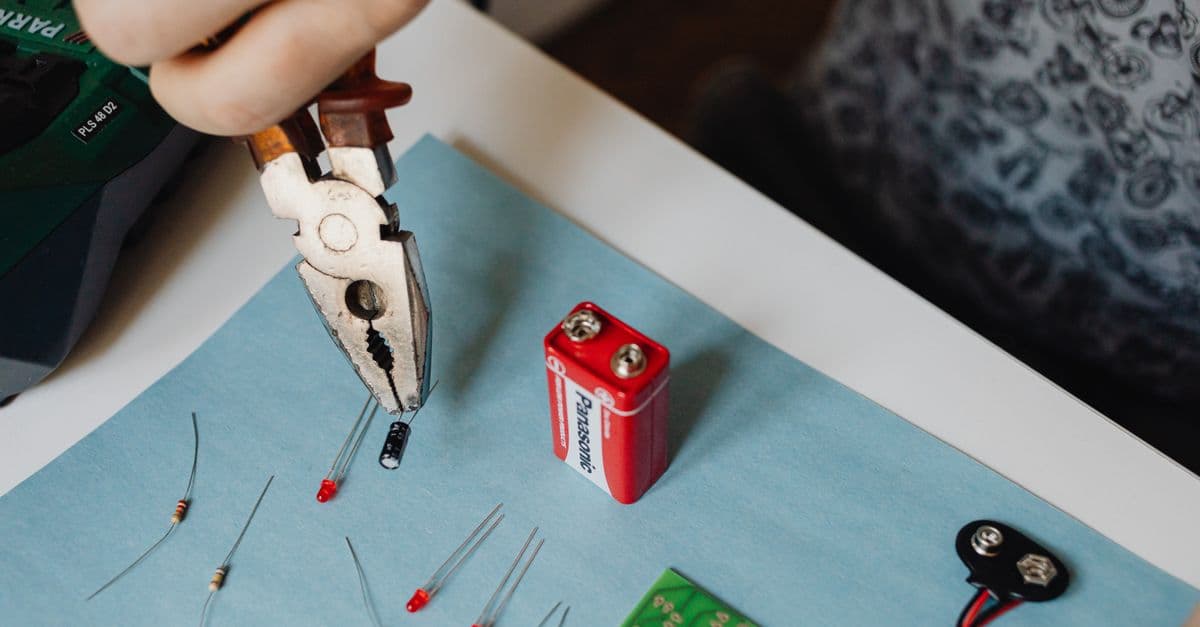
Photo: Ramesh Kambattan / Pexels
The supercapacitor is an electrical storage device that stores energy in an electric field at the electrode-electrolyte interface, rather than in chemical form. A single farad of capacitance was considered exotic in the 1950s; today, supercapacitors routinely store farads and tens of farads in a volume the size of a soda can. The invention was accidental: in 1957, an electrical engineer named Howard Becker at General Electric was studying how activated carbon behaved in an electrolytic cell and noticed something the textbooks said should not happen. The carbon surface seemed to be storing far more electrical charge than classical physics predicted. That accident evolved, over the next 60 years, into a device that now powers regenerative braking in electric buses, stabilizes power grids, and stores energy faster than any battery ever could. The supercapacitor stores energy electrostatically on surfaces only nanometers thick — a mechanism so different from batteries that the two are now used together, each compensating for the other's weakness.
What Makes a Supercapacitor Different From a Battery
The difference between a battery and a supercapacitor is not a matter of degree — it is a difference in mechanism. Both store energy and release it as electrical current, but how they do it is fundamentally different, and that difference shapes everything about how each is used.
Battery — a device that stores energy in chemical form through reversible electrochemical reactions; charges and discharges slowly but stores energy densely.
Supercapacitor — also called an ultracapacitor or electric double-layer capacitor (EDLC); a device that stores energy in an electric field at the electrode-electrolyte interface, with no chemical reaction involved; charges and discharges very rapidly but stores less total energy per unit weight than a battery.
In a battery, when you connect it to a circuit, chemical reactions at the anode and cathode produce electrons, which flow through the external circuit to power a device. The chemical transformation is slow — limited by the rate at which ions can move through the electrolyte and the rate at which molecules can break apart or recombine. This is why a battery takes minutes or hours to charge fully. But batteries can store a lot of energy densely: a kilogram of lithium-ion battery stores roughly 0.25 kilowatt-hours (250 watt-hours), enough to run a smartphone all day.
In a supercapacitor, there is no chemical reaction at all. Instead, when you apply a voltage, positive charges accumulate on one electrode and negative charges on the other, separated by an extremely thin layer of electrolyte. The two layers of opposite charge — the "double layer" — create an electric field that stores electrical energy. Think of it as two charged plates in a capacitor, but with the distance between the plates shrunk to nanometers by using a highly porous electrode material. The closer the plates, the more charge can be stored. Supercapacitors are supercapacitors because of this geometric trick: they use porous activated carbon with a surface area of 1,000 to 3,000 square meters per gram. A one-kilogram block of supercapacitor electrode has a surface area equivalent to 25 American football fields.
The trade-off is immediate. A kilogram of supercapacitor stores only about 0.01 kilowatt-hours — 25 times less energy than a lithium-ion battery. But it can discharge all that energy in seconds, while a battery would take minutes. For applications that demand rapid energy release (or absorption), supercapacitors are unbeatable.
Source: Burke, A. (2007). "Ultracapacitors: Why, How, and Where Is the Technology." Journal of Power Sources, Vol. 91, pp. 37–50. The standard reference on supercapacitor mechanisms and performance comparisons with batteries.
The Accident That Started It All: Becker's Discovery
Howard Becker was an engineer at General Electric's research laboratory in Schenectady, New York, in the mid-1950s. His assignment had nothing to do with energy storage. He was investigating activated carbon's behavior in electrolytic cells — particularly its electrical properties when submerged in sulfuric acid. Activated carbon is carbon that has been treated with steam or chemical agents to create millions of tiny pores, dramatically increasing its surface area. Becker was measuring what capacitance this system exhibited.
According to classical physics, the capacitance of a parallel-plate capacitor is given by the formula C = εA/d, where C is capacitance, ε is the permittivity of the material between the plates, A is the area of the plates, and d is the distance between them. The distance between activated carbon's pores and the liquid electrolyte was on the order of angstroms — billionths of a meter — but the textbooks suggested the capacitance should still be quite small. Becker measured far more capacitance than theory predicted. His first reaction was that his measurement equipment must be faulty.
It was not. What Becker had stumbled upon was the electric double layer: a phenomenon that electrochemists understood in principle but had not fully appreciated in this context. When activated carbon is immersed in an electrolyte, negative ions (anions) from the liquid are attracted to the positive electrode and form a thin layer on the carbon surface. Positive ions (cations) form a layer at the negative electrode. These two oppositely charged layers, separated by distances of only a few angstroms, create an enormous electric field — and therefore enormous capacitance. The capacitance arises not from the bulk properties of the electrolyte but from the geometry of the interface.
Becker realized that if he took two electrodes of activated carbon, separated them with a filter to prevent electrical contact but allow ions to pass, submerged the assembly in sulfuric acid, and applied a voltage, he could store electrical charge at an unprecedented density — measured in farads per gram or even farads per cubic centimeter. Farads were considered enormous capacitances in that era. A one-farad capacitor was the size of a filing cabinet. Becker's device could store farads in the volume of a thimble.
Source: Becker, H.I. (1957). US Patent 2,959,744 — "Electrical Double Layer Capacitor." Filed July 23, 1957, issued November 8, 1957. The original filing describing the double-layer mechanism and activated carbon construction.
General Electric assigned the patent to Becker, but the company saw no commercial application. In the 1950s, the demand for rapid energy storage was small. Batteries were adequate for most needs. The supercapacitor sat in the patent office, unused.
How the Double Layer Actually Works
To understand why supercapacitors became important, you need to understand the mechanism in detail. The electric double layer is where the physics gets subtle.
When you apply a voltage across a supercapacitor — say, +1 volt on one electrode, ground on the other — the voltage does not drive an electrochemical reaction. Instead, it creates an electric field that attracts ions from the electrolyte. At the positive electrode (the anode), negatively charged ions (anions) from the electrolyte migrate to the carbon surface and form a layer of negative charge adsorbed onto the porous structure. This accumulated negative charge is attracted to the positive electrode and creates a potential difference at that interface.
At the negative electrode (the cathode), positively charged ions (cations) do the same. They accumulate on the carbon surface, creating a layer of positive charge attracted to the negative electrode.
Between these two layers of opposite charge — separated by the pore fluid and maybe an angstrom or two of hydration layer — exists an electric field. This field stores electrical energy, exactly as the field between the plates of a conventional capacitor stores energy. The energy is given by U = (1/2)CV², where C is capacitance and V is voltage.
Double layer — the pair of oppositely charged layers that forms at the electrode-electrolyte interface in a supercapacitor; the negative ions adsorb to the positive electrode and positive ions adsorb to the negative electrode, creating a nanometer-scale separation and enormous electric field.
The genius of activated carbon is surface area. An unprocessed carbon particle has a smooth surface with an area proportional to its volume. Activated carbon is riddled with pores — tiny channels and chambers — that dramatically increase the surface area available for the double layer to form. The same mass of carbon, when activated, can have a surface area a thousand times greater. Therefore, its capacitance increases by a factor approaching a thousand.
The capacitance of a double layer at an electrode-electrolyte interface is roughly 20 microfarads per square centimeter — a universal number that shows up across many electrode materials and electrolytes. So a material with a surface area of 1,000 square meters per gram, using a 1-gram sample, has a total double-layer capacitance of roughly 20 farads.
This is why supercapacitors are called supercapacitors: they achieve capacitances that would have required enormous physical devices in the era before double-layer science was fully exploited. Today, commercial supercapacitors range from a few farads to over 3,000 farads in a single cell.
Source: Pandolfo, A.G. and Hollenkamp, A.F. (2006). "Carbon Properties and Their Role in Supercapacitors." Journal of Power Sources, Vol. 157, No. 1, pp. 11–27. A comprehensive review of activated carbon structure and its relationship to supercapacitor performance.
From Patent Curiosity to Commercial Device: The 1970s and 1980s
General Electric held Becker's patent, but GE saw no market. The company was focused on large-scale electrical infrastructure and had no interest in a niche energy-storage device with modest energy density and uncertain applications.
In the 1970s, the space race and emerging military electronics created new demands. Satellites and military guidance systems needed power backup devices that could deliver energy very rapidly — faster than batteries could manage. The U.S. military funded research into supercapacitors, recognizing them as potential solutions to the problem of rapid power delivery.
A Japanese company, Panasonic (then Matsushita), licensed the technology from General Electric in the 1970s and began manufacturing supercapacitors commercially under the name "Electric Double Layer Capacitor" (EDLC). Panasonic's engineers improved Becker's design, optimized electrode materials, and developed better electrolytes. By the early 1980s, Panasonic was selling supercapacitors for memory backup in computers — keeping RAM powered when the main electrical supply was cut off, allowing computers to safely write data to disk before shutting down.
A second Japanese company, NEC (Nippon Electric), also began development, and German company Bosch followed. By the 1990s, supercapacitors had achieved sufficient energy density and reliability that they began appearing in consumer applications: uninterruptible power supplies (UPS), backup power for industrial control systems, and memory protection for computers.
The key breakthrough came with the recognition that supercapacitors and batteries had complementary strengths. A battery could store lots of energy but release it slowly; a supercapacitor could release energy extremely fast but stored less total energy. In a hybrid system — a supercapacitor paired with a battery — the battery handled sustained power delivery, while the supercapacitor handled power spikes. This pairing is now standard in electric vehicles.
The Supercapacitor and the Electric Vehicle Revolution
The modern electric vehicle is the reason supercapacitors became essential. When an electric vehicle brakes, it has the opportunity to capture the kinetic energy that would otherwise be dissipated as heat in the brake pads — a process called regenerative braking. The captured energy can be stored for later use, improving the vehicle's overall efficiency.
The challenge is one of power. When a car brakes hard, it must absorb a huge amount of power in a few seconds. A typical car might absorb 50 to 150 kilowatts during aggressive braking. Sending all that power into a battery at once can damage the battery cells, degrade its chemistry, and shorten its lifespan. The battery is not designed to accept power that fast; its internal resistance heats up excessively.
A supercapacitor, by contrast, can accept that power easily. Its internal resistance is much lower; it does not undergo chemical reactions that degrade with fast charging. A supercapacitor can absorb 150 kilowatts for a few seconds with no damage whatsoever.
The solution, now implemented in many electric buses and some electric cars, is a hybrid energy storage system: a lithium-ion battery for sustained power delivery, paired with a supercapacitor bank for regenerative braking and rapid power spikes. When the brakes are applied, the supercapacitor absorbs the regenerative current. When the car accelerates again, the supercapacitor discharges first (because it can deliver power very fast), and the battery provides sustained power. The supercapacitor recharges whenever the battery is supplying power to the motor. This pairing improves overall system efficiency, extends battery lifetime, and improves the vehicle's power response.
Source: Hadjipaschalis, I., Poullikkas, A., and Efthimiou, V. (2009). "Overview of Current and Future Energy Storage Technologies for Electric Vehicles." Renewable Energy, Vol. 33, No. 1, pp. 114–127. A detailed analysis of hybrid energy storage systems in electric vehicles.
Some electric buses now use a supercapacitor-only system for energy storage, with the bus charging for 30 seconds at every stop. The supercapacitor charges and discharges thousands of times per year, handling the rapid power pulses that the brake-regeneration cycle demands. This application — electric buses with supercapacitor storage — is now deployed in cities worldwide, from Beijing to Paris to Los Angeles.
Comparing Supercapacitors, Batteries, and Fuel Cells
The energy storage landscape in 2026 includes three major technologies, each with different performance profiles.
| Metric | Supercapacitor | Lithium-Ion Battery | Hydrogen Fuel Cell |
|---|---|---|---|
| Energy Density (Wh/kg) | 5–10 | 150–250 | ~33 (including tank) |
| Power Density (W/kg) | 5,000–10,000 | 500–2,000 | 500–1,500 |
| Charge Time | seconds–minutes | 30–60 minutes | 3–5 minutes |
| Discharge Time | seconds–minutes | hours | hours |
| Cycle Lifetime | 500,000–1,000,000 | 1,000–5,000 | ~1,000 |
| Temperature Range | −20 to +60 °C | −20 to +60 °C | −40 to +80 °C |
| Self-discharge Rate | ~20–30% per month | ~2–3% per month | 0% (stored as gas) |
| Cost (2024) | $3–10/Wh | $0.10–0.15/Wh | $0.50–1.00/Wh |
Supercapacitors dominate in applications requiring rapid charge or discharge. They are used in grid stabilization, wind turbine pitch control, elevator regenerative braking, and mining truck regenerative systems. Batteries dominate in sustained-energy applications: smartphones, electric vehicles, and portable electronics. Fuel cells are emerging in heavy-duty applications like trucks and trains, where sustained power delivery and rapid refueling are critical.
In practice, the three are increasingly used in combination. A modern electric bus might have a hydrogen fuel cell for long-range sustained power, a battery for medium-term storage, and a supercapacitor for handling brake regeneration and acceleration spikes.
Source: Trovão, J.P.F., Pereirinha, P.G., and Jorge, H.M. (2014). "Hybrid Energy Storage Systems for Reliable EV Fast Charging Stations." IEEE Transactions on Industrial Electronics, Vol. 61, No. 8, pp. 3898–3907. Technical comparison of hybrid storage architectures.
Why Supercapacitors Aren't Really Capacitors (A Misnomer)
Here is a persistent source of confusion: supercapacitors are not, in the strict sense, capacitors at all. A capacitor is a device with two conducting plates separated by a dielectric (insulating) material. The energy is stored in the electric field within the dielectric. The capacitance is given by C = εA/d, where ε is the permittivity of the dielectric, A is the plate area, and d is the distance between them.
A supercapacitor has no dielectric in the classical sense. Instead, it has an electrolyte — an ionic conductor — between the electrodes. The storage mechanism is not an electric field in a dielectric but an accumulation of charge at the electrode surface, separated by a layer of ions in the electrolyte. This is electrochemistry, not electrostatics. The energy storage mechanism is fundamentally different from a capacitor's.
Despite this, supercapacitors are called capacitors because they behave like capacitors electrically: the voltage across them is proportional to the charge stored (V = Q/C), and they follow the capacitor equations when you analyze circuits. But the physics underneath is distinct enough that physicists and electrochemists argue about what to call the device. "Electrochemical capacitor," "ultracapacitor," "electric double-layer capacitor," and "supercapacitor" are all used, but none is entirely accurate. The name stuck anyway, and "supercapacitor" is now standard in industry.
Electrochemical capacitor — the technically precise name for a supercapacitor, emphasizing that the storage mechanism involves electrochemistry at an electrode surface rather than electrostatics in a bulk dielectric.
This is a reminder that terminology in science often lags behind understanding. We use the word "supercapacitor" for a device that is not a capacitor, just as we call the moon's orbit an "orbit" even though the moon orbits Earth while Earth orbits the sun — mutual gravitation, not a simple circular path. Names persist even when they become technically misleading.
The Self-Discharge Problem and Modern Electrolytes
One significant drawback of supercapacitors is self-discharge: they lose their stored charge over time even when disconnected from any circuit. A fully charged supercapacitor might lose 20 to 30 percent of its charge in a month, sitting unused on a shelf. A battery loses charge far more slowly — 2 to 3 percent per month for lithium-ion.
The reason is that the electric field in a supercapacitor is leaking. The electrolyte has a finite electrical conductivity (it is not a perfect insulator), so a tiny current flows between the plates through the electrolyte, gradually discharging the device. This is the supercapacitor equivalent of "the battery got old and leaked." But whereas battery leakage is usually irreversible degradation, supercapacitor self-discharge can be partially reversed by recharging.
Modern supercapacitor design has partly addressed this by using electrolytes with lower ionic conductivity and by coating electrodes to reduce leakage. Solid-state electrolytes and hybrid devices combining supercapacitor and battery mechanisms are in development, aiming to reduce self-discharge while maintaining fast charge and discharge.
The Takeaway
The supercapacitor is a reminder that engineering breakthroughs often come from paying attention to anomalies. Howard Becker measured something the textbooks said should not exist, investigated instead of dismissing it, and found a new mechanism for storing electrical energy. That mechanism — the electric double layer — is now fundamental to energy storage systems worldwide. Supercapacitors will not replace batteries; their energy density is too low. But paired with batteries, they enable the rapid power delivery that electric vehicles, renewable energy grids, and industrial systems increasingly demand. As the world shifts to electricity as its primary energy carrier, the devices that accept and deliver that electricity fastest become more valuable. The supercapacitor, born from a 1957 laboratory accident, is now essential to that transition.
Frequently Asked Questions
Q: Why are supercapacitors called supercapacitors if they are not really capacitors?
A: The name is a historical accident. Supercapacitors behave like capacitors electrically (voltage is proportional to stored charge), so the name stuck even though the underlying storage mechanism is electrochemical, not electrostatic. Technically, "electrochemical capacitor" is more accurate, but "supercapacitor" is now the industry standard.
Q: How long do supercapacitors last compared to batteries?
A: Supercapacitors last far longer in terms of charge-discharge cycles — up to 1 million cycles, compared to 1,000 to 5,000 for lithium-ion batteries. However, supercapacitors self-discharge over time (20–30 percent per month) while sitting unused, whereas batteries self-discharge slowly (2–3 percent per month). For long-term storage, batteries are better.
Q: Can you use supercapacitors alone to power an electric car?
A: Theoretically yes, but practically no. A supercapacitor would need to be enormous to store enough energy for a typical electric vehicle's daily driving range. A single supercapacitor cell can store only 5 to 10 watt-hours per kilogram; you would need 10 to 20 tons of supercapacitor to store what 50 kilograms of lithium-ion battery stores. The hybrid approach — supercapacitor plus battery — is the practical solution.
Q: Why do supercapacitors charge so fast?
A: Because no chemical reaction is involved. When you charge a battery, ions must migrate through the electrolyte and react at the electrode surface, a chemical process limited by reaction kinetics and ion transport. In a supercapacitor, ions simply accumulate on the electrode surface; there is no chemical reaction to occur, only electrostatic accumulation. This is why supercapacitors can reach full charge in seconds.
Q: What will replace supercapacitors in the future?
A: Solid-state supercapacitors and hybrid devices combining supercapacitor and battery properties are in development. These aim to increase energy density while maintaining the fast charge-discharge rates. Graphene and other advanced materials are being investigated to improve electrode surface area and reduce self-discharge, but no revolutionary replacement is yet proven in production.
Q: Are supercapacitors safe compared to lithium-ion batteries?
A: Supercapacitors are generally considered safer. They store energy electrostatically, not chemically, so there is no risk of thermal runaway (the uncontrolled exothermic chemical reaction that causes lithium-ion batteries to catch fire). However, large supercapacitors store significant electrical energy and must be handled carefully to avoid electrical shock.
Read next:
Follow new articles
Add SciHub101 to your feed reader to see new science and technology stories.
About the Author
SciHub101 is an independent science and technology publication founded and edited by Buğra Sözeri, a software engineer and app developer based in Türkiye. AI tools assist with drafting and research. Source documentation in the existing archive is uneven, and articles are being reviewed and corrected. The Editorial Team byline identifies editorial responsibility; it does not certify specialist or independent human review. Where we compare products, anything built by our own team is labelled as such — see the editorial guidelines and About page for how corrections and disclosures work.
Related Articles

Brain-Computer Interfaces: How Electrodes Read Your Mind
Brain-computer interfaces convert neural signals into digital commands. From Vidal's 1973 coinage to Neuralink's 2024 human implant, here's how BCIs work and what they can and cannot do.

Television Invention: Baird, Farnsworth, and Electronic TV
Television emerged from mechanical scanning, cathode-ray tubes, electronic imaging, and broadcast infrastructure. This guide explains the real invention story.
Battery Invention: From Volta Pile to Lithium-Ion
The battery begins with Volta's pile, but modern batteries evolved through chemistry, materials, portability, and rechargeable systems.
The Invention of the Electric Battery — SciHub101
From Alessandro Volta's 1800 voltaic pile to the 2019 Nobel Prize for lithium-ion: how the battery became the defining technology of the portable power age.
Sodium-Ion Batteries Explained: Chemistry, Advantages, Trade-Offs and Uses
Sodium-ion batteries move sodium instead of lithium ions. See how the cathode, hard-carbon anode and electrolyte work, the numbers, and where they fit.
The Lithium-Ion Battery: How Three Scientists Powered the Wireless Age
The lithium-ion battery's full history: Whittingham's 1976 Exxon work, Goodenough's LiCoO2 breakthrough, Yoshino's 1985 prototype, the 2019 Nobel Prize, and today.